Here’s a sobering truth: the average SaaS company loses 5-7% of its customers every month to churn. For a business with $1M ARR, that’s $50,000-$70,000 in recurring revenue walking out the door annually—before you factor in the $400+ it costs to acquire each replacement customer.
I’ve spent years watching SaaS founders obsess over acquisition while their existing customers quietly cancel. The smartest operators I know flipped this script. They invested in customer success early, and it paid off: reducing churn by just 5% can increase profits by 125% according to Bain & Company research.
But here’s the problem. Most customer success signals are scattered across support tickets, product analytics, feature requests, and renewal notes. Without a centralized platform, you’re flying blind until it’s too late.
What Is Customer Success Software?
Customer success software helps SaaS companies proactively manage customer relationships, reduce churn, and drive expansion revenue. Unlike reactive support tools that wait for customers to complain, CS platforms predict problems before they happen and guide customers toward success.
At its core, a customer success platform does three things:
- Health scoring: Tracks customer engagement and predicts churn risk using product usage, support interactions, and sentiment data
- Journey orchestration: Automates touchpoints based on where customers are in their lifecycle—from onboarding to renewal
- Revenue optimization: Identifies expansion opportunities and flags at-risk accounts before they churn
The best platforms integrate with your CRM, support system, product analytics, and communication tools to create a complete view of each customer.
Why Customer Success Matters More Than Ever in 2026
The SaaS landscape has shifted. In 2026, AI-native SaaS companies report gross revenue retention as low as 40%, compared to the B2B SaaS median of roughly 82%. Competition is fiercer, switching costs are lower, and customers expect proactive value delivery.
Consider these benchmarks:
- B2B SaaS companies with strong onboarding (time-to-first-value under 7 days) see 50% lower churn rates
- The median net revenue retention for best-in-class SaaS companies is 120%+
- Companies with dedicated CS platforms reduce churn by 40-60% on average
- It costs 5-25x more to acquire a new customer than to retain an existing one
If you’re running a SaaS business without visibility into customer health, you’re essentially managing your revenue with a blindfold on.
The 10 Best Customer Success Software for SaaS in 2026
I’ve evaluated dozens of platforms based on real user feedback, feature depth, integration capabilities, and pricing transparency. Here are the 10 best customer success software options for SaaS companies in 2026.
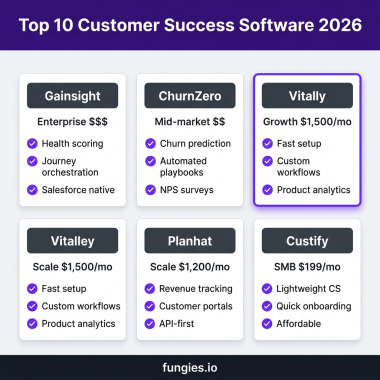
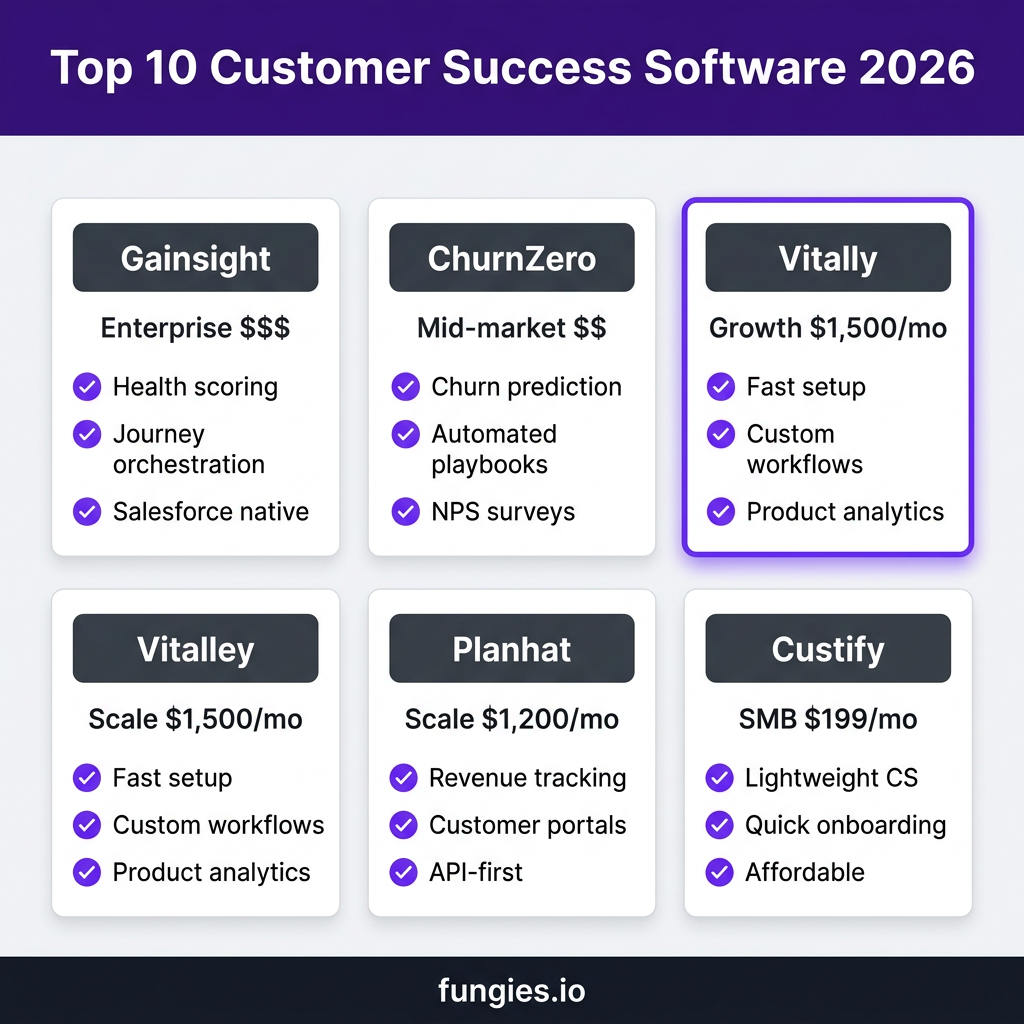
1. Gainsight — Best for Enterprise Customer Success
Gainsight is the undisputed leader in enterprise customer success. If you’re running a mature SaaS company with 1,000+ customers and dedicated CS operations, this is your platform.
Key Features:
- Advanced health scoring with customizable metrics
- Journey orchestration and success plans
- Deep Salesforce native integration
- Predictive analytics and AI-powered insights
- Comprehensive reporting dashboards
Pricing: Enterprise-only (typically $50,000+/year)
Best for: Large enterprises with mature CS operations and Salesforce-centric tech stacks
2. Vitally — Best for Fast-Growing Mid-Market SaaS
Vitally has become the go-to choice for mid-market SaaS companies that need powerful CS capabilities without the enterprise complexity. It’s fast to implement, highly customizable, and built for teams that want to move quickly.
Key Features:
- Custom health scores and dashboards
- Automated playbooks and workflows
- Real-time customer data aggregation
- Collaborative workspace for CS teams
- Strong API for custom integrations
Pricing: Growth plan starts around $1,500/month
Best for: Fast-growing SaaS companies (100-1,000 customers) that need speed and flexibility
3. ChurnZero — Best for Churn Prevention
As the name suggests, ChurnZero focuses specifically on reducing customer churn. If retention is your primary concern, this platform offers the most targeted feature set.
Key Features:
- Real-time churn risk alerts
- Automated save plays for at-risk accounts
- In-app engagement and NPS surveys
- Customer journey mapping
- Renewal and expansion forecasting
Pricing: Mid-market pricing (platform fee + per-user licenses)
Best for: SaaS companies where reducing churn is the top priority
4. Planhat — Best for Revenue-Focused CS Teams
Planhat takes a revenue-centric approach to customer success, making it ideal for teams that need to track expansion opportunities alongside retention metrics.
Key Features:
- Revenue tracking and expansion identification
- Customer portals for self-service success
- API-first architecture
- Product usage analytics
- Collaborative customer workspaces
Pricing: Scale plan starts around $1,200/month
Best for: Revenue-focused CS teams that prioritize expansion alongside retention
5. Custify — Best for Small Teams and Startups
Custify offers core customer success functionality at a price point accessible to smaller SaaS companies. It’s lightweight, quick to set up, and doesn’t require a dedicated CS ops team.
Key Features:
- Lightweight health scoring
- Quick onboarding (days, not weeks)
- Affordable pricing for SMBs
- Essential automation workflows
- Good integration coverage
Pricing: Starts around $199/month
Best for: Small SaaS teams (under 100 customers) getting started with CS
6. Totango — Best for Modular CS Approach
Totango pioneered the modular approach to customer success, letting you start small and add capabilities as you grow. Their “SuccessBLOCs” are pre-built modules for common CS scenarios.
Key Features:
- Modular SuccessBLOCs for common use cases
- Flexible deployment options
- Enterprise-grade security
- Strong segmentation capabilities
- Pre-built integrations
Pricing: Modular pricing based on selected BLOCs
Best for: Companies that want to start small and expand their CS capabilities gradually
7. Staircase AI — Best for AI-Powered Insights
Staircase AI focuses on using artificial intelligence to analyze customer communications and predict health scores. It’s a newer entrant but offers genuinely innovative AI capabilities.
Key Features:
- AI analysis of customer communications
- Sentiment tracking across channels
- Predictive health scoring
- Automated insight generation
- Integration with Slack, email, and support tools
Pricing: Mid-market pricing
Best for: Teams that want AI-powered insights into customer health
8. Hook — Best for Data-Heavy Teams
Hook is designed for SaaS companies that want deep data analysis capabilities. It excels at pulling together disparate data sources and creating actionable insights.
Key Features:
- Advanced data aggregation
- Custom metric creation
- Deep product analytics integration
- Flexible reporting
- Data warehouse connectivity
Pricing: Custom pricing based on data volume
Best for: Data-driven teams with complex analytics needs
9. Salesforce Service Cloud — Best for Salesforce Ecosystem
If you’re already deeply invested in Salesforce, Service Cloud offers customer success capabilities that integrate seamlessly with your existing CRM data and workflows.
Key Features:
- Native Salesforce integration
- Case management and support
- Knowledge base capabilities
- Einstein AI for predictions
- Omni-channel support
Pricing: Starts at $165/user/month
Best for: Companies already using Salesforce as their primary CRM
10. HubSpot Service Hub — Best for All-in-One Growth
HubSpot Service Hub integrates customer success with marketing and sales, making it ideal for companies that want a unified view of the entire customer journey.
Key Features:
- Unified CRM with marketing and sales
- Ticketing and help desk
- Customer feedback surveys
- Knowledge base
- Automation and workflows
Pricing: Free tier available; paid plans from $45/month
Best for: Companies using HubSpot for marketing/sales who want integrated CS
Customer Success Software Comparison Table
| Platform | Best For | Starting Price | Setup Time | Key Strength |
|---|---|---|---|---|
| Gainsight | Enterprise | $50K+/year | 3-6 months | Mature CS ops |
| Vitally | Mid-market | ~$1,500/mo | 2-4 weeks | Speed & flexibility |
| ChurnZero | Churn prevention | Mid-market | 4-6 weeks | Retention focus |
| Planhat | Revenue teams | ~$1,200/mo | 3-4 weeks | Expansion tracking |
| Custify | Small teams | ~$199/mo | 1-2 weeks | Affordability |
| Totango | Modular approach | Varies | 2-4 weeks | Scalable modules |
| Staircase AI | AI insights | Mid-market | 2-3 weeks | AI-powered analysis |
| Hook | Data-heavy teams | Custom | 3-5 weeks | Deep analytics |
| Salesforce | Salesforce users | $165/user/mo | 4-8 weeks | Native integration |
| HubSpot | All-in-one growth | $45/mo | 1-2 weeks | Unified platform |
How to Choose the Right Customer Success Software
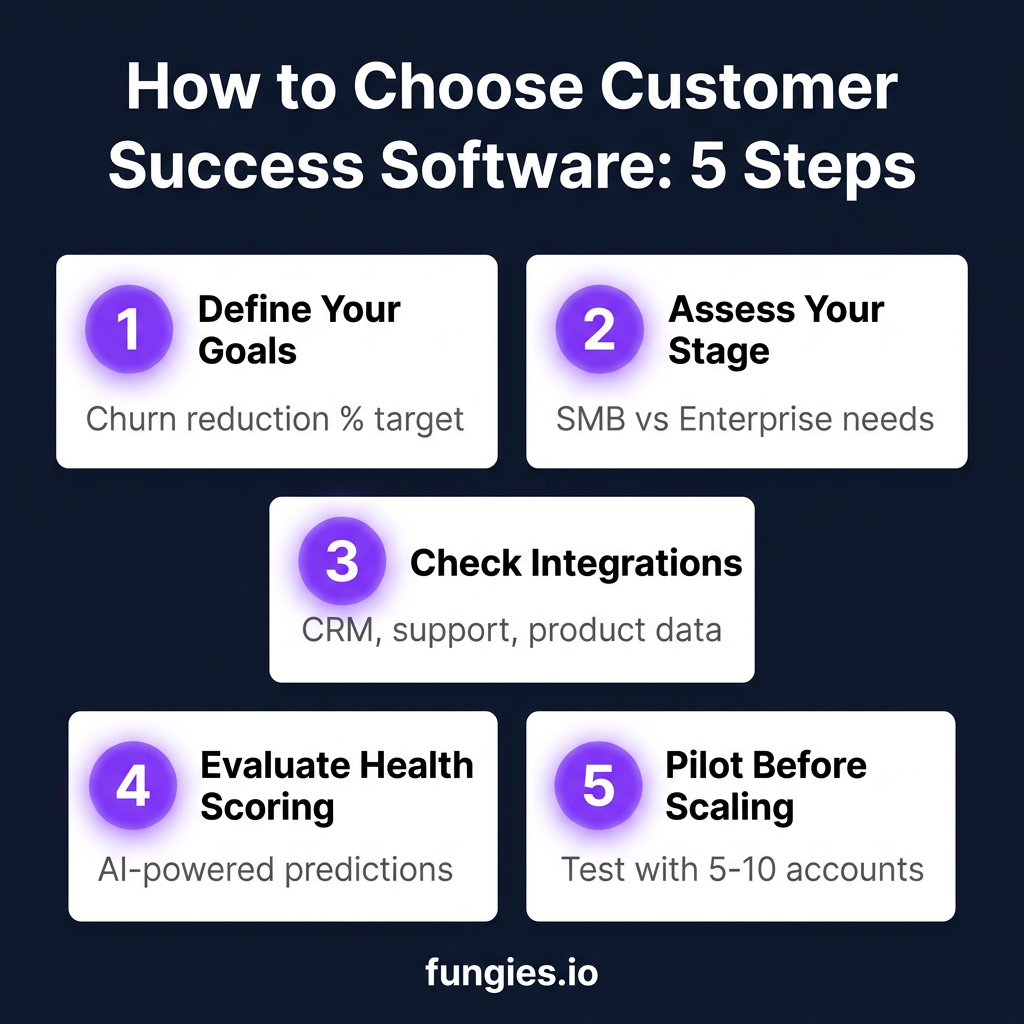
With so many options, how do you pick the right one? Here’s my five-step framework:
Step 1: Define Your Goals
Be specific. Are you trying to reduce churn from 7% to 3%? Increase expansion revenue by 20%? Improve onboarding completion rates? Your goals determine which features matter most.
Step 2: Assess Your Stage
A seed-stage startup with 50 customers doesn’t need Gainsight. A mid-market company with 500 customers will outgrow Custify. Match the platform to your current scale and growth trajectory.
Step 3: Check Integrations
Your CS platform needs to talk to your CRM, support system, product analytics, and communication tools. Poor integrations mean data silos, and data silos mean blind spots.
Step 4: Evaluate Health Scoring
Not all health scores are created equal. Look for platforms that let you customize scoring based on your specific product metrics and customer behaviors. AI-powered predictive scoring is increasingly valuable.
Step 5: Pilot Before Scaling
Never roll out a CS platform to your entire customer base immediately. Start with 5-10 accounts, validate that the insights are actionable, and refine your workflows before expanding.
Common Mistakes to Avoid
I’ve seen too many SaaS companies botch their CS software implementation. Here are the biggest mistakes:
- Buying too early: If you have fewer than 20 customers, you don’t need a CS platform yet. Use a spreadsheet.
- Over-engineering health scores: Start simple. Three to five metrics beats twenty every time.
- Ignoring adoption: The best platform is worthless if your team doesn’t use it. Plan for change management.
- Neglecting data hygiene: Bad data in, bad insights out. Clean your data before implementation.
- Focusing only on churn: CS is about growth too. Track expansion opportunities, not just risk.
Frequently Asked Questions
When should a SaaS company invest in customer success software?
Generally, when you have 50-100 customers or $1M+ in ARR. Before that, a well-organized spreadsheet and regular customer conversations are sufficient. The key signal is when you can no longer keep track of all your customers’ statuses in your head.
How much should SaaS companies spend on customer success software?
As a rule of thumb, expect to spend 1-3% of your ARR on customer success tools. For a $5M ARR company, that’s $50K-$150K annually. The ROI is typically strong: reducing churn by even 1-2 percentage points usually pays for the platform many times over.
What’s the difference between customer success and customer support software?
Customer support is reactive—customers reach out with problems, and you solve them. Customer success is proactive—you monitor customer health, anticipate issues, and guide customers toward value. Support tools (Zendesk, Intercom) handle tickets. CS tools (Gainsight, Vitally) prevent tickets from happening.
Can I use my CRM for customer success?
For very small teams, yes. But CRMs lack the specialized features that make CS effective: health scoring, journey orchestration, product usage tracking, and churn prediction. Most growing SaaS companies eventually outgrow their CRM for CS purposes.
How long does it take to implement customer success software?
Implementation timelines vary widely. Simple platforms like Custify or HubSpot can be running in 1-2 weeks. Enterprise solutions like Gainsight typically take 3-6 months. The biggest variable isn’t the software—it’s your data quality and integration complexity.
Conclusion: Invest in Retention Before It’s Too Late
Customer acquisition gets all the glory, but retention pays the bills. The SaaS companies that win in 2026 and beyond will be those that invest in customer success early and systematically.
The right customer success software gives you visibility into customer health, automates proactive engagement, and helps you spot expansion opportunities before your competitors do. Whether you choose Gainsight for enterprise scale, Vitally for mid-market growth, or Custify for startup affordability, the key is to start before churn becomes a crisis.
Remember: it’s 5-25x cheaper to retain a customer than to acquire a new one. The math is simple. The execution is where winners separate themselves from the pack.
Ready to streamline your SaaS billing and focus on what matters? Get started with Fungies—the Merchant of Record platform that handles payments, tax compliance, and checkout so you can focus on keeping your customers happy.
Sources
- Custify: 14 Customer Retention Strategies for SaaS
- FeatureBot: 10 Actionable SaaS Customer Retention Strategies
- Venture Harbour: SaaS Customer Retention Strategies
- Gleap: 7 Best Customer Success Tools for SaaS in 2026
- Cuoral: Customer Success Software Comparison 2026
- Userpilot: Customer Churn Rate in 2026
- Optifai: B2B SaaS Churn Rate Benchmarks
- The CS Café: Customer Success Platforms 2026