Last updated: July 8, 2026 | Reading time: 15 minutes
In 2023 alone, EU businesses lost €128 billion to VAT non-compliance. That’s not a typo—it’s the official figure from the European Commission’s VAT Gap Report. For SaaS founders, digital product sellers, and content creators, tax compliance isn’t just an accounting headache. It’s a existential risk that can trigger fines up to €25,000 per country, criminal charges, and business closure.
This guide is for you if you’re selling software subscriptions, digital downloads, online courses, or any digital product across borders. We’ll cover everything: what a Merchant of Record actually is, how it differs from a payment gateway, country-by-country tax rules for 20+ jurisdictions, real penalty data, and how to eliminate your tax liability entirely.
What Is a Merchant of Record?
A Merchant of Record (MoR) is a legal entity that takes full responsibility for selling goods or services to your end customers. This isn’t just payment processing—it’s legal liability transfer. When you use an MoR like Fungies, Paddle, or FastSpring, they become the seller of record in the eyes of tax authorities. They handle VAT registration in 130+ countries, calculate and collect the correct tax rates, file returns, remit payments, and absorb the liability if something goes wrong.
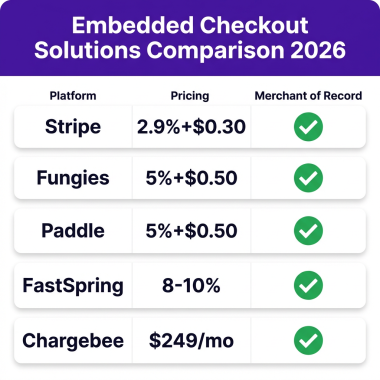
Here’s the critical distinction: with a payment gateway like Stripe or PayPal, you remain the Merchant of Record. You must register for VAT in every country where you exceed thresholds, calculate taxes yourself (or buy Stripe Tax), file returns, and face penalties for non-compliance. The gateway just moves money. An MoR moves liability.
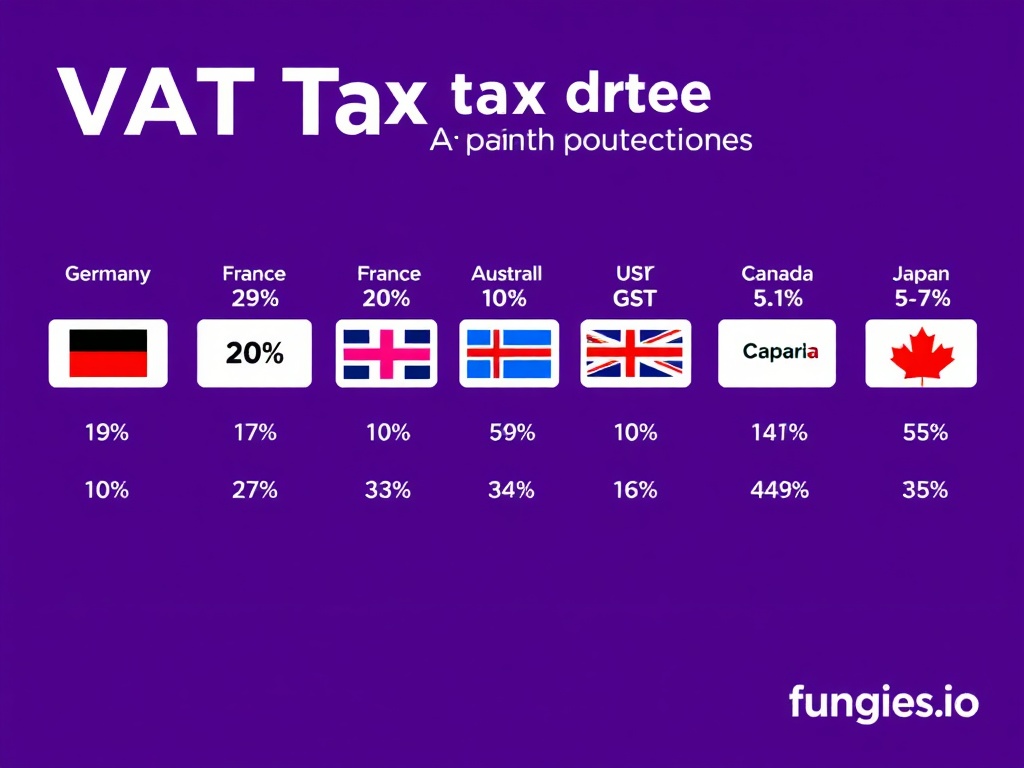
Infographic: VAT Rates on Digital Products Across Key Markets
Key Statistics at a Glance
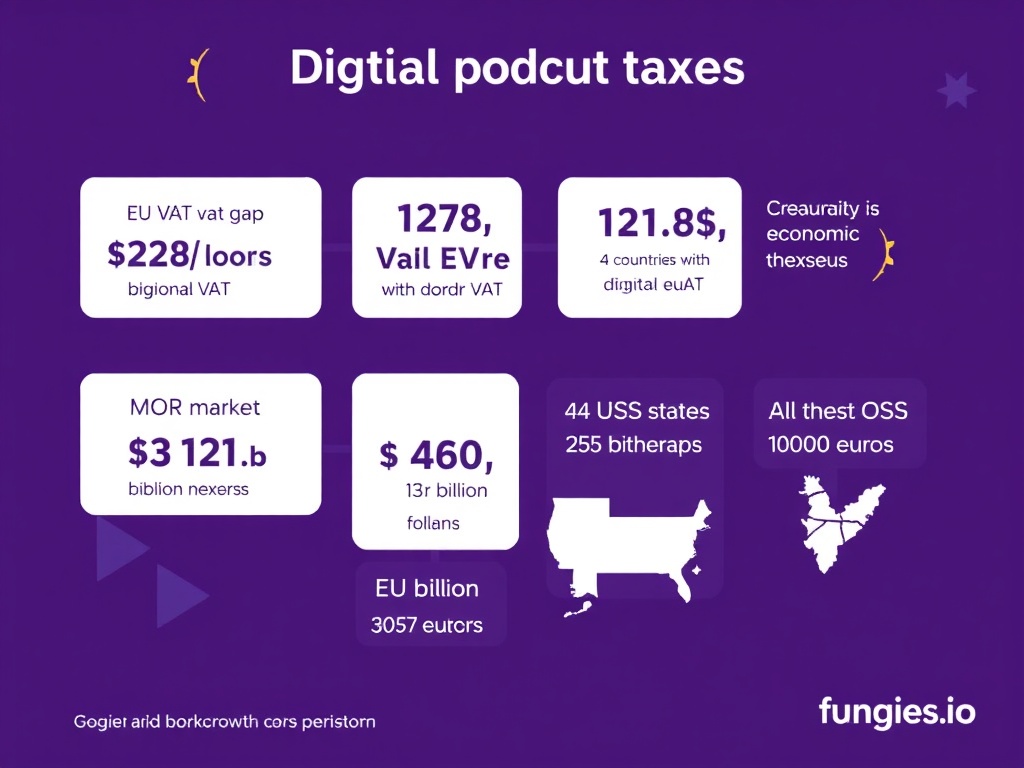
- €128 billion — The EU VAT compliance gap in 2023, representing 9.5% of total VAT liability that went uncollected due to non-compliance (European Commission)
- 130+ countries — Now impose VAT or GST on digital services sold by non-resident businesses
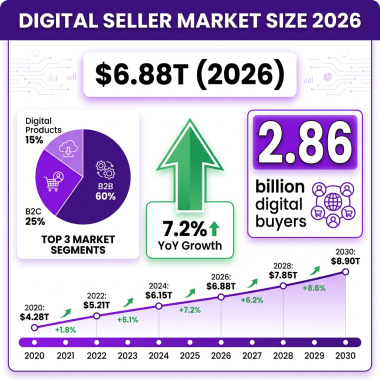
- $13.20 billion — Global Merchant of Record software market size in 2025, projected to reach $35.43 billion by 2032 at 14.96% CAGR (Research and Markets)
- $252.33 billion — Creator economy market size in 2025, growing at 23.3% CAGR to reach $1.35 trillion by 2033 (Grand View Research)
- 45 US states — Now have economic nexus laws requiring out-of-state sellers to collect sales tax
- 25 US jurisdictions — Currently tax SaaS products in some form (Anrok)
- €10,000 — The EU-wide threshold for OSS (One Stop Shop) registration for cross-border B2C sales
- €159 million — Total VAT penalties imposed on EU businesses in 2022 alone (1StopVAT)
- Up to €25,000 — Maximum VAT late filing penalties in Germany
- 7.75% — Current UK late payment interest rate charged by HMRC from day one of delay
Country-by-Country Tax Rules for Digital Products
Tax compliance for digital products is jurisdiction-specific, and the rules change constantly. Below is a comprehensive reference table covering 20 major markets. For non-resident sellers (businesses without a local entity), most countries impose zero thresholds—you must register from your first sale.
| Country | VAT/GST Rate | Registration Threshold (Non-Resident) | Filing Frequency | Late Filing Penalty |
|---|---|---|---|---|
| Germany | 19% | No threshold | Quarterly via OSS | Up to €25,000 |
| France | 20% | No threshold | Quarterly via OSS | 10% of VAT due + interest |
| Italy | 22% | No threshold | Quarterly via OSS | 30% of VAT due minimum |
| Spain | 21% | No threshold | Quarterly via OSS | 1-15% of VAT due |
| Netherlands | 21% | No threshold | Quarterly via OSS | €2,920 – €5,830 |
| United Kingdom | 20% | No threshold | Quarterly (MTD) | £200 penalty points + interest |
| Poland | 23% | No threshold | Quarterly via OSS | Up to 100% of VAT due |
| Hungary | 27% | No threshold | Quarterly via OSS | Up to 200% of VAT due |
| Denmark | 25% | No threshold | Quarterly via OSS | Up to 10% of VAT due |
| Sweden | 25% | No threshold | Quarterly via OSS | Up to 40% of VAT due |
| Norway | 25% | NOK 50,000 | Bi-monthly | Up to 100% of VAT due |
| Switzerland | 8.1% | CHF 100,000 | Quarterly | Up to 20% of VAT due |
| Australia | 10% GST | AUD 75,000 | Quarterly | Up to 200% of GST due |
| New Zealand | 15% GST | NZD 60,000 | Bi-monthly | Up to 150% of GST due |
| Canada | 5-15% GST/HST | CAD 30,000 | Quarterly | Up to 17% + interest |
| Japan | 10% | JPY 10 million | Annual | Up to 35% of tax due |
| South Korea | 10% | KRW 80 million | Quarterly | Up to 20% of VAT due |
| Singapore | 9% GST | SGD 1 million | Quarterly | Up to 200% of GST due |
| Austria | 20% | No threshold | Quarterly via OSS | Up to 10% of VAT due |
| Belgium | 21% | No threshold | Quarterly via OSS | €100 – €1,250 per return |
European Union: The OSS System
The EU’s One Stop Shop (OSS) system, introduced July 2021, was designed to simplify cross-border VAT compliance—but it still requires registration and quarterly filings. For EU businesses selling to consumers in other EU countries, the €10,000 threshold applies. Cross that threshold, and you must charge VAT at the customer’s country rate (not your home rate) and file OSS returns.
For non-EU businesses selling digital services to EU consumers, there is no threshold. You must register for VAT from your first euro of sales. You can use the non-union OSS scheme to file a single quarterly return covering all EU member states, but you’re still responsible for calculating the correct rate for each country (ranging from 17% in Luxembourg to 27% in Hungary).
United States: Economic Nexus Chaos
Following the 2018 South Dakota v. Wayfair Supreme Court decision, 45 US states now impose economic nexus requirements on remote sellers. The most common threshold is $100,000 in annual sales OR 200 transactions—but this varies by state. Alabama uses $250,000. California uses $500,000. Some states count gross sales, others only taxable sales.
Here’s the bigger problem for SaaS companies: only 25 US jurisdictions currently tax SaaS products, and the rules are inconsistent. Some tax B2B SaaS but exempt B2C. Some tax SaaS delivered on tangible media but exempt cloud-based delivery. Determining your obligations requires state-by-state analysis.
Infographic: Key Statistics Every Digital Seller Must Know
Tax Obligations by Business Type
| Business Type | Key Tax Obligations | Common Mistakes | Risk Level |
|---|---|---|---|
| SaaS Companies | VAT in EU from first sale; Economic nexus in 45 US states; GST in Australia, NZ, Canada | Assuming B2B SaaS is exempt; Missing economic nexus thresholds | High |
| Content Creators | VAT on digital downloads, courses, memberships; Income tax on all revenue; 1099-K reporting in US | Treating PayPal/Stripe as tax handlers; Not registering for VAT | Medium-High |
| AI/API Companies | B2B reverse charge in EU; SaaS taxability varies by US state; Digital services VAT globally | Misclassifying AI outputs as non-taxable; Ignoring API call location | High |
| Game Developers | VAT on digital downloads; Platform obligations (Steam, Apple take liability); In-game currency taxation | Assuming platforms handle all taxes; DLC classification errors | Medium |
| E-book/Course Sellers | Digital products VAT in 130+ countries; Reduced rates may apply for educational content | Not distinguishing B2B vs B2C; Missing reduced rate eligibility | Medium |
Tax Remittance: What It Means and How It Works
Tax remittance is the process of transferring collected taxes to the appropriate government authority. For VAT/GST, this typically means quarterly filings with remittance due 1 month after quarter-end. For US sales tax, due dates vary by state—monthly, quarterly, or annually depending on volume.
Here’s what self-compliance looks like in practice: You register for VAT in Germany, France, UK, Australia, and 15 other countries. Each quarter, you calculate tax collected by jurisdiction, file returns in local currencies, remit payments via international wire (with fees), and maintain audit documentation for 6-10 years depending on the country. Miss a filing deadline in Italy? That’s up to 30% of VAT due in penalties. Miss a payment in the UK? 7.75% interest from day one, plus escalating penalties.
With a Merchant of Record, remittance is invisible to you. The MoR collects tax at checkout, holds it in escrow, files returns in each jurisdiction, and remits on your behalf. You receive net revenue minus the MoR fee (typically 5% + $0.50 per transaction).
Fines and Penalties: What Non-Compliance Costs
| Jurisdiction | Fine Type | Amount | Interest Rate | Criminal Threshold |
|---|---|---|---|---|
| EU (Germany) | Late filing | Up to €25,000 | 1.75% – 6% annually | Intentional evasion |
| EU (France) | Late payment | 10% of VAT due | 5.4% annually | Fraudulent filing |
| EU (Italy) | Non-compliance | 30-100% of VAT | 4.5% annually | Tax fraud |
| United Kingdom | Late payment | 3% at day 15, 3% at day 30, 10% annually after | 7.75% from day one | Deliberate non-payment |
| United States (IRS) | Failure to file | 5% per month, max 25% | 7% annually (Q1 2025) | Willful evasion |
| United States (States) | Late filing | 4.5% – 25% | Varies by state | Criminal fraud |
| Australia | Late filing | Up to 200% of GST | Short-term treasury rate | Intentional evasion |
| Canada | Late remittance | Up to 17% + interest | Prescribed rate + 4% | Tax evasion |
The European Commission estimates that uncollected VAT across the EU reached €128 billion in 2023. Tax authorities are responding with real-time reporting requirements, e-invoicing mandates, and cross-border data sharing. The cost of non-compliance is rising—and the likelihood of getting caught is too.
Infographic: Merchant of Record vs Self-Compliance
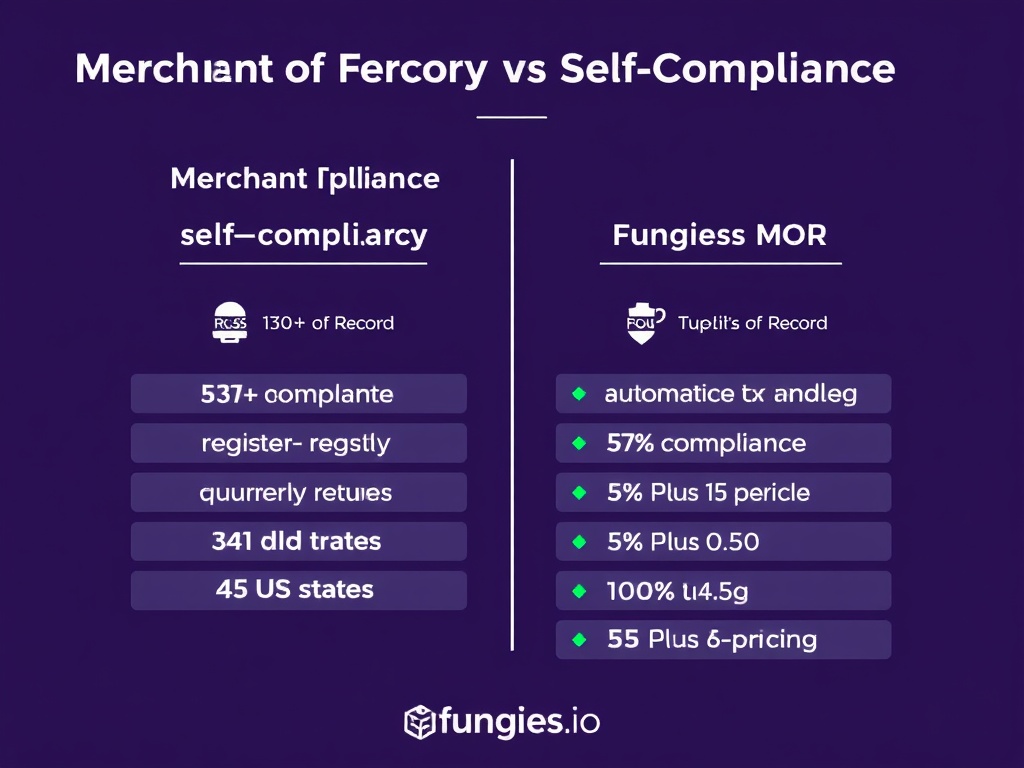
How Merchant of Record Solves Tax Compliance
A Merchant of Record eliminates your tax liability through a legal structure called the “reseller model.” Here’s how it works:
- You sell your software license or digital product to the MoR (e.g., Fungies)
- The MoR resells that product to your end customer
- The MoR is the legal seller, so tax obligations sit with them
- You receive net revenue minus the MoR fee
This isn’t tax evasion—it’s tax compliance by proxy. The MoR registers for VAT in 130+ countries, implements tax calculation at checkout, files returns, remits payments, and handles audits. You focus on building your product.
MoR vs Payment Gateway: The Real Comparison
| Feature | Merchant of Record (Fungies) | Payment Gateway (Stripe) |
|---|---|---|
| Transaction Fee | 5% + $0.50 | 2.9% + $0.30 |
| VAT Registration | Handled by MoR | You must register yourself |
| Tax Calculation | Automatic at checkout | Stripe Tax add-on ($0.05/transaction) |
| Return Filing | MoR files in all jurisdictions | You file yourself or hire accountants |
| Audit Liability | MoR absorbs liability | You face audits and penalties |
| Setup Time | Minutes | Weeks (tax setup + registrations) |
| True Cost at $100K MRR | $5,000/month + fees | $2,900/month + $3,000-10,000/month tax compliance |
The headline rate difference (5% vs 2.9%) is misleading. When you factor in VAT registration costs (€2,000-5,000 per country), accountant fees for multi-jurisdictional filing ($3,000-10,000/month), and the risk of penalties, the MoR is often cheaper—and always safer.
Frequently Asked Questions
What is the difference between a payment gateway and a merchant of record?
A payment gateway (Stripe, PayPal, Braintree) processes transactions but leaves you as the legal seller. You’re responsible for tax registration, calculation, filing, and liability. A Merchant of Record (Fungies, Paddle, FastSpring) becomes the legal seller, absorbing all tax obligations. You pay a higher transaction fee but zero compliance costs.
Do I need to charge VAT on SaaS subscriptions in the EU?
Yes. SaaS is classified as an electronic service under EU VAT rules. For B2C sales, you must charge VAT at the customer’s country rate from your first sale (no threshold for non-EU sellers). For B2B sales with valid VAT IDs, the reverse charge mechanism applies—your customer accounts for VAT, not you.
What happens if I don’t collect sales tax in the US?
If you exceed economic nexus thresholds ($100,000 or 200 transactions in most states) and fail to collect sales tax, you face penalties of 4.5% to 25% of tax due, plus interest at 7% annually. States can also pursue criminal charges for willful evasion. The 2018 Wayfair decision eliminated the physical presence requirement—economic nexus alone triggers obligations.
How does the EU VAT One Stop Shop (OSS) work?
The OSS allows you to file a single quarterly VAT return covering all EU member states where you have B2C sales. Instead of registering in 27 countries, you register once (in your home country for EU businesses, or any EU country for non-EU businesses). You still must charge VAT at each customer’s country rate, but you remit through one portal. The €10,000 threshold applies—below it, you charge your home country rate; above it, you charge destination rates.
What are the penalties for not registering for VAT in the EU?
Penalties vary by country but are severe. Germany charges up to €25,000 for late filing. France charges 10% of VAT due plus interest. Italy charges 30-100% of VAT due. The UK charges 3% at day 15, another 3% at day 30, then 10% annually, plus 7.75% interest from day one. Criminal charges apply for intentional evasion.
Conclusion: Eliminate Tax Liability with Fungies
Global tax compliance for digital products isn’t a finance problem—it’s a business risk. With 130+ countries imposing VAT on digital services, 45 US states with economic nexus, and penalties reaching €25,000 per jurisdiction, the cost of self-compliance is unsustainable for most SaaS and digital product businesses.
A Merchant of Record transfers that liability. Fungies handles VAT registration in 130+ countries, calculates and collects tax at checkout, files returns, remits payments, and absorbs audit risk. You pay 5% + $0.50 per transaction—no monthly fees, no setup costs, no compliance burden.
Get started with Fungies today and focus on building your product, not navigating global tax law.
Sources & References
- European Commission — VAT Gap Report 2025 (€128 billion compliance gap)
- Research and Markets — Merchant of Record Software Market Forecast 2025-2032
- Grand View Research — Creator Economy Market Size 2025-2033
- Tax Foundation — VAT Rates in Europe 2026
- Sales Tax Institute — Economic Nexus State by State Chart
- Anrok — SaaS Sales Tax by State 2026
- Paddle — VAT Penalties Guide for SaaS Companies
- GOV.UK — VAT Rules for Digital Services to Consumers
- TaxRoot — UK VAT Penalties 2026
- 1StopVAT — EU VAT Compliance Penalties (€159 million in 2022)
- Double Point Accountancy — UK VAT on Digital Services Guide
- Avalara — Economic Nexus State by State Guide
- Stripe — Introduction to US Sales Tax and Economic Nexus
- Paddle — What is a Merchant of Record
- Fungies — Paddle vs FastSpring vs Lemon Squeezy Comparison
\n