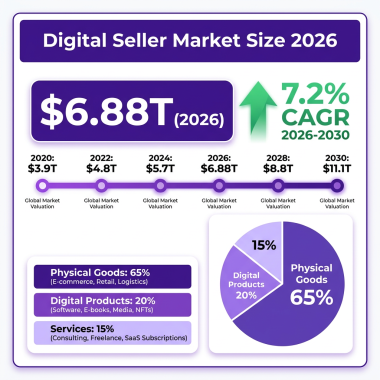
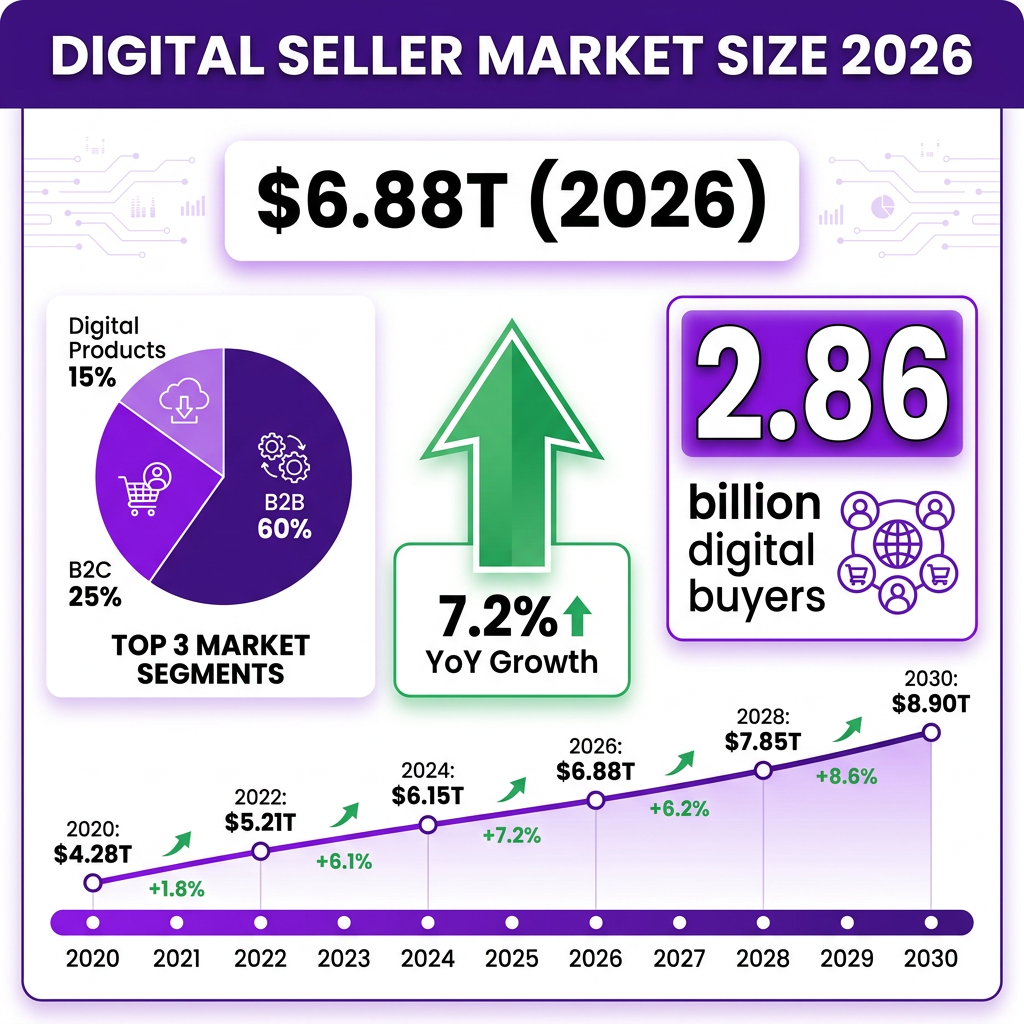
The digital selling landscape has reached an inflection point in 2026. With global e-commerce sales projected to hit an unprecedented $6.88 trillion—representing a 7.2% year-over-year increase from 2025’s $6.42 trillion—the opportunity for digital sellers has never been greater. More than 2.86 billion digital buyers are expected to make purchases online this year, making digital commerce the dominant force in global retail, accounting for over 20% of total global retail sales.
This isn’t just another year of incremental growth. The digital seller market in 2026 represents a fundamental shift in how commerce operates, with new platforms, technologies, and consumer behaviors reshaping the industry at an unprecedented pace. From the explosive rise of TikTok Shop to the maturation of AI-powered shopping experiences, sellers who understand these dynamics will capture disproportionate value in this $6.88 trillion ecosystem.
The transformation we’re witnessing goes beyond simple channel shift from physical to digital. It encompasses entirely new business models, from direct-to-consumer brands that bypass traditional retail entirely, to social commerce that merges entertainment with purchasing, to B2B marketplaces that are digitizing trillions of dollars in business procurement. For entrepreneurs, established brands, and investors alike, understanding this landscape is no longer optional—it’s essential for survival and growth.
In this comprehensive analysis, we’ll dive deep into the market data, emerging trends, key players, challenges, and opportunities that define digital selling in 2026. Whether you’re a seller looking to optimize your strategy, an investor evaluating opportunities, or an industry observer tracking the evolution of commerce, this guide provides the data-driven insights you need to navigate this dynamic market.

Market Overview: The $6.88 Trillion Digital Seller Ecosystem
The scale of the digital seller market in 2026 is difficult to overstate. What began as a niche channel for tech-savvy early adopters has evolved into the primary retail infrastructure for the global economy. The United States e-commerce market alone is on track to reach $1.8 trillion by 2030, representing 29% of all retail sales in the country—a figure that would have seemed impossible just a decade ago.
The growth trajectory has been nothing short of extraordinary. From 2020 to 2026, the global e-commerce market has nearly doubled, driven by the digital transformation of procurement processes, the rise of B2B marketplaces, and the increasing comfort of business buyers with online purchasing. The COVID-19 pandemic accelerated adoption by approximately five years, and those behavioral changes have proven sticky even as physical retail has reopened.
What’s particularly notable about 2026 is the diversification of the digital seller ecosystem. While Amazon and Shopify continue to dominate—together controlling nearly 50% of US e-commerce—a new generation of platforms is challenging the status quo. Temu, TikTok Shop, and Walmart now compete in a tight $15-22 billion range, each carving out distinct value propositions that appeal to different seller and buyer segments.
The B2B segment represents perhaps the most significant untapped opportunity. The global B2B e-commerce market is expected to reach $36.16 trillion by 2026, growing from $32.11 trillion in 2025. This dwarfs the B2C market and reflects the digital transformation of procurement processes across industries. US digital channels are projected to generate 56% of US B2B revenue via online and self-service channels in 2025, up from just 32% in 2020—a transformation that represents trillions of dollars in economic activity.
Regional variations tell an equally compelling story. The Asia-Pacific region continues to gain market share, with China leading the way in mobile commerce adoption and live shopping innovation. However, the most dramatic growth is coming from smaller markets like Latin America and the Middle East, where digital infrastructure investments are paying dividends in e-commerce penetration rates. Cross-border e-commerce has become a significant growth driver, with sellers increasingly able to reach global audiences without the traditional barriers of international retail.
The democratization of digital selling tools has also played a crucial role in market expansion. What once required significant technical expertise and capital investment can now be launched with minimal resources. Platforms like Shopify, WooCommerce, and BigCommerce have lowered the barriers to entry, enabling millions of entrepreneurs to start online businesses. This democratization has created a vibrant ecosystem of small and medium-sized sellers who collectively represent a significant portion of overall e-commerce volume.
Payment infrastructure has evolved alongside the market. The proliferation of digital wallets, buy-now-pay-later services, and localized payment methods has reduced friction in the checkout process, increasing conversion rates and expanding the addressable market. In 2026, over 5.2 billion people use digital wallets globally, making mobile and digital wallet payments the preferred transaction methods for a majority of online shoppers.
Key Statistics and Data: The Numbers Behind the Digital Seller Revolution
Understanding the digital seller market requires diving deep into the data that defines this ecosystem. Here are the key statistics that every seller, investor, and industry observer should know:
Global Market Size and Growth
The global e-commerce market will reach $6.88 trillion in 2026, up from $6.42 trillion in 2025. This represents a compound annual growth rate that continues to outpace traditional retail by a significant margin. By 2027, the e-commerce market is projected to exceed $7.9 trillion, with nearly 34% of shoppers engaging in online shopping at least once a week. This sustained growth demonstrates that e-commerce is not a temporary pandemic-induced shift but a permanent transformation of consumer behavior.
The digital products economy generates more than $2.5 trillion in value annually as of 2025, representing one of the fastest-growing segments in global commerce. This includes everything from software and digital media to online courses and virtual goods. The global software market alone generated revenue of over $742 billion in 2025, a 5.5% increase from 2024. The global mobile app market was valued at $330.6 billion in 2025 and is expected to grow at a CAGR of 14.3% to reach $1.1 trillion by 2034.
Consumer Behavior and Demographics
Over 2.86 billion people will make digital purchases in 2026. This represents more than one-third of the global population and demonstrates the truly mass-market nature of digital commerce. The digital buyer population has grown steadily as internet penetration increases in developing markets and as older demographics become more comfortable with online purchasing. In 2020 alone, 2 billion consumers purchased digital products, and that number has grown substantially since.
Consumer behavior data reveals deep engagement with digital commerce. 68% of internet users pay for digital content monthly, demonstrating the subscription economy’s hold on consumer spending. Transaction volumes surged nearly 70% between 2022 and 2024, indicating not just more buyers but more frequent purchasing. Around 58% of shoppers in the U.S. have purchased a product after seeing it on social media, highlighting the importance of social proof and discovery in the purchase journey.
Mobile Commerce Statistics
Mobile commerce accounts for 60% of total global e-commerce sales in 2026, with the market valued at $2.4 trillion. This share has grown steadily from 43% in 2018 and is projected to hit 63% by 2028. The global mobile commerce market is projected to grow from $2.42 trillion in 2026 to $5.01 trillion by 2034, exhibiting a CAGR of 9.5% during the forecast period.
US mobile commerce is estimated at $410 billion in 2026 and is expected to climb to $856 billion by 2027 as more American consumers shift to phone-first shopping habits. US mobile retail commerce sales are forecast to grow to $647.95 billion in 2025, fueled by mobile wallet adoption and personalized AI recommendations. Over 1.65 billion people are expected to shop through their phones, accounting for nearly one-third of the global digital population.
Social Commerce and Platform Data
The global social commerce market is worth $2.11 trillion in 2026, growing at a 29.12% CAGR. This represents one of the fastest-growing segments in digital commerce. The US social commerce market was $114.7 billion in 2025 and is projected to grow to $188.3 billion by 2030 at a 10.4% CAGR. With over 5.2 billion people on social media—64% of the global population—platforms like Facebook, TikTok, and Instagram have become powerful shopping hubs.
TikTok Shop US GMV has surpassed $20 billion in 2026, with the platform growing at 87% per year. The average TikTok Shop conversion rate sits at 4.7%, compared to 1.9% for other social commerce platforms and 2.5-3.0% for traditional e-commerce. Over 70 million people in the U.S. use TikTok Shop. Facebook remains the most popular social commerce platform in the U.S.—over 250 million people interact with Facebook Shops each month, and one million users make purchases monthly through the platform.
Platform Market Share and Competition
Amazon remains the dominant US marketplace, with an estimated $300 billion in third-party sales—more than seven times eBay’s volume and roughly 20 times that of the next competitors. Amazon and Shopify together control 49.7% of US e-commerce in 2026. With a market cap exceeding $2 trillion, Amazon ranks as the most valuable e-commerce company globally. In 2025, Amazon made $172 billion in global net revenue from third-party sales alone.
The challenger platforms are gaining ground. Temu claims 14% of US e-commerce, and its global GMV reached 66% of Amazon’s marketplace GMV in 2025, up from 40% in 2020. TikTok Shop and Walmart each operate in the $15-22 billion GMV range. Three platforms—Temu, TikTok Shop, and Walmart—now compete in this tight range, while specialized marketplaces from Wayfair to Whatnot have carved defensible positions serving niches.
B2B E-commerce Data
The global B2B e-commerce market is estimated at $32.11 trillion in 2025, growing to $36.16 trillion by 2026. The global B2B e-commerce market will grow at a 14.5% compound annual growth rate through 2026. US manufacturing and wholesale distribution sales reached $15.12 trillion in 2025. US digital channels are projected to generate 56% of US B2B revenue via online and self-service channels in 2025, up from 32% in 2020.
Technology and AI Impact
AI referral traffic to e-commerce sites grew twelve times in seven months according to Adobe research. 72% of consumers who use AI for shopping now make it their primary search tool. This represents a fundamental shift in product discovery that sellers must optimize for to remain competitive. Generative engine optimization (GEO) is becoming as important as traditional SEO for product visibility.
Major Trends Shaping Digital Selling in 2026
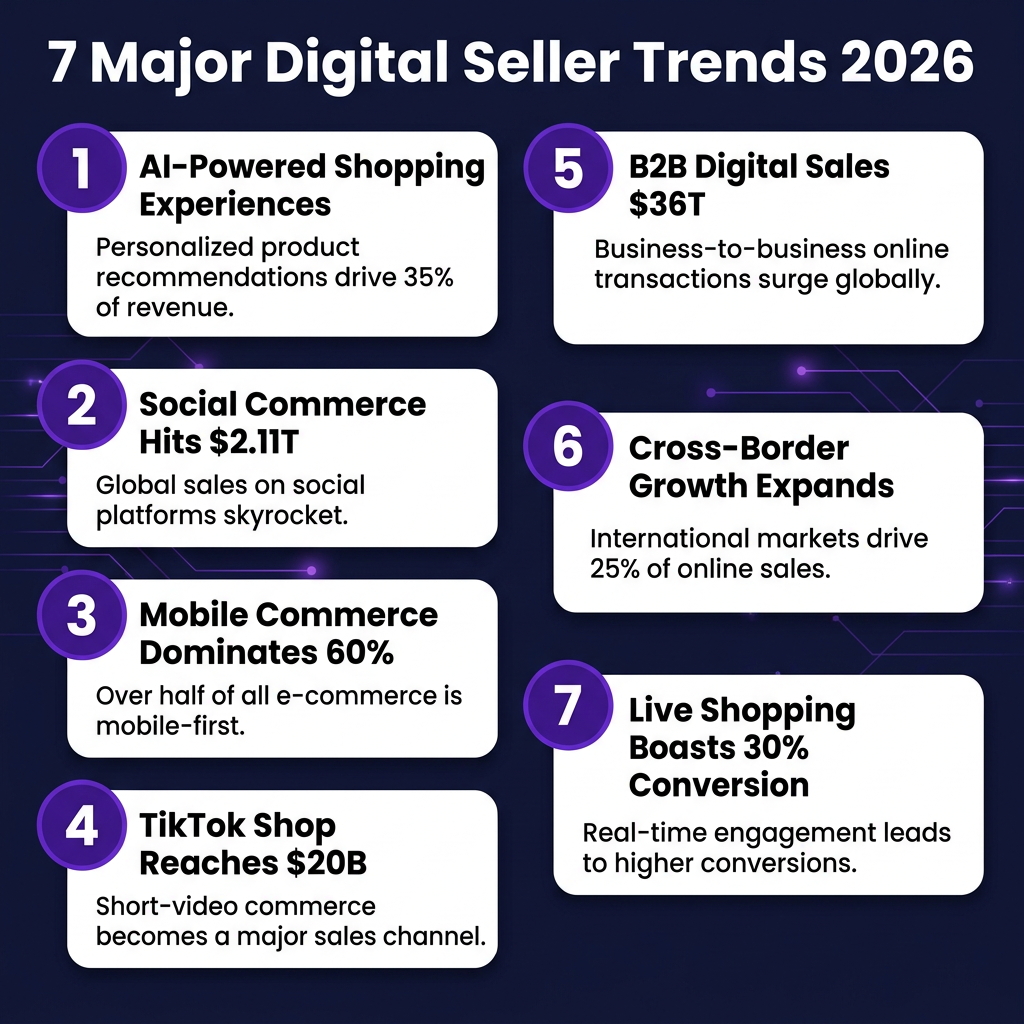
The digital seller market in 2026 is being reshaped by seven major trends that are redefining how commerce happens online. Understanding these trends is essential for any seller looking to capture value in this rapidly evolving ecosystem.
1. AI-Powered Shopping and Generative Engine Optimization
Artificial intelligence has moved from a back-end efficiency tool to the frontline of customer experience. AI-powered product recommendations, visual search, and conversational commerce are now baseline expectations for digital shoppers. The most significant development is the rise of generative engine optimization (GEO)—the practice of optimizing product data to appear in AI-generated search results.
According to Adobe’s research, AI referral traffic to e-commerce sites grew twelve times in just seven months. 72% of consumers who use AI for shopping now make it their primary search tool. This means that if your products don’t appear in AI-generated results, they simply don’t exist for a significant and growing portion of ready-to-buy shoppers.
Sellers are responding by investing in rich product data, structured schema markup, and AI-optimized content. The winners in this new environment are those who can provide the detailed, accurate product information that AI systems need to confidently recommend their products. This includes comprehensive product descriptions, high-quality images, detailed specifications, and authentic customer reviews.
2. The Social Commerce Revolution
Social commerce has evolved from a novelty to a primary revenue channel. The global social commerce market hitting $2.11 trillion in 2026 represents a fundamental shift in how consumers discover and purchase products. Platforms like TikTok Shop, Instagram Checkout, and Facebook Shops have created seamless shopping experiences that keep users within their apps from discovery to purchase.
TikTok Shop stands out as the fastest-growing commerce platform in North America, with US GMV surpassing $20 billion in 2026. Its 4.7% conversion rate—more than double the average for other social commerce platforms—demonstrates the power of algorithm-driven product discovery combined with impulse-friendly checkout flows.
Live shopping, a phenomenon that originated in China, is gaining traction globally. With conversion rates reaching 30% in some categories, live shopping events represent a high-engagement sales channel that combines entertainment with commerce. Sellers who can master the art of live presentation are capturing disproportionate value. The integration of shopping directly into social feeds removes friction from the purchase journey, turning casual browsing into immediate transactions.
3. Mobile-First Commerce
With mobile commerce accounting for 60% of total global e-commerce sales, the mobile experience is no longer a secondary consideration—it’s the primary one. The $2.4 trillion mobile commerce market in 2026 is expected to reach $5 trillion by 2034, growing at a 9.5% compound annual growth rate.
This shift has profound implications for seller strategy. Mobile-optimized product pages, one-click checkout, and mobile-first payment methods like digital wallets are now essential. The sellers winning in this environment have invested heavily in mobile user experience, recognizing that a frictionless mobile journey is the key to capturing the modern consumer.
Over 1.65 billion people are expected to shop through their phones in 2026, accounting for nearly one-third of the global digital population. This massive user base represents both an opportunity and a challenge—sellers must optimize for smaller screens, slower connections, and the unique behaviors of mobile shoppers. Progressive web apps (PWAs), accelerated mobile pages (AMP), and native app experiences are all part of the mobile optimization toolkit.
4. The Rise of New Marketplaces
While Amazon and Shopify maintain their dominance, a new generation of marketplaces is challenging the established order. Temu, TikTok Shop, and Walmart now compete in a tight $15-22 billion GMV range, each offering distinct value propositions that appeal to different seller and buyer segments.
Temu has disrupted the market with its ultra-low prices and direct-from-China model, claiming 14% of US e-commerce and its global GMV reached 66% of Amazon’s marketplace GMV in 2025, up from 40% in 2020. Temu’s aggressive customer acquisition strategy and gamified shopping experience have captured a significant segment of price-sensitive consumers.
TikTok Shop leverages the platform’s massive user base and algorithmic discovery to drive impulse purchases. With US GMV surpassing $20 billion in 2026 and a 4.7% conversion rate, TikTok Shop represents the fastest-growing commerce platform in North America. Its integration of entertainment and commerce creates a unique shopping experience that appeals to younger demographics.
Walmart continues to invest heavily in its digital marketplace, leveraging its physical store footprint for omnichannel fulfillment. With $15 billion in GMV, Walmart offers sellers access to a massive customer base and the credibility of an established retail brand. The company’s focus on grocery and essentials provides a different customer mix than Amazon.
5. B2B Digital Transformation
The B2B e-commerce market represents the largest untapped opportunity in digital selling. At $36.16 trillion globally, it dwarfs the B2C market and is growing at a 14.5% compound annual growth rate. The shift to digital B2B purchasing accelerated during the pandemic and has proven permanent, with business buyers now expecting the same seamless experiences they enjoy as consumers.
US digital channels are projected to generate 56% of US B2B revenue via online and self-service channels in 2025, up from just 32% in 2020. This transformation is driven by millennial and Gen Z buyers who prefer digital interactions, as well as by the efficiency gains that digital procurement offers. The traditional model of phone and fax orders is rapidly giving way to self-service portals and automated purchasing systems.
Sellers who can adapt their B2C expertise to B2B contexts—offering bulk pricing, purchase order support, and integration with procurement systems—are capturing significant value in this growing market. The B2B buyer journey is increasingly self-directed, with buyers conducting extensive research online before making purchasing decisions.
6. Cross-Border Commerce Growth
Cross-border e-commerce has become a significant growth driver, with sellers increasingly able to reach global audiences without the traditional barriers of international retail. The Asia-Pacific region continues to gain market share, while Latin America and the Middle East are experiencing the most dramatic growth in e-commerce value.
This globalization of digital selling is enabled by improvements in logistics, payment processing, and localization technology. Sellers can now offer localized shopping experiences, accept local payment methods, and fulfill orders efficiently across borders. The winners in this environment are those who can navigate the complexities of international tax, customs, and regulations.
Language localization, currency conversion, and culturally appropriate marketing are essential for cross-border success. Sellers who invest in understanding local markets and adapting their offerings accordingly are capturing disproportionate growth in emerging markets.
7. Sustainability and Digital Product Passports
Sustainability has moved from a marketing differentiator to a core business requirement. The rise of Digital Product Passports (DPPs)—digital records that track a product’s lifecycle from manufacture to disposal—is transforming how sellers communicate sustainability credentials to increasingly conscious consumers.
Regulatory pressure is driving this trend, with the EU leading the way in requiring transparency around product origins, materials, and environmental impact. Sellers who can provide verifiable sustainability data are gaining preferential placement on major platforms and capturing the growing segment of environmentally conscious consumers.
Beyond compliance, sustainability represents a genuine business opportunity. Studies consistently show that consumers are willing to pay premiums for sustainable products, and the most successful sellers in 2026 are those who have authentically integrated sustainability into their business models.
Key Players and Competitive Landscape
The digital seller ecosystem in 2026 is dominated by a handful of platforms that control the majority of transaction volume. Understanding this competitive landscape is essential for sellers choosing where to invest their resources.
Amazon: The Undisputed Leader
Amazon remains the dominant force in digital selling, with an estimated $300 billion in third-party sales—more than seven times eBay’s volume and roughly 20 times that of the next competitors. With a market cap exceeding $2 trillion, Amazon ranks as the most valuable e-commerce company globally.
The company’s dominance extends beyond sheer volume. Amazon’s logistics network, Prime membership program, and advertising platform create a comprehensive ecosystem that keeps both sellers and buyers locked in. In 2025, Amazon made $172 billion in global net revenue from third-party sales alone.
Amazon’s recent innovations include Rufus, its AI shopping assistant, and Amazon Haul, a direct-from-China storefront launched to compete with Temu. These experiments operate at the scale of entire companies—if just half of Rufus sales occurred in the US, it would rank as the seventh-largest marketplace in the country.
For sellers, Amazon offers unmatched reach but at a significant cost. Referral fees, fulfillment fees, and advertising costs can consume 30-50% of revenue. The platform’s algorithmic search and recommendation systems create both opportunities and challenges—sellers must master Amazon SEO and advertising to succeed.
Shopify: The Merchant Champion
Shopify has established itself as the leading platform for independent merchants, providing the tools and infrastructure for businesses to build their own branded online stores. Together with Amazon, Shopify controls 49.7% of US e-commerce—a remarkable duopoly that shapes the competitive landscape.
Shopify’s value proposition centers on merchant independence. Unlike Amazon, where sellers compete within a marketplace, Shopify enables businesses to own their customer relationships and build distinct brand identities. The platform’s ecosystem of apps and integrations provides flexibility that appeals to growing businesses.
Recent developments include Shopify Marketplace Connect, which allows merchants to connect their Shopify stores to Amazon and manage cross-platform sales from a single dashboard. This omnichannel approach reflects the reality that successful sellers in 2026 must maintain presence across multiple platforms.
The Challenger Platforms
Three platforms—Temu, TikTok Shop, and Walmart—now compete in a tight $15-22 billion GMV range, each offering distinct value propositions:
Temu has disrupted the market with its ultra-low prices and direct-from-China model. The platform claims 14% of US e-commerce and its global GMV reached 66% of Amazon’s marketplace GMV in 2025, up from 40% in 2020. Temu’s aggressive customer acquisition strategy and gamified shopping experience have captured a significant segment of price-sensitive consumers.
TikTok Shop leverages the platform’s massive user base and algorithmic discovery to drive impulse purchases. With US GMV surpassing $20 billion in 2026 and a 4.7% conversion rate, TikTok Shop represents the fastest-growing commerce platform in North America. Its integration of entertainment and commerce creates a unique shopping experience that appeals to younger demographics.
Walmart continues to invest heavily in its digital marketplace, leveraging its physical store footprint for omnichannel fulfillment. With $15 billion in GMV, Walmart offers sellers access to a massive customer base and the credibility of an established retail brand. The company’s focus on grocery and essentials provides a different customer mix than Amazon.
Niche and Specialized Platforms
Beyond the major players, specialized marketplaces from Wayfair to Whatnot have carved defensible positions serving niches that mass-market platforms struggle to capture. Etsy dominates handmade and vintage goods. Wayfair leads in furniture and home goods. Whatnot has created a vibrant marketplace for collectibles and trading cards.
For sellers, these niche platforms offer opportunities to reach highly targeted audiences with less competition than the major marketplaces. The most successful sellers in 2026 maintain presence across both mass-market and specialized platforms, optimizing their product mix for each channel.

Challenges and Pain Points for Digital Sellers
Despite the massive opportunity, digital sellers face significant challenges in 2026. Understanding these pain points is essential for developing strategies to overcome them.
1. Platform Dependency and Fee Pressure
The concentration of e-commerce in Amazon and Shopify creates significant dependency risk for sellers. Platform fee increases, policy changes, and algorithm updates can devastate businesses overnight. Amazon’s take rates—including referral fees, fulfillment fees, and advertising costs—can consume 30-50% of seller revenue.
Sellers are responding by diversifying across platforms, building direct-to-consumer channels, and investing in brand recognition that can drive traffic independent of platform algorithms. However, the resources required to maintain presence across multiple platforms create barriers for smaller sellers.
2. Supply Chain and Logistics Complexity
Logistics is no longer a cost center—it’s a strategic differentiator. Sellers face increasing pressure to offer fast, free shipping while managing inventory across multiple channels and geographies. The complexity of cross-border logistics, customs clearance, and last-mile delivery creates significant operational challenges.
Tariff-driven challenges have forced many sellers to rethink their fulfillment models, storing inventory closer to end markets to reduce dependence on cross-border small parcels. The winners in this environment are investing in sophisticated inventory management systems and building relationships with multiple logistics providers.
3. Customer Acquisition Costs
As digital advertising becomes more competitive and privacy regulations limit targeting capabilities, customer acquisition costs have risen dramatically. The shift from third-party cookies to first-party data requires sellers to build direct relationships with customers—a significant challenge for marketplace sellers who don’t own the customer relationship.
Sellers are responding by investing in content marketing, influencer partnerships, and community building. The most successful are creating value beyond the transaction—educational content, entertainment, and community engagement that builds brand loyalty and reduces dependence on paid acquisition.
4. Counterfeit and Quality Control
The rise of direct-from-China platforms like Temu has intensified concerns around counterfeit products and quality control. Sellers of authentic products face unfair competition from counterfeiters who don’t bear the costs of quality control, safety testing, and brand building.
Major platforms are investing in brand protection and authentication technologies, but the problem persists. Sellers must be vigilant in monitoring for counterfeit versions of their products and proactive in building brand recognition that helps consumers identify authentic products.
Opportunities and Growth Strategies
Despite the challenges, the digital seller market in 2026 offers unprecedented opportunities for those who can execute the right strategies. Here are the key growth strategies that successful sellers are employing:
1. Multi-Channel Selling
The most successful sellers in 2026 maintain presence across multiple platforms—Amazon for reach, Shopify for brand building, TikTok Shop for discovery, and niche platforms for targeted audiences. This diversification reduces platform risk and maximizes customer touchpoints.
Tools like Shopify Marketplace Connect and multi-channel inventory management systems make this approach increasingly feasible. The key is optimizing product listings, pricing, and fulfillment for each platform’s unique characteristics while maintaining brand consistency.
2. AI and Automation
AI is transforming every aspect of digital selling, from product description generation to dynamic pricing to customer service. Sellers who embrace AI tools can operate with efficiency that was impossible just a few years ago.
Generative engine optimization—optimizing product data for AI-generated search results—is becoming as important as traditional SEO for product visibility. Sellers should invest in rich product data, structured markup, and AI-optimized content to capture this growing source of traffic.
3. Social Commerce and Live Shopping
The $2.11 trillion social commerce market represents a massive opportunity for sellers who can master content-driven selling. TikTok Shop’s 4.7% conversion rate and live shopping’s 30% conversion rates demonstrate the power of entertainment-integrated commerce.
Sellers should invest in content creation capabilities, influencer partnerships, and live shopping infrastructure. The ability to tell compelling product stories through video content is becoming as important as traditional merchandising skills.
4. B2B Expansion
The $36 trillion B2B e-commerce market offers massive expansion opportunities for sellers who can adapt their B2C expertise to business buyers. This includes offering bulk pricing, purchase order support, net payment terms, and integration with procurement systems.
Platforms like Amazon Business and Shopify B2B are making it easier for sellers to serve business customers. The sellers who invest in B2B capabilities now will capture disproportionate value as business buying continues its digital transformation.
Case Studies and Success Stories
Real-world examples illustrate the strategies that drive success in the digital seller market. Here are three case studies that demonstrate different paths to growth:
Case Study 1: Multi-Channel Mastery
A mid-sized home goods seller started 2024 primarily dependent on Amazon, with 80% of revenue coming from the platform. Recognizing the platform risk, they invested in building a Shopify store, launched on TikTok Shop, and established presence on Wayfair.
By mid-2026, their revenue mix had transformed: 40% Amazon, 25% Shopify, 20% TikTok Shop, and 15% other channels. Total revenue had grown 150% while platform risk was significantly reduced. The key was optimizing each channel—Amazon for established products, TikTok for viral-ready items, and Shopify for building customer relationships.
Case Study 2: Social Commerce Breakthrough
A beauty brand with modest traditional e-commerce sales invested heavily in TikTok content creation in 2025. By partnering with micro-influencers and creating authentic, educational content, they built a following that translated directly to sales through TikTok Shop.
Their TikTok Shop revenue grew from zero to $5 million annually in 18 months, with a 6.2% conversion rate—significantly above platform averages. The key was authentic content that provided genuine value rather than overt selling, building trust that converted to purchases.
Case Study 3: B2B Digital Transformation
An industrial supplies seller traditionally dependent on phone and email orders invested in B2B e-commerce capabilities in 2024. They implemented self-service ordering, bulk pricing tools, and integration with major procurement systems.
By 2026, 60% of their revenue came through digital channels, up from 15% in 2024. Average order value increased 40% as the self-service platform made it easier for customers to place large orders. The investment in digital capabilities positioned them to capture the wave of millennial buyers who prefer digital purchasing.
Future Outlook and Predictions (2026-2030)
The digital seller market will continue its rapid evolution through the remainder of the decade. Here are the key predictions for 2026-2030:
Market Size Projections
Global e-commerce sales are projected to exceed $7.9 trillion by 2027 and approach $10 trillion by 2030. The US e-commerce market will reach $1.8 trillion by 2030, representing 29% of all retail sales. Mobile commerce will account for 63% of total e-commerce sales by 2028, up from 60% in 2026.
The B2B e-commerce market will grow to $47 trillion by 2030, maintaining its position as the largest segment of digital commerce. Social commerce will reach $7.55 trillion by 2031, growing at a 29.12% CAGR from 2026’s $2.11 trillion base.
Technology Trends
AI will become the primary interface for product discovery, with voice shopping, visual search, and conversational commerce becoming mainstream. Augmented reality will transform product visualization, allowing customers to “try before they buy” for everything from furniture to clothing. Blockchain-based supply chain tracking will become standard, enabling the transparency that consumers increasingly demand.
Platform Evolution
The platform landscape will continue to fragment, with specialized marketplaces capturing increasing share in vertical categories. Social commerce will mature from its current experimental phase to become a primary shopping channel. The distinction between online and offline retail will blur completely as omnichannel becomes the default expectation.
Regulatory Environment
Data privacy regulations will continue to tighten, making first-party data strategies essential. Sustainability reporting requirements will expand, with Digital Product Passports becoming mandatory in major markets. Platform regulation will address the dominance of Amazon and Shopify, potentially creating new opportunities for smaller players.
Key Takeaways
- The global digital seller market will reach $6.88 trillion in 2026, with over 2.86 billion digital buyers worldwide
- Mobile commerce accounts for 60% of total e-commerce sales, making mobile optimization essential
- Social commerce has exploded into a $2.11 trillion market, with TikTok Shop leading at $20B+ GMV
- The B2B e-commerce opportunity at $36.16 trillion dwarfs B2C and represents the largest growth opportunity
- AI-powered shopping and generative engine optimization are becoming essential for product discovery
- Multi-channel selling across Amazon, Shopify, TikTok Shop, and niche platforms reduces risk and maximizes reach
- Platform dependency remains the biggest risk, with Amazon and Shopify controlling nearly 50% of US e-commerce
- Customer acquisition costs continue rising, making first-party data and community building essential
- Cross-border commerce offers massive growth potential as logistics and payment infrastructure improve
- Sustainability and transparency are becoming baseline requirements rather than differentiators
Sources and Citations
- Marketplace Pulse – Top 10 E-Commerce Marketplaces in 2026 (https://www.marketplacepulse.com/articles/top-10-e-commerce-marketplaces-in-2026)
- NovaData – Amazon and Shopify Control 50% of US E-Commerce (https://novadata.io/resources/news/amazon-shopify-50-percent-us-ecommerce-2026)
- Statista – eCommerce Worldwide Market Forecast (https://www.statista.com/outlook/emo/ecommerce/worldwide)
- Swell – 32 Digital Product Sales Statistics (https://www.swell.is/content/digital-product-sales-statistics)
- Experro – B2B eCommerce Statistics & Market Size 2026 (https://www.experro.com/blog/b2b-ecommerce-statistics/)
- Ringly.io – Mobile Commerce Statistics 2026 (https://www.ringly.io/blog/mobile-commerce-statistics-2026)
- Ringly.io – Social Commerce Statistics 2026 (https://www.ringly.io/blog/social-commerce-statistics-2026)
- Social Commerce Club – TikTok Shop Statistics 2026 (https://socialcommerceclub.com/blogs/tiktok-shop/tiktok-shop-statistics-2026)
- Whop – 100+ Digital Products Statistics for 2026 (https://whop.com/blog/digital-product-statistics/)
- Digital Commerce 360 – Top 15 Ecommerce Trends 2026 (https://www.digitalcommerce360.com/2026/01/06/top-15-ecommerce-trends-to-watch-in-2026/)
- Mirakl – 2026 Marketplace Predictions (https://www.mirakl.com/blog/2026-marketplace-predictions-that-will-change-how-you-sell-online)
- Adobe Research – AI Shopping Behavior Data
- Publicis Sapient – Future E-Commerce Trends (https://www.publicissapient.com/resources/blog/future-ecommerce-trends)
- Akeneo – 2026 eCommerce Trends (https://www.akeneo.com/blog/2026-ecommerce-trends/)
- Deloitte Digital – 2026 B2B Commerce Research (https://www.deloittedigital.com/us/en/insights/research/b2b-commerce-trends.html)
The digital seller market in 2026 represents one of the most dynamic and opportunity-rich environments in the global economy. With $6.88 trillion in projected sales, 2.86 billion digital buyers, and transformative technologies reshaping every aspect of commerce, the sellers who thrive will be those who embrace change, diversify their strategies, and put the customer experience at the center of everything they do. The future of commerce is digital—and that future is now.