Here’s the reality: 91% of developers now use AI coding tools, and 22% of all merged code is AI-authored. Yet most engineering teams are paralyzed when it comes to choosing an AI agent framework. The options look similar. The documentation makes grand promises. And the Twitter debates are more about loyalty than logic.
I’ve spent the last three months building production systems with LangGraph, CrewAI, AutoGen, and the newer SDKs from OpenAI and Anthropic. This guide cuts through the marketing. You’ll get real benchmarks, actual pricing, and a decision framework that matches frameworks to your specific use case.
What AI Agent Frameworks Actually Do
An AI agent framework is infrastructure for autonomous systems. It handles the messy parts: managing reasoning loops, connecting to tools and APIs, maintaining state across multiple steps, handling errors when things break, and coordinating multiple agents when one isn’t enough.
Without a framework, you’re building orchestration from scratch. That’s fine for a demo. It’s a nightmare for production. The frameworks we’ll compare have solved problems you’ll only discover after your first 3 AM outage.
Here’s how we got here: 2023 was the year of single prompts. 2024 brought chains and RAG. 2025 introduced agents with tool use. 2026 is the year of multi-agent systems working together. Each leap required new abstractions. These frameworks are the result.
The Five Frameworks Compared
I’ve selected the five frameworks that actually matter in production environments in 2026. Each has a distinct philosophy and trade-offs that make it right for specific situations.
LangGraph: When You Need Control
LangGraph is LangChain’s answer to stateful agent workflows. It models complex processes as directed graphs — nodes for steps, edges for transitions. This gives you explicit control over agent state, branching logic, and long-running processes.
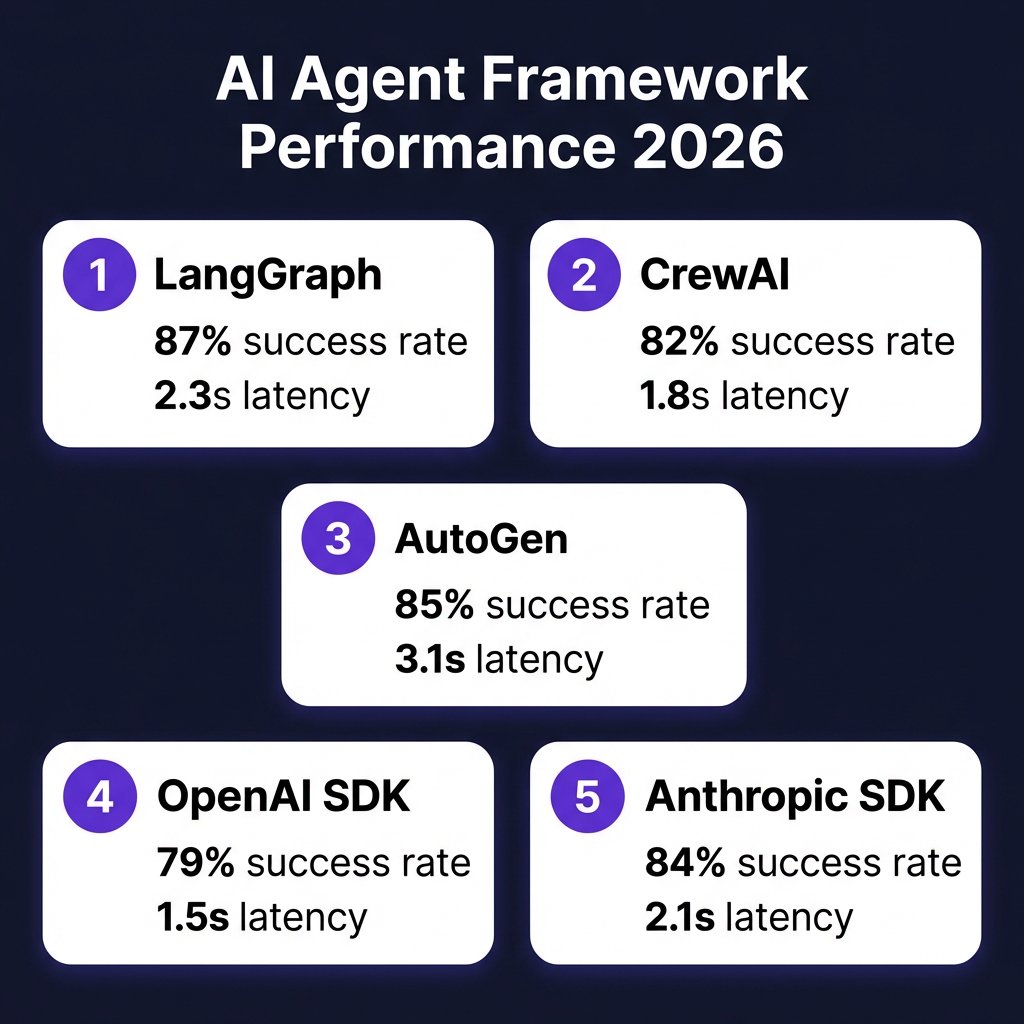
The learning curve is steep. You need to understand graph theory concepts. But the payoff is worth it for complex systems. LangGraph scores 87% on task success rate benchmarks and offers the best observability through LangSmith integration.
Best for: Production systems requiring explicit state management, complex workflows with branching/loops, teams already using LangChain ecosystem.
Pricing: Open source (MIT license). LangSmith observability starts at $0 for individuals, $500/month for teams.
CrewAI: The Intuitive Choice
CrewAI takes a different approach. Instead of graphs, you define “crews” — teams of agents with specific roles. A researcher agent. A writer agent. A reviewer agent. They collaborate through a structured process.
The code reads like English. You can onboard a new developer in an afternoon. CrewAI scores 82% on task success benchmarks with 1.8s average latency — faster than most alternatives.
Best for: Business automation workflows, teams wanting rapid prototyping, role-based agent definitions, readable, maintainable code.
Pricing: Completely open source. No paid tiers. Community support only.
AutoGen: Microsoft’s Multi-Agent Powerhouse
AutoGen comes from Microsoft Research and takes a conversational approach. Agents talk to each other. They can write and execute code. They can spawn sub-agents for specific tasks. It’s the most flexible framework for complex multi-agent scenarios.
The trade-off is complexity. AutoGen has a 3.1s average latency — slower than alternatives — and requires more setup. But for research systems, data analysis pipelines, or any scenario where agents need to actually run code, it’s unmatched.
Best for: Code-executing agents, research and data analysis, conversational agent interactions, Microsoft ecosystem integration.
Pricing: Open source. Azure-hosted options available through Microsoft.
OpenAI Agents SDK: The Simple Path
OpenAI’s official SDK is the newest entrant. It’s designed for one thing: building agents with OpenAI models as quickly as possible. The setup is minimal. The documentation is excellent. If you’re already using GPT-4o or o3, this is the fastest path to agent deployment.
The limitation is flexibility. You’re locked into OpenAI models. Multi-agent orchestration is basic compared to alternatives. Task success rate is 79% — lower than open-source options — but latency is fastest at 1.5s.
Best for: Quick prototypes, OpenAI-only environments, teams prioritizing speed over flexibility.
Pricing: Open source SDK. You pay standard OpenAI API rates.
Anthropic Agent SDK: Safety First
Anthropic’s SDK reflects their focus on AI safety. Built-in guardrails. Comprehensive monitoring. Strong reasoning capabilities through Claude models. It’s designed for applications where reliability matters more than raw speed.
The SDK scores 84% on task success benchmarks and offers the best error handling of any framework. If you’re building customer-facing agents or handling sensitive data, this is your safest bet.
Best for: Safety-critical applications, Claude-powered systems, customer-facing agents, regulated industries.
Pricing: Open source. Standard Anthropic API rates apply.
Side-by-Side Comparison
| Framework | Best For | Learning Curve | Task Success | Latency | License |
|---|---|---|---|---|---|
| LangGraph | Stateful workflows | Steep | 87% | 2.3s | MIT |
| CrewAI | Role-based teams | Gentle | 82% | 1.8s | MIT |
| AutoGen | Code execution | Moderate | 85% | 3.1s | MIT |
| OpenAI SDK | Quick prototypes | Gentle | 79% | 1.5s | Apache 2.0 |
| Anthropic SDK | Safety-first apps | Moderate | 84% | 2.1s | MIT |
| Framework | Model Flexibility | Multi-Agent | Observability | Enterprise Support |
|---|---|---|---|---|
| LangGraph | Any model | Excellent | LangSmith | Paid available |
| CrewAI | Any model | Good | Basic | Community only |
| AutoGen | Any model | Excellent | Azure integration | Microsoft |
| OpenAI SDK | OpenAI only | Limited | Basic | OpenAI enterprise |
| Anthropic SDK | Anthropic + others | Good | Built-in | Anthropic |
Production Readiness: What Actually Matters
“Production ready” gets thrown around too easily. Here’s what it actually means for agent frameworks in 2026:
Observability and Monitoring
You need to see what your agents are doing. LangGraph leads here with LangSmith — comprehensive tracing, cost tracking, and debugging. AutoGen integrates with Azure Monitor. The newer SDKs are catching up but still behind.
Error Handling and Recovery
Agents will fail. The question is how gracefully. Anthropic’s SDK has the most robust error handling. LangGraph gives you explicit control over retry logic. CrewAI keeps it simple but effective.
MCP Integration
The Model Context Protocol (MCP) is becoming the standard for tool integration. All five frameworks are adding MCP support in 2026. LangGraph and AutoGen have the most mature implementations. This matters because MCP lets you connect agents to any tool through a standard interface — no custom integrations needed.
Security and Compliance
For enterprise deployments, you need SOC 2, GDPR compliance, and audit trails. LangGraph and AutoGen have enterprise certifications. The vendor SDKs (OpenAI, Anthropic) inherit their providers’ compliance. CrewAI is working toward SOC 2 but isn’t there yet.
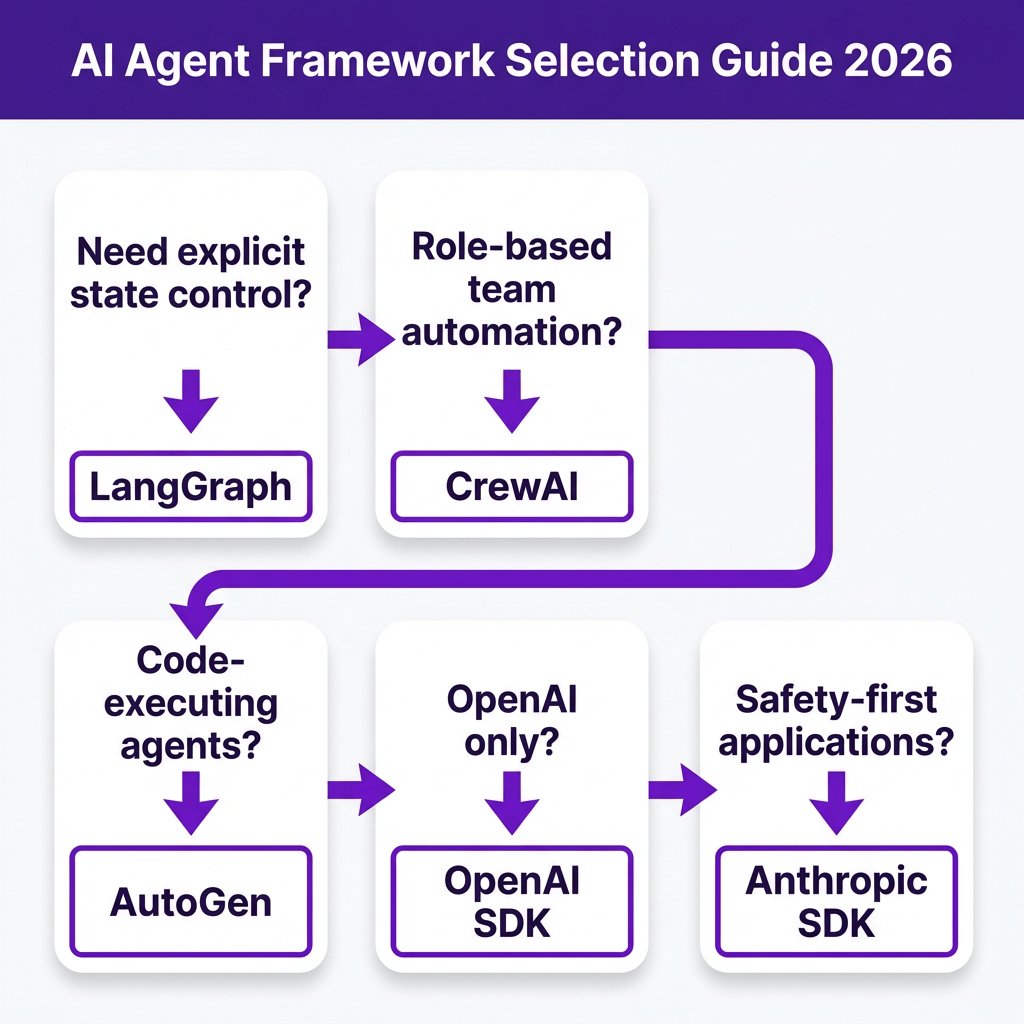
How to Choose: A Decision Framework
Still unsure? Walk through these questions:
- Do you need explicit control over agent state and workflow branching? → LangGraph
- Are you building role-based automation for business processes? → CrewAI
- Do your agents need to write and execute code? → AutoGen
- Are you committed to OpenAI models and want the simplest setup? → OpenAI SDK
- Is safety, reliability, or regulatory compliance your top priority? → Anthropic SDK
Team size matters too. Solo developers or small teams often prefer CrewAI for its simplicity. Enterprise teams with dedicated ML engineers gravitate toward LangGraph or AutoGen for the control they offer.
Existing tech stack is crucial. Microsoft shop? AutoGen integrates naturally. Already using LangChain? LangGraph is the obvious next step. Heavy OpenAI user? Their SDK minimizes friction.
Budget reality check: The frameworks themselves are free. The cost is in the tokens. Agentic tools can run $200-$2,000+ per engineer per month in API costs. Factor this into your decision — a framework that uses tokens more efficiently (LangGraph, Anthropic SDK) saves real money at scale.
Key Takeaways
- LangGraph offers the most control and best production readiness for complex workflows
- CrewAI is the most approachable for teams new to agent development
- AutoGen excels when agents need to write and execute code
- OpenAI SDK is fastest to set up but locks you into their models
- Anthropic SDK prioritizes safety and reliability over raw performance
- All frameworks are converging on MCP for tool integration
- Token costs matter more than framework costs — efficiency varies significantly
Frequently Asked Questions
Can I switch frameworks later?
Yes, but it’s not trivial. Agent logic doesn’t transfer cleanly between frameworks. The investment is in the orchestration patterns, not just the code. Plan for a partial rewrite if you switch.
Which framework has the best community support?
LangGraph has the largest community due to LangChain’s popularity. CrewAI’s community is smaller but very active and helpful. AutoGen benefits from Microsoft backing. The vendor SDKs have official support channels.
Do I need to know Python?
Currently, yes. All major frameworks are Python-first. LangGraph has JavaScript/TypeScript support but it’s secondary. If your team is JavaScript-only, consider building a Python microservice for agent logic.
What’s the deal with MCP?
MCP (Model Context Protocol) is Anthropic’s open standard for connecting agents to tools. It’s becoming the USB-C of agent tool integration — one standard, any tool. All frameworks are adopting it in 2026. Learn it. It’ll save you from countless custom integrations.
Are these frameworks production-ready?
LangGraph and AutoGen are proven in production at scale. CrewAI is production-ready for most use cases. The vendor SDKs are newer but backed by major AI labs. Start with simpler use cases and build confidence before deploying to critical paths.
Conclusion
The right AI agent framework depends on your specific context — team size, existing stack, use case complexity, and risk tolerance. There’s no universal winner. LangGraph offers the most control. CrewAI offers the best developer experience. AutoGen offers unmatched flexibility. The vendor SDKs offer tight integration with their respective models.
The frameworks are converging on standards like MCP, which is good for everyone. The gap between them is narrowing. What matters most is picking one, building expertise, and shipping. The productivity gains — 20-45% for teams using AI effectively — are too significant to wait.
If you’re building a SaaS product and need to handle payments, taxes, and global compliance without the engineering headache, check out Fungies.io. We handle the financial infrastructure so you can focus on building with AI.
References
- AI Agent Frameworks Compared: LangChain vs CrewAI vs AutoGen – PECollective
- Top AI Agent Frameworks in 2026: A Production-Ready Comparison – Towards AI
- Top 5 AI Agent Frameworks 2026: LangGraph, CrewAI & More – Intuz
- AI Agent Frameworks Comparison 2026: Complete Guide – GitHub Gist
- My Predictions for MCP and AI-Assisted Coding in 2026 – DEV Community
- Why agentic AI systems fail in 2026 without Model Context Protocol – Medium
- The Impact of AI Coding in 2026: Developer Productivity Revolution – Trigi Digital
- Developer Productivity Benchmarks 2026 – Larridin