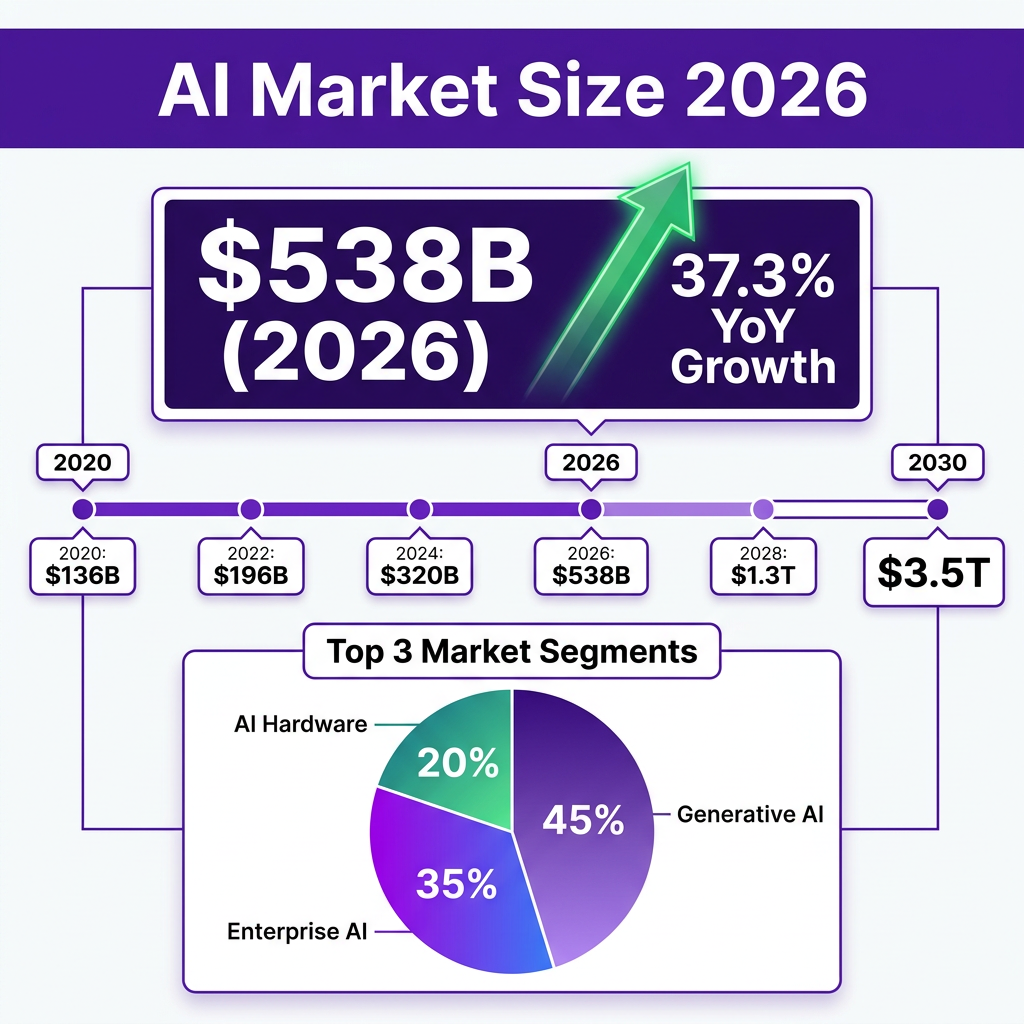
The artificial intelligence market has reached an inflection point in 2026. With global valuations hitting $538 billion and year-over-year growth accelerating to 37.3%, AI has transitioned from experimental technology to the primary driver of digital transformation across every major industry. This isn’t just another tech trend—it’s a fundamental restructuring of how businesses operate, compete, and create value.
What’s particularly striking about the 2026 landscape is the sheer scale of capital flowing into AI. Gartner projects worldwide AI spending will reach an astonishing $2.52 trillion in 2026, representing a 44% increase from the previous year. This spending isn’t limited to tech giants; enterprises across healthcare, finance, manufacturing, and retail are deploying AI at unprecedented scale. The transformation is happening faster than most analysts predicted, with adoption curves that make previous technology cycles look sluggish by comparison.
The implications extend far beyond the technology sector. AI is reshaping labor markets, creating new categories of jobs while automating others. It’s changing competitive dynamics, allowing smaller companies to punch above their weight by leveraging AI tools. And it’s creating new regulatory challenges as policymakers struggle to keep pace with technological change. Understanding the AI market in 2026 requires looking not just at the numbers, but at the broader economic and social transformation underway.

Market Overview: The $538 Billion AI Ecosystem
The global AI market has grown from a niche research field to a half-trillion-dollar industry in less than a decade. According to Grand View Research, the market size reached $539.45 billion in 2026, with projections indicating it will expand to $3.5 trillion by 2033 at a compound annual growth rate (CAGR) of 30.6%. This trajectory places AI among the fastest-growing technology markets in history, comparable to the early days of the internet but with significantly more immediate commercial applications.
To understand the scale of this growth, consider the historical context. In 2020, the global AI market was valued at approximately $62 billion. By 2024, it had quadrupled to $244 billion. The jump to $538 billion in 2026 represents more than a doubling in just two years—a rate of expansion that dwarfs even the early internet boom. This acceleration reflects both technological maturation and the emergence of practical applications that deliver measurable business value.
Several factors are driving this explosive growth. First, the maturation of generative AI technologies has created immediate, tangible business value. McKinsey reports that 71% of organizations now regularly use generative AI in at least one business function, up dramatically from 2023 when less than a third had adopted the technology. This isn’t pilot testing—this is production deployment at scale, with companies integrating AI into core workflows and customer-facing applications.
Second, enterprise AI platforms have evolved from experimental tools to core infrastructure. The enterprise AI market alone is expected to surpass $600 billion by 2035, as large organizations implement AI to enhance operational efficiency, decision-making, and customer experience. Companies like Microsoft, Google, and Amazon have built comprehensive AI platforms that make deployment accessible to businesses of all sizes, removing the technical barriers that previously limited adoption.
Third, the AI software platforms market has emerged as a critical orchestration layer, valued at $29.3 billion in 2026 and projected to reach $96.8 billion by 2035. These platforms provide the middleware that connects AI models to business applications, handling everything from data preparation to model deployment and monitoring. This infrastructure layer is essential for enterprises seeking to operationalize AI at scale.
The generative AI segment deserves special attention. Valued at $55.51 billion in 2026, this subsector is projected to reach $1.2 trillion by 2035, growing at a CAGR of 36.97%. Generative AI has moved beyond chatbots and image generation to become a core productivity tool across industries. From code generation to content creation, from drug discovery to financial modeling, generative AI is reshaping knowledge work in ways that were unimaginable just three years ago.
Regional distribution of AI investment tells its own story. North America continues to dominate, accounting for over 80% of global AI venture funding. However, Asia-Pacific is rapidly closing the gap, with China, Japan, and South Korea making massive investments in AI infrastructure and talent. Europe, while slower to commercialize, is leading in AI regulation and ethical frameworks, potentially creating a competitive advantage as global standards emerge. The Middle East, particularly the UAE and Saudi Arabia, is also making significant investments in AI as part of broader economic diversification strategies.
Key Statistics and Data Points
The numbers behind the AI market tell a story of unprecedented growth and transformation. Here are the key statistics that define the industry in 2026:
Market Size and Growth: The global AI market reached $538 billion in 2026, with a year-over-year growth rate of 37.3%. The generative AI subsegment alone accounts for $136 billion of this total. By 2033, the overall market is projected to reach $3.5 trillion, representing a CAGR of 30.6%. These figures represent consensus estimates from multiple research firms including Grand View Research, MarketsandMarkets, and Precedence Research.
Enterprise Spending: Gartner forecasts that worldwide AI spending will total $2.52 trillion in 2026, a 44% increase from 2025. This spending spans hardware (GPUs, specialized chips), software (platforms, applications), and services (consulting, implementation, training). The scale of this investment indicates that AI has moved from discretionary innovation budgets to core operational expenditure.
Adoption Rates: McKinsey’s latest research shows that 71% of organizations now regularly use generative AI in at least one business function. This represents a dramatic acceleration from 2023, when adoption was below 33%. Healthcare leads with a 40% long-term adoption rate, followed by automotive at 18%. These adoption rates are significantly higher than those seen during comparable phases of previous technology cycles like cloud computing or mobile.
Productivity Impact: Organizations using AI for over three years report a 25% reduction in cost per contact in customer service operations. Those applying generative AI to one or two use cases see a 30% cost reduction. 64% of business leaders believe AI will improve productivity, while 42% expect it to streamline job processes. These productivity gains are translating directly to competitive advantage and margin improvement.
Venture Capital Concentration: AI captured approximately 80% of global venture funding in Q1 2026, totaling roughly $242 billion of the $300 billion invested globally. This represents the highest concentration of VC capital in any single technology sector in history. The concentration reflects both the scale of opportunity and the capital intensity of building competitive AI capabilities.
Major Funding Rounds: The scale of AI investment is staggering. Anthropic raised $30 billion at a $380 billion valuation. xAI raised $20 billion in Series E funding. ElevenLabs secured $500 million at an $11 billion valuation. Skild AI raised $1.4 billion, valuing the robotics company at $14 billion. These mega-rounds reflect investor conviction that AI will create trillion-dollar companies.
Talent Premium: The AI talent war continues to intensify. AI/ML engineers command a 42% salary premium compared to traditional software developers. This premium reflects both the scarcity of qualified professionals and the direct impact of AI talent on business outcomes. Companies are competing aggressively for AI researchers, with total compensation packages at leading firms exceeding $1 million annually.
Industry Verticals: AI adoption varies significantly by sector. Banking and financial services lead in AI investment, followed by healthcare, retail, and manufacturing. The AI in manufacturing market alone is projected to grow from $34.18 billion in 2025 to $155 billion by 2030, at a 35.3% CAGR. Each vertical is developing its own AI use cases and best practices.
Infrastructure Investment: Tech megacaps are projected to invest over $300 billion in AI infrastructure in 2026. This includes data centers, specialized chips, and networking equipment. This infrastructure build-out is creating a foundation for the next decade of AI growth and represents a significant capital commitment from the industry’s largest players.
Major Trends Shaping AI in 2026
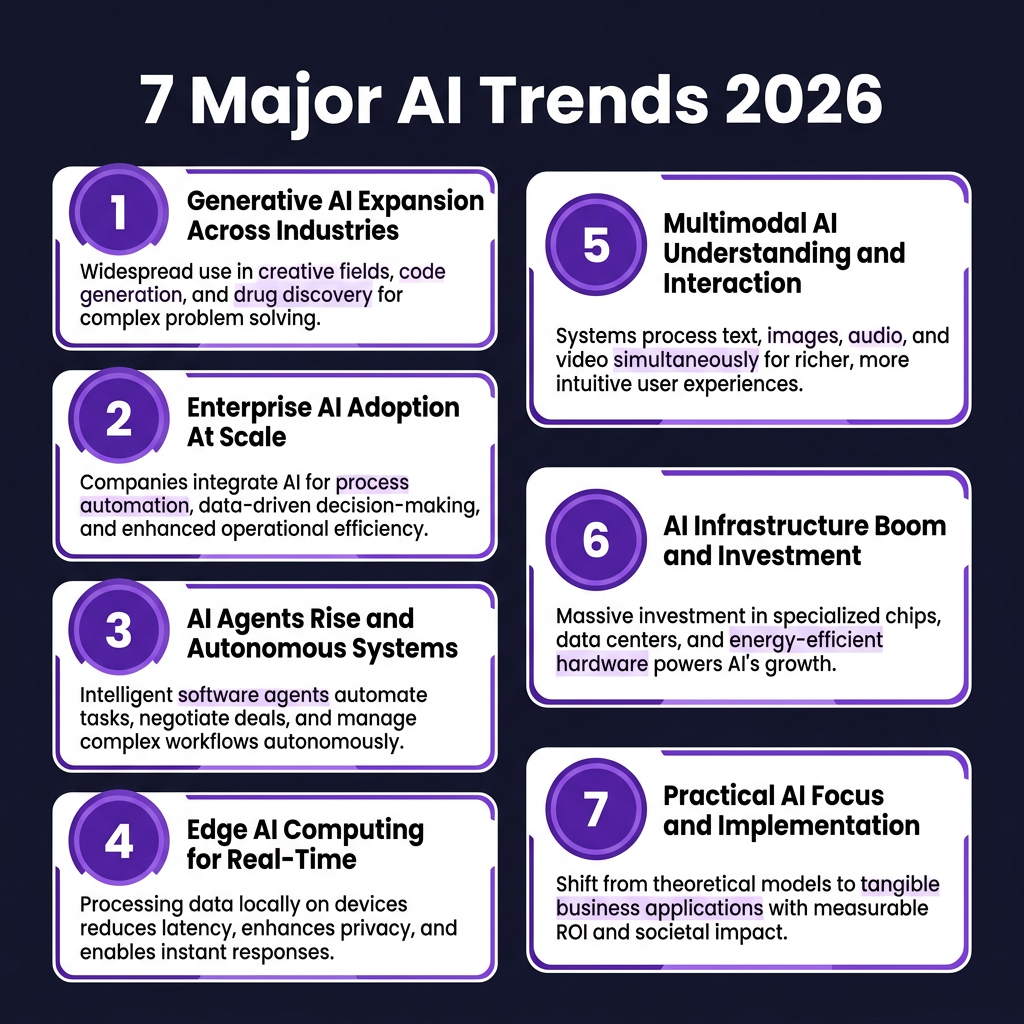
The AI landscape in 2026 is defined by seven major trends that are reshaping how businesses and consumers interact with artificial intelligence:
1. The Rise of Enterprise AI Adoption
AI has moved from the innovation lab to the boardroom. Enterprises are no longer experimenting with AI—they’re deploying it at scale across core business functions. OpenAI’s CFO Sarah Friar announced that the company’s 2026 focus revolves around “practical adoption” in health, science, and enterprise. OpenAI now has $20 billion in annual recurring revenue, with enterprise customers driving significant growth.
2. Generative AI Expansion
The generative AI market is projected to grow from $91.57 billion in 2026 to $400 billion by 2030, at a 34.3% CAGR. This growth is forcing businesses to prioritize generative tools for automating creative and analytical workflows. From marketing copy to code generation, from drug discovery to financial modeling, generative AI is becoming embedded in every knowledge worker’s toolkit.
3. AI Agents and Autonomous Systems
2026 marks the emergence of AI agents—systems that can autonomously perform complex tasks by combining reasoning, planning, and tool use. These agents go beyond simple chatbots to handle multi-step workflows like research, data analysis, and customer support. This trend represents a shift from AI as a tool to AI as an autonomous worker.
4. Edge AI and Distributed Computing
As AI models become more efficient, they’re moving from centralized data centers to edge devices. Edge AI enables real-time processing on smartphones, IoT devices, and industrial equipment without relying on cloud connectivity. This trend is critical for applications requiring low latency, such as autonomous vehicles and industrial automation.
5. Multimodal AI Capabilities
The next generation of AI systems can process and generate multiple types of content—text, images, audio, video, and code—within a single model. This multimodal capability enables more natural human-computer interaction and opens new applications in content creation, accessibility, and creative tools.
6. AI Infrastructure Boom
The build-out of AI infrastructure is unprecedented. Data center construction is at an all-time high, with specialized facilities designed specifically for AI workloads. Chip manufacturers like NVIDIA, AMD, and emerging players are racing to produce the specialized silicon that powers AI training and inference.
7. Focus on Practical AI and ROI
The hype cycle is giving way to practical implementation. Companies are focusing on AI applications that deliver measurable ROI rather than novelty. This shift is evident in the types of AI projects getting funded—automation of back-office functions, customer service enhancement, and decision support systems are priorities.
Key Players and Competitive Landscape
The AI market in 2026 is dominated by a mix of established tech giants and well-funded startups, each carving out distinct positions in the value chain:
Frontier Model Providers: OpenAI remains the leader in generative AI with ChatGPT, GPT-4, and enterprise APIs generating $20 billion in ARR. Anthropic has emerged as a strong competitor with its Claude models, recently raising $30 billion at a $380 billion valuation. Google DeepMind continues to push research boundaries while integrating AI across Google’s product suite. xAI, founded by Elon Musk, raised $20 billion and is positioning itself as an alternative to OpenAI.
Cloud AI Platforms: Microsoft has leveraged its partnership with OpenAI to integrate AI across Azure, Office 365, and Windows. The company’s Copilot products are becoming ubiquitous in enterprise workflows. Amazon Web Services offers a comprehensive suite of AI services through Amazon Bedrock and SageMaker. Google Cloud Platform provides Vertex AI and Gemini integration.
Enterprise AI Startups: A new generation of startups is building specialized AI solutions for enterprise use cases. Glean raised $150 million at a $7.2 billion valuation for its enterprise search and AI assistant. Baseten secured $150 million at $2.15 billion for its AI inference platform. These companies are bridging the gap between foundation models and enterprise applications.
AI Chip Manufacturers: NVIDIA continues to dominate the AI chip market with its GPUs, capturing an estimated 80% market share in data center AI accelerators. AMD and Intel are gaining ground with competitive offerings. Specialized chip startups like Cerebras, SambaNova, and Groq are challenging incumbents with novel architectures.
Vertical AI Solutions: Companies are building AI solutions tailored to specific industries. In healthcare, OpenEvidence raised $250 million at a $1.2 billion valuation. In robotics, Skild AI raised $1.4 billion at $14 billion. In voice AI, ElevenLabs raised $500 million at $11 billion. These vertical solutions often achieve higher accuracy by focusing on domain-specific data.

Challenges and Pain Points
Despite the tremendous growth and opportunity, the AI industry faces significant challenges that could impact its trajectory:
1. AI Hallucinations and Reliability: The most pressing challenge facing generative AI is hallucinations—false or fabricated information generated by AI models. According to recent research, 56% of organizations cite hallucinations as a top concern when deploying AI. In legal contexts, courts have increasingly flagged instances where filings include hallucinated citations and invented case law. This reliability issue limits AI deployment in high-stakes applications.
2. Data Privacy and Security: AI systems require vast amounts of data, raising privacy concerns. 53% of organizations cite cybersecurity as a major risk when implementing AI. The challenge is particularly acute for enterprises handling sensitive customer data. Regulations like GDPR in Europe and emerging AI-specific legislation are creating compliance complexity.
3. Talent Shortage and Skills Gap: The demand for AI talent far exceeds supply. The 42% salary premium for AI/ML engineers reflects this scarcity. Organizations struggle to find talent that understands both the technology and the domain-specific use cases where AI can deliver value.
4. Regulatory Uncertainty: AI regulation is evolving rapidly, creating uncertainty for businesses. The EU AI Act has established risk-based categories for AI systems. In the US, federal AI regulation remains fragmented. 45% of organizations cite regulatory compliance as a top concern when deploying AI.
5. Infrastructure Costs: Training and running large AI models requires significant computational resources. The cost of GPUs and specialized AI chips has risen dramatically, making it difficult for smaller players to compete. The infrastructure cost barrier could lead to further consolidation in the industry.
6. Intellectual Property Concerns: 46% of organizations cite intellectual property issues as a risk when using AI. Questions about copyright for AI-generated content, patent protection for AI innovations, and liability for AI decisions remain unresolved.
Opportunities and Growth Strategies
Despite the challenges, the AI market presents enormous opportunities for businesses that can execute effectively:
1. Enterprise AI Implementation Services: The gap between AI potential and practical implementation represents a massive opportunity. Most enterprises lack the internal expertise to deploy AI effectively. Consulting firms, system integrators, and specialized AI implementation partners are seeing explosive demand.
2. Industry-Specific AI Solutions: Horizontal AI platforms are becoming commoditized. The real opportunity lies in vertical AI solutions tailored to specific industries. Healthcare AI, financial services AI, manufacturing AI, and legal AI each require domain expertise and specialized data.
3. AI Infrastructure and Developer Tools: The picks-and-shovels play in AI remains compelling. As more companies build AI applications, demand for infrastructure—vector databases, model monitoring tools, prompt management systems—continues to grow.
4. AI-Powered Automation: The automation of knowledge work represents a trillion-dollar opportunity. From customer service to legal document review, from medical diagnosis to financial analysis, AI can handle tasks previously requiring human expertise.
5. Edge AI and IoT Integration: As AI models become more efficient, the opportunity to deploy AI on edge devices is expanding. This enables new applications in autonomous vehicles, industrial automation, smart cities, and consumer electronics.
Case Studies and Success Stories
Real-world implementations demonstrate the transformative potential of AI when deployed effectively:
Case Study 1: Customer Service Transformation
A major telecommunications company implemented generative AI for customer service, deploying AI agents to handle routine inquiries. The results were dramatic: a 30% reduction in cost per contact, 40% faster resolution times, and a 15-point improvement in customer satisfaction scores. The key to success was starting with a narrow use case and gradually expanding the AI’s scope.
Case Study 2: Healthcare Diagnostic Assistance
A regional hospital network deployed AI for radiology screening, using computer vision to analyze X-rays and flag potential issues for human review. The AI system achieved 95% accuracy in detecting pneumonia, reducing the time to diagnosis from hours to minutes.
Case Study 3: Manufacturing Quality Control
An automotive parts manufacturer implemented AI-powered visual inspection on its production lines. The system uses computer vision to detect defects in real-time, achieving 99.5% accuracy compared to 85% for human inspectors. The implementation paid for itself within six months.
Future Outlook and Predictions
Looking ahead to 2027-2030, several trends will shape the evolution of the AI market:
Market Size Projections: The AI market is projected to reach $1.2 trillion by 2030 and $3.5 trillion by 2033. This growth will be driven by continued enterprise adoption, new application categories, and the emergence of AI-native products and services.
Technology Evolution: We expect to see the emergence of more capable AI agents that can autonomously handle complex, multi-step tasks. Multimodal AI will become standard, with models seamlessly processing text, images, audio, and video.
Regulatory Maturation: By 2028, we expect clearer regulatory frameworks in major markets. The EU AI Act will be fully implemented, providing a template for other jurisdictions. Industry-specific regulations will provide clearer guidance for developers and users.
Market Consolidation: The current fragmented landscape will likely consolidate. Many AI startups will be acquired by larger players seeking talent and technology. Cloud providers will deepen their AI offerings.
Hardware Innovation: Specialized AI chips will continue to evolve, with new architectures optimized for inference rather than training. This will enable more efficient deployment of AI at scale.
Key Takeaways
- The global AI market reached $538 billion in 2026, growing at 37.3% year-over-year, with projections of $3.5 trillion by 2033
- Enterprise adoption has accelerated dramatically, with 71% of organizations now using generative AI in at least one business function
- AI captured 80% of global venture funding in Q1 2026, with major rounds including Anthropic ($30B), xAI ($20B), and ElevenLabs ($500M)
- Seven major trends are shaping the market: enterprise adoption, generative AI expansion, AI agents, edge computing, multimodal capabilities, infrastructure build-out, and practical ROI focus
- Key challenges include AI hallucinations (56% of organizations concerned), data privacy (53%), talent shortage (42% salary premium), and regulatory uncertainty
- The biggest opportunities lie in enterprise implementation services, vertical AI solutions, AI infrastructure tools, and knowledge work automation
- By 2030, the AI market could reach $1.2 trillion, with generative AI alone projected at $400 billion
Sources and Citations
- Grand View Research – AI Market Size 2026: https://www.grandviewresearch.com/industry-analysis/artificial-intelligence-ai-market
- Gartner – Worldwide AI Spending Forecast: https://www.gartner.com/en/newsroom/press-releases/2026-1-15-gartner-says-worldwide-ai-spending-will-total-2-point-5-trillion-dollars-in-2026
- Noizz – AI Market Size 2026 Statistics: https://noizz.io/statistics/ai-market-size-2026
- Precedence Research – Generative AI Market: https://www.precedenceresearch.com/generative-ai-market
- McKinsey – State of AI 2026: https://www.mckinsey.com/capabilities/quantumblack/our-insights/the-state-of-ai
- Crunchbase – Q1 2026 Venture Funding: https://news.crunchbase.com/venture/record-breaking-funding-ai-global-q1-2026/
- TechCrunch – AI Funding Rounds 2026: https://techcrunch.com/2026/02/17/here-are-the-17-us-based-ai-companies-that-have-raised-100m-or-more-in-2026/
- MarketsandMarkets – AI Market Forecast 2030: https://www.marketsandmarketsblog.com/ai-market-growth-size-share-forecast-2030.html
- Acumen Research – Enterprise AI Trends: https://www.acumenresearchandconsulting.com/blogs/enterprise-ai-market
- Thomson Reuters – AI Hallucinations Report: https://www.thomsonreuters.com/en-us/posts/ai-in-courts/hallucinations-report-2026/
Regional Analysis: AI Markets Around the World
The global AI market is not uniform; different regions are developing distinct strengths and approaches to AI development and deployment. Understanding these regional differences is crucial for businesses seeking to enter or expand in the AI market.
North America: The United States remains the dominant force in AI, accounting for over 80% of global venture funding. Silicon Valley continues to be the epicenter of AI innovation, hosting the headquarters of OpenAI, Anthropic, Google DeepMind (US operations), and numerous startups. The US benefits from a combination of world-class research universities, deep capital markets, and a regulatory environment that has historically been permissive toward technology innovation. Canada has also emerged as an AI hub, with the Vector Institute in Toronto and significant government investment in AI research.
Asia-Pacific: China is the second-largest AI market globally, with massive investments from both government and private sector. Chinese companies like Baidu, Alibaba, and Tencent are developing competitive AI models and applications. The government’s strategic focus on AI as a key technology for economic development has created a supportive environment for AI companies. Japan and South Korea are also significant players, with strengths in robotics and manufacturing AI. India is emerging as an AI services hub, leveraging its large pool of technical talent.
Europe: While slower to commercialize AI compared to the US and China, Europe is taking a leadership role in AI regulation and ethics. The EU AI Act establishes a risk-based framework for AI regulation that is influencing global standards. European companies are strong in industrial AI and manufacturing applications. The UK, despite Brexit, remains a significant AI research center with DeepMind (now part of Google) and numerous university research programs.
AI Applications by Industry
AI is being deployed across virtually every industry, with each sector developing unique use cases and facing specific challenges:
Healthcare: AI is being used for diagnostic imaging, drug discovery, personalized medicine, and administrative automation. The healthcare AI market is projected to reach $148 billion by 2030. Key applications include radiology screening, pathology analysis, and clinical decision support. However, healthcare AI faces significant regulatory hurdles and liability concerns.
Financial Services: Banks and financial institutions are using AI for fraud detection, algorithmic trading, credit scoring, and customer service. The fintech sector has been particularly aggressive in adopting AI, with robo-advisors and AI-powered lending platforms becoming mainstream. Risk management and regulatory compliance are also major AI use cases in finance.
Manufacturing: Industrial AI is being deployed for predictive maintenance, quality control, supply chain optimization, and robotics. The manufacturing AI market is growing at 35% annually. Smart factories that use AI to optimize production in real-time are becoming the standard in advanced manufacturing.
Retail and E-commerce: AI powers recommendation engines, demand forecasting, inventory management, and personalized marketing. Customer service chatbots and virtual shopping assistants are becoming common. The retail AI market is expected to exceed $50 billion by 2030.
Transportation: Autonomous vehicles remain the most visible AI application in transportation, but AI is also being used for route optimization, predictive maintenance, and traffic management. The transportation AI market is projected to reach $75 billion by 2030.
Investment Strategies for the AI Market
For investors looking to participate in the AI boom, several strategies have emerged:
Infrastructure Plays: Investing in the companies that provide the hardware and infrastructure for AI—NVIDIA, AMD, data center REITs, and semiconductor equipment makers. These companies benefit from AI growth regardless of which applications succeed.
Cloud Platforms: The major cloud providers (Microsoft, Amazon, Google) are integrating AI across their platforms and capturing significant value from AI adoption. Their existing enterprise relationships provide a distribution advantage.
Vertical Solutions: Companies that build AI solutions for specific industries often achieve higher margins and stronger competitive positions than horizontal platforms. Healthcare AI, financial AI, and legal AI are particularly attractive verticals.
Enterprise Software: Traditional enterprise software companies are embedding AI into their products, creating new revenue streams and competitive advantages. Companies like Salesforce, ServiceNow, and Workday are examples.
Conclusion
The AI market in 2026 represents one of the most significant technology shifts in history. With a market size of $538 billion and growth rates exceeding 37%, AI is transforming industries and creating new economic opportunities at an unprecedented pace. The convergence of mature technology, massive capital investment, and practical enterprise adoption has created a market dynamic that will shape the global economy for the next decade.
For businesses, the imperative is clear: AI adoption is no longer optional. Companies that successfully integrate AI into their operations will gain significant competitive advantages in efficiency, customer experience, and innovation. Those that fail to adapt risk being left behind by more agile competitors.
For investors, the AI market offers opportunities across the value chain—from infrastructure to applications, from horizontal platforms to vertical solutions. The key is identifying companies with sustainable competitive advantages and clear paths to profitability.
For policymakers, the challenge is balancing innovation with regulation. Ensuring AI safety, protecting privacy, and addressing labor market impacts while maintaining the competitive dynamics that drive innovation will require careful calibration.
The AI market of 2026 is just the beginning. As the technology continues to evolve and new applications emerge, we can expect AI to become even more deeply embedded in the global economy. The companies, investors, and countries that position themselves effectively today will reap the rewards in the decades to come.
Deep Dive: Generative AI Subsegment Analysis
Generative AI has emerged as the fastest-growing segment within the broader AI market, attracting the majority of venture capital and media attention. This subsector, which includes large language models, image generation, video synthesis, and audio generation, is projected to grow from $55.51 billion in 2026 to over $1.2 trillion by 2035.
The generative AI market can be segmented by modality: text (the largest segment, dominated by models like GPT-4, Claude, and Gemini), image (led by Midjourney, DALL-E, and Stable Diffusion), video (an emerging category with Runway and Pika Labs), and audio (including voice synthesis by ElevenLabs and music generation). Each modality is developing its own ecosystem of model providers, application developers, and enterprise use cases.
Enterprise adoption of generative AI is particularly strong in marketing and content creation, software development, customer service, and legal document review. Companies report significant productivity gains: marketing teams can produce 5x more content, developers write code 30% faster, and customer service teams handle 40% more inquiries. These productivity improvements translate directly to cost savings and revenue growth.
However, generative AI also faces unique challenges. Hallucinations remain a significant concern, with studies showing that even the best models produce factually incorrect information 10-20% of the time on complex queries. Copyright issues are unresolved, with ongoing litigation over training data. And the environmental impact of training large models has drawn criticism from sustainability advocates.
AI Talent and Workforce Transformation
The AI boom has created unprecedented demand for technical talent. Machine learning engineers, AI researchers, data scientists, and MLOps specialists are among the most sought-after professionals in the job market. The 42% salary premium for AI roles reflects both the scarcity of qualified candidates and the business impact these professionals can deliver.
But the talent shortage extends beyond technical roles. There’s a growing need for “AI translators”—professionals who can bridge the gap between technical capabilities and business applications. These roles require understanding both AI technology and specific industry domains. Product managers, business analysts, and consultants with AI expertise are increasingly valuable.
The workforce transformation goes beyond hiring. Companies are investing heavily in upskilling existing employees to work with AI tools. Training programs that teach employees how to use AI effectively are becoming standard. The goal is not to replace workers with AI, but to augment their capabilities and allow them to focus on higher-value tasks.
Educational institutions are also adapting. Universities are expanding AI programs, and online learning platforms are seeing record enrollment in AI courses. However, the pace of technological change means that formal education often lags behind industry needs. Continuous learning and on-the-job training are becoming essential for AI professionals.
AI Ethics and Responsible Development
As AI becomes more powerful and pervasive, questions of ethics and responsible development have moved to the forefront. Organizations deploying AI must navigate complex ethical considerations around bias, fairness, transparency, and accountability.
Bias in AI systems remains a significant concern. Models trained on historical data can perpetuate and amplify existing biases. In hiring, lending, and criminal justice applications, biased AI systems can cause real harm. Addressing bias requires careful attention to training data, algorithmic design, and ongoing monitoring of model outputs.
Transparency and explainability are also critical. As AI systems make more important decisions, users and regulators demand to understand how those decisions are made. Explainable AI (XAI) techniques are being developed to make model outputs more interpretable. The EU AI Act specifically requires high-risk AI systems to be explainable.
Leading AI companies are establishing ethics boards and responsible AI practices. Microsoft, Google, and OpenAI have all published AI principles and established review processes for new capabilities. Industry groups are developing standards and best practices for ethical AI development. However, critics argue that self-regulation is insufficient and that stronger external oversight is needed.
Competitive Dynamics and Market Structure
The AI market is characterized by intense competition at multiple levels. At the foundation model layer, OpenAI, Anthropic, Google, and Meta are competing to build the most capable models. This competition is driving rapid capability improvements but also raising concerns about safety and responsible development.
At the platform layer, cloud providers are competing to offer the most comprehensive AI services. Microsoft has gained significant ground through its partnership with OpenAI, while Google is leveraging its deep research expertise. Amazon is positioning itself as the neutral platform that can support any model. This competition is driving down prices and making AI more accessible.
At the application layer, thousands of startups are building AI-powered applications for every conceivable use case. This is the most fragmented and competitive layer, with low barriers to entry but high barriers to sustainable competitive advantage. Success requires either deep domain expertise, proprietary data, or unique distribution channels.
The market structure is likely to evolve toward consolidation at the foundation and platform layers, with continued fragmentation at the application layer. Foundation models require massive capital investment, creating natural barriers to entry. Platforms benefit from network effects and customer lock-in. Applications, however, can be built with relatively modest investment, enabling continued innovation from startups.
The Road Ahead: 2027-2030
Looking ahead, the AI market will continue to evolve rapidly. Several developments are likely to shape the next phase of AI growth:
Artificial General Intelligence (AGI): While opinions vary on timing, most experts expect AGI—AI systems that can match human performance across a wide range of tasks—within the next decade. The pursuit of AGI is driving massive investment in research and infrastructure. Whether achieved through scaling existing approaches or new breakthroughs, AGI would fundamentally transform the AI market and the global economy.
AI-Native Applications: Just as mobile-native applications transformed the mobile market, AI-native applications that are designed from the ground up around AI capabilities will emerge. These applications will do things that were previously impossible, not just automate existing workflows. The winners in the next phase of AI will likely be companies that can imagine and build these AI-native experiences.
Democratization of AI: As AI tools become more accessible, we’ll see broader participation in AI development and deployment. No-code and low-code AI platforms will enable non-technical users to build AI applications. Open source models will provide alternatives to proprietary systems. This democratization will accelerate innovation and create new categories of AI applications.
Regulatory Maturation: By 2030, we expect a more mature regulatory environment for AI. The EU AI Act will be fully implemented, providing a template for other jurisdictions. Industry-specific regulations for healthcare, finance, and transportation will provide clearer guidance. While regulation may slow some applications, it will also create legitimacy and trust that enables broader adoption.
The AI market of 2026 is just the beginning of a transformation that will reshape the global economy. For businesses, investors, and policymakers, understanding and adapting to this transformation is essential for success in the coming decades.
Final Thoughts: The AI Transformation
The artificial intelligence market in 2026 represents a pivotal moment in technological history. With $538 billion in market value, 37.3% growth rates, and 71% enterprise adoption, AI has transitioned from a promising technology to an essential business capability. The scale of investment—$2.52 trillion in global spending and $242 billion in venture funding—reflects a fundamental belief that AI will reshape the global economy.
For business leaders, the question is no longer whether to adopt AI, but how to do so effectively and responsibly. The companies that succeed will be those that can bridge the gap between AI’s potential and practical implementation, that can navigate the challenges of hallucinations, privacy, and regulation while capturing the productivity and innovation benefits that AI offers.
For investors, the AI market offers opportunities across the entire value chain—from the chip manufacturers building the infrastructure to the application developers creating new user experiences. The key is identifying sustainable competitive advantages in a rapidly evolving market.
For society, the AI transformation raises profound questions about work, privacy, and the future of human agency. Addressing these questions will require collaboration between technologists, policymakers, and citizens. The choices we make today about AI governance, education, and economic policy will shape the world for generations to come.
The AI market of 2026 is not an endpoint but a beginning. As the technology continues to evolve, as new applications emerge, and as regulatory frameworks mature, we can expect AI to become even more deeply embedded in our economic and social fabric. The transformation is just getting started.