Here’s a sobering statistic: the average B2B SaaS company now spends $1,200 to acquire a single customer. That’s up 14% from just a year ago. If you’re running a SaaS business in 2026, you already know the brutal truth — customer acquisition costs are climbing while attention spans are shrinking.
But here’s what most founders miss: not all acquisition channels are created equal. Some deliver 702% ROI. Others burn cash with little to show for it. The difference between scaling profitably and bleeding money often comes down to choosing the right mix of channels for your specific stage and audience.
In this guide, I’ll break down the 10 best SaaS customer acquisition channels for 2026, backed by real ROI data and benchmarks from over 2,500 SaaS companies. Whether you’re pre-revenue or pushing past $10M ARR, you’ll find actionable insights to optimize your acquisition strategy.
What Makes a SaaS Acquisition Channel “Best”?
Before diving into the list, let’s establish what “best” actually means. In my experience running paid campaigns across multiple SaaS companies, the highest-performing channels share three characteristics:
- Measurable ROI: You can clearly attribute revenue to the channel (even if imperfectly)
- Scalable volume: The channel can deliver 10x more customers without 10x the effort
- Audience alignment: Your target buyers actually spend time there
With that framework in mind, here are the 10 best SaaS customer acquisition channels ranked by overall effectiveness and ROI potential.
1. SEO and Content Marketing (702% ROI)
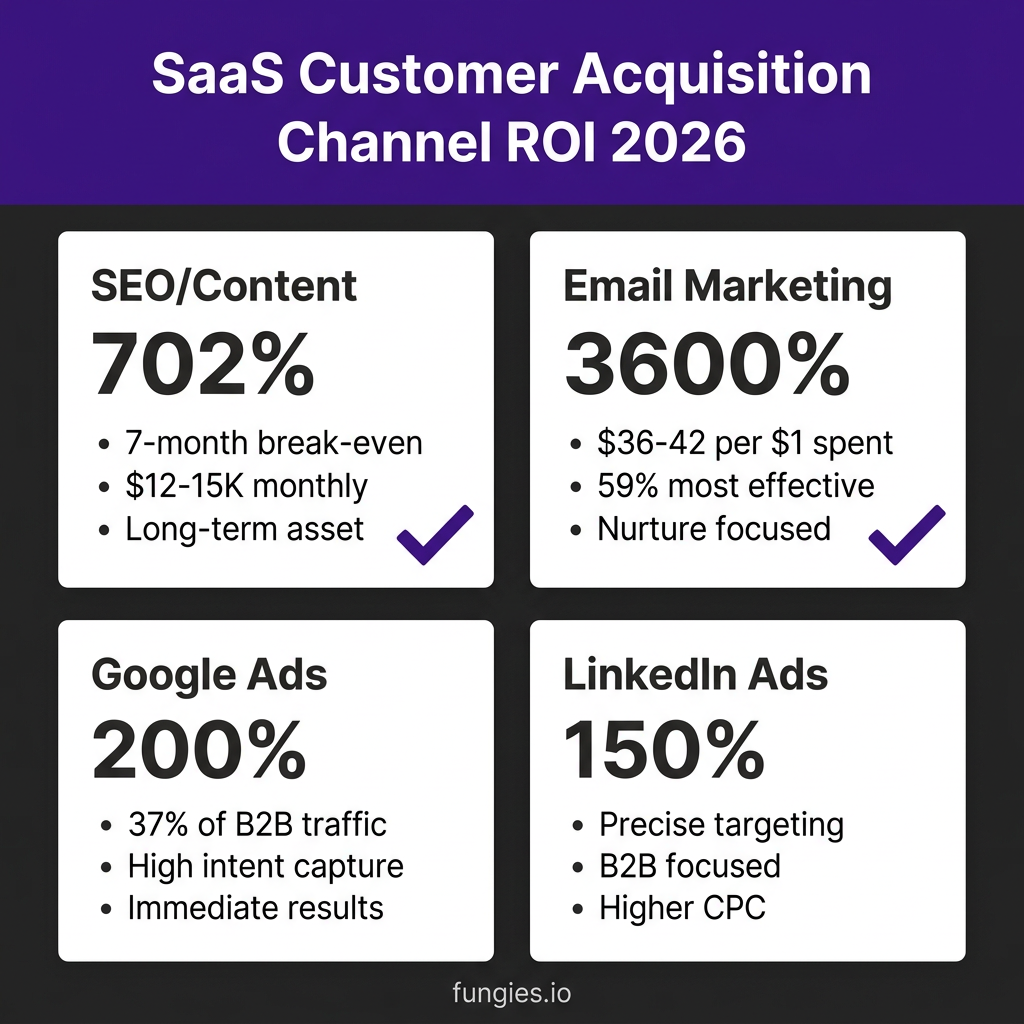
SEO isn’t just the highest-ROI channel for SaaS — it’s not even close. B2B SaaS companies see an average 702% ROI from SEO with a break-even time of just 7 months. Compare that to paid channels where you’re lucky to break even at all.
The math is compelling. A well-executed SEO strategy costs $12,000–$15,000 monthly but generates compounding returns. Content you publish today continues driving leads years later. That’s the opposite of paid ads, where traffic stops the moment you pause campaigns.
Best for: SaaS companies with longer sales cycles and complex products that benefit from educational content.
Key metrics: 82% of SaaS companies now have dedicated content teams. The ones that don’t are leaving money on the table.
2. Email Marketing (3,600% ROI)
If SEO wins on total ROI, email marketing wins on efficiency. For every $1 spent on email marketing, SaaS companies see an average return of $36–$42. That’s a 3,600% ROI that makes every other channel look expensive.
Here’s why it works: 59% of B2B marketers name email as their most effective revenue channel. Unlike social or search, you own your email list. Algorithm changes can’t touch it. And modern email automation lets you nurture leads from first touch to purchase with minimal manual effort.
Best for: Every SaaS company, but especially those with existing email lists or trial users to nurture.
Pro tip: 77% of email ROI comes from triggered campaigns, not broadcast blasts. Focus on behavioral sequences — onboarding, re-engagement, and expansion — rather than weekly newsletters.
3. Google Ads (200% ROI)
Google Ads captures existing demand — people actively searching for solutions like yours. That’s why it accounts for 37% of all B2B web traffic despite representing a smaller slice of marketing budgets.
The key is intent. Someone searching “best CRM for small business” is infinitely more qualified than someone who saw your ad while scrolling Instagram. Google Ads lets you intercept high-intent buyers at the exact moment they’re evaluating solutions.
Best for: SaaS companies with clear search demand and the budget to compete on high-value keywords.
Reality check: CPCs for competitive SaaS keywords can hit $50–$100. You need strong conversion rates and healthy LTV to make the math work.
4. LinkedIn Ads (150% ROI)
LinkedIn is expensive. There’s no getting around it. But for B2B SaaS targeting specific job titles, company sizes, or industries, the precision is unmatched. You can reach “VP of Engineering at Series B startups” with scary accuracy.
The trade-off is cost. LinkedIn CPCs often run 3–5x higher than Google. But if your deal sizes justify it — think $10K+ annual contracts — the targeting precision can deliver positive ROI where broader channels fail.
Best for: Enterprise SaaS, developer tools, and any product where the buyer has a specific job title you can target.
Strategy note: Most SaaS companies use LinkedIn wrong. They run conversion campaigns to cold audiences. The winning approach? Use LinkedIn for awareness and retargeting, not direct response.
5. Product-Led Growth (PLG)
Product-led growth treats your product as the primary acquisition channel. Free trials, freemium tiers, and viral features drive user acquisition without traditional marketing spend.
The data backs this up. 58% of B2B SaaS companies now have a PLG motion, and 91% of them plan to increase investment. When users can experience value before paying, conversion rates improve and sales cycles shorten.
Best for: SaaS products with quick time-to-value and self-serve onboarding.
Key insight: Companies using Product Qualified Leads (PQLs) see 3x higher free-to-paid conversion rates than those relying on traditional MQLs.
6. Partnerships and Integrations
Strategic partnerships put your product in front of established audiences. Integrations with platforms like Salesforce, HubSpot, or Slack expose you to millions of potential users who already trust the ecosystem.
The best part? Partnership acquisition costs are often 50–70% lower than paid channels. You’re leveraging trust that’s already been built rather than paying to interrupt strangers.
Best for: SaaS products that integrate with larger platforms and can deliver clear value within those ecosystems.
7. Webinars and Virtual Events
Webinars consistently rank among the highest-converting lead generation tactics for B2B SaaS. They combine education with direct engagement, letting prospects experience your expertise before committing to a purchase.
Interactive Q&As build trust, address objections in real-time, and convert attendees into qualified leads. The key is delivering genuine value, not thinly veiled sales pitches.
Best for: Complex SaaS products that require explanation and benefit from thought leadership positioning.
8. Referral Programs
Referral marketing leverages your happiest customers to acquire new ones. Dropbox famously grew to 4 million users through referrals. While that level of virality is rare, even modest referral programs can deliver 20–30% of new customers at minimal cost.
The psychology is simple: people trust recommendations from peers far more than brand advertising. A referred customer also has 16% higher lifetime value on average.
Best for: SaaS products with satisfied customers and clear value propositions that are easy to explain.
9. Community-Led Growth
Building a community around your product creates a moat competitors can’t easily copy. Slack, Notion, and Figma all leveraged community to drive acquisition and retention.
Community members become advocates, content creators, and support resources. They reduce your support burden while increasing product stickiness. The acquisition happens organically as members invite colleagues and share their experiences.
Best for: SaaS products with passionate user bases and use cases that benefit from peer learning.
10. Cold Outreach (When Done Right)
Cold email gets a bad rap because most people do it badly. Spammy, templated messages get ignored. But personalized, research-backed outreach to ideal prospects still works — especially for high-value B2B deals.
The key is relevance. If you’ve done your homework and can demonstrate specific value for that prospect’s situation, cold outreach converts. Tools like Apollo and Lavender help scale personalization without sacrificing quality.
Best for: Enterprise SaaS with defined ideal customer profiles and deal sizes that justify manual outreach.
Channel Comparison: The Data at a Glance
| Channel | Avg ROI | Time to Results | Best Stage | Key Metric |
|---|---|---|---|---|
| SEO/Content | 702% | 4–6 months | All stages | Organic traffic growth |
| Email Marketing | 3,600% | Immediate | All stages | Revenue per email |
| Google Ads | 200% | Immediate | $1M+ ARR | Cost per acquisition |
| LinkedIn Ads | 150% | 2–4 weeks | $5M+ ARR | Lead quality score |
| PLG | 400%+ | 3–6 months | Product-ready | Trial-to-paid rate |
| Partnerships | 300% | 3–6 months | $2M+ ARR | Partner-sourced ARR |
| Webinars | 250% | 1–2 months | All stages | Attendee-to-demo rate |
| Referrals | 500% | 1–3 months | Post-PMF | Referral rate % |
| Community | 350% | 6–12 months | $3M+ ARR | Community-influenced revenue |
| Cold Outreach | 180% | 2–4 weeks | Enterprise | Meeting booking rate |
How to Choose the Right Mix for Your Stage
Your optimal channel mix depends heavily on your current ARR and growth stage:
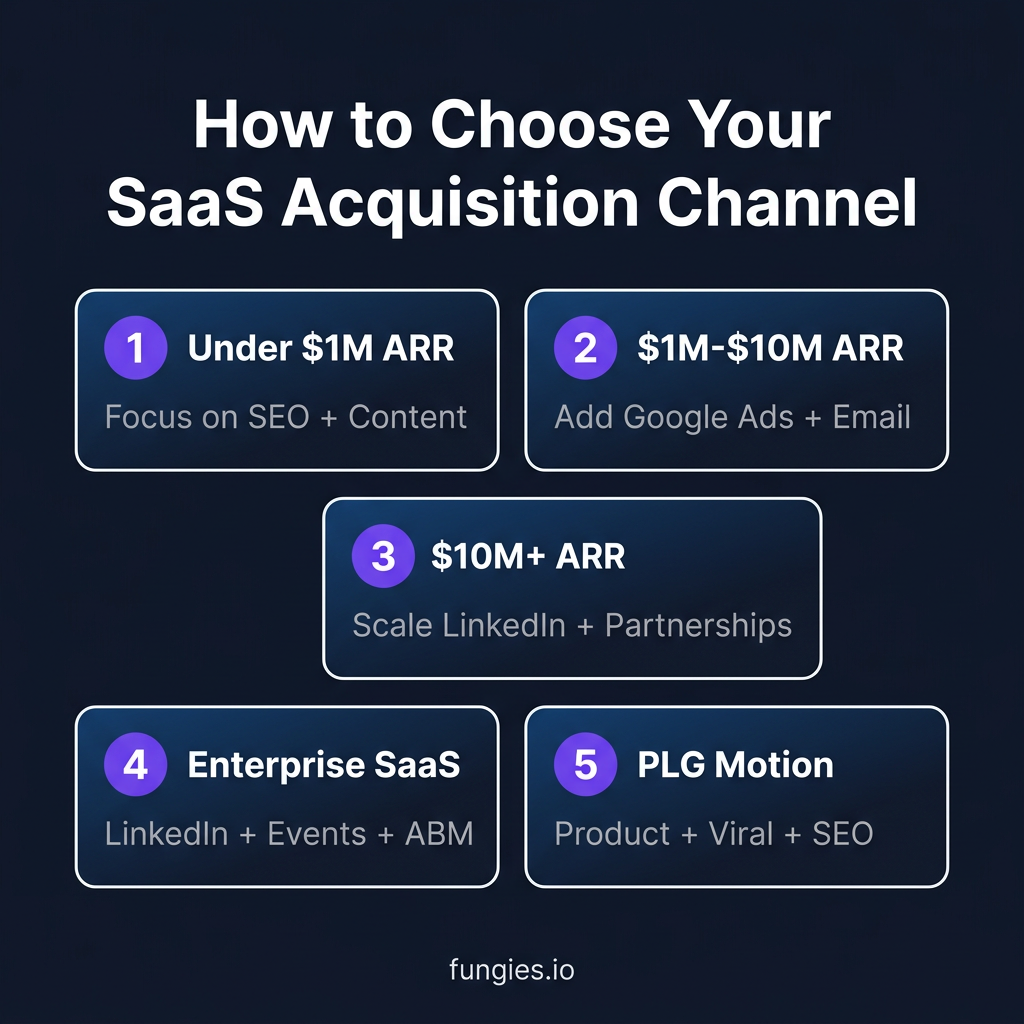
Under $1M ARR: Focus on SEO/content and email. These compound over time and don’t require massive budgets. Add PLG if your product supports it.
$1M–$10M ARR: Layer in Google Ads for immediate demand capture. Test webinars and partnerships. Double down on what’s working.
$10M+ ARR: Scale LinkedIn for enterprise deals. Build community and referral programs. Invest in brand marketing.
Enterprise SaaS: Prioritize LinkedIn, ABM, and cold outreach. Longer sales cycles require different tactics than self-serve products.
Common Mistakes to Avoid
After auditing dozens of SaaS acquisition strategies, I see the same mistakes repeatedly:
- Spreading too thin: Trying to be on every channel instead of dominating one or two
- Ignoring attribution: Not tracking which channels actually drive revenue
- Chasing shiny objects: Jumping to TikTok before nailing Google Ads
- Underinvesting in SEO: Treating content as a side project rather than a core channel
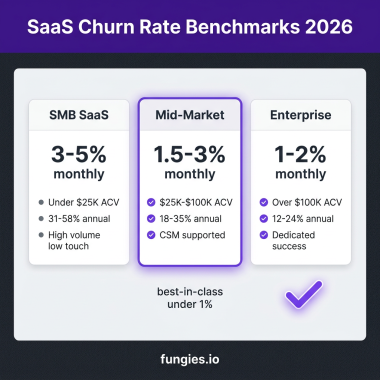
- Neglecting retention: Pouring money into acquisition while churn erodes gains
Frequently Asked Questions
What’s the best customer acquisition channel for early-stage SaaS?
For pre-revenue and early-stage SaaS, SEO and content marketing offer the best combination of low cost and compounding returns. Email marketing is also essential if you have any existing list or trial users. Avoid expensive paid channels until you have product-market fit and unit economics that support paid acquisition.
How much should SaaS companies spend on customer acquisition?
Benchmark data shows SaaS companies invest ~$1.55 in sales and marketing for every $1 of new ARR. However, this varies by stage. Early-stage companies often spend 40–60% of revenue on acquisition, while mature companies spend 20–30%. The key metric is payback period — aim for CAC payback within 12 months.
Is paid advertising worth it for SaaS?
Paid advertising works for SaaS when three conditions are met: (1) you have product-market fit, (2) your LTV supports the acquisition cost, and (3) you can track attribution reasonably well. Google Ads typically outperforms social for B2B SaaS due to higher intent. Start with small budgets, prove ROI, then scale.
What’s the average customer acquisition cost for SaaS?
The average B2B SaaS CAC is $1,200, but this varies dramatically by segment. Small business SaaS might see CACs of $200–$500, while enterprise SaaS can exceed $10,000 per customer. The more important metric is LTV:CAC ratio — healthy SaaS businesses maintain 3:1 or higher.
How long does it take to see results from SEO?
Most SaaS companies see meaningful SEO results within 4–6 months, with break-even typically around 7 months. However, SEO is a long-term play — the real returns come in years 2 and 3 as content accumulates authority and rankings. That’s why starting early, even pre-launch, is so valuable.
Conclusion: Build Your Acquisition Engine
Customer acquisition isn’t about finding a silver bullet. It’s about building a diversified engine where multiple channels work together. SEO and content create the foundation. Email nurtures relationships. Paid channels capture immediate demand. Product-led growth reduces friction.
The SaaS companies winning in 2026 aren’t relying on single channels. They’re orchestrating multiple acquisition sources, measuring rigorously, and doubling down on what works. Start with the channels that match your stage, prove they work, then expand your mix.
And remember — acquisition is only half the battle. The best growth strategy combines efficient acquisition with strong retention. A customer who stays for years is worth far more than one who churns quickly, no matter how cheap they were to acquire.
Ready to streamline your SaaS billing and focus on growth? Get started with Fungies.io — the all-in-one payment platform with 5% + $0.50 flat pricing, no monthly fees, and global tax compliance built-in.
Sources
- First Page Sage — B2B SaaS Marketing Channels 2026 Comparison
- Oliver Munro — 60+ SaaS Marketing Statistics & Benchmarks for 2026
- RevenueZen — 45 SaaS Content Marketing Statistics for 2025
- ChartMogul — The SaaS Go-To-Market Report
- ProductLed — Product-Led Growth Benchmarks
- Phoenix Strategy Group — CAC Benchmarks by Channel for 2025
- SaaS Capital — 2025 SaaS Retention Benchmarks
- Benchmarkit — 2025 SaaS Performance Metrics