10 Best SaaS Pricing Models and Strategies for 2026: A Data-Backed Guide
Discover the 10 best SaaS pricing models for 2026 with real data from 1,200+ companies. Compare tiered, usage-based, freemium, and hybrid pricing strategies with conversion benchmarks and expert recommendations.
Here’s a number that should keep every SaaS founder up at night: executives spend only 11.5 hours on pricing strategy over their entire business lifetime. That’s according to 2025 research from SaaSfactor, and it costs companies an estimated 10-15% of potential revenue. I’ve seen startups with incredible products fail because they slapped on a $29/month price tag and called it a day.
Pricing isn’t just about covering costs—it’s about capturing value, segmenting your market, and building a sustainable growth engine. The right SaaS pricing model can mean the difference between stagnation and hypergrowth. In this guide, I’ll break down the 10 best SaaS pricing models and strategies that are actually working in 2026, backed by real data from over 1,200 companies.
What Is a SaaS Pricing Model?
A SaaS pricing model is the framework you use to charge customers for your software. It’s how you translate the value you deliver into dollars. But here’s the thing most founders miss: your pricing model isn’t just a billing mechanism—it’s a fundamental part of your go-to-market strategy.
The model you choose affects everything from your customer acquisition cost (CAC) to your churn rate to how easily you can expand revenue from existing customers. According to OpenView’s 2025 research, 77% of the largest software companies now use some form of consumption-based pricing. The landscape has shifted dramatically from the simple subscription days.
Why Your Pricing Model Matters More Than You Think
Let me hit you with some hard truths from the data:
- SaaS companies using value metrics grow at 2x the rate of those that don’t (SaaSfactor, 2025)
- Hybrid pricing models (subscription + usage) report the highest median growth rate at 21%
- 48% of SaaS leaders make critical pricing decisions based on intuition alone (SBI Growth, 2025)
- Companies with deal desks are 20% more likely to meet or exceed revenue goals
Pricing is the fastest way to increase revenue without writing a single line of code. A 1% improvement in pricing can increase profits by 11-15%—more than any other business lever. Yet most founders spend more time choosing their tech stack than their pricing strategy.
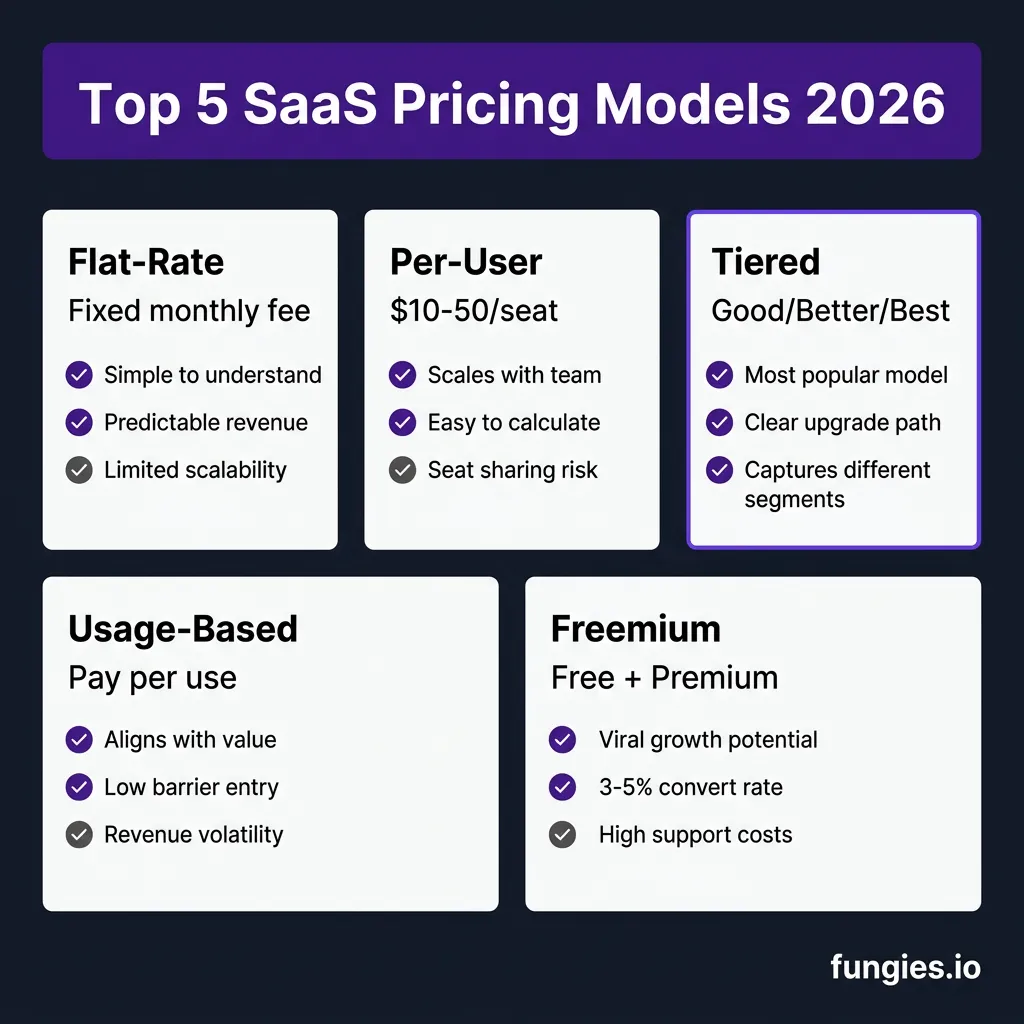
1. Tiered Pricing (Good, Better, Best)
Tiered pricing—often called “Good, Better, Best”—is the most popular SaaS pricing model for a reason. It works. You offer three (sometimes four) distinct plans, each with increasing features and price points. This model captures different customer segments without requiring separate products.
Why it works: The decoy effect is real. When you present three options, most customers gravitate toward the middle tier. It feels like a balanced choice—not too cheap, not too expensive. Companies like Slack, Notion, and Zoom have built empires on this model.
Best for: Products with clear feature differentiation and multiple user personas. If you can easily segment your features into “basic,” “professional,” and “enterprise” buckets, this model is a natural fit.
Real-world example: Notion’s pricing starts with a generous free plan, moves to Plus at $10/seat/month, then Business at $15/seat/month, and finally Enterprise with custom pricing. Each tier adds features that justify the upgrade: more guests, advanced permissions, SAML SSO.
2. Per-User (Seat-Based) Pricing
Per-user pricing charges based on the number of seats or licenses. It’s simple, predictable, and aligns cost with team size. Most B2B SaaS companies use this model because it’s easy for buyers to understand and easy for finance teams to budget.
The catch: Seat sharing. When customers start sharing logins to save money, your revenue growth stalls. According to Maxio’s 2025 report, this is the #1 complaint from SaaS finance teams using per-seat models.
Best for: Collaboration tools where each user gets independent value. Think project management software, CRMs, or design tools like Figma where individual productivity matters.
Pro tip: Consider “active user” pricing instead of total seats. Only charge for users who actually log in during the billing period. It reduces friction and builds goodwill.
3. Usage-Based Pricing (Pay-As-You-Go)
Usage-based pricing (UBP) charges customers based on consumption—API calls, storage used, messages sent, or compute hours. It’s the fastest-growing pricing model in SaaS, with 77% of large software companies now incorporating it into their revenue models.
The appeal: Perfect value alignment. Customers pay for what they use, nothing more. It lowers the barrier to entry (start small, grow big) and captures expansion revenue naturally as customers succeed.
The challenge: Revenue predictability. When usage fluctuates, so does your MRR. Finance teams hate surprises. You’ll need robust metering infrastructure and clear customer communication about usage trends.
Best for: Infrastructure products, AI tools, data processing services, or any product where value scales directly with usage. AWS, Twilio, and OpenAI have proven this model at scale.
4. Freemium Model
Freemium gives users unlimited access to a basic version forever, with premium features behind a paywall. It’s the ultimate top-of-funnel strategy—Slack, Notion, Figma, and Canva all built billion-dollar businesses on freemium.
The brutal math: Freemium converts at 3-5% on average. That means you need 20-33 free users to get one paid customer. The model only works if your free tier has viral mechanics (sharing, collaboration) or if your support costs are near zero.
Conversion benchmarks by industry:
| Industry | Visitor to Freemium | Freemium to Paid |
|---|---|---|
| Communications | 12.4% | 3.8% |
| Cybersecurity | 12.2% | 3.6% |
| Enterprise | 12.2% | 3.8% |
| HR/Talent | 12.8% | 3.3% |
| Average | 12.0% | 3.7% |
Best for: Products with network effects, viral sharing built-in, or low marginal cost to serve free users. If your product gets more valuable as more people use it, freemium is your friend.
5. Flat-Rate Pricing
Flat-rate pricing charges a single fee regardless of usage or users. It’s the simplest model—one price, one plan, take it or leave it. Basecamp famously uses this approach at $299/month for unlimited users.
Why it works: No decision fatigue. Customers don’t need to calculate seats, predict usage, or compare tiers. It’s refreshing in a world of complex pricing pages.
The downside: You’re leaving money on the table. Enterprise customers who would pay $10,000/month get the same deal as startups. And you can’t capture expansion revenue as customers grow.
Best for: Products with a narrow ideal customer profile or strong ideological commitment to simplicity. If you hate sales conversations about pricing, this model eliminates them.
6. Free Trial (Time-Limited)
Free trials give full feature access for a limited time—typically 7, 14, or 30 days. Unlike freemium, trials create urgency. The clock is ticking, and customers know they need to make a decision.
Conversion rates tell the story:
- Opt-in trials (no credit card): 18-25% convert to paid
- Opt-out trials (credit card required): 48-50% convert to paid
- Median trial-to-paid across all SaaS: 34% (down from 50% in 2023)
The trade-off is clear: requiring a credit card reduces signups by 60-70% but triples conversion rates. Most PLG companies now use opt-in trials to maximize top-of-funnel, then rely on product onboarding to drive conversion.
Best for: Products where time-to-value is short. If users can experience your “aha moment” within the trial period, this model works beautifully.
7. Hybrid Pricing (Subscription + Usage)
Hybrid pricing combines a base subscription with usage-based overages. It’s the gold standard for 2026, delivering the predictability of subscriptions with the growth potential of usage-based models.
How it works: Customers pay a flat monthly fee for a base package (say, 1,000 API calls), then pay per unit for additional usage. This gives finance teams predictable baseline revenue while capturing upside from power users.
The data: Hybrid models report the highest median growth rate at 21%, outperforming pure subscription or pure usage-based approaches. Companies using platform or usage-based pricing are more likely to meet growth targets.
Best for: Mature SaaS companies with diverse customer bases. If you have both small startups and large enterprises using your product, hybrid pricing lets you serve both without custom contracts.
8. Per-Feature Pricing (Add-On Model)
Per-feature pricing lets customers build their own plan by selecting specific features or modules. It’s modular, flexible, and captures willingness-to-pay for premium capabilities without forcing customers into higher tiers.
Why it works: Not every customer wants every feature. A startup might need advanced analytics but not SSO. An enterprise might need SSO but not advanced analytics. Per-feature pricing lets each customer optimize their spend.
The complexity: Your billing system becomes a nightmare. Tracking which customer has which features, handling partial month prorations, and preventing feature combinations that break your product—it all adds operational overhead.
Best for: Products with truly modular features that deliver independent value. If your features are more like LEGO blocks than a cohesive product, this model shines.
9. Outcome-Based Pricing
Outcome-based pricing charges customers based on results, not usage or seats. It’s the ultimate alignment of incentives—you only get paid when your customer succeeds.
The pioneer: Intercom Fin charges $0.99 per successful AI resolution. If the AI doesn’t solve the customer’s problem, Intercom doesn’t get paid. It’s bold, customer-friendly, and rapidly becoming the standard for AI-powered tools.
The challenge: You need rock-solid attribution. When a customer achieves an outcome, can you definitively prove your software caused it? If not, you’ll have endless disputes.
Best for: AI tools, automation software, or any product where success is measurable and attributable. If you can clearly connect your software to revenue saved or earned, outcome-based pricing is worth testing.
10. Dynamic/Personalized Pricing
Dynamic pricing uses AI and data to adjust prices based on customer segment, behavior, or willingness-to-pay. It’s controversial but increasingly common, especially for enterprise deals.
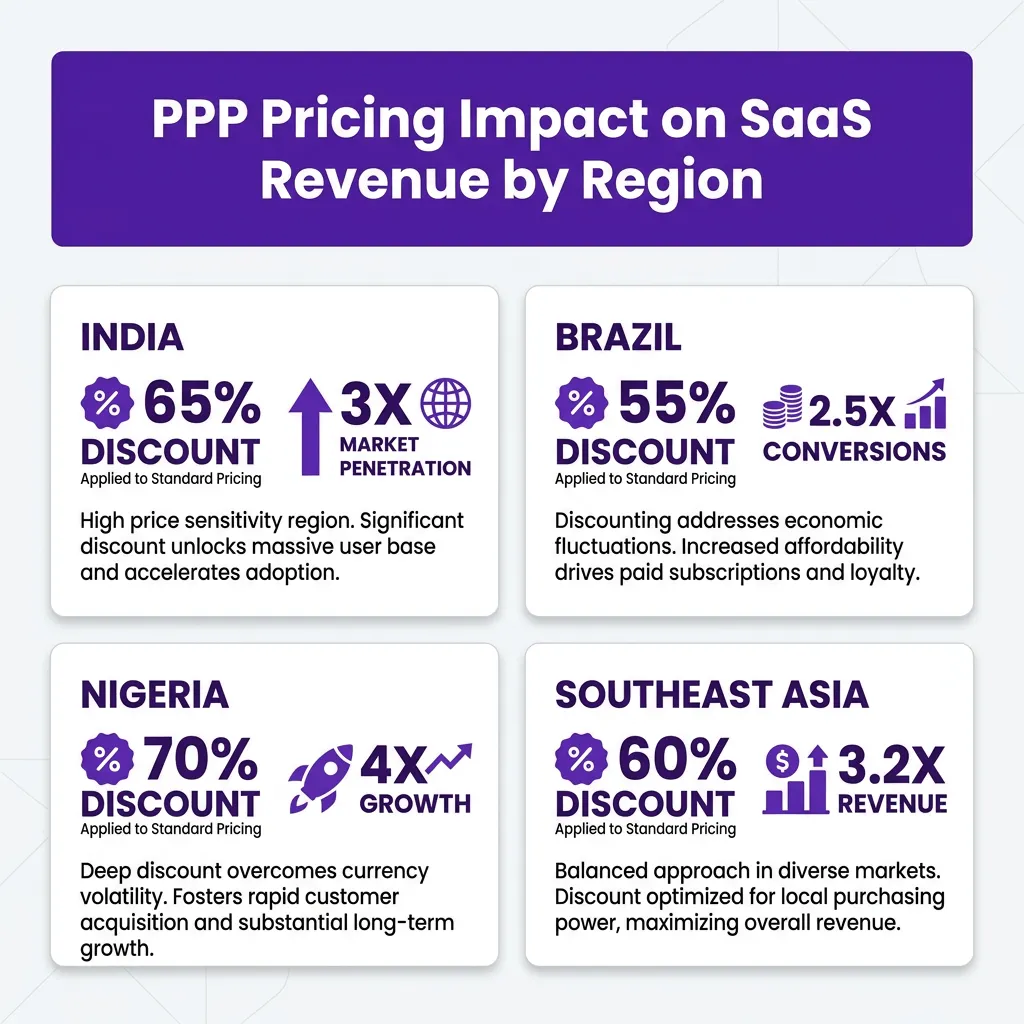
Regional pricing is the most accepted form—increasing global revenue by 25-40% while only reducing average unit price by 15-20%. Customers in different markets have different ability to pay, and smart SaaS companies adjust accordingly.
The risk: If customers discover they’re paying more than peers for the same product, trust evaporates. Transparency and fairness matter. Most SaaS companies using dynamic pricing keep it behind the scenes for enterprise deals only.
Best for: Companies with sophisticated pricing teams and enterprise sales motions. If you’re doing six-figure deals with custom terms anyway, dynamic pricing is just formalizing what you’re already doing.
Comparison: Which Pricing Model Is Right for You?
| Model | Predictability | Growth Potential | Complexity | Best For |
|---|---|---|---|---|
| Tiered | High | Medium | Low | Most B2B SaaS |
| Per-User | High | Medium | Low | Collaboration tools |
| Usage-Based | Low | High | High | Infrastructure/AI |
| Freemium | Low | Very High | Medium | Viral products |
| Flat-Rate | Very High | Low | Very Low | Simple products |
| Free Trial | Medium | Medium | Low | Quick time-to-value |
| Hybrid | High | Very High | High | Mature SaaS |
| Per-Feature | Medium | Medium | Very High | Modular products |
| Outcome-Based | Low | High | High | AI/automation |
| Dynamic | Medium | High | Very High | Enterprise sales |
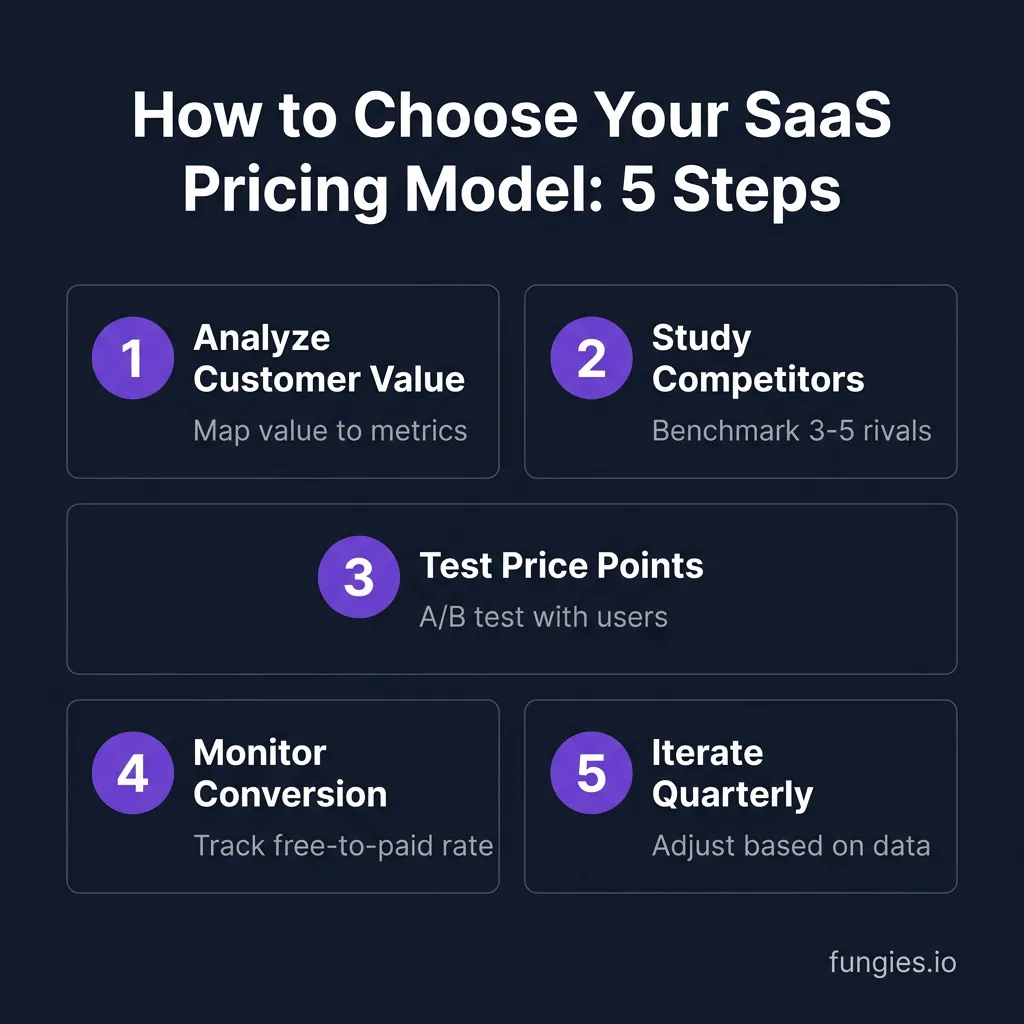
How to Choose Your SaaS Pricing Model: A 5-Step Framework
After analyzing hundreds of SaaS companies, here’s the framework I use to recommend pricing models:
Step 1: Map Value to Metrics
What metric best represents the value your customers get? If it’s “hours saved,” consider outcome-based pricing. If it’s “team members using the tool,” per-user pricing makes sense. If it’s “API calls made,” usage-based is natural.
Step 2: Analyze Your Customer Base
Are your customers homogeneous (similar size, similar needs) or heterogeneous? Homogeneous customers favor flat-rate or simple tiered pricing. Heterogeneous customers need more flexibility—hybrid or per-feature models.
Step 3: Benchmark Competitors
Don’t be different just to be different. If every competitor uses per-user pricing, there’s probably a reason. Customers have mental models for how your category should be priced. Violate them at your peril—unless you have a very good reason.
Step 4: Test Before You Commit
Run pricing experiments with new signups. A/B test different models if you can. Measure not just conversion rates, but 12-month revenue per customer. A model with lower conversion but higher expansion revenue might be the winner.
Step 5: Plan for Evolution
Your pricing model should change as your product and market mature. Early-stage startups often start with simple tiered pricing, then add usage-based components as they scale. Don’t paint yourself into a corner with a model you can’t evolve.
Common SaaS Pricing Mistakes to Avoid
I’ve audited dozens of SaaS pricing pages. Here are the mistakes I see over and over:
- Underpricing: Most founders charge too little. If you’re not getting pushback on price, you’re too cheap.
- Too many tiers: Three tiers is the sweet spot. More than four creates decision paralysis.
- Hidden pricing: “Contact sales” for pricing kills conversion for self-serve customers. Be transparent.
- Ignoring expansion revenue: Your pricing should make it easy for customers to spend more as they grow.
- Set-and-forget: Pricing isn’t a one-time decision. Review quarterly, adjust annually.
FAQ: SaaS Pricing Models
What is the most popular SaaS pricing model?
Tiered pricing (Good, Better, Best) is the most popular model, used by the majority of B2B SaaS companies. It balances simplicity with the ability to capture different customer segments. According to ChartMogul, 57% of SaaS companies use free trials, while freemium is used by about 28%.
What is a good free-to-paid conversion rate?
For freemium models, 3-5% is considered good and 8-12% is great. For free trials, opt-in trials convert at 18-25% (good) to 25-35% (great), while opt-out trials with credit cards convert at 48-50%. These benchmarks vary significantly by industry and product complexity.
Should I use freemium or free trial?
Choose freemium if your product has viral mechanics, low marginal costs, and a long sales cycle. Choose free trials if you have a short time-to-value, higher price points, and want faster monetization. Many successful companies now use hybrid approaches—freemium for acquisition, trials for premium features.
How often should I change my SaaS pricing?
Review pricing quarterly, test changes with new customers monthly, and make major pricing updates annually. The best SaaS companies treat pricing as a continuous optimization problem, not a one-time decision. However, avoid changing prices too frequently—customer trust depends on predictability.
What is usage-based pricing best for?
Usage-based pricing works best when value scales directly with consumption—infrastructure services, AI tools, data processing, or API-based products. It’s less suitable for products where usage doesn’t correlate with value, like project management or HR software.
Conclusion: Your Pricing Is a Growth Lever
Pricing isn’t just about covering costs—it’s about capturing value, segmenting your market, and building a sustainable business. The right SaaS pricing model aligns your incentives with your customers’, makes expansion revenue natural, and creates predictable growth.
Don’t make the mistake of spending just 11.5 hours on this decision. Invest time in understanding your customers’ willingness to pay, testing different models, and optimizing based on data. Your future self—and your revenue—will thank you.
Ready to start monetizing your digital products? Create your free Fungies account and launch your SaaS billing in minutes, not months. With support for tiered, usage-based, and hybrid pricing models, Fungies gives you the flexibility to evolve your pricing as you grow.
Sources
- SaaSfactor – The 2025 SaaS Pricing Playbook
- SBI Growth – 2025 State of SaaS Pricing Report
- ChartMogul – The SaaS Conversion Report 2026
- First Page Sage – SaaS Freemium Conversion Rates 2026
- Metronome – State of Usage-Based Pricing 2025
- Maxio – 2025 SaaS Pricing Trends Report
- Artisan Strategies – SaaS Conversion Rate Benchmarks 2026