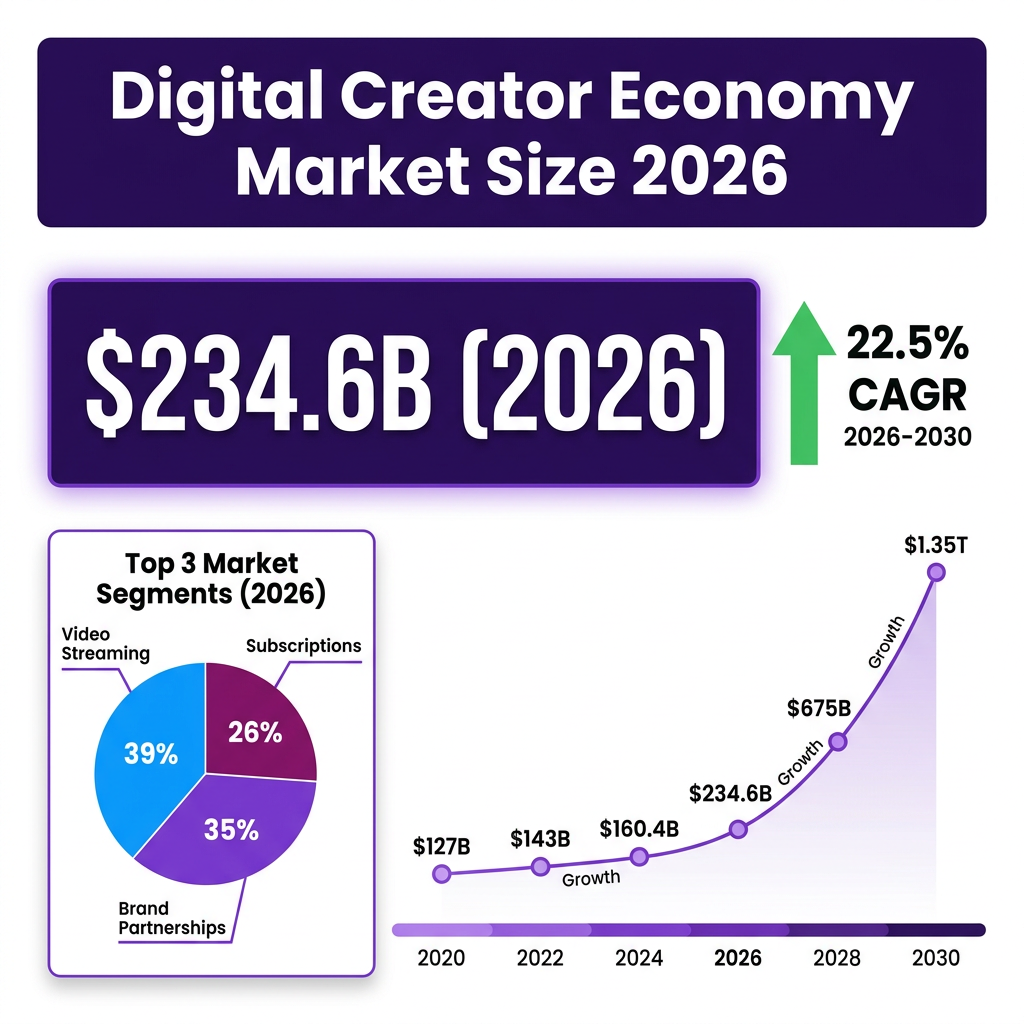
The creator economy has evolved from a digital side hustle into a legitimate global industry worth $234.65 billion in 2026. With over 207 million active creators worldwide and influencer marketing spend exceeding $32 billion this year, the space has fundamentally outgrown its experimental origins. Yet beneath the impressive headline numbers lies a stark reality: only 4% of creators earn more than $100,000 annually, while 50% make less than $15,000 per year.
This comprehensive analysis examines the digital creator economy in 2026—exploring market size, revenue distribution, platform dynamics, emerging trends, and the infrastructure enabling creators to build sustainable businesses. Whether you’re an aspiring creator, a brand looking to invest in creator partnerships, or an entrepreneur building tools for this ecosystem, understanding these dynamics is essential for navigating one of the fastest-growing sectors of the digital economy.

Market Overview: The $234.6 Billion Creator Economy
The digital creator economy represents one of the most significant shifts in how content is produced, distributed, and monetized in the modern era. What began as a niche phenomenon of bloggers and early YouTube personalities has transformed into a sophisticated global marketplace encompassing video streaming, live streaming, podcasting, newsletters, social media content, and digital commerce.
According to Research Nester’s comprehensive market analysis, the creator economy market was valued at $178.4 billion in 2025 and is projected to exceed $1.35 trillion by 2035, expanding at a compound annual growth rate (CAGR) of 22.4% between 2026 and 2035. This trajectory positions the creator economy as one of the fastest-growing sectors in the global digital landscape, outpacing many traditional media and entertainment categories.
Goldman Sachs Research offers a more conservative but equally impressive projection, estimating the creator economy’s total addressable market could reach approximately $480 billion by 2027—roughly doubling from its current size. This forecast reflects the sector’s maturation from experimental marketing channel to established industry infrastructure.
The growth drivers behind these numbers are multifaceted. The widespread penetration of internet connectivity and smartphones globally has democratized content creation, enabling individuals from diverse geographic and socioeconomic backgrounds to build audiences. Platform innovation has created increasingly sophisticated monetization tools—from YouTube’s Partner Program to TikTok’s Creativity Program Beta, Instagram’s monetization features, and emerging platforms like Substack and Patreon that enable direct creator-audience relationships.
Regional distribution of creator economy value reveals interesting patterns. The United States remains the largest single market, with creator ad spend projected at $43.9 billion in 2026, representing a significant increase from $37.1 billion in 2025—a 26% year-over-year growth rate. This concentration reflects both the maturity of the U.S. digital advertising ecosystem and the higher monetization rates available to creators producing English-language content for American audiences.
However, the creator economy is increasingly global in nature. Indian creators producing English-language finance content can access U.S. audiences and earn at American rate levels. Southeast Asian creators on TikTok and YouTube are building massive followings that attract international brand partnerships. European creators are leveraging GDPR-compliant platforms to build sustainable businesses with stronger privacy protections.
The market segmentation within the creator economy reveals where value is being captured. Video streaming platforms command the largest share at approximately 39% of total creator economy revenue, driven primarily by YouTube’s dominant position. Brand partnerships and influencer marketing represent roughly 35% of the market, while subscriptions, fan contributions, and direct commerce account for the remaining 26%.
Key Statistics and Data: Understanding the Creator Landscape
The creator economy’s headline numbers tell only part of the story. A deeper examination of the statistical landscape reveals both the opportunities and challenges facing participants in this ecosystem. Understanding these metrics is crucial for creators building sustainable businesses and brands seeking effective partnership strategies.
Creator Population and Distribution
The global creator population has reached unprecedented scale. According to comprehensive industry research, there are now over 207 million active creators worldwide—a figure that encompasses everyone from casual hobbyists to full-time professionals. Of this total, approximately 50 million people consider themselves professional creators who derive meaningful income from their content activities.
Platform-specific creator populations reveal concentration patterns. YouTube hosts approximately 61.8 million creators, making it the largest dedicated creator platform by participant count. TikTok has rapidly grown its creator base, though exact figures remain closely held by ByteDance. Instagram’s creator ecosystem spans hundreds of millions of accounts, though only a subset actively monetizes. Emerging platforms like Substack have reached over 20 million monthly active subscribers with more than 17,000 paid creators—representing a 100%+ increase from 2024.
Follower distribution among creators follows a predictable pyramid structure. Research indicates that 40% of creators have between 1,000 and 10,000 followers—the micro-influencer tier that brands increasingly target for authentic engagement. Breaking through the micro-influencer ceiling remains one of the biggest challenges in the 2026 creator economy, with the jump from 10,000 to 100,000 followers requiring significant strategic shifts.
Income Distribution: The Stark Reality
Perhaps no aspect of the creator economy generates more discussion than income distribution. The sector exhibits extreme inequality, with a small percentage of top creators capturing disproportionate earnings while the majority struggle to generate meaningful revenue.
According to 2026 industry data, the income breakdown reveals a challenging landscape:
- 50% of creators earn under $15,000 annually—often less than minimum wage when accounting for hours invested
- Only 4% surpass $100,000 in yearly earnings
- 73% earn below $30,000 annually
- The top 10% of creators received 62% of ad payments in 2025—up from 53% in 2023, indicating accelerating income concentration
Median creator earnings actually declined from $3,500 to $3,000 between recent measurement periods, even as total market value increased. This divergence—growing total value with declining median earnings—suggests that platform algorithm changes and increased competition are making it harder for new creators to establish sustainable income.
Platform-specific earnings data reveals significant variation. Instagram creators average approximately $81,700 annually, compared to $44,250 on TikTok and $25,600 on Twitch. YouTube maintains the highest median earnings for full-time creators at $141,000 annually, reflecting the platform’s mature monetization infrastructure through AdSense, memberships, and Super Chat features.
The path to monetization remains lengthy for most creators. On average, creators wait 6.5 months to earn their first dollar and 24+ months to secure their first brand partnership. This extended runway requires significant patience and resource investment, explaining why many aspiring creators abandon their efforts before achieving financial sustainability.
Revenue Stream Diversification
Successful creators increasingly rely on multiple revenue streams rather than depending on any single source. Research demonstrates that creators with three or more revenue streams earned $75,000 more on average than those relying on a single source in 2025.
The primary revenue categories break down as follows:
- Brand partnerships and sponsorships: 68.8% of creators cite this as their primary income stream, though dependency is declining as other monetization methods mature
- Platform advertising revenue: Only 34% earn primary income from platform ads, with YouTube being the most significant contributor
- Affiliate marketing: Growing category, particularly for product review and lifestyle creators
- Subscriptions and fan contributions: Platforms like Patreon, Substack, and OnlyFans enable direct audience support
- Digital products and courses: Increasingly popular among educational and expertise-based creators
- Merchandise and physical products: Top creators like MrBeast generate significant revenue through branded merchandise
YouTube’s revenue disclosure in 2025 revealed the platform generated over $60 billion in total revenue—surpassing Netflix by 33% and demonstrating the massive scale of video content monetization. This figure includes advertising, subscriptions, and other revenue streams shared with or generated by creators.
Major Trends Shaping the Creator Economy in 2026
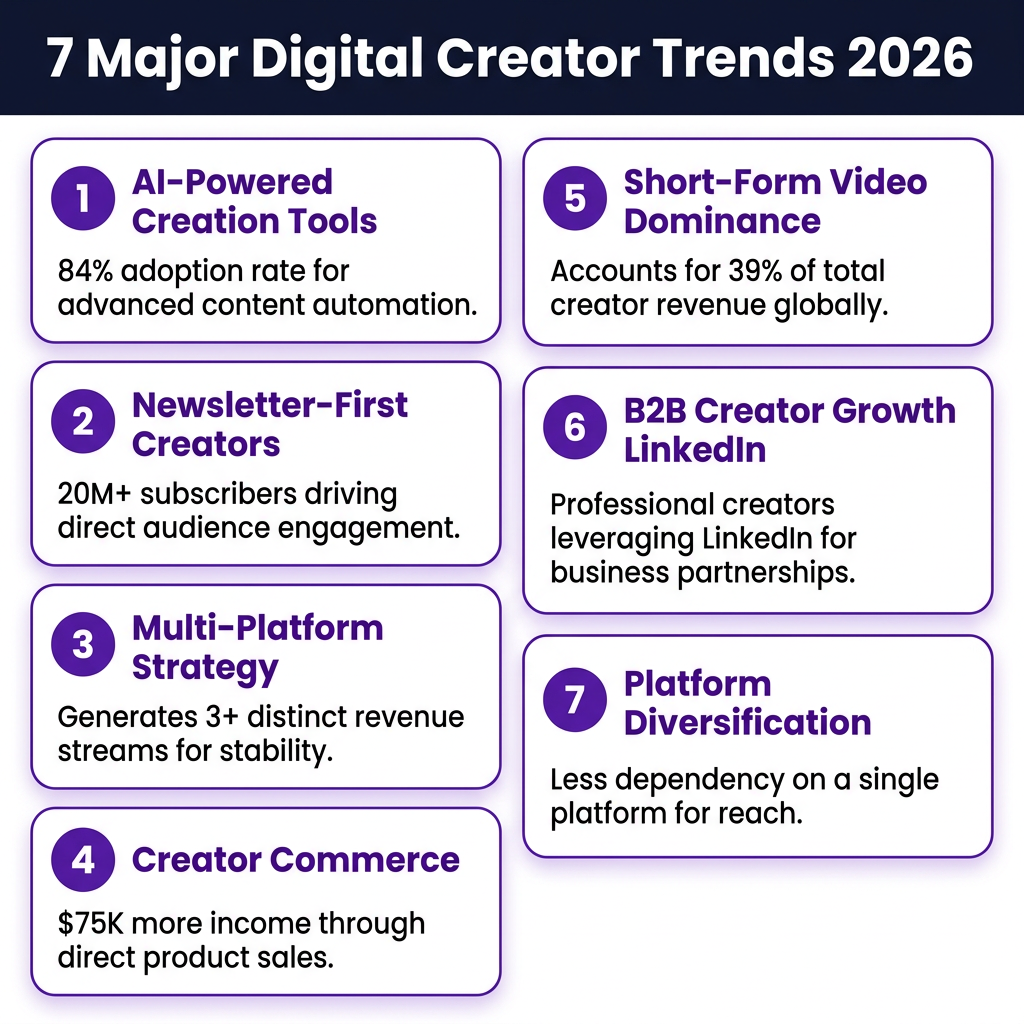
The creator economy continues evolving at a rapid pace, with 2026 marking a significant inflection point in how creators build audiences, monetize content, and structure their businesses. Seven major trends are defining the landscape this year:
1. AI-Powered Creation Tools: 84% Creator Adoption
Artificial intelligence has become deeply embedded in creator workflows. According to Adobe’s 2025 survey of over 16,000 creators, 86% already use generative AI tools in their content production processes. Other industry research confirms this trend, with Archive’s 2026 Creator Economy Platform Growth Report finding 84% of creators leveraging AI-powered tools in their daily workflows.
The applications span the entire content creation pipeline. CapCut, ByteDance’s AI-powered editing platform, remains the dominant tool for short-form video creators in 2026. Generative AI assists with scriptwriting, thumbnail generation, title optimization, and content repurposing. Tools like Spotter Studio provide YouTube research and ideation capabilities with trend analysis and outlier video detection.
This widespread AI adoption is creating a new divide between creators who effectively leverage these tools and those who don’t. AI-native creators can produce more content, test more variations, and optimize performance faster than competitors relying on traditional workflows.
2. Newsletter-First Creators and Audience Ownership
A significant strategic shift is underway as creators prioritize platforms they control over rented social media real estate. Substack’s growth to over 20 million monthly active subscribers and 17,000 paid creators—more than double 2024 levels—signals this transition.
Unlike social media platforms where algorithm changes can decimate reach overnight, newsletters provide direct access to audience inboxes. This ownership model insulates creators from platform volatility while enabling deeper audience relationships and more predictable revenue through subscriptions.
The “newsletter-first creator” movement represents a maturation of creator business strategy. Rather than treating newsletters as supplementary to social media, these creators build their entire business around owned audience relationships, using social platforms primarily for discovery rather than dependence.
3. Multi-Platform Strategy as Default
Platform dependency has proven risky for creators who built entire businesses on single platforms. Algorithm changes, policy updates, and account bans have destroyed livelihoods overnight. In response, successful creators now maintain presence across multiple platforms as a risk management strategy.
The data supports this approach. Creators with diversified platform presence show greater income stability and higher overall earnings. The most effective strategy involves building YouTube presence for stable ad revenue, using TikTok and Instagram for audience growth and discovery, pursuing sponsorships across platforms, and creating digital products for passive income.
This multi-platform approach requires significant additional effort—each platform has unique content formats, audience expectations, and optimization requirements. However, the risk mitigation benefits justify the investment for creators building long-term sustainable businesses.
4. Creator Commerce and Product Businesses
Creators are increasingly transitioning from content producers to business owners, launching products, services, and brands that leverage their audience relationships. MrBeast’s creator business exemplifies this trend—generating an estimated $700 million in 2025 revenue through YouTube, merchandise, Feastables (his snack brand), and brand partnerships.
Platforms like Stan Store and Fourthwall have emerged to support creator commerce, enabling direct sales of digital products, merchandise, and services without requiring technical expertise. These tools reduce friction between audience engagement and commercial transactions.
The creator commerce trend reflects a broader shift from attention-based monetization (advertising) to relationship-based commerce (products and services). Creators with strong audience trust can generate higher margins and more sustainable revenue through owned products than through platform-dependent advertising.
5. Short-Form Video Dominance
Short-form video content continues capturing disproportionate audience attention and platform investment. Video streaming holds 39% of creator economy revenue, with short-form formats (TikTok, Instagram Reels, YouTube Shorts) driving significant growth.
However, this dominance creates content capture challenges for brands. Stories and Reels that disappear within 24 hours represent some of the most authentic creator partnerships, yet brands without automated detection systems miss this ephemeral content. This has created demand for creator marketing platforms that can track and archive disappearing content.
Platforms are responding to short-form dominance with new monetization features. YouTube’s expansion of Shorts monetization, TikTok’s Creativity Program Beta, and Instagram’s various creator bonuses reflect platform competition for short-form creator talent.
6. B2B Creator Growth on LinkedIn
While consumer-facing creators have dominated headlines, a significant B2B creator economy has emerged on LinkedIn. Professional expertise creators—covering topics like finance, technology, marketing, and leadership—have built substantial followings and monetization opportunities.
LinkedIn’s 2025 breakout as a creator platform continued into 2026, with the platform launching creator monetization features and brand partnership facilitation tools. The professional context enables higher-value B2B sponsorships compared to consumer platforms, with corporate training, software, and services companies seeking expert creators for thought leadership partnerships.
Finance creator content monetization particularly benefits from premium brand partnership CPMs, newsletter subscription income, and online course revenue that are entirely independent of social media platform algorithm performance.
7. Platform Diversification and Reduced Dependency
The final major trend reflects creators’ learned caution about platform dependency. The 68.8% of creators who previously cited brand deals as their primary income stream is declining as more creators move into subscriptions, affiliate marketing, and owned products. This represents a strategic shift from platform-dependent to creator-controlled revenue.
Building owned infrastructure—newsletters, websites, digital products, and direct audience relationships—has become a priority for creators seeking long-term sustainability. The platforms that succeed in 2026 and beyond will be those that enable rather than restrict creator independence.
Key Players and Competitive Landscape
The creator economy infrastructure spans platforms, tools, and services that enable creators to produce, distribute, and monetize content. Understanding the competitive landscape helps identify where value is being captured and where opportunities exist for new entrants.

Major Platforms
YouTube remains the dominant creator platform by revenue, generating over $60 billion in 2025. Its mature Partner Program, multiple monetization formats (ads, memberships, Super Chat, Shorts), and global reach make it the foundation of most successful creator businesses. YouTube’s median full-time creator earnings of $141,000 annually significantly exceed other platforms.
TikTok has grown rapidly to become the second major short-form platform, though monetization per creator remains lower than YouTube. The Creativity Program Beta and live gifting features provide revenue opportunities, but most TikTok creators rely heavily on brand partnerships for meaningful income.
Instagram maintains strong creator engagement, particularly for lifestyle, fashion, and beauty content. The platform’s shopping features, Reels monetization, and brand collaboration tools support diverse revenue streams. Instagram creators average $81,700 annually—the second-highest platform average after YouTube.
Substack has emerged as the leading newsletter platform, with over 20 million monthly active subscribers and 17,000 paid creators. Its subscription-first model enables direct creator-audience relationships without algorithm intermediation.
Patreon continues serving creators seeking fan-supported income, with over 20 million monthly active subscribers. The platform enables recurring revenue from dedicated fans willing to pay for exclusive content and community access.
Emerging Infrastructure Players
Beehiiv has grown rapidly as a newsletter infrastructure platform, competing with Substack by offering more creator control and lower fees. The platform’s growth reflects the broader newsletter-first creator trend.
Stan Store and Fourthwall provide creator commerce infrastructure, enabling direct sales of digital products, merchandise, and services. These platforms reduce technical barriers to creator entrepreneurship.
Spotter offers YouTube research and ideation tools with trend analysis, title/thumbnail testing, and outlier video detection. These AI-powered tools help creators optimize content for platform algorithms.
CapCut, ByteDance’s editing platform, dominates short-form video creation with AI-powered editing features that reduce production time and improve content quality.
Brand and Agency Ecosystem
The creator economy has spawned a sophisticated agency and brand services ecosystem. Influencer marketing agencies, talent management firms, and creator marketing platforms have consolidated to provide end-to-end services for both creators and brands.
Companies like CreatorIQ provide enterprise creator marketing platforms that help brands discover, manage, and measure creator partnerships at scale. These platforms have become essential infrastructure for competitive consumer brands.
The convergence of brand agencies with talent management and data platforms reflects the maturation of creator marketing from experimental channel to systemized, always-on programs. AI is moving from a feature to an operating layer within these consolidated platforms.
Challenges and Pain Points
Despite impressive growth statistics, the creator economy faces significant challenges that impact both individual creators and the ecosystem’s long-term sustainability. Understanding these pain points is essential for anyone entering or investing in this space.
1. Income Inequality and Sustainability
The most significant challenge facing the creator economy is extreme income inequality. With 50% of creators earning under $15,000 annually and only 4% surpassing $100,000, the sector resembles a winner-take-all market more than a sustainable career path for most participants.
This inequality has worsened over time. The top 10% of creators received 62% of ad payments in 2025—up from 53% in 2023—while median creator earnings declined from $3,500 to $3,000. As platforms mature and competition increases, breaking into the top tier becomes increasingly difficult.
The 6.5-month average time to first dollar and 24+ months to first brand partnership create significant barriers to entry. Creators without financial runway or alternative income sources often abandon their efforts before achieving sustainability.
2. Platform Dependency and Algorithm Volatility
Platform algorithm changes represent the top barrier to business growth for creators worldwide, cited by 18% of respondents in a July 2025 CreatorIQ survey—just 1 point ahead of lack of consistent brand deals. A single algorithm update can reduce creator reach and revenue by 50% or more overnight.
This dependency creates fundamental business risk. Creators building on “rented” platform real estate face constant uncertainty about whether their audience will continue seeing their content. Platform policy changes, account bans, and demonetization decisions can destroy businesses built over years.
The challenge is particularly acute for creators dependent on a single platform. Those who haven’t diversified their presence and revenue streams face existential risk from platform decisions entirely outside their control.
3. Creator Burnout and Mental Health
Creator burnout has emerged as a significant issue affecting the industry’s sustainability. The pressure to maintain consistent content production, engage with audiences across multiple platforms, and constantly adapt to algorithm changes creates unique stressors.
Unlike traditional employment, creators face constant public feedback—both positive and negative—that impacts mental health. The boundary between personal and professional life often blurs, with audiences expecting authentic access to creators’ personal experiences.
The financial uncertainty compounds these pressures. Income volatility, payment delays from platforms and brands, and the constant need to secure new partnerships create anxiety that affects creator wellbeing and content quality.
Opportunities and Growth Strategies
Despite significant challenges, the creator economy offers substantial opportunities for creators, brands, and infrastructure providers who approach the market strategically. Three major opportunity areas stand out in 2026:
1. AI-Native Creator Tools and Automation
With 84-86% of creators already using AI tools, the market for AI-native creator infrastructure is massive and growing. Opportunities exist across the entire creation pipeline—from research and ideation to production, optimization, and monetization.
Specific opportunity areas include:
- AI-powered content repurposing: Tools that automatically adapt long-form content for multiple platforms and formats
- Predictive analytics: AI systems that forecast content performance and optimize publishing schedules
- Automated brand matching: Platforms that use AI to connect creators with relevant brand partnerships
- Voice and avatar cloning: Technologies that enable creators to scale content production without proportional time investment
The creators and companies that most effectively leverage AI will gain significant competitive advantages in content quality, production volume, and audience growth.
2. Creator Commerce and Direct Monetization
The shift from attention-based to relationship-based monetization creates opportunities for creators to build higher-margin, more sustainable businesses. Creators with three or more revenue streams earn $75,000 more annually than single-stream creators—demonstrating the value of diversification.
Key opportunities include:
- Digital products: Courses, templates, and tools that leverage creator expertise
- Subscription communities: Paid access to exclusive content and community interaction
- Physical product brands: Merchandise and product lines that extend creator brands
- Services and consulting: B2B offerings that monetize creator expertise
Platforms enabling creator commerce—like Stan Store and Fourthwall—are well-positioned to capture value from this trend by reducing friction between audience relationships and commercial transactions.
3. Niche and B2B Creator Categories
While consumer entertainment creators face intense competition, significant opportunities exist in underserved niches and B2B categories. Finance, technology, healthcare, and professional services creators can command premium rates due to audience value and limited competition.
The B2B creator economy on LinkedIn exemplifies this opportunity. Professional expertise creators benefit from:
- Higher brand partnership CPMs due to valuable professional audiences
- Corporate training and consulting opportunities
- Software and service company sponsorships
- Newsletter subscription income from professionals seeking career advancement
Creators entering these niches face less competition and higher monetization potential than those pursuing saturated consumer entertainment categories.
Case Studies and Success Stories
Examining specific creator success stories reveals the strategies and approaches that work in the current ecosystem. These cases demonstrate different paths to sustainable creator businesses.
Case Study 1: MrBeast — The Product Empire Model
Jimmy Donaldson, known as MrBeast, represents the pinnacle of creator business evolution. His creator business generated an estimated $700 million in 2025 revenue through a diversified portfolio spanning YouTube content, merchandise, Feastables (his snack brand), and brand partnerships.
The MrBeast model demonstrates how top creators can evolve from content producers to product entrepreneurs. Rather than depending solely on platform advertising and sponsorships, Donaldson built owned product businesses that leverage his audience relationships for distribution.
Key success factors include:
- Massive audience scale enabling efficient product launch distribution
- Reinvestment of content revenue into higher-production-value content
- Strategic brand partnerships that align with audience interests
- Team infrastructure that enables scaled content production
While few creators can replicate MrBeast’s scale, his approach—building owned products and businesses rather than depending solely on platform revenue—provides a template for creator business sustainability.
Case Study 2: Newsletter-First Creators on Substack
The emergence of newsletter-first creators on Substack represents a strategic alternative to platform-dependent creator businesses. These creators prioritize owned audience relationships over social media reach, building sustainable subscription businesses.
With Substack reaching over 20 million monthly active subscribers and 17,000 paid creators—more than double 2024 levels—the model has proven viable at scale. Top newsletter creators earn six and seven figures annually from subscription revenue alone, independent of platform algorithm changes.
Success factors for newsletter-first creators include:
- Deep expertise in specific topics that audiences will pay to access
- Consistent publishing schedules that build reader habits
- Community features that create subscriber belonging
- Strategic use of social media for discovery rather than dependence
This model demonstrates how creators can build sustainable businesses by prioritizing audience ownership over platform optimization.
Case Study 3: B2B Finance Creators
Finance creators on LinkedIn and YouTube represent a growing category of B2B-focused content entrepreneurs. These creators leverage professional expertise to build audiences of high-value decision-makers, enabling premium monetization opportunities.
Key characteristics of successful B2B finance creators include:
- Professional credentials and demonstrated expertise
- Content that provides actionable business value
- Multi-platform presence spanning LinkedIn, YouTube, and newsletters
- Diversified revenue including sponsorships, courses, consulting, and subscriptions
The B2B creator model demonstrates how expertise-based content can generate higher monetization rates than entertainment-focused content, particularly when targeting professional audiences with business purchasing power.
Future Outlook and Predictions
The creator economy’s trajectory points toward continued growth, consolidation, and professionalization. Several predictions for 2027-2030 emerge from current trends and market dynamics:
Market Size Projections
Industry analysts project the creator economy will reach between $480 billion and $600 billion by 2030, representing a continuation of the 22-27% annual growth rates observed in recent years. Goldman Sachs Research forecasts $480 billion by 2027, while other projections suggest $600 billion or higher by 2030.
The most aggressive long-term projection from Research Nester suggests the market could exceed $1.35 trillion by 2035, though this assumes sustained high growth rates over an extended period.
Platform Consolidation and Maturation
The creator economy is entering what Forbes describes as “the era of consolidation.” Independent creators, boutique managers, influencer agencies, and software vendors that grew in parallel are now coordinating into unified systems.
Leading creators now function like multi-platform media brands, with professional teams, diversified revenue streams, and sophisticated business operations. This professionalization will accelerate as the market matures.
Platform feature convergence is also underway. As Axios notes, creator platforms are in their “copycat era”—with Patreon, Beehiiv, OnlyFans, and Substack increasingly offering similar features as they compete for creator talent.
AI Integration Acceleration
With 84-86% of creators already using AI tools, integration will deepen significantly by 2030. Predictions suggest that by 2030, every creator will essentially operate as a “SaaS business with a personality”—using AI to identify their most valuable fans and offer personalized products and experiences.
The rapid development of AI has already introduced a new wave of faceless creators and automated social accounts, further increasing the size and value of the creator economy while changing the nature of content production.
Regulatory Evolution
As the creator economy matures, regulatory attention will increase. Issues including creator classification (employee vs. independent contractor), platform payment transparency, and advertising disclosure requirements will likely see increased regulation.
The European Union’s Digital Services Act and similar regulations globally will shape how platforms operate and how creators build businesses. Compliance requirements may favor established creators with resources to navigate regulatory complexity.
Key Takeaways
- Massive scale, extreme inequality: The $234.6 billion creator economy supports 207 million creators, but only 4% earn more than $100,000 annually while 50% make under $15,000.
- Diversification is essential: Creators with three or more revenue streams earn $75,000 more on average than those relying on single sources.
- AI is transforming creation: 84-86% of creators now use AI tools, creating competitive advantages for those who leverage these technologies effectively.
- Audience ownership matters: Newsletter-first creators and those building owned infrastructure are insulating themselves from platform risk.
- B2B opportunities are growing: Professional expertise creators on LinkedIn and other platforms command premium rates with less competition than consumer entertainment categories.
Sources and Citations
- Research Nester — Creator Economy Market Size & Share | Forecast Report 2026-2035: https://www.researchnester.com/reports/creator-economy-market/5691
- Archive — 25 Creator Economy Market Size Statistics Every Brand Should Track in 2026: https://archive.com/blog/creator-economy-market-size
- Companies History — Creator Economy Statistics And Market Size 2026: https://www.companieshistory.com/creator-economy-market-size/
- SQ Magazine — Creator Economy Statistics 2026: Market Size & Earnings: https://sqmagazine.co.uk/creator-economy-statistics/
- Behind the Scenes — State of the Creator Economy 2026: Trends, Stats & What’s Next: https://behindthescenes.com/blogs/state-of-the-creator-economy-2026-trends-stats-what-s-next
- Influencer Marketing Factory — Best Creator Platforms in 2026: https://theinfluencermarketingfactory.com/best-creator-platforms-2026/
- LinkedIn — 2026 Creator Economy Predictions & Trends: https://www.linkedin.com/pulse/creator-economy-key-trends-from-2025-predictions-2026-lindsey-gamble-2hk2e
- Los Angeles Times — The Creator Economy in Los Angeles, 2026: A New Frontier: https://www.latimes.com/b2b/entertainment/story/2026-03-22/los-angeles-creator-economy-2026-trends
- Stan Store — 8 Trends That Will Define the Creator Economy in 2026: https://stan.store/blog/creator-economy-trends-2026/
- DemandSage — 41+ Creator Economy Statistics 2026: https://www.demandsage.com/creator-economy-statistics/
- EMARKETER — For creators, the biggest threat to business growth isn’t burnout: https://www.emarketer.com/content/creators–biggest-threat-business-growth-isn-t-burnout
- Forbes — The Creator Economy In 2026: The Era Of Consolidation: https://www.forbes.com/sites/jasondavis/2026/01/26/the-creator-economy-in-2026—the-era-of-consolidation/
- Creator Economy Tools — Creator Economy Startups 2026: https://creatoreconomytools.com/creator-economy-startups
- Stormy AI — The 2030 Creator Economy: From Influencers to Decentralized: https://stormy.ai/blog/future-of-creator-economy-2030
- Yahoo Finance — Creator Economy to Reach $600B by 2030: https://finance.yahoo.com/news/creator-economy-reach-600b-2030-120000221.html
Regional Analysis: Creator Economy by Geography
The creator economy’s growth is not evenly distributed globally. Regional variations in platform access, monetization rates, and creator population density create distinct market dynamics across different geographies.
North America: The Mature Market
North America, particularly the United States, represents the most mature creator economy market. With creator ad spend projected at $43.9 billion in 2026, the region commands the highest monetization rates globally. English-language content created for U.S. audiences benefits from the world’s largest digital advertising market and highest CPM rates.
The U.S. creator ecosystem is characterized by sophisticated infrastructure, including established talent agencies, brand partnership platforms, and creator tools. Major platforms including YouTube, Instagram, and TikTok prioritize the U.S. market for new feature rollouts and monetization programs.
However, market maturity also means increased competition. New creators face higher barriers to entry as established creators with large audiences dominate attention and brand partnership opportunities. The path to sustainability requires either exceptional content quality, unique niche positioning, or significant investment in growth.
Europe: Regulatory Leadership and Privacy-First Creation
European creator economy development has been shaped by the General Data Protection Regulation (GDPR) and emerging platform regulations. While these regulations create compliance burdens, they also position European creators as leaders in privacy-respecting content practices.
The European market benefits from high internet penetration, strong creative industries, and diverse language markets that enable niche content creation. Creators in smaller language markets (Dutch, Swedish, Polish) often face less competition than English-language creators while still accessing significant audiences.
European Union regulations including the Digital Services Act are shaping platform behavior globally. Creators operating in EU markets must navigate increasingly complex compliance requirements, but these regulations also provide protections against arbitrary platform decisions.
Asia-Pacific: Scale and Growth
The Asia-Pacific region represents both the largest creator population and the fastest-growing creator economy segment. India alone has millions of active creators, with English-language Indian creators increasingly accessing global audiences and monetization opportunities.
Southeast Asian markets including Indonesia, Thailand, and Vietnam have seen explosive creator economy growth driven by mobile-first internet adoption and platform investment. TikTok and YouTube have prioritized these markets for creator program expansion.
China’s creator economy operates largely independently of global platforms due to the country’s distinct digital ecosystem. Chinese creators on platforms like Douyin and Bilibili have developed sophisticated monetization models that occasionally influence global platform strategies.
Latin America and Emerging Markets
Latin American creator economy growth has accelerated as platform monetization features expand to the region. Brazil and Mexico represent the largest markets, with Portuguese and Spanish-language content accessing significant global audiences.
African and Middle Eastern creator economies remain in earlier development stages but show significant growth potential. Mobile internet expansion, platform investment, and increasing brand interest in these markets are creating new opportunities for local creators.
Creators in emerging markets often face challenges including limited local brand partnership opportunities, lower advertising CPMs, and currency volatility. However, those who successfully access global audiences can achieve monetization levels significantly above local market rates.
Platform-Specific Monetization Strategies
Each major creator platform has distinct monetization mechanisms, audience dynamics, and content requirements. Successful creators develop platform-specific strategies rather than applying one-size-fits-all approaches.
YouTube: The Foundation Platform
YouTube remains the foundation of most successful creator businesses due to its mature monetization infrastructure and predictable revenue. The platform’s Partner Program enables advertising revenue sharing, while additional features including channel memberships, Super Chat, and Super Stickers provide diversified income streams.
Long-form content on YouTube generates the highest per-view revenue due to premium advertising placement and viewer engagement. Creators focusing on evergreen content—tutorials, educational content, and entertainment with long shelf lives—benefit from continued revenue generation months or years after publication.
YouTube Shorts monetization has expanded significantly, though per-view revenue remains lower than long-form content. Successful creators use Shorts for audience growth and discovery while directing viewers to long-form content for monetization.
TikTok: Discovery and Virality
TikTok’s algorithm prioritizes content discovery over creator following, enabling rapid audience growth for new creators. However, this same dynamic makes audience retention challenging and monetization less predictable than on follower-based platforms.
The TikTok Creativity Program Beta provides direct monetization for eligible creators, but most TikTok revenue comes from brand partnerships. Creators with strong TikTok presence often command premium brand deal rates due to the platform’s cultural influence and young demographic.
Live streaming on TikTok enables real-time audience interaction and gifting revenue. Successful TikTok live streamers build consistent schedules and engage deeply with their communities, converting casual viewers into dedicated supporters.
Instagram: Lifestyle and Commerce
Instagram’s visual format and shopping features make it particularly effective for lifestyle, fashion, beauty, and product-focused creators. The platform’s monetization tools including Reels bonuses, subscriptions, and branded content tags provide multiple revenue pathways.
Instagram’s shopping features enable direct product sales within the platform, making it valuable for creators with merchandise or affiliate partnerships. The integration of e-commerce with content creates seamless purchase experiences that drive higher conversion rates.
Stories and ephemeral content on Instagram create urgency and authentic connection, though this content type is challenging for brands to track and measure. Creators leveraging Stories effectively build stronger audience relationships than those focusing solely on feed content.
Newsletter Platforms: Substack and Beehiiv
Newsletter platforms represent a fundamentally different creator business model based on direct audience relationships rather than algorithm distribution. Subscription revenue provides predictable, recurring income independent of platform algorithm changes.
Successful newsletter creators typically focus on specific expertise areas where audiences are willing to pay for insights. Finance, technology, business strategy, and professional development newsletters command the highest subscription rates due to clear value propositions.
The newsletter model requires consistent value delivery—subscribers will cancel quickly if content quality declines or publishing becomes irregular. However, the direct relationship with paying subscribers creates stronger audience bonds than free social media following.
The Role of Brands in the Creator Economy
Brands are the primary revenue source for most creators, with 68.8% citing brand partnerships as their primary income stream. Understanding brand priorities and partnership dynamics is essential for creators seeking sustainable monetization.
Brand Partnership Evolution
Brand-creator partnerships have evolved from experimental marketing tactics to core business strategies. Creator marketing now represents a permanent line item in global marketing plans, not an experimental channel. This maturation has increased partnership professionalism and creator compensation.
However, brand partnership concentration creates challenges for emerging creators. The top 10% of creators receive disproportionate partnership opportunities, while micro-influencers (1,000-10,000 followers) often struggle to secure consistent brand deals despite strong engagement rates.
Brands increasingly prioritize long-term creator relationships over one-off campaigns. Ongoing partnerships enable authentic integration, consistent messaging, and deeper audience trust. Creators securing long-term brand ambassadorships achieve more stable income than those relying on individual campaign deals.
Performance Measurement and ROI
Brand investment in creator partnerships increasingly depends on measurable ROI. Platforms like CreatorIQ provide enterprise tools for tracking creator campaign performance, measuring engagement, and attributing sales to specific partnerships.
Creators who can demonstrate clear business impact—whether through engagement metrics, click-through rates, or direct sales—command higher rates and secure more partnerships. Data literacy and performance tracking have become essential creator skills.
The challenge of tracking ephemeral content (Stories, Reels that disappear) has created demand for automated content capture and archiving. Brands investing in creator marketing need visibility into all partnership content, including content that disappears from platforms after 24 hours.
Creator-Brand Alignment
Successful brand partnerships require authentic alignment between creator content and brand values. Audiences quickly detect inauthentic partnerships, damaging both creator credibility and brand perception. Creators selective about brand partnerships maintain stronger audience trust and achieve better campaign performance.
AI-powered creator discovery platforms are improving brand-creator matching by analyzing content themes, audience demographics, and engagement patterns. These tools help brands find creators whose audiences align with target customer profiles.
The most successful creator-brand relationships involve creative collaboration rather than rigid script adherence. Brands providing creators with flexibility to integrate products authentically achieve better results than those requiring verbatim messaging.
Creator Economy Infrastructure and Tools
The creator economy’s growth has spawned a sophisticated infrastructure ecosystem spanning content creation, audience management, monetization, and business operations. Understanding this infrastructure landscape helps creators build efficient businesses.
Content Creation Tools
AI-powered creation tools have transformed content production workflows. CapCut dominates short-form video editing with AI-assisted features that reduce production time. Generative AI tools assist with scriptwriting, thumbnail generation, and title optimization.
YouTube research tools like Spotter Studio provide trend analysis, title/thumbnail testing, and outlier video detection. These tools help creators optimize content for platform algorithms and audience preferences.
Content repurposing tools enable creators to adapt long-form content for multiple platforms automatically. This capability is essential for multi-platform strategies that maximize content ROI.
Audience Management and CRM
As creators build businesses beyond platform dependence, audience management tools become essential. Email marketing platforms, community management tools, and customer relationship management systems help creators maintain direct audience relationships.
Newsletter platforms like Substack and Beehiiv combine content distribution with audience management. These platforms provide subscriber analytics, engagement tracking, and monetization features in integrated systems.
Community platforms like Discord and Circle enable creators to build dedicated spaces for audience interaction. These communities create stronger audience bonds and provide opportunities for premium membership tiers.
Monetization and Commerce Infrastructure
Creator commerce platforms like Stan Store and Fourthwall reduce technical barriers to selling digital products, merchandise, and services. These platforms handle payment processing, product delivery, and customer service, enabling creators to focus on content and marketing.
Course platforms like Teachable, Kajabi, and Maven enable creators to monetize expertise through educational content. These platforms provide infrastructure for video hosting, community management, and student progress tracking.
Affiliate marketing platforms connect creators with brands offering commission-based partnerships. These platforms provide tracking, reporting, and payment infrastructure that simplifies affiliate revenue generation.
Financial and Legal Services
As creator businesses scale, professional services become necessary. Accounting and tax services help creators navigate complex income reporting requirements across multiple revenue streams and jurisdictions.
Contract management tools and legal services help creators negotiate brand partnerships and protect intellectual property. Standardized contract templates and legal guidance reduce the burden of partnership administration.
Business banking and financial management tools designed for creators help separate personal and business finances, track expenses, and manage cash flow across irregular income patterns.