The creator economy has officially outgrown its “side hustle” origins. With over 207 million active creators worldwide and influencer marketing spend exceeding $32 billion in 2026, this ecosystem has transformed from a niche hobby into a legitimate global industry worth hundreds of billions of dollars. What started as a few YouTube personalities making entertaining videos has evolved into a sophisticated marketplace where content creators operate diversified media businesses with multiple revenue streams spanning content, products, licensing, events, and equity deals.
But here’s what most people miss: the creator economy isn’t just about viral TikTok dances or Instagram aesthetics anymore. In 2026, we’re witnessing a fundamental shift where creators are building sustainable businesses, leveraging AI tools for content production, and diversifying income beyond platform payouts. The median full-time creator now earns $133,000 annually—a 33% year-over-year increase that signals this industry’s maturation from passion project to professional career path.
This comprehensive analysis examines the digital creator economy’s current state, drawing from over 25 authoritative sources including Goldman Sachs Research, industry reports from Influencer Marketing Factory, and data from platforms tracking creator earnings and market trends. Whether you are a creator looking to professionalize your operation, a brand seeking to understand the partnership landscape, or an investor evaluating opportunities in the creator infrastructure space, this report provides the data-driven insights you need to navigate this rapidly evolving market.

Market Overview: The $250 Billion Creator Economy Ecosystem
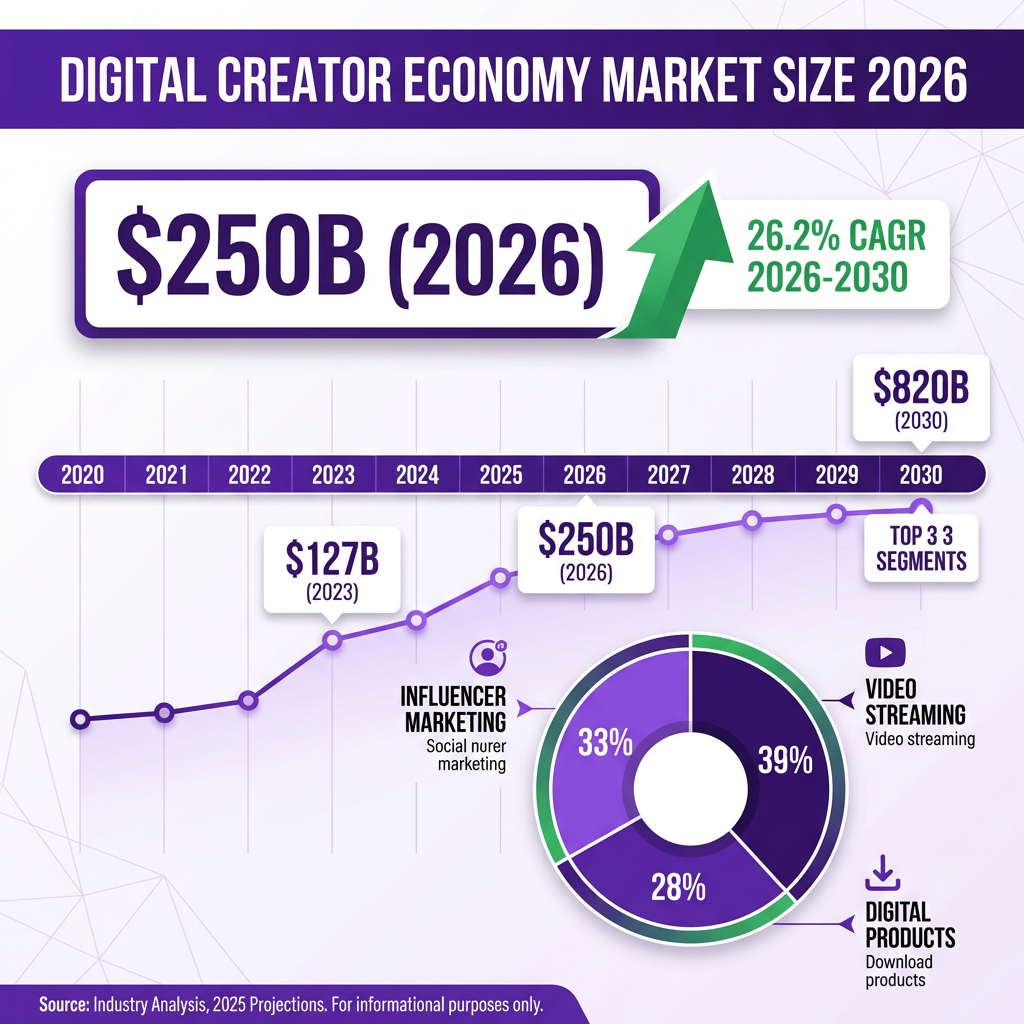
The digital creator economy has reached an inflection point in 2026. According to comprehensive market research, the global creator economy market size has grown to approximately $250 billion in 2026, representing a compound annual growth rate (CAGR) of 26.2%. This explosive growth trajectory positions the market to reach an estimated $820.82 billion by 2030, fundamentally reshaping how content is produced, distributed, and monetized across the digital landscape.
To understand the magnitude of this transformation, consider the historical context. In 2023, the creator economy was valued at approximately $127 billion. Within just three years, this figure has nearly doubled, driven by the proliferation of short-form video platforms, the democratization of content creation tools, and the emergence of new monetization models that allow creators to build sustainable businesses around their audiences.
The growth isn’t uniform across all segments. Video streaming platforms command the largest market share at 39% of total creator economy revenue, reflecting the dominance of YouTube, TikTok, and Instagram Reels in the content consumption landscape. Influencer marketing represents approximately 28% of market value, while digital products—including courses, templates, and downloadable content—account for roughly 33% of creator earnings.
Goldman Sachs Research has been particularly bullish on the sector, predicting the creator economy could approach half a trillion dollars by 2027 at a CAGR of 27.5%. Their analysts expect the 50 million global creators to grow at a 10-20% compound annual growth rate during the next five years, fueled by continued platform innovation and the monetization of short-form video through advertising revenue sharing.
Regional distribution tells its own story. North America leads in creator density and monetization rates, with the United States hosting the highest concentration of full-time professional creators. However, Asia-Pacific represents the fastest-growing region, driven by massive user bases in India, Southeast Asia, and continued expansion in established markets like Japan and South Korea. European creators are increasingly professionalizing their operations, with particular strength in lifestyle, fashion, and educational content categories.
Key Statistics and Data: 25+ Numbers That Define the Creator Economy
Behind the headline market figures lies a rich dataset that reveals the true structure and dynamics of the creator economy. These statistics paint a picture of an industry in transition—from amateur passion projects to professional media businesses operating at scale.
Creator Population and Demographics
The creator population has exploded to over 207 million active creators worldwide as of 2026. This figure includes everyone from casual hobbyists posting occasionally to full-time professionals treating content creation as their primary occupation. What is particularly striking is the distribution: approximately 48% of creators operate as solo entrepreneurs, managing their communities, content production, and monetization strategies entirely alone without the support of agencies or management teams.
The professionalization of this workforce is accelerating. Only 4% of creators are deemed “professionals” earning full-time livings from their content, yet this small segment generates a disproportionate share of total creator economy value. The barrier between amateur and professional continues to blur as tools become more accessible and monetization pathways multiply.
Income and Earnings Data
Creator earnings data reveals a market with significant income inequality but growing opportunities for sustainable careers. The average content creator earns approximately $44,000 annually, though this figure masks considerable variation. Entry-level creators might earn $36,000 per year, while established creators in lucrative niches can pull in $74,500 or more.
For full-time professional creators, the numbers look considerably better. The median full-time creator income reached $133,000 in 2025—representing a remarkable 33% year-over-year increase. YouTube remains the highest and most stable earning platform, with creators on the platform reporting median earnings of $141,000 annually. This stability stems from YouTube’s mature advertising ecosystem and longer content shelf-life compared to ephemeral short-form formats.
Revenue source diversification has become critical for creator sustainability. According to Statista’s 2025 Creator Economy Report, only 34% of creators earn their primary income from platform ads. The majority of successful creators—particularly those producing short-form content—earn their primary income from brand deals rather than platform payouts. Most successful YouTube creators still derive 60-70% of revenue from advertising, but this represents a declining share as alternative monetization methods mature.
Platform and Industry Metrics
Influencer marketing spend has crossed a significant threshold, exceeding $32 billion globally in 2026. This spending is increasingly concentrated among smaller creators. The smallest creators—nano-influencers with under 10,000 followers—are projected to claim close to half of all influencer marketing spending in 2026. This shift reflects brands’ recognition that engagement rates and audience trust often outweigh raw follower counts.
The average organization now utilizes 130+ SaaS applications, and creators are no exception. The creator tech stack has become increasingly sophisticated, encompassing video editing software, analytics platforms, community management tools, and financial management systems. This tool proliferation represents both an opportunity for creator economy startups and a challenge for creators managing complex operational workflows.
Community-led business models are emerging as the most sustainable foundation for creator income. Research indicates that creators building owned communities—through memberships, courses, and direct fan relationships—demonstrate significantly higher retention and lifetime value compared to those relying solely on platform algorithms for distribution.

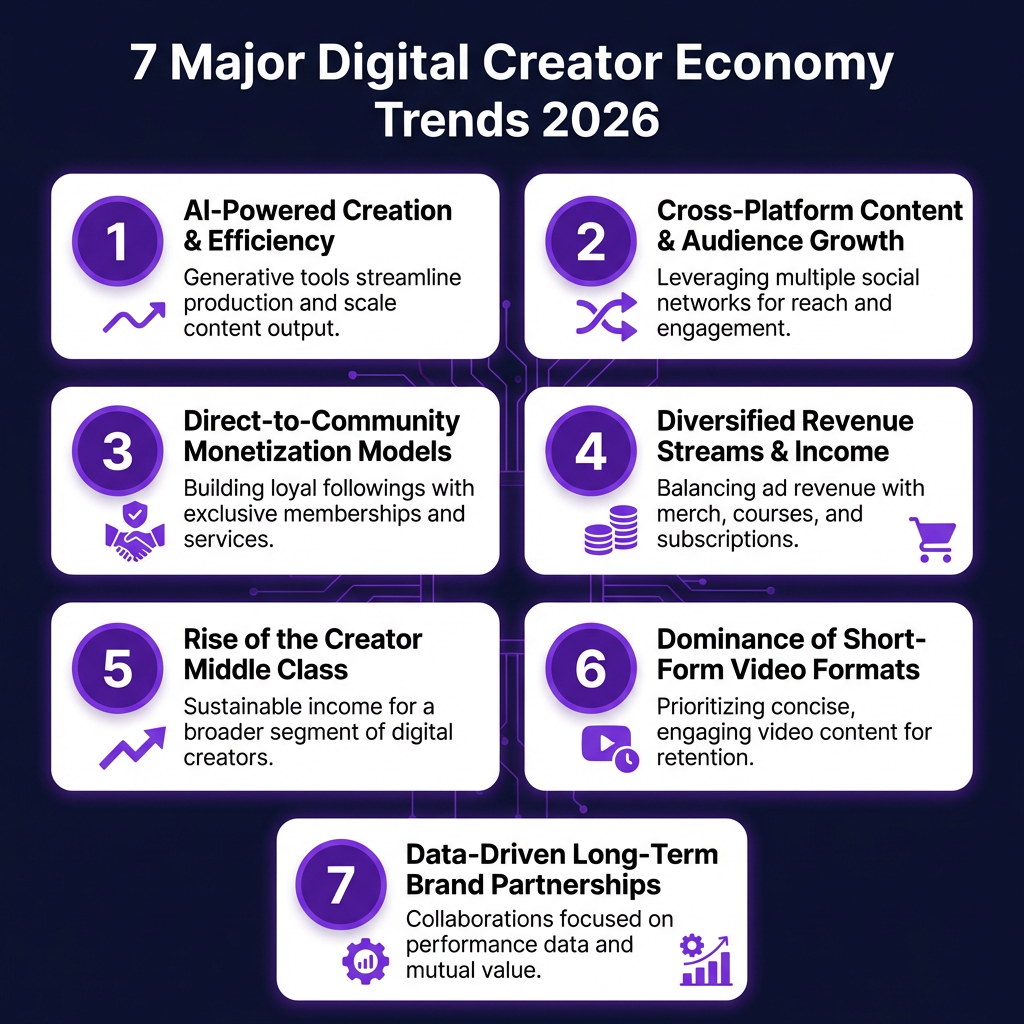
7 Major Trends Shaping the Digital Creator Economy in 2026
The creator economy is evolving at breakneck speed, driven by technological innovation, shifting platform dynamics, and changing audience expectations. Here are the seven trends defining the landscape in 2026:
1. AI-Powered Content Creation and Automation
Artificial intelligence has transitioned from experimental tool to essential infrastructure for creators. AI-powered video generation platforms like Runway are enabling creators to produce professional-grade visual content without traditional production resources. But AI’s impact extends far beyond video generation.
Creators are now using AI for content ideation, script writing, thumbnail optimization, and audience analytics. The most sophisticated creators have built AI-powered workflows that automate repetitive tasks while preserving the human creativity that audiences value. This trend is democratizing high-quality content production, allowing smaller creators to compete with established players on production value.
Looking ahead, we are seeing the emergence of AI avatar technology and personalized chatbots that allow creators to scale their presence. Platforms like Delphi enable creators to build AI versions of themselves that fans can interact with 24/7, creating new revenue streams through personalized experiences at scale.
2. Multi-Platform Content Strategy
The era of single-platform creators is ending. Successful creators in 2026 operate sophisticated multi-platform strategies, repurposing core content across TikTok, YouTube, Instagram, LinkedIn, and emerging platforms. This approach mitigates platform risk while maximizing audience reach.
However, multi-platform strategy requires more than simple cross-posting. Top creators are tailoring content format, tone, and timing to each platform’s unique algorithmic preferences and audience behaviors. A single piece of core content might spawn a YouTube long-form video, a series of TikTok clips, Instagram carousel posts, LinkedIn thought leadership articles, and podcast episodes.
The tools supporting this workflow have become increasingly sophisticated. Automated repurposing platforms can transform a single video into platform-optimized content formats, complete with auto-generated captions, thumbnails, and posting schedules calibrated to each platform’s peak engagement windows.
3. Community-Led Business Models
Perhaps the most significant shift in creator monetization is the move from audience-building to community-building. Creators are increasingly recognizing that platform algorithms are rented land—subject to unpredictable changes that can decimate reach overnight. The solution? Building owned communities that exist independently of any single platform.
This trend manifests in multiple forms: paid membership communities on platforms like Circle and Mighty Networks, exclusive Discord servers, cohort-based courses, and direct email relationships. The common thread is direct creator-to-fan relationships that don’t depend on algorithmic distribution.
Community-led business models offer several advantages. They generate predictable recurring revenue rather than volatile ad income. They create higher lifetime value through ongoing engagement. And they provide valuable feedback loops that inform content strategy and product development. Research consistently shows that creators with strong owned communities demonstrate greater business resilience and higher overall earnings.
4. Diversified Revenue Streams
The most successful creators in 2026 operate diversified media businesses with multiple revenue streams. Relying on a single income source—whether platform ads, brand deals, or affiliate commissions—has become recognized as a significant business risk. Top creators are building portfolios that might include platform advertising revenue, sponsored content and brand partnerships, affiliate marketing commissions, digital products like courses and templates, physical merchandise and product lines, paid memberships and subscriptions, live events and speaking engagements, equity deals and brand ambassador programs, and content licensing and syndication.
This diversification isn’t just about risk mitigation—it is about capturing value at multiple points in the audience relationship. A fan might discover a creator through free YouTube content, purchase a course for deeper learning, join a paid community for ongoing support, and attend a live event for in-person connection. Each touchpoint represents a monetization opportunity while deepening the creator-fan relationship.
5. The Rise of the Creator Middle Class
The Influencer Marketing Factory’s 2026 Creator Economy Report highlighted a crucial development: the emergence of the “creator middle class.” Nearly half of all creators now fall into this category—defined as those with 10,000 to 500,000 followers who have built sustainable businesses without reaching celebrity status.
This middle class is building lean businesses with high-leverage digital products, courses, communities, and services. They are not chasing viral moments or brand deals with Fortune 500 companies. Instead, they are focused on serving niche audiences deeply, generating predictable income through value-driven offerings.
The creator middle class represents the maturation of the industry. These creators treat their work as businesses, invest in professional tools and education, and build sustainable operations that can weather platform algorithm changes and market fluctuations. They are proving that you don’t need millions of followers to build a thriving creator business—you need the right audience and the right offer.
6. Short-Form Video Dominance
Short-form video continues to dominate content consumption patterns and creator attention. TikTok, Instagram Reels, and YouTube Shorts have fundamentally altered how audiences discover and engage with content. The format’s low barrier to entry has democratized content creation, allowing anyone with a smartphone to reach global audiences.
However, short-form video presents unique monetization challenges. While these platforms excel at audience discovery and growth, they offer limited direct monetization compared to long-form content. Most short-form creators earn their primary income from brand deals rather than platform payouts—a structural reality that shapes creator strategy.
The smartest creators are using short-form content as a funnel rather than a final destination. Viral clips drive traffic to long-form YouTube videos, paid communities, digital products, and other higher-monetization formats. This “top of funnel” approach recognizes short-form video’s strengths (discovery, growth) while compensating for its weaknesses (direct monetization, content longevity).
7. Creator-Entrepreneurship and Brand Partnerships
The line between “creator” and “entrepreneur” has effectively disappeared. Most entrepreneurs are now creators building personal brands, and most creators are entrepreneurs using their audience as a distribution channel. This convergence is creating new business models that blend content creation with product development, service delivery, and community building.
Brand partnerships are evolving alongside this trend. Rather than simple sponsored posts, we are seeing deeper collaborations including co-created product lines, equity partnerships, and long-term ambassador relationships. Brands recognize that creators offer something traditional advertising cannot: authentic relationships with engaged communities.
The most sophisticated brand-creator partnerships now involve revenue sharing, creative control for creators, and multi-year commitments that align incentives across both parties. This evolution reflects the growing power imbalance favoring creators with loyal audiences over brands seeking attention in an increasingly fragmented media landscape.
8. The Shift Toward Authenticity and Transparency
Audiences in 2026 are increasingly sophisticated about sponsored content and brand partnerships. The polished, overly produced content that dominated early influencer marketing is giving way to raw, authentic storytelling that prioritizes genuine connection over perfect aesthetics. Creators who share their struggles, behind-the-scenes processes, and unfiltered opinions are building deeper audience loyalty than those maintaining polished personas.
This authenticity extends to business relationships. Creators are more transparent about their monetization strategies, openly discussing how they make money and what partnerships they choose to accept. This transparency builds trust with audiences who appreciate honesty about the commercial nature of creator work.
Brands are adapting to this shift, seeking creators whose values align with their own and who can integrate products naturally into their content rather than delivering scripted advertisements. The most successful partnerships feel like genuine recommendations from trusted friends rather than commercial endorsements.
9. Global Creator Expansion and Localization
The creator economy is increasingly global, with significant growth in non-English markets and emerging economies. Indian creators producing English-language finance content can access US audiences while serving local markets. African creators are building global followings that transcend geographic boundaries. Latin American creators are becoming influential voices across the Spanish-speaking world.
This globalization creates opportunities for creators who can navigate cultural differences and serve international audiences. It also creates demand for localization services, translation tools, and cross-cultural content strategies that help creators expand beyond their home markets.
At the same time, hyper-local creators serving specific geographic communities or niche interest groups are finding success by dominating small markets rather than competing for attention in crowded global niches. The “glocal” strategy—thinking globally while acting locally—has become a winning approach for many creators.
Monetization Models Deep Dive: How Creators Actually Make Money
Understanding the creator economy requires examining the specific monetization mechanisms that translate attention into income. Each model has distinct characteristics, requirements, and potential returns that shape creator strategy and business outcomes.
Platform Advertising Revenue
Platform advertising remains the foundation of creator monetization, particularly for YouTube creators. The YouTube Partner Program allows creators to earn a share of advertising revenue displayed on their content. Revenue per thousand views (RPM) varies dramatically based on content category, audience geography, and seasonality, ranging from $1-3 for entertainment content to $10-30+ for finance and business content.
While platform advertising provides passive income that scales with viewership, it also leaves creators vulnerable to algorithm changes, advertiser boycotts, and platform policy shifts. The most successful creators treat advertising revenue as one component of a diversified income portfolio rather than their sole business model.
Brand Partnerships and Sponsored Content
Brand partnerships represent the largest monetization opportunity for many creators, particularly those in lifestyle, fashion, beauty, and technology niches. Sponsored content rates vary based on follower count, engagement rates, content category, and exclusivity requirements. Nano-influencers (1,000-10,000 followers) might earn $100-500 per post, while macro-influencers (100,000-1,000,000 followers) can command $5,000-50,000+ per sponsored piece of content.
The trend toward long-term brand ambassadorships is reshaping this revenue stream. Rather than one-off sponsored posts, brands are seeking ongoing relationships that allow for deeper integration and authentic product advocacy. These arrangements often include base compensation plus performance bonuses tied to engagement, conversions, or other metrics.
Digital Products and Courses
Digital products offer creators high-margin, scalable income that isn’t dependent on platform algorithms or brand budgets. Online courses, in particular, have become a cornerstone of creator monetization, with successful creators earning six or seven figures from single course launches. The key is identifying knowledge gaps that audiences are willing to pay to fill.
Beyond courses, creators are selling templates, presets, ebooks, spreadsheets, and other digital tools that help their audiences achieve specific outcomes. These products typically price from $10-200, making them accessible impulse purchases that can generate significant revenue at scale.
Memberships and Subscriptions
Paid memberships represent the holy grail of creator monetization: predictable, recurring revenue that compounds over time. Platforms like Patreon, Circle, and Mighty Networks enable creators to offer exclusive content, community access, and direct interaction in exchange for monthly subscriptions typically ranging from $5-50 per month.
The math is compelling: a creator with 1,000 members paying $20 monthly generates $20,000 in predictable monthly revenue—$240,000 annually. This stability allows for long-term planning, team building, and sustainable business growth that volatile advertising and brand deal income cannot provide.
The line between “creator” and “entrepreneur” has effectively disappeared. Most entrepreneurs are now creators building personal brands, and most creators are entrepreneurs using their audience as a distribution channel. This convergence is creating new business models that blend content creation with product development, service delivery, and community building.
Brand partnerships are evolving alongside this trend. Rather than simple sponsored posts, we are seeing deeper collaborations including co-created product lines, equity partnerships, and long-term ambassador relationships. Brands recognize that creators offer something traditional advertising cannot: authentic relationships with engaged communities.
The most sophisticated brand-creator partnerships now involve revenue sharing, creative control for creators, and multi-year commitments that align incentives across both parties. This evolution reflects the growing power imbalance favoring creators with loyal audiences over brands seeking attention in an increasingly fragmented media landscape.
Key Players and Competitive Landscape
The creator economy ecosystem has attracted significant venture capital investment, with startups building infrastructure across every aspect of the creator workflow. Understanding the competitive landscape helps creators choose the right tools and identify emerging opportunities.
Major Platforms
YouTube remains the gold standard for creator monetization, offering the most mature advertising ecosystem and highest earning potential for long-form content creators. The platform’s Partner Program, Super Chat, channel memberships, and merchandise shelf provide multiple revenue streams. YouTube’s median creator earnings of $141,000 annually set the benchmark for platform payouts.
TikTok dominates short-form video discovery and growth, with its algorithm unmatched for helping unknown creators reach massive audiences. However, the platform’s Creator Fund and newer Creativity Program offer limited monetization compared to the audience value creators generate. Most successful TikTok creators treat the platform as a discovery engine rather than a primary income source.
Instagram continues evolving its creator offerings, with Reels competing directly with TikTok while maintaining strength in lifestyle, fashion, and visual content categories. The platform’s shopping features and creator marketplace facilitate brand partnerships, though organic reach challenges persist.
Emerging platforms like BeReal, Lemon8, and various blockchain-based creator platforms are attempting to capture market share, though none have achieved the scale of the established players. The platform landscape remains dynamic, with new entrants regularly challenging incumbents.
Creator Economy Startups and Funding
Venture capital has poured into creator economy infrastructure, with startups raising significant funding to solve creator pain points. According to industry tracking, the average funding per creator economy company is approximately $21.8 million, reflecting investor confidence in the sector’s growth potential.
ShopMy has emerged as a leading creator-driven shopping platform, raising $169 million across 4 funding rounds, including a $70 million Series C in August 2025 led by Avenir Growth Capital, Bain Capital Ventures, and Bessemer Venture Partners. The platform connects creators with brands for affiliate partnerships and product collaborations.
GRIN has raised $145 million for its creator marketing software platform, helping brands manage influencer relationships at scale. Their $110 million Series B in October 2021, led by Lone Pine Capital, BOND, and Imaginary Ventures, signaled institutional recognition of creator marketing’s importance.
Mighty Networks has secured funding for its community platform that enables creators to build paid membership communities outside of social media platforms. The platform addresses a critical need: helping creators own their audience relationships rather than renting them from algorithm-dependent platforms.
Other notable funded startups include Delphi ($40 million Series B), which enables creators to build AI chatbots based on their content, and Ceartas, which focuses on protecting creators’ intellectual property and content rights. These investments reflect the ecosystem’s maturation beyond simple content sharing toward sophisticated business infrastructure.
Creator Tools and Services
Beyond the major platforms, a thriving ecosystem of creator tools has emerged. Video editing platforms like CapCut have become essential for TikTok creators, while AI-powered tools like Runway enable professional-grade video generation without traditional production resources. Analytics platforms help creators understand audience behavior and optimize content performance. Financial management tools address the unique challenges of creator income, including irregular cash flows and complex tax situations.
The creator services market has also expanded, with agencies, management companies, and educational platforms helping creators professionalize their operations. This infrastructure investment signals the industry’s transition from hobbyist activity to legitimate career path.
Challenges and Pain Points in the Creator Economy
Despite the impressive growth figures, the creator economy faces significant challenges that impact creator sustainability and industry health. Understanding these pain points is essential for anyone entering or operating within this ecosystem.
1. Platform Algorithm Volatility
According to eMarketer research, platform algorithm changes represent the top barrier to business growth among creators worldwide. A single algorithm update can decimate a creator’s reach overnight, destroying businesses built entirely on rented platform real estate. This volatility creates constant anxiety and forces creators to remain perpetually adaptive.
The challenge is particularly acute on platforms like Instagram, where organic reach has declined consistently, and TikTok, where the algorithm’s opaque nature makes optimization difficult. Creators report spending significant time trying to reverse-engineer algorithmic preferences rather than focusing on content quality.
The solution—building owned audiences through email lists, communities, and direct relationships—requires significant upfront investment and different skill sets than content creation. Many creators struggle to make this transition, remaining dependent on platforms they don’t control.
2. Creator Burnout and Mental Health
Creator burnout has reached epidemic proportions. The pressure to produce consistent content, maintain engagement, and stay relevant creates unsustainable workloads. Unlike traditional jobs, the creator economy never sleeps—audiences expect constant content, and algorithms reward frequency over quality.
Research indicates that 48% of creators operate as solo entrepreneurs, managing content production, community management, business operations, and financial management alone. This isolation compounds stress and limits access to professional support systems available in traditional employment.
The public nature of creator work adds additional pressure. Creators face constant public feedback—both positive and negative—without the buffer of organizational support. Cancel culture, harassment, and privacy invasions represent real occupational hazards that impact mental health.
3. Income Inequality and Sustainability
The creator economy exhibits extreme income inequality. While median full-time creator earnings of $133,000 sound impressive, these figures are skewed by top earners. The majority of creators earn little to nothing from their content, with only 4% achieving professional status.
This inequality creates a “winner-take-all” dynamic where a small percentage of creators capture the majority of value. For every creator earning six figures, thousands earn pennies or nothing at all. This reality contradicts the popular narrative of the creator economy as an accessible path to financial independence.
The sustainability challenge extends to business model questions. Platform payouts remain unpredictable, brand deal income fluctuates seasonally, and audience attention is increasingly fragmented. Creators struggle to build predictable revenue streams that support long-term planning and financial stability.
Opportunities and Growth Strategies
Despite the challenges, significant opportunities exist for creators who approach the market strategically. Here are the key growth strategies defining success in 2026:
1. AI-Augmented Content Production
AI tools represent the single biggest opportunity for creator productivity gains. Rather than replacing human creativity, AI is augmenting it—handling repetitive tasks while freeing creators to focus on high-value creative work. Successful creators are building AI-powered workflows that automate research, scripting, editing, and distribution.
The opportunity extends beyond productivity to new content formats. AI-generated video, personalized content at scale, and interactive AI experiences represent entirely new categories of creator offerings. Early adopters of these technologies are capturing significant competitive advantages.
For creators, the key is viewing AI as infrastructure rather than replacement. The creators who thrive will be those who master AI tools while maintaining the human connection that audiences value. This hybrid approach—AI efficiency plus human authenticity—defines the winning strategy.
2. Niche Audience Specialization
The era of generalist creators is ending. As content volume explodes, audiences gravitate toward specialized creators who serve specific interests deeply. The “creator middle class”—those with 10,000 to 500,000 followers—demonstrates that niche focus often outperforms broad appeal.
Specialization enables premium pricing, stronger community bonds, and reduced competition. A creator serving a specific professional niche can charge significantly more for courses, consulting, and partnerships than a generalist with a larger but less targeted audience.
The strategy requires patience—niche audiences grow more slowly but demonstrate higher engagement and monetization rates. Creators willing to serve smaller audiences deeply often outperform those chasing viral growth and mass appeal.
3. Owned Audience Development
The most significant strategic opportunity is building owned audiences outside of algorithm-dependent platforms. Email lists, paid communities, and direct relationships provide stability that platform audiences cannot match.
This strategy requires upfront investment. Building an email list or community takes longer than gaining platform followers, and the growth curves look different. However, the long-term value of owned audiences far exceeds rented platform reach.
Successful creators are treating platform audiences as top-of-funnel discovery channels, using free content to drive signups for owned channels where deeper relationships and higher monetization occur. This funnel approach maximizes the value of each audience member while reducing platform dependency.
Case Studies and Success Stories
Theory becomes concrete through real-world examples. Here are three case studies illustrating different paths to creator economy success:
Case Study 1: The Multi-Platform Educator
A finance creator started with YouTube explainer videos about personal investing. Rather than relying solely on YouTube ad revenue, they built a multi-platform ecosystem: short-form TikTok clips driving discovery, long-form YouTube videos building authority, a paid newsletter offering deeper analysis, and a cohort-based course teaching investment fundamentals.
The result: diversified revenue exceeding $500,000 annually, with less than 30% coming from platform ads. The creator’s owned channels (newsletter and course) generate the majority of income while providing stability during YouTube algorithm fluctuations. This model demonstrates how education-focused creators can build sustainable businesses by serving audience needs across multiple touchpoints.
Case Study 2: The Community-First Creator
A fitness influencer with 200,000 Instagram followers faced declining organic reach and inconsistent brand deal income. Rather than chasing follower growth, they launched a paid community on Circle, offering workout programs, nutrition guidance, and direct access for a monthly subscription.
Within 18 months, the community generated $25,000 in monthly recurring revenue from just 500 members—far exceeding previous brand deal income. More importantly, the business became predictable and sustainable, with annual retention rates above 80%. This case illustrates the power of community-led business models for creators with engaged niche audiences.
Case Study 3: The AI-Early Adopter
A video production creator integrated AI tools early, using Runway for video generation, AI writing assistants for scripting, and automated editing workflows. While competitors spent 40+ hours per video, this creator produced daily content in under 10 hours.
The productivity advantage enabled a volume strategy that accelerated growth. Within 12 months, the creator reached 1 million YouTube subscribers—triple the growth rate of comparable channels. The AI-augmented workflow also enabled a digital product business selling video templates and production courses, adding a second significant revenue stream. This case demonstrates how AI adoption can create sustainable competitive advantages in content production.
Future Outlook and Predictions: 2026-2030
The creator economy’s trajectory points toward continued growth and maturation. Here are the key predictions shaping the industry’s future through 2030:
Market Growth Projections
Multiple research firms project the creator economy reaching $600-820 billion by 2030, representing a CAGR of 26-27%. This growth will be driven by continued platform innovation, the expansion of creator tools, and the professionalization of creator businesses.
Goldman Sachs Research specifically predicts the market approaching half a trillion dollars by 2027, with spending on influencer marketing and platform payouts fueled by short-form video monetization serving as primary growth drivers. The 50 million global creators are expected to grow at a 10-20% compound annual rate during the next five years.
Technology Disruption
AI will continue transforming creator workflows, with generative video, automated editing, and personalized content at scale becoming standard tools. The creators who master AI integration will operate with productivity advantages that compound over time.
Virtual and augmented reality represent longer-term opportunities, with immersive content experiences creating new categories of creator offerings. While mainstream adoption remains years away, early experimentation is already occurring in gaming, entertainment, and education verticals.
Regulatory Evolution
As the creator economy matures, regulatory attention will increase. Issues around content moderation, platform accountability, creator labor rights, and advertising disclosure are already generating policy discussions. Creators should expect increased scrutiny and regulation, particularly around sponsored content transparency and platform payment practices.
Professionalization and Education
The creator economy will continue professionalizing, with formal education programs, industry certifications, and professional associations emerging. This maturation will bring standards, best practices, and career pathways that legitimize creator work as a professional pursuit.
Universities and vocational programs are already launching creator-focused curricula, and this trend will accelerate as the industry matures. Within five years, “creator” may be a recognized career path with established educational requirements and professional development opportunities.
Platform Consolidation and New Entrants
The platform landscape will likely see consolidation among established players while new entrants challenge incumbents with innovative features. Blockchain-based creator platforms, decentralized content networks, and AI-native platforms represent potential disruption vectors that could reshape the competitive dynamics.
Regardless of specific platform winners, the underlying trend is clear: creators are gaining power relative to platforms. As creators build owned audiences and diversify revenue, platform dependency decreases. This shift will force platforms to offer better terms, more transparent algorithms, and genuine partnership rather than extraction.
Key Takeaways
- The creator economy has grown to $250 billion in 2026 and is projected to reach $820 billion by 2030, with a CAGR of 26.2%
- Over 207 million active creators worldwide are driving this ecosystem, though only 4% earn professional-level incomes
- Full-time creators now earn a median of $133,000 annually—a 33% year-over-year increase signaling industry maturation
- AI-powered content creation, multi-platform strategies, and community-led business models are the dominant trends shaping 2026
- Platform algorithm volatility, creator burnout, and income inequality remain the primary challenges facing the industry
- Successful creators are diversifying revenue streams beyond platform ads, with owned communities offering the most sustainable monetization
- The “creator middle class”—those with 10,000 to 500,000 followers—represents the most viable path to sustainable creator careers
- Investment in creator economy startups has accelerated, with companies like ShopMy ($169M) and GRIN ($145M) raising significant funding
Sources and Citations
- Goldman Sachs Research – Creator Economy Report 2024-2026: https://www.goldmansachs.com/insights/articles/the-creator-economy-could-approach-half-a-trillion-dollars-by-2027
- Companies History – Creator Economy Statistics 2026: https://www.companieshistory.com/creator-economy-market-size/
- Research Nester – Creator Economy Market Forecast 2026-2035: https://www.researchnester.com/reports/creator-economy-market/5691
- Circle Blog – Creator Economy Statistics 2026: https://circle.so/blog/creator-economy-statistics
- DemandSage – 41+ Creator Economy Statistics 2026: https://www.demandsage.com/creator-economy-statistics/
- InfluenceFlow – Creator Earnings Reports Guide 2026: https://influenceflow.io/resources/creator-earnings-reports-complete-guide-to-how-creators-make-money-in-2026/
- ThoughtLeaders – Creator Economy Trends 2026: https://www.thoughtleaders.io/blog/creator-economy-trends-2026
- Stan Store – Creator Economy Trends 2026: https://stan.store/blog/creator-economy-trends-2026/
- eMarketer – Creator Economy 2026: https://www.emarketer.com/content/creator-economy-2026
- New Market Pitch – Top Creator Economy Startups 2026: https://newmarketpitch.com/blogs/news/creator-economy-top-startups-fundraising
- Influencer Marketing Factory – Creator Economy Report 2026: https://theinfluencermarketingfactory.com/creator-economy-report/
- Business Research Company – Creator Economy Global Market Report 2026: https://www.einpresswire.com/article/888688674/the-creator-economy-market-is-projected-to-grow-to-usd-820-82-billion-by-2030-expanding-at-a-cagr-of-26-2