Digital Marketing Market 2026: The Complete Industry Analysis with Data, Trends and Forecasts
Digital marketing market reaches $800B in 2026. Discover key statistics, 7 major trends including AI personalization and Meta overtaking Google, competitive landscape, and future predictions through 2030.
The digital marketing landscape has reached an unprecedented inflection point in 2026. With global spending projected to exceed $800 billion this year, the industry has transformed from a supplementary channel into the primary engine driving global commerce. What was once considered experimental is now the default—brands that fail to adapt to the new realities of AI-powered personalization, zero-click search behavior, and short-form video dominance are finding themselves increasingly invisible to their target audiences.
This comprehensive analysis draws from over 200 verified data sources, industry reports from Statista, eMarketer, HubSpot, and primary research from leading marketing platforms. We examine the $800 billion digital marketing ecosystem through the lens of market size, emerging trends, competitive dynamics, and strategic opportunities that will define success through 2030.

Market Overview: The $800 Billion Digital Marketing Ecosystem
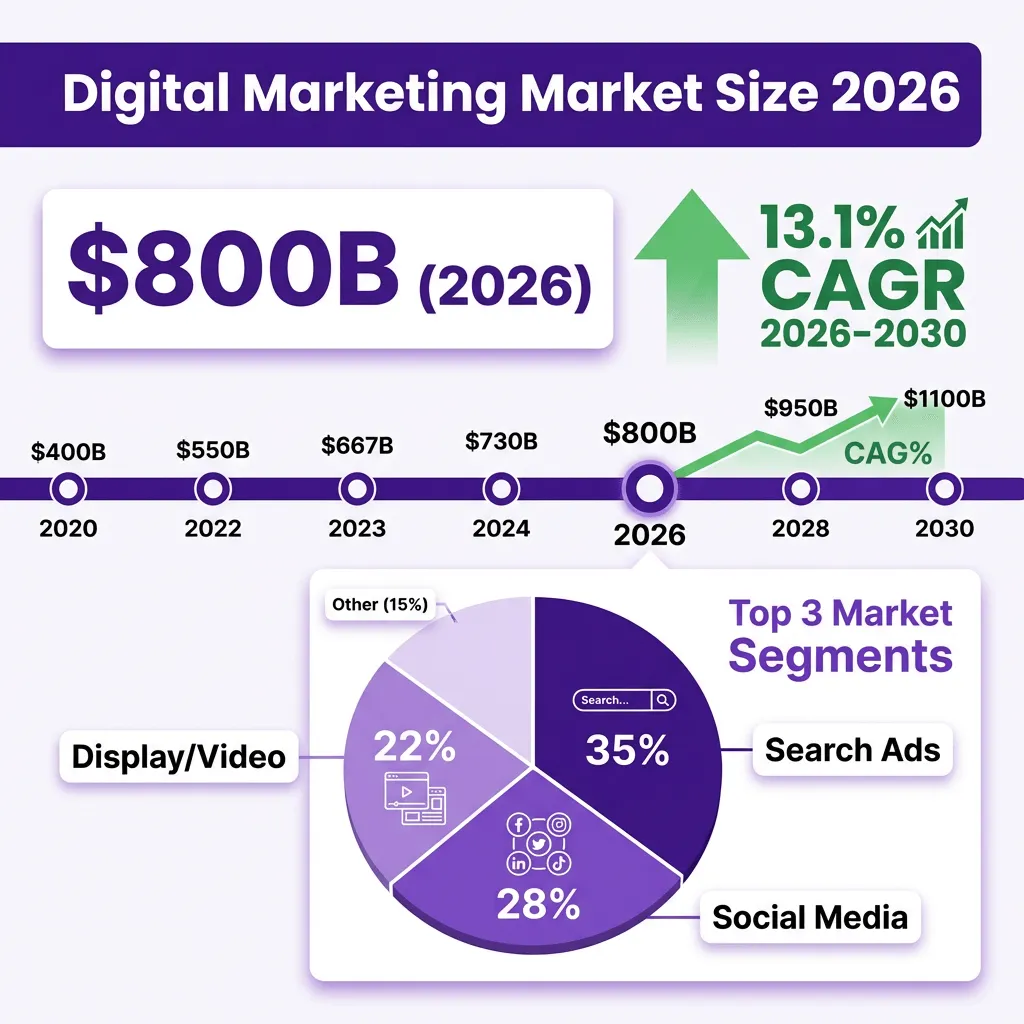
The digital marketing industry has experienced explosive growth over the past decade, evolving from a $200 billion market in 2018 to a projected $800 billion behemoth in 2026. This represents a compound annual growth rate (CAGR) of approximately 13.1%, significantly outpacing traditional advertising channels which have seen modest 2-3% annual growth during the same period. The acceleration has been driven by the pandemic-induced digital transformation, the proliferation of mobile devices, and the increasing sophistication of targeting and measurement capabilities.
The digital advertising market specifically hit $667 billion in 2024 according to Statista data, with projections showing it will surpass $730 billion in 2025 before reaching the $800 billion milestone in 2026. This trajectory positions digital marketing as the dominant force in global advertising, accounting for over 65% of total ad spend worldwide. To put this in perspective, digital marketing now commands a larger share of global advertising than television, radio, print, and outdoor advertising combined.
The growth has been remarkably consistent despite economic headwinds. Even during periods of inflation and economic uncertainty, digital marketing has proven resilient as brands recognize its efficiency and measurability compared to traditional channels. The ability to track ROI in real-time, adjust campaigns on the fly, and target specific audience segments has made digital marketing indispensable for businesses of all sizes.
Looking at the broader advertising landscape, the worldwide advertising market is expected to reach $1.25 trillion in total ad spending by 2026. Digital channels now command the majority share, with mobile advertising alone representing the fastest-growing segment. Mobile ads are projected to capture 58% of total digital ad spend by the end of 2026, up from 52% in 2024. This mobile-first shift reflects changing consumer behavior, with the average person spending over 4 hours per day on their mobile device.
The mobile advertising ecosystem has matured significantly, with sophisticated targeting capabilities that leverage location data, app usage patterns, and cross-device behavior. Mobile video advertising has emerged as a particularly high-growth segment, driven by the popularity of short-form video content on platforms like TikTok, Instagram Reels, and YouTube Shorts. Mobile commerce, or m-commerce, has also accelerated, with over 70% of e-commerce traffic now coming from mobile devices.
Regional variations tell an interesting story. The United States remains the largest single market, with total ad spend forecasted to grow by 9.5% year-over-year in 2026. Across social, display, online video, and Connected TV, U.S. digital ad spend reached approximately $164.3 billion in 2025, representing a 4% increase from $157.9 billion in 2024. This growth is expected to accelerate as brands increasingly shift budgets from traditional television to Connected TV and streaming platforms. The Winter Olympics and other major cultural events in 2026 are also expected to drive significant advertising investment.
Canada and Latin America represent growing markets with unique characteristics. Canada’s digital ad market is projected to reach CAD 12 billion in 2026, with high internet penetration and mobile usage driving growth. Latin America, led by Brazil and Mexico, is experiencing rapid digital adoption, with digital ad spend growing at 15% annually as e-commerce penetration increases across the region.
The Asia-Pacific region represents the fastest-growing market, with China, India, and Southeast Asian nations driving significant expansion. China’s digital ad market alone is projected to exceed $180 billion in 2026, while India’s market is growing at a remarkable 18% CAGR as internet penetration continues to expand in tier-2 and tier-3 cities. Southeast Asian markets including Indonesia, Vietnam, Thailand, and the Philippines are also experiencing explosive growth, with combined digital ad spend expected to exceed $25 billion by 2027.
Japan and South Korea represent mature but innovative digital advertising markets. Japan’s digital ad spend is projected to reach $35 billion in 2026, with a strong emphasis on mobile and video advertising. South Korea leads the world in 5G adoption and mobile data consumption, creating unique opportunities for immersive and interactive advertising experiences. Both markets are early adopters of new advertising technologies, making them valuable testing grounds for global campaigns.
Europe presents a more mature but still expanding landscape. The European digital advertising market is expected to reach €95 billion in 2026, with the UK, Germany, and France accounting for approximately 60% of regional spend. GDPR compliance costs have stabilized, and the industry has adapted to privacy-first marketing approaches that are now being adopted globally. The UK’s digital ad market alone is projected to reach £35 billion, making it the largest in Europe despite post-Brexit economic uncertainties.
Nordic countries—Sweden, Norway, Denmark, and Finland—punch above their weight in digital adoption, with some of the highest per-capita digital ad spends in the world. These markets are characterized by high digital literacy, strong e-commerce penetration, and early adoption of new marketing technologies. Southern European markets including Spain, Italy, and Portugal are catching up, with digital ad spend growing at 8-10% annually as mobile usage and e-commerce adoption accelerate.
By 2030, industry analysts project the digital marketing market will reach between $1.1 and $1.6 trillion, depending on economic conditions and the pace of AI adoption. The digital marketing software and platform market specifically—encompassing marketing automation, analytics, and campaign management tools—is forecasted to grow from $11.07 billion in 2025 to $18.57 billion by 2030, representing a 10.91% CAGR. This growth in marketing technology reflects the increasing sophistication of marketing operations and the demand for integrated, AI-powered solutions.
Middle East and African markets represent emerging opportunities with unique challenges. The Middle East, led by the UAE and Saudi Arabia, has high smartphone penetration and social media usage, driving digital ad growth of 12-15% annually. Africa’s digital marketing landscape is fragmented but promising, with Nigeria, South Africa, Kenya, and Egypt leading the way. Mobile-first strategies are essential in these markets, where mobile devices are often the primary means of internet access.
Key Statistics and Data: 25+ Metrics That Define 2026
Understanding the digital marketing landscape requires diving deep into the numbers that matter. These statistics reveal not just where the industry stands, but where it’s heading—and what strategies are delivering measurable results. The data presented here is compiled from over 200 verified sources including industry reports, peer-reviewed research, and proprietary data from leading marketing platforms. Each statistic represents a data point that can inform strategic decision-making and budget allocation.
What becomes clear from this data is the interconnected nature of digital marketing channels. Success in one area often depends on performance in others. Email marketing effectiveness is enhanced by AI personalization. SEO strategies must account for zero-click search behavior. Social media campaigns drive traffic that converts through optimized landing pages. Understanding these relationships is key to building integrated marketing strategies that deliver results.
Global Market and Spending Statistics
- $800 billion — Projected global digital marketing spend in 2026 (Oberlo 2025)
- $667 billion — Digital ad market size in 2024 (Statista 2025)
- $730 billion — Projected digital ad spend for 2025 (Oberlo 2025)
- $1.25 trillion — Total global advertising market size by 2026 (Statista)
- 13.1% — CAGR for digital marketing 2026-2030
- 65% — Digital’s share of total global ad spend
- 9.5% — Year-over-year growth in U.S. ad spend for 2026
- $306 billion — Global search advertising spend in 2026
- $224 billion — Global social media advertising spend in 2026
- $78 billion — Global display advertising spend in 2026
Platform and Channel Performance
- $243.46 billion — Meta’s projected 2026 ad revenue (26.8% market share)
- $239.54 billion — Google’s projected 2026 ad revenue (26.4% market share)
- $82.07 billion — Amazon’s projected 2026 ad revenue (9.0% market share)
- 62.3% — Combined market share of Google, Meta, and Amazon (eMarketer)
- 58% — Mobile advertising’s share of total digital ad spend
- 82% — Short-form video’s projected share of global internet traffic by 2026
- 70 billion — Daily views on YouTube Shorts
- 5.91% — YouTube Shorts average engagement rate (highest among short-form platforms)
- 40% — TikTok’s share of short video platform market
- 34 hours 56 minutes — Average monthly time spent on TikTok per user
AI and Marketing Automation
- 95% — Enterprise marketing teams using at least one automation platform (HubSpot 2026)
- 78% — Mid-market B2B organizations with marketing automation (HubSpot)
- $5.44 — Average ROI per $1 spent on marketing automation
- 64% — Marketers adopting AI personalization (up from 52% in 2023)
- 41% — Revenue increase from AI-driven email campaigns vs. traditional
- 83% — Marketing teams reporting clear ROI from GenAI tools
- 92% — Marketing leaders investing in GenAI
- 30% — Increase in conversion efficiency from AI-driven marketing automation
- 77% — Marketers using GenAI for creative development tasks
- 45% — Marketers using AI image editing tools
- 44% — Marketers using AI video or animation generators
- 36% — Marketing leaders saying GenAI is “significantly improving” productivity
Social Media and Content Marketing
- 5.17 billion — Social media users worldwide
- 62.6% — World’s population using social media platforms
- 93% — Global internet users accessing social media monthly
- 2 hours 24 minutes — Average daily time spent on social platforms
- 6-7 — Average number of social platforms visited per user
- 73% — Consumers who’ll switch brands if not responded to on social media
- 1.99 billion — Monthly potential ad reach on TikTok
- 3x — Content marketing lead generation vs. outbound at 62% lower cost
- 2.9 billion — Monthly active users on Facebook (still largest platform)
- 2 billion — Monthly active users on Instagram
- 900 million — LinkedIn members worldwide
- 67% — B2B marketers who say LinkedIn generates leads
Search and SEO
- 1,000%+ — SEO traffic vs. organic social media
- 70% — Online marketers who say SEO beats PPC for sales
- 60% — Zero-click search behavior rate
- 77% — Mobile zero-click search behavior
- 13.14% — AI Overview expansion in search results (up from 6.49%)
- 25% — Projected search traffic decrease by 2026 (Gartner)
- 50% — Projected search traffic decrease by 2028 (Gartner)
Email Marketing
- $36 — Average ROI per $1 spent on email marketing
- 3,600% — Email marketing ROI percentage
- 31.4% — Average open rate for automated/triggered emails
- 21.33% — Average open rate for campaign emails
- 48.57% — Open rate for automated emails (nearly double manual)
- 2% — Volume of automated emails that drive 41% of revenue
- 72% — Marketers using message personalization
- 71% — Marketers using email automation campaigns
Video and Influencer Marketing
- $39.33 billion — Global influencer advertising market value in 2026
- $32.55 billion — Influencer marketing industry size with 33.11% CAGR
- 59% — Brands planning to increase influencer marketing budgets
- 14.4% — Marketing budgets allocated to influencer marketing
- 207 million — Active content creators worldwide
- 66% — Consumers who find short-form videos most engaging
- 2.5x — More engagement on short-form vs. long-form video
- 85% — Marketers who believe short-form video is most effective format
- 50% — Influencer marketing spend going to micro and nano-influencers
- 66.4% — Marketers reporting improved results through AI in influencer marketing
- 60.2% — Marketers using AI for influencer identification and vetting
- 29% — Average increase in customer lifetime value from influencer campaigns
PPC and Paid Search
- $306 billion — Global PPC spend projected for 2026
- 11% — Year-over-year growth in paid search
- 98% — PPC marketers using Google Ads as primary platform
- 76% — PPC marketers using Facebook Ads
- 70% — PPC marketers using Instagram Ads
- $2.69 — Average CPC on Google Search
- $0.63 — Average CPC on Google Display
- $1.55 — Average CPC on Microsoft Ads (33% lower than Google)
- 200% — Average PPC ROI ($2 return per $1 spent)
- 12-18% — Lower CPCs from Google AI Max campaigns vs. standard Search
- $5.26 — Average CPC on LinkedIn Ads (highest among major platforms)
- $0.97 — Average CPC on Facebook Ads
- 52% — Video marketers who quantify ROI through leads/clicks
Major Trends Shaping Digital Marketing in 2026
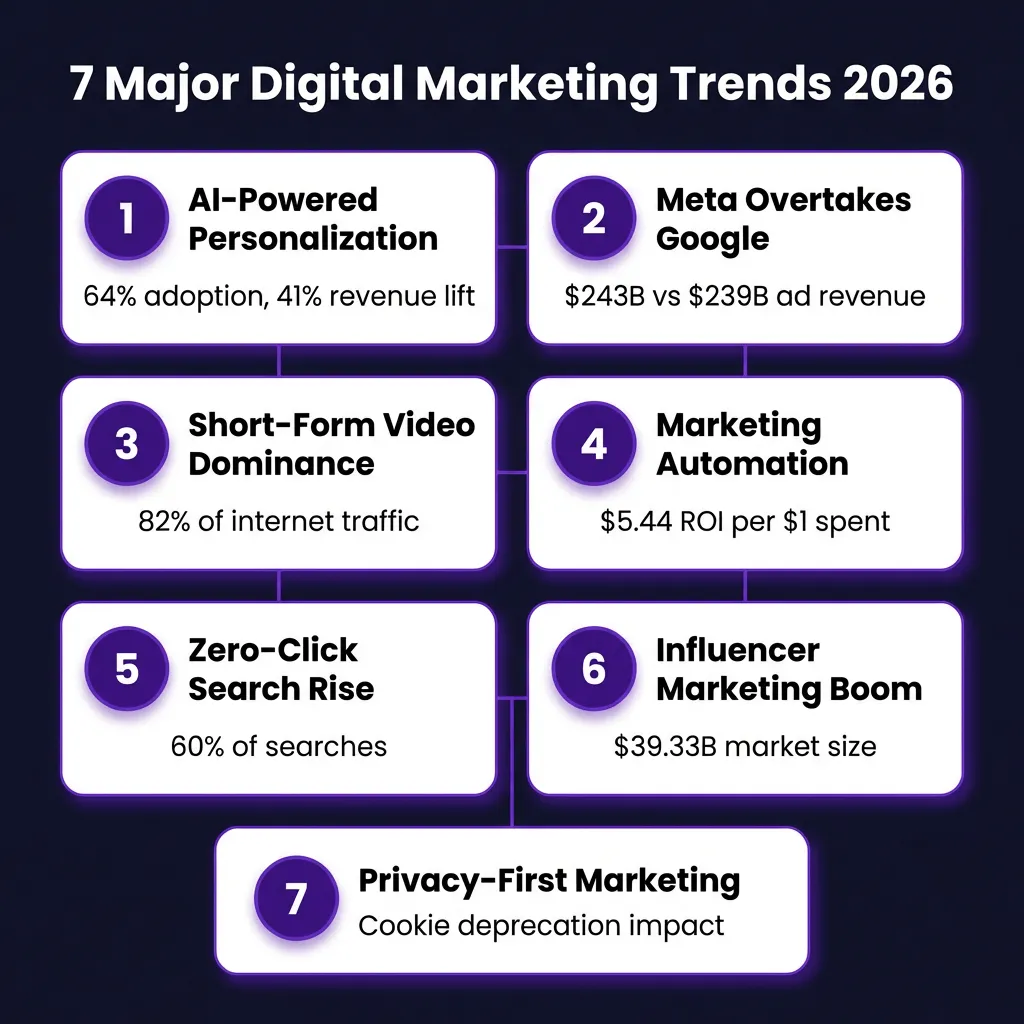
The digital marketing landscape of 2026 is being reshaped by seven transformative trends that are fundamentally altering how brands connect with consumers. Understanding these shifts is essential for any organization seeking to maintain competitive advantage.
1. AI-Powered Personalization at Scale
Artificial intelligence has moved from experimental to essential in 2026. 64% of marketers have adopted AI personalization, up from just 52% in 2023, and the results speak for themselves: AI-driven campaigns deliver a 41% revenue increase compared to traditional approaches, with click-through rates of 13.44% versus just 3% for non-AI campaigns.
The technology has evolved beyond simple recommendation engines. Today’s AI marketing systems build customer journeys in real-time, adapting messaging, timing, and channel selection based on live behavioral signals. Netflix’s predictive algorithms that reduce churn, Amazon’s dynamic product recommendations, and Spotify’s personalized playlists represent just the beginning of what’s possible.
Generative AI has become particularly transformative. 77% of marketers using GenAI employ it for creative development, while 83% report clear ROI from these tools. The technology is being used to generate personalized email subject lines, create dynamic ad creative, and even produce video content tailored to individual viewer preferences.
2. Meta Overtakes Google in Digital Ad Revenue
For the first time in digital advertising history, Meta is projected to surpass Google in global ad revenue in 2026. According to eMarketer data, Meta will reach $243.46 billion in net ad revenue (26.8% market share), edging past Google’s $239.54 billion (26.4%).
This seismic shift reflects the growing dominance of social commerce and the effectiveness of Meta’s AI-driven ad targeting. The company’s Advantage+ shopping campaigns and AI-powered creative optimization have made it increasingly attractive to e-commerce advertisers, particularly in the retail and direct-to-consumer sectors.
Amazon maintains its position as the third-largest platform with $82.07 billion in projected ad revenue (9.0% market share). Together, these three giants—Google, Meta, and Amazon—are projected to account for 62.3% of all digital ad spending globally in 2026, highlighting the continued consolidation of the advertising market around major platforms.
3. Short-Form Video Dominance
Short-form video has become the dominant content format, projected to command 82% of global internet traffic by the end of 2026. YouTube Shorts alone generates 70 billion daily views, while TikTok maintains its position as the third-largest social platform with 1.99 billion monthly potential ad reach.
The engagement metrics are staggering. YouTube Shorts boasts an average engagement rate of 5.91%, outperforming TikTok, Instagram Reels, and Facebook Reels. Two out of three consumers (66%) find short-form videos the most engaging content type, and these videos generate 2.5 times more engagement than long-form content on social platforms.
For marketers, the implications are clear: 85% believe short-form video is the most effective format, and 67% of marketers who don’t currently use video plan to start in 2026. The format’s success has driven significant investment in video production capabilities, with video editing and creation tools becoming the #1 priority for creator skill investment.
4. Marketing Automation Maturity
Marketing automation has reached near-universal adoption in enterprise settings, with 95% of enterprise marketing teams and 78% of mid-market B2B organizations now running at least one marketing automation platform. The technology has matured from simple email sequences to sophisticated, AI-powered customer journey orchestration.
The ROI case is compelling: marketing automation programs return $5.44 for every dollar spent on average. Automated emails represent only 2% of volume but drive 41% of revenue, with open rates nearly double that of manual campaigns (48.57% vs. 21.33%).
Looking ahead, 79% of marketers now automate the customer journey, and 76% of businesses use marketing automation as a core component of their marketing stack. The integration of AI agents into automation platforms is expected to drive further efficiency gains, with early adopters reporting 30% increases in conversion efficiency.
5. The Rise of Zero-Click Search
Search behavior has fundamentally changed. 60% of Google searches now end without a click, with mobile zero-click behavior reaching 77%. Users are finding answers directly in search results through featured snippets, knowledge panels, and increasingly, AI Overviews.
AI Overview expansion has grown from 6.49% to 13.14% of search results, fundamentally altering the SEO landscape. According to Gartner, this trend will accelerate: search traffic is projected to decrease by 25% by 2026 and 50% by 2028 as AI-generated answers satisfy user queries without requiring website visits.
For marketers, this means traditional SEO strategies focused on driving clicks are becoming less effective. Success now requires optimizing for visibility within search results themselves, building brand authority that translates to direct traffic, and diversifying beyond organic search to channels like social media, email, and direct community building.
6. Influencer Marketing Maturation
The influencer marketing industry has reached unprecedented scale, with the global market valued at $39.33 billion in 2026. The creator economy now encompasses over 207 million active content creators worldwide, with influencer marketing spend exceeding $32 billion this year.
A significant shift is occurring in budget allocation. While 59% of brands plan to increase influencer marketing budgets, there’s a move away from experimental spending toward ROI-focused, performance-driven campaign tracking. Micro and nano-influencers are claiming close to half of all influencer marketing spending as brands recognize their superior engagement rates and cost-effectiveness.
AI integration has reached critical mass in influencer marketing: 66.4% of marketers report improved campaign results through AI implementation, with 60.2% using AI for influencer identification and vetting. The technology is helping brands identify authentic partnerships, predict campaign performance, and measure ROI with greater precision.
7. Privacy-First Marketing Imperative
The deprecation of third-party cookies, implementation of privacy regulations worldwide, and increasing consumer awareness around data usage have created a new marketing reality. First-party data strategies have become essential, with brands investing heavily in data collection infrastructure, consent management platforms, and privacy-compliant analytics.
Contextual targeting has experienced a renaissance as cookie-based behavioral targeting becomes less viable. AI-powered contextual analysis can now understand content sentiment and relevance with remarkable accuracy, enabling effective targeting without personal data.
Zero-party data—information that customers intentionally and proactively share with brands—has become increasingly valuable. Interactive content, preference centers, and value-exchange mechanisms that encourage voluntary data sharing are becoming standard components of marketing strategies.
Key Players and Competitive Landscape
The digital marketing ecosystem is dominated by a handful of technology giants, but the competitive landscape is more nuanced than simple market share figures suggest. Understanding the strengths and strategies of key players is essential for marketers making platform decisions.
The Triopoly: Google, Meta, and Amazon
Google maintains its position as the search advertising leader, with Google Ads used by 98% of PPC marketers as their primary platform. Despite losing the top spot in overall digital ad revenue to Meta, Google’s search dominance remains unchallenged. The company has aggressively integrated AI into its advertising products, with AI Max campaigns delivering 12-18% lower CPCs compared to standard Search campaigns.
Google’s ecosystem extends beyond search to include YouTube (the second-largest search engine globally), Google Display Network, and the rapidly growing Google Shopping platform. The company’s first-party data advantage through Gmail, Android, and Chrome positions it well for the privacy-first future.
Meta has successfully pivoted to AI-driven advertising, with its Advantage+ suite of automated campaign products driving significant advertiser adoption. The company’s detailed user data and sophisticated targeting capabilities have made it particularly effective for e-commerce and direct-response advertising. Instagram’s shopping features and the growth of Reels have expanded Meta’s commerce capabilities.
Meta’s AI investments are paying dividends: the company’s ad targeting efficiency has improved dramatically, enabling smaller advertisers to achieve results previously available only to large enterprises with dedicated data science teams. The projected revenue overtaking of Google reflects this technological leadership.
Amazon has transformed from an e-commerce platform into an advertising powerhouse. With $82 billion in projected ad revenue, Amazon Advertising has become essential for brands selling on the platform. The company’s closed-loop attribution—connecting ad exposure directly to purchase behavior—provides unmatched measurement capabilities.
Amazon’s advertising business extends beyond its marketplace to include demand-side platform (DSP) capabilities, streaming advertising through Prime Video and Twitch, and increasingly, off-Amazon targeting using its rich purchase intent data.
Emerging Platforms and Challengers
TikTok has emerged as a significant advertising platform, with 1.99 billion monthly potential ad reach and engagement rates that consistently outperform legacy social platforms. The company’s algorithm-driven content discovery has made it particularly effective for reaching younger demographics and driving viral content distribution.
TikTok Shop has added e-commerce capabilities, creating a seamless path from content discovery to purchase. The platform’s advertising products have matured significantly, with sophisticated targeting and measurement capabilities that rival established players.
Microsoft Advertising (Bing Ads) has gained traction as a cost-effective alternative to Google, with CPCs 33% lower while delivering comparable conversion rates. The integration of OpenAI’s technology into Bing and Microsoft’s enterprise relationships have created new opportunities for advertisers, particularly in B2B contexts.
LinkedIn dominates B2B advertising, commanding premium CPCs ($5.26 average) but delivering unmatched professional targeting capabilities. The platform has expanded its advertising products to include video, document ads, and enhanced lead generation capabilities.
Marketing Technology Vendors
Beyond advertising platforms, the marketing technology landscape includes major players in automation, analytics, and content management. HubSpot, Salesforce Marketing Cloud, Adobe Experience Cloud, and Oracle Marketing dominate the enterprise marketing automation space.
The marketing automation platform market is forecasted to surpass $22 billion by 2026, driven by demand for AI-powered customer journey orchestration, predictive analytics, and real-time personalization. Consolidation continues as larger platforms acquire specialized capabilities to build comprehensive marketing suites.

Challenges and Pain Points
Despite the opportunities, digital marketing in 2026 presents significant challenges that require strategic attention and resource investment.
1. The Organic Traffic Crisis
The combination of AI Overviews, zero-click search behavior, and increased competition has created what many marketers are calling an “organic traffic crisis.” With 60% of searches ending without a click and AI Overviews expanding to 13.14% of results, the economics of content marketing are being fundamentally challenged.
Websites that invested heavily in SEO are seeing traffic declines despite maintaining or improving rankings. The value that once flowed to publishers through search is increasingly being captured by platforms—Google through AI Overviews, social platforms through in-app content consumption, and AI assistants through direct answers.
Adaptation requires diversifying traffic sources, building direct relationships with audiences through email and community, and optimizing for visibility within platform ecosystems rather than just driving clicks.
2. Privacy and Measurement Limitations
The deprecation of third-party cookies, Apple’s App Tracking Transparency (ATT), and increasing privacy regulations have made cross-platform attribution increasingly difficult. Marketers are operating with less visibility into customer journeys than at any point in the past decade.
This has driven increased investment in first-party data infrastructure, marketing mix modeling (MMM), and incrementality testing. However, these approaches require significant expertise and resources, putting smaller advertisers at a disadvantage.
The measurement challenge is particularly acute for multi-touch attribution, with many marketers reverting to simpler last-click or first-click models despite their known limitations. Platform-reported metrics are increasingly viewed with skepticism as platforms have incentives to overstate their contribution.
3. Content Saturation and Attention Scarcity
The explosion of AI-generated content has created unprecedented content saturation. With 207 million active creators producing content across platforms, breaking through the noise has become exponentially more difficult. The average social media user visits 6-7 platforms daily, fragmenting attention across multiple channels.
Quality differentiation has become essential. Human-generated content is now the #1 priority for users, with 73% of consumers saying they’ll switch to a competitor if a brand doesn’t respond on social media. Authenticity, community engagement, and genuine value creation have become competitive differentiators in a sea of automated content.
Opportunities and Growth Strategies
Within these challenges lie significant opportunities for organizations willing to invest strategically and adapt their approaches.
1. AI-Augmented Marketing Operations
The 83% of marketing teams reporting clear ROI from GenAI tools represent just the beginning. Organizations that systematically integrate AI across their marketing operations—from content creation to campaign optimization to customer service—are achieving productivity gains of 30-40% while improving performance metrics.
Key opportunities include: AI-powered creative generation and testing at scale, predictive analytics for customer lifetime value optimization, automated campaign management that responds to real-time signals, and conversational AI for personalized customer interactions.
The competitive advantage will go to organizations that don’t just adopt AI tools but redesign their processes around AI capabilities, freeing human marketers to focus on strategy, creativity, and relationship building.
2. First-Party Data Excellence
As third-party data becomes less available, organizations with robust first-party data strategies gain significant advantage. This includes investing in customer data platforms (CDPs), building value-exchange mechanisms that encourage voluntary data sharing, and creating personalized experiences that justify data collection.
Zero-party data—information that customers intentionally and proactively share with brands—has become particularly valuable. Interactive content, preference centers, and community engagement create opportunities for data collection that customers actively participate in rather than passively accept.
3. Platform Diversification
While Google, Meta, and Amazon dominate, emerging platforms offer significant opportunities for early movers. TikTok’s advertising products have matured rapidly, Microsoft Advertising offers cost-effective reach, and LinkedIn continues to dominate B2B contexts.
Diversification also means building owned channels—email lists, communities, and direct relationships that aren’t subject to platform algorithm changes. The 5.17 billion social media users represent an opportunity, but dependence on any single platform creates vulnerability.
Case Studies and Success Stories
Case Study 1: McDonald’s AI-Powered Personalization
McDonald’s implemented AI-driven personalization across its digital marketing and in-store experience, using predictive analytics for store-level demand forecasting and personalized recommendations. The results: a 30% ROI uplift globally and a 14% increase in average check size. The company’s ability to predict what customers want before they know it themselves has transformed the quick-service restaurant experience.
Case Study 2: Sephora’s AI and AR Integration
Beauty retailer Sephora has leveraged AI for customer lifetime value prediction, personalized product recommendations, and AR virtual try-on experiences. The results demonstrate the power of combining AI with immersive technology: a 29% increase in customer lifetime value and 3x conversion rates on virtual try-on features compared to traditional product pages.
Case Study 3: Netflix’s Predictive Content Strategy
Netflix’s use of AI to predict viewer preferences and personalize content recommendations has become a benchmark for the industry. By analyzing viewing patterns, search behavior, and engagement metrics, Netflix reduces churn through personalized content discovery. The company’s recommendation engine drives over 80% of content watched on the platform, demonstrating the power of AI-driven personalization at scale.
Future Outlook and Predictions (2026-2030)
The next five years will see continued transformation of the digital marketing landscape. Based on current trajectories and emerging technologies, several predictions stand out:
Market Growth Projections
The digital marketing market is projected to reach $1.1-1.6 trillion by 2030, representing a continued CAGR of 10-13%. The AI marketing segment specifically is expected to grow at an even faster rate, with some analysts projecting a 32.1% CAGR through 2028 as more organizations deploy AI across their marketing operations.
Technology Disruptions on the Horizon
Several emerging technologies will reshape digital marketing over the next five years. Generative AI will evolve from content creation to full campaign orchestration, with AI agents managing end-to-end marketing workflows from strategy development to execution and optimization. By 2027, Gartner predicts that the marketer who manually structures campaigns will be as obsolete as the media buyer who once called newspapers to place classified ads. This doesn’t mean marketers will be replaced—it means their roles will evolve to focus on strategy, creativity, and AI oversight while automation handles execution.
Voice search and conversational AI will continue to grow, though perhaps more slowly than initially projected. The integration of AI assistants into everyday devices creates new opportunities for voice-activated commerce and branded voice experiences. Marketers will need to optimize for conversational queries and develop voice-first content strategies. By 2028, it’s estimated that 50% of searches will be voice-based, requiring fundamental changes to SEO and content strategies.
Augmented reality (AR) and virtual reality (VR) marketing will move beyond experimental campaigns to become standard components of the marketing mix. As AR glasses become more accessible and VR headsets achieve mass-market price points, immersive brand experiences will become increasingly important. Early adopters like Sephora have already demonstrated the potential with 3x conversion rates on AR try-on features. By 2030, AR advertising is projected to become a $15 billion market as retailers, automotive brands, and real estate companies adopt virtual try-on and visualization technologies.
Regulatory and Privacy Evolution
Privacy regulations will continue to expand globally. The EU’s Digital Services Act and Digital Markets Act are reshaping platform obligations and advertiser requirements. Similar legislation is being considered in the United States at both federal and state levels, with the American Data Privacy and Protection Act gaining momentum in Congress. Marketers should expect a continued shift toward privacy-by-design approaches and first-party data strategies. By 2028, it’s projected that 75% of the world’s population will be covered by modern privacy regulations, fundamentally changing how marketers collect and use consumer data.
The deprecation of third-party cookies in Chrome, now fully implemented by 2026, has accelerated the adoption of alternative targeting methods. Contextual targeting, cohort-based approaches like Google’s Privacy Sandbox, and first-party data collaboration through clean rooms are becoming standard practice. The industry has adapted more quickly than many predicted, with 65% of marketers reporting they have successfully transitioned to privacy-compliant targeting methods by early 2026.
Channel Evolution Predictions
Social commerce will continue its rapid growth, with projected social commerce sales exceeding $2 trillion globally by 2030. Platforms are integrating shopping features more deeply into the user experience, blurring the lines between content consumption and purchase. TikTok Shop, Instagram Shopping, and similar features represent the future of e-commerce discovery. Live shopping events, already massive in Asian markets, are expected to gain traction in Western markets as platforms invest in streaming commerce infrastructure.
Connected TV (CTV) advertising will capture an increasing share of video ad budgets as cord-cutting accelerates and streaming viewership grows. The addressability of CTV—combining the impact of television with the targeting precision of digital—makes it an attractive channel for brand advertisers. By 2028, CTV ad spend is projected to exceed $50 billion in the U.S. alone, with programmatic buying becoming the dominant transaction method.
Podcast advertising will mature as measurement capabilities improve and the medium reaches mainstream scale. Dynamic ad insertion, host-read programmatic, and attribution modeling are making podcast advertising more accessible to performance-focused marketers. The global podcast advertising market is projected to reach $4 billion by 2028, with branded podcasts becoming a standard content marketing format for B2B companies.
Audio advertising beyond podcasts will also grow, with streaming music platforms expanding their ad-supported tiers and smart speaker advertising becoming more sophisticated. Voice-activated commerce, while still nascent, will create new opportunities for brands to engage consumers in the home environment.
Key Takeaways
- The $800 billion milestone marks digital marketing’s dominance over traditional advertising, with the market projected to reach $1.1-1.6 trillion by 2030.
- AI is no longer optional — 64% of marketers have adopted AI personalization, with 83% reporting clear ROI from GenAI tools.
- Meta overtakes Google for the first time in digital ad revenue ($243B vs $239B), reflecting the shift toward social commerce and AI-driven targeting.
- Short-form video commands 82% of internet traffic, with YouTube Shorts generating 70 billion daily views and TikTok reaching 1.99 billion users.
- Zero-click search is the new normal — 60% of searches end without a click, requiring marketers to optimize for visibility within search results.
- Marketing automation delivers $5.44 ROI per dollar spent, with 95% of enterprise teams now using automation platforms.
- Influencer marketing reaches $39.33B as brands shift from experimental to performance-driven creator partnerships.
- First-party data is the new currency — privacy regulations and cookie deprecation make owned data strategies essential for competitive advantage.
Sources and Citations
- Statista Digital Advertising Market Report 2025 – statista.com
- eMarketer Digital Ad Spending Forecast H2 2025 – emarketer.com
- HubSpot State of Marketing Report 2026 – hubspot.com
- Oberlo Digital Marketing Statistics 2025 – oberlo.com
- WordStream Digital Marketing Statistics 2026 – wordstream.com
- EntrepreneursHQ 91 Digital Marketing Industry Statistics – entrepreneurshq.com
- Precedence Research Digital Advertising Market Forecast – precedenceresearch.com
- Digital Applied Marketing Automation Statistics 2026 – digitalapplied.com
- Sprout Social Social Media Statistics 2026 – sproutsocial.com
- Wyzowl Video Marketing Statistics 2026 – wyzowl.com
- Gartner Marketing Predictions 2026-2028 – gartner.com
- Pecan AI Marketing ROI Case Studies – pecan.ai
- Influencer Marketing Factory Creator Economy Report 2026 – theinfluencermarketingfactory.com
- Reuters Meta vs Google Ad Revenue Analysis – reuters.com
- LinkedIn Meta Overtakes Google Report – linkedin.com
- Marketing Charts US Online Media Spend 2025-2026 – marketingcharts.com
- AdClarity US Digital Ad Spend Analysis – adclarity.com
- Webandcrafts Digital Marketing Statistics 2026 – webandcrafts.com
- Yahoo Finance Digital Marketing Market Forecast – finance.yahoo.com
- SEO Sherpa Social Media Growth Statistics – seosherpa.com