The global e-commerce market has evolved from a digital novelty into the dominant force reshaping retail worldwide. With global e-commerce sales projected to reach $6.88 trillion in 2026 and the market expected to grow to an astounding $83.19 trillion by 2035, understanding this ecosystem isn’t optional—it’s essential for any business looking to thrive in the modern economy. Whether you’re an indie game developer selling digital products, a SaaS founder building subscription revenue, or a traditional retailer expanding online, the e-commerce landscape of 2026 offers unprecedented opportunities alongside significant challenges.
The transformation we’re witnessing represents more than just a shift in where transactions occur—it’s a fundamental reimagining of the relationship between businesses and consumers. In this comprehensive analysis, we’ll explore the market size, key trends, competitive landscape, and strategic opportunities that define e-commerce in 2026. Drawing on data from leading research firms, industry reports, and real-world case studies, this article provides the insights you need to navigate and succeed in the world’s largest digital marketplace.
What makes 2026 particularly significant is the maturation of the industry. We’re no longer in the “growth at all costs” phase. The battleground has shifted from customer acquisition to operational excellence. Amazon and Shopify now control approximately 50% of U.S. e-commerce between them, leaving the remaining half increasingly contested. Mobile commerce accounts for nearly 59% of total online retail sales, and social commerce has exploded past $1.17 trillion globally. The question isn’t whether to sell online—it’s how to do it profitably in an environment where customer expectations have never been higher.

Market Overview: The $24.9 Trillion E-Commerce Ecosystem
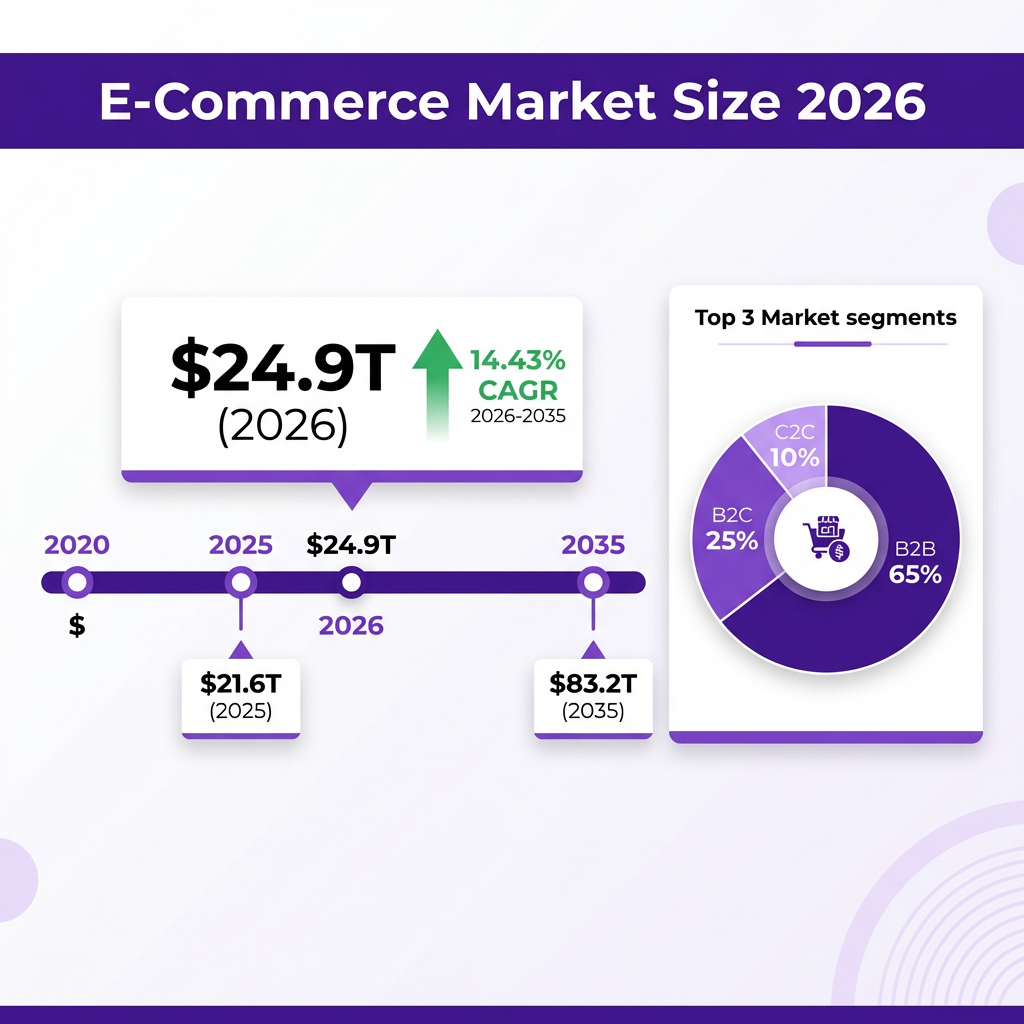
The e-commerce market of 2026 represents one of the largest economic shifts in human history. According to Precedence Research, the global e-commerce market size is valued at $21.62 trillion in 2025 and is projected to reach $24.90 trillion in 2026. This isn’t just incremental growth—it’s a fundamental restructuring of how commerce happens globally. The compound annual growth rate (CAGR) of 14.43% from 2026 to 2035 indicates that we’re still in the relatively early stages of this transformation, with the market expected to nearly quadruple over the next decade.
To understand the scale of this market, consider that e-commerce now accounts for more than 20% of total global retail sales. By 2027, online sales are expected to make up nearly a quarter (22.6%) of all retail transactions worldwide. This shift has been accelerated by several factors: the proliferation of smartphones, improved logistics infrastructure, the normalization of digital payments, and perhaps most significantly, changing consumer behaviors that have been permanently altered by the digital-first experiences of recent years.
The regional distribution of e-commerce activity reveals important insights for businesses planning their market entry strategies. Asia Pacific dominates with over 57% of global e-commerce revenue in 2025, driven primarily by China’s massive digital economy. China remains the world’s largest e-commerce market, with platforms like Alibaba and JD.com processing transactions that dwarf their Western counterparts. However, Europe and North America represent highly mature markets with strong growth potential in specialized niches. The European online retail market alone is forecast to generate $805 billion in earnings in 2026, with online penetration approaching 40% in many countries.
The B2B e-commerce segment deserves particular attention because it represents the largest portion of the market by transaction value. The B2B e-commerce market is expected to reach $36 trillion by 2026, growing at a 14.5% CAGR. This segment has been slower to digitize than B2C, which means there’s still significant runway for growth. A remarkable 61% of B2B buyers now prefer a buying journey that doesn’t involve a sales representative, and since 2020, over 90% of B2B companies have transitioned to virtual sales models. The number of decision-makers willing to invest $10 million or more in e-commerce transactions has increased by 83%, signaling that even the largest B2B purchases are moving online.
The consumer side of the equation is equally impressive. Over 3 billion people now purchase online annually, representing nearly half of the global internet population. This massive user base has an average revenue per user (ARPU) of approximately $3,950, indicating strong monetization across diverse markets. The demographic composition of online shoppers is also evolving. Gen Z shoppers primarily use Instagram (53%) and TikTok (41%) for product discovery, while Millennials prefer Instagram (52%) and Facebook (49%). This generational shift is driving platform strategies and marketing investments across the industry.
Looking at the technology infrastructure supporting this growth, there are now more than 31 million e-commerce websites and online stores on the internet. Shopify alone powers approximately 30% of e-commerce websites in the U.S., with 24% from regular Shopify stores and 6% from Shopify Plus enterprise accounts. Shopify’s platform accounts for 30% of the top 1 million websites globally, demonstrating its dominance in the infrastructure layer of e-commerce. This concentration of market power among a few key platforms has significant implications for merchants, who must navigate platform policies, fees, and competitive dynamics while building their businesses.
Key Statistics and Data Points Defining the Industry
The e-commerce industry of 2026 is defined by a set of compelling statistics that reveal both the opportunities and challenges facing businesses in this space. Understanding these numbers is crucial for strategic planning, resource allocation, and competitive positioning. Let’s examine the most significant data points across various dimensions of the e-commerce ecosystem.
Market Size and Growth: Global e-commerce sales are projected to hit $6.88 trillion in 2026, representing 7.2% year-over-year growth from the prior year. This follows the 8.3% growth seen in 2025, when sales reached $6.86 trillion. By 2028, global e-commerce sales are forecasted to reach $7.89 trillion. The long-term trajectory is even more impressive, with the market expected to grow from $24.90 trillion in 2026 to approximately $83.19 trillion by 2035. This sustained growth rate of over 14% annually indicates that e-commerce will continue to capture an increasing share of global commerce.
Consumer Behavior: Approximately 2.86 billion digital buyers are expected globally in 2026. Around 27% of people worldwide now shop online regularly. The average cart abandonment rate stands at 70.22%, meaning 7 out of 10 shoppers abandon their carts before completing a purchase. This statistic highlights the critical importance of checkout optimization, retargeting strategies, and friction reduction in the purchase process. Mobile devices now account for nearly 59% of total online retail sales, making mobile optimization not just important but essential for any e-commerce operation.
Platform Dominance: Amazon generated approximately $440 billion in U.S. sales in 2025, representing a 35.7% share of the $1.2 trillion U.S. e-commerce market. Shopify claimed a 14% share of U.S. e-commerce, up from 12% the previous year. Together, these two platforms account for approximately 50% of all U.S. e-commerce activity. Walmart remains the most significant competitor outside this duopoly, though its marketplace GMV of roughly $10 billion is still a fraction of Amazon’s volume. eBay posted $39.1 billion in U.S. GMV in 2025, up 10% year-over-year, having successfully pivoted to focus on enthusiasts and collectors.
Social Commerce: Social commerce sales have exceeded $1.17 trillion globally. TikTok Shop reached an estimated $15.1 billion in U.S. GMV in 2025, remarkable scale for a platform in only its second full year of operation. Instagram and Facebook remain dominant discovery platforms, with 53% of Gen Z using Instagram for product discovery and 52% of Millennials doing the same. The integration of shopping features directly into social media platforms has transformed these from purely marketing channels into full-fledged sales channels.
B2B Transformation: B2B digital sales have grown from 13% in 2013 to 80% in 2025, marking a 67% increase over 12 years. The proportion of B2B companies’ e-commerce revenue from digital channels has grown from 32% in 2020 to a projected 56% by 2025 in the U.S. 75% of buyers are ready to change suppliers for a more seamless and user-friendly online buying experience. 73% of B2B buyers are members of Generation Z, who prefer to make online purchases and expect digitally rich buying experiences.
Conversion and Performance: Average e-commerce conversion rates vary significantly by industry, but generally fall between 2.5% and 3% across most sectors. The introduction of AI-powered personalization has shown to increase conversion rates by up to 20% in some implementations. Live chat integration has helped businesses like Ad Hoc Atelier increase conversion rates from 0.35% to 0.9% while reducing cart abandonment from 83% to 73%. Average response times have been reduced from hours to minutes through automation, with some companies achieving 1-minute average response times.
Future Projections: U.S. e-commerce sales are projected to reach $1.8 trillion by 2030. By 2040, the share of online purchases is expected to rise to 95%, while physical stores will account for just 5% of transactions. The global AI e-commerce market is anticipated to approach $51 billion by 2033, expanding at a CAGR of 24.3%. These projections suggest that the transformation we’re witnessing is not a temporary shift but a permanent restructuring of global commerce.
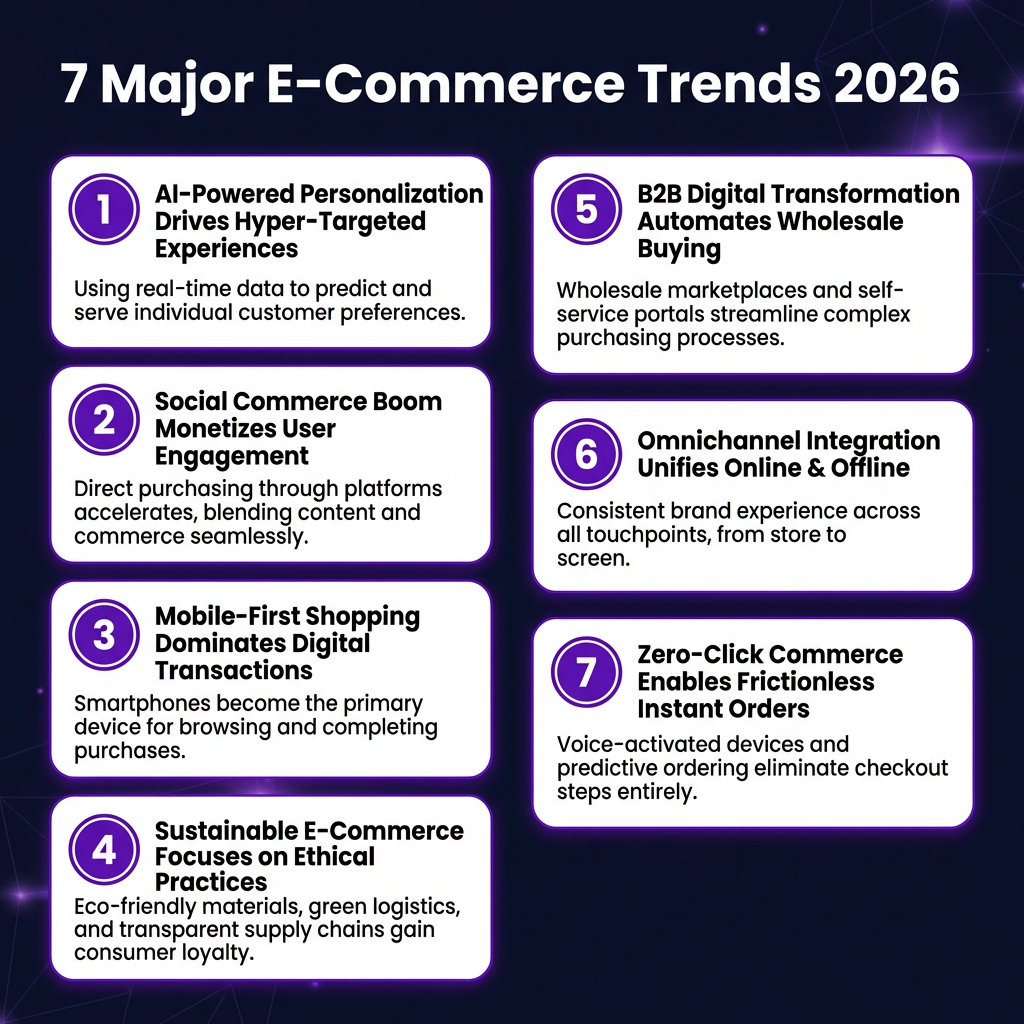
Seven Major Trends Shaping E-Commerce in 2026
The e-commerce landscape of 2026 is being reshaped by several powerful trends that are fundamentally altering how businesses operate and how consumers shop. Understanding these trends is essential for anyone looking to build or scale an online business. Let’s examine each trend in detail, with data and examples that illustrate their impact.
1. AI-Powered Personalization and Automation
Artificial intelligence has moved from a marketing buzzword to an operational necessity in e-commerce. The global AI e-commerce market is projected to reach $51 billion by 2033, growing at a 24.3% CAGR. AI is now being deployed across the entire e-commerce value chain, from demand forecasting and inventory management to personalized product recommendations and customer service automation.
The shift in AI application is notable: it’s moving from front-end customer interfaces to back-end operational decision-making. Forecasting demand, allocating inventory, and routing orders are increasingly handled by AI systems designed to respond faster than human-led processes, especially during volatility or sudden demand spikes. Machine learning algorithms now enable dynamic pricing, visual search accuracy, and real-time fraud detection that protects transactions while improving conversion rates.
Generative AI tools are being used to automatically generate marketing content, product descriptions, and even visual assets. Chatbots and virtual assistants like Agentforce provide 24/7 customer care, handling routine inquiries while escalating complex issues to human agents. The result is improved customer satisfaction, reduced operational costs, and increased sales through better-targeted recommendations.
2. The Explosion of Social Commerce
Social commerce has transcended its experimental phase to become a major sales channel. With over $1.17 trillion in global sales, platforms like Instagram, TikTok, and Facebook have transformed from discovery tools into full-fledged marketplaces. TikTok Shop’s rapid growth to $15.1 billion in U.S. GMV in just its second year demonstrates the power of integrating entertainment with commerce.
The demographic patterns are clear: Gen Z primarily uses Instagram (53%) and TikTok (41%) for product discovery, while Millennials prefer Instagram (52%) and Facebook (49%). This shift requires businesses to rethink their marketing strategies, investing in content creation, influencer partnerships, and platform-native shopping experiences rather than simply driving traffic to external websites.
The key insight for 2026 is that social commerce isn’t just about selling—it’s about building community, creating authentic content, and meeting customers where they already spend their time. Brands that treat social platforms as mere advertising channels are missing the deeper opportunity to build relationships and loyalty through genuine engagement.
3. Mobile-First Shopping Dominance
Mobile commerce now accounts for nearly 59% of total online retail sales, making smartphones the primary shopping device for consumers worldwide. This shift has profound implications for website design, checkout flows, and payment methods. Mobile optimization is no longer a nice-to-have—it’s the primary consideration for e-commerce development.
The rise of mobile has also driven adoption of mobile wallets, one-click checkout solutions, and app-based shopping experiences. Consumers expect seamless transitions between discovery (often on social media), research (on mobile browsers), and purchase (through optimized mobile checkout). Any friction in this mobile journey directly impacts conversion rates and revenue.
Progressive Web Apps (PWAs), accelerated mobile pages (AMP), and platform-specific apps are all part of the mobile commerce ecosystem. The businesses winning in 2026 are those that have invested in creating fast, intuitive, and secure mobile experiences that match or exceed the quality of their desktop counterparts.
4. Sustainable and Ethical E-Commerce
Sustainability has moved from a niche concern to a mainstream expectation. Consumers increasingly want to know the environmental and social impact of their purchases, and they’re willing to pay a premium for products that align with their values. ESG (Environmental, Social, and Governance) considerations are now central to e-commerce strategy, affecting everything from product sourcing to packaging and shipping.
This trend manifests in several ways: carbon-neutral shipping options, sustainable packaging materials, transparent supply chains, and product lifecycle information. Brands that can authentically communicate their sustainability efforts are building stronger customer loyalty and commanding higher price points. Conversely, brands that ignore these concerns risk alienating significant portions of their potential customer base, particularly among younger demographics.
The operational implications are significant. Businesses are investing in greener logistics, circular economy models (including resale and recycling programs), and transparent reporting on environmental impact. This isn’t just marketing—it’s becoming a operational requirement for competing in the modern e-commerce landscape.
5. B2B Digital Transformation Acceleration
The B2B e-commerce revolution is perhaps the most significant underreported story of 2026. With the market expected to reach $36 trillion and 61% of B2B buyers preferring rep-free buying experiences, the traditional B2B sales model is being fundamentally restructured. The shift from 13% digital sales in 2013 to 80% in 2025 represents one of the fastest transformations in business history.
This transformation is driven by changing buyer demographics—73% of B2B buyers are now Generation Z or Millennials who expect the same digital experiences in their professional purchases as they get in their personal shopping. They want self-service portals, transparent pricing, instant quotes, and seamless reordering capabilities.
The implications extend beyond technology to organizational structure. Companies are retraining sales teams to focus on complex consultative selling while automating routine transactions. The businesses thriving in B2B e-commerce are those that have invested in sophisticated e-commerce platforms that can handle complex pricing, contract management, and integration with procurement systems.
6. Omnichannel Integration and Unified Commerce
The distinction between online and offline retail has become increasingly meaningless. Modern consumers expect seamless experiences across all touchpoints—whether they’re browsing on mobile, purchasing in-store, or returning via mail. Omnichannel order orchestration has become mandatory, not optional.
This trend encompasses click-and-collect services, ship-from-store fulfillment, unified inventory visibility, and consistent pricing and promotions across channels. The technology challenge is significant: businesses must integrate e-commerce platforms, point-of-sale systems, inventory management, and customer data platforms to create truly unified experiences.
The businesses winning in omnichannel are those that view it not as a technology project but as an organizational transformation. Breaking down silos between online and offline teams, aligning incentives, and creating unified customer views are just as important as the technical integrations.
7. Zero-Click Commerce and Predictive Purchasing
Perhaps the most futuristic trend gaining traction in 2026 is zero-click commerce—the use of predictive AI to ship orders before customers even place them. For consumables and regularly purchased items, AI systems analyze usage patterns, predict when replenishment is needed, and automatically process orders.
This trend extends to AI agents and personal assistants that browse, compare, and execute purchases on behalf of consumers. Instead of manually searching for products, consumers are delegating purchasing decisions to AI agents that understand their preferences, budgets, and requirements.
For merchants, this trend requires new approaches to visibility and customer acquisition. If AI agents are making purchasing decisions, then traditional marketing and SEO strategies may become less relevant. Instead, businesses need to ensure their products are discoverable by AI systems, with comprehensive data, competitive pricing, and strong reputation signals.
Key Players and the Competitive Landscape
The e-commerce competitive landscape of 2026 is characterized by extreme concentration at the top, with Amazon and Shopify controlling approximately half of the U.S. market, while a fragmented long tail of smaller players competes for the remaining share. Understanding this competitive dynamic is crucial for any business entering or operating in the e-commerce space.
Amazon: The Marketplace Behemoth
Amazon generated approximately $440 billion in U.S. sales in 2025, representing a 35.7% share of the entire U.S. e-commerce market. Globally, Amazon’s GMV surpassed $800 billion in 2025. The company’s marketplace model—infrastructure that sellers inhabit but shoppers interact with as a unified Amazon experience—has proven remarkably resilient and scalable.
Amazon’s competitive advantages include its vast fulfillment network, Prime membership program with over 200 million members globally, sophisticated advertising platform, and the trust it has built with consumers over two decades. For sellers, Amazon offers unparalleled reach but at the cost of significant fees, intense competition, and dependence on a platform they don’t control.
The company’s strategy continues to emphasize operational excellence, with investments in faster delivery (same-day and one-day shipping), AI-powered shopping experiences, and expansion into new categories and geographies. For competitors, Amazon sets the baseline for customer expectations around selection, price, and delivery speed.
Shopify: The Infrastructure Layer
Shopify represents a fundamentally different model from Amazon. Rather than operating a centralized marketplace, Shopify provides the infrastructure for millions of independent merchants to operate their own branded storefronts. With a 14% share of U.S. e-commerce (up from 12% the previous year) and global GMV of $378 billion, Shopify has become the dominant platform for independent e-commerce.
Shopify’s model appeals to merchants who want to own their customer relationships, control their brand experience, and avoid the race-to-the-bottom pricing common on marketplaces. The platform’s ecosystem includes payments (Shopify Payments), fulfillment (Shopify Fulfillment Network), and a vast app marketplace that extends functionality.
The company’s global GMV is now 66% as large as Amazon’s third-party marketplace GMV, up from 40% in 2020 and 25% in 2018. This growth trajectory suggests that the independent commerce model is gaining ground against centralized marketplaces, at least in terms of aggregate transaction volume.
Walmart: The Omnichannel Challenger
Walmart remains the most significant competitor to Amazon at scale, though its online marketplace (estimated at roughly $10 billion in GMV) is still a fraction of Amazon’s volume. Walmart’s competitive advantage lies in its physical footprint—over 4,700 stores in the U.S. that can serve as fulfillment centers, pickup locations, and returns centers.
The company’s omnichannel strategy leverages this physical presence to offer services like curbside pickup, same-day delivery, and easy returns that pure-play e-commerce companies struggle to match. Walmart+ membership program provides an alternative to Amazon Prime, though it hasn’t achieved the same level of market penetration.
eBay: The Niche Specialist
eBay posted $39.1 billion in U.S. GMV in 2025, up 10% year-over-year. After years of struggling to compete with Amazon in general merchandise, eBay has successfully pivoted to focus on enthusiasts and collectors—categories where its auction model and unique inventory provide genuine differentiation.
This focus strategy has allowed eBay to find profitable growth in segments like sneakers, luxury goods, trading cards, and collectibles. By acknowledging it couldn’t win in new-in-season goods, eBay has built a sustainable position in areas where curation, authentication, and community matter more than price and speed.
Emerging Players: TikTok, Temu, and Shein
Several newer entrants are reshaping specific segments of the e-commerce market. TikTok Shop reached $15.1 billion in U.S. GMV in 2025, demonstrating the power of integrating entertainment and commerce. By allowing users to purchase products without leaving the app, TikTok has created a new paradigm for impulse purchasing driven by content.
Temu and Shein have disrupted the ultra-low-price segment, leveraging direct-from-manufacturer supply chains and aggressive social media marketing to offer prices that traditional retailers can’t match. However, their de minimis advantage (avoiding tariffs on small shipments) has been structurally eroded by regulatory changes, potentially impacting their long-term competitiveness.
These emerging players represent different strategic approaches to e-commerce: TikTok with content-driven discovery, Temu and Shein with extreme cost leadership. Their success demonstrates that despite Amazon and Shopify’s dominance, there are still opportunities for differentiation and growth in specific segments.

Challenges and Pain Points in E-Commerce 2026
Despite the enormous growth and opportunity in e-commerce, businesses face significant challenges that can make or break their success. Understanding these pain points is essential for developing strategies to overcome them. Let’s examine the three most critical challenges facing e-commerce businesses in 2026.
1. Cart Abandonment and Conversion Optimization
The average cart abandonment rate of 70.22% represents a massive loss of potential revenue for e-commerce businesses. This means that for every 10 customers who add items to their cart, only 3 complete their purchase. The causes are well-documented: unexpected shipping costs, complicated checkout processes, mandatory account creation, security concerns, and limited payment options.
Addressing cart abandonment requires a multi-faceted approach. Transparent pricing—including shipping costs—early in the shopping journey reduces surprises at checkout. Guest checkout options eliminate friction for first-time buyers. Multiple payment methods, including digital wallets and buy-now-pay-later options, accommodate diverse customer preferences. Trust signals like security badges, reviews, and clear return policies address security concerns.
Retargeting strategies, including abandoned cart emails and display ads, can recover a portion of lost sales. However, the most effective approach is prevention—designing checkout flows that minimize friction and address objections before they lead to abandonment. Companies like Ad Hoc Atelier have demonstrated that live chat integration can reduce cart abandonment from 83% to 73% while increasing conversion rates.
2. Fulfillment and Logistics Complexity
As e-commerce scales, fulfillment has become a critical competitive battleground. Customer expectations for fast, free shipping have been set by Amazon Prime, creating pressure that smaller merchants struggle to meet. Rising shipping costs, supply chain disruptions, and the complexity of managing inventory across multiple channels create significant operational challenges.
In 2026, distributed and regionalized fulfillment networks have become essential for reducing transit times and managing risk. Storing inventory closer to end customers reduces shipping costs and delivery times but requires sophisticated inventory management and forecasting. The businesses thriving are those that have invested in tighter integrations between e-commerce platforms, warehouse management systems, and carriers.
Returns management has become a strategic capability rather than an afterthought. With return rates in some categories exceeding 30%, efficient reverse logistics, faster restocking, and clearer visibility into returned inventory are essential for cost control and customer satisfaction. The challenge is balancing customer-friendly return policies with the operational and financial reality of processing returns.
3. Customer Acquisition Costs and Platform Dependence
Customer acquisition costs (CAC) have risen dramatically across all channels as competition intensifies and privacy changes (like iOS 14.5’s App Tracking Transparency) have made targeting more difficult. For many e-commerce businesses, CAC has become the single largest expense, often exceeding the lifetime value (LTV) of acquired customers.
Platform dependence creates additional risk. Merchants selling on Amazon face increasing fees, intense competition, and the constant risk of account suspension or policy changes. Shopify merchants, while owning their customer relationships, depend on the platform for critical infrastructure. Social commerce sellers are subject to algorithm changes that can dramatically impact visibility overnight.
The solution to both challenges lies in diversification and direct relationships. Building owned channels—email lists, SMS subscribers, and direct traffic—reduces dependence on any single platform. Investing in retention and repeat purchase rates improves LTV:CAC ratios. Creating genuine brand differentiation, rather than competing solely on price, builds defensibility against both competitors and platform policies.
Opportunities and Growth Strategies
Despite the challenges, the e-commerce landscape of 2026 offers enormous opportunities for businesses that can execute effectively. Let’s explore three key growth strategies that are driving success in the current environment.
1. International Expansion and Cross-Border Commerce
With Asia Pacific representing over 57% of global e-commerce revenue, international expansion offers significant growth potential for businesses currently focused on single markets. Cross-border e-commerce has become increasingly accessible through platforms that handle localization, payments, and logistics.
Key considerations for international expansion include understanding local consumer preferences, navigating regulatory requirements (including data privacy and product standards), and building local logistics capabilities or partnerships. The businesses succeeding in cross-border commerce are those that invest in genuine localization—not just translation, but adaptation of product offerings, marketing messages, and customer service to local markets.
Europe represents a particularly attractive opportunity, with the market forecast to generate $805 billion in online retail earnings in 2026. The relative uniformity of the EU market, combined with high purchasing power and mature logistics infrastructure, makes it an attractive target for U.S. and Asian businesses looking to expand.
2. Subscription and Recurring Revenue Models
Subscription commerce has proven to be a powerful model for improving customer lifetime value and creating predictable revenue streams. From software (SaaS) to physical products, businesses are finding ways to convert one-time transactions into ongoing relationships.
The subscription model offers several advantages: predictable revenue that enables better planning and investment, higher customer lifetime value, ongoing customer relationships that enable upselling and cross-selling, and reduced customer acquisition costs through retention. For digital products like games and software, subscription models align incentives between providers and customers around ongoing value delivery.
Successful subscription businesses focus on reducing churn through excellent onboarding, ongoing engagement, and continuous value delivery. They also offer flexibility in subscription tiers, allowing customers to choose the level of service that matches their needs and budget.
3. AI-Driven Operational Excellence
The businesses achieving the highest margins in 2026 are those that have leveraged AI not just for marketing, but for operational optimization. From demand forecasting that reduces inventory carrying costs to dynamic pricing that maximizes revenue, AI is transforming the economics of e-commerce. Companies implementing AI-driven inventory management report reductions in stockouts of up to 65% while simultaneously decreasing excess inventory by 20-30%. These operational improvements translate directly to improved cash flow and profitability.
Beyond inventory, AI is revolutionizing customer service through intelligent chatbots that can handle 80% of routine inquiries without human intervention, freeing human agents to focus on complex issues that require empathy and judgment. Dynamic pricing algorithms analyze competitor pricing, demand patterns, and inventory levels in real-time to optimize prices for maximum revenue. Visual search capabilities allow customers to find products by uploading images, creating entirely new discovery pathways that drive incremental sales.
Specific applications include: inventory optimization that ensures popular products are in stock while minimizing excess inventory; fraud detection that reduces chargebacks and losses; customer service automation that handles routine inquiries while escalating complex issues; and personalized product recommendations that increase average order value.
The key insight is that AI in 2026 is not about replacing humans but augmenting them. The most successful implementations combine AI efficiency with human judgment, using automation for routine tasks while reserving human attention for high-value activities like complex customer issues, strategic decisions, and creative work.
Case Studies: Lessons from E-Commerce Success Stories
Theory is valuable, but real-world examples provide the most actionable insights. Let’s examine three case studies that illustrate different paths to e-commerce success.
Case Study 1: Ad Hoc Atelier — Conversion Optimization Through Live Chat
Ad Hoc Atelier, an Italian e-commerce platform offering exclusive clothing collections, faced a challenge that will be familiar to many online retailers: a cart abandonment rate of 83%, significantly higher than the industry average of 70%. The company was experiencing long response times, cold and generic email communications, and customers who didn’t want to communicate through phone calls.
The solution was implementing live chat software to recreate the experience of an in-store assistant. By adding a live chat button to their website, Ad Hoc Atelier was able to engage visitors at critical moments in their buyer’s journey, answering questions and providing recommendations in real-time. The results were dramatic: conversion rates increased from 0.35% to 0.9%, cart abandonment decreased from 83% to 73%, and average response times dropped from 3 hours to just 1 minute.
The key lesson from Ad Hoc Atelier is that sometimes the most effective e-commerce improvements come from replicating the best aspects of physical retail in the digital environment. Personal, immediate assistance—delivered through the right technology—can overcome the trust and friction barriers that cause cart abandonment.
Case Study 2: Dollar Shave Club — Subscription Model Disruption
Dollar Shave Club’s launch in 2012 with a viral video and simple value proposition—quality razors delivered to your door for a dollar a month—demonstrated the power of the subscription model to disrupt established industries. The company’s direct-to-consumer approach bypassed traditional retail channels, allowing them to offer significantly lower prices while building direct relationships with customers.
The company’s growth was explosive. Within five years, Dollar Shave Club had captured 15% of the U.S. razor market and was acquired by Unilever for $1 billion in 2016. The key factors in their success were: a clear, compelling value proposition; a frictionless subscription experience; clever, authentic marketing that resonated with their target demographic; and a focus on customer retention through excellent service and product quality.
The broader lesson is that subscription models can transform commoditized products into high-value recurring revenue streams. By focusing on convenience, cost savings, and customer experience, Dollar Shave Club proved that even mature markets can be disrupted with the right business model and execution.
Case Study 3: Gymshark — Community-Driven Growth
Gymshark’s journey from a garage-based startup to a $1 billion+ brand represents one of the most impressive e-commerce success stories of the past decade. Founded in 2012 by a 19-year-old university student, Gymshark leveraged social media and influencer partnerships to build a global fitness apparel brand with minimal traditional marketing spend.
The company’s strategy focused on building a community around fitness culture rather than simply selling products. By partnering with fitness influencers early and authentically engaging with their audience, Gymshark created a brand that customers felt personally connected to. The company’s use of social proof, limited-edition drops, and exclusive access created urgency and excitement that drove sales.
Gymshark’s success demonstrates the power of community-driven e-commerce. In an era of rising customer acquisition costs, building a loyal community that advocates for your brand can create sustainable competitive advantage. The company’s ability to generate massive sales during product drops without traditional advertising shows what’s possible when brand and community are aligned.
Future Outlook and Predictions: 2026-2030
Looking beyond 2026, several trends will shape the evolution of e-commerce through 2030 and beyond. Understanding these future developments is essential for long-term strategic planning.
The Continued Shift to Online: By 2040, the share of online purchases is expected to rise to 95%, while physical stores will account for just 5% of transactions. While this projection may seem extreme, the trajectory is clear: e-commerce will continue to capture an increasing share of total retail. U.S. e-commerce sales alone are projected to reach $1.8 trillion by 2030.
AI Integration Deepens: The global AI e-commerce market is anticipated to approach $51 billion by 2033, expanding at a CAGR of 24.3%. By 2030, AI will be deeply embedded in every aspect of e-commerce operations, from supply chain optimization to hyper-personalized customer experiences. The distinction between AI-assisted and traditional e-commerce will become meaningless as AI becomes table stakes.
Platform Consolidation Continues: The trend toward concentration of market power among a few dominant players is likely to continue. Amazon and Shopify’s combined 50% market share may increase further, though regulatory scrutiny could limit their growth. Meanwhile, the remaining 50% of the market will become increasingly fragmented, with niche players finding success in specialized segments.
Cross-Border Commerce Accelerates: As logistics networks improve and payment systems become more interoperable, cross-border e-commerce will become the norm rather than the exception. Businesses that can navigate the complexity of international selling—local regulations, cultural preferences, and logistics—will have access to the full global market of 3+ billion online shoppers.
New Interfaces Emerge: Voice commerce, augmented reality shopping, and AI agent-mediated purchasing will move from experimental to mainstream. The way consumers discover and purchase products will diversify beyond traditional websites and apps, requiring merchants to maintain presence across an expanding array of touchpoints.
Key Takeaways for E-Commerce Success in 2026
- Operational excellence is the new competitive advantage. In a mature market, the winners are those who execute flawlessly on fulfillment, customer service, and conversion optimization—not just those who acquire customers most aggressively.
- Mobile and social are non-negotiable. With 59% of sales on mobile and over $1.17 trillion in social commerce, businesses must optimize for these channels or risk irrelevance.
- Platform diversification reduces risk. Depending on a single platform—whether Amazon, Shopify, or a social media channel—creates vulnerability. Building owned channels and direct customer relationships provides stability.
- AI is transforming every aspect of e-commerce. From personalization to operations, businesses that effectively leverage AI will achieve significant competitive advantages in efficiency and customer experience.
- B2B e-commerce represents massive untapped opportunity. With 61% of B2B buyers preferring digital self-service and the market approaching $36 trillion, the B2B segment offers significant growth potential for businesses that can meet its unique requirements.
Sources and Citations
- Craftberry Global Ecommerce Statistics 2025/2026 – https://craftberry.co/articles/global-e-commerce-statistics
- Precedence Research E-commerce Market Size Forecast – https://www.precedenceresearch.com/e-commerce-market
- Marketplace Pulse: Amazon and Shopify Market Share – https://www.marketplacepulse.com/articles/amazon-and-shopify-are-now-half-of-us-e-commerce
- Digital Commerce 360: Top 15 Ecommerce Trends 2026 – https://www.digitalcommerce360.com/2026/01/06/top-15-ecommerce-trends-to-watch-in-2026/
- Flowlu: 60 E-commerce Stats for 2026 – https://www.flowlu.com/blog/productivity/ecommerce-statistics/
- Quantumrun E-commerce Business Statistics 2026 – https://www.quantumrun.com/consulting/ecommerce-business-statistics/
- Tidio: 15 Best Ecommerce Case Studies 2026 – https://www.tidio.com/blog/ecommerce-case-studies/
- Forrester US Retail E-Commerce Forecast 2025-2030 – https://www.forrester.com/blogs/us-retail-in-2030-e-commerce-expands-stores-still-matter/
- Retail Dive: US E-commerce Sales Forecast 2030 – https://www.retaildive.com/news/online-retail-sales-ecommerce-forecast-2030/812833/
- Voyado: Inside E-commerce 2026 Report – https://voyado.com/resources/guides/inside-e-commerce/