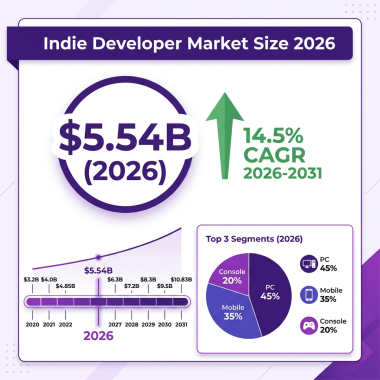
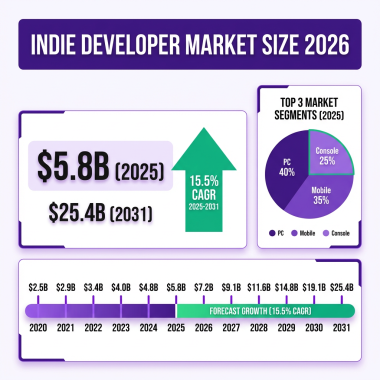
Welcome to the paradox of the indie developer market in 2026 — where the barrier to entry has never been lower, the tools have never been more powerful, but the path to sustainable success has never been more challenging. The global indie game market alone is projected to reach $5.54 billion in 2026, growing at a compound annual growth rate (CAGR) of 14.54% through 2031 when it will hit $10.83 billion. Yet beneath these impressive headline numbers lies a more complex reality: while the total revenue for indie games on Steam reached $650 million in Q1 2026 alone, this money is increasingly concentrated among a smaller number of breakout hits.
The broader indie developer ecosystem — spanning SaaS applications, mobile apps, developer tools, and digital products — has become one of the most dynamic segments of the technology industry. A perfect storm of factors is driving this growth: AI-powered development tools that democratize coding, bootstrapping resources that eliminate the need for venture capital, and platforms like Steam, App Store, and GitHub that provide global distribution at zero upfront cost.

Market Overview: The $5.54 Billion Indie Developer Ecosystem
The indie developer market has evolved dramatically over the past decade. What started as a niche community of hobbyist game developers has transformed into a legitimate career path for solo founders and small teams building everything from mobile games to enterprise SaaS applications. In 2025, independent games accounted for 25% of Steam’s total revenue — a figure that would have seemed impossible just five years ago.
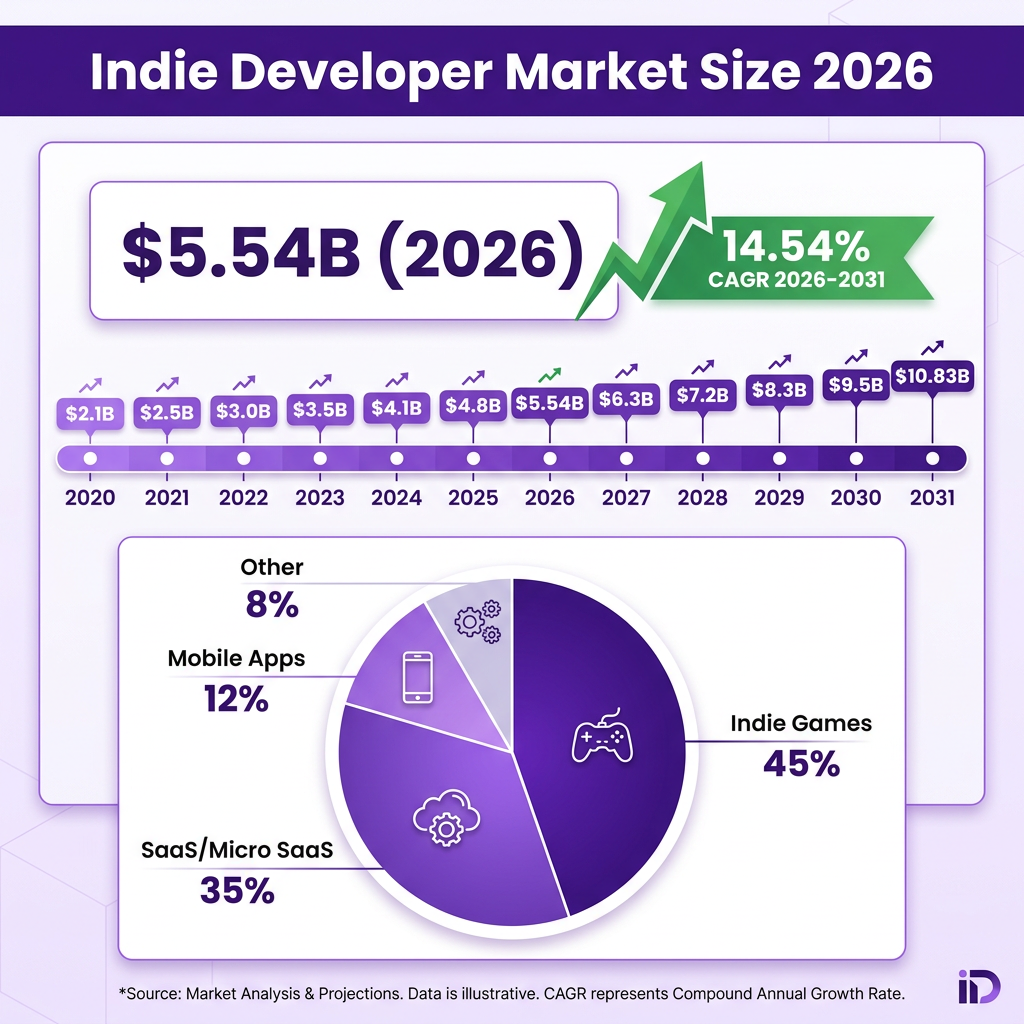
The market’s growth trajectory is impressive. The global indie game market, valued at $4.85 billion in 2025, is projected to surge to $5.54 billion in 2026 and reach an impressive $10.83 billion by 2031. This represents a robust compound annual growth rate of 14.54%, significantly outpacing many traditional software segments. But games are just one piece of the puzzle. The micro-SaaS segment alone is growing at roughly 30% annually, from $15.70 billion in 2024 to a projected $59.60 billion by 2030.
Regional distribution shows the United States leading with $3.1 billion in indie market revenue share in 2023, followed by the European Union at $2.8 billion. However, the democratization of development tools means we’re seeing explosive growth in emerging markets, where solo founders can compete on equal footing with developers from traditional tech hubs.
The broader SaaS industry context is equally relevant. The global SaaS market reached $399.10 billion in 2024 and is projected to hit $819.23 billion by 2030. Within this massive ecosystem, indie developers and micro-SaaS founders are carving out increasingly valuable niches, often achieving profitability faster than their venture-backed counterparts.
Key Statistics and Data Points
Understanding the indie developer market requires diving deep into the numbers that define success, failure, and everything in between. Here are the critical statistics that paint a complete picture of the landscape in 2026:
Market Size and Growth: The global indie game market is valued at $5.54 billion in 2026, with projections reaching $10.83 billion by 2031. The micro-SaaS segment is experiencing even faster growth at 30% annually. The broader SaaS market, which includes many indie developers, is projected to reach $819.23 billion by 2030.
Platform Performance: Steam remains the dominant platform for indie game developers, with indie games generating $650 million in Q1 2026 alone. Independent games now represent 25% of Steam’s total revenue. The median indie game on Steam earns between $5,000 and $15,000 in lifetime gross revenue, though top performers can reach millions.
Developer Demographics: 55% of indie developers are solo developers working alone. The average age of indie developers is 32 years, and women represent 30% of the indie developer community. 70% of indie games fail to generate sustainable revenue, highlighting the challenging nature of the market.
Revenue Benchmarks: The average micro SaaS earns $1,735 in monthly recurring revenue (MRR) with a 64% profit margin. Only around 5% of Indie Hackers products make more than $100,000 per year. Solo founders can reach six, seven, or even eight-figure revenue with the right product-market fit.
Development Trends: 90% of game developers are already using AI in their workflows, with 97% believing it is actively reshaping the industry. 7,300 Steam games reported using generative AI in 2026. AI reduces build time by 70%+ for many development tasks.
Bootstrapping Success: The share of startups with solo founders and no VC cash climbed from 22% in 2015 to 38% in 2024. Most bootstrapped SaaS businesses reach initial profitability between months 8-14. Early-stage founders often earn zero salary during the first 19 months until hitting breakeven.
Platform Distribution: PC remains the dominant platform for indie games, though mobile and console continue to grow. Digital distribution through Steam, Epic Games Store, and console marketplaces has eliminated traditional publishing barriers. Global distribution is now accessible to anyone with an internet connection.
Geographic Distribution: The United States leads the indie developer market with $3.1 billion in revenue share, followed by the European Union at $2.8 billion. However, emerging markets in Asia, Latin America, and Eastern Europe are showing explosive growth rates, with developers from these regions increasingly competing on the global stage. The democratization of development tools and distribution platforms has leveled the playing field, allowing talented developers from anywhere to reach global audiences.
Genre and Category Performance: RPGs and simulation games tend to generate higher lifetime value per player, which is why they appear more often among top-grossing indie titles. In the SaaS space, developer tools, productivity applications, and niche B2B solutions show the strongest performance. Games with long-term engagement mechanics — like progression systems, multiplayer features, and regular content updates — significantly outperform one-time purchase titles in revenue generation.
Funding and Investment Landscape: While bootstrapping dominates the indie scene, venture funding for indie developers reached new heights in 2025. However, only around 5% of Indie Hackers products make more than $100,000 per year, highlighting the difficulty of achieving significant revenue even with external funding. The most successful indie developers typically combine modest external funding with aggressive bootstrapping, maintaining control while accessing growth capital.
Competitive Landscape: The indie developer market has become increasingly competitive as barriers to entry have fallen. In 2026, an estimated 50,000+ new indie games and SaaS products will launch, creating a crowded marketplace where differentiation is essential. However, the total addressable market is also expanding rapidly, with new platforms, emerging markets, and evolving customer needs creating opportunities for developers who can identify and serve underserved niches. The developers succeeding in this environment are those who combine technical excellence with strong marketing, community building, and customer empathy.
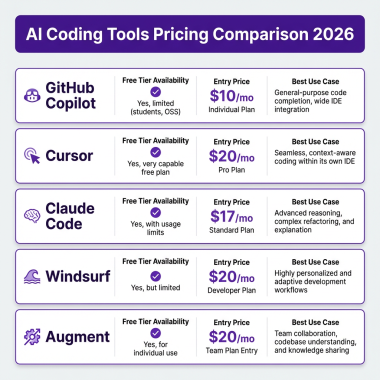
Technology Stack Evolution: The technology stacks used by indie developers have evolved significantly. Cloud infrastructure from AWS, Google Cloud, and Vercel has reduced operational costs to historic lows. Modern frameworks like React, Next.js, and Unity enable rapid development with professional-quality results. AI-powered tools like GitHub Copilot, Cursor, and Claude Code have transformed the development process, allowing solo developers to achieve productivity levels previously requiring entire teams. Payment processing through Stripe, Paddle, and merchant of record services like Fungies.io have eliminated the complexity of global commerce.
Major Trends Shaping the Indie Developer Market in 2026
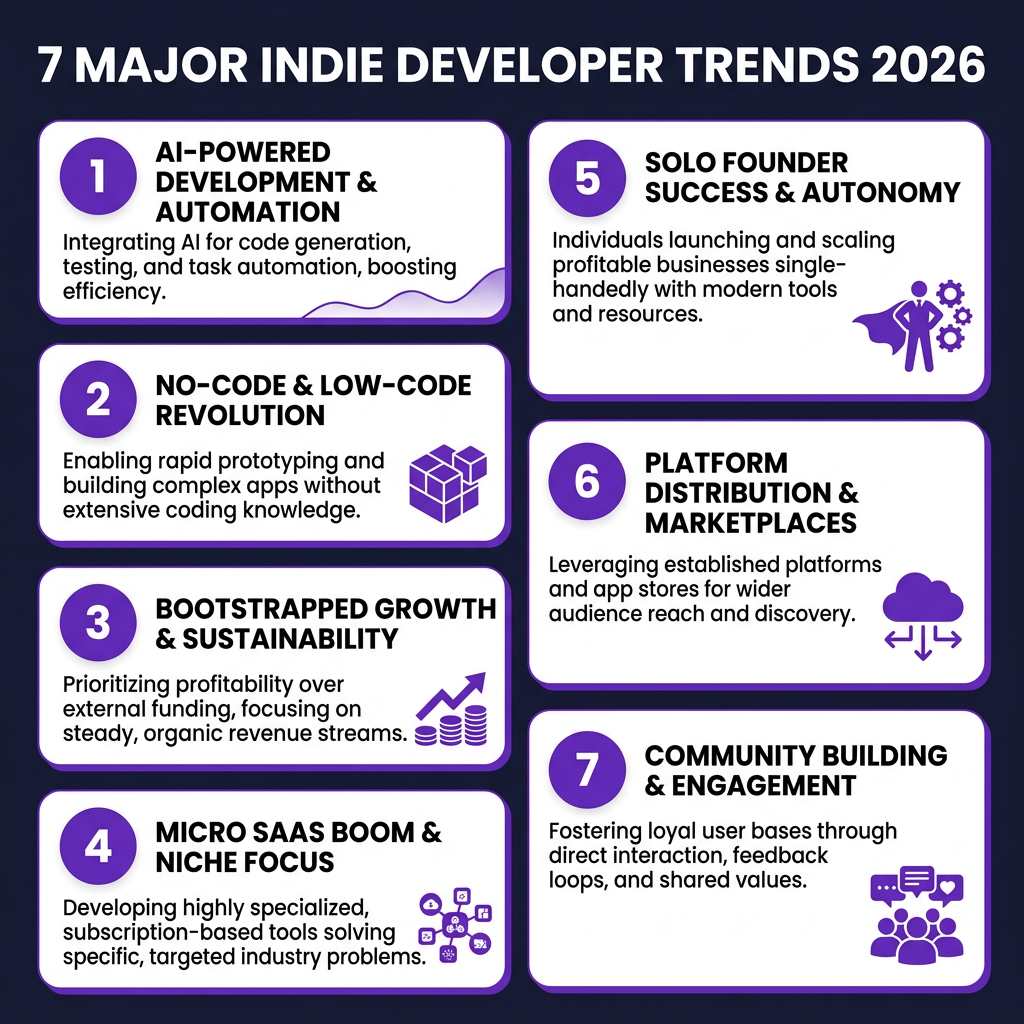
The indie developer landscape is being reshaped by nine powerful trends that are determining who succeeds and who gets left behind. Understanding these trends is essential for anyone looking to build an independent software business in 2026. These trends represent fundamental shifts in how software is built, distributed, and monetized — shifts that favor agile, community-focused developers over traditional corporate structures.
1. AI-Powered Development Revolution
Artificial intelligence has fundamentally transformed what solo developers can accomplish. AI coding assistants like Claude Code, Cursor, and GitHub Copilot now handle 80% of routine coding tasks, allowing indie developers to ship products in weeks that would have taken months in 2023. What took 3 months to build in 2023 now takes 2 weeks with modern AI tools.
But AI’s impact extends beyond coding. AI art generators have democratized asset creation for game developers. AI-powered testing tools can identify bugs and performance issues automatically. Natural language processing enables developers to create complex game narratives and dialogue systems without hiring writers. For SaaS founders, AI handles customer support, content creation, and marketing automation.
The statistics are striking: 87% of game developers are using AI agents in their workflows as of 2025. 90% of game developers are already using AI in their workflows, with 97% believing it is actively reshaping the industry. AI is not replacing developers — it is empowering them to create better experiences faster than ever before.
2. The No-Code and Low-Code Explosion
The barrier to building software has never been lower. No-code platforms like Webflow, Bubble, and FlutterFlow enable non-technical founders to build functional applications without writing a single line of code. Low-code solutions bridge the gap, allowing developers to move faster by handling boilerplate automatically.
This democratization means that indie developers can now focus on what matters most: solving real problems for real customers. The technical implementation, which once required years of programming experience, can now be handled by visual interfaces and AI-assisted coding tools. Many successful founders start with no-code platforms, then rebuild custom solutions once they’ve validated demand and generated revenue.
3. Bootstrapped Growth Over Venture Capital
A significant shift is occurring in how indie developers fund their projects. The share of startups with solo founders and no VC cash climbed from 22% in 2015 to 38% in 2024. This trend reflects a growing recognition that venture capital isn’t the only path to building a successful software business — and often isn’t the best path for indie developers.
Bootstrapping offers several advantages: complete ownership and control, no pressure to chase unsustainable growth metrics, and the ability to build at your own pace. Solo founders are hitting $20,000 MRR without employees. The economics have never been better for self-funded ventures, with cloud infrastructure costs at historic lows and AI tools reducing the need for large teams.
4. The Micro SaaS Boom
Micro SaaS — small, focused software products run by 1-3 people — has emerged as the dominant business model for indie developers. These products solve specific problems for narrow audiences, typically generating $50,000 to $3 million+ annually with profit margins exceeding 60%.
The micro-SaaS segment is growing at roughly 30% annually, significantly outpacing the broader SaaS market. The focused scope means products can be built and launched in 4 to 12 weeks rather than 6 to 24 months. Pricing typically ranges from $29 to $199 monthly, striking a balance between affordability for customers and sustainable revenue for founders.
5. Solo Founder Success Stories
The myth that you need a team to build a successful software business has been thoroughly debunked. One-person companies are generating serious revenue in 2026. From Stardew Valley (created by a single developer and generating tens of millions) to Photopea (a browser-based Photoshop alternative run solo for 11+ years) to TypingMind (an AI chat interface built by a solo founder), the examples are numerous and inspiring.
These success stories share common patterns: relentless execution, smart leverage of tools and platforms, and a focus on solving real problems rather than building perfect products. The key insight is that one person with a laptop and a “ship fast” mentality can out-earn a venture-backed startup with 50 employees.
6. Platform Distribution at Zero Cost
Distribution, once the biggest challenge for indie developers, has been solved by modern platforms. Steam, Epic Games Store, App Store, Google Play, and GitHub provide global reach with zero upfront cost. Social media platforms like Twitter/X, Reddit, and LinkedIn enable free marketing to targeted audiences.
This democratization of distribution means that a solo developer in Warsaw can compete on equal footing with teams in San Francisco. The platforms handle payment processing, tax compliance, and customer support, allowing developers to focus on building great products.
7. Community-Led Growth
Successful indie developers in 2026 are building communities around their products, not just customer bases. The “build in public” movement, popularized by platforms like Indie Hackers and Twitter, has shown that transparency and community engagement drive growth more effectively than traditional marketing.
Developers share their journey — successes and failures alike — building trust and attracting early adopters who become evangelists. This community-first approach creates sustainable competitive advantages that are difficult for larger competitors to replicate.
8. The Rise of AI-Generated Content
Generative AI has transformed content creation for indie developers. In 2026, over 7,300 Steam games reported using generative AI for assets, narratives, or gameplay elements. AI art generators like Midjourney, DALL-E, and Stable Diffusion enable developers to create professional-quality artwork without hiring artists. AI writing assistants help craft compelling narratives, dialogue, and marketing copy. For resource-constrained indie developers, these tools level the playing field against larger studios with bigger budgets.
However, this trend also raises important questions about originality, copyright, and player acceptance. Developers must navigate these concerns carefully, being transparent about AI usage while leveraging the productivity benefits. The most successful developers use AI as a tool to amplify their creativity rather than replace it entirely.
9. Subscription and Live Service Models
The business models employed by indie developers have shifted significantly toward recurring revenue. Rather than one-time purchases, successful indie games increasingly adopt live service models with regular content updates, battle passes, and cosmetic microtransactions. SaaS products naturally fit the subscription model, but we’re also seeing indie games embrace monthly subscriptions for premium features or early access.
This shift toward recurring revenue provides more predictable income streams, enabling developers to plan long-term and invest in ongoing development. Games as a service and SaaS subscriptions both benefit from the compounding effect of retained customers, where each month’s revenue builds upon the previous month’s base. This predictability is invaluable for solo developers who need to manage personal finances without the safety net of a regular salary.
Key Players and Success Stories
The indie developer market is filled with inspiring success stories that demonstrate what’s possible with the right combination of skills, timing, and execution. These stories prove that solo founders and small teams can build businesses that rival or exceed traditional venture-backed startups in both revenue and impact. Here are some of the most notable players and their achievements:
Pieter Levels (@levelsio)
Perhaps the most famous indie hacker of our time, Pieter Levels continues to dominate the indie developer scene in 2026. Known for his “ship fast” philosophy, Levels has built multiple successful products including Nomad List, Remote OK, and Photo AI. His approach — building 12 projects in 12 months to find what sticks — has inspired thousands of developers worldwide.
Levels’ success demonstrates the power of rapid iteration and public building. He doesn’t aim for perfection on the first try; instead, he optimizes for market feedback latency. When he launched an AI profile picture generator, he made $10,000 in the first day. His one-person empire now generates over $3 million annually.
Eric Barone (ConcernedApe)
The creator of Stardew Valley represents the gold standard of indie game development. Barone spent four years developing the game entirely by himself, handling programming, art, music, and writing. Stardew Valley has sold over 20 million copies and generated tens of millions in revenue — all created by a single developer.
Barone’s story illustrates the power of long-term compounding through quality. While many indie developers chase quick wins, Barone focused on creating something genuinely special. The result is a game that continues to sell years after release, providing ongoing revenue without ongoing work.
Ivan Kutskir (Photopea)
Kutskir built a Photoshop killer in the browser and ran it solo for 11+ years. Photopea is a free, browser-based image editor that rivals professional software in functionality. With millions of monthly users and premium subscriptions, Photopea generates substantial revenue while remaining a one-person operation.
The lesson from Kutskir’s success is clear: find a painful problem (expensive professional software), create a compelling alternative (free browser-based tool), and iterate based on user feedback over many years. Sustainable success comes from solving real problems, not chasing trends.
Danny Postma
A prominent figure in the AI-powered indie developer space, Danny Postma has built multiple successful AI products including HeadshotPro and AI Avatar generators. His approach combines rapid development, AI integration, and aggressive marketing to achieve impressive revenue numbers quickly.
Postma’s success demonstrates the opportunity at the intersection of indie development and AI. By leveraging AI tools to build AI products, he’s able to move faster than traditional developers while riding the wave of AI hype that drives customer interest.
AJ (ajlkn)
The creator of Carrd, a simple website builder that turned into a million-dollar solo empire. Carrd enables users to create simple, responsive one-page sites with zero coding required. By focusing on simplicity and a specific use case (one-page sites), AJ built a profitable business that serves millions of users.
AJ’s portfolio of micro-products demonstrates another viable strategy: building multiple small products rather than betting everything on one big idea. Each product serves a specific niche, and together they generate substantial recurring revenue.
Marc Lou (ShipFast)
Marc Lou has become a prominent figure in the indie developer community through his ShipFast boilerplate and transparent sharing of his journey. Starting from zero, Lou built multiple successful products and openly shared his revenue numbers, growth strategies, and lessons learned. His approach emphasizes rapid shipping, validating ideas quickly, and not falling in love with products before they’ve proven market demand.
Lou’s success demonstrates the power of building for developers, by developers. His products solve problems he personally experienced, ensuring genuine product-market fit. By sharing his journey publicly, he’s built a loyal following that eagerly awaits each new launch, providing immediate distribution for his products.
Sahil Lavingia (Gumroad)
While Gumroad has grown beyond a typical indie project, Sahil Lavingia’s journey from solo founder to running a platform that powers thousands of indie creators remains instructive. After laying off most of his staff and returning to profitability as a lean operation, Lavingia demonstrated that sustainable business models trump growth-at-all-costs mentalities.
Gumroad’s story illustrates the importance of adapting to market conditions and being willing to make difficult decisions. The platform’s focus on simplicity and creator empowerment has made it a favorite among indie developers selling digital products, courses, and memberships.

Challenges and Pain Points
Despite the opportunities, the indie developer market is not without significant challenges. Understanding these pain points is essential for anyone considering this path.
1. Market Saturation and Discovery
The same tools that make development easier have also flooded the market with new products. Steam released over 14,000 games in 2023, and the number continues to grow. The App Store adds thousands of new apps monthly. Standing out in this crowded landscape requires more than just a good product — it requires effective marketing, community building, and often, luck.
The “indiepocalypse” discourse reflects real concerns: while total market revenue grows, that revenue is increasingly concentrated among a smaller number of breakout hits. The median indie game earns only $5,000-$15,000 lifetime, not enough to sustain a full-time developer. 70% of indie games fail to generate sustainable revenue.
2. The Financial Reality
Indie development is financially precarious. Early-stage founders often earn zero salary during the first 19 months until hitting breakeven. Owner income for an indie game studio ranges from losses exceeding $235,000 in the first year to over $43 million in annual EBITDA by year 5 — but most never reach that upper range.
The realistic expectation for founder salary during the first two years is zero cash salary until the projected breakeven point. This financial pressure forces many talented developers to abandon their projects or return to traditional employment before achieving success.
3. Technical and Creative Burnout
Solo developers wear many hats: programmer, designer, marketer, accountant, customer support. This breadth of responsibility leads to burnout, especially when projects stretch over months or years without revenue. The isolation of solo work compounds the problem — there’s no team to share the burden or provide emotional support.
Many successful indie developers report periods of intense stress and burnout, even after achieving financial success. The passion that drives people to indie development can become all-consuming, damaging relationships and mental health.
4. Platform Risk and Dependency
Indie developers are increasingly dependent on platforms they don’t control. Steam, Apple, and Google can change their policies, algorithms, or fee structures with little warning. A single algorithm change can decimate discoverability. A policy update can render a business model obsolete.
This platform risk creates ongoing uncertainty. Successful developers diversify across multiple platforms, but this requires additional effort and expertise. The alternative — betting everything on a single platform — leaves developers vulnerable to forces beyond their control.
Opportunities and Growth Strategies
Despite the challenges, significant opportunities exist for indie developers who approach the market strategically. Here are the key growth strategies working in 2026:
1. AI-First Product Development
The developers seeing the fastest success in 2026 are those who build AI into their products from day one, not as an afterthought. AI-powered features create differentiation in crowded markets and command premium pricing. Customers are actively seeking AI-enhanced solutions, creating immediate demand for products that deliver genuine AI value.
The strategy is straightforward: identify a problem, determine how AI can solve it better than traditional approaches, and build the minimum viable product quickly. The AI landscape is moving fast — speed to market matters more than perfection.
2. Vertical Specialization
Generic products struggle to gain traction in saturated markets. The solution is vertical specialization — solving specific problems for specific industries. Instead of building “project management software,” build “project management software for dental practices” or “project management software for indie game developers.”
This approach reduces competition, increases pricing power, and makes marketing more efficient. The ideal bootstrapped SaaS niche combines four elements: narrow market focus (10,000-100,000 potential customers), clear pain points with quantifiable impact, manageable technical complexity, and willingness to pay $29-$199 monthly.
3. Build in Public
The “build in public” movement has proven its effectiveness. By sharing the development journey — including failures and setbacks — developers build trust and attract early adopters who become invested in their success. This community-first approach creates sustainable competitive advantages.
Platforms like Twitter/X, Indie Hackers, and Reddit provide free distribution to targeted audiences. The transparency of building in public also creates accountability, pushing developers to ship consistently rather than perfecting endlessly in private.
4. Portfolio Approach
Rather than betting everything on one product, successful indie developers are adopting a portfolio approach. Build multiple small products, see what resonates with the market, and double down on winners. Pieter Levels’ approach of building 12 projects in 12 months exemplifies this strategy.
The portfolio approach reduces risk and increases the probability of finding product-market fit. Not every product will succeed, but with multiple attempts, the odds of hitting a winner increase significantly. The key is keeping each project small enough that failure is survivable.
Case Studies: From Zero to Success
Real-world examples provide the most valuable insights. Here are three detailed case studies of indie developers who achieved significant success:
Case Study 1: Stardew Valley — The Long Game
Eric Barone spent four years developing Stardew Valley entirely by himself. He handled programming, art, music, writing, and design. The game launched in 2016 and has sold over 20 million copies, generating tens of millions in revenue.
Key Success Factors: Barone focused on quality over speed, creating a game that resonated emotionally with players. He solved a real problem — the lack of Harvest Moon-style games on PC. He engaged with the community throughout development, building anticipation and a loyal following.
Lessons: Long-term compounding through quality can outperform rapid iteration. Solving a genuine pain point for a passionate community creates sustainable demand. One person can compete with large studios by focusing on what matters most.
Case Study 2: Photo AI — Riding the AI Wave
Pieter Levels launched Photo AI, an AI photography platform, and generated $10,000 in revenue on the first day. The product leverages AI to create professional-quality photos without a camera, tapping into the massive demand for AI-powered creative tools.
Key Success Factors: Levels leveraged his existing audience from previous products. He moved fast, launching quickly to capture the AI hype wave. He identified a clear use case (professional headshots) with obvious value. He priced aggressively based on the value created.
Lessons: Timing matters — riding technology waves can accelerate growth dramatically. Existing audiences provide launch advantages that compound over time. Clear value propositions with obvious ROI convert better than abstract benefits.
Case Study 3: Bootstrapped SaaS to $8K MRR
A solo founder featured on Indie Hackers bootstrapped a workflow automation tool to $8,000 monthly recurring revenue in 5 months, starting with just $1,600 in savings and zero advertising budget. The founder focused on a specific niche, built in public, and leveraged community marketing.
Key Success Factors: The founder identified a painful problem in a specific industry. They built a minimal viable product quickly and iterated based on user feedback. They shared their journey publicly, attracting early adopters who became advocates. They avoided paid advertising, relying on organic growth and word-of-mouth.
Lessons: You don’t need venture capital to build a successful SaaS. Starting small and iterating beats perfecting in isolation. Community-driven marketing can outperform paid channels for niche products.
Case Study 4: Photopea — The Long-Term Solo Empire
Ivan Kutskir’s Photopea represents perhaps the most impressive solo developer achievement in recent history. Built and maintained entirely by one person for over 11 years, Photopea is a browser-based image editor that rivals Adobe Photoshop in functionality. With millions of monthly active users and a freemium business model generating substantial revenue, Photopea proves that sustainable success doesn’t require teams, funding, or constant pivots.
Key Success Factors: Kutskir identified a genuine pain point — expensive professional software — and created a compelling free alternative. He focused on feature parity with industry standards while maintaining the simplicity of a web application. Over more than a decade, he continuously improved the product based on user feedback, building an increasingly defensible position.
Lessons: Solving real problems with free alternatives to expensive software creates massive user bases. Long-term consistency compounds into competitive advantages that are impossible to replicate quickly. Technical excellence and continuous improvement matter more than marketing spend or growth hacks.
Future Outlook and Predictions (2026-2031)
The indie developer market will undergo significant transformation over the next five years. Here are the key predictions based on current trends and market dynamics:
Market Growth Projections
The global indie game market is projected to grow from $5.54 billion in 2026 to $10.83 billion by 2031, representing a CAGR of 14.54%. The micro-SaaS segment will grow even faster, from $15.70 billion in 2024 to $59.60 billion by 2030 — a 30% annual growth rate. By 2030, the typical knowledge worker will own stakes in 50-200 different assets, most generating $50-$500 monthly individually.
AI Democratization Accelerates
By 2027, AI development tools will be so advanced that non-programmers can build complex applications through natural language interfaces. This will flood the market with new products while simultaneously raising quality expectations. Developers who embrace AI early will have significant advantages over those who resist the transition.
Gartner predicts huge disruption in software development by 2026, with AI handling the majority of routine coding tasks. This isn’t just a tech trend — it’s a full-blown revolution that changes everything for indie hackers, SaaS founders, and solo developers.
Platform Consolidation and New Entrants
Expect continued consolidation among major platforms, with potential acquisitions and mergers changing the distribution landscape. At the same time, new platforms will emerge, particularly in AI-native distribution and Web3 ecosystems. Successful indie developers will maintain presence across multiple platforms to reduce dependency risk.
The Rise of Indie Collectives
While solo development will remain viable, we’ll see growth in indie collectives — loose associations of solo developers who collaborate on projects while maintaining independence. These collectives will share resources, cross-promote products, and provide mutual support without the overhead of traditional companies.
Regulatory Challenges
As indie developers handle more sensitive data and AI-generated content, regulatory scrutiny will increase. Privacy regulations, AI disclosure requirements, and platform-specific rules will create compliance burdens. Successful developers will invest in legal and compliance infrastructure early.
The Maturation of Indie Development
By 2031, indie development will no longer be considered an alternative path — it will be a mainstream career choice alongside traditional employment and venture-backed entrepreneurship. Educational institutions will offer courses in indie development, and “indie developer” will be a recognized job title. The stigma of “not being a real business” will have completely disappeared as solo founders routinely out-earn corporate executives.
The tools will continue to evolve, with AI handling increasingly complex tasks and no-code platforms enabling ever-more-sophisticated applications. However, the fundamentals will remain unchanged: solve real problems, move fast, build community, and stay persistent. The developers who master these fundamentals while leveraging new technologies will define the next era of software creation.
Key Takeaways
- The indie developer market is booming: Valued at $5.54 billion in 2026 and projected to reach $10.83 billion by 2031, with the micro-SaaS segment growing at 30% annually.
- AI is the great equalizer: 90% of developers now use AI tools, reducing build times by 70%+ and enabling solo founders to compete with larger teams.
- Bootstrapping is viable: 38% of startups now operate without VC funding, with solo founders hitting $20K+ MRR regularly.
- Discovery remains the biggest challenge: 70% of indie products fail to generate sustainable revenue due to market saturation and poor marketing.
- Specialization wins: Vertical-specific products targeting narrow niches outperform generic solutions in crowded markets.
- Community is everything: Building in public and cultivating engaged communities creates sustainable competitive advantages.
- Speed matters: The developers winning in 2026 are those who ship fast, iterate based on feedback, and ride technology waves early.
Sources and Citations
- Fungies.io Indie Developer Market Analysis 2026 – https://fungies.io/indie-developer-market-analysis-2026
- Accio Business 2025 Indie Game Trends – https://www.accio.com/business/2025-indie-game-trends
- Gitnux Indie Game Industry Statistics 2026 – https://gitnux.org/indie-game-industry-statistics
- Steam Page Analyzer Indie Game Revenue Data – https://www.steampageanalyzer.com
- Mordor Intelligence Indie Game Market Report – https://www.mordorintelligence.com/industry-reports/indie-game-market
- BigIdeasDB Micro SaaS Examples 2026 – https://bigideasdb.com/micro-saas-examples-2026
- SuperFrameworks Micro SaaS Ideas – https://superframeworks.com/articles/best-micro-saas-ideas-solopreneurs
- Solo Business Hub One-Person Company Examples – https://www.solobusinesshub.com/success-stories/one-person-company-examples
- Build MVP Fast Free AI Tools for Indie Hackers – https://www.buildmvpfast.com/blog/free-ai-tools-indie-hackers-2026
- GoodFirms AI in Game Development – https://www.goodfirms.co/blog/ai-in-game-development-studios-tools-experiences
- Riftwood Studio Rise of AI in Game Development – https://www.riftwoodstudio.com/blog/the-rise-of-ai-in-game-development-in-2026
- Indie Hackers Community – https://www.indiehackers.com
- How To Market A Game 2026 Q1 Analysis – https://howtomarketagame.com/2026/05/14/2026-q1-games
- Financial Models Lab Indie Game Studio Income – https://financialmodelslab.com/blogs/how-much-makes/indie-game-development-studio
- Reddit r/gamedev Indiepocalypse Discussion – https://www.reddit.com/r/gamedev/comments/1ssgxta/the_indiepocalypse_is_here_steam_q1_2026_data