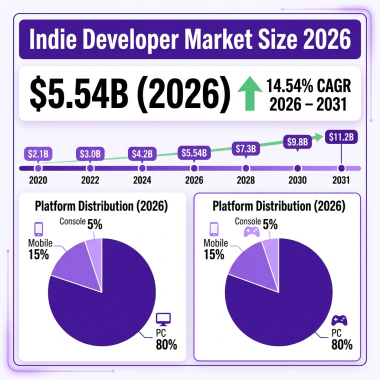
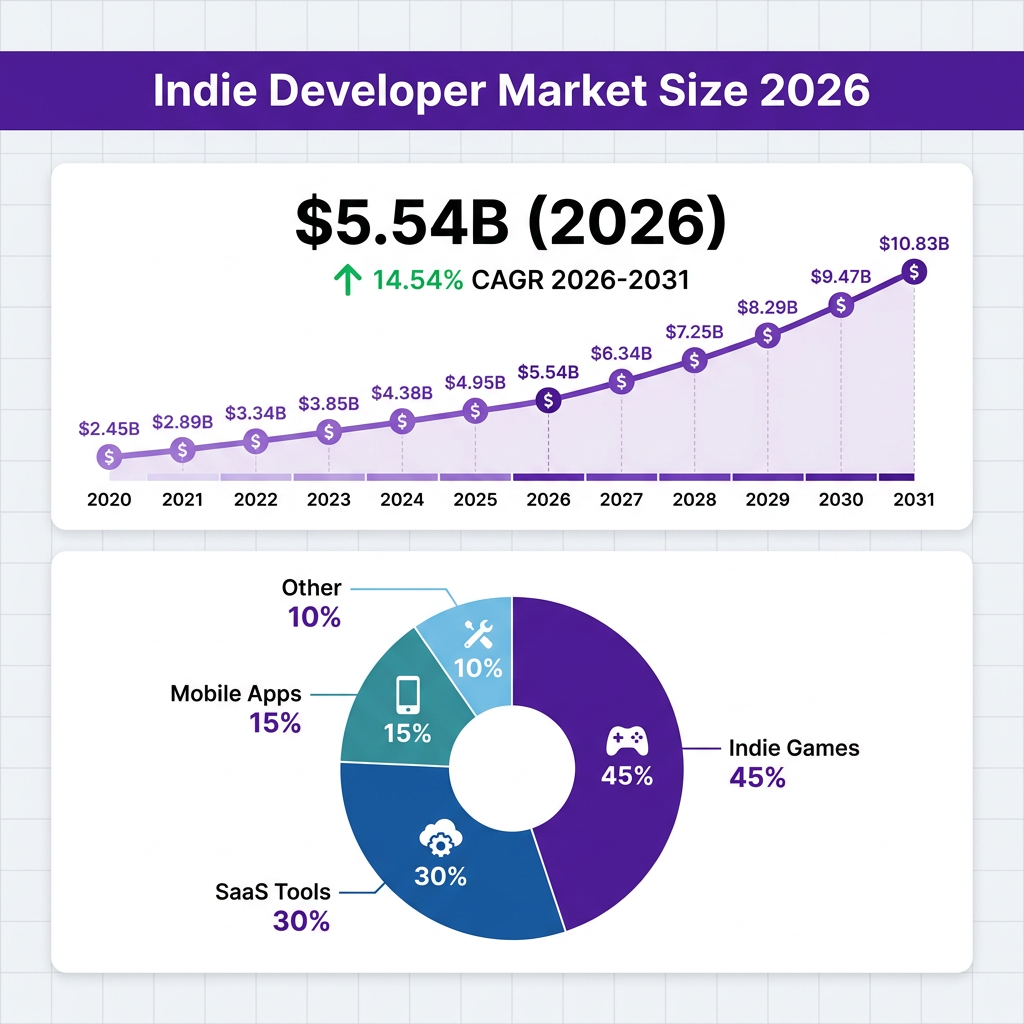
Welcome to the paradox of the indie developer market in 2026 — where the barrier to entry has never been lower, the tools have never been more powerful, but the path to sustainable success has never been more challenging. The global indie game market alone is projected to reach $5.54 billion in 2026, growing at a compound annual growth rate (CAGR) of 14.54% through 2031 when it will hit $10.83 billion. Yet beneath these impressive headline numbers lies a more complex reality: while the total revenue for indie games on Steam reached $650 million in Q1 2026 alone, this money is increasingly concentrated among a smaller number of breakout hits.
This is not just about games. The broader indie developer ecosystem — spanning SaaS applications, mobile apps, developer tools, and digital products — has become one of the most dynamic segments of the technology industry. A perfect storm of factors is driving this growth: AI-powered development tools that democratize coding, bootstrapping resources that eliminate the need for venture capital, and platforms like Steam, App Store, and GitHub that provide global distribution at zero upfront cost.
But here is the uncomfortable truth that most industry reports will not tell you: 70% of indie developers fail, and the median indie game on Steam earned just $249 in 2025. The median indie SaaS generates only $145 per month in recurring revenue. This is not a market for the faint of heart. It is a high-stakes arena where the winners take most, and the middle class is being squeezed.

Market Overview: The $5.54 Billion Indie Developer Ecosystem
The indie developer market has evolved dramatically from its garage-hacker origins. What started as a niche community of hobbyists has transformed into a legitimate career path and business model that attracts talent from major tech companies and fresh graduates alike. Understanding the scale and scope of this market is essential for anyone looking to enter or invest in this space.
The Global Indie Game Market
The indie game segment represents the most visible and well-documented portion of the indie developer market. According to multiple industry analyses, the global indie game market was valued at $4.85 billion in 2025 and is projected to reach $5.54 billion in 2026. This represents year-over-year growth of approximately 14.2%, a figure that outpaces many traditional sectors of the entertainment industry.
The long-term trajectory is even more impressive. Industry forecasts predict the market will reach $10.83 billion by 2031, maintaining a compound annual growth rate of 14.54% throughout the forecast period. This sustained growth is driven by several factors: the continued expansion of digital distribution platforms, the rising quality and sophistication of indie titles, and the growing acceptance of indie games as a legitimate alternative to AAA productions.
Steam, the dominant PC gaming platform, serves as the primary marketplace for indie developers. In 2025, Steam reported 147 million monthly active users, up 11.4% from 132 million in 2024. The platform generated $16.2 billion in revenue through November 2025, representing 50% annualized growth. Most significantly for indie developers, independent games accounted for 25% of Steam’s total revenue in 2025 — a figure that would have seemed impossible just five years ago.
The scale of the Steam marketplace is staggering. In 2025 alone, 19,606 new games were published on the platform. Of these, 5,863 titles earned over $100,000 in revenue. The top five new indie games of 2025 generated over $500 million in combined revenue. Yet these headline numbers mask a brutal reality: the median indie game on Steam earned just $249 in 2025, and most games make effectively nothing after accounting for Steam’s 30% cut, refunds, and taxes.
The Indie SaaS and Developer Tools Market
While indie games capture the headlines, the indie SaaS and developer tools market represents an equally significant and arguably more sustainable segment. According to BigIdeasDB’s State of Indie SaaS Revenue 2026 report, which analyzed 3,787 real bootstrapped SaaS businesses with non-zero revenue, the indie SaaS ecosystem is thriving — but with important caveats.
The median indie SaaS earns $145 per month. When a market is this skewed, the median is the only honest anchor — it tells us that half of all revenue-generating indie SaaS make less than $145 a month. However, the top performers tell a different story. Bootstrapped SaaS companies with $3M to $20M in ARR show median revenue growth of 15%, Net Revenue Retention (NRR) of 103%, and Gross Revenue Retention (GRR) of 91%.
The 90th percentile of bootstrapped SaaS companies in the $3M-$20M ARR range are growing by 42.3% annually, with NRR of 117.9%. These numbers demonstrate that while the median indie SaaS struggles to generate meaningful revenue, successful bootstrapped companies can achieve impressive growth rates and retention metrics that rival venture-backed competitors.
The broader SaaS market provides context for these figures. Gartner’s Q4 2025 SaaS Market Report indicates that micro-niches experienced 340% growth compared to broad market platforms — a trend that fundamentally reshapes entrepreneurial approaches to software development. This shift toward specialization benefits indie developers who can dominate narrow market segments that larger players ignore.
Key Statistics and Data Points
Data is the foundation of any serious market analysis. Here are the key statistics that define the indie developer landscape in 2026, organized by category for easy reference.
Market Size and Growth
- Global indie game market value 2026: $5.54 billion
- Projected market value 2031: $10.83 billion
- Compound annual growth rate (CAGR): 14.54%
- Indie games share of Steam revenue 2025: 25%
- Steam total revenue (Jan-Nov 2025): $16.2 billion
- Steam monthly active users 2025: 147 million (up 11.4% from 2024)
- Steam daily active users 2025: 69 million
- Steam concurrent user peak (Jan 2026): 41.81 million (all-time record)
- Games published on Steam 2025: 19,606
- Steam games earning $100K+ in 2025: 5,863 titles
- Indie SaaS median monthly revenue: $145
- Bootstrapped SaaS median growth rate ($3M-$20M ARR): 15%
- Bootstrapped SaaS 90th percentile growth rate: 42.3%
Developer Demographics and Work Patterns
- Indie developers working solo: 55%
- Indie developer failure rate: 70%
- Indie developers experiencing burnout/stress: 60%
- Average indie game development time: 18 months
- Indie developers using Unity: 82%
- Developers using AI tools in 2026: 84%
- Code that is AI-generated in real workflows: 41%
- Solo founders as share of new startups: Growing rapidly
Revenue and Financial Performance
- Median indie game lifetime earnings (commercial intent): $5,000-$15,000
- Median indie game Steam revenue 2025: $249
- Indie games revenue on Steam Q1 2026: $650 million
- Top 5 new indie games 2025 combined revenue: $500+ million
- US game developer median salary (GDC 2025): $129,000/year
- Most indie developers annual earnings: Under $20,000
- Indie SaaS median monthly recurring revenue: $145
- Bootstrapped SaaS median NRR: 103%
- Bootstrapped SaaS median GRR: 91%
Development Costs and Budgets
- Solo 2D mobile game budget: $10,000 – $50,000
- Small 2D indie game budget: $20,000 – $100,000
- Mid-scale indie game budget: $50,000 – $300,000
- High-end indie game budget: $300,000 – $2,000,000+
- Typical indie game budget range: £40,000 – £150,000 ($50K-$190K)
- Low-code platform development time reduction: Up to 90%
Seven Major Trends Shaping Indie Development in 2026
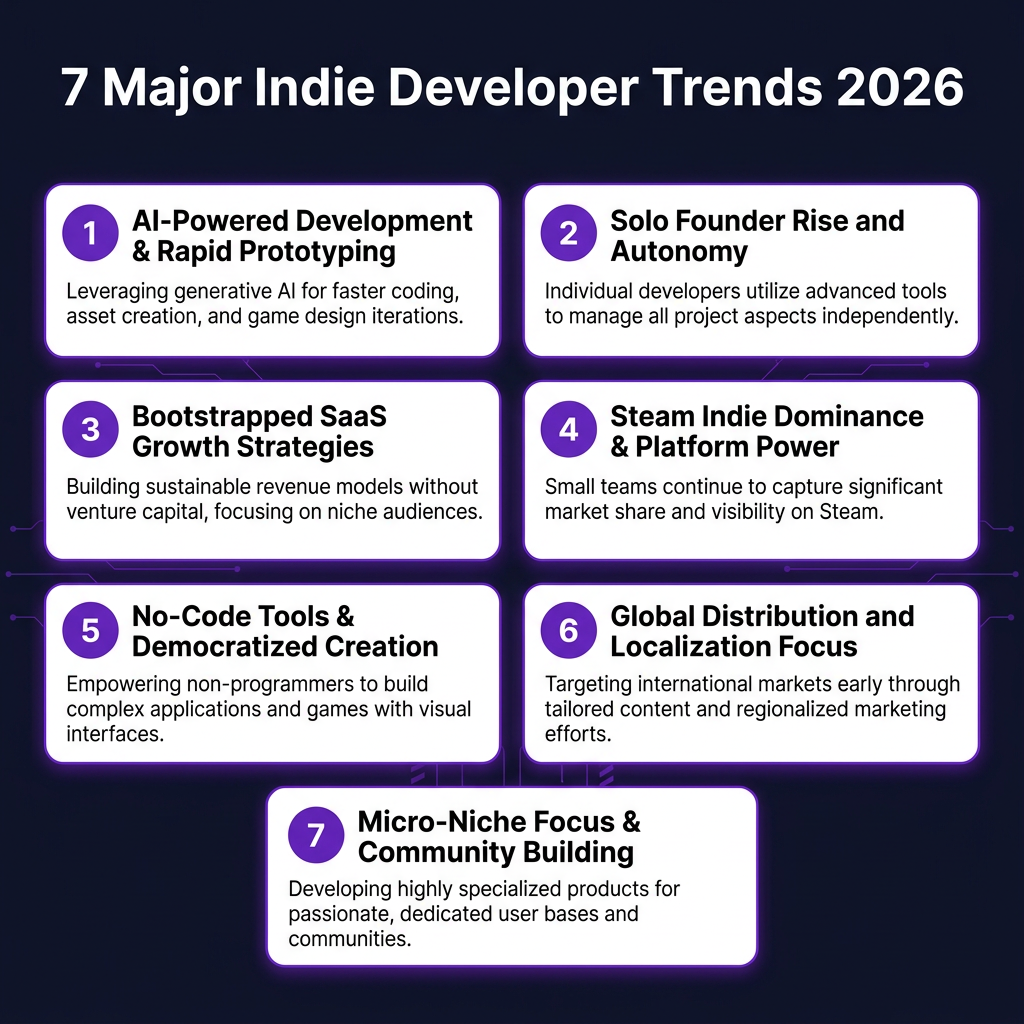
The indie developer landscape is evolving rapidly, driven by technological shifts, platform changes, and evolving consumer preferences. Here are the seven most significant trends defining the market in 2026.
1. AI-Powered Development Tools Democratize Creation
Perhaps no trend is transforming indie development more profoundly than the integration of AI-powered tools into the development workflow. In 2026, 84% of developers use or plan to use AI tools, and approximately 41% of all code is already AI-generated in real workflows. This represents a fundamental shift in how software gets built.
For indie developers, AI tools level the playing field. A solo developer with access to Claude Code, Cursor, or GitHub Copilot can now accomplish tasks that previously required a team of specialists. Code generation, debugging, testing, and even documentation can be accelerated dramatically. Some developers report 2-3x productivity improvements after integrating AI tools into their workflows.
The implications extend beyond coding. AI-powered art generation tools reduce the cost of visual assets. AI writing assistants help with marketing copy and store descriptions. AI analytics tools provide insights that previously required data science expertise. The barrier to creating a polished, professional product has never been lower.
2. The Rise of the Solo Founder
Independent solo founders now account for a rapidly growing share of new startups. The traditional model of building a company — raising venture capital, hiring a team, scaling quickly — is being challenged by a new paradigm. Solo founders are building profitable digital businesses with minimal funding, proving that you do not need investors or big teams to succeed online.
This trend is particularly visible in the SaaS space. Platforms like Indie Hackers document thousands of solo founders building businesses that generate anywhere from a few hundred to millions of dollars in annual revenue. The common thread: these founders prioritize autonomy, profitability, and direct control over their entrepreneurial journey.
The distinction between solopreneur, bootstrapper, and indie hacker is worth understanding. A solopreneur is a structure (one person). A bootstrapper is a funding choice (no VC). An indie hacker is a style (internet product + direct revenue + small scope). These categories increasingly overlap as more founders choose to build independently.
3. Bootstrapped SaaS Growth Accelerates
The bootstrapped SaaS movement is gaining momentum as founders reject the venture capital treadmill in favor of sustainable, profitable growth. According to SaaS Capital’s 2026 benchmarking survey of more than 1,000 private B2B SaaS companies, bootstrapped companies with $3M to $20M in ARR demonstrate impressive metrics: 15% median revenue growth, 103% NRR, and 91% GRR.
What makes bootstrapped SaaS particularly attractive to indie developers is the control it provides. Without external investors to answer to, founders can make long-term decisions, prioritize customer satisfaction over growth-at-all-costs, and build businesses that align with their personal values and lifestyle goals.
The micro-niche strategy is especially effective for bootstrapped SaaS. Gartner’s research shows micro-niches experienced 340% growth compared to broad market platforms. Indie developers can dominate narrow market segments that larger players ignore, building defensible businesses with loyal customer bases.
4. Steam’s Indie Dominance and the Revenue Shift
Steam’s 2025 data reveals a seismic shift in the gaming industry. Independent games now account for 25% of the platform’s total revenue. In the Platinum Tier — representing the top 12 highest grossing games — $20 indie titles like Hollow Knight: Silksong and Schedule 1 now stand shoulder to shoulder with billion-dollar franchises.
This represents a fundamental change in the economics of game development. To generate the same gross revenue as a $70 AAA game, these $20 indies must move nearly four times the volume. Yet they are doing exactly that, demonstrating that consumers are increasingly willing to support high-quality independent productions over formulaic corporate releases.
For indie developers, Steam’s dominance is a double-edged sword. The platform provides unparalleled access to 147 million monthly active users. But with 19,606 new games published in 2025, discoverability has become the primary challenge. Success on Steam now requires not just a great game, but sophisticated marketing, community building, and platform optimization.
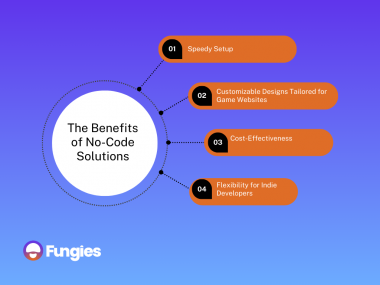
5. No-Code and Low-Code Platforms Expand Possibilities
Low-code and no-code platforms have significantly lowered the barriers to designing websites, databases, and complex automated workflows. According to industry research, these platforms can reduce development time by up to 90%, enabling creators with limited coding knowledge to build functional applications.
For indie developers, these platforms serve multiple purposes. Non-technical founders can build MVPs and validate ideas before investing in custom development. Technical founders can automate workflows, build internal tools, and create prototypes rapidly. The ecosystem of tools — from Webflow to Bubble to Retool — provides options for virtually every use case.
The distinction between low-code and no-code matters. Low-code platforms still require some technical knowledge but dramatically reduce the amount of hand-coding needed. No-code platforms enable non-technical users to build applications without writing any code. Both categories are maturing rapidly, with enterprise-grade features becoming standard.
6. Global Distribution at Zero Upfront Cost
The infrastructure for global distribution has never been more accessible. Platforms like Steam, the App Store, Google Play, and GitHub provide immediate access to billions of potential customers with no upfront fees. Payment processing, tax handling, and content delivery are handled automatically.
This democratization of distribution has profound implications. A developer in Warsaw, Jakarta, or Buenos Aires can reach the same global audience as a studio in San Francisco or Tokyo. The geographic barriers that once protected incumbent players have dissolved. Talent and execution matter more than location or connections.
However, global distribution also means global competition. When everyone can publish everywhere, standing out becomes harder. The developers who succeed are those who combine technical excellence with marketing sophistication, community engagement, and platform optimization.
7. Micro-Niche Focus and Specialization
The days of building general-purpose tools for broad markets are fading. The most successful indie developers in 2026 are those who dominate micro-niches — highly specific market segments that larger players ignore. This strategy offers several advantages: reduced competition, higher customer loyalty, better pricing power, and more efficient marketing.
Examples abound. Instead of building another project management tool, successful indie developers create tools for specific workflows: podcast production management, veterinary clinic scheduling, or church volunteer coordination. These micro-niches may seem small, but they can support highly profitable businesses when served well.
The 340% growth in micro-niches compared to broad market platforms validates this approach. Indie developers who embrace specialization are finding sustainable success while generalists struggle to differentiate.
Key Players and Competitive Landscape
The indie developer ecosystem includes a diverse array of platforms, tools, and communities that enable independent creators. Understanding the competitive landscape is essential for strategic positioning.
Distribution Platforms
Steam dominates PC gaming with 147 million monthly active users and 75% market share. The platform’s 30% revenue share is standard, though it reduces to 25% after $10 million and 20% after $50 million. Steam’s discovery algorithm, wishlist system, and seasonal sales events are critical for indie success.
Epic Games Store offers an 88/12 revenue split that challenges Steam’s dominance, though its user base remains smaller. Epic’s exclusive deals and free game programs provide alternative paths to visibility.
App Store and Google Play control mobile distribution. Both take 30% of revenue (15% for small developers under certain thresholds). The mobile market is larger than PC but more competitive, with discovery challenges that make Steam look manageable.
itch.io serves as the indie-friendly alternative, offering flexible revenue sharing (default 10%) and a community focused on experimental and artistic games. While smaller, itch.io provides valuable visibility for niche titles.
Development Tools and Engines
Unity remains the dominant game engine for indie developers, used by 82% according to industry surveys. Its asset store, cross-platform capabilities, and extensive documentation make it the default choice. However, recent pricing controversies have pushed some developers toward alternatives.
Unreal Engine offers superior graphical capabilities and a 5% royalty model (waived under $1 million). Its learning curve is steeper than Unity, but the gap is narrowing with each release.
Godot has emerged as the open-source alternative, gaining traction among developers concerned about Unity’s commercial direction. Completely free and MIT-licensed, Godot represents a viable option for developers prioritizing ownership and control.
GameMaker and Construct serve the 2D game market with approachable interfaces that require minimal coding. These tools enable non-programmers to create commercial-quality games.
AI Coding Assistants
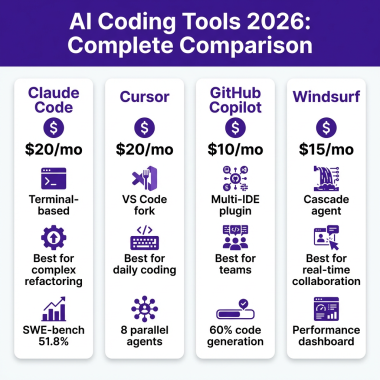
GitHub Copilot leads the market with broad IDE support and integration with existing workflows. Its subscription model ($10-19/month) is accessible to most indie developers.
Cursor has gained significant traction with its AI-native IDE approach, offering features like codebase-wide refactoring and natural language editing. Its pricing ($20/month Pro) targets professional developers.
Claude Code from Anthropic provides agentic capabilities that go beyond autocomplete, enabling complex multi-file operations and debugging assistance.
Replit, Codeium, and numerous other tools compete in this rapidly evolving space. The right choice depends on workflow, language preferences, and budget.

Challenges and Pain Points
The indie developer journey is not for the faint of heart. Despite the low barriers to entry, significant challenges make sustainable success elusive for most.
1. Discoverability Crisis
With 19,606 games published on Steam in 2025 alone, getting noticed is the primary challenge for indie developers. The median indie game earned just $249 — not enough to cover a month’s rent, let alone development costs. Discovery is a massive challenge for developers with commercial aspirations in 2026.
The platforms are not entirely indifferent to this problem. Steam’s discovery algorithm, curation features, and seasonal sales events provide pathways to visibility. But the sheer volume of releases means most games receive minimal organic exposure. Developers must build their own audiences through social media, content marketing, influencer outreach, and community engagement.
The marketing burden falls heavily on solo developers who may have no background in promotion. Building a game and building an audience are entirely different skill sets, yet both are required for success.
2. Financial Sustainability
The economics of indie development are brutal. Development costs range from $10,000 for a simple mobile game to $2 million+ for a polished 3D PC/console title. Most indie developers earn under $20,000 a year from their games. Compare this to the median $129,000 salary for a salaried game developer in the US.
The 70% failure rate means most indie developers will not recoup their investment. Even those who release commercially often find themselves in the “middle class” — earning enough to justify continuing, but not enough to build sustainable businesses.
For SaaS indie developers, the challenge is different but equally daunting. The median indie SaaS earns $145 per month. At that rate, building a business that can support a full-time founder requires years of growth — assuming the product finds product-market fit at all.
3. Burnout and Mental Health
Indie development is emotionally and physically demanding. The combination of financial pressure, isolation, and the intense effort required to ship creates conditions for burnout. Industry surveys indicate 60% of indie developers experience burnout and stress.
Solo developers face particular challenges. Without colleagues to share the burden, every problem falls on one person. The pressure to handle development, marketing, customer support, and business administration simultaneously is unsustainable for many.
The 55% of indie developers who work solo are especially vulnerable. While solo development offers autonomy and control, it also means no one to bounce ideas off, no one to cover when you’re sick, and no one to celebrate wins with.
Opportunities and Growth Strategies
Despite the challenges, the indie developer market offers genuine opportunities for those who approach it strategically. Here are proven strategies for building sustainable indie businesses.
1. Build in Public and Community-First
The most successful indie developers build their audience before they launch their product. Through Twitter, Reddit, Discord, and dedicated communities, developers can cultivate followings that translate into launch-day sales and ongoing support.
The “build in public” movement exemplifies this approach. By sharing progress, challenges, and lessons learned, developers create narratives that engage potential customers. This transparency builds trust and creates investment in the project’s success.
Community-first development also provides invaluable feedback. Early community members become beta testers, feature advisors, and advocates. Their input shapes the product and their advocacy drives organic growth.
2. Embrace the Portfolio Approach
Given the 70% failure rate, relying on a single product is risky. Successful indie developers often adopt a portfolio approach, building multiple smaller products rather than betting everything on one big release.
This strategy diversifies risk and creates multiple revenue streams. A developer might maintain several SaaS tools, each generating modest but reliable income. Or a game developer might release smaller titles regularly while working on larger projects.
The portfolio approach also accelerates learning. Each project teaches lessons that improve the next. Developers who ship frequently develop better instincts for what works and what doesn’t.
3. Leverage AI for Competitive Advantage
With 84% of developers now using AI tools, the question is not whether to adopt AI but how to use it most effectively. The developers who thrive in 2026 will be those who integrate AI deeply into their workflows, using it not just for code generation but for design, marketing, analytics, and customer support.
AI enables solo developers to punch above their weight. A single developer with AI assistance can produce work that previously required a small team. This productivity advantage compounds over time, allowing AI-enabled developers to ship faster and iterate more quickly.
The key is developing AI fluency — learning to prompt effectively, understanding AI limitations, and knowing when to rely on human judgment. Developers who master these skills gain significant competitive advantages.
Case Studies and Success Stories
Theory is useful, but real examples provide the most valuable insights. Here are three case studies illustrating different paths to indie success.
Case Study 1: From Side Project to $8K/Month (Indie Hackers)
Courtland Allen founded Indie Hackers in 2016 as a side project while working as a software engineer. The community grew organically as Allen interviewed successful indie founders and shared their stories. Within a year, Indie Hackers was generating $8,000 per month in revenue from sponsorships and partnerships.
In 2017, Stripe acquired Indie Hackers, but Allen remained at the helm, continuing to build the community. The key lessons: start with a genuine problem (Allen’s own curiosity about how indie businesses worked), build in public, and let community growth drive revenue rather than forcing monetization prematurely.
Case Study 2: The $1 Million Solo Developer (Code Monkey)
The developer behind Code Monkey (Endless Loop Studios) has published 8+ games on Steam and generated over $1 million in total revenue. The strategy: build a portfolio of smaller, focused games rather than betting everything on one big title. Each game teaches lessons that improve the next. The developer also built a YouTube audience that drives game sales and creates additional revenue through courses and tutorials.
The key insight: diversification across products and revenue streams creates sustainability. Game sales, YouTube ad revenue, course sales, and Patreon support combine to create a stable business that can weather the inevitable flops.
Case Study 3: The Bootstrap SaaS Success (Jotform)
Aytekin Tank founded Jotform in 2006 as a bootstrapped alternative to expensive form builders. Without external funding, Tank built the product while working a full-time job, eventually quitting when revenue supported him. Today, Jotform serves millions of users and generates tens of millions in annual revenue.
The key lessons: bootstrap to maintain control, focus on solving a specific problem better than alternatives, and prioritize sustainable growth over rapid scaling. Jotform’s success came from consistent execution over years, not from a single breakthrough moment.
Future Outlook and Predictions (2026-2031)
The indie developer market will continue evolving rapidly over the next five years. Here are the key predictions for where the market is headed.
Market Growth Projections
The indie game market is projected to grow from $5.54 billion in 2026 to $10.83 billion by 2031, representing a CAGR of 14.54%. This growth will be driven by continued platform expansion, rising consumer acceptance of indie products, and the increasing quality of independent productions.
However, this growth will be increasingly concentrated. The winners-take-most dynamic will intensify as platforms optimize for engagement and revenue. The gap between successful indies and the long tail will widen, creating a more polarized market.
AI Integration Deepens
By 2028, AI-generated code will likely exceed 60% of all production code. The developers who thrive will be those who develop sophisticated AI workflows, using AI not just for generation but for architecture, testing, optimization, and maintenance.
The role of the developer will shift from writing code to directing AI systems. This transition will favor developers with strong architectural thinking and product sense over those with pure coding skills.
Platform Consolidation and New Entrants
Steam’s dominance will likely continue, but new platforms will emerge targeting specific niches. Subscription services like Xbox Game Pass and Netflix Games will become increasingly important distribution channels for indie developers.
For SaaS, vertical-specific platforms will emerge to serve micro-niches more effectively than general-purpose tools. These platforms will create new opportunities for indie developers to reach targeted audiences.
The Rise of Indie AA
A new category is emerging between indie and AAA: the “AA” or “double-A” game. These are independent productions with budgets in the $1-10 million range, teams of 10-50 people, and production values approaching AAA quality.
Games like Hollow Knight: Silksong exemplify this trend. Priced at $20-50, these titles offer experiences that rival AAA productions at a fraction of the price. By 2028, we expect to see at least 5 breakout indie AA games annually, hitting that $30-50 price range and achieving mainstream success.
Deep Dive: The Economics of Indie Game Development
Understanding the financial realities of indie game development requires looking beyond headline numbers to the underlying economics that determine success or failure. The gap between the $5.54 billion market size and the median $249 earnings per game reveals a market with extreme winner-take-all dynamics.
Revenue Distribution and the Long Tail
The revenue distribution in indie gaming follows a power law curve. A small number of breakout hits generate the majority of revenue, while the vast majority of releases struggle to recoup their development costs. Of the 19,606 games published on Steam in 2025, only 5,863 (approximately 30%) earned more than $100,000. This means 70% of releases fell below this threshold.
The concentration is even more extreme at the top. The top five indie games released in 2025 generated over $500 million in combined revenue. This represents a significant portion of the total $650 million in indie game revenue on Steam in Q1 2026 alone. A handful of titles are capturing a disproportionate share of the market.
For developers, this distribution has profound implications. The expected value of releasing an indie game is low, even if the potential upside is high. A rational approach to indie development must account for this reality, either by diversifying across multiple releases or by finding ways to systematically improve the probability of success.
Development Cost Structure
Indie game development costs vary dramatically based on scope, team size, and platform. A solo developer working on a 2D mobile game might spend $10,000 to $50,000 over 4-8 months. A small team creating a 2D PC game could invest $20,000 to $100,000 over 6-12 months. Mid-scale projects with 2-5 people typically require $50,000 to $300,000 over 12-18 months.
The highest-end indie productions — the “AA” games — can cost $300,000 to $2 million or more. These projects often involve teams of 10-20 people working for 2-3 years. While still “indie” by the lack of publisher funding, these projects rival smaller AAA productions in scope and quality.
Hidden costs often surprise first-time developers. Marketing budgets, which can equal or exceed development costs for competitive genres, are frequently underestimated. Localization, porting to multiple platforms, and ongoing post-launch support add significant expenses. Legal fees, accounting, and business administration costs accumulate even for solo developers.
Platform Economics and Revenue Sharing
Steam’s 30% revenue share has become the industry standard, though the platform reduces its cut to 25% after $10 million in revenue and 20% after $50 million. For most indie developers, these higher tiers are aspirational rather than relevant to their actual business. The effective cost of Steam distribution includes not just the revenue share but also the cost of building wishlists, running discounts, and competing for visibility.
Mobile platforms present a different economic picture. Both Apple and Google take 30% of revenue (reduced to 15% for small developers under certain programs). However, the mobile market’s scale — roughly half of total gaming revenue — makes it attractive despite the challenges. The cost of user acquisition on mobile often exceeds platform fees, with CPI (cost per install) rates making profitable monetization difficult for all but the most successful titles.
Console platforms (PlayStation, Xbox, Nintendo) offer another distribution channel with their own economics. Development kit costs, certification processes, and platform-specific requirements add friction. Revenue shares are typically 30%, similar to other platforms. For indie developers, console releases often come after PC success, using the established audience to justify the additional porting costs.
The Indie SaaS Landscape: Beyond Games
While indie games capture headlines, the indie SaaS ecosystem represents a larger and more stable market for independent developers. The dynamics here differ significantly from gaming, offering alternative paths to sustainable income.
The Bootstrap SaaS Model
Bootstrapped SaaS companies — those built without venture capital funding — have become increasingly viable as infrastructure costs have fallen and distribution channels have matured. The median bootstrapped SaaS with $3M-$20M in ARR demonstrates solid fundamentals: 15% median growth, 103% net revenue retention, and 91% gross revenue retention.
These metrics compare favorably to venture-backed SaaS companies, often with better unit economics due to the discipline imposed by limited capital. Bootstrapped founders must achieve profitability quickly, leading to more sustainable business models and stronger customer relationships.
The challenge is reaching scale. While the median venture-backed SaaS might raise millions to accelerate growth, bootstrapped companies grow organically through reinvested profits. This slower growth is offset by founder control and the absence of pressure to achieve unicorn valuations.
Micro-SaaS and the Portfolio Approach
Micro-SaaS — small software tools serving narrow use cases — has emerged as a popular model for indie developers. Rather than building a comprehensive platform, micro-SaaS founders create focused tools that solve specific problems. Examples include email verification services, social media scheduling tools, and niche analytics platforms.
The portfolio approach involves building and maintaining multiple micro-SaaS products rather than betting everything on a single platform. Each product might generate only hundreds or thousands of dollars per month, but the combined revenue can support a comfortable lifestyle. This diversification also reduces risk — if one product fails, others continue generating income.
Successful micro-SaaS operators often use no-code or low-code tools to accelerate development, allowing them to launch products quickly and validate demand before investing heavily in custom development. This lean approach maximizes learning while minimizing risk.
Revenue Benchmarks and Expectations
Setting realistic expectations is crucial for indie SaaS founders. The data shows that reaching $1,000-$10,000 MRR (monthly recurring revenue) is achievable within 12-18 months for focused products with clear value propositions. This tier represents the “achievable bar” for solo founders.
The $10,000-$100,000 MRR tier typically requires 2-5 years of sustained effort. At this level, founders often need to build small teams or develop sophisticated automation to handle customer acquisition and support. Examples at this scale include TypingMind, SavvyCal, and Plausible Analytics.
The $100,000+ MRR tier represents public breakouts — companies like Fathom Analytics and certain products from prolific indie hackers like Pieter Levels. These successes demonstrate that solo founders can build substantial businesses, though they remain exceptional cases rather than typical outcomes.
Regional Variations in Indie Development
The indie developer market is global, but opportunities and challenges vary significantly by region. Understanding these variations helps explain market dynamics and identifies emerging opportunities.
North America: Mature but Competitive
North America, particularly the United States, remains the largest market for indie developers. The region benefits from mature infrastructure, access to capital, and a large domestic audience. However, competition is intense, and cost of living pressures make the economics challenging for developers in high-cost cities.
The median game developer salary of $129,000 in the US sets a high opportunity cost for indie development. Developers who quit jobs to go indie must generate significant revenue to match their previous income. This pressure drives many to maintain day jobs while building indie projects on the side.
Europe: Diverse and Growing
Europe’s indie scene is diverse, with strong communities in the UK, Germany, France, Poland, and the Nordic countries. Lower costs of living in Eastern Europe create arbitrage opportunities — developers can build for global markets while benefiting from local cost advantages.
European developers also benefit from stronger social safety nets, which reduce the risk of indie development. Universal healthcare and unemployment benefits provide cushions that don’t exist in the US system, enabling more developers to take risks.
Asia-Pacific: Emerging Powerhouse
The Asia-Pacific region is becoming increasingly important in indie development. Countries like South Korea, Japan, and China have large domestic markets and growing export capabilities. Southeast Asian nations offer low costs and rapidly improving technical education.
Mobile-first development is particularly strong in Asia, reflecting the region’s smartphone-centric internet usage. Indie developers in these markets often target global audiences from day one, leveraging their cost advantages to compete on price while maintaining quality.
Conclusion: Navigating the Indie Developer Market in 2026
The indie developer market in 2026 presents a paradox of unprecedented opportunity and brutal competition. The tools have never been better, the distribution has never been more accessible, and the potential rewards have never been higher. Yet the median outcomes remain discouraging, with most indie developers failing to achieve sustainable income.
Success in this environment requires more than technical skill. It demands business acumen, marketing sophistication, community engagement, and psychological resilience. The developers who thrive are those who treat their work as a business from day one, who build audiences before products, and who leverage AI and other tools to maximize their productivity.
The data tells a clear story: the indie developer market is growing, but the spoils go to those who approach it strategically. Whether building games, SaaS tools, or other digital products, the principles remain the same. Find a niche, solve a real problem, build in public, and iterate based on feedback. The tools are there. The platforms are ready. The only question is whether you have the persistence and adaptability to succeed.
For those willing to embrace the challenge, the indie developer path offers something rare in modern work: genuine autonomy, direct connection with customers, and the possibility of building something meaningful on your own terms. The odds may be long, but the potential rewards — both financial and personal — make the journey worthwhile for those with the courage to begin.
Key Takeaways
- The indie developer market is valued at $5.54 billion in 2026 and growing at 14.54% CAGR, but success is increasingly concentrated among a small number of winners.
- AI-powered development tools are democratizing creation, with 84% of developers now using AI and 41% of code being AI-generated.
- The median indie game earns just $249 on Steam, while the median indie SaaS generates $145/month — highlighting the challenge of sustainable revenue.
- Bootstrapped SaaS companies with $3M-$20M ARR show strong metrics: 15% median growth, 103% NRR, and 91% GRR.
- Micro-niches are growing 340% faster than broad market platforms, making specialization the winning strategy for indie developers.
- Steam indie games now account for 25% of platform revenue, with top indie titles generating hundreds of millions in sales.
- Discoverability remains the primary challenge, with 19,606 games published on Steam in 2025 alone.
- Successful indie developers adopt portfolio approaches, build in public, and leverage AI for competitive advantage.
Sources and Citations
- Accio – 2025 Indie Game Trends Data & 2026 Outlook: https://www.accio.com/business/2025-indie-game-trends
- Gitnux – Indie Game Industry Statistics 2026: https://gitnux.org/indie-game-industry-statistics
- Notebookcheck – Indie games accounted for 25% of Steam’s revenue in 2025: https://www.notebookcheck.net/Indie-games-accounted-for-25-of-Steam-s-revenue-in-2025.1189429.0.html
- Steam Page Analyzer – How Much Do Indie Game Developers Make 2026: https://www.steampageanalyzer.com/blog/how-much-do-indie-game-developers-make
- Icon Era – Steam Statistics 2026: https://icon-era.com/statistics/steam
- BigIdeasDB – State of Indie SaaS Revenue 2026: https://bigideasdb.com/state-of-indie-saas-revenue-2026
- SaaS Capital – 2026 Benchmarking Metrics for Bootstrapped SaaS: https://www.saas-capital.com/blog-posts/benchmarking-metrics-for-bootstrapped-saas-companies
- Better Launch – SaaS Examples in 2026: https://www.betterlaunch.co/blog/saas-examples
- Juego Studios – Indie Game Development Cost 2026: https://www.juegostudio.com/blog/indie-game-development-cost
- Index.dev – Developer Productivity Statistics with AI Tools 2026: https://www.index.dev/blog/developer-productivity-statistics-with-ai-tools
- Siift.ai – Understanding Indiehackers and the Builder Trend 2026: https://siift.ai/blog/understanding-indiehacker-who-they-are-and-why-it-matters-en
- Waveup – What is an indie hacker 2026: https://waveup.com/blog/what-is-an-indie-hacker