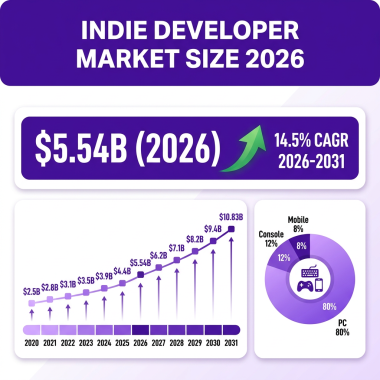
In 2025, independent games accounted for 25% of Steam’s total revenue—a figure that would have seemed impossible just five years ago. The global indie game market, valued at $4.85 billion in 2025, is projected to surge to $5.54 billion in 2026 and reach an impressive $10.83 billion by 2031, growing at a compound annual growth rate (CAGR) of 14.54%. But this is not just about games. The broader indie developer ecosystem—spanning SaaS applications, mobile apps, developer tools, and digital products—has become a formidable force reshaping how software is built, distributed, and monetized.
Welcome to the paradox of the indie developer market in 2026—where the barrier to entry has never been lower, the tools have never been more powerful, but the path to sustainable success has never been more challenging. Solo founders now account for 36% of all new startups, up from just 17% in 2017. The first solo unicorn IPO is projected for 2026. And yet, 70% of indie games still fail to break even, while burnout affects 60% of independent developers.
This comprehensive analysis dives deep into the indie developer market of 2026. We’ll examine the $5.54 billion ecosystem, explore the seven transformative trends reshaping the landscape, analyze the competitive environment, and uncover both the challenges and opportunities facing independent creators today. Whether you’re an aspiring indie hacker, a solo game developer, or an investor tracking the next wave of digital entrepreneurship, this report provides the data, insights, and strategic frameworks you need to navigate this dynamic market.

Market Overview: The $5.54 Billion Indie Developer Ecosystem
The indie developer market has evolved far beyond its gaming origins to encompass a diverse ecosystem of independent software creators. Understanding this market requires examining its size, growth trajectory, and the various segments that comprise this thriving industry.
Global Market Size and Valuation
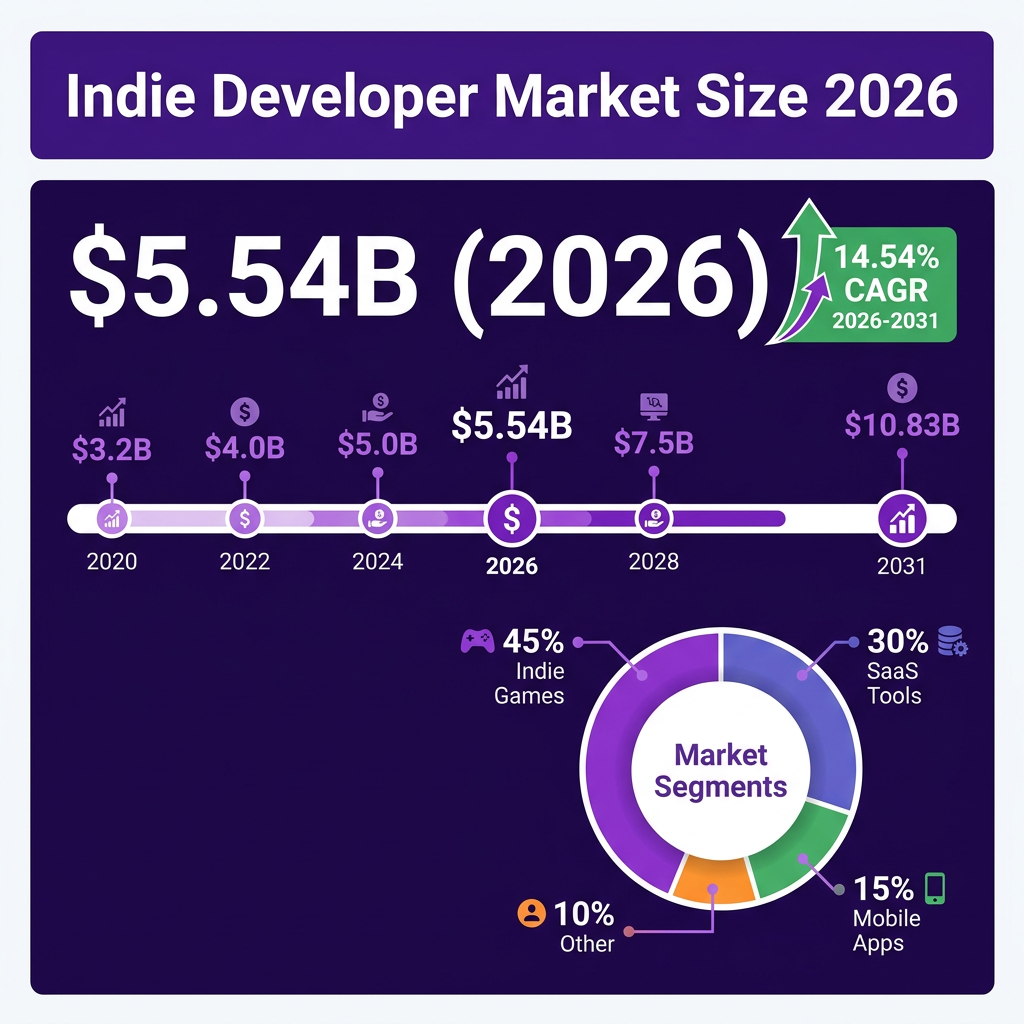
The global indie game market alone reached $4.85 billion in 2025 and is projected to grow to $5.54 billion in 2026. This represents a significant acceleration from previous years, driven by platform democratization, improved distribution channels, and the rise of solo founders leveraging AI-powered development tools. By 2031, the market is expected to nearly double to $10.83 billion, maintaining a robust CAGR of 14.54%.
However, the indie game sector represents only a portion of the broader indie developer ecosystem. When including indie SaaS products, mobile applications, developer tools, and digital products, the total addressable market expands significantly. The global software development market, which encompasses indie developers alongside enterprise and mid-market players, is valued at over $800 billion in 2026, with indie developers capturing an increasingly meaningful share of niche verticals and specialized tools.
The game engine market, a critical infrastructure component for indie game developers, was valued at $3.43 billion in 2025 and is projected to reach $3.87 billion in 2026. This market is expected to grow to $10.34 billion by 2034, reflecting the expanding base of independent developers requiring accessible, powerful development tools.
Market Segmentation and Revenue Distribution
The indie developer market can be segmented across multiple dimensions:
By Product Type: Indie games represent approximately 45% of the market, followed by SaaS tools and applications at 30%, mobile apps at 15%, and other digital products (templates, plugins, assets) at 10%. This distribution reflects the gaming industry’s maturity as an indie-friendly sector while highlighting the rapid growth of indie SaaS as a viable business model.
By Platform: PC gaming through Steam dominates with 75% market share of PC gaming distribution. Steam reached 147 million monthly active users in 2026, with a record 41.81 million concurrent users in January 2026. The platform hosts over 120,000 games and generated $16.2 billion in revenue through November 2025. Console and mobile represent smaller but significant segments for indie developers.
By Business Model: Premium (one-time purchase) remains the dominant model for indie games, though free-to-play with in-app purchases and subscription models are gaining traction. For indie SaaS, subscription revenue models dominate, with usage-based pricing emerging as a growing trend in 2026.
Regional Distribution and Growth Markets
North America and Europe continue to lead in indie developer activity, driven by mature digital infrastructure, access to funding, and established distribution platforms. However, Asia-Pacific is emerging as the fastest-growing region, with significant indie development activity in South Korea, Japan, and increasingly China—where platforms like Steam have gained traction despite regulatory challenges.
Latin America and Southeast Asia represent emerging markets with growing indie developer communities, often characterized by lower costs of living that enable developers to sustain longer development cycles with limited funding. These regions are increasingly becoming sources of innovative indie products that find global audiences through digital distribution.
Key Statistics and Data: The Numbers Behind the Movement
The indie developer landscape is defined by stark contrasts—between the potential for outsized success and the reality of widespread failure, between the democratization of tools and the increasing sophistication required to compete. Here are the key statistics that define this market in 2026:
Market Size and Growth Metrics
- Global indie game market value 2026: $5.54 billion
- Projected market value 2031: $10.83 billion
- Compound annual growth rate (CAGR): 14.54%
- Indie games share of Steam revenue: 25%
- Steam monthly active users: 147 million
- Steam peak concurrent users (January 2026): 41.81 million
- Steam total games catalog: 120,000+
- Steam annual revenue: $16.2 billion
- Game engine market size 2026: $3.87 billion
- Steam Deck units sold: 4 million+
Developer Demographics and Team Structure
- Solo founders as percentage of new startups: 36% (up from 17% in 2017)
- Indie developers working solo: 55%
- Average indie game development time: 18 months
- Indie developers experiencing burnout: 60%
- Developers using Unity as primary engine: 82%
- Average team size for successful indie games: 2-5 people
Revenue and Financial Performance
- Median lifetime earnings for indie games on Steam: $5,000-$15,000
- Indie game failure rate: 70%
- Average upfront advance from indie game publishers 2026: $602,818
- Percentage of indies breaking even: 30%
- Top 5% of indie games revenue threshold: $500,000+
- Average indie SaaS MRR at 12 months: $2,000-$5,000
Platform and Distribution Statistics
- Unity market share in game development: 23.91%
- Unreal Engine market share: 16.05%
- Blender market share: 14.76%
- Godot GitHub stars (May 2026): 110,926
- Unity Pro annual cost: $2,310
- Unity Q4 2025 revenue: $503 million
Funding and Investment Landscape
- Blue Ocean Games indie fund size: $30 million
- BITKRAFT Ventures AUM: $1.05 billion (19 deals in 2025)
- Griffin Gaming Partners AUM: $1.5 billion
- a16z Games fund size: $1.2 billion across two funds
- Typical seed investment range for indie games: $500,000-$2 million
- Solo founder acquisition by Wix (Base44): 6-month-old AI startup
These statistics reveal a market characterized by high variance—where the median outcome is modest, but the potential for exceptional success attracts a continuous influx of new developers. The 70% failure rate is sobering, yet the 30% who succeed include breakout hits that generate millions in revenue, often with teams of just 1-3 people.
Major Trends Shaping Indie Development in 2026
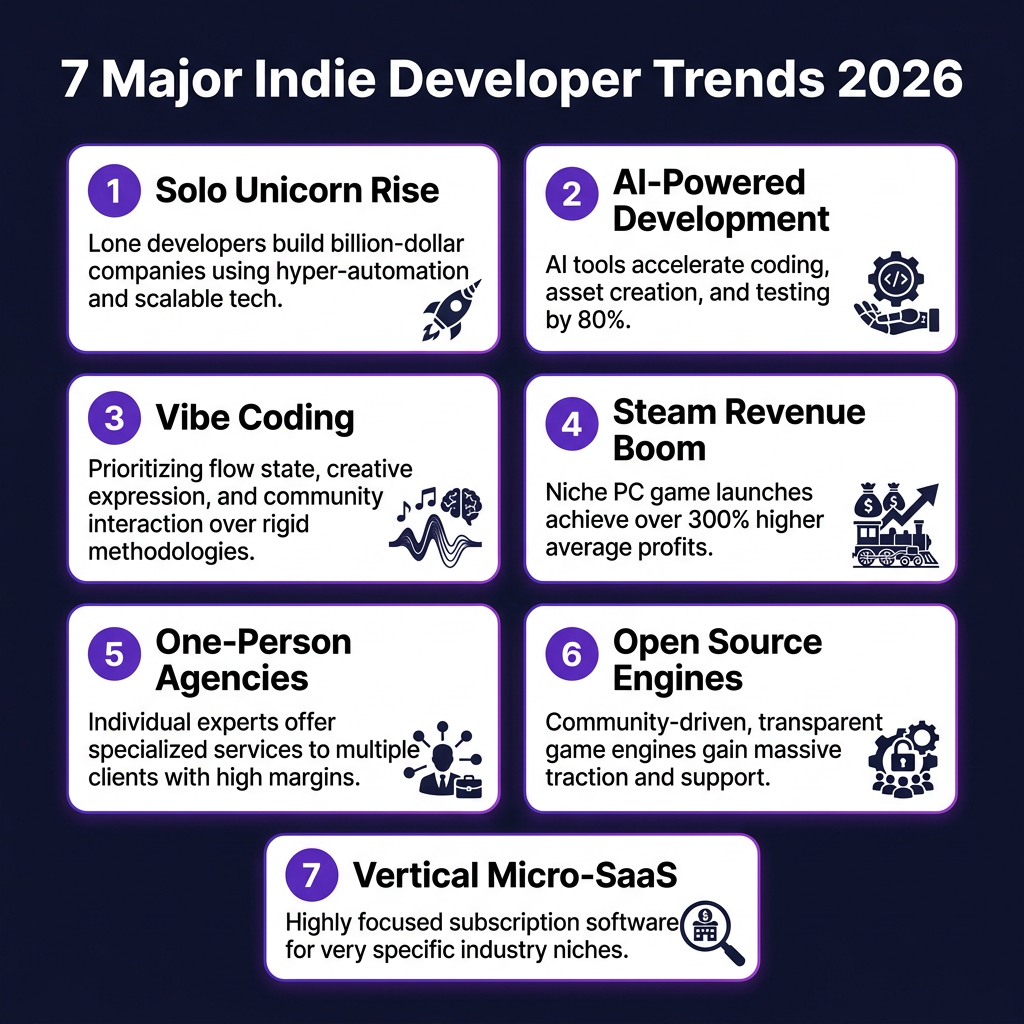
The indie developer landscape is being transformed by seven major trends that are redefining what’s possible for independent creators. Understanding these trends is essential for anyone looking to build, invest in, or compete with indie developers.
1. The Rise of the Solo Unicorn
The concept of a “solo unicorn”—a billion-dollar company built and run primarily by one person—has shifted from fantasy to near-reality. Researchers Engin Caglar and Bernd Lapp’s report “One-Person, Billion-Dollar Company: Rethinking the Org Chart” documents this emerging phenomenon. Solo founders have jumped from 17% of startups in 2017 to 36% in 2024, and the first solo unicorn IPO is projected for 2026.
This trend is enabled by AI-powered development tools, no-code platforms, and global talent marketplaces that allow solo founders to achieve outputs previously requiring teams of 10-50 people. The $200/month tool stack can now replace what once required a 10-person team, from design and development to marketing and customer support.
The implications are profound: the traditional startup model of raising capital, hiring a team, and scaling headcount is being challenged by a new paradigm where individual creators can build substantial businesses with minimal overhead. This doesn’t just change how companies are built—it changes what kinds of companies are possible.
2. AI-Powered Development and Vibe Coding
AI has fundamentally changed the economics of indie development. Tools like GitHub Copilot, Claude, ChatGPT, and specialized game development AIs have reduced development time by 30-50% for many tasks. “Vibe coding”—using AI to generate code based on natural language descriptions—has emerged as a dominant development paradigm in 2026.
For indie developers, this means faster prototyping and iteration cycles, reduced need for specialized expertise in every technology, ability to ship products that would previously require larger teams, and lower barriers to entry for non-technical founders. However, this democratization also means increased competition, as more people can now build and ship products. The differentiator has shifted from technical capability to product vision, market understanding, and execution speed.
The most successful indie developers in 2026 are those who have integrated AI into their workflows not as a replacement for skill, but as a force multiplier for their existing capabilities. They’re using AI to handle routine tasks while focusing their own efforts on the creative and strategic decisions that determine success.
3. The Steam Revenue Revolution
Steam’s 2025 revenue charts revealed a seismic shift: indie games now account for 25% of total platform revenue. This represents a fundamental change in the PC gaming market, where independent developers are competing directly with AAA studios and winning. Games like R.E.P.O. and other indie hits have demonstrated that small teams can achieve massive commercial success without publisher backing.
Steam’s continued investment in indie-friendly features—improved discovery algorithms, Steam Next Fest events, and regional pricing tools—has created an environment where quality indie games can find their audience. The platform’s 147 million monthly active users represent an unprecedented addressable market for independent developers.
This shift has not gone unnoticed by AAA publishers, many of whom are now adopting indie-like development practices for smaller projects. The boundary between “indie” and “AAA” is increasingly blurred, with the real differentiator being development philosophy rather than budget size.
4. One-Person Agencies and Micro-SaaS
The indie hacker movement has evolved beyond individual products to encompass “one-person agencies”—solo operators offering specialized services powered by AI tools and automation. These micro-businesses can generate $100,000-$500,000 in annual revenue with minimal overhead, representing a new model for sustainable indie entrepreneurship.
Vertical micro-SaaS—highly specialized tools for niche markets—has emerged as a particularly attractive category. Rather than competing in broad categories, indie developers are finding success by solving specific problems for specific audiences, often charging premium prices for specialized solutions.
The key insight driving this trend is that small can be a competitive advantage. Small teams can move faster, iterate more quickly, and build deeper relationships with their customers than larger competitors. In a world where AI can handle scale, the human elements of judgment, taste, and relationship become the differentiators.
5. Open Source Engine Adoption
Godot’s rise represents a significant shift in the game engine landscape. With 110,926 GitHub stars as of May 2026 and the release of Godot 4.6.2, the open-source engine has become a viable alternative to Unity and Unreal for many indie developers. The engine’s zero cost, open-source nature, and improving capabilities have attracted developers concerned about Unity’s pricing changes and licensing terms.
This trend toward open-source tools extends beyond game engines to encompass development frameworks, asset pipelines, and deployment infrastructure. Indie developers are increasingly building on open foundations that provide long-term stability and community support.
The open-source movement in game development reflects a broader shift in how developers think about their tools. Rather than accepting vendor lock-in, indie developers are prioritizing flexibility, transparency, and community ownership. This doesn’t just reduce costs—it creates a more resilient foundation for long-term projects.
6. Vertical AI and Specialized Workflows
The 2026 insight that “AI features are weak—AI workflows win” has reshaped how indie developers approach AI integration. Rather than adding superficial AI features, successful indie products are built around AI-powered workflows that fundamentally transform how users accomplish tasks.
This trend favors indie developers who can identify specific workflows to automate and optimize, creating products that deliver 10x improvements over traditional approaches. The ability to ship AI-native products quickly gives indies an advantage over larger, slower-moving competitors.
The winners in this space are not those with the most AI features, but those who have most deeply integrated AI into the core value proposition of their products. They’re not selling “AI-powered” tools—they’re selling better outcomes that happen to be enabled by AI.
7. Community-First Development and Building in Public
The “build in public” movement has matured into a core strategy for indie developers. Sharing development progress, revenue numbers, and lessons learned on platforms like Twitter/X, Indie Hackers, and Reddit has become a standard practice for building audience, gathering feedback, and creating marketing momentum before launch.
Community-first development—building products with and for a specific community rather than launching to a general audience—has proven to be a more reliable path to product-market fit for indie developers. This approach reduces marketing costs, increases word-of-mouth growth, and creates defensible moats through community loyalty.
The transparency of building in public can be uncomfortable, but it creates accountability and builds trust with potential customers before a product even launches. For indie developers without massive marketing budgets, this organic growth channel has become essential.
Key Players and Competitive Landscape
The indie developer ecosystem comprises a diverse array of platforms, tools, funding sources, and success stories. Understanding the competitive landscape is essential for positioning products and identifying partnership opportunities.
Distribution Platforms
Steam remains the dominant platform for PC indie games, commanding 75% market share with 147 million monthly active users. Valve’s continued investment in indie-friendly features—including improved discovery algorithms, Steam Next Fest events, and regional pricing—has strengthened its position as the premier destination for independent games.
Epic Games Store continues to compete through exclusive deals and a more favorable revenue split (88/12 vs. Steam’s 70/30), though its market share remains significantly smaller. The store’s free weekly games program has built a substantial user base that indie developers can access.
itch.io serves as the home for experimental and artistic indie games, offering developers maximum flexibility in pricing and distribution. While revenue per title is typically lower than Steam, the platform provides valuable visibility for niche and innovative projects.
Game Engines and Development Tools
Unity maintains its position as the most popular engine among indie developers with 23.91% market share and 82% of indie developers using it as their primary engine. Despite pricing controversies, Unity’s ecosystem, asset store, and cross-platform capabilities keep it dominant. Unity 6.4, released March 17, 2026, continues the platform’s evolution.
Unreal Engine holds 16.05% market share and is favored by indie developers targeting high-fidelity 3D experiences. Epic’s revenue share model (5% after $1 million in revenue) and the Epic MegaGrants program provide significant support for indie projects.
Godot has emerged as the leading open-source alternative, with 110,926 GitHub stars and growing adoption among developers seeking free, open-source solutions. Godot 4.6.2, released March 31, 2026, has addressed many performance and feature gaps compared to commercial engines.
Funding and Investment Sources
BITKRAFT Ventures leads gaming-focused VC with $1.05 billion AUM and 19 deals in 2025, investing $3M-$30M across seed to Series B stages. The firm’s focus on interactive entertainment infrastructure positions it as a key player in the indie ecosystem.
Griffin Gaming Partners manages $1.5 billion across multi-stage investments, typically deploying $7M-$50M per deal. The firm’s long-term approach and industry expertise make it a valuable partner for scaling indie studios.
a16z Games has $1.2 billion across two funds plus the Speedrun accelerator, bringing Silicon Valley’s largest VC firm’s resources to gaming. Their investments span studios, platforms, and infrastructure.
Blue Ocean Games launched a $30 million fund specifically targeting indie game developers, addressing the early-stage funding gap that many indies face. The fund’s structure allows developers to maintain IP ownership while accessing capital.

Challenges and Pain Points
Despite the opportunities, indie developers face significant challenges that contribute to the 70% failure rate. Understanding these pain points is crucial for developing strategies to overcome them.
1. Discovery and Marketing
With 120,000+ games on Steam and thousands of apps launching daily across mobile and web platforms, discovery has become the primary challenge for indie developers. The median indie game earns only $5,000-$15,000 lifetime on Steam—not because of quality issues, but because most games never find their audience.
Marketing requires skills distinct from development, and many indie developers struggle to effectively promote their work. The shift to community-first development and building in public represents a response to this challenge, but it requires consistent effort and transparency that doesn’t come naturally to all creators.
The discoverability problem is compounded by platform algorithms that favor established titles with existing engagement. New releases must fight for visibility against games with thousands of reviews and established player bases. Breaking through this noise requires either significant marketing spend or exceptional viral potential.
2. Financial Sustainability
The average 18-month development cycle for indie games means developers must sustain themselves without revenue for extended periods. With median earnings of $5,000-$15,000, most indie games fail to cover the cost of development, let alone provide a living wage.
For indie SaaS, the path to sustainable MRR (monthly recurring revenue) is similarly challenging. While the subscription model provides predictable revenue, reaching $10,000+ MRR—the threshold for sustainable full-time income—often takes 12-24 months of consistent effort.
Many indie developers are forced to maintain day jobs while building their projects, extending development timelines and increasing the risk of burnout. Those who do go full-time often face intense pressure to generate revenue quickly, which can lead to rushed releases and compromised quality.
3. Burnout and Mental Health
Sixty percent of indie developers report experiencing burnout, a statistic that reflects the intense pressure of solo or small-team development. The combination of creative work, business management, marketing, and financial stress creates a perfect storm for mental health challenges.
The romanticized image of indie development often masks the reality of long hours, isolation, and financial uncertainty. Developers who succeed long-term are those who build sustainable practices and support systems, rather than those who sacrifice everything for a single release.
The isolation of solo development can be particularly challenging. Without colleagues to share the burden of decision-making or provide emotional support, solo developers bear the full weight of their project’s success or failure. Building communities of fellow indie developers has become an essential survival strategy.
4. Technical Complexity and Scope Management
While tools have become more accessible, player expectations have increased simultaneously. A “simple” indie game in 2026 must meet standards of polish, performance, and feature completeness that would have qualified as AAA a decade ago.
Scope creep—the gradual expansion of project scope during development—remains a primary cause of indie game failure. The ability to cut features, ship a minimum viable product, and iterate based on feedback is a critical skill that many developers lack.
The gap between a playable prototype and a shippable product is often underestimated. What seems like a small amount of remaining work can stretch into months of polish, bug fixing, and platform compliance. Developers who don’t plan for this “last 20%” often find themselves unable to finish their projects.
Opportunities and Growth Strategies
Despite the challenges, significant opportunities exist for indie developers who approach the market strategically. Here are the key growth strategies for 2026:
1. Niche Domination
The most reliable path to indie success is dominating a specific niche rather than competing in broad categories. Whether it’s a specific game genre, a narrow SaaS use case, or a specialized tool, becoming the best solution for a specific audience creates sustainable competitive advantage.
Examples include Stardew Valley (farming simulation), Vampire Survivors (bullet heaven), and countless indie SaaS tools that solve specific problems for specific industries. The key is identifying underserved niches with passionate audiences willing to pay for quality solutions.
Niche domination works because it reduces competition and increases word-of-mouth potential. In a small community, excellence gets noticed and rewarded. The challenge is finding niches large enough to support a business but specific enough to defend against larger competitors.
2. Platform Arbitrage
New platforms and distribution channels create temporary windows of opportunity where competition is lower and discovery is easier. Early movers on Steam, the App Store, and other platforms have historically captured disproportionate value.
In 2026, emerging opportunities include AI-native platforms, VR/AR distribution channels, and blockchain-based gaming ecosystems. While not all will succeed, identifying and experimenting with new platforms early can yield significant returns.
The key to platform arbitrage is speed and willingness to experiment. By the time a platform is proven, the window of opportunity has often closed. Successful indie developers monitor emerging platforms and are willing to invest in unproven channels before the competition arrives.
3. AI-Augmented Development
Developers who master AI tools can achieve 2-5x productivity improvements over those who don’t. This isn’t just about coding assistants—it’s about using AI for art generation, sound design, marketing copy, customer support, and business operations.
The $200/month AI tool stack that replaces a 10-person team is now a reality for many indie developers. Those who build workflows around AI capabilities can punch far above their weight class.
However, AI augmentation is not a magic bullet. It requires learning new tools, developing new workflows, and understanding the limitations of current AI capabilities. The developers who benefit most are those who invest time in mastering these tools rather than treating them as simple shortcuts.
4. Community-Driven Development
Building a community before launching a product has become a repeatable strategy for indie success. Through Discord servers, newsletters, and social media presence, developers can validate ideas, gather feedback, and build an audience of ready buyers before shipping.
This approach reduces the risk of building something nobody wants and creates a built-in marketing channel for launch. Games like Hades and SaaS products like Buffer have demonstrated the power of community-driven development.
The key to community-driven development is authenticity and consistency. Communities are built on trust, and trust is built through sustained engagement and genuine value creation. Developers who treat community as a marketing channel rather than a genuine relationship often find their communities fail to materialize.
Case Studies and Success Stories
Real-world examples provide the most valuable insights into what works in indie development. Here are three case studies from 2025-2026:
Case Study 1: R.E.P.O. — The Breakout Hit
R.E.P.O. emerged as one of the standout indie successes of 2025-2026, demonstrating that small teams can still achieve massive commercial success. The game leveraged viral social media marketing and streamer culture to build momentum, ultimately generating millions in revenue.
Key success factors included a unique gameplay hook that was immediately watchable, aggressive pricing strategy, and perfect timing with market trends. The game’s success on Steam contributed to indie games capturing 25% of platform revenue.
The R.E.P.O. story illustrates the power of streamer-friendly design. In an era where Twitch and YouTube drive significant game discovery, creating experiences that are entertaining to watch has become as important as creating experiences that are fun to play. The game’s chaotic, social nature made it perfect for content creators looking for engaging material.
Case Study 2: Base44 — The Solo Unicorn Path
In June 2025, solo founder Maor Shlomo sold his six-month-old AI startup, Base44, to Wix for a significant sum. The company was built entirely by one person using AI tools and no-code platforms, representing the emerging “solo unicorn” model.
Base44’s success demonstrates that the solo founder model can work for B2B SaaS as well as consumer products. The key was identifying a specific problem (AI-powered website building), solving it well, and leveraging AI to scale output without scaling headcount.
The Base44 acquisition validated the emerging model of AI-augmented solo entrepreneurship. It showed that a single person, armed with the right tools and targeting the right market, can create significant value in a short timeframe. This case has inspired a new wave of solo founders pursuing similar paths.
Case Study 3: Vampire Survivors — Niche Domination
Vampire Survivors, developed primarily by Luca Galante (poncle), became a phenomenon by perfecting the “bullet heaven” genre. With development costs under $1,000, the game generated tens of millions in revenue and spawned an entire subgenre of imitators.
The success factors included extreme focus on core gameplay loop, minimal production values that didn’t detract from the experience, accessible price point ($3), and genre innovation that created a new category. The case demonstrates that technical sophistication matters less than understanding and serving player needs.
Vampire Survivors proved that a compelling core loop can overcome modest production values. The game’s simple graphics and limited features didn’t hinder its success because the fundamental gameplay was so satisfying. This lesson has inspired many indie developers to focus on gameplay first and production values second.
Future Outlook and Predictions (2026-2031)
The indie developer market will undergo significant transformation between 2026 and 2031. Here are the key predictions based on current trends and market dynamics:
Market Growth Projections
The indie game market will nearly double from $5.54 billion in 2026 to $10.83 billion by 2031, maintaining a 14.54% CAGR. This growth will be driven by continued platform expansion, emerging market adoption, and the increasing viability of indie development as a career path.
The broader indie developer ecosystem—including SaaS, tools, and digital products—will likely grow even faster, potentially reaching $25-30 billion by 2031 as solo founders and small teams capture larger shares of niche markets.
As the market grows, we can expect increased professionalization of indie development. What was once a hobbyist pursuit is becoming a viable career path, with established best practices, educational resources, and support infrastructure. This professionalization will raise the bar for entry while also making success more achievable for those who approach it systematically.
Technology Disruptions
AI will continue to reshape indie development, with several key developments expected:
- AI-generated assets (art, sound, music) will become indistinguishable from human-created content
- Natural language programming will enable non-coders to build complex applications
- AI playtesting and balancing will reduce development cycles for games
- Automated marketing and community management will become standard
These developments will further lower barriers to entry while increasing competition. The developers who thrive will be those who combine AI capabilities with unique creative vision and deep market understanding.
The risk is that AI democratization could lead to market saturation, making it harder for any individual product to stand out. Successful indie developers will need to develop new differentiation strategies as technical capabilities become commoditized.
Platform Evolution
Steam’s dominance will likely continue, but new platforms will emerge:
- Cloud gaming services will create new distribution opportunities for indies
- VR/AR platforms will mature, creating new categories for indie innovation
- Blockchain-based gaming will find product-market fit for specific use cases
- AI-native platforms will emerge as new distribution channels
The platform landscape in 2031 may look very different from today. Indie developers who remain platform-agnostic and quick to adapt will be best positioned to capitalize on these shifts.
The Solo Unicorn Arrives
The first solo unicorn IPO is projected for 2026-2027, validating the model of billion-dollar companies built by single founders. This will trigger a wave of investment in solo-founder tools, resources, and communities, further accelerating the trend.
By 2031, solo-founded companies could represent 50%+ of new startups, with several solo unicorns operating across different sectors. The organizational chart of the future may look very different from today’s corporate structures.
This shift has profound implications for the future of work. If single individuals can build billion-dollar companies, the entire edifice of corporate employment comes into question. We may see a mass migration of talent from traditional employment to indie entrepreneurship as the path to wealth creation.
Additional market insights reveal that the indie developer ecosystem is becoming increasingly sophisticated. As the market matures, we’re seeing the emergence of specialized service providers, dedicated indie publishing labels, and educational programs specifically designed for independent creators. This infrastructure development is making it easier than ever for new developers to enter the market with realistic expectations and support systems in place.
The geographic distribution of indie development is also shifting. While North America and Europe remain dominant, we’re seeing rapid growth in Asia-Pacific regions, particularly in South Korea, Japan, and Southeast Asia. These regions bring unique cultural perspectives and gameplay preferences that are enriching the global indie landscape. Developers from these regions are increasingly finding global audiences through digital distribution platforms that transcend traditional geographic boundaries.
Looking at the funding landscape, we’re witnessing a democratization of capital access. Beyond traditional VC and publisher models, crowdfunding platforms, revenue-based financing, and community investment are providing new pathways for indie developers to fund their projects. This diversification of funding sources is reducing the power imbalance between creators and capital providers, allowing developers to maintain more control over their work.
Key Takeaways
- The indie developer market is valued at $5.54 billion in 2026 and growing at 14.54% CAGR, projected to reach $10.83 billion by 2031
- Indie games now capture 25% of Steam revenue, demonstrating that small teams can compete with AAA studios
- Solo founders represent 36% of new startups (up from 17% in 2017), with the first solo unicorn IPO expected in 2026
- AI-powered development tools have reduced development time by 30-50%, enabling solo founders to achieve outputs previously requiring teams of 10-50 people
- Despite the opportunities, 70% of indie games fail to break even, and 60% of developers experience burnout
- The most successful indie developers focus on niche domination, community-driven development, and AI-augmented workflows
- Open-source engines like Godot (110,926 GitHub stars) are gaining market share as alternatives to Unity and Unreal
- Vertical micro-SaaS and one-person agencies represent emerging business models for sustainable indie entrepreneurship
Sources and Citations
- Mordor Intelligence — Indie Game Market Size & Share Analysis (2026-2031): https://www.mordorintelligence.com/industry-reports/indie-game-market
- Steam Page Analyzer — Indie Game Revenue Statistics 2026: https://www.steampageanalyzer.com/blog/indie-game-revenue-data
- Gitnux — 90+ Indie Game Industry Statistics 2026: https://gitnux.org/indie-game-industry-statistics
- Icon Era — Steam Statistics Market Trends 2026: https://icon-era.com/statistics/steam
- Indieis.land — The Indie Hacker Toolkit for 2026: https://indieis.land/blog/indie-hacker-tools-trends-2026
- Forbes — Solopreneurs Can Reach $1 Billion In Revenue (January 2026): https://www.forbes.com/sites/elainepofeldt/2026/01/28/as-more-founders-aim-to-build-billion-dollar-one-person-businesses
- Fortune Business Insights — Game Engine Market Size 2034: https://www.fortunebusinessinsights.com/game-engine-market-111802
- Stray Spark Studio — Godot vs Unity vs Unreal 2026: https://www.strayspark.studio/blog/godot-vs-unity-vs-unreal-2026
- Peony.ink — 10 Best Gaming Investors in 2026: https://www.peony.ink/blog/top-gaming-investors
- Global Venturing — Blue Ocean Games $30M Fund: https://globalventuring.com/corporate/asia/games-investor-blue-ocean-launches-30m-fund
- Studio Showdown — How to Fund an Indie Game 2026: https://studio-showdown.com/how-to-fund-an-indie-game-the-2026-strategic-guide
- Keyhole Software — Software Development Statistics 2026: https://keyholesoftware.com/software-development-statistics-2026
- Seeles AI — Best Game Engines for Indie Developers 2026: https://www.seeles.ai/resources/blogs/best-game-engines-indie-developers-2026
- Cipher Projects — The Rise of the One Person Business: https://cipherprojects.com/blog/posts/rise-one-person-business-solo-founders-reshaping-entrepreneurship
- Founder Institute — The Solo Unicorn Is Here: https://fi.co/insight/the-solo-unicorn-is-here-and-2026-is-the-window