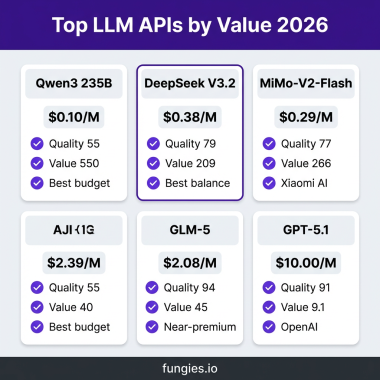
Here’s a number that should wake you up: choosing the wrong LLM for your workload can cost you 100x more than necessary for the same quality output.
In 2026, a request that costs $0.0001 on Gemini 2.5 Flash-Lite runs $0.10+ on Claude Opus 4.6. If you’re processing millions of tokens per month, that difference isn’t pocket change—it’s the margin between a profitable AI feature and one that bleeds cash.
Two years ago, running a flagship LLM cost $10 per million input tokens. Today you can get better models for a quarter of that price. The collapse in inference costs has reshaped what’s economically feasible, from side-project chatbots to enterprise document pipelines chewing through millions of pages monthly.
Why LLM API Pricing Matters for SaaS
If you’re building a SaaS product with AI features, API costs directly impact your unit economics. A customer support chatbot doing 100M output tokens per month pays $1,000 on GPT-5.4—or $42 on DeepSeek V3.2. Same quality tier for most conversational tasks.
The spread between cheap and premium now exceeds 1,000x. Getting model selection wrong by even one tier can destroy your margins. This guide breaks down current pricing across all major providers and shows you exactly how to optimize your AI spend.
Complete LLM API Pricing Comparison (April 2026)
Prices are per 1 million tokens. Input = tokens you send to the API. Output = tokens the model generates. Context window = how much text the model can process at once.
| Model | Provider | Input | Output | Context |
|---|---|---|---|---|
| Gemini 2.5 Flash-Lite | $0.10 | $0.40 | 1M | |
| GPT-4.1 nano | OpenAI | $0.10 | $0.40 | 1M |
| Gemini 2.5 Flash | $0.15 | $0.60 | 1M | |
| GPT-4.1 mini | OpenAI | $0.40 | $1.60 | 1M |
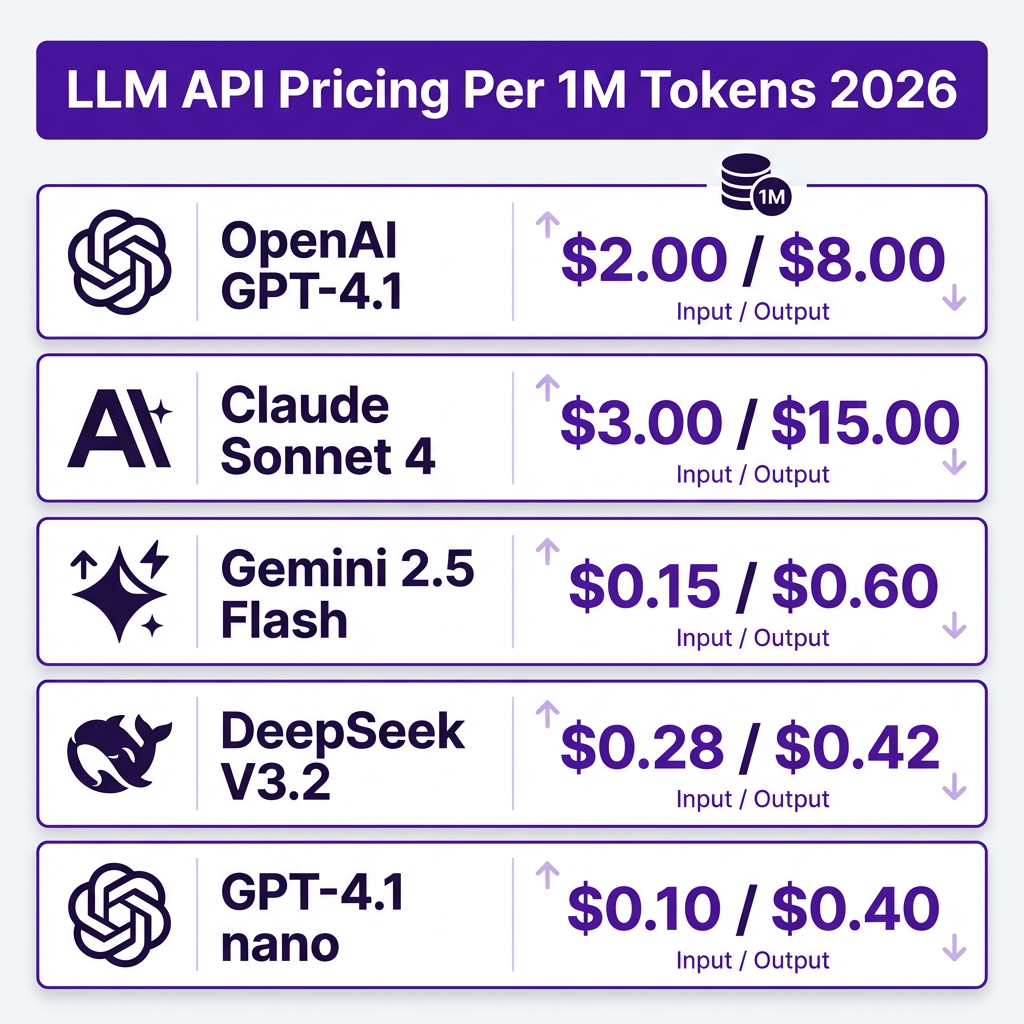
| DeepSeek V3.2 | DeepSeek | $0.28 | $0.42 | 128K |
| GPT-4.1 | OpenAI | $2.00 | $8.00 | 1M |
| Claude Sonnet 4 | Anthropic | $3.00 | $15.00 | 200K |
| Claude Opus 4.6 | Anthropic | $5.00 | $25.00 | 1M |
Provider Breakdown: What You Get for Your Money
OpenAI: The Safe Default
OpenAI runs the broadest model lineup. Their GPT-4.1 family (nano, mini, standard) covers every price point from $0.10 to $2.00 per million input tokens. The key advantage: mature function calling, structured output, and the largest ecosystem of tools.
Best for: Teams that want reliability and don’t want to experiment. The API just works.
Anthropic Claude: Premium Quality, Premium Price
Claude models lead coding benchmarks. Sonnet 4.5 holds the top SWE-Bench score at 82%. Opus 4.6 is the most capable model for complex reasoning. But you’ll pay 2-3x more than OpenAI for comparable tiers.
Best for: Code generation, complex agent workflows, and tasks where accuracy directly impacts revenue.
Google Gemini: The Price Leader
Google undercuts everyone. Gemini 2.5 Flash at $0.15/$0.60 per million tokens includes a 1M context window. They also offer a free tier for development—no other frontier provider does this.
Best for: Cost-sensitive applications, long-context tasks, and teams willing to trade some ecosystem maturity for price.
DeepSeek: The Disruptor
DeepSeek V3.2 matches GPT-5.4-class quality at $0.28/$0.42 per million tokens—that’s 24x cheaper on output. Cache hits drop input cost to $0.028. The catch: reliability issues during peak usage and data routes through China.
Best for: Non-sensitive workloads where cost matters more than data sovereignty.
Cost by Real-World Workload
Raw per-token pricing only tells part of the story. Here’s what different workloads actually cost:
Chatbot / Conversational AI
Average conversation: 2,000 tokens input (system prompt + history), 500 tokens output per turn, 5 turns per session.
| Model | Cost per Session | Cost per 10K Sessions/Month |
|---|---|---|
| Gemini 2.5 Flash | $0.005 | $45 |
| GPT-4.1 mini | $0.012 | $120 |
| GPT-4.1 | $0.06 | $600 |
| Claude Sonnet 4 | $0.068 | $675 |
Document Processing Pipeline
Average document: 8,000 tokens input, 1,000 tokens output (summary + extraction).
| Model | Cost per Document | Cost per 50K Docs/Month |
|---|---|---|
| Gemini 2.0 Flash | $0.001 | $60 |
| GPT-4.1 nano | $0.001 | $60 |
| Gemini 2.5 Flash | $0.002 | $90 |
| Claude Haiku 3.5 | $0.010 | $520 |
| GPT-4.1 | $0.024 | $1,200 |
Code Generation / Analysis
Average request: 3,000 tokens input (code + instructions), 2,000 tokens output.
| Model | Cost per Request | Cost per 100K Requests/Month |
|---|---|---|
| Mistral Large 2 | $0.018 | $1,800 |
| GPT-4.1 | $0.022 | $2,200 |
| Gemini 2.5 Pro | $0.024 | $2,375 |
| Claude Sonnet 4 | $0.039 | $3,900 |
| Claude Opus 4 | $0.195 | $19,500 |
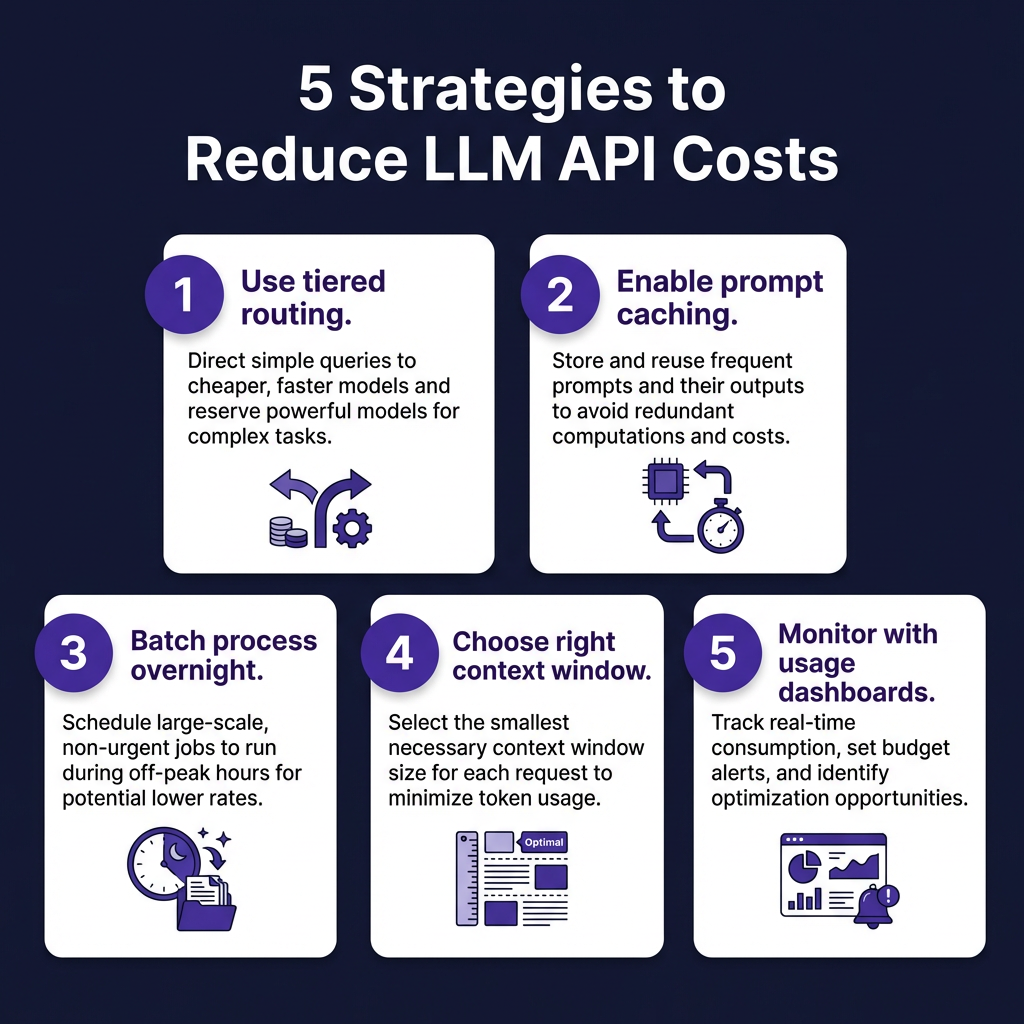
5 Strategies to Cut Your LLM API Costs by 80%
1. Implement Tiered Model Routing
Route requests to different models based on complexity. Use a cheap classifier (GPT-4.1 nano or Gemini 2.0 Flash) to assess request difficulty, then route simple requests to budget models and complex ones to premium models.
Result: 40-60% cost reduction compared to using a single model for everything.
2. Enable Prompt Caching
Both OpenAI and Anthropic offer prompt caching for system prompts and repeated context. Cached input tokens cost roughly 10% of standard input price. For applications with consistent system prompts, this is free money.
Result: Up to 90% reduction on input token costs for cached content.
3. Use Batch Processing
OpenAI’s Batch API gives 50% off all models for async workloads processed within 24 hours. For document processing, reporting, and other non-real-time tasks, batching is a no-brainer.
Result: 50% cost reduction on eligible workloads.
4. Right-Size Your Context Window
Don’t pay for 1M context if you only use 10K. Gemini 2.5 Flash gives you 1M context at $0.15/$0.60. But if your use case fits in 128K, GPT-4o-mini at $0.15/$0.60 might be faster and just as good.
Result: 20-30% savings by matching context window to actual needs.
5. Monitor and Set Budget Alerts
You can’t optimize what you don’t measure. Set up usage dashboards, track costs by feature, and configure budget alerts. Many teams discover that 80% of their AI spend comes from 20% of their features.
Result: Visibility into spend patterns enables targeted optimization.
Key Takeaways
- Cheapest option: Gemini 2.5 Flash-Lite at $0.10/$0.40 per million tokens
- Best value: DeepSeek V3.2 at $0.28/$0.42 with 90% cache discounts
- Best overall: GPT-4.1 family for reliability and ecosystem
- Premium choice: Claude Opus 4.6 when accuracy directly impacts revenue
- Cost spread: 1,000x difference between cheapest and most expensive models
FAQ: LLM API Pricing
What’s the cheapest LLM API in 2026?
Google’s Gemini 2.5 Flash-Lite at $0.10 per million input tokens and $0.40 per million output tokens. For even lower costs, DeepSeek V3.2 offers cache hits at $0.028 per million input tokens.
Is OpenAI or Anthropic more expensive?
Anthropic is generally 2-3x more expensive than OpenAI for comparable tiers. Claude Sonnet 4 at $3/$15 costs more than GPT-4.1 at $2/$8. The premium buys better coding performance and longer outputs (up to 128K).
How much does it cost to run an AI chatbot?
For 10,000 chat sessions per month: $45 on Gemini 2.5 Flash, $120 on GPT-4.1 mini, or $600 on GPT-4.1. The model choice determines whether your AI feature is profitable.
Can I use multiple LLM providers?
Yes, and you should. Use tiered routing to send simple tasks to cheap models (Gemini Flash) and complex tasks to premium models (Claude Opus). This hybrid approach typically cuts costs 40-60%.
What’s the difference between input and output tokens?
Input tokens are what you send to the API (prompts, context, instructions). Output tokens are what the model generates (responses, code, summaries). Output tokens typically cost 2-5x more than input tokens.
Conclusion
LLM API pricing in 2026 offers unprecedented choice—and unprecedented opportunity to waste money. The gap between the cheapest and most expensive models exceeds 1,000x. For SaaS developers, model selection is now one of the highest-leverage decisions you can make.
Start with tiered routing. Cache your prompts. Batch non-urgent work. And always measure before optimizing. The teams that master AI cost optimization will have a massive advantage over those that don’t.
Ready to build AI-powered features with predictable costs? Get started with Fungies and focus on your product while we handle the complexity.
References
- PE Collective – LLM Pricing Comparison April 2026
- Cloudidr – LLM API Pricing 2026
- TLDL – LLM API Pricing 2026
- Morph LLM – LLM API Comparison 2026
- OpenAI API Pricing
- Anthropic Claude Pricing
- Google Gemini Pricing
\n