Here’s a number that should wake you up: Dropbox grew from 100,000 to 4 million users in just 15 months. Not through massive ad spend. Not through enterprise sales teams. They did it with a single, elegantly designed referral program that achieved a viral coefficient of 0.35 and saved an estimated $48 million in traditional advertising costs.
That 3,900% growth wasn’t luck. It was growth hacking at its finest.
What Is SaaS Growth Hacking, Really?
Growth hacking isn’t just marketing with a cooler name. It’s a systematic approach to growth that treats user acquisition, activation, and retention as an integrated engineering problem rather than a series of disconnected campaigns.
Sean Ellis, who coined the term back in 2010, defined a growth hacker as “a person whose true north is growth.” But here’s what that actually means in 2026: growth hackers use data, creativity, and product mechanics to build self-sustaining systems that acquire users more efficiently than traditional channels ever could.
The global SaaS market hit $315.68 billion in 2025 and is projected to reach $1.48 trillion by 2034. With that kind of competition, you can’t afford to pay $5 to acquire a $1 customer. You need loops, not funnels.
Why Most SaaS Growth Strategies Fail
Before we dive into what works, let’s be honest about what doesn’t. I’ve audited dozens of SaaS growth programs, and the same patterns keep showing up:
- Chasing vanity metrics: Focusing on signups instead of activated users who actually experience value
- Ignoring unit economics: The median blended CAC payback for $5M-$25M ARR SaaS is now 18 months — up from 15 months in 2023
- One-and-done campaigns: Running isolated initiatives instead of building compounding systems
- Copying without context: Implementing Dropbox’s referral program for a B2B enterprise tool that users don’t want to share
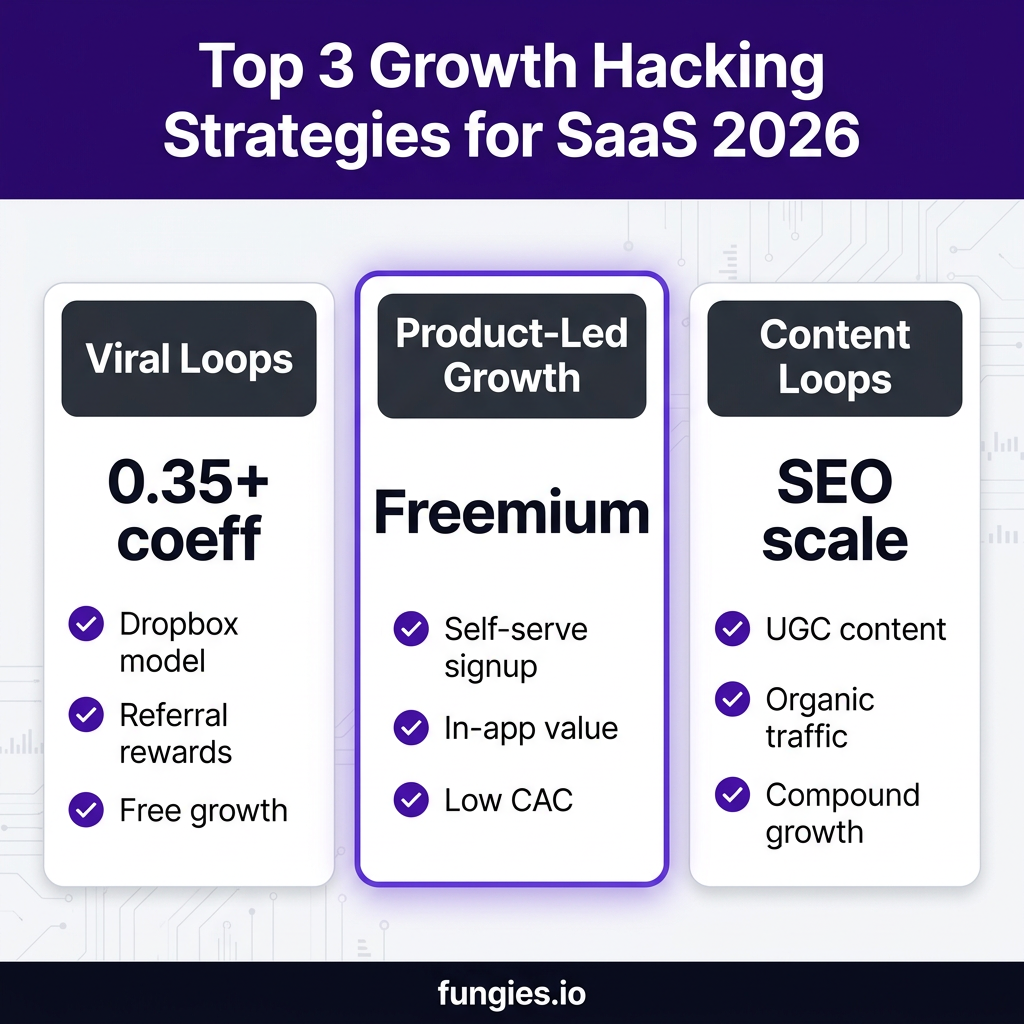
The truth? Growth hacking only works when the mechanics match your product, audience, and business model. Let’s look at the three strategies that actually move the needle in 2026.
Strategy 1: Viral Loops (The Dropbox Model)
Viral loops are the holy grail of growth hacking. When they work, they feel like biking downhill — your key metrics grow exponentially while the average investment to create that growth stays flat or even decreases.
Here’s how Dropbox engineered theirs:
- Two-sided rewards: Both referrer and invitee got 500MB of free storage
- Product-aligned incentives: The reward (storage) was directly tied to the product’s core value
- Frictionless sharing: One-click email and social media integration
- Strategic timing: Prompts appeared when users hit storage limits — a moment of genuine need
The result? 35% of daily signups came from referrals. Every 10 users generated 3.5 new ones. That’s the power of a viral coefficient above 0.3 — the threshold where growth becomes self-sustaining.
How to Build Your Own Viral Loop
Not every product can replicate Dropbox’s exact model. But the principles are universal:
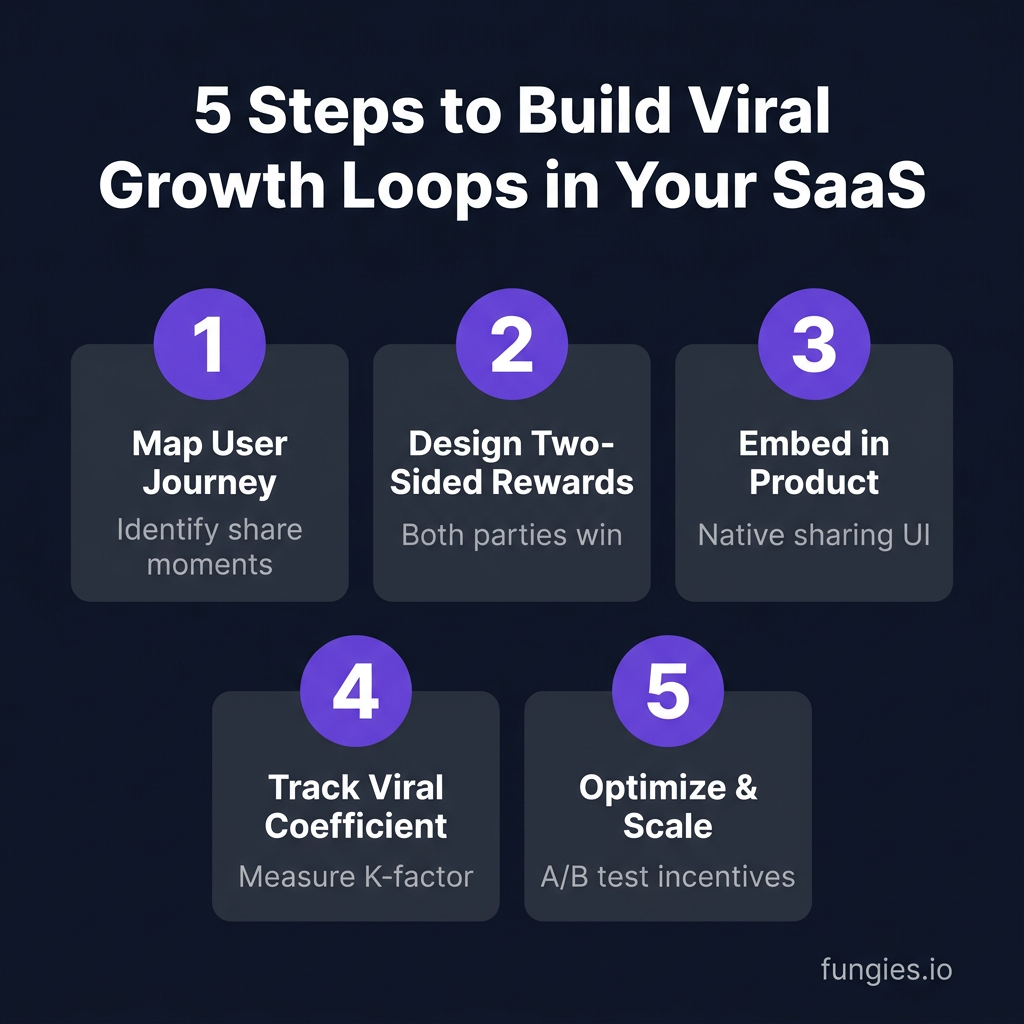
- Identify natural sharing moments: When does your user genuinely want to invite someone? For Slack, it’s when you need to add a teammate. For Calendly, it’s when you’re scheduling with someone outside your organization.
- Make the reward mutual: Both parties should benefit. One-sided rewards feel transactional; two-sided rewards feel like gifts.
- Embed it in the product: Don’t bury your referral program in a settings menu. Surface it when users are experiencing value.
- Track your K-factor: Viral coefficient = (Average invites sent per user) × (Conversion rate of invites). If it’s below 0.2, your loop isn’t working.
Strategy 2: Product-Led Growth (PLG)
80-90% of the highest-growth B2B subscription SaaS companies in 2025 have an always-free plan. That’s not a coincidence — it’s product-led growth in action.
PLG is an end-user-focused growth model that relies on the product itself as the primary driver of customer acquisition, conversion, and expansion. Instead of sales teams convincing buyers, the product convinces users through direct experience.
Here’s why PLG works so well for SaaS:
- Lower CAC: Users acquire themselves through free trials or freemium tiers
- Higher intent: When users convert, they’ve already experienced value
- Faster sales cycles: No procurement process for self-serve upgrades
- Better retention: Users who convert organically understand the product better
The data backs this up. Bootstrapped SaaS companies with $3M-$20M ARR show median net revenue retention of 103% — and those in the 90th percentile hit 117.9%. PLG compounds because satisfied users become advocates.
Implementing PLG in Your SaaS
Transitioning to PLG isn’t just about adding a free tier. It requires rethinking your entire user journey:
- Time-to-value: How quickly can a new user experience something meaningful? Aim for under 5 minutes.
- Activation milestones: Define the specific actions that correlate with retention. For Fungies, it’s creating the first product and generating a checkout link.
- Upgrade triggers: Identify natural expansion moments — hitting usage limits, adding team members, or accessing premium features.
- In-app guidance: Replace sales demos with contextual tooltips, templates, and progressive disclosure.
Strategy 3: Content Loops & SEO
The third growth engine is content — but not the “publish and pray” approach that wastes so much marketing budget. I’m talking about content loops: systems where user-generated or programmatic content attracts new users, who then create more content.
Substack is the textbook example. Writers publish newsletters, which attract readers. Some readers become writers, creating more newsletters that attract more readers. The loop compounds.
For SaaS companies, content loops typically work differently:
- Template galleries: Notion’s template gallery drives massive organic traffic. Each template is a landing page optimized for specific use cases.
- User-generated case studies: When customers share their success stories, they create authentic content that converts better than any ad.
- Programmatic SEO: Creating thousands of targeted landing pages at scale. Zapier’s “Connect App A to App B” pages dominate search results for integration queries.
- Tool-based content: Free calculators, generators, or graders that solve immediate problems while demonstrating product value.
Growth Hacking Tactics That Work in 2026
Beyond the three core strategies, here are specific tactics I’m seeing work across SaaS companies right now:
1. The Viral Signup Process
Don’t just collect emails. Turn signups into referral engines. Based on analyzing 100+ successful indie hackers, the pattern is clear: embed sharing into onboarding. When someone signs up, immediately show them how to invite their team or share on social for an incentive.
2. Micro-Landing Pages for Each Use Case
Build dedicated landing pages for every use case, persona, and pain point. Instead of one generic homepage, have 50 specific entry points. This is how you capture long-tail search traffic with high intent.
3. AI-Powered Personalization at Scale
Every company founded in 2025 reported AI as core to its product. But the growth hack isn’t just adding AI features — it’s using AI to personalize onboarding, recommendations, and outreach at a scale that wasn’t possible before.
4. Partnerships Over Cold Outreach
Cold email is dying. Response rates have plummeted. What’s working? Strategic partnerships with complementary tools, integration marketplaces, and co-marketing with non-competing SaaS companies that share your audience.
5. Community-Led Growth
Build a community before you need it. Discord servers, Slack groups, or Circle communities create engaged users who stick around longer and refer others. The median gross revenue retention for bootstrapped SaaS is 91% — community can push you into the 100%+ club.
Measuring What Matters
Growth hacking without measurement is just guessing. Here are the metrics that actually matter:
| Metric | Benchmark | Why It Matters |
|---|---|---|
| Viral Coefficient (K) | > 0.3 | Above this threshold, growth becomes self-sustaining |
| CAC Payback Period | < 12 months | How fast you recover acquisition costs |
| Net Revenue Retention | > 100% | Growth from existing customers |
| Time to Value | < 5 minutes | Speed to first meaningful experience |
| Trial-to-Paid Conversion | 15-25% | Quality of your acquisition funnel |
| Expansion ARR | > 40% of new ARR | Your ability to grow existing accounts |
Healthy SaaS unit economics follow these rules: LTV:CAC ratio above 3:1, CAC payback under 12 months, gross margins of 70-85%, and NRR above 100%.
Common Growth Hacking Mistakes to Avoid
I’ve seen smart founders sabotage their growth with these errors:
- Optimizing for the wrong metric: Don’t chase signups if they don’t activate. A smaller number of engaged users beats a large number of churned accounts.
- Ignoring the “why”: Dropbox’s referral program worked because users genuinely wanted more storage. If your incentive doesn’t align with user motivation, it won’t work.
- Feature bloat: Adding growth features (referral widgets, social sharing) that clutter the core experience. Every element should earn its place.
- Giving up too early: Most growth experiments fail. You need to run 10 experiments to find 1 winner. The winners compound; the failures are just tuition.
FAQ: SaaS Growth Hacking
What is a good viral coefficient for SaaS?
A viral coefficient (K-factor) above 0.3 is considered good — this means every 10 users bring in 3+ new ones. Above 1.0 is viral nirvana, where growth accelerates without additional input. Dropbox achieved 0.35, which drove their explosive growth.
How long should CAC payback be for SaaS?
The target CAC payback period is under 12 months for healthy SaaS businesses. In 2026, the median blended CAC payback for $5M-$25M ARR SaaS is 18 months, but top-performing companies maintain sub-12 month payback through efficient growth loops.
Is product-led growth right for every SaaS?
No. PLG works best for products with low complexity, clear time-to-value, and individual user decision-making. Complex enterprise software with long implementation cycles and committee-based purchasing often needs sales-led or hybrid models.
What’s the difference between growth hacking and traditional marketing?
Traditional marketing focuses on campaigns with defined budgets and timelines. Growth hacking treats growth as an engineering problem — building systems and loops that compound over time. Growth hackers prioritize speed, experimentation, and measurable outcomes over brand awareness.
How do I start growth hacking with a limited budget?
Start with one loop. Map your user journey, identify the natural sharing moment, and build a simple two-sided referral program. Measure your K-factor obsessively. If it works, double down. If not, iterate quickly. Most successful growth hacks started as minimal viable experiments.
Conclusion: Build Loops, Not Funnels
The era of pouring money into Facebook Ads and hoping for the best is over. In 2026, sustainable SaaS growth comes from building systems that compound — viral loops that turn users into advocates, product-led experiences that sell themselves, and content engines that attract the right audience at scale.
Dropbox’s 3,900% growth wasn’t a fluke. It was the result of understanding user psychology, aligning incentives with product value, and measuring what mattered. The playbook is there. The tools are better than ever. The only question is whether you’ll execute.
Ready to implement growth hacking in your SaaS? Start by analyzing your current user journey. Find the moment when users experience genuine value. That’s where your growth loop begins.
Get started with Fungies today — the merchant of record platform that handles payments, tax compliance, and checkout so you can focus on building growth loops that scale.