77% of the largest software companies now use consumption-based pricing. If you’re still charging flat subscription fees while your competitors bill by actual usage, you’re leaving money on the table.
I remember talking to a founder last year who was terrified of switching to usage-based billing. “What if customers get sticker shock?” he asked. Six months later, his net dollar retention had jumped 18%. His customers weren’t leaving — they were growing with him.
This guide breaks down everything you need to know about implementing usage-based billing in your SaaS business. From choosing the right pricing model to selecting billing infrastructure that won’t break your engineering team.
What Is Usage-Based Billing?
Usage-based billing (UBB) — also called consumption billing or metered billing — charges customers based on actual product consumption rather than fixed periodic fees.
Instead of paying $99/month for 10 seats regardless of activity, customers pay for what they use: API calls, storage consumed, compute minutes, messages sent, or any other value metric your product delivers.
Here’s how it works in practice:
- Metering: Your application tracks usage events (API calls, data processed, etc.)
- Aggregation: Usage data is collected and aggregated over a billing period
- Rating: Pricing rules are applied to calculate charges
- Invoicing: Customers receive bills reflecting actual consumption
The key difference from traditional subscriptions? Revenue scales with customer success. When your customers grow, your revenue grows automatically — no sales intervention required.
Why Usage-Based Billing Is Taking Over SaaS
The shift isn’t just a trend. The data tells a compelling story:
- 78% of companies with UBP adopted it within the last five years
- 77% of the largest software companies now incorporate consumption-based pricing
- Companies with hybrid models (subscription + usage) report 21% higher median growth rates
- Usage-based companies consistently report NDR rates 10–15% higher than seat-based peers
- 15% lower churn rates when product usage correlates with customer value delivery
But the real driver? AI.
With AI-native products, seat-based pricing makes no sense. An AI coding assistant doesn’t care how many developers you have — it cares how many tokens you process. 25% of companies now employ usage-based pricing specifically for AI features, and that number is climbing fast.
The Business Case
| Metric | Subscription Model | Usage-Based Model |
|---|---|---|
| Net Dollar Retention | 100-110% | 115-130% |
| Expansion Revenue | Requires sales effort | Automatic |
| Time-to-Value for Customers | Immediate | Immediate |
| Revenue Predictability | High | Moderate (improving) |
| Churn Risk | Binary (cancel/subscribe) | Gradual (usage → zero) |
The trade-off is clear: you sacrifice some revenue predictability for significantly higher growth potential and customer alignment.
Types of Usage-Based Pricing Models
Not all usage-based billing looks the same. Here are the main approaches:
1. Pure Usage (Pay-As-You-Go)
Customers pay only for what they consume, with no base fee.
Best for: Infrastructure products, API services, compute resources
Examples: AWS, Twilio, SendGrid
Pros: Lowest barrier to entry, perfect alignment with value
Cons: Revenue volatility, harder to predict cash flow
2. Hybrid (Subscription + Usage)
A base subscription fee covers basic usage, with overages charged at usage rates.
Best for: Most B2B SaaS products
Examples: Slack, Zoom, Datadog
Pros: Predictable base revenue + expansion upside
Cons: More complex to implement and communicate
3. Prepaid Credits
Customers purchase credits upfront and draw down as they use the product.
Best for: AI products, developer tools, creative software
Examples: OpenAI, Midjourney, ElevenLabs
Pros: Improves cash flow, reduces monthly volatility
Cons: Requires credit management, potential breakage disputes
4. Tiered Usage
Usage falls into predefined tiers with different per-unit pricing.
Best for: Products with clear usage bands
Examples: Mailchimp (email volume tiers), Cloudflare
Pros: Simpler customer understanding, built-in volume discounts
Cons: Cliff effects at tier boundaries
5. Graduated Pricing
Different per-unit rates apply to different usage bands (0-1K: $0.10/unit, 1K-10K: $0.08/unit, etc.)
Best for: Enterprise products with wide usage ranges
Examples: Snowflake, Segment
Pros: Smooth pricing curve, rewards high-volume customers
Cons: Complex to calculate and communicate
Choosing Your Value Metric
Your value metric is the unit you charge for. Choose wrong, and you’ll misalign incentives. Choose right, and growth becomes automatic.
Good Value Metrics
- Directly correlate with customer value: The more customers use, the more value they get
- Customers can control: They can reduce usage if costs become a concern
- Easy to understand: No complex formulas or opaque calculations
- Hard to game: Can’t be easily manipulated to reduce bills
Examples by Product Type
| Product Type | Strong Value Metrics | Weak Value Metrics |
|---|---|---|
| API Service | API calls, data processed | Server uptime, API endpoints |
| AI/ML Platform | Tokens, compute minutes, predictions | Model downloads, API keys |
| Analytics | Events tracked, queries run | Dashboards created, users |
| Communication | Messages sent, minutes used | Contacts stored, channels |
| Storage | GB stored, transfer volume | File count, folder depth |
The Test
Ask yourself: “If a customer doubles their usage, do they get approximately double the value?” If yes, you’ve found a good metric.
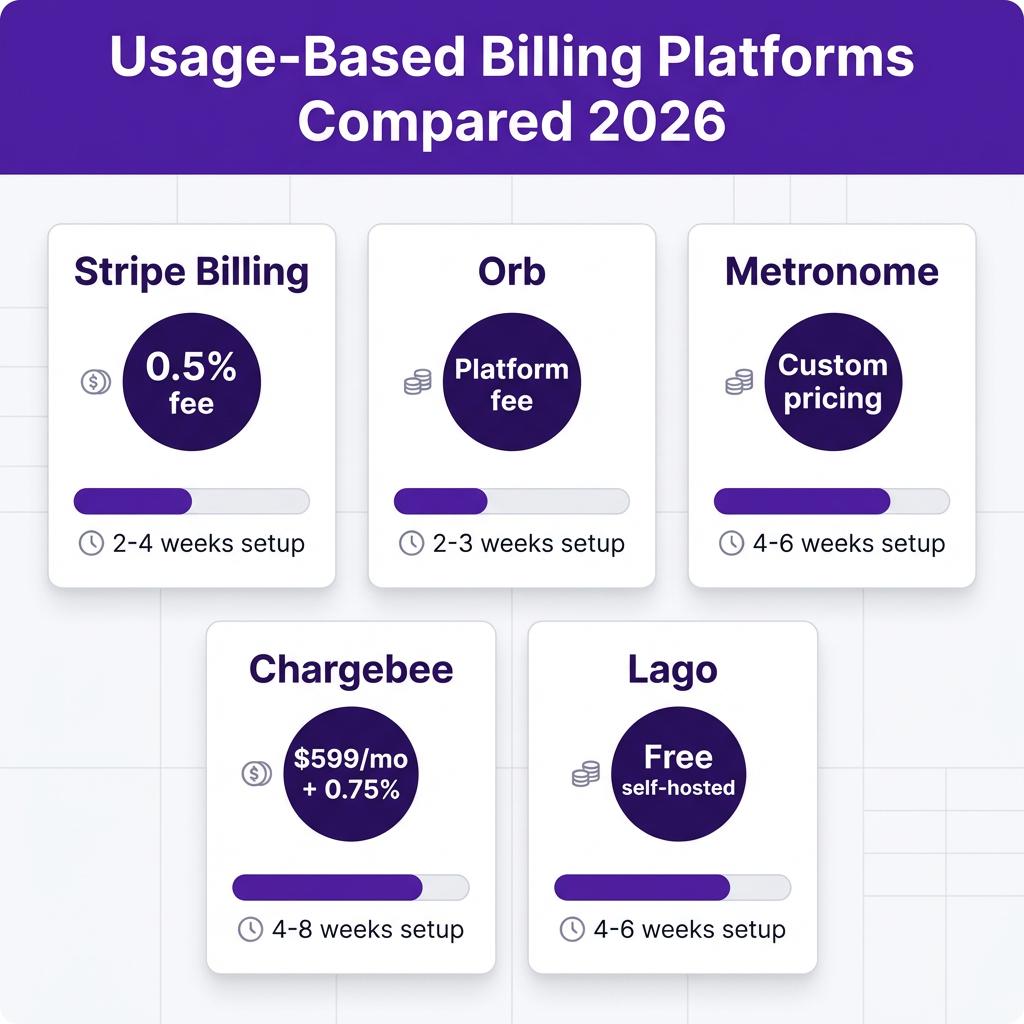
Top Usage-Based Billing Platforms Compared
Here’s how the leading platforms stack up in 2026:
Stripe Billing
| Feature | Details |
|---|---|
| Pricing | 0.5% on recurring payments (on top of Stripe’s 2.9% + $0.30) |
| Metering | Custom metered billing via API |
| Strengths | Deep Stripe integration, reliable infrastructure, global payments |
| Weaknesses | Limited token awareness, requires engineering for complex models |
| Setup Time | 2-4 weeks |
Orb
| Feature | Details |
|---|---|
| Pricing | Platform fee based on usage (no transaction fees) |
| Metering | Native token + GPU minute primitives |
| Strengths | Instant pricing changes, RevGraph architecture, pricing experimentation UI |
| Weaknesses | Limited customization for highly bespoke models |
| Setup Time | 2-3 weeks |
Metronome
| Feature | Details |
|---|---|
| Pricing | Custom (enterprise-focused) |
| Metering | Flexible meters, centralized rate cards |
| Strengths | Strong metering, good for multi-meter bundles |
| Weaknesses | Requires separate billing solution, limited reporting |
| Setup Time | 4-6 weeks |
Chargebee
| Feature | Details |
|---|---|
| Pricing | Free up to $250K billing, then $599/mo + 0.75% overage |
| Metering | Real-time usage ingestion, metered plans |
| Strengths | Mature platform, strong subscription + usage hybrid support |
| Weaknesses | Usage features hidden behind enterprise tiers, complex pricing |
| Setup Time | 4-8 weeks |
Lago
| Feature | Details |
|---|---|
| Pricing | Open source (self-hosted) or cloud plans from $0 |
| Metering | Event-based, flexible pricing models |
| Strengths | No vendor lock-in, complete control, no percentage fees |
| Weaknesses | Requires engineering maintenance, smaller ecosystem |
| Setup Time | 4-6 weeks |
Conclusion
Usage-based billing isn’t just a pricing change — it’s a fundamental shift in how you align with customer value. Companies that implement it well see higher retention, faster growth, and better unit economics.
The key is choosing the right value metric, selecting billing infrastructure that matches your complexity, and communicating transparently with customers throughout the transition.
If you’re building a SaaS product in 2026, you need a billing strategy that scales with your customers. Usage-based billing is that strategy.
Ready to implement usage-based billing with a payment infrastructure that handles global tax compliance automatically? Get started with Fungies — our Merchant of Record platform handles the complexity while you focus on growth.