Selling digital products globally in 2026? You’re probably unknowingly racking up tax liabilities in multiple countries. When a customer in Germany buys your SaaS subscription or an Australian downloads your ebook, local tax authorities expect their cut—and they don’t care that your business is based elsewhere.
Digital product tax compliance isn’t optional. Over 140 countries now impose VAT, GST, or sales tax on digital services sold to their residents. Get it wrong, and you’re looking at penalties, back taxes, and potential legal action. This guide breaks down exactly what you need to know about digital product tax compliance by country in 2026.
Why Digital Product Tax Compliance Matters Now
The rules changed dramatically over the past decade. Before 2015, most countries didn’t tax digital products sold by foreign businesses. That loophole closed fast. The EU led the charge with VAT on digital services in 2015, and nearly every major economy followed suit.
Today, if you sell software subscriptions, online courses, digital downloads, or streaming services to consumers internationally, you likely have tax obligations in multiple jurisdictions. The threshold for registration varies—some countries require immediate compliance, while others offer small business exemptions—but the trend is toward broader coverage and lower thresholds.
Here’s the kicker: tax authorities are getting smarter. They’re sharing data through international agreements and using AI to detect non-compliant sellers. The “I’ll deal with it when I’m bigger” approach is increasingly risky.
Digital Product Tax Rates by Country: The Complete 2026 Breakdown
Tax rates vary significantly by region. Understanding these differences is crucial for pricing your products and forecasting your true revenue per market.
European Union: 20% Average VAT Rate
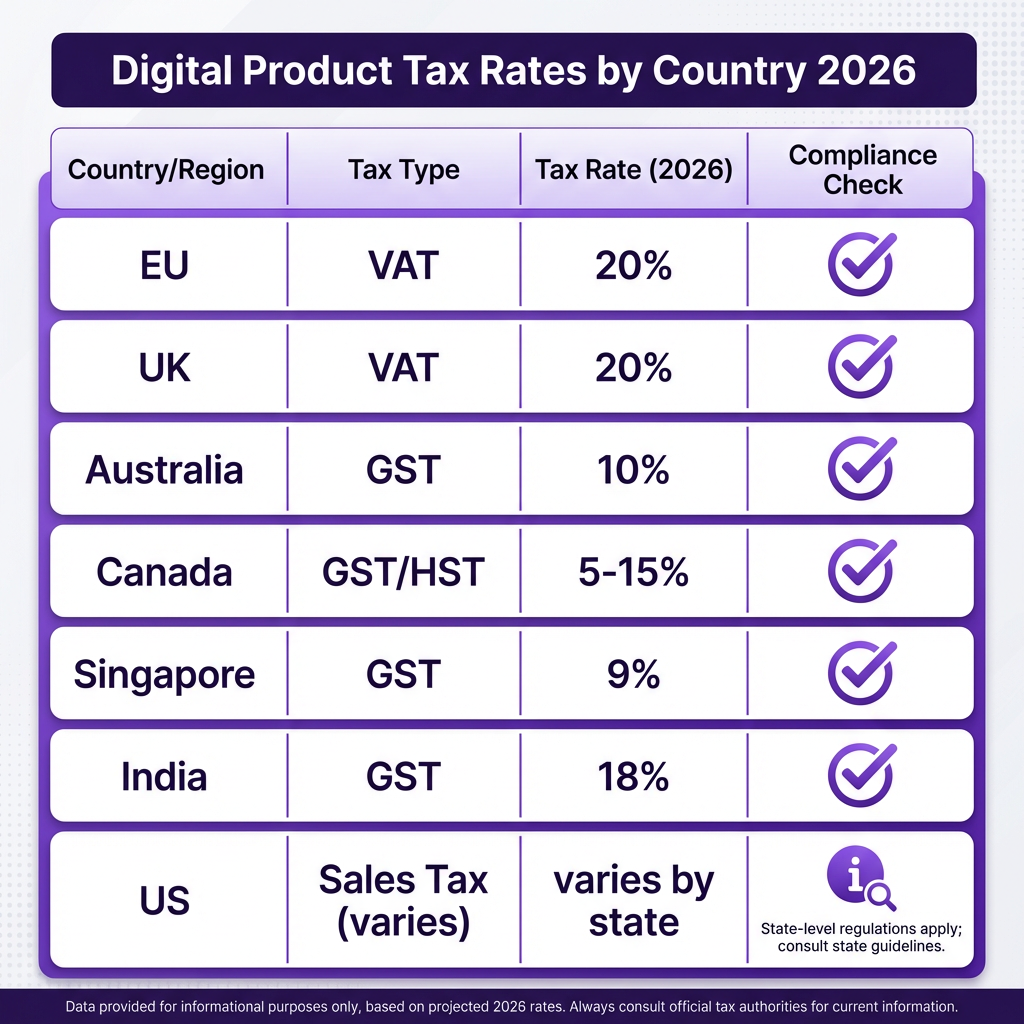
The EU applies VAT to all digital services sold to consumers (B2C) at the rate of the customer’s country. Rates range from 17% in Luxembourg to 27% in Hungary, with most major markets (Germany, France, Spain) at 20-21%.
Key 2026 update: The EU-wide €10,000 threshold for cross-border B2C sales remains in effect. Stay under this across all EU countries, and you can charge your home country’s VAT rate. Exceed it, and you must charge VAT at the customer’s local rate and register for the One-Stop Shop (OSS) system.
United Kingdom: 20% VAT on Digital Services
Post-Brexit, the UK operates its own system. Non-UK businesses selling digital services to UK consumers must register for UK VAT immediately—there’s no threshold. The standard rate is 20%.
UK businesses can no longer use the EU VAT MOSS scheme for EU sales. They must either register in each EU country they sell to or use the non-Union OSS scheme.
United States: Variable Sales Tax by State
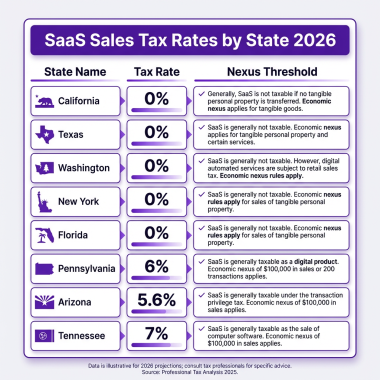
The US has no federal sales tax on digital products. Instead, 45 states plus DC impose sales tax, with varying rules on digital product taxability. As of 2026, approximately 38 states tax SaaS and digital products.
Economic nexus thresholds vary by state but typically trigger at $100,000 in annual sales or 200 transactions. Some states have lower thresholds for remote sellers. This creates a complex compliance landscape where you might owe sales tax in a dozen states without realizing it.
Australia: 10% GST on Digital Services
Since July 2017, Australia has imposed 10% GST on digital services sold to Australian consumers by non-resident providers. The registration threshold is AUD $75,000 annually. Below this, registration is voluntary; above it, mandatory.
Canada: 5-15% GST/HST
Canada applies GST (5%) or HST (13-15% depending on province) to digital products sold to Canadian consumers. The registration threshold is CAD $30,000 over any four consecutive calendar quarters.
Singapore: 9% GST
Singapore taxes digital services supplied by foreign providers to local consumers at 9% GST. The registration threshold is SGD $1 million annually. Singapore also introduced mandatory e-invoicing starting April 2026 for GST-registered businesses.
India: 18% GST on OIDAR Services
India taxes Online Information Database Access and Retrieval (OIDAR) services at 18% GST. Foreign providers must register for GST immediately if selling to Indian consumers—there’s no threshold exemption. Compliance is strict, with penalties for late registration and filing.
The 5-Step Process for Global Tax Compliance
Navigating international tax compliance doesn’t have to be overwhelming. Follow this structured approach to ensure you’re meeting obligations across all your markets.
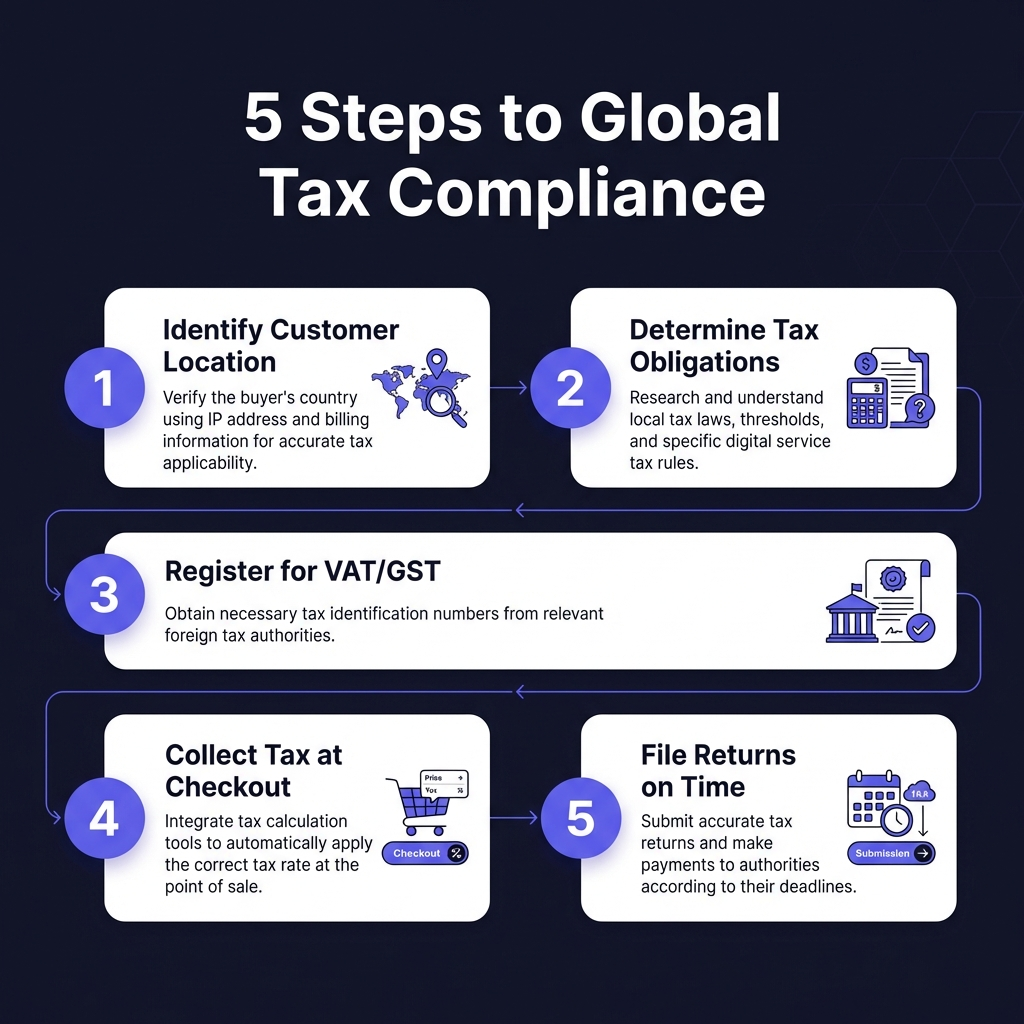
Step 1: Identify Your Customer’s Location
Tax obligations depend on where your customer is located, not where your business is based. You need to determine their country (and sometimes state/province) at the point of sale.
Best practices: collect and validate billing addresses, use IP geolocation as a secondary check, and keep records of how you determined location. Tax authorities may audit this data.
Step 2: Determine Your Tax Obligations
Research the specific rules for each country where you have customers. Consider: Is your product taxable? (Some countries exempt certain digital products.) What’s the registration threshold? Do B2B sales follow different rules? Are there simplified schemes like OSS or MOSS available?
Step 3: Register for VAT/GST Where Required
Once you exceed a threshold or establish nexus, you must register. This typically involves submitting an application to the local tax authority, receiving a tax ID number, and setting up for ongoing compliance.
For EU sales, the One-Stop Shop (OSS) simplifies this—you register once and file a single quarterly return covering all EU member states.
Step 4: Collect Tax at Checkout
Your checkout process must calculate and collect the correct tax amount based on the customer’s location. This requires up-to-date tax rate databases and location validation.
Key considerations: Display prices inclusive or exclusive of tax based on local requirements, apply correct rates for different product types, and handle tax-exempt B2B transactions with valid VAT/GST IDs.
Step 5: File Returns and Remit Tax
Filing frequencies vary by country—monthly, quarterly, or annually. Missing deadlines results in penalties and interest charges. Keep detailed records of all transactions, tax collected, and filings made.
Common Compliance Mistakes to Avoid
Even well-intentioned businesses make these errors:
- Assuming digital products aren’t taxable: This was true a decade ago. It’s not true now in most major markets.
- Ignoring economic nexus thresholds: You don’t need a physical presence to owe sales tax. Pure revenue or transaction volume can create nexus.
- Misclassifying B2B vs B2C: Business customers often have different tax treatment. Validate VAT/GST IDs for B2B reverse charge.
- Using outdated tax rates: Rates change. EU member states adjust VAT rates periodically. US state rates and rules evolve constantly.
- Poor record keeping: Tax authorities can audit years of transactions. You need detailed records to defend your filings.
FAQ: Digital Product Tax Compliance
Do I need to register for VAT in every EU country?
No. The EU One-Stop Shop (OSS) allows you to register in one EU country and file a single quarterly return covering all EU sales. You’ll still charge VAT at each customer’s local rate, but the filing is consolidated.
What’s the difference between VAT, GST, and sales tax?
VAT (Value Added Tax) and GST (Goods and Services Tax) are consumption taxes applied at each stage of production, with businesses deducting input tax. Sales tax (US) is applied only at the final sale to consumers. For digital product sellers, the practical difference is minimal—you collect and remit the tax either way.
Are there any countries that don’t tax digital products?
A few smaller markets still don’t impose digital taxes, but the list is shrinking. Most major economies—US, EU, UK, Canada, Australia, Japan, Singapore, India—all tax digital products sold to their residents by foreign providers.
What happens if I don’t comply?
Penalties vary by country but typically include: fines for late registration (often a percentage of revenue), interest on unpaid tax, penalties for late filing (fixed amounts plus percentages of tax owed), and in severe cases, restrictions on doing business or criminal charges for tax evasion.
Can I use a Merchant of Record to handle tax compliance?
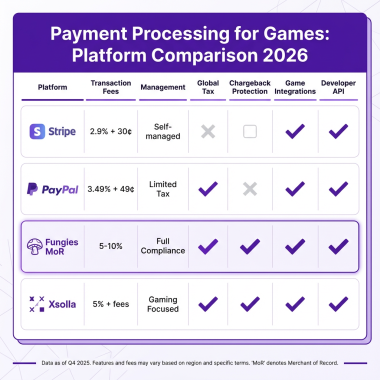
Yes. A Merchant of Record (MoR) acts as the legal seller of your products, handling all tax registration, collection, and remittance on your behalf. This eliminates your direct tax obligations in most jurisdictions and significantly simplifies compliance.
Conclusion: Don’t Let Tax Compliance Block Your Growth
Global digital product sales open massive revenue opportunities—but they come with tax obligations that can’t be ignored. The complexity of tracking rates, thresholds, and filing requirements across dozens of countries is a real operational burden.
You have three options: handle compliance manually (time-consuming and error-prone), use tax calculation software (better, but you still handle registration and filing), or use a Merchant of Record that takes on the legal responsibility entirely.
For most growing digital product businesses, the MoR route makes the most sense. It lets you focus on building and selling your products while staying compliant everywhere you sell.
Simplify Your Global Tax Compliance
Fungies.io handles VAT, GST, and sales tax compliance in 150+ countries—automatically. Focus on growing your business, not filing tax returns.
No credit card required • Automatic tax handling • Global coverage
Sources
- European Commission – VAT e-Commerce Rules (2026)
- UK HMRC – VAT on Digital Services Guidance
- Australian Taxation Office – GST on Digital Products
- Canada Revenue Agency – GST/HST for Non-Residents
- Singapore IRAS – GST on Digital Services
- India GST Council – OIDAR Services Rules