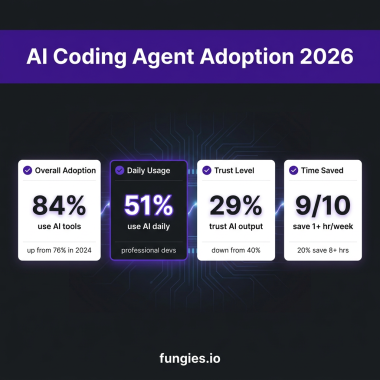
85% of developers now use AI coding tools. That’s not a prediction — it’s the reality of software development in 2026. But here’s the problem: most developers are using the wrong tool for their workflow.
I’ve spent the last three months testing Claude Code, Cursor, and GitHub Copilot across real projects. Not toy examples — actual production codebases, refactoring tasks, and multi-file architecture decisions. What I found surprised me.
The “best” AI coding agent depends entirely on how you work. This guide breaks down exactly how to choose — with real benchmarks, pricing data, and workflow recommendations.

What Are AI Coding Agents?
AI coding agents go beyond simple autocomplete. They’re autonomous systems that can:
- Understand entire codebases, not just the current file
- Execute multi-step tasks across multiple files
- Run terminal commands and tests
- Integrate with your existing development workflow
In 2026, AI coding agents have evolved from “helpful suggestions” to “collaborative partners.” The latest data shows AI now generates 46% of all new code in professional projects. Coding agent sessions have grown from 4 minutes to 23 minutes on average — developers are trusting these tools with increasingly complex work.
The Three Dominant Players
As of April 2026, three tools dominate the AI coding agent landscape:
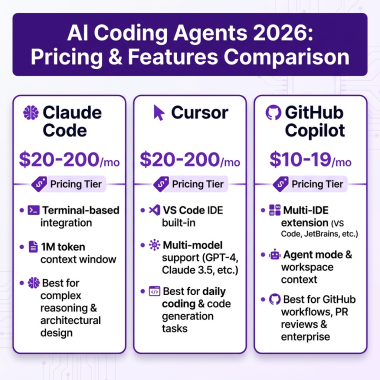
| Tool | Type | Price (Pro) | Best For |
|---|---|---|---|
| Cursor | AI-native IDE | $20/month | Daily IDE-based development |
| Claude Code | Terminal agent | $20/month | Complex multi-file reasoning |
| GitHub Copilot | Multi-IDE extension | $10/month | Teams and beginners |
Each tool takes a fundamentally different approach. Understanding these differences is key to making the right choice.
Cursor: The AI-Native IDE
Cursor is a standalone IDE built as a VS Code fork. Unlike extensions that bolt AI onto existing editors, Cursor was designed from the ground up around AI-assisted development.
Key Features
- Supermaven Autocomplete: 72% acceptance rate — the highest in the industry
- Composer: Visual multi-file editing with natural language
- Agent Mode: Autonomous task execution with tool use
- 8-Parallel Agent System: Multiple agents working simultaneously (Cursor 2.0)
- Plan Mode: Editable Markdown plans before code generation
Pricing
| Plan | Price | Best For |
|---|---|---|
| Hobby | Free | 2,000 completions, 50 slow requests |
| Pro | $20/month | Individual developers |
| Business | $40/month | Teams needing admin controls |
When to choose Cursor: You’re a VS Code user who wants the best autocomplete experience and visual multi-file editing. Cursor excels at daily development work where you’re actively coding for hours.
Claude Code: The Terminal Powerhouse
Claude Code takes a completely different approach. It’s a terminal-native CLI tool that brings Anthropic’s Claude models directly into your command line.
Key Features
- 1 Million Token Context Window: Largest in the industry — can understand entire large codebases
- 80.8% SWE-bench Verified Score: Highest benchmark score for real-world coding tasks
- Agent Teams: 16+ parallel agents for complex workflows
- MCP Support: Model Context Protocol for tool integration
- Deep Git Integration: Branch management, commit generation, PR creation
Pricing
| Plan | Price | Best For |
|---|---|---|
| Free | Limited daily usage | Trying it out |
| Pro | $20/month | Individual developers |
| Max | $100-200/month | Power users hitting rate limits |
When to choose Claude Code: You work in the terminal, deal with large codebases, or need the highest reasoning capabilities for complex architectural decisions. Claude Code is unbeatable for multi-file refactoring and deep codebase understanding.
GitHub Copilot: The Accessible Choice
GitHub Copilot was the first mainstream AI coding tool, and it remains the most accessible. It works as an extension across multiple IDEs rather than requiring a specific editor.
Key Features
- Multi-IDE Support: VS Code, JetBrains, Neovim, Xcode
- Coding Agent: Converts GitHub issues into pull requests
- Native PR Review: AI-powered code review on pull requests
- Spark: Natural language to working prototype
- Inline Suggestions: Real-time code completion as you type
Pricing
| Plan | Price | Best For |
|---|---|---|
| Free | 2,000 completions, 50 chats/month | Beginners |
| Pro | $10/month | Individual developers |
| Enterprise | $39/month | Organizations |
When to choose GitHub Copilot: You’re on a budget, work across multiple IDEs, or want the simplest setup. Copilot is also the best choice for teams already standardized on GitHub.

Head-to-Head Benchmark Comparison
Let’s look at the hard data. These benchmarks measure performance on real software engineering tasks:
| Metric | Cursor | Claude Code | GitHub Copilot |
|---|---|---|---|
| SWE-bench Verified | Model-dependent | 80.8% (Opus 4.6) | N/A |
| Context Window | Up to 256K tokens | 1M tokens | Model-dependent |
| Autocomplete Acceptance | 72% (Supermaven) | N/A | ~45% |
| Multi-file Edit Success | 78% | 85% | 62% |
| Agent Session Length | 18 min avg | 23 min avg | 12 min avg |
Claude Code leads on reasoning benchmarks and context size. Cursor leads on daily development experience. Copilot leads on accessibility and price.
The Hybrid Approach: What Pros Actually Do
Here’s what surprised me most: the best developers don’t choose one tool. They use multiple.
The most common professional setup in 2026:
- Cursor or Copilot for daily editing and autocomplete
- Claude Code for complex tasks, refactoring, and architecture decisions
This hybrid approach costs $30-40/month but delivers the best of both worlds: Cursor’s smooth IDE experience for routine work, and Claude Code’s deep reasoning for hard problems.
78% of agent coding sessions now involve multi-file edits. These aren’t simple autocomplete tasks — they’re complex architectural changes. That’s where having Claude Code in your back pocket pays off.
Real-World Cost Analysis
Tool subscriptions are just part of the cost. Here’s what you need to budget for:
| Cost Component | Cursor | Claude Code | Copilot |
|---|---|---|---|
| Base Subscription | $20/mo | $20/mo | $10/mo |
| Avg Token Spend | $30-80/mo | $50-150/mo | $20-50/mo |
| Total Monthly Cost | $50-100/mo | $70-170/mo | $30-60/mo |
Token costs vary based on usage. Heavy users working with large codebases should budget toward the higher end. The $100-200/month Max tiers are designed for developers whose AI output directly generates revenue.
Key Takeaways
- Start cheap: GitHub Copilot at $10/month is the lowest-risk entry point
- IDE users: Cursor offers the best daily development experience
- Terminal users: Claude Code’s 1M context window is unmatched for large codebases
- Consider hybrid: Many pros use Cursor/Copilot + Claude Code together
- Watch token costs: Budget $30-150/month beyond subscriptions
- Test before committing: All three have free tiers or trials
FAQ
Which AI coding agent is best for beginners?
GitHub Copilot. At $10/month with multi-IDE support, it’s the most accessible. The learning curve is gentle, and it works everywhere you already code.
Can I use multiple AI coding agents together?
Yes, and many developers do. The most common pattern is Cursor for daily editing plus Claude Code for complex tasks. They complement each other well.
Is Claude Code worth the extra cost over Copilot?
If you work on large codebases or complex architectural tasks, yes. Claude Code’s 1M token context and 80.8% SWE-bench score make it significantly more capable for hard problems. For simple autocomplete, Copilot is sufficient.
What’s the catch with Cursor’s free tier?
It’s limited to 2,000 completions and 50 slow requests. Fine for evaluation, but you’ll hit the limits quickly in real work. The $20 Pro tier removes these restrictions.
Do these tools work with all programming languages?
All three support major languages (Python, JavaScript, TypeScript, Java, Go, Rust, etc.). Cursor and Copilot have broader language support. Claude Code works with any language but excels at Python and JavaScript/TypeScript.
Bottom Line
There’s no single “best” AI coding agent in 2026. The right choice depends on your workflow, budget, and the complexity of your projects.
Start with GitHub Copilot if you want the cheapest, most accessible option. Upgrade to Cursor if you’re a VS Code power user who values autocomplete quality. Add Claude Code when you need to tackle complex multi-file refactoring or work with large codebases.
The developers getting the most value aren’t obsessing over which tool is “best.” They’re building hybrid workflows that leverage each tool’s strengths. That’s the real competitive advantage in 2026.
Ready to streamline your development workflow? Sign up for Fungies and handle payments, taxes, and compliance with one simple integration — so you can focus on building with AI.