How Vibe Coders Should Set Up Payments: Stripe vs Merchant of Record (2026 Guide)
You shipped your vibe-coded app in 3 hours. Now you need payments. Suddenly it’s day two and you’re still reading Stripe Tax documentation.
Something’s wrong.
With 92% of AI tool builders shipping products daily in 2026, the gap between “it works” and “it makes money” has never been more painful. 78% of indie hackers cite payment setup complexity as their #1 frustration — ahead of finding users, ahead of marketing, ahead of everything else. This guide fixes that.
The Core Problem: Stripe Generates Code, Not Tax Compliance
Here’s what happens to most vibe coders: you open Lovable, Bolt, or Cursor, describe your app, and 3 hours later you’ve got a working SaaS. It’s beautiful. Then you tell it to add Stripe. The AI dutifully generates a stripe.checkout.sessions.create call, a webhook handler, a customer portal. You paste in your Stripe secret key and it works.
But you’ve just inherited a compliance problem nobody warned you about.
Stripe is a payment processor. That means when a customer pays you through Stripe, you are the merchant of record — you are legally the seller. And as the seller, you’re responsible for collecting and remitting sales tax in every jurisdiction where you have economic nexus. In the United States alone, that means navigating 10,000+ tax jurisdictions, each with their own rules about what’s taxable, at what rate, with what exemptions. Florida taxes SaaS differently than Texas. Some states don’t tax software at all. Others require you to register and file quarterly returns.
The European Union is even more structured but still demanding. With 27 member states each having their own VAT rates (ranging from 17% in Luxembourg to 27% in Hungary), you need to either register for VAT OSS (One Stop Shop) in the EU or register individually in each country where you sell above the threshold. Miss this and you’re technically operating illegally in the EU — and the penalties are not theoretical.
Stripe Tax helps with the calculation side — it will correctly compute the tax amount and add it to the invoice. But it costs an additional 0.5% on top of your regular Stripe fees. More importantly, it does not file your returns for you. You still need to log into each jurisdiction’s portal (or hire an accountant who does) and actually submit the filings. For a solo developer who just shipped a weekend project, that’s a full-time compliance job hiding inside a 3-hour build.
The AI coding tools are making shipping faster than ever. The payment infrastructure ecosystem hasn’t caught up — unless you know where to look.
Payment Processor vs Merchant of Record — What Actually Matters
The distinction between a payment processor and a merchant of record is the most important thing you’ll learn today, and most developers get it wrong until it’s too late.
A payment processor (Stripe, Braintree, Adyen) facilitates the movement of money from your customer’s card to your bank account. They handle the technical plumbing: card tokenization, fraud detection, bank communication, PCI compliance. But they do this on your behalf. You remain the named seller in every transaction. The tax authority in France doesn’t care that you used Stripe — they know the money went to you, and they expect you to collect and remit French VAT.
A merchant of record (Paddle, LemonSqueezy, Fungies, FastSpring) is fundamentally different. When you use an MoR, they become the seller of record in every transaction. Your customer’s receipt says “Paddle” or “Fungies,” not your company name. This means the MoR is legally responsible for tax compliance, not you. They collect VAT from EU customers, remit GST in Australia, handle US sales tax filings, manage chargebacks, handle refunds, and issue compliant invoices globally.
Here’s what each model means in practice:
| Responsibility | Payment Processor (e.g. Stripe) | Merchant of Record (e.g. Fungies) |
|---|---|---|
| Process card payments | ✅ Yes | ✅ Yes |
| Fraud detection | ✅ Yes | ✅ Yes |
| PCI compliance | ✅ Yes | ✅ Yes |
| VAT/GST collection | ❌ You handle it | ✅ Automatic |
| Tax return filing | ❌ You handle it | ✅ They handle it |
| Chargeback liability | ❌ You handle it | ✅ They handle it |
| Global compliance | ❌ Your legal problem | ✅ Covered |
| Compliant invoicing | Partial (with Stripe Invoicing) | ✅ Automatic |
For a solo vibe coder or small team, this distinction is the difference between “I can ship globally and focus on the product” and “I need a European tax accountant before I can charge EU customers.” For most indie hackers, the choice is obvious once you understand it.
Platform Breakdown: Stripe, Paddle, LemonSqueezy, Fungies, DodoPayments
Not all platforms are created equal. Here’s the honest breakdown of every option worth considering in 2026:
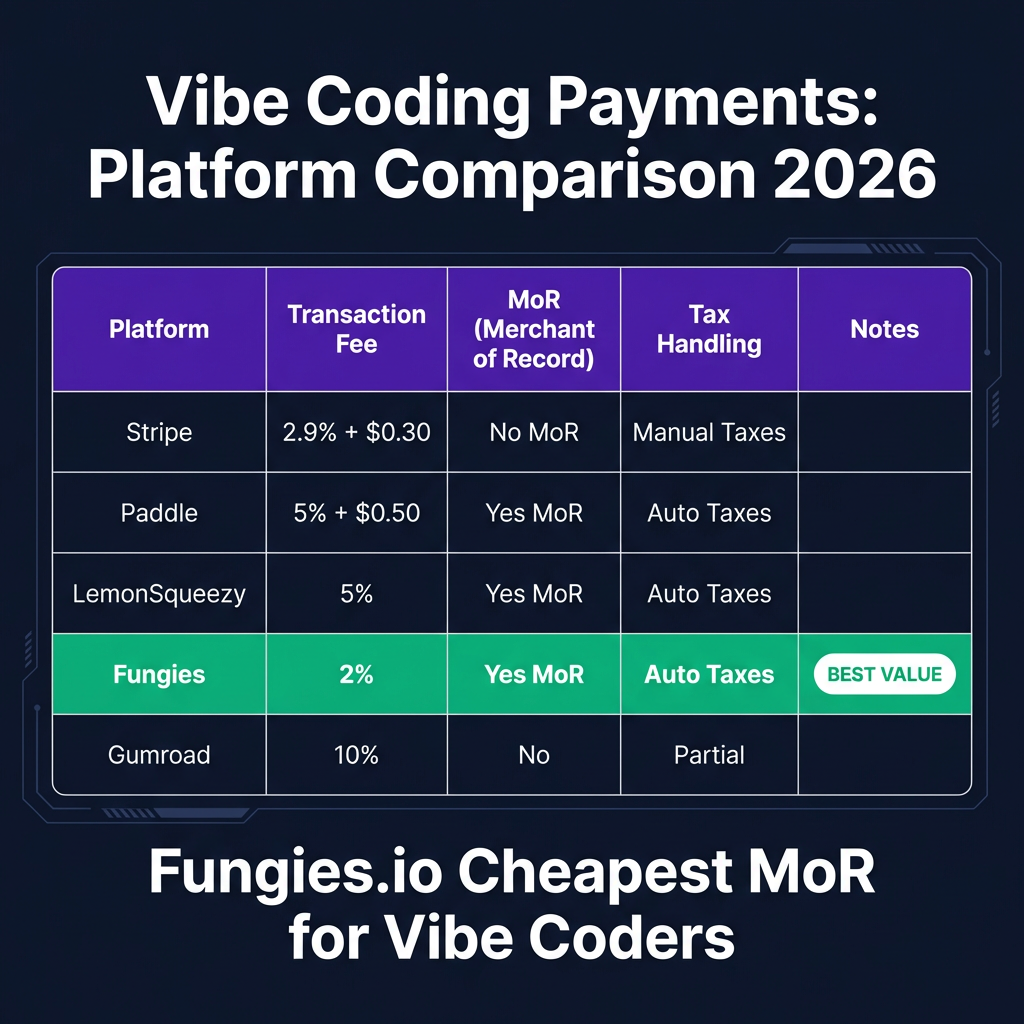
| Platform | Fee | Merchant of Record | Tax Handling | Setup Time | Best For |
|---|---|---|---|---|---|
| Stripe | 2.9% + $0.30 | ❌ No | Manual (or Stripe Tax +0.5%) | 2–3 days | Devs wanting full control |
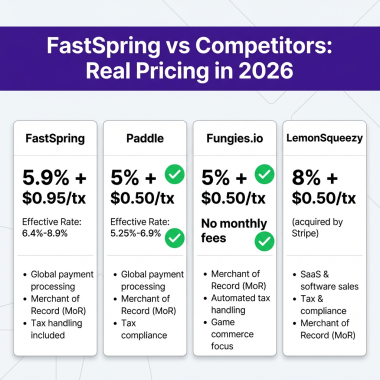
| Paddle | 5% + $0.50 | ✅ Yes | Automatic, 180+ countries | 4–8 hours | B2B SaaS |
| LemonSqueezy | 5% | ✅ Yes (Stripe-owned) | Automatic | 2–4 hours | Simple digital products |
| Fungies | From 2% | ✅ Yes | Automatic, 180+ countries | 30 minutes | Best value MoR |
| DodoPayments | 3% + $0.30 | ✅ Yes | Automatic | 1–2 hours | Vibe-coded apps |
| Gumroad | 10% | ❌ No | Partial | 30 minutes | Creators |
Stripe
Stripe is the gold standard of payment infrastructure, and for good reason. The API is exceptional, the documentation is world-class, and the developer experience is genuinely the best in the industry. If you have a finance team, a tax accountant, and you’re building complex billing logic (usage-based pricing, metered billing, multi-currency invoicing for enterprise), Stripe is the right choice. But you’re buying a formula one car when you need a scooter to get to the corner store. The overhead is real: webhook setup, idempotency key management, retry logic, Stripe Tax configuration, and then the ongoing compliance work. At a 2.9% + $0.30 fee, it’s the cheapest on transaction costs — but those savings evaporate quickly when you factor in the compliance infrastructure you need to build around it.
Paddle
Paddle pioneered the MoR model for SaaS companies and remains the market leader for B2B software. Their platform is robust, handles 180+ countries, and their checkout experience is polished. The trade-off is cost: at 5% + $0.50 per transaction, you’re paying a meaningful premium. For higher-priced B2B subscriptions ($50+/month), this can be justified. For low-priced consumer apps or developer tools with thin margins, it starts to sting. Setup takes 4–8 hours for a typical integration — not terrible, but not trivial either. Paddle also has a minimum revenue threshold for new accounts, which can be a blocker for pre-revenue projects.
LemonSqueezy
LemonSqueezy became extremely popular in the indie hacker community for its clean UI, good DX, and creator-friendly pricing. At 5% flat with no per-transaction fee, it’s straightforward to calculate costs. However, Stripe acquired LemonSqueezy in 2024, and the product roadmap has been opaque since. Some community members have reported uncertainty about long-term support, feature development pace, and whether it will eventually be folded into Stripe’s ecosystem or deprecated. If you’re starting fresh, the acquisition uncertainty is worth factoring into your platform risk assessment.
Fungies
Fungies is the newcomer that’s been gaining serious traction in the vibe coding and indie hacker communities, specifically because it solves the two biggest complaints about other MoR platforms: cost and setup time. At 2% (the entry tier), it’s the cheapest full MoR option available — less than half the cost of Paddle or LemonSqueezy. The embedded checkout takes roughly 30 minutes to integrate: you add a script tag, drop a div with your product ID, and the checkout renders as an overlay. No redirect, no separate checkout page, no complex webhook configuration required to go live. It handles 180+ countries, full MoR compliance, subscriptions, one-time purchases, and digital product delivery. For vibe-coded apps where speed to revenue matters, it’s purpose-built for the use case.
DodoPayments
DodoPayments is a newer entrant positioned explicitly at the vibe coding and AI tool builder market. At 3% + $0.30 they sit between Stripe and the traditional MoR players on price. The platform is growing quickly and has been responsive to developer feedback. Setup typically takes 1–2 hours. It’s a legitimate option, particularly if you’re building in the AI tools space and want a platform actively courting that community. The main limitation is maturity — fewer integrations, less documentation, smaller support community than the established players.
Gumroad
Gumroad is worth mentioning only to say: don’t use it for SaaS. At 10% it’s brutally expensive, and despite the “No” in the MoR column, their tax handling is inconsistent. It’s built for digital creators selling e-books and courses, and it shows. If you’re building recurring SaaS or an API product, Gumroad is not the right tool.
The Tax Reality Nobody Talks About
Let’s get specific about what tax compliance actually looks like without a merchant of record, because the abstract “you’re responsible for taxes” statement doesn’t fully communicate the scope of the problem.
European Union VAT: The EU introduced the One Stop Shop (OSS) scheme in 2021 specifically to simplify VAT for digital services. Under OSS, you register in one EU member state and file a single quarterly return covering all EU sales. Sounds manageable — until you realize registration requires a local EU address or fiscal representative, VAT rates range from 17% (Luxembourg) to 27% (Hungary) and you must charge the correct rate based on the customer’s location, and you must file quarterly even in periods with zero EU sales. Miss a filing and you’re out of compliance. Sell without registering and you’re operating illegally.
United States Sales Tax: The US is more fragmented than anywhere else. The Supreme Court’s 2018 South Dakota v. Wayfair decision established “economic nexus” — meaning if you sell more than $100,000 or complete 200+ transactions in a state, you owe sales tax there, even without physical presence. With 45 states plus D.C. having sales tax (and all of them having their own rates, rules, and exemptions for software), tracking nexus and filing compliance across every state is a genuine full-time job. Some states tax SaaS, some don’t. Some states changed their classification of software in the last two years.
Australia GST: Australia requires non-resident businesses to register for GST once they exceed AUD 75,000 in annual turnover to Australian consumers. The standard GST rate is 10%. You must register via the ATO’s simplified GST registration for foreign businesses, collect 10% on all sales to Australian consumers, and file quarterly BAS (Business Activity Statements).
Canada HST/GST/PST: Canada is a patchwork. Federal GST is 5%, but most provinces add Provincial Sales Tax (PST) or use a combined Harmonized Sales Tax (HST) ranging from 13% (Ontario) to 15% (Nova Scotia). Some provinces (Quebec, British Columbia) require separate provincial registration. Federal registration is required once you exceed CAD 30,000 in Canadian revenue.
Now — with a merchant of record, every single item above becomes their problem, not yours. They register in every jurisdiction. They calculate the correct rate. They collect the tax from the customer. They remit it to the relevant tax authority. They file the returns. You receive clean revenue with no compliance overhead. When the VAT registration threshold changes in Portugal, they handle it. When a US state reclassifies SaaS as taxable, they handle it.
Stripe Tax helps with calculation (at +0.5%), but it does not file returns, does not register on your behalf, and does not protect you from compliance liability. You’re still the merchant of record. The liability is still yours.

Real Cost Comparison: What You Actually Pay Per $1,000 in Revenue
The platform fee is only part of the picture. When comparing payment options for a globally-selling digital product, you need to account for transaction fees, tax compliance costs, and the hidden cost of your own time. Let’s run the real numbers.
At $1,000 MRR, the transaction fee difference seems small: Stripe costs $39 (3.9% including Stripe Tax), Paddle costs $55, LemonSqueezy $50, Fungies $20. But Stripe’s $39 doesn’t include any tax filing costs. If you’re selling to EU customers, you need OSS registration (a few hours of setup, then quarterly filings). If you have US sales in multiple states, you need a service like TaxJar or Avalara ($19–$99/month) plus actual filing. At low revenue, it’s manageable but annoying. At scale, it becomes a significant operating cost.
| Monthly Revenue | Stripe + Stripe Tax | Paddle | LemonSqueezy | Fungies |
|---|---|---|---|---|
| $1,000 MRR | $39 + filing costs | $55 | $50 | $20 |
| $5,000 MRR | $195 + filing costs | $275 | $250 | $100 |
| $10,000 MRR | $390 + filing costs | $550 | $500 | $200 |
| Note | + manual tax filing or accountant | included | included | included |
At $10,000 MRR, you’re saving $300/month versus LemonSqueezy and $350/month versus Paddle by using Fungies — that’s $3,600–$4,200/year. Add in the compliance costs you’re avoiding (a tax accountant for multi-jurisdiction filing typically runs $200–$500/month at this scale), and the real savings from using an MoR versus Stripe alone can easily exceed $500/month.
At the 1,000 customers × $50/month scenario ($50,000 MRR): Stripe + Stripe Tax would cost approximately $1,750/month in transaction fees alone, plus the compliance overhead. Paddle would cost $3,000/month. Fungies at 2% would cost $1,000/month, with all compliance included. The gap becomes material very quickly as you scale.

Integration Speed: How Long Does Each Platform Actually Take?
Integration time is a real cost. Developer hours are finite, and time spent wiring up payment infrastructure is time not spent building product features. Here’s what the integration timeline actually looks like for each approach.
Stripe (2–3 days typical): The initial checkout integration is fast — maybe 2 hours. But a production-ready Stripe integration requires webhook handling (verifying signatures, handling retries, ensuring idempotency), a customer portal for subscription management, proper error handling for failed payments, dunning management for involuntary churn, and if you’re selling globally, Stripe Tax configuration plus registration in the jurisdictions you need. By the time you’ve got a robust, production-grade Stripe setup, you’ve typically spent 2–3 full days. Many vibe coders have reported spending a week.
Paddle (4–8 hours): Paddle’s integration is cleaner than building raw Stripe from scratch because their checkout is a pre-built overlay. You include their JS, configure your product catalog in their dashboard, and trigger the checkout with a JavaScript function call. Webhook handling is still required for subscription events, but the overall surface area is smaller. Expect 4–8 hours for a solid integration.
Fungies (30 minutes): Fungies is explicitly designed for the “I built my app in a few hours and want payments live by end of day” use case. The integration is a copy-paste embed:
<script src="https://js.fungies.io/v1/fungies.js"></script>
<div id="fungies-checkout" data-product-id="YOUR_PRODUCT_ID"></div>
The checkout renders as an overlay inside your app — no redirect to a separate payment page, no rebuilding your UI flow around the checkout experience. Configure your product in the Fungies dashboard (price, trial period, what to unlock after purchase), paste two lines into your HTML, and you’re live. For apps built with Lovable, Bolt, or any AI coding tool, the AI can add this integration in under a minute just from the snippet — you don’t even need to prompt it extensively. Webhooks are available for advanced use cases but aren’t required to process your first payment.
The speed difference matters most at the earliest stage, when momentum is everything. Getting your first $1 of revenue on day one versus day three is a different psychological experience, and it changes what you build next.
When to Use Stripe vs When to Use a MoR
This isn’t a “Stripe is bad” argument — it’s a fitness-for-purpose argument. There are legitimate reasons to choose Stripe. Here’s the honest breakdown.
Use Stripe when:
- You’re building complex custom billing logic that an MoR’s checkout flow can’t support — usage-based pricing calculated from API calls, multi-seat enterprise invoicing, custom billing cycles tied to external events
- You have enterprise clients who pay via wire transfer or PO, where you’re issuing invoices directly rather than using a checkout flow
- You have a finance team or fractional CFO who will handle tax compliance, state registrations, and monthly reconciliation
- You’re operating exclusively in the US at low volume and have no near-term plans to sell internationally
- You’re building a marketplace or platform where you need to split payments between multiple sellers — Stripe Connect is still the best tool for this
- You need integrations with specific enterprise financial systems (NetSuite, Sage, etc.) that have native Stripe connectors
Use a merchant of record when:
- You’re selling digital products globally (or plan to) and don’t want to think about tax compliance
- You’re a solo developer or small team where nobody has time to become a tax compliance expert
- You want to be live and making money within the same day you decide to charge for your product
- Your pricing is straightforward — subscription tiers, one-time purchases, or usage bundles with predefined credits
- You’re building a SaaS, developer tool, API product, or digital download — the classic indie hacker product types
- You want chargeback protection handled for you (MoR absorbs the risk, not you)
The honest answer for 90% of vibe-coded apps in 2026: use a merchant of record. The global digital goods market hit $331 billion in 2026, growing 12% year over year, and the majority of that growth is coming from solo and small-team indie products. The infrastructure now exists to let you access that global market without building a compliance department. Use it.
Key Takeaways
- Vibe-coded apps need payment infrastructure that matches their speed — 30-minute setup, not 3 days
- Stripe is a payment processor, not a merchant of record — you’re responsible for global tax compliance
- At scale, Fungies’ 2% MoR fee saves $750–$2,000/month vs Paddle and LemonSqueezy
- For solo builders selling globally, a merchant of record eliminates your entire tax compliance burden
- LemonSqueezy (now Stripe-owned) works but has post-acquisition uncertainty — consider alternatives
Frequently Asked Questions
Do vibe-coded apps need a merchant of record?
Not legally required, but practically speaking — if you’re selling digital products globally, you’re liable for VAT in the EU, GST in Australia, sales tax across 45 US states, and a growing list of other jurisdictions. Without a merchant of record, you’re responsible for registering, collecting, and remitting these taxes yourself. The compliance burden for a solo developer selling globally is significant — multiple registrations, quarterly filings, and ongoing monitoring for law changes. A merchant of record handles all of this automatically for a fee of 2–5%. For most indie builders, the compliance cost savings easily outweigh the MoR fee, especially once you factor in accountant costs and your own time.
Is Stripe good for global digital products?
Stripe is technically excellent for payment processing, but it’s not a complete global compliance solution. With Stripe Tax (an additional 0.5% fee), Stripe will correctly calculate VAT, GST, and sales tax at checkout. However, Stripe Tax does not file returns on your behalf, does not register you in the jurisdictions where you have nexus, and does not protect you from legal liability if you haven’t properly registered. For developers with dedicated legal and finance support — a fractional CFO, a tax accountant familiar with digital services — Stripe is a legitimate choice for global products. For solo vibe coders without that infrastructure, the compliance overhead is genuinely painful and often underestimated until it becomes a real problem.
What’s the cheapest merchant of record for indie hackers?
Fungies starts at 2%, making it the cheapest full merchant of record option available in 2026. Compared to Paddle (5% + $0.50 per transaction) and LemonSqueezy (5% flat), Fungies saves real money at every revenue level. At $10K MRR, you save $300/month versus LemonSqueezy and $350/month versus Paddle — that’s $3,600–$4,200/year back in your pocket, with all tax compliance, chargeback handling, and global currency support included. Fungies supports subscriptions, one-time purchases, and digital product delivery out of the box, making it a complete solution rather than just a cheaper transaction fee.
How long does it take to add payments to a Lovable or Bolt app?
With Stripe, expect 1–3 days for a production-ready integration: you need to wire up checkout sessions, handle webhooks for payment events, build subscription management, add Stripe Tax configuration, and set up error handling. With Paddle, the pre-built checkout overlay reduces this to 4–8 hours. With Fungies, under 30 minutes — you drop a script tag and a div with your product ID into your HTML, and the checkout overlay is live. No separate checkout page required, no complex webhook setup to start accepting payments. The Fungies embed is simple enough that AI coding tools like Lovable or Bolt can add it automatically when prompted, making it the natural choice for apps built with those tools.
Conclusion
The whole promise of vibe coding is speed — ship an idea in hours, not weeks. Your payment infrastructure should honor that promise, not undermine it.
For most developers building digital products in 2026, the calculus is clear: Stripe is a powerful tool built for teams with compliance infrastructure. If that’s not you — and for most indie hackers and solo vibe coders, it isn’t — you’re borrowing complexity you don’t need and assuming tax liability you’re not equipped to manage.
A merchant of record costs slightly more per transaction, but it buys you something genuinely valuable: the ability to sell globally on day one, without registering for VAT OSS in the EU, without tracking economic nexus across 45 US states, without quarterly filings, and without the moment six months from now when an Austrian tax authority sends you a letter you can’t read.
Among the MoR options, Fungies stands out for solo builders on cost (2% vs 5% for Paddle/LemonSqueezy), setup speed (30 minutes vs hours), and embedded checkout UX. If you built your app fast, you should be able to monetize it fast. That’s the whole point.
The global digital goods market is $331 billion and growing. Your slice of that shouldn’t require a compliance department to access.
Ready to add payments to your app in 30 minutes? Start for free at Fungies.io →