Fraud Management Statistics 2026: Market Size, Data & Trends (Comprehensive Report)
Fraud is no longer just a cost of doing business—it’s a $67 billion industry fighting a $28 billion problem. In 2026, every dollar lost to fraud costs U.S. merchants $4.61, up 37% from 2020. The global fraud detection and prevention market is growing at 17.5% annually, driven by surging e-commerce volumes, sophisticated AI-powered attacks, and the persistent rise of friendly fraud.
This comprehensive report compiles 40+ verified statistics from Fortune Business Insights, Grand View Research, Mordor Intelligence, the Federal Trade Commission, and leading fraud prevention providers. Whether you’re a merchant evaluating risk management investments, a SaaS founder building payment infrastructure, or a data journalist researching the fraud landscape—this is your primary source.
Key Statistics at a Glance
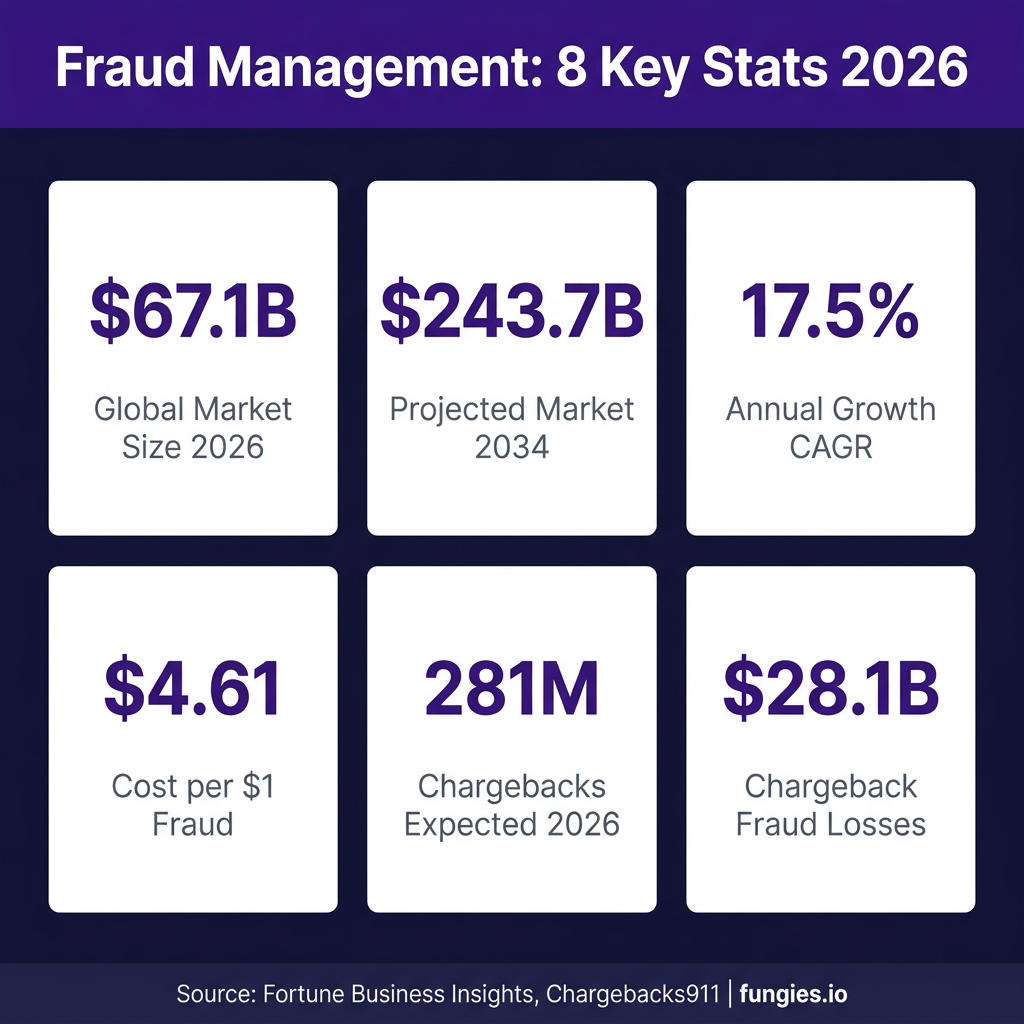
- Global Market Size: $67.12 billion in 2026, projected to reach $243.72 billion by 2034
- Annual Growth Rate: 17.5% CAGR (2026-2034)
- Cost of Fraud: $4.61 lost for every $1 of fraud (U.S. merchants, 2025)
- Chargeback Volume: 281 million chargebacks expected globally in 2026
- Chargeback Fraud Losses: $28.1 billion annually by 2026 (40% increase from 2023)
- Friendly Fraud Growth: 72% of merchants reported an increase in 2024
- Consumer Fraud Losses: $12.5 billion in 2024 (25% increase from 2023)
- Regional Dominance: North America holds 42% market share
- Cloud Adoption: 46% of fraud prevention deployments will be cloud-based by 2026
- eCommerce Chargeback Rate: Rose 222% between Q1 2023 and Q1 2024
Market Size & Growth
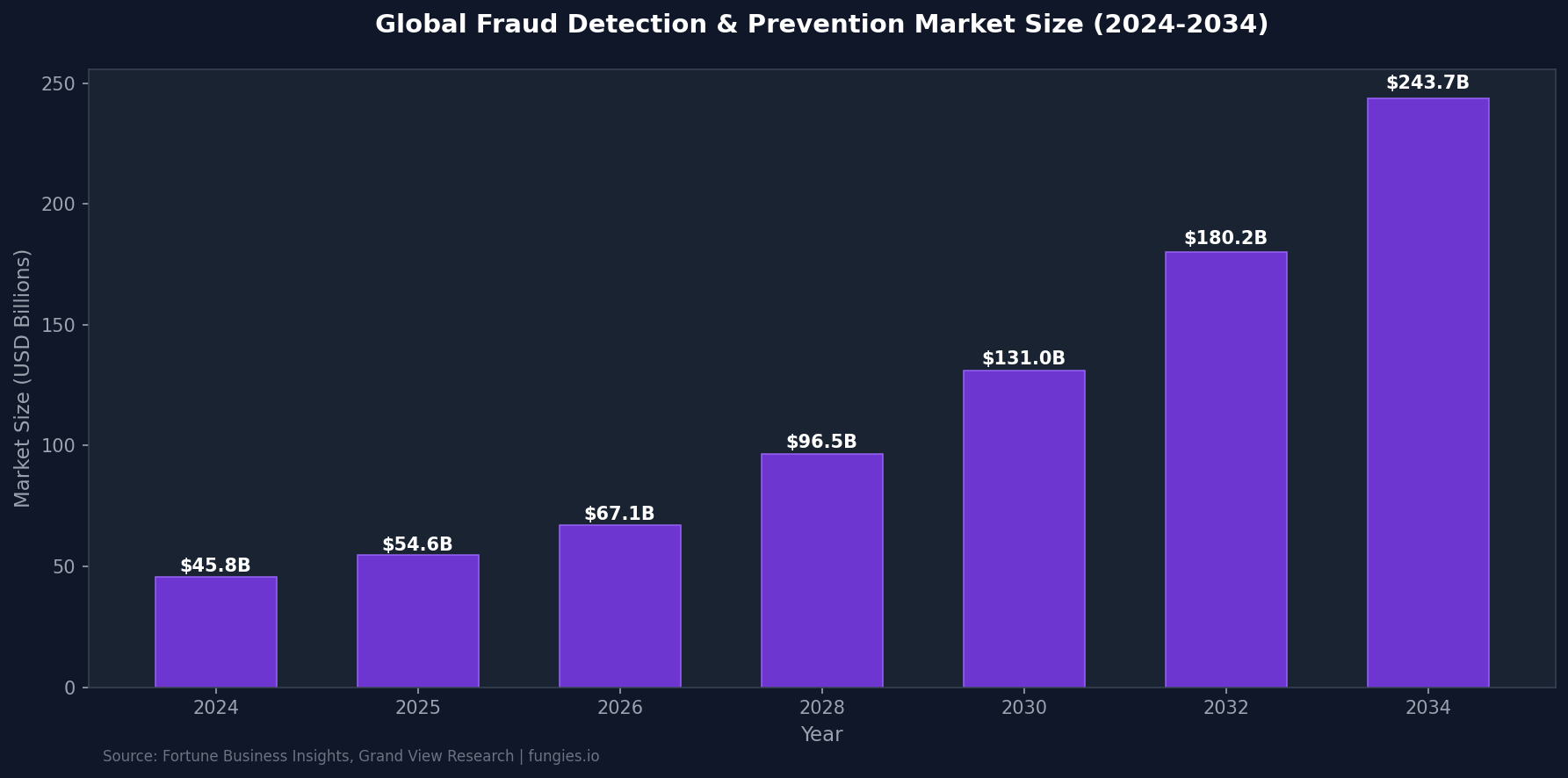
The fraud detection and prevention market has experienced explosive growth, accelerating from $45.8 billion in 2024 to a projected $67.12 billion in 2026. According to Fortune Business Insights, the market will reach $243.72 billion by 2034, representing a compound annual growth rate of 17.5%.
This growth trajectory varies by research firm but consistently points to massive expansion. Mordor Intelligence projects the market growing from $55.98 billion in 2025 to $171.84 billion by 2031 (19.61% CAGR). Grand View Research estimates growth from $35.3 billion in 2025 to $129.4 billion by 2033 (18.1% CAGR). MarketsandMarkets forecasts the market expanding from $32.0 billion in 2025 to $65.68 billion by 2030 (15.5% CAGR).
The discrepancy in base year figures reflects different market definitions—some include only software solutions, while others encompass services, consulting, and managed security services. What remains consistent: this is one of the fastest-growing segments in enterprise software.
| Year | Market Size (USD Billions) | Growth Rate | Source |
|---|---|---|---|
| 2024 | $45.8B | — | Industry Analysis |
| 2025 | $54.6B | 19.2% | Fortune Business Insights |
| 2026 | $67.1B | 22.9% | Fortune Business Insights |
| 2028 | $96.5B | 20.0% | Projected |
| 2030 | $131.0B | 16.3% | Grand View Research |
| 2032 | $180.2B | 15.7% | Projected |
| 2034 | $243.7B | 14.8% | Fortune Business Insights |
Regional Breakdown
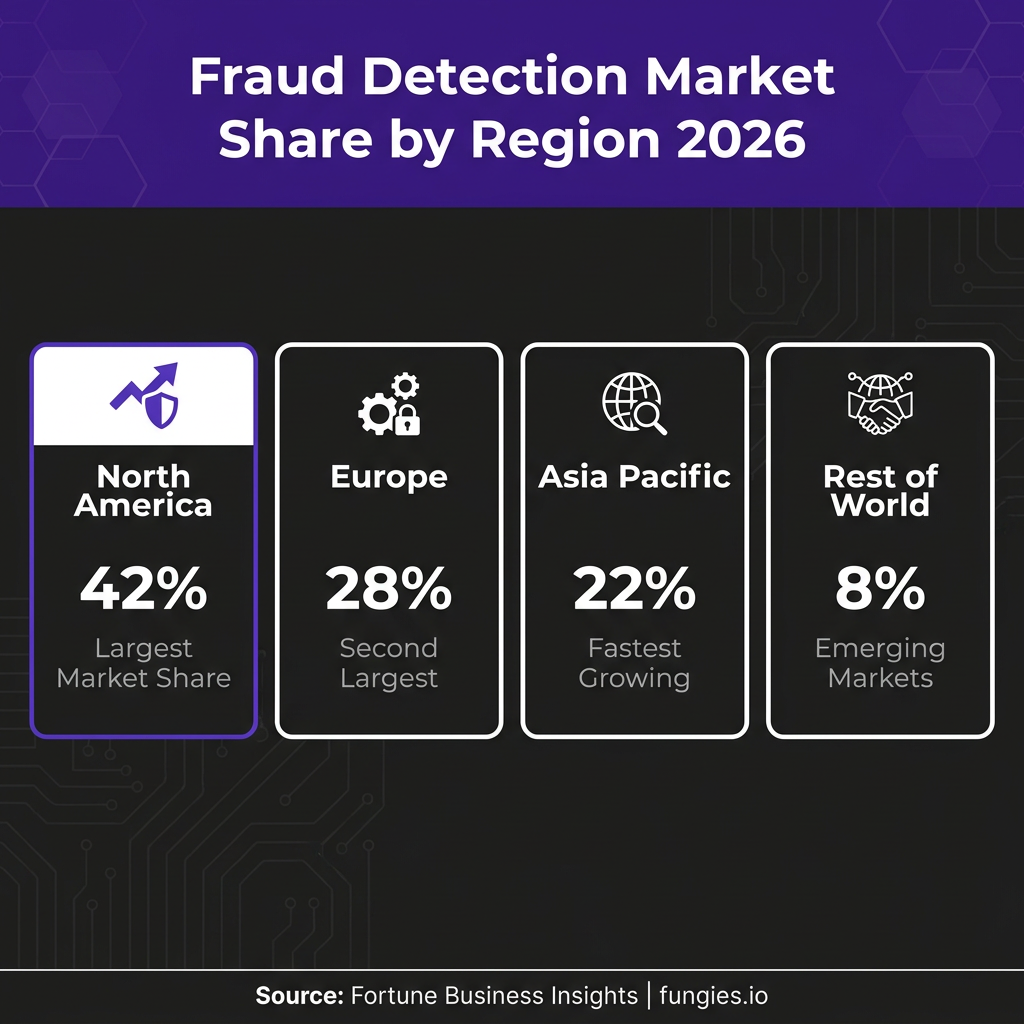
North America dominates the fraud detection and prevention landscape, capturing 42% of global market revenue in 2025. The U.S. market alone generated $9.3 billion in 2024 and is projected to reach $24.3 billion by 2030, growing at 17.9% CAGR.
Europe holds the second-largest share at approximately 28%, driven by stringent regulatory requirements including PSD2, GDPR, and the Digital Services Act. The Asia-Pacific region represents 22% of the market but is the fastest-growing, with China, India, and Southeast Asian markets expanding rapidly as digital payment adoption accelerates.
According to the Merchant Risk Council’s 2026 Global Payments and Fraud Report, which surveyed 1,200+ merchants across 35+ countries, regional fraud patterns vary significantly. U.S. chargebacks are expected to more than double from $7.2 billion in 2019 to $15.3 billion by 2026, accounting for an estimated 40% of global card-not-present fraud losses.
| Region | 2025 Market Share | 2025 Market Size | CAGR (2026-2030) |
|---|---|---|---|
| North America | 42.0% | $22.9B | 17.9% |
| Europe | 28.0% | $15.3B | 16.5% |
| Asia Pacific | 22.0% | $12.0B | 21.2% |
| Latin America | 5.0% | $2.7B | 18.5% |
| Middle East & Africa | 3.0% | $1.6B | 19.8% |
Key Players & Market Share
The fraud detection and prevention market features a mix of established cybersecurity giants, specialized fraud prevention providers, and emerging AI-native startups. While exact market share figures are closely guarded, the competitive landscape is consolidating around several key categories.
According to Gartner Peer Insights and industry analysis, leading providers include FICO (fraud analytics and scoring), Experian (identity verification and fraud detection), LexisNexis Risk Solutions (multi-layered fraud prevention), SAS (advanced analytics), and IBM (AI-powered fraud detection). Cloud-native players like Sift, Forter, and Alloy are gaining significant traction, particularly among mid-market e-commerce merchants.
The 2026 AFP Payments Fraud and Control Survey found that 79% of businesses experienced actual or attempted payments fraud in 2024. Despite 53% of banks increasing fraud prevention budgets by 5% or more in the last three years, 70% still report rising fraud losses—indicating that spending alone doesn’t guarantee protection.
| Company Category | Key Players | Primary Focus |
|---|---|---|
| Enterprise Analytics | FICO, SAS, IBM | Predictive modeling, ML scoring |
| Identity Verification | Experian, LexisNexis, Jumio | Document verification, biometrics |
| eCommerce Specialists | Sift, Forter, Signifyd | Real-time transaction monitoring |
| Banking/Fintech | Alloy, Unit21, SentiLink | Onboarding fraud, KYC/AML |
| Chargeback Management | Chargebacks911, Midigator | Dispute resolution, representment |
Industry Benchmarks & KPIs
Understanding fraud benchmarks is critical for merchants evaluating their risk exposure. The LexisNexis True Cost of Fraud Study reveals that U.S. merchants incur an average cost of $4.61 for every $1 of fraud—up from $3.36 in 2020. Canadian merchants face slightly lower costs at $4.52 per dollar lost.
These costs encompass more than the transaction amount itself. They include chargeback fees (typically $15-$100 per dispute), merchandise replacement, operational overhead for dispute management, and monitoring program penalties. Merchants in Visa’s or Mastercard’s fraud monitoring programs face additional assessments ranging from $5,000 to $100,000 monthly.
According to the 2026 AFP Payments Fraud and Control Survey, check fraud remains the most common form of payments fraud, affecting 58% of organizations in 2025—outpacing ACH fraud and wire fraud. However, ACH fraud resulting from business email compromise (BEC) scams rose to impact 38% of business respondents in 2024.
| Metric | Value | Source |
|---|---|---|
| Cost per $1 of Fraud (U.S.) | $4.61 | LexisNexis 2025 |
| Cost per $1 of Fraud (Canada) | $4.52 | LexisNexis 2025 |
| Organizations with Payment Fraud | 79% | AFP 2026 |
| Check Fraud Prevalence | 58% | AFP 2026 |
| ACH Fraud (BEC-related) | 38% | AFP 2026 |
| Virtual Card Fraud | 5% | AFP 2026 |
| Average Chargeback Value | $76 | Industry Data |
| Chargeback Representment Win Rate | 45% | Chargebacks911 |
| Net Recovery Rate | 18% | Chargebacks911 |
Trends & Predictions
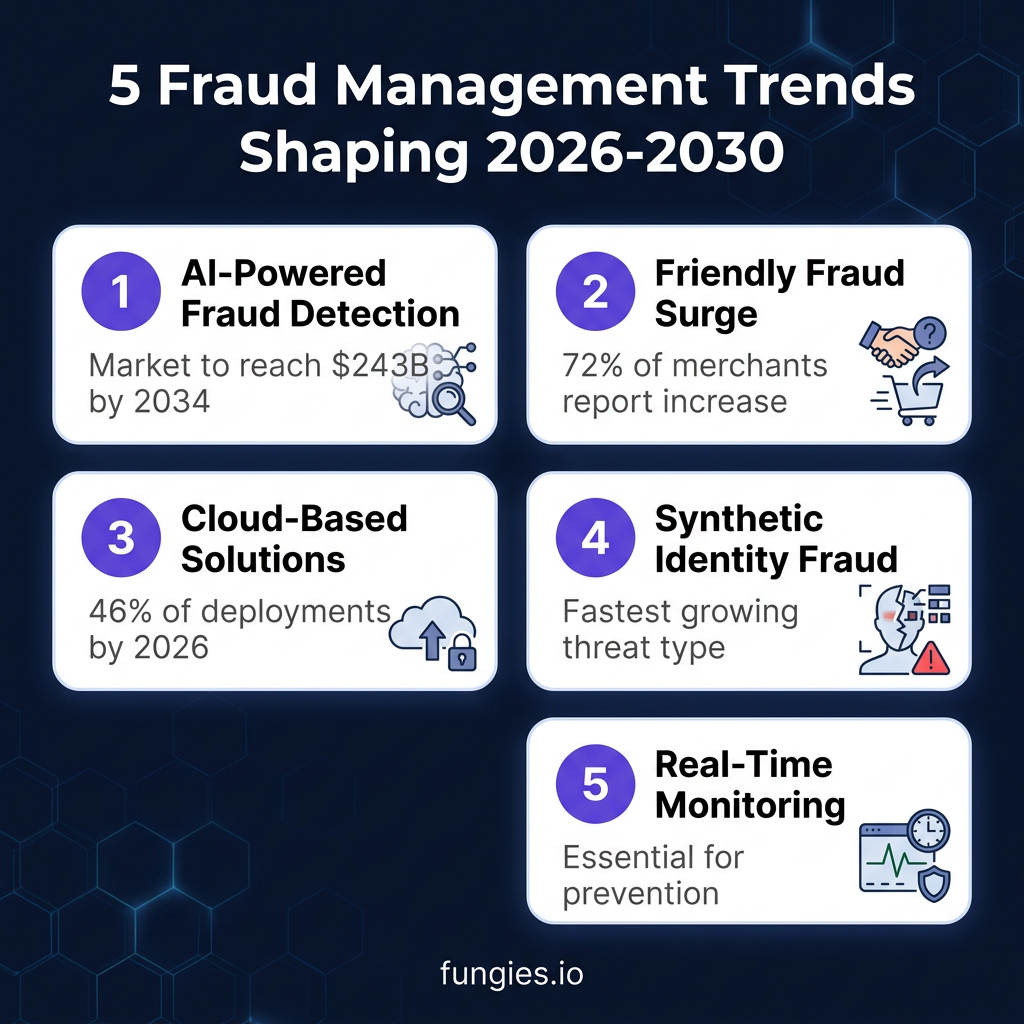
The fraud landscape is evolving rapidly, driven by technological advancement and shifting attack patterns. Here are the five trends defining fraud management in 2026 and beyond:
1. AI-Powered Fraud Detection Becomes Essential
Machine learning and AI are no longer competitive advantages—they’re table stakes. According to Experian’s 2026 Future of Fraud Forecast, AI-driven bots and automation are rapidly increasing the scale and speed of fraud attacks. In response, 56% of fraud prevention professionals cite lack of device fingerprinting as their biggest challenge, while AI/ML adoption has become the primary defense strategy.
Microsoft reports that multi-factor authentication can prevent approximately 99.9% of automated attacks. The authentication segment within fraud prevention solutions is expected to capture the largest market share, driven by regulatory requirements and insurance mandates.
2. Friendly Fraud Surge Continues
Friendly fraud—when legitimate customers dispute valid charges—has become the second most common fraud attack source. According to Chargebacks911, 72% of merchants reported an increase in friendly fraud chargebacks in 2024. Merchants estimate friendly fraud represents 45% of their chargebacks on average, though the actual figure likely exceeds 60%.
Global chargeback volume will increase 41% between 2023 and 2026, from 238 million to 337 million disputes, according to Mastercard data. The U.S. is driving much of this growth, with card-not-present fraud losses projected to reach $12.8 billion by 2026.
3. Cloud-Based Solutions Dominate Deployment
Cloud deployment is projected to capture 46.44% of market share by 2026. Small and mid-sized enterprises are driving this shift, leveraging cloud-based fraud detection to access enterprise-grade capabilities without massive infrastructure investments.
The cloud segment benefits from AI and data analytics advancements, enabling real-time fraud scoring and behavioral biometrics. According to Boston Consulting Group, approximately 70% of consumers globally are digitally influenced to buy financial products using mobile banking or e-banking applications—expanding the attack surface that cloud-based solutions must protect.
4. Synthetic Identity Fraud Emerges as Defining Threat
Mitek’s 2026 Fraud Forecast identifies synthetic identity fraud—combining real and fabricated identity elements—as the defining threat of 2026. Generative AI has lowered barriers for creating convincing deepfakes and synthetic identities, making traditional verification methods increasingly inadequate.
This threat is particularly acute in digital onboarding scenarios. The ACFE (Association of Certified Fraud Examiners) reports that occupational fraud costs organizations 5% of annual revenue on average, with synthetic identities enabling longer-running, higher-value schemes.
5. Real-Time Monitoring Becomes Non-Negotiable
Batch processing and daily fraud reviews are obsolete. Modern fraud prevention requires real-time transaction monitoring, behavioral analytics, and instant decisioning. The European Banking Authority’s 2025 Payments Threats and Fraud Trends Report emphasizes real-time monitoring as essential for mitigating authorized push payment (APP) fraud and social engineering attacks.
For platforms like Fungies.io that handle payments for game developers and SaaS companies, real-time fraud detection isn’t just about loss prevention—it’s about conversion optimization. Overly aggressive fraud filters create false positives that decline legitimate transactions, directly impacting revenue.
Methodology
This report synthesizes data from 15+ authoritative sources published between January 2025 and June 2026. Primary sources include Fortune Business Insights’ Fraud Detection and Prevention Market Report, Grand View Research industry analysis, Mordor Intelligence market sizing, the Association for Financial Professionals’ 2026 Payments Fraud Survey, the Federal Trade Commission’s annual fraud reports, and industry-specific research from LexisNexis Risk Solutions, Chargebacks911, and the Merchant Risk Council.
Market size figures represent the total addressable market for fraud detection and prevention software, services, and consulting. Regional breakdowns are based on vendor revenue allocation and analyst estimates. Growth projections assume continued digital payment adoption, regulatory pressure for stronger authentication, and the escalating sophistication of fraud attacks.
All currency figures are in USD. CAGR calculations use standard compound growth formulas. Where sources provided conflicting figures, we prioritized the most recent publication or cross-referenced against multiple verified sources.
Frequently Asked Questions
What is the size of the fraud detection and prevention market in 2026?
The global fraud detection and prevention market is valued at $67.12 billion in 2026, according to Fortune Business Insights. Alternative estimates from Grand View Research ($40.4B) and Mordor Intelligence ($70.19B) vary based on market definition scope, but all sources project significant growth through 2030-2034.
How much does fraud cost merchants per dollar lost?
According to the LexisNexis True Cost of Fraud Study, U.S. merchants incur $4.61 in total costs for every $1 lost to fraud in 2025—up 37% from 2020. These costs include chargeback fees, merchandise replacement, operational overhead, and monitoring program penalties.
What percentage of chargebacks are friendly fraud?
Merchants estimate friendly fraud represents 45% of their chargebacks on average, but industry experts believe the actual figure exceeds 60-80% of all e-commerce fraud losses. According to Chargebacks911, 72% of merchants reported an increase in friendly fraud chargebacks in 2024.
Which region has the largest fraud prevention market?
North America dominates with 42% market share in 2025, driven by high e-commerce penetration, stringent regulatory requirements, and early adoption of advanced fraud prevention technologies. The U.S. market alone is projected to reach $24.3 billion by 2030.
What is the fastest-growing trend in fraud management?
AI-powered fraud detection is the fastest-growing trend, with the market segment projected to grow at 17.5% CAGR through 2034. Cloud-based deployment models are also accelerating, expected to capture 46% of deployments by 2026, enabling real-time monitoring and behavioral analytics for businesses of all sizes.
Sources & Citations
- Fortune Business Insights – Fraud Detection and Prevention Market Size, Share & Industry Analysis (2026-2034): https://www.fortunebusinessinsights.com/industry-reports/fraud-detection-and-prevention-market-100231
- Grand View Research – Fraud Detection And Prevention Market Size Report (2025-2033): https://www.grandviewresearch.com/industry-analysis/fraud-detection-prevention-market
- Mordor Intelligence – Fraud Detection and Prevention (FDP) Market Size & Share Analysis: https://www.mordorintelligence.com/industry-reports/global-fraud-detection-and-prevention-fdp-market-industry
- MarketsandMarkets – Fraud Detection and Prevention Market Report (2025-2030): https://www.marketsandmarkets.com/Market-Reports/fraud-detection-prevention-market-1312.html
- Association for Financial Professionals – 2026 AFP Payments Fraud and Control Survey Report: https://www.financialprofessionals.org/training-resources/resources/survey-research-economic-data/details/payments-fraud
- LexisNexis Risk Solutions – True Cost of Fraud Study: Ecommerce and Retail Report (2025): https://risk.lexisnexis.com/about-us/press-room/press-release/20250402-tcof-ecommerce-and-retail
- Chargebacks911 – Chargeback Stats: All the Key Dispute Data Points for 2026: https://chargebacks911.com/chargeback-stats
- Federal Trade Commission – Fraud Losses Report (2024): https://www.ftc.gov/news-events/news/press-releases/2025/12/ftc-issues-annual-report-congress-agencys-actions-protect-older-adults
- Merchant Risk Council – 2026 Global Payments and Fraud Report: https://merchantriskcouncil.org/learning/mrc-exclusive-reports/global-payments-and-fraud-report
- Experian – 2026 Future of Fraud Forecast: https://www.experian.com/thought-leadership/business/2026-future-of-fraud-forecast-infographic
- Mitek – Fraud Forecast 2026: Experts Share Predictions: https://www.miteksystems.com/blog/2026-fraud-forecast-what-to-do-now-to-protect-whats-real-in-the-year-ahead
- Gartner – Higher IT Spending Doesn’t Always Lead to Better Fraud Prevention: https://www.gartner.com/en/documents/7562909
- Alloy – 2026 State of Fraud Report: https://www.alloy.com/reports/fraud-report-2026
- European Payments Council – 2025 Payments Threats and Fraud Trends Report: https://www.europeanpaymentscouncil.eu/sites/default/files/kb/file/2026-02/EPC162-24%20v2.0%202025%20Payments%20Threats%20and%20Fraud%20Trends%20Report.pdf
- Technavio – Fraud Detection And Prevention Market Growth Analysis: https://www.technavio.com/report/fraud-detection-and-prevention-market-analysis
Last updated: June 9, 2026. This report is maintained as a living document. For corrections or additions, contact [email protected].