Here’s a number that should get your attention: Qwen 3 235B-A22B now scores 80.6% on MMLU Pro — beating last year’s GPT-4 Turbo on reasoning benchmarks. And it’s completely open source.
The open source LLM landscape has exploded in 2026. We’re no longer talking about “good enough” alternatives to closed models. We’re talking about models that lead on specific benchmarks, run on consumer hardware, and cost nothing to deploy.
But here’s the problem: with hundreds of models on HuggingFace, how do you choose? This guide cuts through the noise. I’ve analyzed the top 10 open source LLMs of 2026 using real benchmark data, actual VRAM requirements, and production use cases.
Why Open Source LLMs Matter in 2026
Three forces are driving the open source revolution:
- Cost control: Running a 70B model locally costs ~$0.04 per 1M tokens vs $0.60-$1.20 for cloud APIs
- Data privacy: Your prompts never leave your infrastructure
- Customization: Fine-tune on your data without vendor lock-in
According to HuggingFace’s Spring 2026 report, the platform now hosts over 2 million models. But here’s the kicker: the top 0.01% of models get half of all downloads. This article focuses on that top tier.
How We Ranked These Models
Every model on this list was evaluated on:
- MMLU Pro: Multi-task language understanding (higher is better)
- LiveCodeBench: Real-world coding ability
- VRAM requirements: What you actually need to run it
- Context window: How much text it can process at once
- License: Can you use it commercially?
The Top 10 Open Source LLMs of 2026
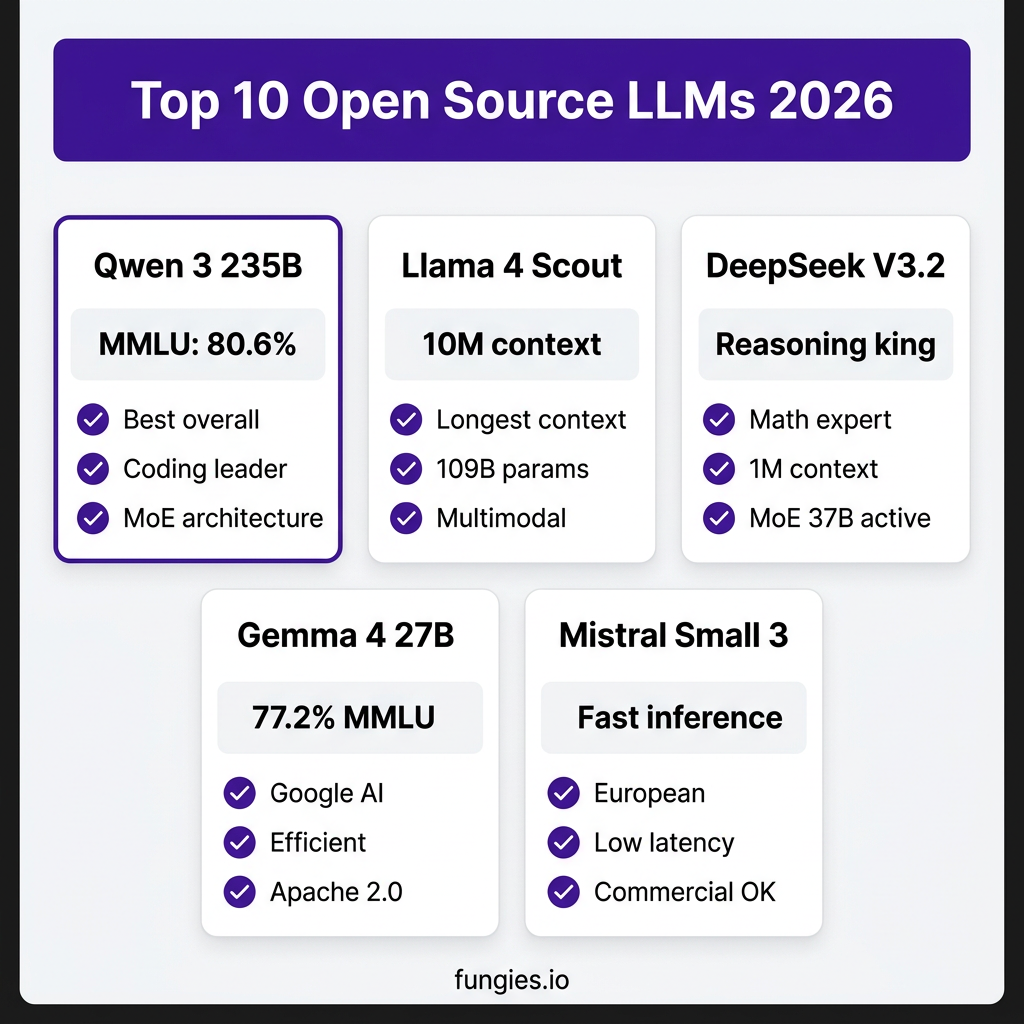
1. Qwen 3 235B-A22B — Best Overall
Alibaba’s flagship model dominates 2026 benchmarks. With 235B total parameters but only 22B active per token (Mixture of Experts architecture), it delivers frontier performance at reasonable inference costs.
| Metric | Score |
|---|---|
| MMLU Pro | 80.6% |
| LiveCodeBench | 69.5% |
| Context Window | 128K tokens |
| VRAM (Q4) | ~60GB |
| License | Qwen License (commercial OK) |
Best for: Production coding assistants, complex reasoning tasks, enterprise deployments
2. Llama 4 Scout — Best for Long Context
Meta’s Llama 4 Scout is the first open model to offer 10 million tokens of context. That’s enough to process entire codebases, long legal documents, or multi-hour video transcripts in a single pass.
| Metric | Score |
|---|---|
| Parameters | 109B (17B active) |
| Context Window | 10M tokens |
| Multimodal | Yes (text + image) |
| VRAM (Q4) | ~40GB |
| License | Llama 4 Community License |
Best for: Document analysis, codebase understanding, multimodal applications
3. DeepSeek V3.2 — Best for Reasoning
DeepSeek V3.2 Speciale is the most ambitious open-weight release of 2026. With ~1 trillion parameters (32-37B active), 1 million token context, and native multimodal generation, it’s designed for complex reasoning workflows.
| Metric | Score |
|---|---|
| Architecture | MoE (1T total, 37B active) |
| Context Window | 1M tokens |
| Math (GSM8K) | 92%+ |
| Deployment | 8x H100 for FP8 |
| License | DeepSeek License |
Best for: Research, math-intensive tasks, agentic workflows requiring deep reasoning
4. Gemma 4 27B — Best Efficiency
Google’s Gemma 4 punches above its weight. The 27B dense model scores 77.2% on MMLU Pro — beating last year’s Gemma 3 27B while being more efficient. It’s the sweet spot for developers who want quality without massive hardware requirements.
| Metric | Score |
|---|---|
| MMLU Pro | 77.2% |
| Parameters | 27B dense |
| VRAM (Q4) | ~16GB |
| License | Apache 2.0 |
| Context | 128K tokens |
Best for: Startups, side projects, commercial applications requiring permissive licensing
5. Mistral Small 3 — Best for European Compliance
Mistral’s latest Small model delivers impressive performance with low latency. As a European model, it’s attractive for teams concerned about data sovereignty and GDPR compliance.
| Metric | Score |
|---|---|
| Parameters | 24B dense |
| Latency | Low (optimized) |
| VRAM (Q4) | ~14GB |
| License | Apache 2.0 |
| Origin | France (EU) |
Best for: EU-based companies, low-latency applications, commercial use
6. GLM-5.1 — Best for Agentic Coding
Zhipu AI’s GLM-5.1 is built for long-horizon coding and software engineering tasks. It excels at agentic workflows where the model needs to plan, execute, and iterate over multiple steps.
| Metric | Score |
|---|---|
| Best for | Agentic workflows |
| SWE-bench | Competitive with GPT-4 |
| Context | 128K tokens |
| License | Model License |
Best for: AI coding agents, multi-step task automation, software engineering
7. DeepSeek R1 32B — Best Local Reasoning
The distilled version of DeepSeek R1 brings advanced reasoning to consumer hardware. It uses chain-of-thought reasoning that shows its work — invaluable for debugging and educational applications.
| Metric | Score |
|---|---|
| Parameters | 32B distilled |
| VRAM (Q4) | ~20GB |
| Reasoning | Visible CoT |
| Math | Strong |
| License | MIT |
Best for: Local deployment, math tutoring, applications requiring explainable reasoning
8. Qwen 3 30B-A3B — Best Mid-Size Model
Not everyone has 60GB of VRAM. The 30B Qwen 3 variant delivers 80% of the flagship’s performance with a fraction of the hardware requirements. It’s the practical choice for most developers.
| Metric | Score |
|---|---|
| Parameters | 30B (3B active) |
| VRAM (Q4) | ~18GB |
| Speed | Fast inference |
| License | Qwen License |
Best for: Single-GPU setups, cost-conscious deployments, prototyping
9. Phi-4 14B — Best Small Model
Microsoft’s Phi-4 proves that bigger isn’t always better. At just 14B parameters, it delivers reasoning capabilities that rival 30B+ models from last year. And it runs on a single consumer GPU.
| Metric | Score |
|---|---|
| Parameters | 14B dense |
| VRAM (Q4) | ~8GB |
| License | MIT |
| Best for | Edge deployment |
Best for: Edge devices, laptops with limited VRAM, embedded applications
10. Gemma 4 12B — Best for Beginners
Just released June 3, 2026, Gemma 4 12B scores 77.2% on MMLU Pro — beating last year’s Gemma 3 27B. It’s the perfect entry point for developers new to local LLMs.
| Metric | Score |
|---|---|
| MMLU Pro | 77.2% |
| Parameters | 12B dense |
| VRAM (Q4) | ~6GB |
| License | Apache 2.0 |
Best for: First-time local LLM users, low-resource environments, educational projects
Complete Benchmark Comparison
| Model | MMLU Pro | LiveCodeBench | VRAM (Q4) | Context |
|---|---|---|---|---|
| Qwen 3 235B-A22B | 80.6% | 69.5% | ~60GB | 128K |
| Llama 4 Scout | 78.5% | 62.0% | ~40GB | 10M |
| DeepSeek V3.2 | 79.0% | 65.0% | 8x H100 | 1M |
| Gemma 4 27B | 77.2% | 58.0% | ~16GB | 128K |
| Mistral Small 3 | 75.0% | 55.0% | ~14GB | 128K |
| GLM-5.1 | 76.0% | 67.0% | ~40GB | 128K |
| DeepSeek R1 32B | 71.2% | 51.8% | ~20GB | 64K |
| Qwen 3 30B-A3B | 74.0% | 52.0% | ~18GB | 128K |
| Phi-4 14B | 68.0% | 45.0% | ~8GB | 64K |
| Gemma 4 12B | 77.2% | 48.0% | ~6GB | 128K |
How to Choose the Right Model
Use this decision framework:
- Maximum performance: Qwen 3 235B-A22B
- Long documents: Llama 4 Scout (10M context)
- Math/reasoning: DeepSeek V3.2 or R1
- Commercial use + permissive license: Gemma 4 (Apache 2.0)
- Single GPU (24GB): Gemma 4 27B or Qwen 3 30B
- Single GPU (16GB): Mistral Small 3 or Phi-4
- Laptop/edge: Gemma 4 12B or Phi-4
Running These Models Locally
The easiest way to get started is with Ollama:
# Install Ollama
curl -fsSL https://ollama.com/install.sh | sh

# Pull a model
ollama pull qwen3:30b
ollama pull gemma4:27b
ollama pull llama4:scout

# Run it
ollama run qwen3:30b
For a ChatGPT-style interface, add Open WebUI:
docker run -d -p 3000:8080 --add-host=host.docker.internal:host-gateway -v open-webui:/app/backend/data --name open-webui --restart always ghcr.io/open-webui/open-webui:main
Key Takeaways
- Open source LLMs now match or exceed closed models on specific benchmarks
- Qwen 3 235B leads on coding (69.5% LiveCodeBench) and general reasoning (80.6% MMLU)
- Llama 4 Scout’s 10M context window enables entirely new use cases
- You can run quality models on consumer hardware — 12B models need just 6GB VRAM
- Apache 2.0 licensed models (Gemma, Mistral, Phi) remove commercial usage concerns
FAQ
Are open source LLMs as good as ChatGPT or Claude?
On specific benchmarks, yes. Qwen 3 235B beats GPT-4 Turbo on MMLU Pro. Llama 4 Scout has 10x the context window of GPT-4. However, closed models still lead on some general-purpose tasks and user experience.
How much VRAM do I need for a 70B model?
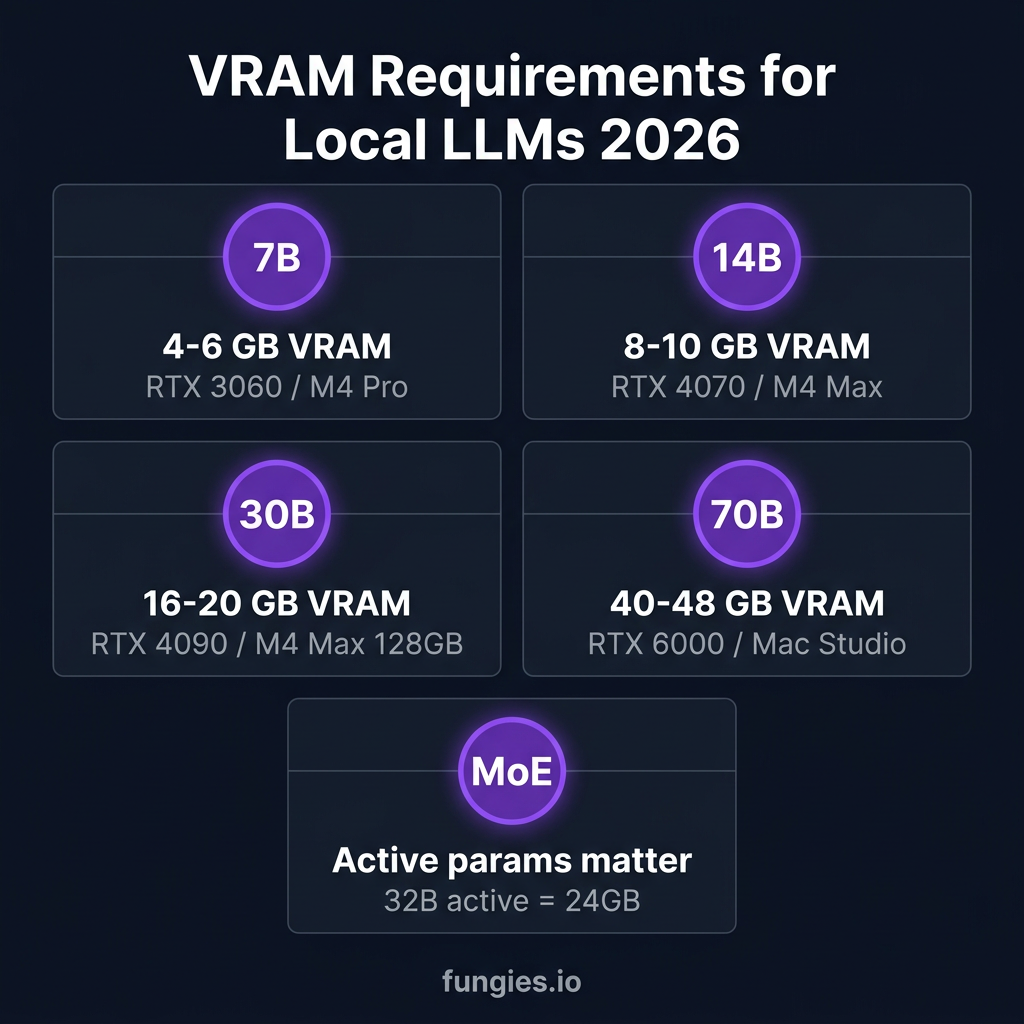
At Q4 quantization, a 70B model needs approximately 40-48GB VRAM. This requires an RTX 4090 (24GB) won’t work — you’ll need an RTX 6000 Ada (48GB), multiple GPUs, or Apple Silicon with 128GB unified memory.
What does MoE (Mixture of Experts) mean for hardware?
MoE models only activate a subset of parameters per token. A 235B model with 22B active uses VRAM proportional to the active parameters, not total. This makes massive models runnable on reasonable hardware.
Can I fine-tune these models?
Yes. Models with permissive licenses (Apache 2.0, MIT) can be fine-tuned for commercial use. Use tools like Unsloth, Axolotl, or HuggingFace TRL for efficient fine-tuning with LoRA/QLoRA.
Which license should I look for?
For maximum flexibility, choose Apache 2.0 or MIT licenses. These allow commercial use, modification, and distribution. Some models (Llama 4, Qwen 3) have custom licenses with specific terms — read them carefully.
Conclusion
The open source LLM landscape in 2026 is incredible. You have models that beat GPT-4 on coding, process 10 million tokens of context, and run on your laptop. All for free.
My recommendation? Start with Gemma 4 12B or Phi-4 to learn the ropes. When you’re ready for production, evaluate Qwen 3 30B or Gemma 4 27B. And if you need maximum capability, Qwen 3 235B or Llama 4 Scout are waiting.
The future of AI is open. Build something.
Ready to add AI-powered features to your app? Fungies.io handles payments, tax compliance, and checkout for digital products — so you can focus on building with these incredible models.