Here’s a number that should wake you up: 61% of SaaS companies now use hybrid pricing models, up from just 49% in 2024. Yet most founders I talk to still pick their pricing strategy based on what their competitors are doing—or worse, what “feels right.”
The truth? Your pricing model isn’t just about how you charge. It’s the foundation of your entire growth strategy. Get it wrong, and you’ll struggle with low conversions, high churn, and stalled revenue. Get it right, and you create a flywheel where customers happily pay more as they grow.
What Is a SaaS Pricing Model (And Why It Matters More Than You Think)
A SaaS pricing model is the structural framework for how you charge customers. It’s not the same as your pricing strategy—strategy is about how much you charge, while the model is about how you charge.
Think of it like this: your pricing model determines the relationship between customer usage and your revenue. Per-user pricing creates a linear relationship—more seats, more money. Usage-based pricing ties revenue directly to value delivered. Tiered pricing segments customers by feature needs.
Here’s why this distinction matters. According to the 2025 SaaS Pricing Benchmark Study analyzing 100+ companies, businesses that align their pricing model with customer value metrics see 30% shorter sales cycles and 25% higher win rates. Meanwhile, companies using the wrong model for their market consistently report forecasting headaches, customer confusion, and expansion revenue that never materializes.
The 6 Core SaaS Pricing Models Explained
Before you can choose, you need to understand what each model actually looks like in practice. Here’s the breakdown based on real 2025 market data.
1. Per-User (Seat-Based) Pricing
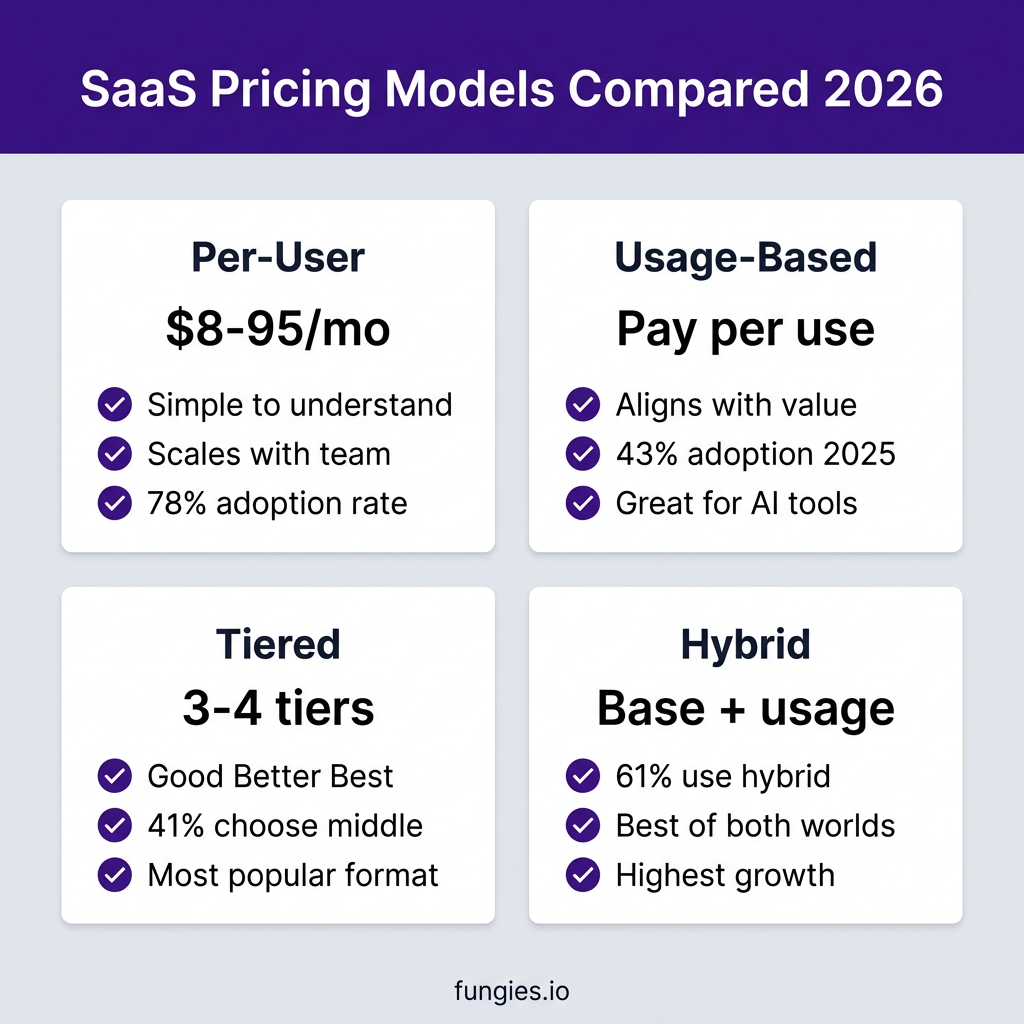
This is the classic SaaS model: you pay per person using the software. It’s simple, predictable, and still dominates the market with 78% adoption in project management tools and 72% in CRM.
Median prices by vertical (2025):
| Vertical | Median Price | Adoption Rate |
|---|---|---|
| HR Tech | $8/user/month | 78% |
| Project Management | $12/user/month | 81% |
| CRM | $65/user/month | 72% |
| Marketing Automation | $89/user/month | 54% |
| Business Intelligence | $95/user/month | 43% |
Best for: Products where team size directly correlates with value, like collaboration tools or admin systems.
The catch: It creates a disincentive to add users. I’ve seen sales teams hesitate to invite new reps to their CRM because of the per-seat cost. That’s friction you don’t want.
2. Usage-Based Pricing
Customers pay for what they consume—API calls, storage, bandwidth, AI tokens. This model has exploded in popularity, growing from 35% adoption in 2022 to 43% in 2025.
The appeal is obvious: price aligns perfectly with value. When your customer succeeds (uses more), you succeed (earn more). Companies like AWS, Twilio, and OpenAI have built empires on this model.
But here’s what the benchmarks don’t tell you: 73% of SaaS companies with usage-based models now actively forecast variable revenue for financial predictability. The revenue roller coaster is real, and investors hate surprises.
Best for: Infrastructure products, AI tools, APIs, and anything where usage varies dramatically between customers.
3. Tiered Pricing (Good, Better, Best)
The industry average is 3.2 public tiers plus a custom enterprise option. This model works because of a psychological quirk: research shows 41.4% of customers choose the middle tier when three options are presented.
The magic is in the framing. Your bottom tier captures price-sensitive users. Your top tier serves as an anchor, making the middle tier look like a bargain. Your middle tier—where most customers land—delivers your ideal unit economics.
Best for: Most B2B SaaS products. If you’re not sure what to pick, start here.
4. Flat-Rate Pricing
One price, unlimited usage. Simple for customers, dangerous for vendors. This model works when your marginal cost per customer is near zero and usage patterns are consistent.
Honestly, I rarely recommend this for growing SaaS. You leave money on the table with power users and may price out smaller customers entirely.
Best for: Niche tools with uniform usage patterns or early-stage products testing product-market fit.
5. Freemium
Free tier forever, pay for premium features. Only 38% of SaaS companies offer freemium in 2025—down from 41% in 2024. The reason? Conversion rates are brutal.
Here’s the data: freemium converts at just 2-5% from free to paid. Free trials? 15-25%. That’s a 5x difference. Freemium only makes sense when your product has network effects (like Slack) or when free users create value for paid users.
Best for: Products with viral loops, network effects, or near-zero marginal cost per user.
6. Hybrid Pricing
This is the fastest-growing approach: combine a base subscription with usage-based overages. Think “$49/month base + $0.01 per API call.”
The 2025 data is striking: companies using hybrid models report the highest median growth rate at 21%, outperforming both pure subscription and pure usage-based approaches. You get predictable baseline revenue plus upside when customers succeed.
Best for: Most modern SaaS products, especially those adding AI features or variable infrastructure costs.
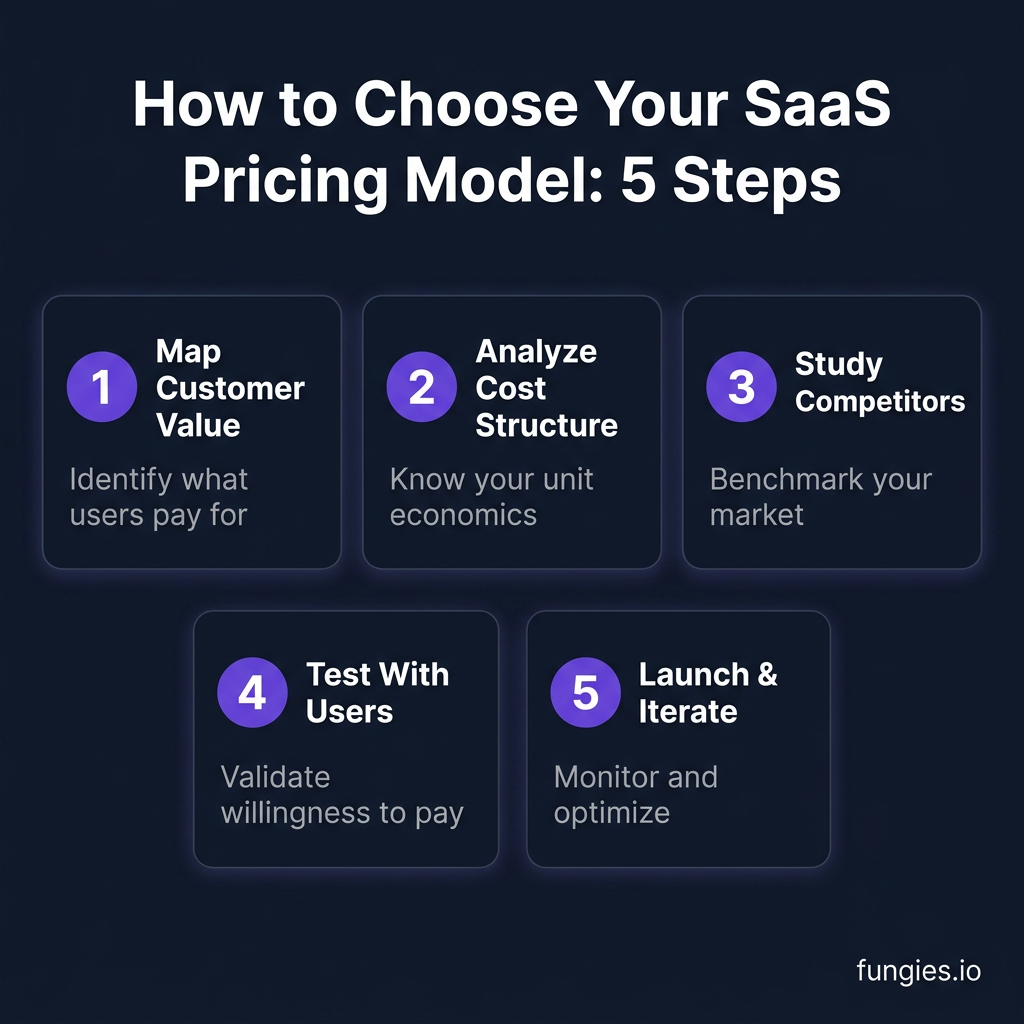
The 5-Step Framework for Choosing Your Pricing Model
Now that you know the options, here’s how to actually make the decision. This framework comes from analyzing 100+ pricing page redesigns and talking to dozens of SaaS founders.
Step 1: Map Your Customer’s Value Perception
Start with this question: what metric best represents the value your customer receives?
For Slack, it’s messages sent (network effects). For AWS, it’s compute used (infrastructure). For Salesforce, it’s seats (organizational adoption). For Stripe, it’s transaction volume (revenue processed).
Your pricing model should align with this value metric. If customers get more value as they use more, usage-based pricing makes sense. If value comes from team adoption, per-user works. If value is binary (you have the tool or you don’t), tiered pricing fits.
Action item: Interview 10 customers. Ask what metric they use to measure success with your product. That’s your value metric.
Step 2: Analyze Your Cost Structure
Your pricing model needs to cover your costs with margin to spare. Here’s what to map:
- Fixed costs: Development, support, sales—costs that don’t scale with usage
- Variable costs: Infrastructure, API fees, AI tokens—costs that scale directly with usage
- Step costs: Support team hires, server upgrades—costs that jump at certain thresholds
If your variable costs are high (like AI infrastructure), pure usage-based pricing protects your margins. If costs are mostly fixed, per-user or tiered pricing gives you operating leverage as you scale.
Action item: Calculate your gross margin at different usage levels. If it drops below 70% at high usage, you need usage-based pricing or strict limits.
Step 3: Study Your Competitive Landscape
Your pricing doesn’t exist in a vacuum. Buyers will compare you to alternatives, and radical deviation creates friction.
Here’s what the 2025 benchmarks show for median entry-level pricing:
| Segment | Starter Price | Professional Price |
|---|---|---|
| SMB-Focused | $15/user/month | $35/user/month |
| Mid-Market | $49/user/month | $89/user/month |
| Enterprise | Custom (avg $47K ACV) | Custom (avg $156K ACV) |
You don’t need to match competitors exactly, but you should know where you sit. Pricing 50% below market signals low quality. Pricing 50% above requires clear differentiation.
Action item: Create a competitive pricing grid. List your top 5 competitors, their pricing models, and their price points. Look for gaps.
Step 4: Test Willingness to Pay
This is where most founders guess. Don’t guess—test.
The Van Westendorp Price Sensitivity Meter is my go-to method. Survey potential customers with four questions:
- At what price would you consider this product too expensive?
- At what price would you consider it getting expensive, but still consider it?
- At what price would you consider it a bargain?
- At what price would you consider it so cheap that quality would be questionable?
The intersection of these responses gives you an optimal price band. Companies using this method before launch see 12-40% higher revenue in their first year compared to those that guess.
Action item: Run a pricing survey with 50+ target customers before finalizing your model.
Step 5: Launch, Monitor, and Iterate
Your first pricing model won’t be perfect. The best SaaS companies treat pricing as a product—they constantly test and refine.
Track these metrics monthly:
- Conversion rate by tier: Are customers choosing the tier you expect?
- Expansion revenue: Are existing customers upgrading over time?
- Churn by tier: Is one tier seeing higher churn than others?
- Net Revenue Retention (NRR): The ultimate measure of pricing health
According to 2025 benchmarks, top-quartile SaaS companies have NRR above 110%. If you’re below 100%, your pricing model may be misaligned with customer value.
Action item: Set a quarterly pricing review. Come prepared with data, not opinions.
Common Pricing Model Mistakes (And How to Avoid Them)
I’ve seen these mistakes kill promising SaaS companies. Learn from them.
Mistake #1: Copying Your Competitors Blindly
Just because Salesforce charges per user doesn’t mean you should. Their customers are enterprises with established procurement processes. Your customers might be startups that balk at per-seat costs.
Fix: Use competitors as data points, not templates. Your unique value proposition should drive your pricing model.
Mistake #2: Underpricing to Win Early Customers
Those “early bird” discounts become anchors you can’t escape. I’ve talked to founders who regret their $9/month starter tier because raising prices feels like betraying early users.
Fix: Start at market rate, even for beta users. Offer extended trials or extra support instead of permanent discounts.
Mistake #3: Ignoring the Decoy Effect
Research from ConversionXL shows that adding a premium tier increases mid-tier selection by approximately 40%. Your most expensive tier isn’t there to sell—it’s there to make your middle tier look reasonable.
Fix: Always offer at least three tiers. Price the top tier at 2-3x your middle tier, even if you don’t expect many takers.
Mistake #4: Making Pricing Too Complex
Hybrid models are powerful, but over-engineering kills conversions. If customers need a calculator to understand their bill, you’ve gone too far.
Fix: The “explain it to your mom” test. If you can’t explain your pricing in one sentence, simplify.
FAQ: Choosing Your SaaS Pricing Model
What’s the most profitable SaaS pricing model?
Hybrid models show the highest growth rates at 21% median, but profitability depends on your cost structure. Usage-based pricing maximizes revenue from power users but creates forecasting challenges. Per-user pricing offers predictability but caps upside. The “most profitable” model is the one that aligns with your specific value metric and cost structure.
Should I use freemium or free trial?
Free trials convert 4-5x better (15-25% vs 2-5%), so start there unless you have network effects. Freemium works for products like Slack or Zoom where free users create value for paid users. For most B2B SaaS, a 14-day free trial of your full product outperforms freemium.
How often should I change my pricing?
The 2025 data shows average SaaS price increases of 8-12% year-over-year. Major pricing model changes should happen rarely—maybe once every 2-3 years. But you should optimize pricing within your model quarterly: adjust tier boundaries, test new price points, and refine feature packaging.
What’s the ideal number of pricing tiers?
The industry average is 3.2 public tiers plus a custom enterprise option. Three tiers work because of the decoy effect—customers anchor on the highest price and perceive the middle tier as the “smart” choice. Two tiers create a binary decision that feels risky. Four or more tiers create decision paralysis.
How do I know if my pricing is working?
Monitor these KPIs monthly: conversion rate from trial to paid (benchmark: 15-25%), net revenue retention (benchmark: 100-110% for good, 120%+ for great), expansion revenue as percentage of total revenue, and churn rate by pricing tier. If NRR is below 100% or expansion revenue is flat, your pricing model is likely misaligned with customer value.
Conclusion: Your Pricing Model Is a Growth Lever
Choosing your SaaS pricing model isn’t a one-time decision—it’s the foundation of your monetization strategy. The data is clear: companies that align pricing with customer value metrics grow faster, retain better, and raise prices more easily than those that copy competitors or guess.
Start with your value metric. Map your cost structure. Study competitors but don’t copy them. Test willingness to pay. Then launch, monitor, and iterate.
Remember: the best pricing model is the one that makes customers happy to pay more as they grow. When your success and their success are aligned, you’ve found the right model.
Ready to implement your chosen pricing model? Get started with Fungies.io—we handle the billing complexity so you can focus on building products customers love.