The average SaaS company loses 7–12% of subscription revenue to failed payments that are never recovered, according to eMarketer. Pick the wrong subscription billing software and that number climbs — because your dunning engine, pricing flexibility, and tax handling all determine how much revenue actually lands in your bank account.
In 2026, the field is crowded. Chargebee, Recurly, Stripe Billing, and Paddle each dominate different segments. And then there’s a newer option — Fungies.io — which takes a different approach entirely as a full Merchant of Record that bundles billing, payments, and tax compliance into one flat fee.
This guide cuts through the noise. We’ll compare the best subscription billing software for SaaS in 2026 on pricing, features, tax handling, dunning, and who each tool actually suits.
What Is Subscription Billing Software (and Why It Matters More Than You Think)?
Subscription billing software automates the entire recurring revenue cycle: plan management, invoicing, payment collection, failed payment recovery, tax calculation, and revenue recognition. It’s not just accounting automation — it’s the engine between your pricing strategy and your actual cash flow.
Get it right and you can launch new pricing tiers in hours, recover 50–65% of failed payments automatically, and stay compliant across 180+ countries without hiring a tax team. Get it wrong and you’re dealing with revenue leakage, manual reconciliation, surprise tax bills, and engineering debt.
Here’s what separates good subscription billing tools from great ones in 2026:
- Dunning engine quality — smart retry logic and customer communication can recover 2-3x more failed payments
- Pricing model flexibility — flat rate, usage-based, tiered, hybrid, metered billing
- Tax handling — do they handle global VAT/GST/sales tax, or do you?
- Revenue recognition — ASC 606 / IFRS 15 compliance matters at Series B+
- Total cost of ownership — the platform fee is never the full story
Chargebee: Best for Growth-Stage SaaS With Complex Billing
Chargebee has been the go-to subscription management platform for B2B SaaS since 2011. It serves 6,500+ companies across 180 countries and handles everything from basic recurring billing to complex CPQ, revenue recognition, and churn deflection flows.
Pricing
- Starter: Free until $250,000 in cumulative lifetime billing, then 0.75% overage on all billing
- Performance: $599/month (billed annually at $7,188/year) for up to $100K MRR, then 0.75% overage
- Enterprise: Custom pricing, contact sales
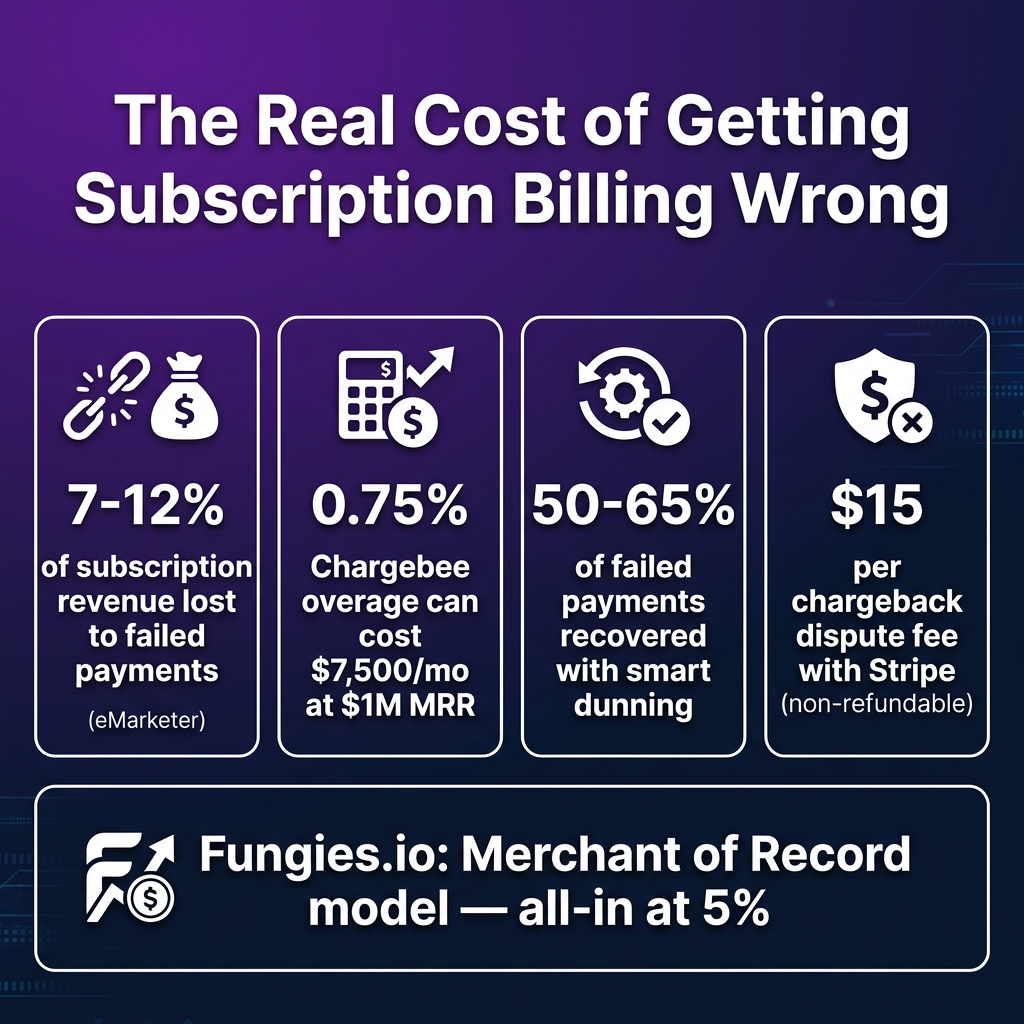
That 0.75% overage sounds small until you do the math. At $1M MRR, the overage fee alone is $7,500 per month — on top of your platform fee and payment processor costs. Plus, Chargebee’s churn deflection tool (formerly Brightback) is a paid add-on, and tax automation requires integrating with a third-party like Avalara or TaxJar.
What it does well
- Best-in-class subscription lifecycle management — trials, upgrades, downgrades, prorations
- Deep CPQ and quote-to-cash workflows for enterprise sales
- Strong revenue recognition (ASC 606) for finance teams
- Extensive integrations: Salesforce, HubSpot, NetSuite, QuickBooks
- Usage-based billing with Chargebee’s metered billing feature
What it doesn’t do
- It’s not a payment processor — you still need Stripe or Braintree underneath
- Global tax compliance is your problem (add $200-500/mo for Avalara or TaxJar)
- No Merchant of Record — cross-border tax filings land on you
Best for: Series B+ B2B SaaS with $100K+ MRR that needs finance-grade billing automation, CPQ, and revenue recognition. Not ideal for early-stage teams or anyone selling globally without a dedicated finance function.
Recurly: Best for Mid-Market With High Transaction Volume
Recurly has been around since 2009 and is purpose-built for subscription management at mid-market scale. It excels at high-volume recurring billing, churn recovery, and flexible pricing model support.
Pricing
- Core: Free for the first 3 months, then starts around $249/month with a % of revenue fee
- Professional: Custom pricing based on transaction volume
- Elite: Enterprise tier, contact sales
Recurly’s real cost depends heavily on your volume and the % transaction fee negotiated. Early reviews on Capterra note that “the actual cost ended up more than 40% higher than anticipated” — a common complaint about subscription billing platforms where percentage fees compound.
What it does well
- Strong dunning engine — one of the most configurable on the market
- Flexible pricing models: flat, tiered, per-unit, usage-based
- Good analytics and MRR/churn reporting out of the box
- Solid multi-currency support across 140+ currencies
- Integration with multiple payment gateways (not locked to one processor)
What it doesn’t do
- Like Chargebee, it’s a billing layer not a payments processor or MoR
- Global tax compliance still your responsibility
- Pricing opacity — hard to forecast true TCO without a sales conversation
Best for: Mid-market SaaS and digital subscription businesses with high transaction volume and complex dunning requirements. Strong choice if you’re already on a payment processor and need billing automation on top.
Stripe Billing: Best for Developer-First Teams Already on Stripe
Stripe Billing is the subscription layer on top of Stripe’s payment infrastructure. If you’re already a Stripe shop, it’s the path of least resistance — no new integration required, same dashboard, same APIs.
Pricing
- Stripe Billing fee: +0.7% per transaction (on top of Stripe’s base 2.9% + $0.30)
- For international cards: Add 1.5% international fee + 1.0% currency conversion
- Effective rate: Can push above 6% for international recurring transactions
The math matters. For a $100/month subscription billed to a European customer: standard Stripe rate is ~$3.20 + $0.70 (Billing) + $1.50 (international) + $1.00 (FX) = $6.40 in fees, or 6.4%. That adds up fast at scale.
What it does well
- Developer-first — the best API and documentation of any billing platform
- Immediate if you’re already on Stripe — zero integration overhead
- Smart Retries for failed payments — Stripe’s ML-powered dunning
- Supports most pricing models: flat, metered, tiered, usage-based
- Stripe Tax available as an add-on (0.5% per transaction)
What it doesn’t do
- Not a Merchant of Record — global tax liability stays with you
- Fees stack up: Billing + Tax + international = can exceed 6%
- Less suited for enterprise billing workflows (CPQ, RevRec, complex entitlements)
- Revenue recognition requires third-party or Stripe Revenue Recognition add-on
Best for: Developer-led startups and growth-stage SaaS already on Stripe. Best under $50K MRR before fee compounding becomes a serious concern. Not the right tool if you need global tax compliance without a dedicated ops team.
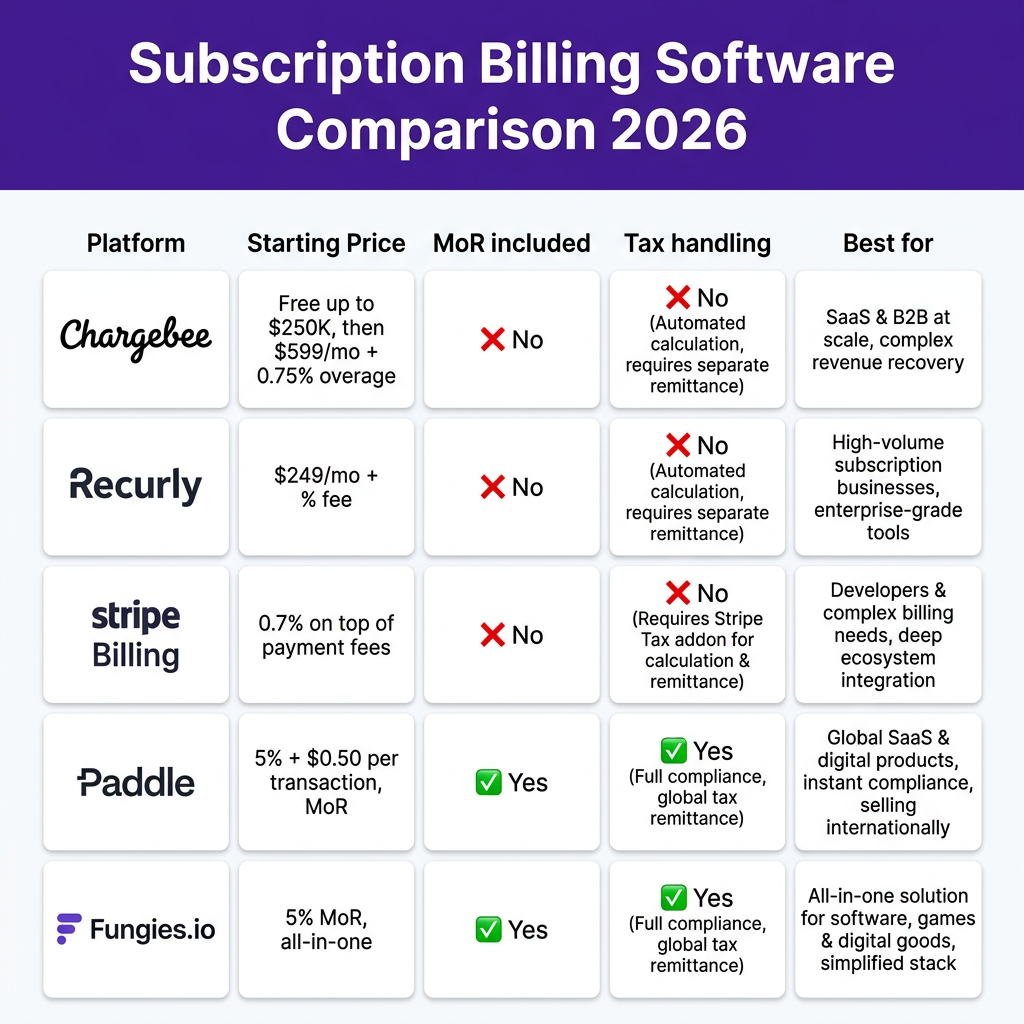
| Platform | Starting Price | Merchant of Record | Tax Handling | Revenue Recognition | Best For |
|---|---|---|---|---|---|
| Chargebee | Free → $599/mo + 0.75% overage | ❌ No | Third-party add-on (Avalara) | ✅ Built-in (RevRec) | Series B+ B2B SaaS |
| Recurly | ~$249/mo + % fee | ❌ No | Third-party required | ✅ Available | Mid-market high volume |
| Stripe Billing | +0.7% on top of Stripe fees | ❌ No | Stripe Tax add-on (+0.5%) | Add-on required | Dev-first, already on Stripe |
| Paddle | 5% + $0.50 per transaction | ✅ Yes | ✅ Included (MoR) | Limited | SaaS selling globally |
| Fungies.io | 5% (all-in) | ✅ Yes | ✅ Included (MoR) | Via dashboard | SaaS, games, digital products |

Paddle: Best All-in-One MoR for Global SaaS
Paddle is a Merchant of Record that includes subscription billing, checkout, payments, and full global tax compliance — all under one roof. This is the key differentiator: unlike Chargebee or Stripe Billing, Paddle takes on the legal and tax liability of every transaction across 180+ countries.
Pricing
- Standard rate: 5% + $0.50 per transaction
- No monthly platform fee
- No separate tax compliance costs — all included
- Enterprise volume discounts available
Paddle markets a “total cost of ownership reduction of up to 25%” compared to Chargebee because you eliminate the need for separate payment processor fees, tax automation software, and compliance infrastructure.
What it does well
- Full Merchant of Record: handles VAT, GST, and US sales tax across all US states
- Built-in subscription management with trials, pauses, plan changes
- Checkout localization and currency conversion
- Billing that’s purpose-built (not bolt-on) with their Lovable Payments integration
- Churn tools included (formerly ProfitWell)
What it doesn’t do well
- Less developer flexibility vs Stripe — tighter control over the checkout experience
- 5% + $0.50 can be expensive at very high ticket sizes or volumes
- Primarily focused on software/SaaS — less suited for non-software digital products
- Revenue recognition is more limited than Chargebee’s
Best for: B2B SaaS and software companies selling globally that want to eliminate tax compliance overhead entirely. Strong choice for teams without a dedicated finance or legal function handling international tax.
Fungies.io: Best for SaaS, Games, and Digital Products (All-in-One MoR)
Fungies.io is a Merchant of Record built specifically for digital product sellers — SaaS subscriptions, game assets, digital downloads, and one-time purchases. Like Paddle, it takes on the full tax liability so you don’t have to. But it’s positioned for a broader range of digital product types, including gaming and creator economy use cases.
Pricing
- All-in rate: 5% per transaction (MoR model)
- No monthly platform fee
- Payments, tax compliance, and subscription management all included
- No hidden overage fees
What it does well
- Full MoR: handles VAT, GST, and sales tax globally — zero tax liability on your side
- Subscription management with recurring billing, plan management, and checkout flows
- Overlay and hosted checkout options — embedded checkout without redirects
- Built for games, SaaS, and digital products (not just B2B software)
- Simple, predictable pricing: 5% all-in with no billing surprises
- Supports all world currencies and global payments
What it doesn’t do (yet)
- Less feature depth than Chargebee for complex CPQ or enterprise RevRec
- Smaller ecosystem of third-party integrations vs Stripe
- Better suited for SMB and growth-stage than large enterprise
Best for: SaaS founders, game developers, and digital product sellers who want to start selling fast without building a tax and compliance stack. Especially strong for solo founders and small teams where operational simplicity is a priority.
Dunning: The Feature That Pays for Your Billing Platform
Dunning is the automated process of recovering failed payments — the silent revenue killer. With 7–12% of subscription revenue at risk from failed payments, your billing platform’s dunning engine has a direct line to your MRR.
Here’s what smart dunning looks like in practice:
- Intelligent retries: Not just “retry in 3 days” — ML-based timing based on card BIN, bank type, and failure reason. Stripe’s Smart Retries does this well.
- Customer communication: Automated email sequences with payment update links, timed to retry cadence
- Segmentation: Treat a long-term customer’s first failed payment differently from a 30-day churner
- Recovery windows: Best-in-class tools like Churn Buster layer on top of billing platforms, achieving 50–65% recovery rates
Companies without structured dunning typically recover only 30–40% of failed payments. With a well-built dunning engine, that number climbs to 50–65%. For a SaaS doing $500K MRR with a 10% failed payment rate, improving recovery from 40% to 60% adds ~$120,000 in annual recovered revenue.
| Platform | Dunning Approach | Smart Retries | Customer Communication | Recovery Add-ons |
|---|---|---|---|---|
| Chargebee | Smart Dunning (built-in on Performance+) | ✅ Yes | Email sequences built-in | Churn Buster compatible |
| Recurly | Revenue Optimization Engine (ROE) | ✅ Yes | Email templates built-in | Most add-ons work |
| Stripe Billing | Smart Retries (ML-powered) | ✅ Yes (best-in-class ML) | Basic emails, needs Churn Buster for advanced | Strong ecosystem |
| Paddle | Built-in with ProfitWell Retain | ✅ Yes | ✅ Included via Retain | ProfitWell Retain included |
| Fungies.io | Built-in retry logic | ✅ Yes | Platform handles notifications | Improving with product roadmap |
The Hidden Costs: What Your Platform Quote Doesn’t Include
Subscription billing pricing is designed to look simple upfront. Here’s what actually adds up:
Chargebee’s true cost at $500K MRR:
- Performance plan: $599/month = $7,188/year
- Overage at 0.75% on $400K above threshold: $3,000/month = $36,000/year
- Payment processor (Stripe): 2.9% + $0.30 = ~$14,500/month
- Tax automation (Avalara/TaxJar): ~$300-600/month
- Churn tool (if needed): $300-500/month
- Total: ~$220,000+/year in billing infrastructure costs
Paddle / Fungies.io at $500K MRR:
- 5% all-in: $25,000/month = $300,000/year
- No tax software, no payment processor fees stacked on top
- Dunning included
- Total: ~$300,000/year but far less operational overhead
The MoR model is relatively more expensive at high volume but eliminates operational complexity. The billing-layer model (Chargebee, Recurly, Stripe) is cheaper at scale but requires you to manage payments, tax, and compliance separately.
The breakeven point is different for every business, but generally:
- Under $50K MRR: Start with Stripe Billing or Chargebee Starter (free) to minimize costs
- $50K–$200K MRR selling globally: MoR model (Paddle, Fungies) becomes competitive when you factor in tax infrastructure costs
- $200K+ MRR, US-only: Chargebee Performance or Recurly typically wins on TCO
- $200K+ MRR, global, complex billing: Chargebee Enterprise or Recurly Professional with Avalara
Key Takeaways
- Failed payment recovery is a revenue opportunity, not just a cost center. Your dunning engine can recover 50–65% of failed payments — that’s real MRR back in your pocket. Don’t pick a billing platform without evaluating this first.
- Tax compliance is the hidden cost that breaks the “Chargebee is cheap” argument. Add Avalara or TaxJar and the gap between billing-layer tools and MoR platforms narrows significantly for global sellers.
- Stripe Billing is only cheap if you stay domestic and under $50K MRR. International fees + Billing fee + Tax add-on can push effective rates past 6%.
- Merchant of Record isn’t just about tax — it’s about legal liability. When you use Paddle or Fungies.io, they’re the seller of record. Chargebacks, disputes, and tax audits go to them, not you.
- The best billing platform is the one you’ll actually outgrow. Start with what gets you live fastest. Chargebee Starter and Stripe Billing are both genuinely free at low volume — use them to find product-market fit, then reevaluate at $100K MRR.
FAQ
What’s the difference between subscription billing software and a Merchant of Record?
Subscription billing software (Chargebee, Recurly, Stripe Billing) automates your recurring billing workflow but sits on top of a payment processor — you’re still legally responsible for collecting and remitting tax, handling chargebacks, and managing compliance. A Merchant of Record (Paddle, Fungies.io) acts as the legal seller of your products — they take on the tax liability, process payments, and handle global compliance. You get revenue minus their fee.
Is Chargebee free to start?
Yes — Chargebee’s Starter plan is genuinely free until you’ve processed $250,000 in cumulative lifetime billing (not monthly, lifetime). After that threshold, a 0.75% overage kicks in on all billing. It’s a great option for early-stage SaaS that wants subscription automation without upfront cost. The Performance plan at $599/month + 0.75% overage makes sense once you’re doing $50K+ MRR consistently.
Which subscription billing software has the best dunning?
For raw dunning intelligence, Stripe’s Smart Retries uses ML to optimize retry timing and consistently outperforms fixed-schedule retry logic. Recurly’s Revenue Optimization Engine is strong for high-volume merchants. Paddle includes ProfitWell Retain which goes beyond retries into customer communication. For any platform, layering Churn Buster on top adds advanced segmentation and recovery campaign logic that can push recovery rates from 40% to 60%+.
When does the Merchant of Record model make financial sense vs building your own billing stack?
Run the numbers at your current MRR. Add up: payment processor fees (2.9% + $0.30 Stripe) + subscription billing platform ($0-599/month + 0.75% overage) + tax automation ($300-600/month) + developer time maintaining integrations (~2-5 hours/month). If that total approaches 5% of your MRR, a MoR at 5% all-in starts looking attractive — especially for teams selling in multiple countries where tax compliance is genuinely complex.
Conclusion: Which Subscription Billing Software Should You Choose?
There’s no universal answer — but here’s the decision tree that actually works:
If you’re just starting out (under $50K MRR), use Chargebee Starter or Stripe Billing. Both are effectively free at low volume. Get to product-market fit first.
If you’re selling globally and don’t want to deal with VAT, GST, or US sales tax nexus, use a Merchant of Record. Paddle or Fungies.io eliminate that entire problem class at 5% per transaction.
If you’re enterprise-grade with CPQ, complex entitlements, and multi-entity accounting, Chargebee Enterprise or Recurly Professional are the right tools — budget for the tax automation layer on top.
If you’re a developer already on Stripe and your billing is straightforward, Stripe Billing is the lowest-friction path. Just model out the fee stack before committing at scale.
Ready to sell subscriptions without the billing infrastructure headache? Start with Fungies.io free — we’re the Merchant of Record so you never have to think about global tax compliance again.
References
- Chargebee Pricing 2026: Plans, Costs & True TCO — CheckThat.ai
- Recurly Pricing 2026 — Agency Handy
- Stripe Pricing 2026: Plans, Costs & Hidden Fees — CheckThat.ai
- Paddle vs. Chargebee — Paddle
- Dunning Management for Subscriptions: Recover Failed Payments 2026 — PayRequest
- Dunning Automation for B2B SaaS: The 2026 Playbook — LedgerUp
- 6 Best SaaS Billing Software for Modern Pricing Models — Alguna
- Stripe Billing vs Chargebee vs Paddle: SaaS Billing 2026 — CraftAim
- Recurly Review 2026 — Dodo Payments