Selling digital goods online has never been easier — or more complicated. While creating ebooks, templates, software, or courses is straightforward, getting paid for them introduces a maze of payment processors, fee structures, tax obligations, and compliance requirements. Choose the wrong payment solution, and you could be leaving 5-10% of your revenue on the table or worse, facing unexpected tax liabilities.
In this guide, we’ll compare the best payment processors for digital goods in 2026, examining fees, features, tax handling, and who each solution works best for. Whether you’re selling your first Notion template or scaling a six-figure digital product business, this comparison will help you make an informed decision.
Why Payment Processor Choice Matters for Digital Goods
Digital products have unique payment requirements that physical goods don’t face. Instant delivery means customers expect immediate access after purchase. Global sales mean dealing with multiple currencies and tax jurisdictions. And because digital goods have near-zero marginal cost, every percentage point in fees directly impacts your profit margins.
The global digital goods market is projected to reach $74 billion by 2027, growing at 8.5% annually. Creators who optimize their payment infrastructure now will capture disproportionate value as the market expands. The difference between a 3% and 8% effective fee rate could mean thousands of dollars monthly for established sellers.
Stripe: The Developer’s Choice
Stripe remains the gold standard for developers and technically-savvy creators who want complete control over their checkout experience. With comprehensive APIs, extensive documentation, and robust webhook support, Stripe lets you build exactly the payment flow you envision.
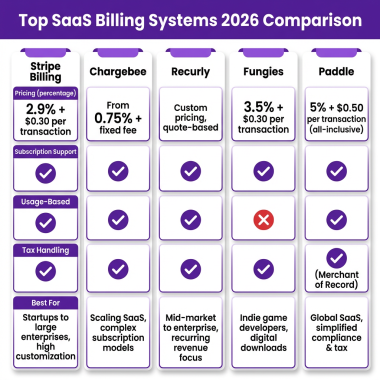
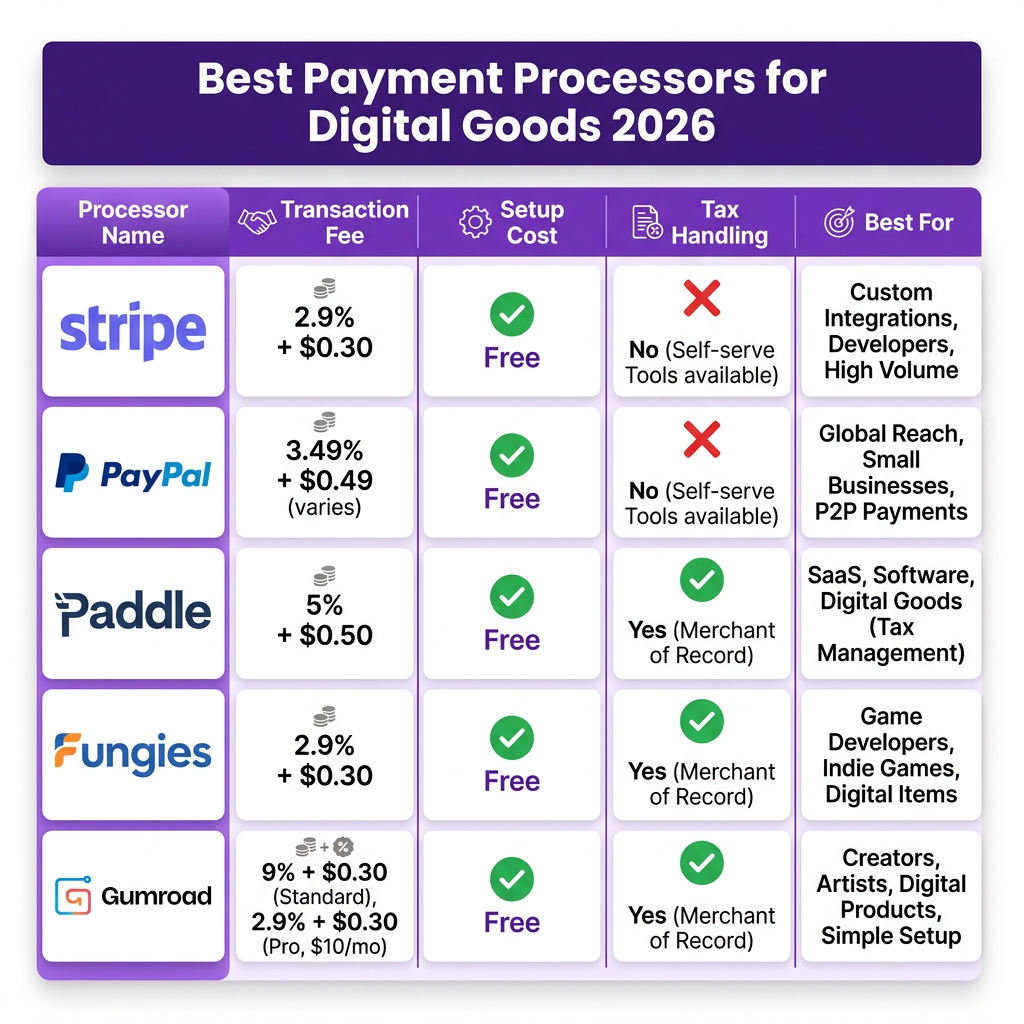
Pricing: 2.9% + $0.30 per transaction for cards. Additional fees for international cards (1%), currency conversion (1%), and disputed payments ($15 per dispute).
Best for: Developers, SaaS companies, and creators with technical resources who need custom checkout flows and don’t mind handling tax compliance themselves.
Tax handling: Stripe provides tax calculation tools through Stripe Tax, but you’re responsible for registration, filing, and remittance in each jurisdiction. This adds significant complexity for global sellers.
PayPal: The Household Name
PayPal’s biggest advantage is trust. With over 400 million active accounts worldwide, customers recognize and trust the PayPal brand. This familiarity can improve conversion rates, especially for first-time customers who might hesitate to enter credit card details on an unfamiliar site.
Pricing: 3.49% + fixed fee per transaction for domestic payments. International payments add 1.5% currency conversion and cross-border fees. Micropayments (under $10) have a different structure: 5% + $0.05.
Best for: Creators targeting mainstream consumers who prioritize brand recognition and buyer protection over lowest fees.
Tax handling: PayPal doesn’t handle sales tax or VAT calculation or remittance. You’re entirely responsible for tax compliance, which becomes burdensome as you scale internationally.
Paddle: The SaaS Specialist
Paddle built its reputation serving software companies and SaaS businesses. As a Merchant of Record, Paddle handles the entire payment stack including tax compliance, making it attractive for businesses that want to focus on product rather than payment infrastructure.
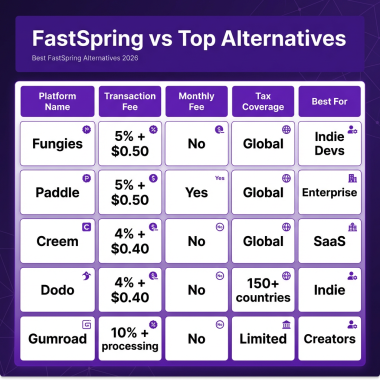
Pricing: 5% + $0.50 per transaction on the basic plan. Custom pricing for high-volume sellers. No additional fees for international payments or tax handling.
Best for: SaaS companies and software sellers who want a complete Merchant of Record solution and don’t mind premium pricing for convenience.
Tax handling: Full Merchant of Record service — Paddle calculates, collects, and remits sales tax and VAT globally. This is Paddle’s primary value proposition.

Fungies: The Creator-Friendly MoR
Fungies positions itself as the Merchant of Record built specifically for creators and indie developers. With competitive pricing, instant payouts, and a focus on digital goods, Fungies aims to deliver MoR benefits without enterprise-level complexity or costs.
Pricing: 4.9% + $0.30 per transaction with no monthly fees. No additional charges for international payments, currency conversion, or tax handling. Volume discounts available for sellers processing over $50,000 monthly.
Best for: Indie creators, game developers, template sellers, and digital product entrepreneurs who want MoR benefits with competitive pricing and fast setup.
Tax handling: Complete Merchant of Record service including global tax registration, calculation, collection, and remittance. Fungies handles VAT, sales tax, and GST compliance automatically.
Gumroad: The Simple Starter
Gumroad democratized digital product sales with its simple, no-code approach. Creators can set up a store in minutes and start selling immediately. While fees have increased over time, Gumroad remains popular for its ease of use and built-in audience features.
Pricing: 10% + processing fees (approximately 3% + $0.30) on the free plan. Premium plans reduce the Gumroad fee to 0% but cost $9-29 monthly plus processing fees.
Best for: Beginners testing the waters with digital products who prioritize simplicity over lowest fees.
Tax handling: Gumroad acts as a Marketplace Facilitator in supported jurisdictions, handling tax collection and remittance. However, coverage isn’t universal, and sellers may still have obligations in unsupported regions.
How to Choose: 5-Step Decision Framework
Selecting the right payment processor depends on your specific situation. Here’s a practical framework to guide your decision:
Step 1: Calculate Your Volume
Estimate your monthly sales volume. At low volumes (under $1,000/month), simplicity matters more than fee optimization. As you scale, small percentage differences compound significantly. A seller doing $10,000 monthly saves $300+ by choosing a 5% solution over an 8% one.
Step 2: Assess Tax Complexity
If you sell to customers in multiple countries or US states, tax compliance becomes complex quickly. A Merchant of Record (Paddle, Fungies) handles this automatically. Self-serve processors (Stripe, PayPal) require you to manage tax registration and filing yourself or pay for additional tax services.
Step 3: Evaluate Technical Resources
Do you have developer resources to build custom checkout flows? If yes, Stripe offers maximum flexibility. If not, hosted solutions like Gumroad, Paddle, or Fungies provide ready-to-use checkout pages that require no coding.
Step 4: Consider Payout Timing
Cash flow matters. PayPal offers instant access to funds. Stripe pays out in 2-7 days depending on your country and history. Paddle and Fungies typically pay out weekly or monthly. If you need immediate access to sales revenue, this could be a deciding factor.
Step 5: Test the Checkout Experience
Before committing, go through the complete purchase flow yourself. Is it smooth? Mobile-friendly? Does it inspire confidence? The best technical solution means nothing if customers abandon their carts due to a confusing checkout process.
Ready to Simplify Your Payment Processing?
Join hundreds of creators using Fungies.io — automated tax compliance, 50+ payment methods, global Merchant of Record.
No credit card required
Frequently Asked Questions
What’s the difference between a payment processor and a Merchant of Record?
A payment processor (Stripe, PayPal) handles transaction processing but you’re the seller of record responsible for tax compliance. A Merchant of Record (Paddle, Fungies) becomes the legal seller, handling all tax obligations on your behalf. MoR solutions cost more but eliminate tax complexity entirely.
Do I need to charge sales tax on digital goods?
It depends on where you and your customers are located. In the US, most states require sales tax on digital goods. In the EU, digital products are subject to VAT. Other countries have varying rules. Without an MoR, you must register, collect, and remit taxes in each jurisdiction where you have customers.
Can I use multiple payment processors?
Yes, many sellers use multiple processors. For example, offering both Stripe (for card payments) and PayPal (for PayPal account holders) can improve conversion rates. However, managing multiple integrations and reconciliation adds complexity.
What’s the real cost of payment processing?
Look beyond the headline rate. Factor in: international transaction fees, currency conversion charges, dispute fees, refund fees, monthly platform fees, and tax compliance costs (if handling yourself). The “real” rate is often 2-4% higher than the advertised rate.
Which processor has the fastest setup?
Gumroad and Fungies offer the fastest setup — you can start selling within minutes. Stripe and PayPal require business verification that can take 1-3 days. Paddle typically has an application and review process that takes several days to a week.
Conclusion: Making Your Choice
The best payment processor for your digital goods depends on your priorities. If you want maximum control and have technical resources, Stripe is unbeatable. If brand trust matters most, PayPal delivers. For hassle-free tax compliance, choose a Merchant of Record like Paddle or Fungies. And if you’re just starting out, Gumroad’s simplicity gets you selling fast.
For most growing creators, we recommend evaluating total cost of ownership rather than just transaction fees. A solution that handles tax compliance automatically can save dozens of hours monthly and prevent costly compliance mistakes. The time you save is time you can invest in creating better products and growing your audience.
Whatever you choose, start selling. The perfect payment processor is the one that gets your products into customers’ hands. You can always migrate as your business evolves.
Ready to Simplify Your Payment Processing?
Join hundreds of creators using Fungies.io — automated tax compliance, 50+ payment methods, global Merchant of Record.
No credit card required
Sources
- Stripe Pricing: stripe.com/pricing
- PayPal Merchant Fees: paypal.com/us/webapps/mpp/merchant-fees
- Paddle Pricing: paddle.com/pricing
- Gumroad Pricing: gumroad.com/pricing
- Digital Goods Market Report 2026: Industry analysis