Fraud Management Statistics 2026: Market Size, Data & Trends (Comprehensive Report)
Global fraud losses hit $48B in 2025. Explore 40+ verified fraud management statistics: market size ($40.4B in 2026), chargeback trends, first-party fraud surge (36% of cases), and regional breakdowns.
Global fraud losses reached $48 billion in 2025, with merchants now losing $4.61 for every dollar of fraud—a 37% increase from five years prior. For businesses selling digital products, SaaS subscriptions, or online services, fraud isn’t just a cost of doing business anymore. It’s a strategic threat that can erode margins, damage customer trust, and create compliance nightmares.
This comprehensive report compiles the latest fraud management statistics from 2025-2026, drawing on data from Juniper Research, LexisNexis Risk Solutions, the Merchant Risk Council, and leading fraud prevention providers. Whether you’re evaluating fraud prevention tools, building a business case for security investment, or simply need authoritative data to cite, you’ll find 40+ verified statistics with sources.
Key Fraud Management Statistics at a Glance
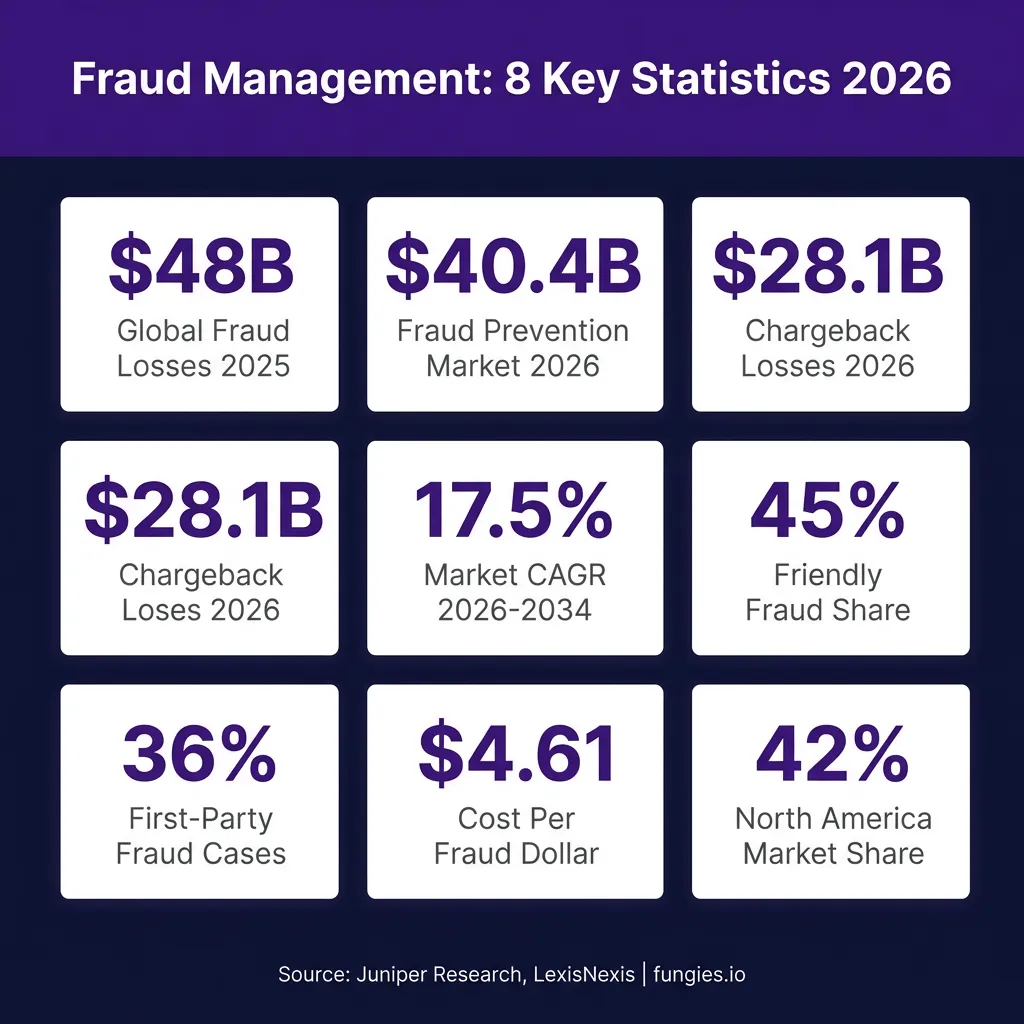
Global fraud detection and prevention market: $40.4 billion in 2026, projected to reach $243.7 billion by 2034 (CAGR 17.5%)
E-commerce fraud losses hit $48 billion in 2025—a 16% year-over-year increase
Chargeback fraud losses projected at $28.1 billion in 2026, up 40% from 2023
First-party (friendly) fraud now accounts for 36% of all fraud cases—more than doubling in one year
Merchants lose $4.61 for every $1 of fraud when accounting for fees, operational costs, and lost merchandise
North America holds 42% of the global fraud prevention market share
Synthetic identity fraud costs U.S. lenders $3.3 billion annually in new account exposure
Account takeover attacks rose 36% in 2024, with 5.1 million U.S. consumers victimized
Global Fraud Detection & Prevention Market Size
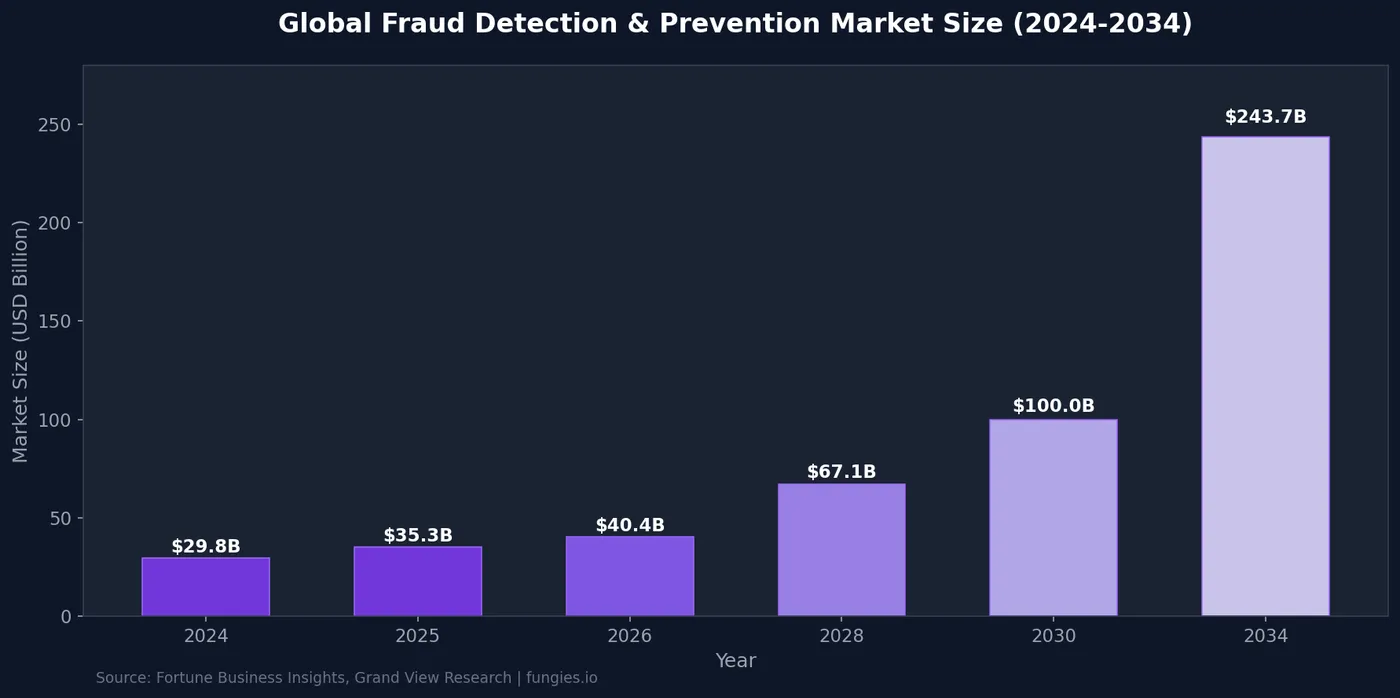
The fraud detection and prevention industry has experienced explosive growth as digital transactions proliferate and fraud tactics evolve. According to Fortune Business Insights, the global market was valued at $54.61 billion in 2025 and is projected to grow to $67.12 billion in 2026. By 2034, the market will reach an estimated $243.72 billion, representing a compound annual growth rate (CAGR) of 17.50%.
Grand View Research provides slightly different figures, estimating the market at $35.3 billion in 2025 with expectations to reach $40.4 billion in 2026 and $129.4 billion by 2033. MarketsandMarkets projects growth from $32.0 billion in 2025 to $65.68 billion by 2030 at a 15.5% CAGR. These variations reflect different segment definitions—some include only software solutions while others encompass services, consulting, and managed security.
| Year | Market Size (USD Billion) | Growth Rate | Source |
|---|---|---|---|
| 2024 | $29.8B | Baseline | MarketsandMarkets |
| 2025 | $35.3B | +18.5% | Grand View Research |
| 2026 | $40.4B | +14.4% | Grand View Research |
| 2028 | $67.1B | +28.5% CAGR | Fortune Business Insights |
| 2030 | $100.0B+ | +17.5% CAGR | Fortune Business Insights |
| 2034 | $243.7B | +17.5% CAGR | Fortune Business Insights |
The AI-powered fraud detection segment is growing even faster. According to The Business Research Company, the AI in fraud management market will reach $37.27 billion by 2030 at a 19.2% CAGR. Machine learning in fraud detection specifically is projected to hit $302.9 billion by 2034, growing from $14.2 billion in 2024 at a remarkable 35.8% CAGR.
E-Commerce Fraud Losses: The True Cost
E-commerce fraud represents the most visible and measurable segment of digital fraud. According to Juniper Research, global e-commerce fraud losses reached $48 billion in 2025—a 16% increase from 2024. The trajectory is alarming: losses are projected to hit $107 billion by 2029, representing a 141% increase in just five years.
However, the direct fraud loss figure only tells part of the story. LexisNexis Risk Solutions calculates that U.S. merchants lose $4.61 for every dollar of fraud when accounting for chargeback fees, operational costs, merchandise replacement, and customer acquisition costs to replace churned accounts. This represents a 37% increase from five years prior.
| Fraud Cost Component | Amount/Cost | Source |
|---|---|---|
| Direct fraud losses (global 2025) | $48 billion | Juniper Research |
| Projected losses (2029) | $107 billion | Juniper Research |
| Cost per fraud dollar (U.S. merchants) | $4.61 | LexisNexis Risk Solutions |
| Revenue lost to fraud (global average) | 2.9% | Merchant Risk Council |
| Revenue lost to fraud (Latin America) | Up to 20% | Merchant Savvy |
| Fraud management spend (Europe/US) | 10% of revenue | Merchant Savvy |
| Fraud management spend (Latin America) | 19% of revenue | Merchant Savvy |
The Merchant Risk Council’s 2026 Global Payments and Fraud Report, based on a survey of 1,200+ merchants across 35+ countries, found that the percentage of revenue lost to payment fraud has actually decreased from 3.6% in 2022 to 2.9% in 2023. This suggests that increased investment in fraud prevention is yielding results—though the absolute dollar losses continue rising due to transaction volume growth.
Regional Breakdown: Where Fraud Hits Hardest
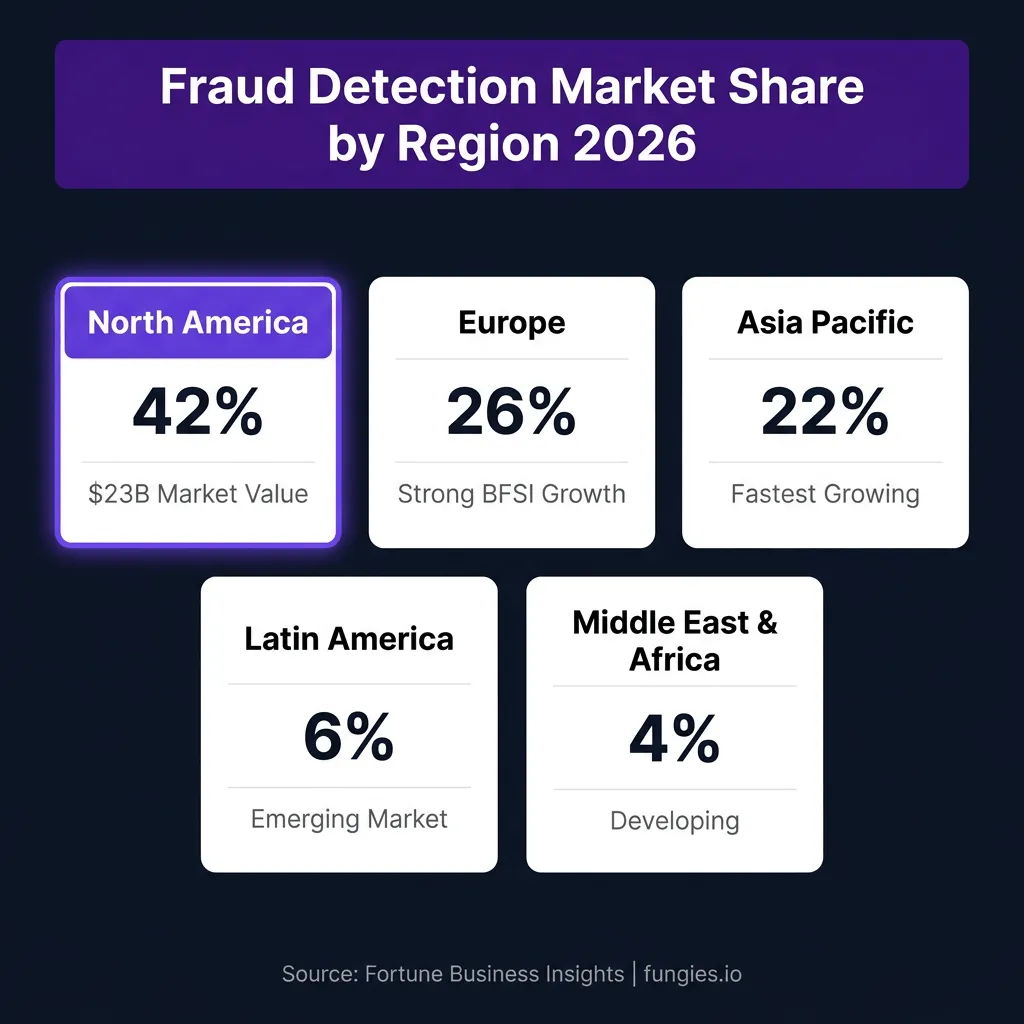
Fraud is a global phenomenon, but its impact varies significantly by region. North America dominates both the fraud prevention market and fraud loss volumes—a function of its massive e-commerce economy and high transaction values.
| Region | Market Share | Fraud Loss Share | Key Characteristics |
|---|---|---|---|
| North America | 42% | 42% | Largest market, highest fraud values |
| Europe | 26% | 26% | Strong BFSI adoption, GDPR compliance focus |
| Asia Pacific | 22% | 22% | Fastest growing, mobile-first fraud |
| Latin America | 6% | 10%+ | Highest fraud rates, emerging market |
| Middle East & Africa | 4% | Variable | Developing infrastructure, growing threats |
According to Merchant Savvy, 42% of all e-commerce fraud by value occurs in the U.S., with 26% in Western Europe and 22% in Asia. Latin America stands out for having the highest fraud rates relative to transaction volume—merchants there can lose up to 20% of e-commerce revenue to fraud, compared to the global average of 2.9%.
The UK provides a detailed case study: Card Not Present (CNP) fraud, predominantly from e-commerce, made up 81% of all UK card fraud with 2.21 million cases in 2022 and losses of £396 million. Account takeover cases in the UK reached 78,000 in 2025, representing 18% of all fraud-risk filings and marking a 6% year-over-year increase.
Fraud Types: The Evolving Threat Landscape
Understanding the specific types of fraud your business faces is critical for effective prevention. The fraud landscape has shifted dramatically, with first-party fraud now surpassing traditional third-party attacks.
First-Party (Friendly) Fraud
First-party fraud—where legitimate customers dispute valid transactions—has exploded. According to LexisNexis Risk Solutions, it now accounts for 36% of all fraud cases globally, up from just 15% the year before. Mastercard reports that friendly fraud makes up over 45% of all chargebacks.
Chargebacks911 data shows that 72% of merchants reported an increase in friendly fraud chargebacks in 2024. By 2026, chargeback fraud is expected to cost merchants $28.1 billion, a 40% increase from $20 billion in 2023.
Account Takeover (ATO)
Account takeover attacks rose 36% in 2024 according to Federal Reserve reporting. DeepStrike research found that 5.1 million U.S. consumers were victimized by ATO fraud in 2024, with losses approaching $16 billion. Veriff’s Fraud Report 2026 found that impersonation fraud accounted for over 85% of all fraud attempts in digital verification flows.
Synthetic Identity Fraud
Synthetic identity fraud—combining real and fabricated information to create new identities—has become one of the most difficult fraud types to detect. According to BIIA, estimated U.S. economic losses from synthetic identity fraud could reach $30-35 billion annually. U.S. lenders faced over $3.3 billion in exposure to synthetic identities tied to new accounts.
Synthetic identity fraud now accounts for up to 80% of new account fraud cases at some financial institutions. Fraud rates rose for 67% of financial institutions in 2025, with synthetic identities being a major contributor.
| Fraud Type | Share of Fraud | Key Statistic | Source |
|---|---|---|---|
| First-Party (Friendly) Fraud | 36% | Up from 15% YoY | LexisNexis |
| Account Takeover | 18% | 36% increase in 2024 | Federal Reserve |
| Synthetic Identity | 30% | $30-35B annual losses | BIIA |
| Identity Fraud | 54% | Largest fraud category | Cifas Fraudscape |
| Payment Fraud | 31% | Fastest growing sector | Cifas Fraudscape |
Chargeback Statistics: The Hidden Tax on Merchants
Chargebacks represent one of the most visible and frustrating fraud costs for merchants. Sift’s Q4 2025 Digital Trust Index projects worldwide chargeback losses to climb from $33.79 billion in 2025 to $41.69 billion in 2028.
The direct costs are just the beginning. According to Mastercard and Investopedia, processor chargeback fees run $20-50 per dispute, but all-in merchant costs average $110 per chargeback. Global chargeback volume is projected to reach 324 million per year by 2028.
The chargeback management market itself is growing rapidly—Market.us projects it will expand from $2.6 billion in 2025 to $9.3 billion by 2035 at a 13.5% CAGR, with software/platforms capturing 72.8% of market share.
Industry Benchmarks & KPIs
What should your fraud prevention program aim for? Here are the key benchmarks from industry research:
| Metric | Benchmark | Source |
|---|---|---|
| Acceptable chargeback rate | <0.9% (Visa), <1.5% (high-risk) | Card network rules |
| Fraud recovery rate (>75% of funds) | 22% of organizations | AFP 2025 Survey |
| Organizations facing fraud attempts | 79% | AFP 2025 Survey |
| Business Email Compromise (top avenue) | 63% of organizations | AFP 2025 Survey |
| Deepfake selfie increase | 58% in 2025 | Entrust 2026 Report |
| Biometric fraud attempts (deepfakes) | 1 in 5 | Entrust 2026 Report |
| AI-driven fraud threat expectation by 2030 | 96% of executives | Datos Insights |
The Association for Financial Professionals’ 2025 Payments Fraud and Control Survey found that 79% of organizations faced fraud attempts in 2024. However, the fraud recovery rate has declined significantly—only 22% of organizations recovered more than 75% of funds, down from 41% previously. This highlights the growing sophistication of fraudsters and the difficulty of recovering stolen funds.
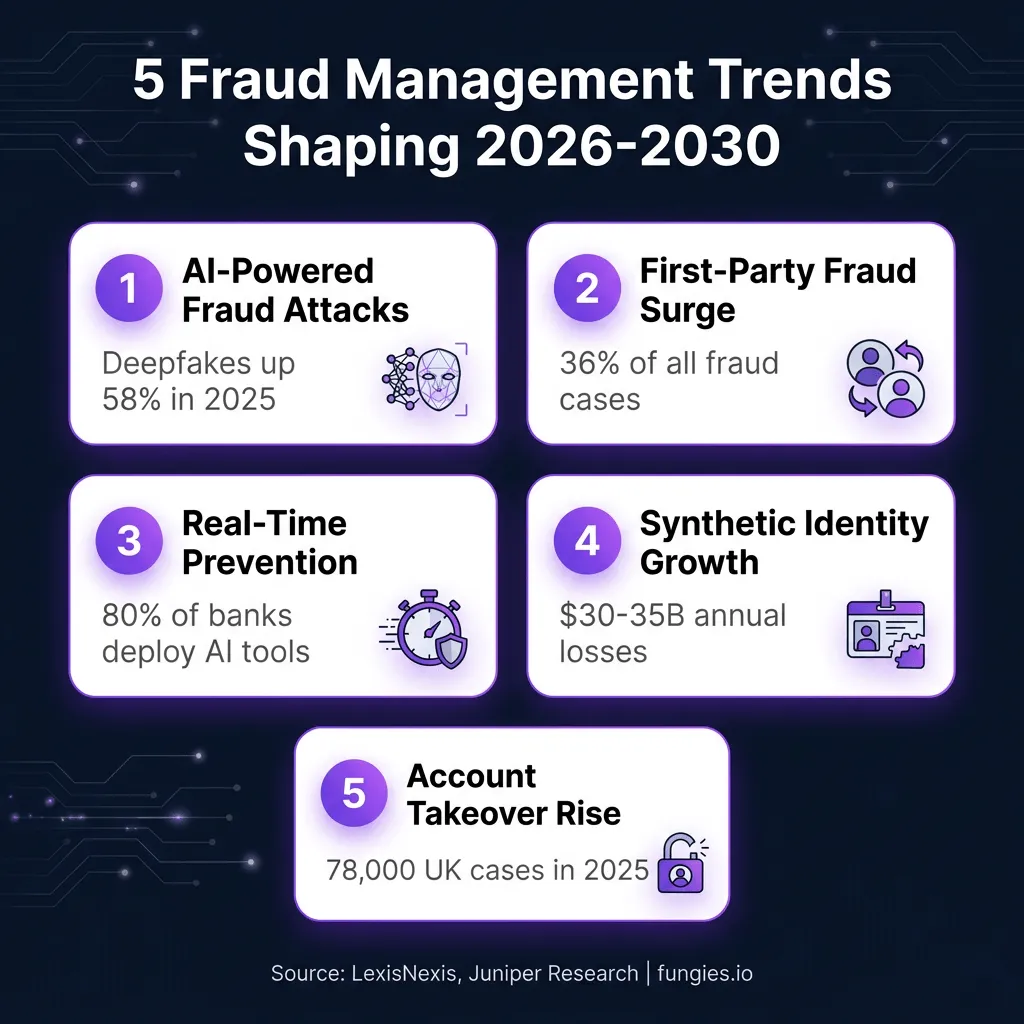
5 Fraud Management Trends Shaping 2026-2030
Based on analysis from LexisNexis Risk Solutions, Juniper Research, and industry experts, here are the five trends that will define fraud management over the next five years:
1. AI-Powered Fraud Attacks
Generative AI has become a double-edged sword. While 80%+ of leading banks have deployed AI-driven fraud detection tools by the end of 2025, criminals are using the same technology against them. Deepfake selfies increased 58% in 2025, and deepfakes now account for one in five biometric fraud attempts. Entrust’s 2026 Identity Fraud Report confirms that AI-generated documents and synthetic media are making fraud harder to detect than ever.
2. First-Party Fraud Surge
The most significant shift in 2025-2026 is the explosion of first-party fraud. LexisNexis reports it now represents 36% of all fraud—more than doubling from 15% in 2024. Mastercard’s First-Party Trust program expansion reflects the industry’s recognition that friendly fraud has become a systemic problem requiring new prevention approaches.
3. Real-Time Prevention Becomes Standard
Batch processing and delayed fraud detection are no longer acceptable. According to Stealth Agents research, more than 80% of leading banks deployed AI-driven fraud detection tools by the end of 2025. Real-time transaction monitoring, behavioral biometrics, and instant decisioning are becoming table stakes for competitive fraud prevention.
4. Synthetic Identity Fraud Expansion
Synthetic identities—blending real and fake data—are becoming the fraudster’s weapon of choice for new account fraud. With estimated annual losses of $30-35 billion and accounting for up to 80% of new account fraud cases, this threat requires sophisticated identity verification that goes beyond traditional document checks.
5. Account Takeover Evolution
ATO attacks are becoming more sophisticated, moving beyond credential stuffing to session hijacking, SIM swapping, and MFA bypass techniques. With 5.1 million U.S. consumers victimized in 2024 and losses near $16 billion, account protection has become a board-level priority for financial institutions and digital platforms.
Methodology & Data Sources
This report compiles data from primary research conducted by leading industry organizations and market research firms. All statistics are sourced from reports published between January 2025 and June 2026. Market size figures represent the consensus range across multiple research firms; where estimates differ significantly, we provide the range and cite specific sources.
Key data sources include: Juniper Research’s eCommerce Fraud Prevention Market reports, LexisNexis Risk Solutions’ Global State of Fraud and Identity Report 2026, the Merchant Risk Council’s 2026 Global eCommerce Payments and Fraud Report (based on 1,200+ merchant surveys), the Association for Financial Professionals’ 2025 Payments Fraud and Control Survey, Fortune Business Insights’ Fraud Detection and Prevention Market Analysis, Grand View Research industry reports, and Entrust’s 2026 Identity Fraud Report.
Limitations: Market size projections vary between research firms based on segment definitions and geographic scope. Fraud loss figures rely on self-reported merchant data and may underrepresent actual losses. Regional data availability varies, with less comprehensive reporting from emerging markets.
Frequently Asked Questions
What is the global fraud detection market size in 2026?
The global fraud detection and prevention market is valued at approximately $40.4 billion in 2026, with projections ranging from $35.3 billion (Grand View Research) to $67.1 billion (Fortune Business Insights) depending on segment definitions. The market is expected to grow at a 15.5%-17.5% CAGR through 2030-2034.
How much do merchants lose to fraud per dollar of fraud?
According to LexisNexis Risk Solutions, U.S. merchants lose $4.61 for every dollar of fraud when accounting for chargeback fees, operational costs, merchandise replacement, and customer acquisition costs. This represents a 37% increase from five years prior.
What percentage of fraud is first-party (friendly) fraud?
First-party fraud now accounts for 36% of all fraud cases globally, according to LexisNexis Risk Solutions—more than doubling from 15% in 2024. Mastercard reports that friendly fraud makes up over 45% of all chargebacks.
What is the projected e-commerce fraud loss by 2029?
Juniper Research projects that global e-commerce fraud losses will reach $107 billion by 2029, representing a 141% increase from $44.3 billion in 2024. This growth is driven by AI-powered attacks, rising friendly fraud, and increasing digital transaction volumes.
Which region has the highest fraud prevention market share?
North America dominates with 42% of the global fraud detection and prevention market, followed by Europe at 26% and Asia Pacific at 22%. North America also accounts for approximately 42% of global e-commerce fraud losses by value.
Sources & Citations
Fortune Business Insights – Fraud Detection and Prevention Market Growth Report 2026-2034: https://www.fortunebusinessinsights.com/industry-reports/fraud-detection-and-prevention-market-100231
Grand View Research – Fraud Detection And Prevention Market Size Report 2033: https://www.grandviewresearch.com/industry-analysis/fraud-detection-prevention-market
MarketsandMarkets – Fraud Detection and Prevention Market Report 2025-2030: https://www.marketsandmarkets.com/Market-Reports/fraud-detection-prevention-market-1312.html
Juniper Research – Fraudulent eCommerce Transactions to Surpass $131 Billion by 2030: https://www.juniperresearch.com/press/fraudulent-ecommerce-transactions-to-surpass-131bn
Merchant Risk Council – 2026 Global Payments and Fraud Report: https://merchantriskcouncil.org/learning/mrc-exclusive-reports/global-payments-and-fraud-report
LexisNexis Risk Solutions – Global State of Fraud and Identity Report 2026: https://risk.lexisnexis.com/insights-resources/infographic/fraud-and-identity-trends
Association for Financial Professionals – 2025 Payments Fraud and Control Survey: https://www.financialprofessionals.org/training-resources/resources/survey-research-economic-data/details/payments-fraud
Chargebacks911 – Chargeback Stats 2026: https://chargebacks911.com/chargeback-stats
Sift – Q4 2025 Digital Trust Index: https://sift.com/index-reports-disputes-q4-2025
Merchant Savvy – Payment Fraud Statistics 2026: https://www.merchantsavvy.co.uk/payment-fraud-statistics
BIIA – Synthetic Identity Fraud Statistics 2026: https://www.biia.com/synthetic-identity-fraud-statistics-2026-hard-numbers-big-threats
DeepStrike – Account Takeover Statistics 2026: https://deepstrike.io/blog/account-takeover-statistics
Veriff – Account Takeover Fraud Statistics 2026: https://www.veriff.com/fraud/news/account-takeover-fraud-statistics
Entrust – 2026 Identity Fraud Report: https://www.entrust.com/resources/reports/identity-fraud-report
Cifas – Fraudscape 2026: https://www.fraudscape.co.uk
SEON – Global Statistics in Account Takeover Fraud for 2026: https://seon.io/resources/statistics-account-takeover-fraud
The Business Research Company – AI In Fraud Management Market Report 2026: https://www.thebusinessresearchcompany.com/report/ai-in-fraud-management-global-market-report
Market.us – Machine Learning in Fraud Detection Market: https://scoop.market.us/machine-learning-in-fraud-detection-market-news
Datos Insights – Five Forces Reshaping Fraud Prevention by 2030: https://datos-insights.com/blog/global-fraud-prevention-trends-2030
Custom Market Insights – Enterprise Fraud Management Market 2026-2035: https://www.custommarketinsights.com/report/enterprise-fraud-management-market
Last updated: June 17, 2026. This report is maintained by Fungies.io as a resource for the payments and digital commerce industry. For merchants handling digital goods, SaaS subscriptions, or online services, implementing robust fraud prevention isn’t just about loss reduction—it’s about protecting customer trust and ensuring sustainable growth.