The digital marketing landscape has reached an inflection point in 2026. With global spending surpassing $680 billion and artificial intelligence fundamentally reshaping how brands connect with consumers, understanding the current state of digital marketing is not just beneficial—it is essential for survival. Whether you are a SaaS founder looking to optimize acquisition costs, an indie developer launching your first product, or a marketing director navigating the post-cookie era, the data tells a clear story: the rules have changed, and the winners are those who adapt fastest.
Consider this: a decade ago, digital marketing was a specialized function within broader marketing organizations. Today, it is the dominant form of marketing, consuming nearly two-thirds of global advertising budgets. The transformation has been swift and unforgiving. Companies that clung to traditional media strategies have seen their market share erode, while digital-native brands have built empires with minimal traditional advertising. The $680 billion flowing through digital channels in 2026 represents not just a shift in spending, but a fundamental reimagining of how businesses connect with customers.
In this comprehensive analysis, we will examine the $680+ billion digital marketing ecosystem through the lens of hard data and verified statistics. From the rise of AI-powered autonomous campaigns to the challenges of signal loss and privacy regulations, we will explore the forces shaping the industry and provide actionable insights for businesses of all sizes. By the end of this report, you will have a clear understanding of where to invest your marketing budget, which channels deliver the highest ROI, and how to position your brand for success in an increasingly AI-driven marketplace.

Market Overview: The $680+ Billion Digital Marketing Ecosystem
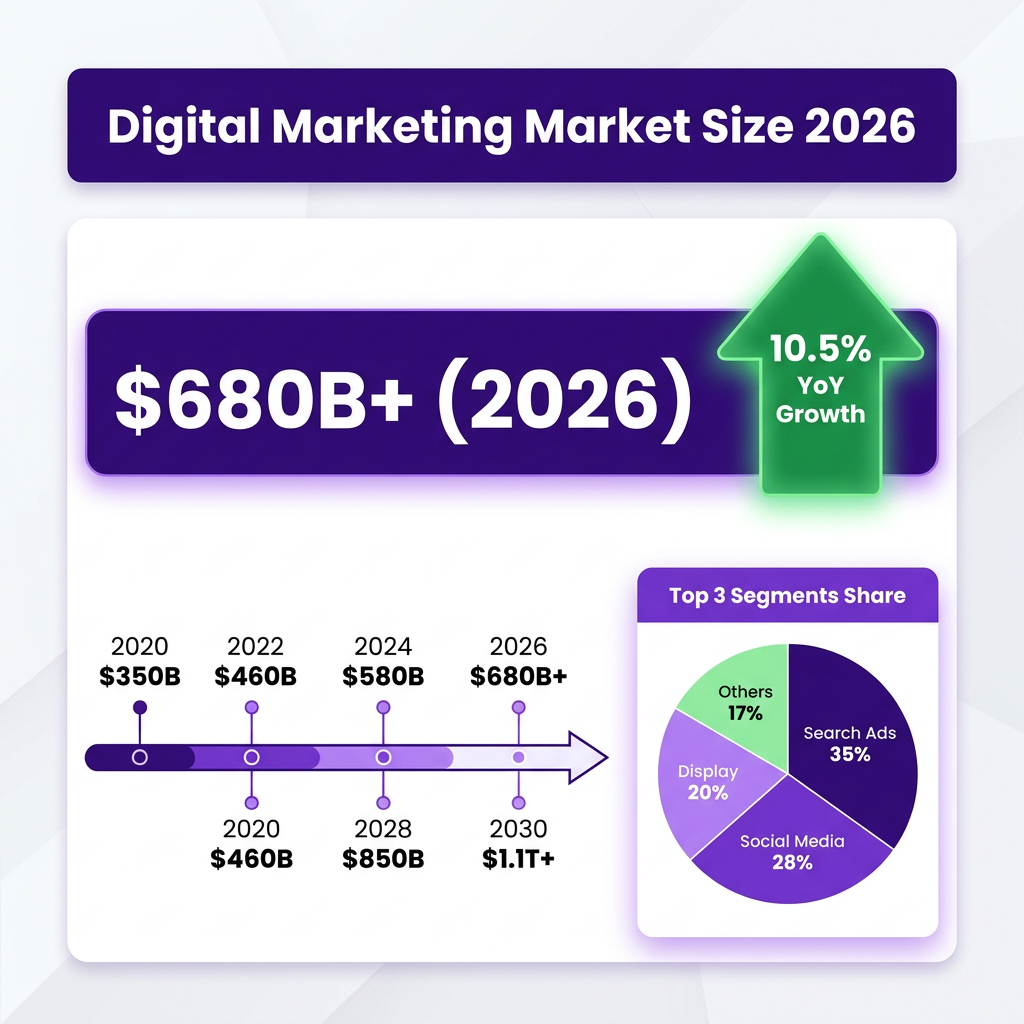
The global digital marketing market has evolved into a massive economic force, with estimates placing its value between $457 billion and $654 billion depending on measurement scope, and total digital advertising expenditure reaching $680 billion in 2026. This represents a remarkable 10.5% year-over-year growth rate, driven primarily by AI-powered advertising innovations, the expansion of retail media networks, and the rapid growth of connected TV (CTV) advertising.
To understand the scale of this market, consider that digital advertising now commands the largest share of global ad spend, surpassing traditional media including television, print, and radio combined. The Business Research Company reports that digital ad spending reached $709.65 billion in 2025 and is projected to grow to $1.088 trillion by 2030 at a compound annual growth rate (CAGR) of 8.6%. This trajectory positions digital marketing as one of the fastest-growing sectors in the global economy.
The market’s composition reveals interesting patterns about where marketing dollars flow. Search advertising maintains its position as the dominant format, capturing approximately 35% of total digital ad spend, followed by social media advertising at 28%, and display advertising at 20%. Video advertising, including both in-stream and connected TV formats, has emerged as the fastest-growing segment with 17% year-over-year growth, reflecting consumers’ insatiable appetite for video content across platforms.
Geographic distribution of digital marketing spend reveals the United States as the dominant market, accounting for approximately 38% of global digital ad expenditure. However, the Asia-Pacific region is experiencing the fastest growth, with China, India, and Southeast Asian markets expanding at double-digit rates. Europe represents roughly 22% of global spend, with the UK, Germany, and France leading the regional market.
The shift toward mobile continues unabated, with mobile devices now accounting for 60% of all digital ad spend. In-app advertising specifically has grown at 17% year-over-year, as consumers increasingly engage with apps rather than mobile web browsers. This mobile-first reality has profound implications for creative development, landing page optimization, and conversion tracking.
Looking at the broader advertising landscape, Dentsu’s Global Ad Spend Forecasts project total global advertising expenditure to reach $1.04 trillion in 2026, representing a 5.1% increase from the previous year. Digital channels now capture approximately 65% of this total spend, up from just 40% in 2019. This shift reflects not only changing consumer media consumption habits but also digital’s superior targeting capabilities and measurement precision compared to traditional media.
Key Statistics and Data Points Every Marketer Must Know
The digital marketing landscape is defined by numbers, and the statistics for 2026 paint a picture of an industry in rapid transformation. The sheer volume of data available to modern marketers would have been unimaginable just a decade ago. Every click, impression, conversion, and engagement is tracked, analyzed, and optimized. But data without insight is just noise. The following statistics represent the signal—the metrics that truly matter for understanding where the industry stands and where it is headed.
For SaaS companies and digital product sellers, these numbers have direct implications for budget allocation, channel selection, and strategic planning. A marketer who understands that email delivers $36-$45 for every dollar spent will prioritize list building and retention. A founder who recognizes that 88% of organizations now use AI will invest in automation before competitors. The data tells a story—successful marketers learn to read it.
Market Size and Growth
- Global digital advertising spend: $680 billion in 2026 (SearchLab)
- Year-over-year growth rate: 10.5%
- Projected market size by 2030: $1.088 trillion (Business Research Company)
- CAGR (2025-2030): 8.6%
- Digital’s share of total ad spend: 65% and climbing
Platform Dominance and Market Share
- Top 3 platforms (Google, Meta, Amazon) capture 64% of global digital ad spend
- Google maintains approximately 28% market share
- Meta’s share has grown to 26.8%, projected to surpass Google by end of 2026
- Amazon’s advertising business continues rapid expansion
- LinkedIn Ads growing at 22% year-over-year, driven by B2B advertisers
- 45% of B2B advertisers name LinkedIn as their primary advertising channel
ROI and Performance Metrics
- Email marketing ROI: $36-$45 for every $1 spent (3600-4500% ROI)
- Content marketing average return: $3 per dollar spent vs. $1.80 for paid advertising
- SEO-focused content delivers 748% ROI for B2B companies
- AI-optimized content shows 32% higher engagement rates
- AI-optimized content drives 47% better conversion rates
- Businesses using AI content tools report 42% lower content production costs
AI Adoption and Automation
- 88% of organizations now use AI in at least one business function
- 80% of marketers globally now use AI tools
- 92% of large marketing teams use AI-generated content
- 62% of marketers use AI to brainstorm new topics
- Organizations using AI writing tools report 59% faster content creation
- AI writing tools deliver 77% higher content output volume
- Over 60% of marketers using AI report text-to-video platforms cut creation time by more than half
Social Media and Content Marketing
- 98-99% of social media users access platforms via mobile devices
- YouTube: 2.70 billion monthly active users
- WhatsApp: 3 billion monthly active users
- 91% of companies have integrated video marketing into their strategies
- 99% of video marketers say video increased user understanding of their product
- 21% of marketers say short-form videos deliver the highest ROI
- 81% of marketers say content marketing is a core business strategy
- Companies with documented content strategy see 33% higher ROI
Search and AI-Powered Discovery
- 44% of users who tried AI-powered search say it has become their primary source
- Only 31% prefer traditional search over AI-powered alternatives
- 30% of all mobile searches are related to local stores
- Visitors from AI platforms spend 68% more time on websites than traditional organic search
7 Major Trends Shaping Digital Marketing in 2026
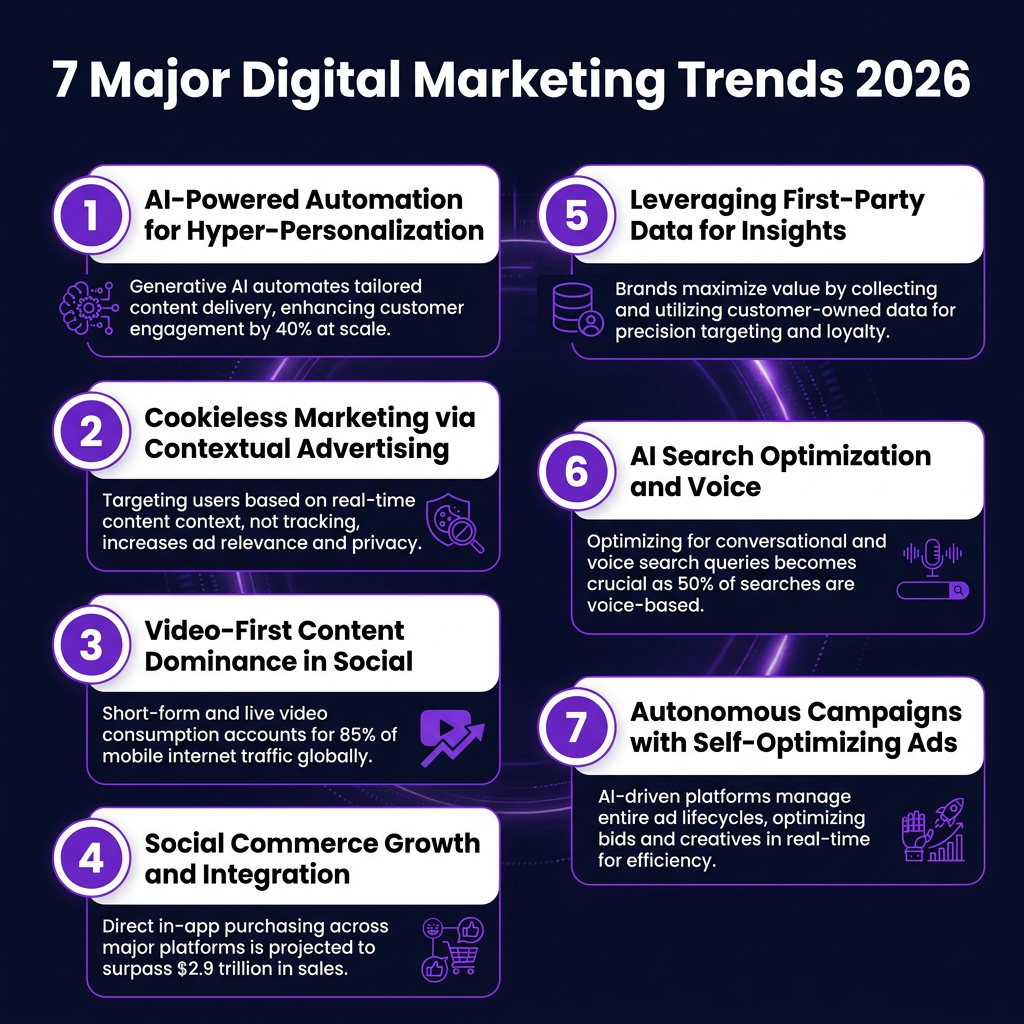
The digital marketing landscape of 2026 is being reshaped by seven transformative trends that are fundamentally altering how brands connect with consumers. These are not passing fads or speculative technologies—they are structural shifts that have already changed the competitive dynamics of the industry. Understanding these trends is not optional—it is the difference between campaigns that thrive and those that waste budget.
The pace of change has accelerated dramatically. Where marketers once had years to adapt to new platforms or technologies, they now have months. The half-life of marketing tactics has shortened, while the importance of strategic fundamentals has increased. The seven trends outlined below represent both the greatest challenges and the greatest opportunities facing marketing leaders in 2026.
1. AI-Powered Marketing Automation and Autonomous Campaigns
Artificial intelligence has evolved from a creative shortcut to a full-fledged marketing copilot. In 2026, AI does not just assist with content creation—it manages campaigns end-to-end, optimizing creatives, budgets, and targeting in real-time. Platforms like Google’s Performance Max and Meta’s Advantage+ use machine learning to automatically allocate budget across channels, adjust bids, and serve the most effective creative combinations to each user.
The impact is measurable: businesses using AI-driven marketing see 82% higher ROI compared to traditional approaches. Predictive analytics now forecast customer behavior and trends with increasing accuracy, allowing marketers to anticipate needs before they are expressed. Netflix’s recommendation engine, Amazon’s dynamic product suggestions, and Spotify’s personalized playlists demonstrate what is possible when AI truly understands user preferences.
For SaaS companies and digital product sellers, this means opportunity. AI can now predict which visitors are most likely to convert, automatically adjust pricing displays based on user segments, and personalize onboarding flows in real-time. The barrier to entry for sophisticated marketing automation has never been lower.
2. The Cookieless Marketing Revolution
Third-party cookies are officially dead. Google completed Chrome’s deprecation in early 2024, joining Safari and Firefox in eliminating cross-site tracking. For marketers, this is not a future problem—it is the present reality. With 20 US states now enforcing comprehensive privacy laws and 34.9% of browsers already blocking third-party cookies by default, the old playbook of behavioral retargeting no longer works.
The winners in this new landscape have rebuilt their measurement from the server layer up. First-party data—information collected directly from customers with explicit permission—is more accurate, more compliant, and more stable than third-party data ever was. Contextual targeting, which matches ads to content context rather than user profiles, has made a significant comeback. And privacy-safe measurement frameworks are restoring attribution visibility without compromising user trust.
For businesses selling digital products, this shift creates both challenge and opportunity. Building direct relationships with customers through email, community, and owned channels becomes more valuable than ever. The brands that invest in first-party data infrastructure today will have a significant competitive advantage tomorrow.
3. Video-First Content Strategy
Video has become non-negotiable. 91% of companies have integrated video marketing into their strategies, and 99% of video marketers report that video increases user understanding of their products. But it is not just about having video—it is about having the right video for each platform and purpose.
Short-form video has emerged as the highest-ROI format, with 21% of marketers citing it as their top-performing content type. TikTok, Instagram Reels, and YouTube Shorts have trained consumers to expect snackable, engaging video content. Meanwhile, long-form video remains essential for complex B2B products and educational content.
AI has dramatically reduced video production barriers. Text-to-video platforms cut content creation time by more than half for 60% of marketers using AI, while AI video tools reduce production costs by 80%—slashing time-to-market from three weeks to 24 hours. This democratization of video production means even small teams can compete with enterprise content operations.
4. Social Commerce and In-Platform Purchasing
The line between social media and e-commerce has dissolved. Social commerce—purchasing directly within social platforms—has exploded, with platforms investing heavily in native checkout experiences. Instagram Shopping, TikTok Shop, and Facebook Marketplace have trained consumers to discover, evaluate, and purchase without ever leaving their favorite apps.
For digital product sellers, this trend presents a strategic decision. While social commerce offers frictionless purchasing, it also means surrendering control of the customer relationship and paying platform fees. The most successful brands use social commerce for discovery while building direct relationships through owned channels for repeat purchases.
The data is compelling: social commerce conversion rates are significantly higher than traditional e-commerce, driven by the trust consumers place in peer recommendations and influencer endorsements. As platforms improve their checkout experiences and payment options, this trend will only accelerate.
5. First-Party Data as Competitive Advantage
In a world without third-party cookies, first-party data has become the most valuable asset a marketer can possess. The brands winning in 2026 have constructed first-party data programs that create genuine consumer value in exchange for data consent. This is not about tricking users into surrendering information—it is about building trust through transparency and delivering personalized experiences that justify the data exchange.
Email marketing, often declared dead, has experienced a renaissance. With $36-$45 return for every $1 spent, email remains the highest-ROI channel. But modern email marketing looks nothing like the batch-and-blast approaches of the past. Behavioral triggers, predictive content, and AI-powered personalization have transformed email into a sophisticated retention and conversion engine.
For SaaS companies, first-party data strategies center on product usage data, support interactions, and community engagement. Every touchpoint becomes an opportunity to learn more about customers and deliver more relevant experiences. The companies that master this virtuous cycle of data collection and value delivery will dominate their categories.
6. AI Search Optimization and Discovery
The search landscape has fundamentally changed. 44% of users who have tried AI-powered search through ChatGPT, Gemini, Claude, and Google’s AI Overviews say it has become their primary and preferred source for internet searching. Only 31% prefer traditional search. This shift has profound implications for SEO and content strategy.
AI search does not just find pages—it synthesizes answers. This means content must be structured for extraction, with clear entity relationships, structured data markup, and comprehensive coverage of topics. The brands optimizing for AI search today are building the foundation for discoverability in a world where traditional rankings matter less than being included in AI-generated responses.
Visitors referred by AI platforms spend 68% more time on websites than those from traditional organic search, suggesting higher intent and engagement. For content marketers, this validates investment in comprehensive, authoritative content that AI systems can confidently cite.
7. Autonomous Campaign Management
The ultimate expression of AI in marketing is autonomous campaign management—systems that require minimal human intervention to plan, execute, and optimize campaigns across channels. By 2027, the marketer who manually structures campaigns will be as obsolete as the media buyer who once called newspapers to place classified ads.
Today’s autonomous systems can generate creative variations, allocate budgets across platforms, adjust targeting parameters, and optimize for multiple objectives simultaneously. They learn from every interaction, continuously improving performance without human intervention. This does not eliminate the need for marketers—it elevates their role from execution to strategy, from button-pushing to insight generation.
For resource-constrained teams, autonomous campaign management is a force multiplier. Small marketing teams can now execute sophisticated, multi-channel campaigns that would have required large agencies just a few years ago. The democratization of marketing technology continues to level the playing field.
Key Players and Competitive Landscape
The digital marketing industry is dominated by a handful of tech giants, but the competitive dynamics are shifting in ways that create opportunities for challengers and specialized platforms.
The Triopoly: Google, Meta, and Amazon
Google, Meta, and Amazon collectively capture 64% of global digital ad spend, up 4 percentage points in just two years. This consolidation reflects the competitive advantages of scale: superior data, better machine learning models, and more efficient auction markets.
Google maintains its dominance through search advertising, which remains the highest-intent marketing channel. With approximately 28% market share, Google’s advertising empire spans Search, YouTube, Display Network, and programmatic platforms. The company’s deep integration of AI into ad products—particularly Performance Max—has strengthened its position despite regulatory pressure and privacy changes.
Meta is the growth story of 2026. With 26.8% market share and accelerating growth, Meta is projected to surpass Google as the world’s largest digital advertising business by the end of the year. Meta’s recovery from the iOS 14 privacy changes demonstrates the resilience of its first-party data advantage. The company’s investment in AI—particularly the Advantage+ suite—has paid dividends, with advertisers reporting superior performance on Meta platforms compared to alternatives.
Amazon continues its rapid ascent in advertising. With unparalleled purchase intent data and closed-loop attribution, Amazon Advertising has become essential for e-commerce brands. The platform’s expansion into video and off-Amazon advertising threatens to disrupt the Google-Meta duopoly.
Emerging Platforms and Specialized Players
Beyond the triopoly, several platforms are carving out significant positions:
- LinkedIn: Growing at 22% year-over-year, LinkedIn has become the dominant B2B advertising platform. 45% of B2B advertisers name LinkedIn as their primary channel, above Google Ads (36%). The platform’s professional context and robust targeting capabilities justify premium pricing.
- TikTok: Despite regulatory challenges, TikTok remains the engagement leader, particularly among younger demographics. The platform’s algorithm delivers unmatched organic reach, while TikTok Shop has emerged as a significant e-commerce force.
- Microsoft Advertising: Leveraging its OpenAI partnership, Microsoft has integrated AI capabilities across its advertising products. Bing’s AI-powered search experiences create new advertising opportunities.
- Retail Media Networks: Walmart, Target, and other retailers have built substantial advertising businesses leveraging their first-party purchase data. These closed-loop ecosystems offer superior attribution for consumer brands.
The MarTech Ecosystem
Marketing technology spending represents approximately 25.4% of total marketing budgets, reflecting the central role of technology in modern marketing operations. The MarTech landscape includes:
- Customer Data Platforms (CDPs): Essential for first-party data management and identity resolution
- Marketing Automation: HubSpot, Marketo, and Salesforce Marketing Cloud dominate, but AI-native challengers are gaining ground
- Content Management: Headless CMS and AI-powered content platforms are reshaping content operations
- Analytics and Attribution: Server-side tracking and privacy-safe measurement tools have become essential
- AI Content Tools: From copywriting to video generation, AI tools have reached mainstream adoption

Challenges and Pain Points in 2026
Despite the opportunities, digital marketing in 2026 faces significant challenges that require strategic adaptation. The same forces driving growth—AI, privacy regulations, platform consolidation—also create friction and complexity. Marketing leaders must navigate these challenges while maintaining growth and efficiency.
The challenges outlined below are not temporary obstacles to be overcome, but structural features of the new marketing landscape. Success requires building organizations and strategies that are resilient to signal loss, rising costs, and regulatory complexity. The companies that master these challenges will find themselves with durable competitive advantages.
1. Signal Loss and Attribution Degradation
The combination of privacy regulations, cookie deprecation, and platform restrictions has created a measurement crisis. Marketers are operating with significantly less visibility into customer journeys than just a few years ago. Multi-touch attribution has become increasingly difficult, forcing many organizations to rely on modeled conversions and incrementality testing rather than direct tracking.
The impact is real: 77% of email ROI comes from triggered campaigns and multi-touch journeys, but simple last-click attribution drastically undervalues these contributions. Marketers who fail to adapt their measurement frameworks are making decisions based on incomplete data, leading to suboptimal budget allocation.
2. Rising Customer Acquisition Costs
As competition intensifies and targeting becomes less precise, customer acquisition costs have risen across channels. The days of cheap Facebook leads and inexpensive Google Ads clicks are largely over. This cost pressure forces marketers to focus on conversion rate optimization, customer lifetime value, and retention strategies rather than pure acquisition volume.
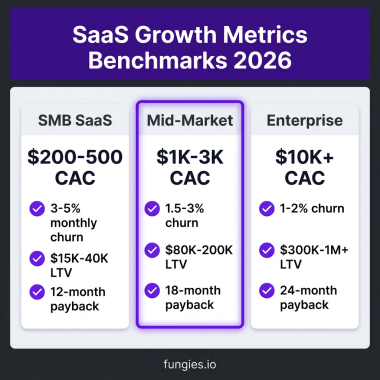
For SaaS companies, this means unit economics matter more than ever. The businesses that can acquire customers efficiently and retain them profitably will thrive; those that rely on growth-at-all-costs funding will struggle.
3. Content Saturation and Attention Scarcity
The explosion of AI-generated content has created a saturation problem. With 92% of large marketing teams using AI-generated content, the volume of marketing material has increased dramatically while quality remains variable. Cutting through the noise requires exceptional creativity, genuine expertise, and authentic voice—things AI cannot easily replicate.
Social media fatigue is real, with users increasingly skeptical of branded content. The brands winning attention are those that provide genuine value—education, entertainment, or community—rather than thinly veiled sales pitches.
4. Privacy Compliance Complexity
With 20 US states enforcing comprehensive privacy laws and regulations tightening globally, compliance has become a significant burden. The definition of “sensitive personal data” has expanded to include precise geolocation, health inferences, and even neural data in some jurisdictions. Marketing practices that were standard just a few years ago now require explicit opt-in consent.
The late 2025 joint investigation by California, Colorado, and Connecticut focused on businesses claiming to honor Global Privacy Control signals while continuing to fire retargeting pixels. The message is clear: enforcement is real, and violations are costly.
Opportunities and Growth Strategies
Despite the challenges, 2026 presents significant opportunities for marketers who adapt strategically.
1. AI-First Marketing Operations
The marketers and organizations winning in 2026 have embraced AI not as a replacement for human creativity but as a force multiplier for strategic thinking. With 88% of organizations now using AI in at least one function, the question is no longer whether to adopt AI but how to integrate it effectively.
Key opportunities for AI-first marketing operations include:
- Predictive Analytics: Anticipating customer needs before they are expressed
- Dynamic Personalization: Real-time content and offer customization
- Automated Optimization: AI-powered bid management and budget allocation
- Content at Scale: AI-assisted content production maintaining quality
- Intelligent Attribution: Machine learning models that fill measurement gaps
2. First-Party Data Infrastructure
Building direct relationships with customers through owned channels has never been more valuable. Email marketing’s $36-$45 ROI demonstrates the power of permission-based communication. The opportunity lies in creating data collection experiences that deliver genuine value in exchange for information.
Strategies include:
- Value-First Lead Magnets: Tools, calculators, and resources worth exchanging data for
- Community Building: Owned communities that generate engagement and insights
- Loyalty Programs: Structured programs that reward data sharing
- Zero-Party Data Collection: Explicit preference centers and surveys
3. Video-First Content Strategy
Video delivers ROI 49% faster than text-based content, making it essential for companies needing quicker returns. The democratization of video production through AI tools means even resource-constrained teams can execute professional video strategies.
Key opportunities for video-first content strategies include:
- Short-Form Video at Scale: AI-powered creation for TikTok, Reels, and Shorts
- Product Demonstrations: Video as the primary sales tool for complex products
- Educational Content: Building authority through video courses and tutorials
- User-Generated Content: Leveraging customer videos for authentic social proof
Case Studies and Success Stories
Real-world examples demonstrate what is possible when these strategies are executed effectively.
Case Study 1: AI-Powered Content Strategy
A B2B SaaS company implemented an AI-assisted content strategy that combined generative AI for first drafts with human editors for quality control. The results: 59% faster content creation, 77% higher content output volume, and a 42% reduction in content production costs. More importantly, AI-optimized content drove 32% higher engagement rates and 47% better conversion rates than their previous manual approach.
The key insight: AI did not replace their content team—it made them more strategic. Writers focused on angle development, expert interviews, and creative concepts while AI handled research, outlining, and initial drafting.
Case Study 2: First-Party Data Transformation
An e-commerce brand facing signal loss from cookie deprecation invested heavily in first-party data infrastructure. They built a comprehensive email program with behavioral triggers, predictive content, and personalized journeys. The result: email became their highest-ROI channel, generating $42 for every $1 spent. More importantly, they reduced dependence on paid acquisition from 80% to 45% of revenue, dramatically improving unit economics.
Their approach combined a value-first lead magnet strategy, sophisticated segmentation, and AI-powered personalization to deliver relevant content at scale.
Case Study 3: Video-First Product Launch
A software company launching a new product relied entirely on video for their go-to-market strategy. They created a series of short-form videos for social discovery, long-form tutorials for education, and personalized video demos for high-value prospects. The campaign generated 3x the engagement of their previous text-heavy launches and reduced sales cycle length by 35%.
Their video strategy covered the entire funnel—from awareness through acquisition to activation—creating a cohesive narrative that resonated with prospects at every stage of the buyer journey.
Future Outlook and Predictions: 2027-2030
Looking beyond 2026, several trends will define the next phase of digital marketing evolution. The industry is poised for continued transformation as technology advances and consumer behaviors evolve.
AI-Native Marketing by 2027
By 2027, AI-native marketing will be the default, not the exception. The distinction between “AI-powered” and traditional marketing will disappear as AI becomes embedded in every tool and workflow. Marketers will spend less time executing campaigns and more time defining strategy, creative direction, and ethical guardrails for autonomous systems. This shift will require new skill sets, with data literacy and AI fluency becoming as essential as copywriting and design skills.
The marketing teams that thrive will be those that successfully blend human creativity with machine efficiency. Strategy, brand voice, and customer empathy will remain distinctly human domains, while execution, optimization, and analysis will be increasingly automated. Organizations that resist this transition will find themselves outpaced by more agile competitors.
The $1 Trillion Milestone
Digital advertising will surpass $1 trillion globally by 2028, with emerging markets driving significant growth. The Asia-Pacific region will likely overtake North America as the largest digital advertising market by 2029, reflecting shifting economic centers and internet adoption patterns. India, Indonesia, and Vietnam are expected to be the fastest-growing markets, presenting significant opportunities for global brands willing to invest in localized strategies.
This growth will be accompanied by increased scrutiny from regulators and consumers alike. Transparency in advertising practices, ethical use of AI, and respect for consumer privacy will become competitive differentiators rather than compliance checkboxes.
Immersive Marketing Experiences
Augmented reality (AR) and virtual reality (VR) will move from novelty to necessity for certain categories. By 2030, expect AR-enabled product visualization, virtual showrooms, and immersive brand experiences to be standard for e-commerce, real estate, automotive, and high-consideration purchases. The Apple Vision Pro and competing devices will accelerate adoption, creating new canvases for brand storytelling.
Early adopters in this space are already seeing results. Furniture retailers using AR visualization report significant reductions in return rates, while automotive brands using VR showrooms report increased engagement and faster purchase decisions. As hardware becomes more accessible, these immersive experiences will become expected rather than exceptional.
Voice and Conversational Commerce
Voice search and conversational AI will reshape how consumers discover and purchase products. Marketing strategies will need to account for voice-first discovery, where traditional visual branding matters less than sonic identity and conversational relevance. The proliferation of smart speakers, in-car assistants, and wearable devices creates new touchpoints for brand interaction.
By 2030, a significant portion of e-commerce transactions will occur through conversational interfaces. Brands that invest in voice optimization, chatbot sophistication, and natural language processing today will be positioned to capture this emerging channel.
Ethical AI and Responsible Marketing
As AI becomes more powerful, ethical considerations will move from compliance checklists to competitive advantages. Brands that demonstrate responsible AI use—transparent algorithms, fair targeting, and privacy-respecting personalization—will earn consumer trust in an era of increasing skepticism. The companies that treat ethics as a marketing differentiator rather than a legal requirement will build stronger, more durable customer relationships.
This extends to content authenticity as well. As AI-generated content becomes ubiquitous, human-created content may command a premium. Transparency about AI usage in content creation will become a trust signal, with some audiences preferring explicitly human-created material.
The Democratization of Enterprise Marketing
Perhaps the most significant trend for 2027-2030 is the continued democratization of sophisticated marketing capabilities. Tools that once required enterprise budgets and specialized teams are now accessible to small businesses and individual creators. AI-powered creative tools, autonomous campaign management, and advanced analytics are leveling the playing field in ways that benefit smaller, more agile competitors.
This democratization will force enterprise marketers to compete on creativity, strategy, and brand purpose rather than budget and scale. The advantage will shift to organizations that can move quickly, experiment boldly, and build genuine connections with their audiences.
Key Takeaways for Marketing Leaders
The digital marketing landscape of 2026 presents both unprecedented opportunities and significant challenges. Here are the essential insights every marketing leader should internalize:
- The $680 billion digital marketing market is growing at 10.5% annually, with AI and video driving the fastest growth segments. Investment in these areas is not speculative—it is essential for competitive relevance.
- Email marketing delivers the highest ROI at $36-$45 per dollar spent, making first-party data infrastructure the most valuable investment for sustainable growth. The cookieless future makes owned channels more important than ever.
- 88% of organizations now use AI in marketing, shifting the competitive advantage from execution to strategic AI integration. The question is no longer whether to adopt AI, but how to implement it effectively.
- The cookieless future is here today—brands must build direct customer relationships through owned channels rather than relying on third-party data and behavioral tracking.
- Video content delivers ROI 49% faster than text-based content, making it essential for time-sensitive campaigns and product launches. Short-form video in particular has emerged as the highest-ROI format.
- Meta is projected to overtake Google as the largest digital advertising platform by end of 2026, reflecting the power of social discovery and first-party data advantages.
- 44% of users prefer AI-powered search over traditional search, requiring new optimization strategies focused on answer synthesis rather than page ranking.
- First-party data and privacy compliance are foundational to sustainable marketing operations. Brands that build trust through transparent data practices will have lasting competitive advantages.
- Customer acquisition costs are rising across channels, making retention, lifetime value optimization, and conversion rate optimization more important than pure acquisition volume.
- Content saturation requires differentiation through genuine expertise, authentic voice, and unique perspectives that AI cannot easily replicate.
Sources and Citations
This analysis is based on data from the following authoritative sources:
- SearchLab – Online Advertising Statistics 2026
- The Business Research Company – Digital Ad Spending Global Market Report 2026
- Dentsu – 2026 Global Ad Spend Forecast
- eMarketer – Meta to Surpass Google in Digital Ad Revenues
- Digital Marketing Institute – Digital Marketing Trends 2026
- Klaviyo – Marketing Automation Trends for 2026
- WSI World – Email Marketing ROI Statistics 2026
- Email Monday – Email Marketing ROI Statistics
- Digital Applied – Digital Advertising Statistics 2026
- SQ Magazine – Generative AI Statistics 2026
- Digital Elevator – AI Stats for 2026
- Master of Code – Generative AI Statistics
- Vention – AI Adoption Statistics Q1 2026
- Sprout Social – Social Media Marketing Statistics 2026
- Genesys Growth – Content Marketing ROI Statistics 2026
- SellersCommerce – Video Marketing Statistics 2026
- Secure Privacy – US State Privacy Laws 2026
- EMARKETER – FAQ on Identity Resolution 2026
- Quartr – The Rise of Google, Meta, Amazon, and YouTube in Advertising
- MarketsandMarkets – AdTech Market Analysis
The digital marketing landscape will continue to evolve rapidly, but the fundamentals remain constant: understand your audience, deliver genuine value, measure what matters, and adapt continuously. The brands that master these principles while leveraging the transformative power of AI will define the next era of digital marketing.