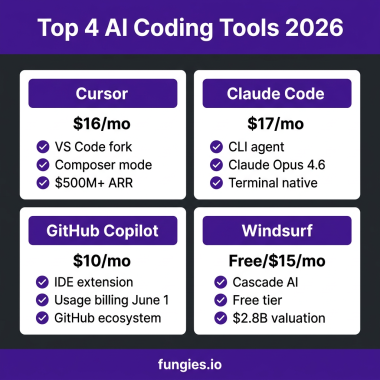
Here’s a number that should get your attention: 90% of developers now use AI coding tools daily (JetBrains AI Pulse, January 2026). But here’s what most teams get wrong — they’re not picking the right tool for their workflow.
Claude Code, Cursor, GitHub Copilot, OpenAI Codex, and Devin aren’t interchangeable. Each one was built with a different philosophy about how AI should fit into software development. Pick the wrong one, and you’re either overpaying or fighting your tools instead of shipping code.
This comparison cuts through the marketing noise. Real pricing. Real benchmarks. Real use cases. No vendor spin.

What Are AI Coding Agents?
AI coding agents go beyond autocomplete. They plan, write, test, and debug code based on natural language requirements. Think of them as junior developers who can take a feature description, understand your codebase, and implement it across multiple files while running tests to verify everything works.
The shift from 2024’s “smart suggestions” to 2026’s autonomous agents is the difference between a spell-checker and a co-author. These tools don’t just complete lines — they reason about architecture, refactor across files, and even create pull requests.
How We Ranked These Tools
This ranking combines data from Stack Overflow’s 49,000-developer survey, JetBrains’ January 2026 AI Pulse (10,000+ professionals), Google’s DORA 2025 report, and direct vendor metrics. We evaluated each tool on:
- Real-world performance — SWE-bench scores and developer productivity metrics
- Pricing transparency — actual costs at different usage levels
- Workflow fit — terminal vs IDE vs autonomous use cases
- Enterprise readiness — security, compliance, and team features
1. Claude Code — Best for Terminal-First Workflows
Pricing: $20/month (Pro) | Team: $20-25/seat/month
Claude Code overtook both Cursor and Copilot in professional usage by Q1 2026 — the fastest reversal in developer tooling history. Built by Anthropic, it’s the most agentic of the major tools. It doesn’t just complete code inline; it understands your entire codebase, edits files autonomously, runs commands, and creates pull requests.
What Makes It Stand Out
- 200K-1M token context window — handles massive codebases that break other tools
- Opus 4.6 model with extended thinking — excels at complex, multi-step engineering problems
- Slack integration — assign tasks directly from Slack messages and return to finished PRs
- MCP (Model Context Protocol) support — extend with external tools and data sources
The Trade-offs
Claude Code is terminal-first. IDE integrations exist (VS Code, JetBrains), but the experience is strongest in the terminal. If your team expects a polished, embedded IDE experience, it can feel raw compared to Cursor. Enterprise pricing is usage-based (seat fee plus API tokens), which can be unpredictable for teams with variable workloads.
Best for: Teams that want autonomous, agentic coding assistance. Particularly strong for async workflows, infrastructure-heavy projects, and organizations already in the Anthropic ecosystem.
2. Cursor — Best AI-Native IDE Experience
Pricing: $20/month (Pro) | Pro+: $60/month | Ultra: $200/month | Team: $40/seat/month
Cursor is a full AI-native IDE — a VS Code fork where AI is baked into every layer, not bolted on. It became the default agentic IDE through 2025, and it still leads for interactive editing and inline changes.
What Makes It Stand Out
- Composer agent — multi-file editing with natural language
- Codebase-wide search — understands context across your entire project
- Tab completion — 72% autocomplete acceptance rate in benchmarks
- Custom model support — bring your own API keys for OpenAI, Anthropic, or Google models
The Trade-offs
Cursor replaces your IDE entirely. If your team is attached to specific VS Code extensions or workflows, there’s friction. Multi-file editing is less reliable than Claude Code for complex refactors. Team pricing is double Copilot’s — a meaningful number at 50+ seats.
Best for: Developers who want the most polished AI-native IDE experience. Ideal for teams that live inside their editor all day and prioritize interactive editing over terminal workflows.
3. GitHub Copilot — Best for Enterprise Rollouts
Pricing: $10/month (Pro) | Pro+: $39/month | Business: $19/seat/month | Enterprise: $39/seat/month
Copilot remains the installed-base leader with 26M+ users and 29% workplace adoption. Its dominance comes from enterprise distribution, Microsoft ecosystem fit, and procurement advantages — not necessarily the highest developer satisfaction.
What Makes It Stand Out
- Widest IDE support — VS Code, Visual Studio, JetBrains, Neovim, Xcode, Eclipse, Zed, and more
- Model flexibility — OpenAI (GPT-5.1, 5.2, 5.4), Anthropic (Claude Haiku 4.5, Sonnet 4.6, Opus 4.6), Google (Gemini 3 Pro, Flash), xAI Grok Code
- Free tier — 2,000 completions + 50 chat/agent requests monthly (no credit card required)
- Enterprise features — custom knowledge bases, PR summaries, code review, SAML SSO
The Trade-offs
Copilot is deeply tied to the GitHub ecosystem. Teams on GitLab, Bitbucket, or self-hosted Git face friction. Premium request limits (300/month on Pro, 1,500/month on Pro+) can constrain heavy users — overages billed at $0.04/request. The coding agent and knowledge base features assume GitHub as your source of truth.
Best for: Organizations prioritizing procurement simplicity, Microsoft ecosystem alignment, and widest IDE support. The clear choice for enterprise-default rollouts.
4. OpenAI Codex — Best for ChatGPT Ecosystem
Pricing: $20/month (via ChatGPT Plus) | Team: $25/seat/month
Codex is the fastest late entrant, gaining traction quickly because it fits naturally into the broader OpenAI and ChatGPT ecosystem. Released as both a CLI tool and integrated ChatGPT feature, it’s designed for developers already living in OpenAI’s universe.
What Makes It Stand Out
- Native ChatGPT integration — no context switching if you already use ChatGPT
- Codex CLI — terminal agent for autonomous coding tasks
- Fast iteration cycle — benefits from OpenAI’s rapid model improvements
- Agents SDK — build custom agents on OpenAI’s infrastructure
The Trade-offs
Codex is newer and less mature than Claude Code or Cursor for complex multi-file tasks. The ecosystem is still building — fewer third-party integrations and community resources. If you’re not already invested in OpenAI’s stack, the value proposition is weaker.
Best for: Teams already heavy on ChatGPT and OpenAI tools. Good fit for async task workflows and developers who want their coding agent integrated with their AI chat workflow.

5. Devin — Best for Full Autonomy
Pricing: $20/month (Core) | Teams: $500/month | Enterprise: Custom
Devin 2.0 (released April 2025) dropped pricing from $500 to $20/month — a 96% reduction that made autonomous AI coding accessible to individual developers. Created by Cognition Labs and branded as the world’s first AI software engineer, Devin doesn’t just suggest code; it independently plans, executes, and iterates on complex engineering tasks.
What Makes It Stand Out
- Parallel agents — run multiple Devin instances simultaneously on different tasks
- Interactive Planning — Devin shows its plan before executing, letting you course-correct
- Jira and Linear integration — connects directly to your project management
- Virtual machine testing — Devin tests its own code in isolated environments
The Trade-offs
Devin is overkill for simple tasks. The Teams plan at $500/month is steep for smaller organizations. It’s designed for workflows where you can hand off entire features, not for tight pair-programming sessions. Goldman Sachs is piloting Devin alongside 12,000 human developers — this is enterprise-grade autonomy, not casual assistance.
Best for: Teams with well-defined tasks that can be handed off completely. Ideal for MVPs, prototype builds, and situations where you need a “junior developer” who works independently.
Complete Pricing Comparison
| Tool | Individual | Team (per seat) | Enterprise |
|---|---|---|---|
| Claude Code | $20/mo | $20-25/mo | Custom (API usage) |
| Cursor | $20-200/mo | $40/mo | Custom |
| GitHub Copilot | $10-39/mo | $19/mo | $39/mo |
| OpenAI Codex | $20/mo | $25/mo | Custom |
| Devin | $20/mo | $500/mo | Custom |
Performance Benchmarks
SWE-bench Verified scores measure real-world software engineering tasks:
| Tool | SWE-bench Verified | Context Window |
|---|---|---|
| Claude Code (Opus 4.6) | 80.8% | 200K-1M tokens |
| GitHub Copilot | 56.0% | 128K-256K tokens |
| Cursor | 51.7% | 128K-200K tokens |
| OpenAI Codex | ~72% | 128K tokens |
| Devin | ~65% | 128K tokens |
How to Choose: Decision Framework
High-performing teams rarely standardize on just one AI coding tool. Multi-tool usage is now the dominant pattern among senior engineers. Here’s how to build your stack:
- Terminal-heavy workflows → Claude Code
- IDE-native editing → Cursor
- Enterprise procurement → GitHub Copilot
- ChatGPT ecosystem → OpenAI Codex
- Full task autonomy → Devin
The practical recommendation: pair an inline tool (Copilot or Cursor) with an agentic tool (Claude Code or Codex CLI). Engineers proficient in both consistently outperform single-tool engineers on time-to-first-merged-PR by a factor of two to three.
Key Takeaways
- 90% of developers now use AI coding tools daily — the question isn’t whether to adopt, but which tools fit your workflow
- Claude Code leads in professional usage and satisfaction, especially for terminal-native and complex refactoring work
- Cursor dominates the AI-native IDE category with the most polished editing experience
- GitHub Copilot wins on reach, price, and enterprise features — best for organization-wide rollouts
- OpenAI Codex fits naturally into ChatGPT-centric workflows
- Devin offers the most autonomy for teams ready to hand off complete tasks
FAQ
Which AI coding agent has the best free tier?
GitHub Copilot offers the most functional free tier: 2,000 completions and 50 chat/agent requests monthly with no credit card required. Cursor and Claude Code have limited free tiers, but you’ll hit ceilings quickly on real projects.
What’s the cheapest AI coding agent for individuals?
GitHub Copilot Pro at $10/month is the cheapest paid option. Claude Code, Cursor, OpenAI Codex, and Devin all start at $20/month for individual plans.
Which AI coding agent is best for large codebases?
Claude Code with its 200K-1M token context window handles massive codebases that break other tools. This is why it’s overtaken Cursor and Copilot in professional usage for complex enterprise projects.
Can I use multiple AI coding agents together?
Yes, and you probably should. The most productive developers pair an inline tool (Copilot or Cursor) for day-to-day coding with an agentic tool (Claude Code or Codex CLI) for complex multi-file tasks and automation.
Which AI coding agent is best for teams?
For enterprise rollouts, GitHub Copilot Business at $19/seat/month offers the best balance of features, security, and price. For teams prioritizing cutting-edge AI features, Cursor Team at $40/seat/month provides the most advanced IDE experience.
Conclusion
The AI coding agent market has fractured into a multi-tool ecosystem. There’s no universal winner — only the right tool for your specific workflow, team size, and technical requirements.
Start with your dominant constraint: Do you need terminal-native agentic work? Pick Claude Code. AI-first IDE experience? Pick Cursor. Enterprise rollout simplicity? Pick Copilot. ChatGPT ecosystem fit? Pick Codex. Full task autonomy? Pick Devin.
And remember — the teams shipping fastest in 2026 aren’t debating which single tool to use. They’re building stacks that combine the best of each.
Ready to streamline your SaaS payments and focus on building? Get started with Fungies.io — the merchant of record platform that handles global tax compliance, VAT, and sales tax automatically.
References
- CosmicJS — Claude Code vs GitHub Copilot vs Cursor (2026)
- Uvik Software — Claude Code vs Cursor vs Copilot vs Codex (2026)
- Verdent — Best AI Coding Assistants 2026
- Lindy — Devin Pricing 2026
- Digital Applied — Devin AI Complete Guide
- Morph — We Tested 15 AI Coding Agents (2026)
- Tech Insider — GitHub Copilot vs Cursor 2026
- DataCamp — Top 13 AI Coding Assistants 2026