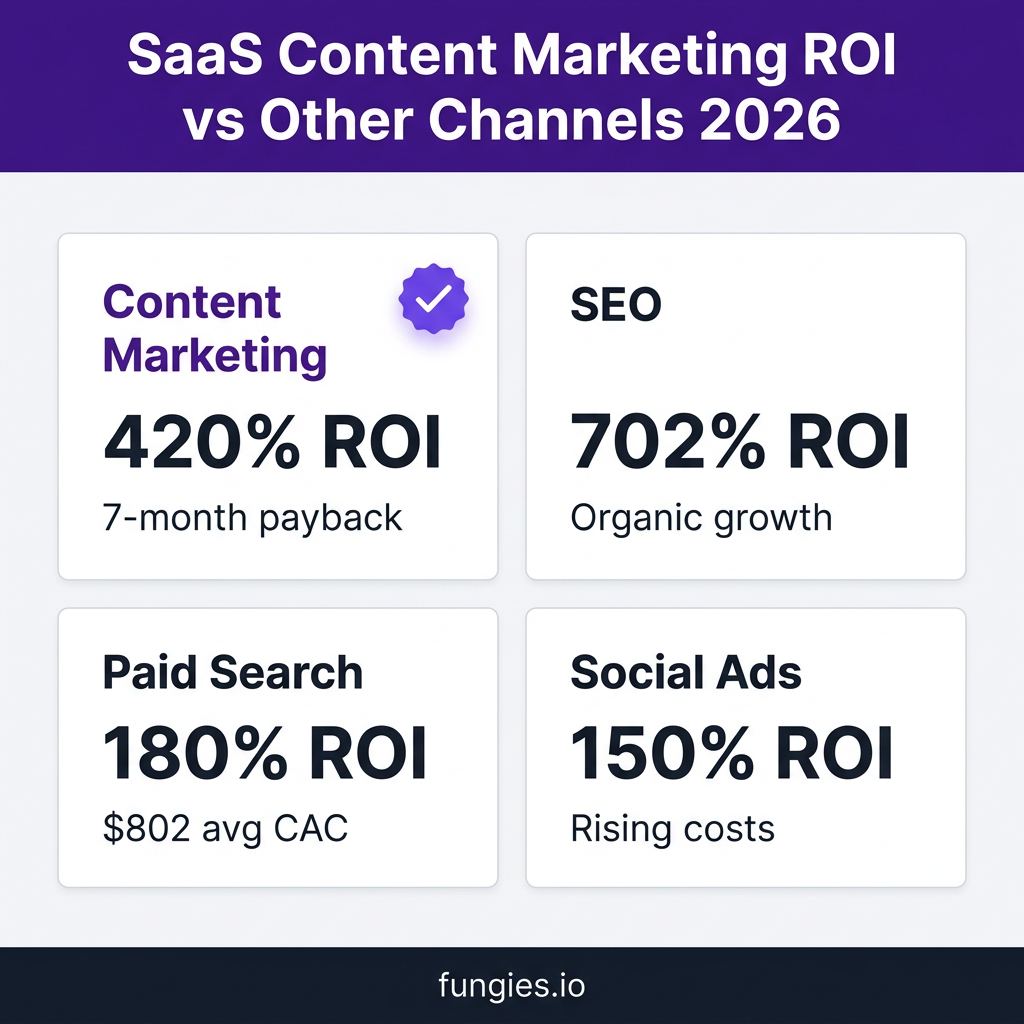
Here’s a stat that should make every SaaS founder pause: B2B SaaS companies that invest in content marketing generate 420% ROI — the highest of any sector. Compare that to the 180% average from paid search, and the picture becomes clear. In 2026, content isn’t just a nice-to-have marketing channel. It’s the most cost-effective growth engine available to SaaS companies.
But here’s the catch. Most SaaS companies approach content marketing wrong. They publish random blog posts, chase vanity metrics, and wonder why their organic traffic doesn’t convert to paying customers. The difference between content that drives revenue and content that sits unread isn’t talent — it’s strategy.
What Is SaaS Content Marketing (And Why It’s Different)
Content marketing for SaaS isn’t the same as content marketing for e-commerce, agencies, or professional services. The buyer journey is longer. The technical complexity is higher. And the sales cycle often involves multiple stakeholders who all need different information at different times.
At its core, SaaS content marketing is the strategic creation and distribution of valuable content to attract, educate, and convert your ideal customers. But the “strategic” part is where most teams fall short. Without a documented strategy, you’re essentially throwing content at the wall and hoping something sticks.
Here’s what makes SaaS content marketing unique:
- Complex products need educational content: Your prospects need to understand not just what your software does, but how it fits into their existing workflows and solves specific pain points.
- Long sales cycles require nurture sequences: Unlike impulse purchases, SaaS buyers research extensively. Content must guide them through weeks or months of consideration.
- Multiple stakeholders need different content: The end user, the budget approver, and the IT evaluator all consume different content formats at different funnel stages.
- Retention matters as much as acquisition: Content doesn’t stop working after the sale. Onboarding content, help documentation, and customer education directly impact churn.
Why SaaS Content Marketing Matters More Than Ever in 2026
Customer acquisition costs have risen 40-60% since 2023. The median B2B SaaS CAC now sits at $1,200, with sales-led enterprise deals costing upwards of $11,400 per customer. Meanwhile, organic channels continue to deliver customers at a fraction of that cost.
Consider these 2026 benchmarks:
- SEO delivers 702% ROI for B2B SaaS with a 7-month break-even time
- Content marketing generates approximately $3 for every $1 spent
- Companies with documented content strategies see 33% higher ROI than those without
- 75% of SaaS companies plan to increase their content marketing budgets this year
The data is unambiguous. But the real opportunity isn’t just in publishing more content — it’s in publishing better content strategically aligned with your business goals.
The SaaS Content Marketing Funnel: TOFU, MOFU, BOFU Explained
Effective SaaS content marketing maps directly to the buyer’s journey. We break this into three distinct stages, commonly called TOFU (Top of Funnel), MOFU (Middle of Funnel), and BOFU (Bottom of Funnel). Each stage serves a different purpose and requires different content formats.
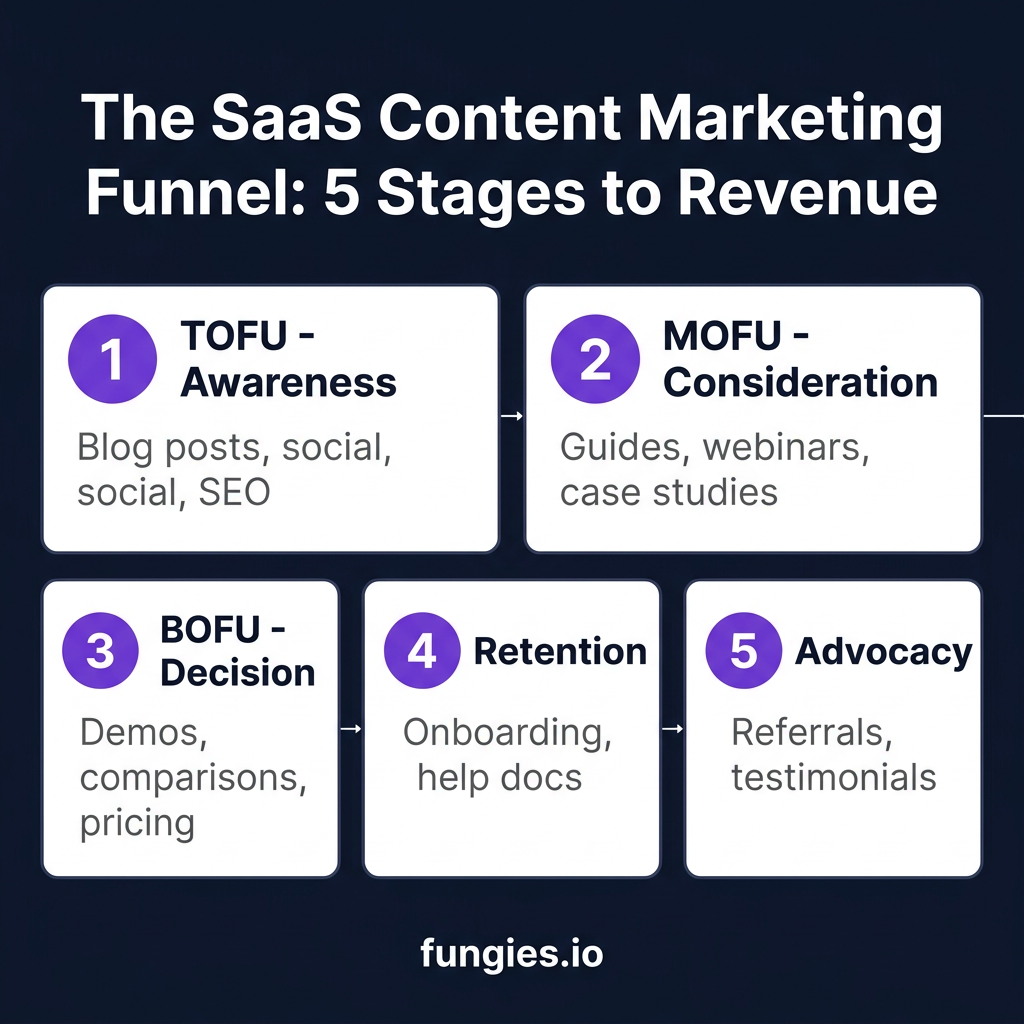
TOFU: Awareness Stage Content
At the top of the funnel, your prospects know they have a problem but haven’t defined it clearly. They’re not looking for solutions yet — they’re looking for understanding. Your content here should educate, not sell.
Best TOFU content formats:
- Educational blog posts addressing industry pain points
- SEO-optimized explainers and “what is” articles
- Social media content that sparks conversations
- Short-form video content for LinkedIn and YouTube
- Industry research and trend reports
The goal isn’t conversion — it’s capturing attention and building trust. TOFU content should answer questions your prospects are already asking Google.
MOFU: Consideration Stage Content
Middle-of-funnel prospects understand their problem and are actively researching solutions. They’re comparing approaches, evaluating vendors, and building their shortlist. Your MOFU content needs to position your product as the right solution without being overly promotional.
Best MOFU content formats:
- In-depth guides and whitepapers
- Webinars and video tutorials
- Case studies showing real results
- Comparison articles (your category vs. alternatives)
- Email nurture sequences for engaged subscribers
This is where content quality really matters. MOFU prospects are sophisticated. Generic fluff won’t cut it. You need detailed, authoritative content that demonstrates genuine expertise.
BOFU: Decision Stage Content
Bottom-of-funnel prospects are ready to buy. They’ve narrowed their options and need final validation that your solution is the right choice. BOFU content should remove friction and make the purchase decision easy.
Best BOFU content formats:
- Product demos and free trials
- Detailed comparison pages (you vs. specific competitors)
- Pricing guides and ROI calculators
- Implementation guides and onboarding overviews
- Customer testimonials and video reviews
Building Your SaaS Content Marketing Strategy: A 7-Step Framework
After auditing dozens of SaaS content programs and talking to hundreds of marketing leaders, I’ve distilled what works into a repeatable framework. Follow these seven steps to build a content engine that drives measurable revenue.
Step 1: Define Your Ideal Customer Profile (ICP)
Before writing a single word, you need crystal-clear clarity on who you’re writing for. Not just demographics — psychographics, pain points, goals, and content consumption preferences.
Ask yourself:
- What keeps your best customers awake at night?
- What questions do they ask during sales calls?
- Where do they hang out online?
- What content formats do they prefer?
The tighter your ICP definition, the more resonant your content will be. Resist the urge to target everyone. The best SaaS content strategies are intentionally narrow.
Step 2: Map Content to the Buyer’s Journey
Once you know your ICP, map their journey from problem awareness to purchase decision. Identify the questions they ask at each stage and the objections they raise.
Create a content matrix that aligns topics with funnel stages:
| Funnel Stage | Content Goal | Example Topics | CTA |
|---|---|---|---|
| TOFU | Educate & attract | “What is [problem]?” | Subscribe to newsletter |
| MOFU | Nurture & convince | “Best [solution] tools” | Download guide |
| BOFU | Convert & close | “[Your product] vs [competitor]” | Start free trial |
Step 3: Conduct Strategic Keyword Research
Keyword research for SaaS isn’t just about search volume. You need to understand search intent and competitive difficulty. A keyword with 500 monthly searches and high purchase intent beats a 10,000-volume informational keyword every time.
Focus on:
- Problem-aware keywords: “how to reduce churn”
- Solution-aware keywords: “best customer retention software”
- Product-aware keywords: “[competitor] alternative”
- Brand keywords: “[your product] pricing”
Use tools like Ahrefs, Semrush, or even Google’s autocomplete to build your keyword universe. Prioritize keywords where you can realistically rank and that indicate buying intent.
Step 4: Develop Your Content Pillars
Rather than publishing one-off posts, organize your content around 3-5 core pillars. Each pillar represents a major theme relevant to your ICP and should include a comprehensive pillar page plus supporting cluster content.
For example, if you sell project management software, your pillars might be:
- Project management methodologies (Agile, Scrum, Kanban)
- Remote team collaboration
- Productivity and time management
- Team scaling and hiring
This pillar-cluster approach signals topical authority to search engines and creates natural internal linking opportunities.
Step 5: Create a Content Calendar and Production Workflow
Consistency beats intensity. A blog that publishes one high-quality post weekly will outperform one that publishes daily for a month then goes silent. Build a sustainable production workflow.
Your workflow should include:
- Content brief creation (target keyword, outline, key points)
- First draft with internal review
- Editing for clarity, SEO, and brand voice
- Visual asset creation (images, graphics, videos)
- Publication and promotion
- Performance tracking and optimization
Most SaaS companies need 2-4 weeks per comprehensive piece. Plan accordingly.
Step 6: Implement Programmatic SEO (When Ready)
Once you’ve mastered manual content creation, consider programmatic SEO. This approach uses templates and structured data to generate hundreds or thousands of targeted landing pages at scale.
Zapier is the classic example. They rank for 1.3 million keywords and get 16+ million monthly visitors — mostly through programmatically generated integration pages. Each page targets a specific “[App A] + [App B] integration” keyword.
Programmatic SEO works best when you have:
- A large dataset (integrations, locations, templates, use cases)
- Clear search intent for each variation
- The technical resources to build and maintain page templates
Start manual, then automate what works.
Step 7: Measure What Matters
Vanity metrics like page views and social shares don’t pay the bills. Track metrics that correlate with revenue:
- Organic traffic growth: Month-over-month increases in qualified visitors
- Conversion rates: Visitors to leads, leads to trials, trials to customers
- Content-influenced pipeline: Deals where content played a role
- Customer acquisition cost by channel: Content CAC vs. paid CAC
- LTV:CAC ratio: Overall unit economics improvement
Set up proper attribution so you can prove content’s impact on revenue. This isn’t just about justification — it’s about optimization. Knowing which content drives the best customers lets you double down on what works.
Content Distribution: Where Most SaaS Companies Fall Short
Creating great content is only half the battle. The other half is getting it in front of the right people. Follow the 80/20 rule: spend 20% of your time creating content and 80% distributing it.
Owned channels: Your email list is your most valuable asset. 59% of B2B marketers name email as their most effective revenue channel. Build nurture sequences that deliver the right content to the right people at the right time.
Earned channels: Guest posting, podcast appearances, and PR can amplify your reach. Focus on publications your ICP actually reads.
Paid channels: Don’t be afraid to put paid promotion behind your best content. A $500 boost on LinkedIn can get your guide in front of thousands of qualified prospects.
Community channels: Reddit, Slack communities, and industry forums can drive highly engaged traffic. But be genuine — spamming links will backfire.
AI and the Future of SaaS Content Marketing
AI has fundamentally changed content marketing. 92% of large marketing teams now use AI-generated content in some capacity. But the winners aren’t those producing the most content — they’re those using AI strategically.
Here’s what’s working in 2026:
- AI for research and outlining: Speed up the early stages of content creation
- AI for optimization: Improve headlines, meta descriptions, and readability
- AI for personalization: Dynamic content that adapts to visitor characteristics
- Human for strategy and storytelling: AI can’t replace genuine expertise and narrative
The companies winning at content marketing use AI to amplify human creativity, not replace it. They publish less content but make each piece more valuable, more comprehensive, and more aligned with search intent.
Common SaaS Content Marketing Mistakes to Avoid
I’ve seen the same mistakes repeated across dozens of SaaS companies. Here are the big ones to watch out for:
1. Publishing without a strategy: Random acts of content don’t compound. Every piece should serve a specific business goal.
2. Focusing on volume over quality: Ten mediocre posts won’t outperform one exceptional guide. Google rewards depth and originality.
3. Ignoring distribution: Great content that nobody sees is wasted effort. Build distribution into your workflow from day one.
4. Neglecting BOFU content: It’s tempting to focus on broad TOFU topics with high search volume. But BOFU content converts 10x better.
5. Not measuring ROI: If you can’t connect content to revenue, you can’t optimize. Invest in proper attribution from the start.
FAQ: SaaS Content Marketing Strategy
How long does it take to see results from SaaS content marketing?
Most SaaS companies see meaningful organic traffic growth within 6-9 months of consistent publishing. However, SEO break-even typically occurs around 7 months, with full ROI realized after 12-18 months. Content marketing is a long game — expect to invest for a year before judging results.
How much should a SaaS company spend on content marketing?
According to 2026 benchmarks, SaaS companies typically invest between $342,000 and $1,090,000 annually on content marketing. Early-stage startups might start with $5,000-10,000 monthly. The key isn’t the absolute amount — it’s consistency and strategic focus.
What content format drives the highest ROI for SaaS?
SEO-optimized long-form content consistently delivers the highest ROI, with B2B SaaS companies achieving 702% returns. Video content accelerates ROI timelines by 49% compared to text. Case studies and comparison pages typically convert best for BOFU prospects.
Should SaaS companies use AI for content creation?
Yes, but strategically. 80% of marketers now use AI tools, with 88% reporting increased efficiency. Use AI for research, outlining, and optimization. But keep humans in charge of strategy, storytelling, and final quality control. AI-generated content without human oversight tends to be generic and fails to rank.
How do I measure content marketing ROI for my SaaS?
Track metrics that connect to revenue: organic traffic growth, conversion rates at each funnel stage, content-influenced pipeline, and customer acquisition cost by channel. Set up multi-touch attribution to understand content’s role in the full buyer journey.
Conclusion: Start Building Your Content Engine Today
SaaS content marketing isn’t a magic bullet. It requires strategy, consistency, and patience. But the data is clear: companies that invest in content marketing achieve lower CAC, higher LTV, and more sustainable growth than those relying solely on paid channels.
The framework I’ve shared — ICP definition, funnel mapping, keyword research, pillar content, programmatic SEO, and proper measurement — works. I’ve seen it drive results across dozens of SaaS companies.
Your competitors are already investing in content. The question isn’t whether you can afford to build a content engine. It’s whether you can afford not to.
Ready to start? Create your free Fungies account and focus your energy on building great products while we handle the payment infrastructure.