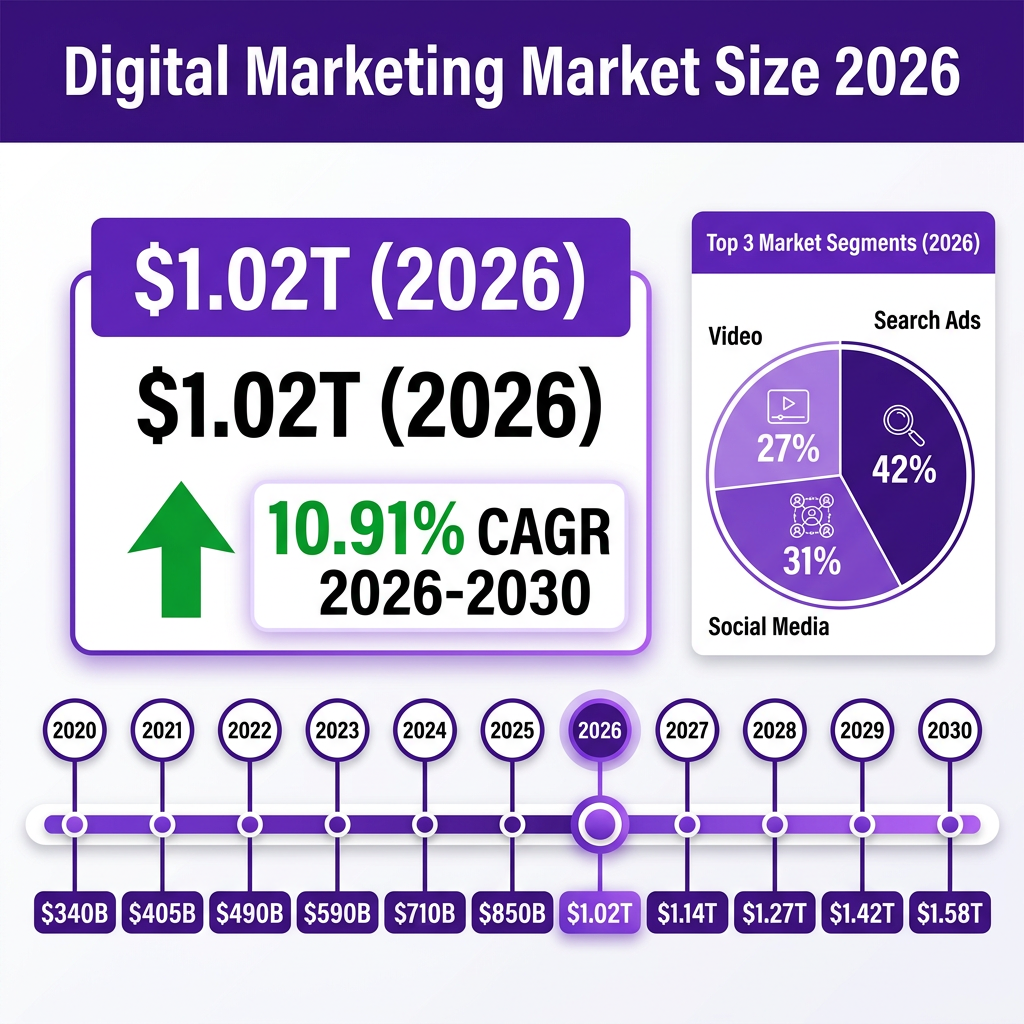
The digital marketing industry has reached an inflection point in 2026. With global ad spending projected to surpass $1.02 trillion this year, businesses are allocating more resources than ever to digital channels. Yet this unprecedented growth comes with equally significant challenges: privacy regulations are reshaping attribution models, AI is transforming how campaigns are created and optimized, and consumer expectations for personalization have never been higher.
According to the Interactive Advertising Bureau (IAB), digital ad revenue climbed to nearly $300 billion in 2025, representing a 13.9% year-over-year increase. Video advertising, social media campaigns, and commerce media are driving this growth, while artificial intelligence reshapes the entire ecosystem. For marketers, entrepreneurs, and business leaders, understanding these shifts isn’t optional—it’s essential for survival in an increasingly competitive landscape.

Market Overview: The $1.02 Trillion Digital Marketing Ecosystem
The global digital marketing market has evolved from a niche channel to the dominant force in advertising. In 2026, digital channels account for more than 67% of all media spending, a figure that would have seemed impossible just a decade ago. This transformation reflects fundamental changes in consumer behavior, technological capabilities, and the measurable ROI that digital channels provide compared to traditional media.
The market’s growth trajectory is impressive by any standard. According to Persistence Market Research, the global digital marketing services market is valued at approximately $750 billion in 2026 and is projected to reach $1.3 trillion by 2033, representing a compound annual growth rate (CAGR) of 8%. This sustained expansion is driven by enterprises accelerating their digital transformation initiatives and steadily reallocating marketing budgets toward online customer acquisition and engagement channels.
Breaking down the market by channel reveals where the money is actually flowing. Search engine optimization (SEO) captures the largest share at approximately 40% of total digital marketing spend, reflecting the foundational role that search engines play in driving website traffic. Social network marketing follows closely, with social media ad revenues reaching $117.7 billion in 2025, showing significant 32.6% year-over-year growth—an increase of $29 billion from the previous year.
Video advertising has emerged as a powerhouse segment, growing 25.4% year-over-year to $78 billion in revenue. This includes connected TV (CTV), social video, online video, and short-form video platforms. The rise of platforms like TikTok, YouTube Shorts, and Instagram Reels has fundamentally altered how brands connect with audiences, shifting from polished, produced content to authentic, short-form storytelling.
Commerce media—advertising embedded within e-commerce platforms—has grown 18.0% year-over-year to $63.4 billion, reinforcing its role as a core performance channel powered by first-party data. As third-party cookies disappear, retailers’ proprietary data has become increasingly valuable, giving rise to retail media networks operated by Amazon, Walmart, Target, and others.
Mobile advertising deserves special attention, with spending expected to reach $495 billion in 2026, making up nearly half of all digital ad investments. This mobile-first reality shapes everything from creative formats to landing page design, as consumers increasingly research, compare, and purchase products entirely on their smartphones.
Geographically, North America remains the largest market, but Asia-Pacific is the fastest-growing region through 2033, driven by integrated e-commerce and digital payment ecosystems in China, India, and Southeast Asia. Europe continues to lead in privacy-conscious marketing practices, with GDPR serving as a model for regulations worldwide.
Key Statistics and Data Points
Understanding the digital marketing landscape requires more than headline figures. The following statistics reveal the nuanced realities that practitioners face daily, from channel performance to consumer behavior shifts.
Global Advertising Spend: Worldwide advertising market will reach $1.25 trillion in ad spending by 2026, with digital channels capturing the majority share. Digital ad spend specifically is projected to surpass $1.02 trillion in 2026, accounting for more than 65% of total media spend.
Social Media Dominance: Social media ad spend worldwide is projected to reach $219 billion in 2026, making up more than 20% of total digital ad budgets. Creator advertising has emerged as a core media channel, with spend reaching $37 billion. Influencer marketing has grown from $1.7 billion in 2016 to $16.4 billion in 2022, and continues expanding.
Video Advertising Growth: Video advertising will account for 38% of total digital ad budgets by the end of 2026. Short-form video drives over 40% of consumer discovery, fundamentally changing how brands approach content creation.
Programmatic Advertising: Programmatic advertising is expected to account for about 87% of digital advertising revenue in 2026, as automated buying and selling of ad inventory becomes the standard across channels.
Search Advertising: Global search ad spending will reach $351.55 billion in 2025 and is expected to grow to $483.55 billion by 2029 at an 8.3% annual rate. SEO remains the leading service type, capturing an estimated 40% of the digital marketing market.
AI Adoption: Nearly half of marketers are reallocating budgets into AI-powered solutions. Marketing technology sector raised over $3.2 billion in 2024, with AI-enabled solutions capturing 65% of total investment.
Email Marketing Persistence: Despite the rise of new channels, email marketing maintains an average ROI of $42 for every $1 spent, making it one of the most cost-effective channels available.
Mobile-First Reality: Mobile devices account for over 60% of all digital media time, yet mobile conversion rates still lag desktop by approximately 30%, representing a significant optimization opportunity.
Consumer Trust: Only 4% of consumers trust advertising as a source of information, while 92% trust recommendations from people they know. This trust gap explains the explosive growth in influencer and creator marketing.
Content Saturation: The average person encounters between 6,000 to 10,000 ads per day, up from 5,000 just five years ago. This saturation makes standing out increasingly difficult and expensive.
Personalization Expectations: 80% of consumers are more likely to purchase from brands that provide personalized experiences, yet only 22% of marketers believe they’re successfully delivering personalization at scale.
Privacy Impact: With third-party cookie deprecation, 41% of marketers say measuring ROI has become more difficult, while 67% of consumers are concerned about how their data is used online.
B2B Research Behavior: B2B buyers complete 57% to 70% of their research before contacting sales, making digital content and SEO critical for capturing demand early in the buyer journey.
E-commerce Scale: The e-commerce industry is currently worth close to $4.9 trillion, with digital marketing serving as the primary driver of traffic and conversions for online retailers.
Voice Search: 50% of all searches are now voice-based, requiring marketers to optimize for conversational queries and featured snippets.
AI Search Impact: AI search engines answer up to 30% of informational queries without a click, creating “dark traffic” that never touches traditional analytics platforms.
Ad Fraud Costs: Digital ad fraud is projected to cost advertisers $100 billion globally in 2026, making brand safety and fraud prevention critical priorities.
Cross-Channel Complexity: The average customer journey now touches 9.5 channels before conversion, up from 4.5 just three years ago, complicating attribution and measurement.
Marketing Budget Allocation: Companies now allocate an average of 9.1% of total revenue to marketing, with B2C companies spending more (13.7%) than B2B companies (7.8%).
Retention Economics: Acquiring a new customer costs 5 to 25 times more than retaining an existing one, driving increased investment in loyalty programs and customer marketing.
Major Trends Shaping Digital Marketing in 2026
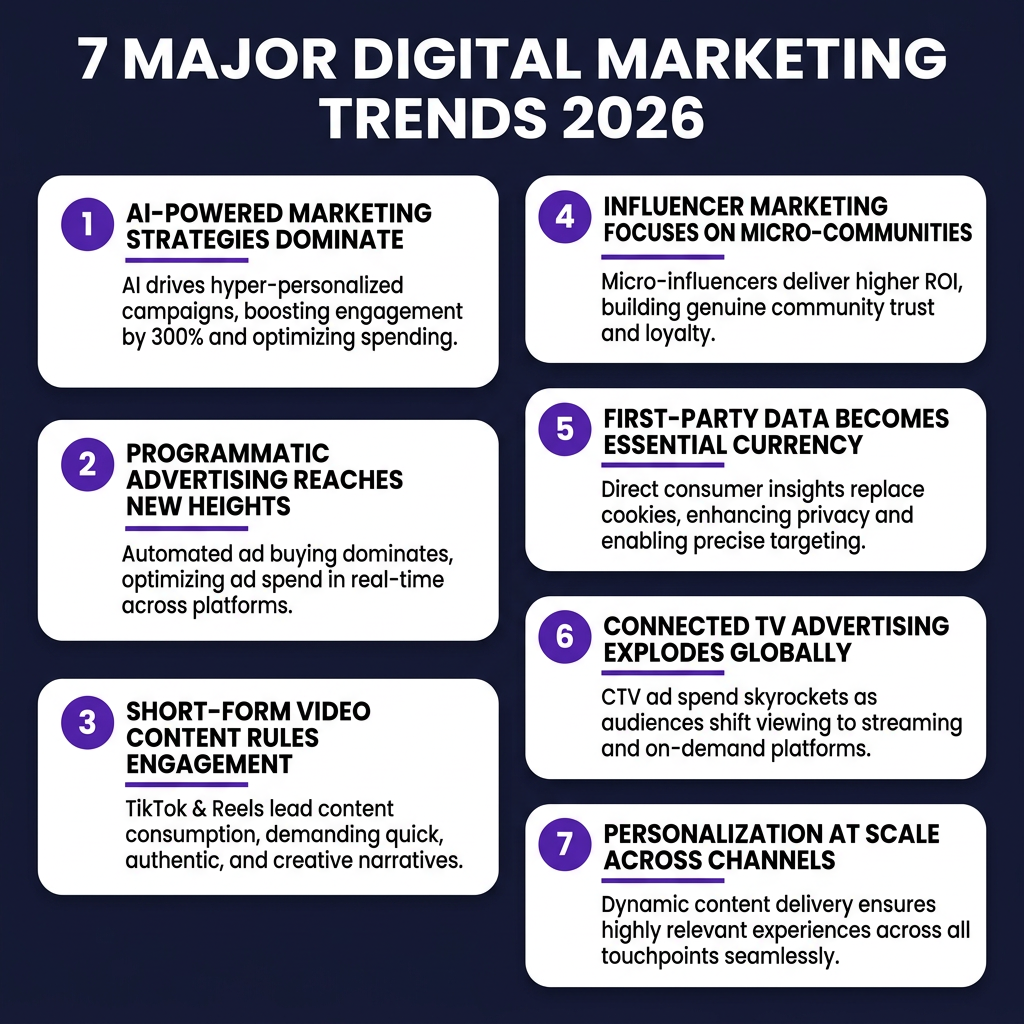
The digital marketing landscape of 2026 is defined by seven major trends that are reshaping how brands connect with customers, measure success, and allocate resources. Understanding these trends is essential for staying competitive in an environment where yesterday’s best practices quickly become obsolete.
1. AI-Powered Marketing Automation
Artificial intelligence has moved from experimental to essential in 2026. AI systems now outperform traditional campaigns by learning across the entire customer journey, connecting signals from discovery, content, influence, and conversion in real time. Predictive analytics, powered by AI, has become integral to digital marketing strategies, allowing marketers to anticipate customer needs at various touchpoints along their journey.
The shift is structural, not incremental. By 2027, the marketer who manually structures campaigns will be as obsolete as the media buyer who once called newspapers to place classified ads. AI doesn’t just automate tasks—it transforms strategy by identifying patterns humans cannot see and optimizing campaigns in real-time based on performance data.
Generative AI is boosting most areas of digital marketing, letting marketers deliver huge amounts of personalization while driving efficiency. From AI-assisted content creation to predictive lead scoring, the technology is embedded throughout the marketing stack. However, the best marketers don’t let AI think for them—AI makes good marketers faster; it doesn’t turn bad strategy into good marketing.
2. Hyper-Personalization at Scale
Personalization has evolved beyond simply inserting a customer’s name into an email. In 2026, hyper-personalization uses AI and machine learning to deliver individualized content, product recommendations, and experiences based on real-time behavior, preferences, and context.
This level of personalization depends on three factors: consent, context, and control. With third-party cookies disappearing, marketers are increasingly reliant on first-party and zero-party data—information that customers voluntarily share. The brands succeeding at personalization have built transparent value exchanges, offering genuine benefits in return for customer data.
The technology enabling this shift includes customer data platforms (CDPs) that unify data from multiple sources, AI engines that predict preferences, and dynamic content systems that assemble personalized experiences in milliseconds. The result is marketing that feels helpful rather than intrusive, relevant rather than creepy.
3. The Rise of Short-Form Video
Short-form video has become the dominant content format, with platforms like TikTok, YouTube Shorts, and Instagram Reels driving over 40% of consumer discovery. The format’s success reflects changing attention spans and consumption habits—users want content that’s entertaining, authentic, and immediately engaging.
For marketers, this shift requires rethinking content strategy. Polished, produced commercials often underperform compared to raw, authentic content created by users or influencers. The most successful brands on these platforms participate in trends, collaborate with creators, and embrace imperfection.
Video marketing has pulled in significant attention because audiences are more likely to watch than read. In 2026, 91% of marketers use video marketing as part of their strategy, up from 84% just a few years ago. The format works across the entire funnel—from awareness through TikTok challenges to conversion through product demonstrations and testimonials.
4. First-Party Data Strategy
The deprecation of third-party cookies has made first-party data the most valuable asset in digital marketing. Brands that have built direct relationships with customers and collected data with consent are now at a significant advantage over those that relied on third-party tracking.
This shift is driving investment in owned channels—email lists, mobile apps, loyalty programs, and community platforms. It’s also fueling the growth of retail media networks, where retailers leverage their first-party data to offer targeted advertising to brands. Amazon, Walmart, Target, and others have built multi-billion dollar advertising businesses on the strength of their customer data.
Successful first-party data strategies focus on value exchange. Customers willingly share information when they receive clear benefits—personalized recommendations, exclusive offers, or enhanced experiences. The brands struggling are those that collected data without delivering value or that relied on third-party data without building direct relationships.
5. Connected TV and Streaming Advertising
Connected TV (CTV) advertising has matured into a core performance channel. As viewers shift from linear TV to streaming platforms, advertisers are following—with the added benefits of precise targeting, measurable outcomes, and programmatic buying.
CTV combines the brand-building power of television with the targeting and measurement capabilities of digital. Advertisers can reach specific audiences based on demographics, interests, and viewing behavior, then measure the impact on website visits, conversions, and sales. This addressability makes CTV attractive to performance marketers, not just brand advertisers.
The growth is substantial. Video advertising across CTV, social video, online video, and short-form video grew 25.4% year-over-year to $78 billion. As streaming platforms introduce ad-supported tiers and improve their advertising capabilities, this growth is expected to continue.
6. Creator and Influencer Marketing Maturation
Creator advertising has become a core media channel, with spend reaching $37 billion. What began as experimental partnerships with bloggers and YouTubers has evolved into a sophisticated industry with standardized metrics, long-term partnerships, and measurable ROI.
The maturation is evident in how brands approach creator partnerships. Rather than one-off sponsored posts, successful brands build ongoing relationships with creators who genuinely align with their values and audience. These partnerships feel authentic because they are—the creators are true brand advocates, not paid mouthpieces.
Nearly half of marketers are reallocating budgets into influencer partnerships, recognizing that consumers trust recommendations from people they follow far more than traditional advertising. The key is finding the right creators—those whose audience matches the target demographic and whose values align with the brand.
7. Privacy-First Marketing
Data privacy has become a cornerstone of digital marketing strategies by 2026. Awareness and concern over how personal information is used and shared continue to grow among consumers, and regulations like GDPR in Europe and CCPA in California have established strict requirements for data collection and use.
The impact is profound. Privacy-driven attribution changes, including cookie deprecation and tracking limits, require new measurement approaches like first-party data and marketing mix modeling. Marketers must now prove ROI without the granular tracking that was previously available, leading to renewed interest in statistical methods and incrementality testing.
Brands that embrace privacy as a competitive advantage—being transparent about data use, giving customers control, and delivering value in exchange for information—are building stronger, more resilient customer relationships. Those that resist or rely on workarounds face regulatory risk and reputational damage.
Key Players and Competitive Landscape
The digital marketing ecosystem is dominated by a handful of technology giants, but the competitive landscape is more nuanced than it appears. Understanding the key players, their strengths, and their strategic positions is essential for marketers making platform decisions.
The Triopoly: Google, Meta, and Amazon
Google, Meta (Facebook and Instagram), and Amazon collectively capture the majority of digital ad spending. Google’s dominance in search advertising gives it unmatched intent data—users actively searching for products and services. Meta’s strength lies in demographic and interest-based targeting across its massive social networks. Amazon has leveraged its e-commerce position to build the third-largest digital advertising business, with the unique advantage of closing the loop from ad exposure to purchase.
Google’s advertising revenue continues to grow, driven by search, YouTube, and programmatic platforms. The company’s AI capabilities, particularly in bidding and optimization, give advertisers tools to maximize performance. However, Google’s dominance faces regulatory pressure, with antitrust investigations in multiple jurisdictions.
Meta has recovered from the challenges of iOS privacy changes by investing in AI-driven ad targeting and diversifying beyond Facebook and Instagram to include WhatsApp and Messenger. The company’s Reels product competes directly with TikTok for short-form video attention, while its Advantage+ shopping campaigns automate campaign creation and optimization.
Amazon’s advertising business has grown rapidly, leveraging its first-party purchase data to offer unique targeting and measurement capabilities. For brands selling on Amazon, advertising has become essential for visibility in an increasingly crowded marketplace. Amazon’s expansion into streaming (Prime Video) and devices (Echo) creates additional advertising inventory.
Emerging Platforms: TikTok, Microsoft, and Retail Media
TikTok has emerged as a major advertising platform, particularly for reaching younger demographics. The platform’s algorithm-driven content discovery creates opportunities for brands to achieve viral reach, while its advertising products have matured to include sophisticated targeting and measurement. TikTok Shop is blurring the lines between content and commerce, allowing users to purchase without leaving the app.
Microsoft Advertising has gained ground, particularly in B2B marketing, through its integration with LinkedIn and its position as the default search engine for ChatGPT and other AI assistants. The company’s acquisition of Activision Blizzard adds gaming inventory to its advertising portfolio.
Retail media networks operated by Walmart, Target, Instacart, and others are capturing an increasing share of CPG and retail advertising budgets. These platforms offer closed-loop measurement—advertisers can see exactly which ad exposures led to purchases—and access to valuable first-party data.
Marketing Technology Vendors
Beyond advertising platforms, the marketing technology landscape includes thousands of vendors offering specialized solutions. Customer Data Platforms (CDPs) like Segment, mParticle, and Tealium help brands unify customer data. Marketing automation platforms like HubSpot, Marketo, and Salesforce Marketing Cloud manage campaigns across channels. Analytics tools like Google Analytics 4, Amplitude, and Mixpanel provide insights into customer behavior.
The trend in martech is toward consolidation and integration. Enterprises are reducing the number of vendors they work with, preferring integrated suites over best-of-breed point solutions. This consolidation benefits larger vendors while creating challenges for specialized startups.
AI-native marketing tools are emerging as a new category, offering capabilities that traditional platforms struggle to match. These tools use large language models for content creation, predictive models for forecasting, and optimization algorithms that continuously improve performance.

Digital Marketing Benchmarks and KPIs by Channel
Understanding industry benchmarks is essential for evaluating performance and setting realistic goals. The following KPIs represent 2026 averages across major digital marketing channels, based on aggregated data from thousands of campaigns.
Google Ads Performance Benchmarks
Google Ads remains the cornerstone of many digital marketing strategies, particularly for capturing high-intent search traffic. Average click-through rates (CTR) vary significantly by industry, ranging from 2.41% in B2B sectors to 6.11% in e-commerce. The average cost per click (CPC) across all industries is $2.69 for search ads, though competitive verticals like legal services and insurance can see CPCs exceeding $50.
Conversion rates on Google Ads average 3.75% across industries, with top performers achieving 10% or higher. Return on ad spend (ROAS) benchmarks vary by business model, but a 4:1 ratio ($4 in revenue for every $1 spent) is generally considered the minimum threshold for profitability. E-commerce businesses typically target higher ROAS, often 5:1 or above, while B2B companies with long sales cycles may accept lower immediate ROAS in favor of lifetime value.
Meta Ads (Facebook and Instagram) Benchmarks
Meta’s advertising platform offers unparalleled targeting capabilities, but performance has shifted significantly following iOS privacy changes. Average CTR across Meta properties is 1.21%, with Instagram generally outperforming Facebook. Cost per thousand impressions (CPM) averages $7.19, though this varies dramatically by audience and placement.
ROAS benchmarks for Meta Ads average 2.79:1 across industries, with e-commerce and retail typically seeing higher returns than B2B or service businesses. The platform’s Advantage+ shopping campaigns, which use AI to automate targeting and creative optimization, have shown promising results for e-commerce advertisers, with some brands reporting 30% improvements in cost per acquisition.
Email Marketing Benchmarks
Email marketing continues to deliver exceptional ROI, with average open rates of 21.33% and click-through rates of 2.62% across industries. However, these averages mask significant variation—welcome emails achieve 50%+ open rates, while promotional emails to unengaged lists may fall below 5%.
The most important email metric is revenue per email subscriber, which averages $0.10 across industries but can reach $1 or more for well-optimized e-commerce programs. List growth rate, unsubscribe rate, and spam complaint rate provide insight into list health and content relevance. Best-in-class email programs maintain unsubscribe rates below 0.5% and spam complaint rates below 0.1%.
SEO and Organic Search Benchmarks
Organic search performance is measured differently than paid channels, with longer time horizons but compounding returns. Average organic CTR for position one on Google is 27.6%, dropping to 2.4% for position ten. The first three positions capture 54.4% of all clicks, making top rankings extremely valuable.
Domain authority, a proxy for ranking potential, correlates strongly with organic traffic. Sites with domain authority above 70 typically capture significant organic market share in their niches. Page load speed, mobile usability, and Core Web Vitals scores increasingly impact rankings, with Google explicitly confirming these as ranking factors.
Social Media Organic Benchmarks
Organic social media reach has declined across platforms as algorithms prioritize content from friends and family over brands. Average organic reach on Facebook is 5.2% of page followers, while Instagram achieves 13.5% for feed posts and 18.7% for Stories. TikTok offers the highest organic reach for brands, with some accounts achieving viral distribution without paid promotion.
Engagement rate (likes, comments, shares divided by followers) averages 0.07% on Facebook, 1.16% on Instagram, and 4.25% on TikTok. Video content consistently outperforms static posts, with native video on Facebook achieving 86% higher reach than link posts.
Industry-Specific Digital Marketing Insights
Different industries face unique challenges and opportunities in digital marketing. Understanding these nuances is essential for developing effective strategies.
E-Commerce and Retail
E-commerce businesses operate in the most competitive digital marketing environment, with thin margins and high customer acquisition costs. The average e-commerce conversion rate is 2.58%, though top performers achieve 5% or higher. Cart abandonment remains a critical challenge, with 69.8% of carts abandoned on average—representing billions in potential revenue.
Successful e-commerce marketing emphasizes product page optimization, abandoned cart recovery sequences, and loyalty programs. The rise of social commerce—purchasing directly through social platforms—offers new opportunities but also risks disintermediating brands from their customers.
SaaS and B2B Technology
B2B SaaS marketing focuses on lead generation and nurturing through long sales cycles. The average cost per lead in B2B technology is $208, with enterprise-focused companies often seeing CPLs exceeding $500. Content marketing, SEO, and LinkedIn advertising are the primary channels, with account-based marketing (ABM) gaining traction for enterprise deals.
Product-led growth (PLG) has transformed SaaS marketing, with freemium models and self-service onboarding reducing reliance on sales teams. Marketing teams in PLG companies focus on activation—getting users to experience value—and expansion—driving upgrades and add-on purchases.
Healthcare and Pharmaceuticals
Healthcare marketing operates under strict regulatory constraints, with HIPAA compliance and FDA regulations limiting targeting and messaging options. Despite these challenges, digital channels have become essential for patient education and healthcare provider engagement.
Healthcare marketers focus on content that addresses patient concerns while maintaining regulatory compliance. Local SEO is critical for healthcare providers, with 77% of patients using search engines before booking appointments. Telehealth adoption has accelerated digital engagement, with patients increasingly comfortable receiving healthcare information and services online.
Financial Services
Financial services marketing combines high customer lifetime values with strict compliance requirements. Trust is the primary currency, with consumers cautious about sharing financial information online. Content marketing that educates and builds credibility outperforms promotional messaging.
Mobile optimization is essential, with 57% of banking customers using mobile apps as their primary channel. Fintech competitors have raised consumer expectations for digital experiences, forcing traditional institutions to accelerate their digital transformation. Personalization that demonstrates understanding of individual financial situations drives engagement and conversion.
Regional Digital Marketing Trends
Digital marketing strategies must account for regional differences in platform preferences, consumer behavior, and regulatory environments.
North America
North America remains the largest digital advertising market, with the United States alone accounting for over $300 billion in annual spend. Platform concentration is high, with Google, Meta, and Amazon capturing the majority of ad dollars. Privacy regulations vary by state, with California’s CCPA setting the standard that other states are following.
Connected TV adoption is highest in North America, making CTV advertising a priority for brand marketers. Retail media networks have gained significant traction, with Amazon capturing the largest share but Walmart, Target, and others growing rapidly.
Europe
Europe leads in privacy regulation, with GDPR serving as the global model for data protection. This regulatory environment has accelerated first-party data strategies and contextual advertising approaches. The Digital Markets Act is reshaping platform competition, potentially opening opportunities for smaller players.
Platform preferences vary significantly by country—WhatsApp dominates in Southern Europe, while email remains stronger in Northern Europe. E-commerce adoption varies, with the UK and Germany leading while Southern and Eastern Europe lag. Localization is essential, with consumers expecting content in their native languages.
Asia-Pacific
Asia-Pacific is the fastest-growing digital marketing region, with China and India driving significant expansion. Mobile-first is the default assumption, with many consumers never owning desktop computers. Super-apps like WeChat in China and Grab in Southeast Asia integrate messaging, payments, and services, creating unique marketing ecosystems.
Live streaming commerce, already massive in China, is expanding across the region. Influencer marketing operates at a different scale, with Chinese live streamers selling billions in products during single sessions. Western platforms have limited presence, with local alternatives dominating—WeChat, LINE, KakaoTalk, and others replace WhatsApp and Messenger.
Latin America
Latin America represents a rapidly growing digital marketing opportunity, with Brazil and Mexico leading the region. Social media usage is among the highest globally, with Brazilians spending an average of 3.5 hours per day on social platforms. WhatsApp is the dominant messaging platform, with business messaging driving significant engagement.
E-commerce is growing rapidly but from a smaller base, with logistics and payment infrastructure challenges limiting penetration in some markets. Mobile wallets and buy-now-pay-later services are gaining traction, creating new marketing opportunities. Influencer marketing is highly effective, with Latin American consumers showing high trust in creator recommendations.
Challenges and Pain Points
Despite the opportunities, digital marketing in 2026 faces significant challenges that keep practitioners up at night. These obstacles require strategic thinking, technical sophistication, and organizational alignment to overcome.
1. Attribution and Measurement Complexity
Proving return on investment remains the number one struggle for marketing professionals in 2026. Privacy regulations limiting tracking, algorithm changes creating visibility uncertainty, and the complexity of multi-touch customer journeys have made attribution more difficult than ever.
The deprecation of third-party cookies has eliminated much of the tracking infrastructure that marketers relied on. With 41% of marketers saying measuring ROI has become more difficult, organizations are investing in alternative approaches: marketing mix modeling, incrementality testing, and first-party data strategies.
AI search engines that answer queries without clicks create “dark traffic” that never touches analytics platforms. When ChatGPT or Google Gemini provides a direct answer, the website that originated the information may never know it contributed to a customer’s knowledge. This visibility gap challenges traditional content marketing measurement.
2. Rising Customer Acquisition Costs
As competition for digital attention intensifies, customer acquisition costs (CAC) have risen across channels. The average person encounters 6,000 to 10,000 ads per day, up from 5,000 just five years ago. This saturation means standing out requires either exceptional creativity or increased spending.
Privacy changes have compounded this challenge. With less precise targeting available, campaigns reach broader, less qualified audiences, driving up costs per acquisition. Platforms’ automated bidding systems, while sophisticated, often optimize for platform goals (revenue) rather than advertiser goals (profitable growth).
The response to rising CAC is a renewed focus on retention and lifetime value. Acquiring a new customer costs 5 to 25 times more than retaining an existing one, making loyalty programs, customer marketing, and product-led growth strategies increasingly important.
3. Talent and Skills Gaps
The pace of change in digital marketing has created a persistent talent gap. Marketers must continuously upskill teams, adapt to shifting customer expectations, and manage unpredictable lead flows—all while delivering measurable results.
AI has transformed the skills required for marketing success. Technical proficiency in data analysis, prompt engineering, and marketing technology has become as important as creative and strategic thinking. Yet many organizations struggle to find talent that combines these capabilities.
Resource constraints particularly challenge startups and smaller businesses, requiring strategic prioritization of high-impact channels. Limited budgets mean every dollar must work harder, and mistakes are more costly.
The solution requires investment in training and development, strategic hiring, and partnerships with agencies or freelancers who can provide specialized expertise. It also demands organizational patience—building capabilities takes time, even as pressure for immediate results intensifies.
Opportunities and Growth Strategies
Within every challenge lies opportunity. The disruptions reshaping digital marketing in 2026 create openings for innovative brands to capture market share, build competitive advantages, and achieve sustainable growth.
1. AI-Augmented Marketing Operations
The same AI technologies creating disruption also create opportunity. Brands that successfully integrate AI into their marketing operations can achieve efficiency and effectiveness that competitors cannot match. This isn’t about replacing marketers—it’s about augmenting their capabilities.
Specific applications include AI-powered content creation that maintains brand voice while scaling production, predictive lead scoring that prioritizes sales effort, dynamic creative optimization that tests thousands of ad variations, and conversational AI that handles routine customer inquiries.
The key is thoughtful implementation. AI works best when applied to specific, well-defined problems with clear success metrics. Organizations that invest in AI without clear objectives often waste resources on solutions looking for problems.
2. First-Party Data Competitive Advantage
Brands that have built direct customer relationships and first-party data assets now possess a competitive moat. As third-party data becomes less available, these assets appreciate in value. The opportunity is to leverage this data for personalization, product development, and customer experience improvements.
Strategies include building loyalty programs that collect valuable data while delivering clear customer benefits, creating community platforms that generate engagement and insights, and developing proprietary research that positions the brand as an authority while collecting zero-party data.
The brands winning in this environment treat data as a product—something to be carefully managed, continuously improved, and strategically deployed. They invest in data infrastructure, governance, and talent, recognizing that data capabilities are becoming as important as brand or distribution.
3. Video-First Content Strategy
The shift to video represents an opportunity for brands willing to invest in new capabilities. Video content consistently outperforms static content across engagement metrics, and the platforms are heavily incentivized to promote video in their algorithms.
Successful video strategies embrace authenticity over production value. The most engaging content often looks like it was created by users rather than professionals. This lowers barriers to entry—brands don’t need Hollywood budgets to succeed, just genuine stories and consistent execution.
The opportunity extends beyond awareness into conversion. Product demonstrations, customer testimonials, and educational content in video format can drive purchase decisions. Live streaming creates real-time engagement and urgency. Short-form video builds brand affinity with younger demographics.
Case Studies and Success Stories
Theory informs, but examples inspire. The following case studies demonstrate how leading brands are navigating the digital marketing landscape of 2026, achieving measurable results through strategic innovation and disciplined execution.
Case Study 1: E-Commerce Brand’s AI-Powered Personalization
A mid-sized e-commerce retailer faced declining conversion rates and rising customer acquisition costs. Their solution was a comprehensive AI-powered personalization strategy that transformed the customer experience.
The implementation included a Customer Data Platform that unified data from website, email, and in-store purchases; AI-driven product recommendations that improved with each interaction; dynamic website content that adapted to individual visitor preferences; and predictive models that identified customers at risk of churning.
Results after 12 months: conversion rate increased 34%, average order value grew 18%, customer lifetime value improved 42%, and marketing ROI increased 56%. The key insight was that personalization at scale requires both technology investment and organizational alignment—marketing, product, and technology teams had to work together to make it succeed.
Case Study 2: B2B SaaS Company’s Content-Led Growth
A B2B SaaS company struggling with high customer acquisition costs shifted to a content-led growth strategy. Rather than competing for expensive paid search keywords, they invested in creating the definitive resource for their target audience.
The approach included comprehensive research reports based on proprietary data, an educational academy with free certification courses, a community platform for practitioners to share best practices, and SEO-optimized tools and calculators that generated organic traffic.
Results after 18 months: organic traffic increased 412%, cost per lead decreased 67%, sales cycle shortened by 23%, and the company generated an additional $1.5 million in attributed revenue. The content assets continued generating returns long after the initial investment, creating a compounding effect that paid advertising cannot match.
Case Study 3: Retail Brand’s Creator Partnership Program
A retail brand seeking to connect with younger demographics developed a creator partnership program that prioritized long-term relationships over one-off sponsored posts. They identified creators whose values aligned with their brand and whose audiences matched their target customers.
The program included exclusive product collaborations, behind-the-scenes access to brand events, creative freedom for creators to develop authentic content, and performance-based incentives tied to actual sales rather than just engagement metrics.
Results after 12 months: brand awareness among target demographics increased 78%, cost per acquisition through creator channels was 45% lower than traditional digital advertising, and customer lifetime value for creator-referred customers was 32% higher than average. The key was treating creators as partners rather than vendors, giving them the freedom to create content that resonated with their audiences.
Future Outlook and Predictions
The digital marketing landscape will continue evolving rapidly through 2030. Based on current trends and emerging technologies, several predictions can be made about the future of the industry.
Market Growth Projections
The global digital marketing market is expected to continue growing at a CAGR of 10.91%, reaching USD 18.57 billion by 2030 according to industry forecasts. Some analysts predict even faster growth, with the market potentially scaling at a CAGR of 32.1% by 2028, reaching a value of USD 24.1 billion.
By 2030, digital channels will likely account for over 75% of total advertising spend, as traditional media continues to decline. The distinction between “digital” and “traditional” marketing will become increasingly irrelevant as all marketing becomes digital in some form.
AI and Automation Transformation
By 2027, the marketer who manually structures campaigns will be as obsolete as the media buyer who once called newspapers to place classified ads. AI will handle routine campaign management, optimization, and reporting, freeing human marketers to focus on strategy, creativity, and customer relationships.
Websites will change dynamically based on who is visiting, with AI assembling personalized experiences in real-time. Campaigns will run and optimize themselves, with human oversight focused on strategic direction rather than tactical execution. Marketing is shifting from guesswork to precision.
The integration of AR and VR into digital marketing strategies will enhance customer engagement and increase conversions as customers can make purchases with greater confidence in the product’s relevance to their needs. Virtual try-ons, immersive product experiences, and virtual showrooms will become standard.
Search and Discovery Evolution
AI search engines will fundamentally change how consumers discover products and services. By 2030, an estimated 50% of product searches may begin with AI assistants rather than traditional search engines. This shift requires marketers to optimize for AI understanding—structured data, clear entity relationships, and authoritative content.
Voice search will continue growing, with projections suggesting that 50% of all searches are already voice-based. Visual search—using images as queries—will also gain traction, requiring brands to optimize their visual assets for discoverability.
Privacy and Regulation
Privacy regulations will continue expanding globally, following the models established by GDPR and CCPA. By 2030, comprehensive privacy legislation will likely be in place in most major markets, fundamentally changing how marketers collect, use, and share customer data.
First-party data strategies will become the norm, with brands that failed to build direct customer relationships at a significant disadvantage. The value of customer data will be explicitly recognized on balance sheets, and data governance will become a core business function.
Channel Convergence
The boundaries between marketing channels will continue blurring. Social commerce, where users discover and purchase without leaving social platforms, will become a major revenue stream. Live streaming commerce, already massive in Asia, will gain traction globally.
Content and commerce will merge, with every piece of content becoming shoppable. The customer journey will become increasingly non-linear, with purchase decisions happening across multiple touchpoints simultaneously.
Key Takeaways
- The digital marketing market has reached $1.02 trillion in 2026, with digital channels now capturing over 67% of all media spending. This growth is driven by video advertising, social media, and commerce media.
- AI has become essential, not optional. Marketers who don’t integrate AI into their operations will be at a significant disadvantage. However, AI augments human capabilities—it doesn’t replace strategic thinking and creativity.
- First-party data is the new competitive moat. With third-party cookies disappearing, brands that have built direct customer relationships possess valuable assets that competitors cannot easily replicate.
- Short-form video dominates discovery, driving over 40% of consumer discovery. Brands must embrace authentic, engaging video content to reach younger demographics.
- Privacy is a competitive advantage. Brands that transparently handle customer data and deliver value in exchange for information will build stronger, more resilient relationships.
Sources and Citations
- Interactive Advertising Bureau (IAB) – 2025 Internet Advertising Revenue Report: https://www.iab.com/news/digital-ad-revenue-climbs-to-nearly-300b/
- Persistence Market Research – Digital Marketing Services Market Forecast 2026-2033: https://www.persistencemarketresearch.com/market-research/digital-marketing-services-market.asp
- Statista – Global Digital Advertising Market Statistics 2026: https://www.statista.com/outlook/mmo/digital-advertising/worldwide
- EntrepreneursHQ – 91 Digital Marketing Industry Statistics 2026: https://entrepreneurshq.com/digital-marketing-industry-statistics/
- LSEO – Top 10 Digital Marketing Trends for 2026: https://lseo.com/blog/generative-engine-optimization/top-10-digital-marketing-trends-for-2026/
- NewMedia – 200+ Affiliate Marketing Statistics for 2026: https://newmedia.com/blog/digital-marketing-statistics
- 1ClickReport – Marketing KPI Benchmarks by Industry 2026: https://www.1clickreport.com/blog/marketing-kpi-benchmarks-industry-2026
- Digital Applied – Digital Marketing KPIs 2026: https://www.digitalapplied.com/blog/digital-marketing-kpis-2026-100-metrics-reference
- Invisio Solutions – Top Digital Marketing Challenges in 2026: https://invisiosolutions.com/top-digital-marketing-challenges-in-2026/
- 7Digits Agency – Online Marketing Case Study Collection 2026: https://7digits.net/online-marketing-case-studies/
- Research and Markets – Digital Marketing Market Forecast 2026-2035: https://www.researchandmarkets.com
- Cognitive Market Research – Digital Marketing Market Analysis 2026: https://www.cognitivemarketresearch.com/digital-marketing-market-report