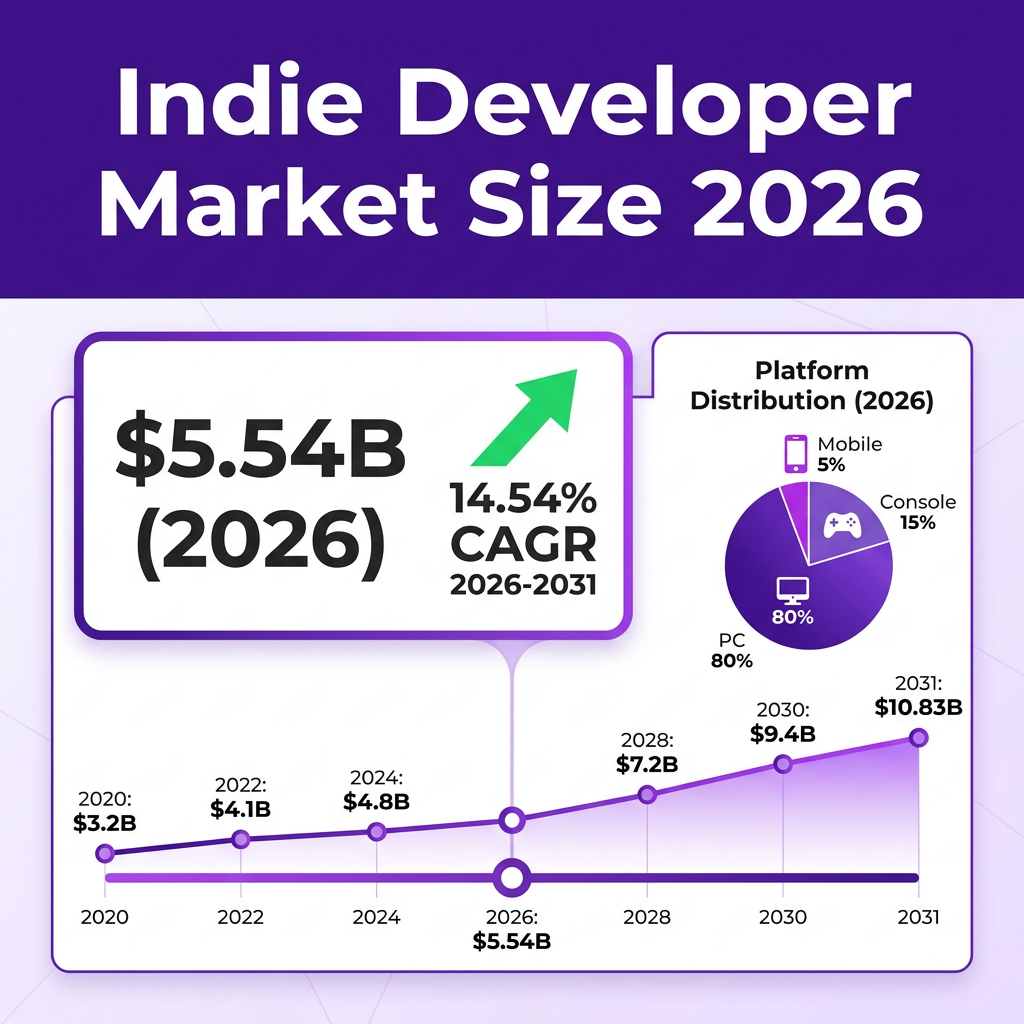
Welcome to the paradox of the indie developer market in 2026 — where the barrier to entry has never been lower, the tools have never been more powerful, but the path to sustainable success has never been more challenging. The global indie game market is projected to reach $5.54 billion in 2026, growing at a compound annual growth rate (CAGR) of 14.54% through 2031 when it will hit $10.83 billion. Yet beneath these impressive headline numbers lies a more complex reality: while the total revenue for indie games on Steam reached $650 million in Q1 2026 alone, this money is increasingly concentrated among a smaller number of breakout hits. This comprehensive analysis examines the complete indie developer landscape in 2026, drawing on the latest market data, industry reports, and expert insights to provide a clear picture of where the market stands, where it is headed, and what strategies are working for successful independent developers in this rapidly evolving ecosystem.

Market Overview: The $5.54 Billion Indie Developer Ecosystem
The indie developer landscape has undergone a remarkable transformation over the past decade. What began as a niche hobby for passionate programmers has evolved into a legitimate career path and a multi-billion dollar industry. In 2026, independent game developers and software creators are not just surviving — they are thriving in ways that would have seemed impossible just a few years ago.
The numbers tell a compelling story of growth and opportunity. The global indie game market reached $4.85 billion in 2025 and is projected to hit $5.54 billion in 2026, representing a robust compound annual growth rate of 14.54%. This growth trajectory is expected to continue through 2031, when the market is forecast to reach $10.83 billion. These figures represent more than just financial growth; they signal a fundamental shift in how games are created, distributed, and consumed.
Steam, the dominant platform for PC gaming, has become the primary battleground for indie developers. According to Alinea Analytics estimates, around 20,000 games were released on Steam in 2025, the vast majority of them indie titles. Yet the revenue distribution tells a sobering story: only around 300 games generated over $1 million in revenue. This concentration of success is both a warning and an opportunity — it demonstrates that while the market is crowded, significant financial success is still achievable for those who can break through the noise.
The platform distribution reveals where indie developers are focusing their efforts. According to the GDC 2025 State of the Game Industry Report, 80% of indie developers target the PC market as their primary platform. This makes sense given Steam’s established infrastructure, massive user base of over 132 million monthly active users, and relatively open publishing policies. Console development accounts for approximately 15% of indie focus, while mobile represents just 5% — a dramatic shift from the mobile gold rush of the early 2010s.
The revenue concentration on Steam is stark. According to Games-Stats.com data, the Indie tag on Steam represents approximately 93,462 games generating roughly $16 billion in total revenue. However, the median revenue per game is approximately $570, while the average sits at around $220,000. This massive disparity between median and average indicates that a small number of highly successful titles are pulling up the average, while the majority of indie games struggle to generate meaningful revenue.
Perhaps most remarkably, over $500 million in gross revenue on Steam (3% of the year’s total) came from just the top 5 new indie releases of 2025: Schedule I ($151M), R.E.P.O., and three other breakout hits. This concentration of revenue demonstrates both the potential for massive success and the challenge of achieving it. The indie market is increasingly becoming a hits-driven business, where a small number of titles capture the lion’s share of revenue and attention.
The broader gaming market context is also important. The global games market in 2026 is expected to exceed $200 billion, with indie games capturing an increasingly significant portion of this pie. According to industry analysts, indie PC revenues have increased at a compound annual rate of 22% between 2018 and 2024, compared to just 8% for AA and AAA games. This outperformance is remarkable given that it happened without a major change in indies’ share of total games available on Steam.
Key Statistics and Data Points
The indie developer market in 2026 is defined by a series of striking statistics that reveal both the opportunities and challenges facing independent creators. Understanding these numbers is essential for anyone looking to enter or succeed in this space.
Market Size and Growth: The indie game market is valued at $5.54 billion in 2026, up from $4.85 billion in 2025. This represents a compound annual growth rate of 14.54%, with projections showing the market reaching $10.83 billion by 2031. The broader video game market is expected to grow from $289.73 billion in 2025 to $326.47 billion in 2026, eventually reaching $593.35 billion by 2030.
Steam Platform Statistics: Steam remains the dominant platform for indie developers. In 2025, approximately 19,606 games were released on Steam — a record number that demonstrates both the accessibility of the platform and the intensity of competition. According to Valve’s GDC 2026 presentation, 5,863 games earned $100,000 or more in 2025 on Steam. This means that roughly 30% of released games achieved what most would consider a baseline level of commercial success.
Revenue Distribution: The revenue concentration in the indie market is extreme. In a study of the top-performing 100 indie games of 2024, just over 8% of these titles captured 80% of the total revenue. Expanding this analysis to a sample of 12,000 indie games reveals that fewer than 0.5% of them account for 80% of the revenue made in the market. This Pareto distribution is even more extreme than in many other creative industries.
Indie Revenue Share: Indie projects generated approximately 25% of the total game revenue on Steam by the end of 2025. According to analysts’ calculations, from January 1 to December 19, 2025, all games on Steam collectively earned a record $17.7 billion. Of this total, around $4.5 billion came from indie games. This 25% share represents a significant increase from previous years and demonstrates the growing commercial importance of independent development.
Development Costs and Timelines: The average indie game now takes 2-3 years to develop, with costs ranging from $50,000 to $500,000 depending on scope and team size. Solo developers working part-time might spend 12 to 24 months bootstrapping on the side before going full-time. Publisher funding for established indie titles typically ranges from $100,000 to $2 million, providing not just capital but also marketing expertise, QA resources, and platform relationships.
AI Adoption in Development: The impact of AI on game development has been profound and rapid. According to BCG’s 2026 Global Gaming Report, approximately 50% of game studios now actively use AI in development, with over 7,300 games on Steam disclosing AI applications — double the figure from 2024. However, this adoption is not without controversy: 52% of game professionals now view generative AI negatively, up from 30% in 2025, while Quantic Foundry research shows 85% of gamers hold negative attitudes toward AI in games.
Genre and Tag Performance: According to Games-Stats.com data, the Indie tag on Steam shows the following distribution: 76% of games are classified as Indie, with 12% also tagged as Action, 6% as Adventure, and 5% as Casual. The total estimated revenue for Indie-tagged games is approximately $16 billion across 93,462 titles. The average revenue per game is approximately $220,000, while the median is just $570 — highlighting the extreme variance in outcomes.
Platform Preferences: The GDC 2025 State of the Game Industry Report reveals that 80% of indie developers focus on PC as their primary platform. Console development attracts 15% of indie attention, while mobile has fallen to just 5%. This platform distribution reflects both the accessibility of PC development and the challenges of mobile discovery and monetization in an era of dominant free-to-play titles.
Funding Landscape: The funding environment for indie developers has expanded significantly. Traditional publishers now compete with crowdfunding platforms, angel investors, revenue-sharing models, and an expanding ecosystem of grants designed specifically for independent creators. According to industry data, there are now 40+ funding options available for indie game developers in 2026, ranging from micro-grants of $500 to publisher deals worth millions.
Success Rates: The harsh reality of indie development is reflected in the success statistics. While 5,863 games earned $100,000+ on Steam in 2025, this represents only about 30% of the approximately 20,000 games released. The majority of indie games fail to generate significant revenue, with many earning less than $1,000 in their lifetime. However, for those that do break through, the rewards can be substantial — the top 5 new indie releases of 2025 generated over $500 million combined.
Major Trends Shaping Indie Development in 2026
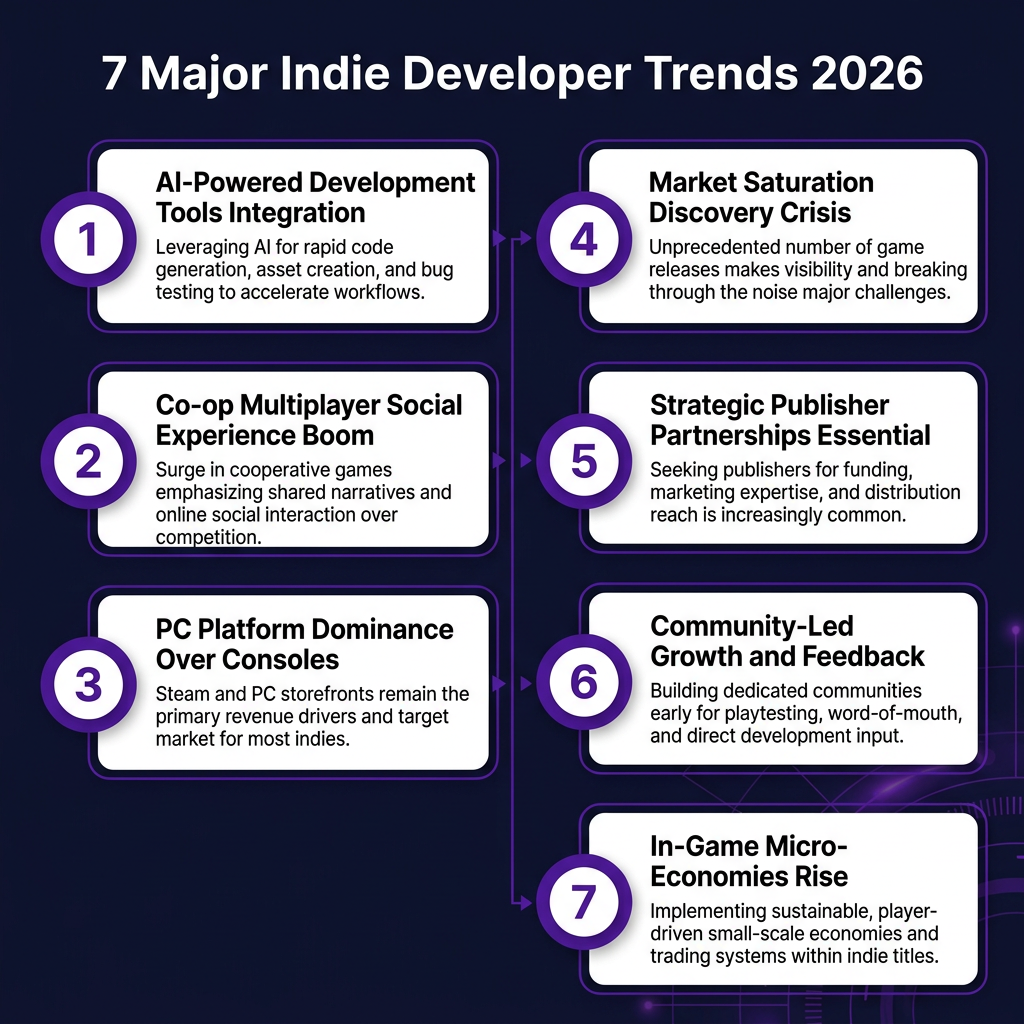
The indie developer landscape in 2026 is being shaped by seven major trends that are fundamentally changing how games are created, marketed, and monetized. Understanding these trends is crucial for any developer looking to succeed in this competitive environment.
1. AI-Powered Development Democratization
Artificial intelligence has become an integral part of the indie development toolkit. According to industry surveys, 87% of game developers are using AI agents in their workflows as of 2025. The applications are wide-ranging: asset generation, NPC AI, procedural generation, game art, narrative design, animation, voice acting, and automated playtesting.
Top AI tools for game development in 2026 include Midjourney ($30/month) for concept art and character design, Scenario.gg ($20-200/month) for custom game asset generation, Inworld AI ($20-100/month) for intelligent NPCs with memory and personality, Unity AI for integrated level design and testing, Promethean AI (free for indie) for environment design, NVIDIA Canvas (free) for AI-powered landscape creation, ChatGPT Plus ($20/month) for dialogue and narrative writing, and Leonardo.AI ($12-48/month) for game art generation.
The impact on development timelines has been dramatic. One AAA studio reported generating 10,000 item icons and descriptions in one month using AI, compared to six months manually — saving $150,000 and five months of development time. For indie developers with limited resources, these efficiency gains can be the difference between completing a project and abandoning it.
2. The Co-op Multiplayer Boom
One of the most significant trends in 2026 is the rise of cooperative multiplayer indie games. The success of titles like Schedule I and R.E.P.O. has demonstrated that players are hungry for shared experiences that emphasize collaboration over competition. This trend reflects a broader shift in player preferences toward social gaming experiences that can be enjoyed with friends.
The co-op trend is particularly interesting because it represents a viable path to success for smaller teams. While competitive multiplayer games often require massive player bases to function effectively, co-op games can succeed with smaller, more dedicated communities. This makes them an attractive option for indie developers who may not have the resources to support large-scale multiplayer infrastructure.
3. PC Platform Dominance
The dominance of PC as the primary platform for indie developers has only strengthened in 2026. With 80% of indie developers targeting PC as their primary platform, the ecosystem has become increasingly PC-centric. This concentration has both benefits and drawbacks. On the positive side, it means that tools, tutorials, and community resources are heavily focused on PC development. On the negative side, it means that PC marketplaces like Steam are becoming increasingly crowded and competitive.
The reasons for PC dominance are clear: Steam offers the most accessible path to market for indie developers, with relatively low barriers to entry and a massive built-in audience. The platform’s review system, wishlist functionality, and discovery algorithms provide mechanisms for quality games to find their audience. However, as more developers flock to Steam, standing out from the crowd has become increasingly challenging.
4. Market Saturation and the Discoverability Crisis
Perhaps the most significant challenge facing indie developers in 2026 is market saturation. With nearly 20,000 games released on Steam in 2025 alone, the platform has become incredibly crowded. This saturation has created a discoverability crisis where even high-quality games struggle to find their audience.
The statistics paint a stark picture: while the total revenue for indie games on Steam reached $650 million in Q1 2026, this money is increasingly concentrated among a smaller number of breakout hits. The median revenue for indie games on Steam is just $570, meaning that the majority of indie games fail to generate meaningful revenue. This concentration of success has made discoverability the single biggest challenge facing independent creators today.
5. Strategic Publisher Partnerships
In response to the discoverability crisis, more indie developers are turning to publishers for support. Working with a publisher can provide substantial funding — typically $100,000 to $2 million for established indie publishers — along with marketing expertise, QA resources, and platform relationships. Publishers like Devolver Digital, Team17, tinyBuild, and Hooded Horse have built reputations for successfully launching indie titles.
The publisher relationship has evolved beyond simple funding. Modern indie publishers offer comprehensive support including marketing campaigns, influencer outreach, platform negotiations, localization, and ongoing post-launch support. For developers struggling with the business side of game development, a good publisher partnership can be transformative.
6. Community-Led Development and Open Development
Successful indie developers in 2026 are increasingly embracing community-led development models. Crowdfunding, open development, and community playtests are shaping the direction of indie titles long before launch. This approach has multiple benefits: it generates early buzz and wishlists, provides valuable feedback during development, and builds a dedicated community that will advocate for the game at launch.
Platforms like Kickstarter, Patreon, and Discord have become essential tools for indie developers looking to build communities around their projects. The most successful indie developers treat community building as a core part of their development process, not an afterthought to be addressed at launch.
7. The Rise of Micro-Economies
One of the most profound shifts in the indie landscape is the rise of micro-economies powered by modding and user-generated content marketplaces. According to industry analysis, these micro-economies are projected to account for nearly 20% of indie game revenue globally. Games that support modding and user-generated content can benefit from ongoing engagement and revenue long after their initial release.
This trend reflects a broader shift in how games are monetized. Rather than relying solely on initial sales, successful indie developers are building sustainable revenue streams through DLC, cosmetics, and community-driven content. This approach can transform a single successful game into a long-term business.
Key Players and Competitive Landscape
The indie developer ecosystem in 2026 is populated by a diverse array of players, from solo developers working in their spare time to established indie studios with multiple successful releases. Understanding the competitive landscape is essential for anyone looking to enter or succeed in this market.
Top Indie Publishers
Several publishers have established themselves as key players in the indie space. Devolver Digital has built a reputation for publishing quirky, innovative titles that push boundaries. Their portfolio includes hits like Hotline Miami, Fall Guys (before acquisition by Epic), and Cult of the Lamb. Devolver is known for taking risks on unusual concepts and providing comprehensive marketing support.
Team17 has evolved from a single-game developer (Worms) into a major indie publisher. Their portfolio spans multiple genres and includes successful titles like Overcooked, Yooka-Laylee, and Hell Let Loose. Team17 offers developers access to their extensive platform relationships and marketing expertise.
tinyBuild has carved out a niche in the horror and simulation genres, with hits like Hello Neighbor and Graveyard Keeper. Their focus on specific genres allows them to build deep expertise and targeted marketing capabilities.
Hooded Horse has emerged as a significant player in the strategy and simulation space, publishing successful titles like Manor Lords and Against the Storm. Their focus on underserved niches has allowed them to build a loyal audience of strategy enthusiasts.
PlayWay has taken a unique approach, publishing a large volume of simulation and casual games. Their portfolio includes hundreds of titles across multiple platforms, demonstrating that there is value in serving niche audiences with specific interests.
Breakout Indie Success Stories of 2025-2026
The indie landscape is defined by its breakout successes — games that capture the zeitgeist and generate massive revenue despite being created by small teams. Schedule I stands as the most successful indie release of 2025, generating $151 million in revenue. The game’s success demonstrates that even in a crowded market, innovative concepts can break through to massive audiences.
R.E.P.O. represents another major success story, contributing to the over $500 million generated by the top 5 indie releases of 2025. The game’s cooperative multiplayer focus aligns with the broader trend toward social gaming experiences.
Mouthwashing has become one of the biggest gaming sensations of recent years, despite being a heavily character-focused game with very little actual gameplay. The psychological horror title demonstrates the power of narrative and atmosphere in the indie space.
Hollow Knight: Silksong, the long-awaited sequel to Hollow Knight, represents the power of building anticipation through quality and community engagement. Despite years of delays, the game maintains massive anticipation and will likely be a major commercial success upon release.
Platform Holders and Infrastructure Providers
Beyond publishers and developers, several platform holders and infrastructure providers play crucial roles in the indie ecosystem. Valve and Steam remain the dominant force, with their platform serving as the primary marketplace for PC indie games. Steam’s discovery algorithms, review system, and wishlist functionality provide mechanisms for quality games to find their audience.
Epic Games Store has emerged as a competitor to Steam, offering developers more favorable revenue splits and occasional exclusive deals. While Epic’s market share remains smaller than Steam’s, their aggressive strategy has forced Valve to improve their offerings for developers.
itch.io serves as an alternative platform focused on experimental and artistic games. While itch.io generates less revenue than Steam, it provides a home for games that might not fit Steam’s commercial focus and serves as an important incubator for indie talent.
Unity and Unreal Engine provide the technical infrastructure that powers the majority of indie games. Both engines have evolved to become more accessible to smaller teams, with Unity particularly popular among mobile and 2D developers and Unreal dominating the 3D space.

Challenges and Pain Points
Despite the opportunities, indie developers in 2026 face significant challenges that can make or break their projects. Understanding these challenges is the first step toward overcoming them.
1. The Discoverability Crisis
The single biggest challenge facing indie developers is discoverability. With nearly 20,000 games released on Steam in 2025, standing out from the crowd has become incredibly difficult. The median revenue of just $570 per game on Steam demonstrates that most indie games fail to find any meaningful audience.
This discoverability crisis is compounded by Steam’s algorithm-driven discovery systems. While these algorithms can surface quality games, they also create a winner-take-all dynamic where successful games get more visibility, while unknown games struggle to get any attention at all. Breaking through this algorithmic barrier requires either significant marketing spend or a stroke of viral luck.
The challenge is not just technical but psychological. Developers pour years of their lives into projects, only to release them into a void where they generate minimal sales. This experience can be devastating both financially and emotionally, leading many talented developers to leave the industry entirely.
2. Development Costs and Financial Pressure
While tools have become more accessible, the cost of creating a competitive indie game has increased. The average indie game now takes 2-3 years to develop, with costs ranging from $50,000 to $500,000. For solo developers or small teams, this represents a significant financial commitment with no guarantee of return.
Many developers bootstrap their projects, working part-time jobs while developing their games on nights and weekends. This approach can extend development timelines significantly, increasing the risk that market conditions will change before the game is released. The financial pressure can also lead to burnout, as developers struggle to balance their day jobs with their passion projects.
Funding options exist, from publishers to crowdfunding to grants, but each comes with its own challenges. Publishers take a significant revenue share and may demand creative control. Crowdfunding requires marketing skills that many developers lack. Grants are competitive and rarely provide enough funding for full development.
3. Market Saturation and Player Expectations
The sheer volume of games being released has raised player expectations while simultaneously making it harder for any individual game to succeed. Players now have access to thousands of high-quality games at low prices, making them less likely to take chances on unknown titles.
This saturation has also driven down prices. With so many games competing for attention, developers often feel pressured to price their games lower than they would like, reducing potential revenue. The race to the bottom in pricing makes it difficult for developers to recoup their investment, let alone make a profit.
Player expectations have also increased. With AAA games setting high standards for graphics, polish, and content, indie developers must work harder to compete. A game that might have been successful five years ago may now be seen as unpolished or lacking in content.
Opportunities and Growth Strategies
Despite the challenges, significant opportunities exist for indie developers who can navigate the current landscape effectively. The following strategies have proven successful for developers in 2026.
1. Leverage AI for Efficiency
AI tools have become essential for indie developers looking to compete with limited resources. By leveraging AI for asset generation, coding assistance, and marketing content, small teams can achieve results that would have required much larger teams in the past.
The key is to use AI strategically, focusing on areas where it can provide the most value. Asset generation is an obvious application, with tools like Midjourney and Scenario.gg enabling developers to create professional-quality art at a fraction of the cost of hiring artists. But AI can also assist with coding, narrative design, marketing copy, and even playtesting.
Developers who embrace AI early and develop workflows that integrate it effectively will have a significant advantage over those who resist the technology. The efficiency gains from AI can mean the difference between completing a project and running out of resources.
2. Build Community Early
The most successful indie developers in 2026 treat community building as a core part of their development process, not an afterthought. By engaging with potential players early — through social media, Discord servers, development blogs, and playable demos — developers can build an audience that will support them at launch.
This community-first approach has multiple benefits. It generates early wishlists, which are crucial for Steam’s discovery algorithms. It provides valuable feedback that can improve the game. And it creates advocates who will spread the word about the game organically.
The key is authenticity. Players can tell when developers are genuinely passionate about their projects versus when they are just trying to build marketing lists. Successful community building requires real engagement and a willingness to listen to feedback.
3. Focus on Underserved Niches
While the overall market is saturated, specific niches remain underserved. By identifying and targeting these niches, developers can find audiences that are hungry for content and willing to support creators who serve them.
Hooded Horse’s success in the strategy space demonstrates the power of niche focus. By concentrating on strategy and simulation games, they have built a loyal audience that trusts their curation and is eager to buy their releases. Other successful niches include cozy games, specific simulation genres, and retro-inspired titles.
The key is to understand the niche deeply and deliver something that genuinely serves its audience. Superficial targeting of a niche without understanding what its players want is unlikely to succeed.
Case Studies and Success Stories
The best way to understand what works in the indie space is to examine the success stories of developers who have navigated the challenges and emerged victorious. The following case studies illustrate different paths to success in the 2026 indie landscape.
Case Study 1: Schedule I — The Breakout Hit
Schedule I represents the dream scenario for indie developers: a game that captures the zeitgeist and generates massive revenue. With $151 million in revenue, it stands as the most successful indie release of 2025 and demonstrates that even in a crowded market, innovative concepts can break through to massive audiences.
The game’s success can be attributed to several factors. First, it tapped into a specific cultural moment with perfect timing. Second, it delivered a polished, engaging experience that kept players coming back. Third, it benefited from organic word-of-mouth marketing as players shared their experiences on social media.
The lesson for other developers is that while replicating Schedule I’s success is unlikely, the factors that contributed to it — cultural relevance, polish, and shareability — are worth pursuing. Games that can tap into current trends while delivering genuine quality have the best chance of breaking through.
Case Study 2: Vampire Survivors — The Great Conjunction
Vampire Survivors represents what industry analyst Chris Zukowski calls a “Great Conjunction” — a period where the genres that are easier to make are also the games that players are hungry for. The game’s simple mechanics and retro graphics were easy to implement, yet they resonated deeply with players looking for satisfying gameplay loops.
The game’s success demonstrates the power of understanding player psychology. By stripping away complexity and focusing on a core satisfying loop, the developers created something that was both easy to make and highly appealing to players. The low price point also made it an easy impulse purchase.
The lesson here is that developers should pay attention to market conditions and be ready to move quickly when a Great Conjunction occurs. Being able to identify and capitalize on these moments can lead to outsized success.
Case Study 3: Bootstrapped Solo Success
While the breakout hits get the headlines, many indie developers are finding success through more modest means. The bootstrapping approach — building a game while working a day job, then transitioning to full-time development once revenue supports it — remains a viable path.
According to data from successful bootstrapped founders, the pattern is clear: spend more time on research than building, validate demand before writing code, and be prepared to iterate based on player feedback. Many founders bootstrap on the side for 12 to 24 months before going full-time.
The key to bootstrapped success is patience and discipline. Developers must resist the urge to quit their day jobs prematurely and be willing to put in the work on nights and weekends. But for those who can sustain the effort, the reward is a sustainable business built on their own terms.
Future Outlook and Predictions
Looking ahead to 2027-2031, several trends are likely to shape the future of indie development. Understanding these trends can help developers position themselves for success in the coming years.
Market Growth Projections
The indie game market is projected to continue its strong growth trajectory. From $5.54 billion in 2026, the market is expected to reach $10.83 billion by 2031, representing a compound annual growth rate of 14.54%. This growth will be driven by continued technological advancement, expanding global markets, and the increasing acceptance of indie games as a legitimate form of entertainment.
The broader video game market is also expected to grow significantly, from $326.47 billion in 2026 to $593.35 billion by 2030. As the overall market expands, indie games are well-positioned to capture a growing share, thanks to their innovation, creativity, and ability to serve niche audiences that AAA studios often ignore.
Technology Trends
Several technological trends will shape the future of indie development. AI will continue to democratize game creation, enabling smaller teams to achieve results that previously required large studios. Cloud gaming and streaming technologies will expand the potential audience for indie games by removing hardware barriers. And new platforms like the Nintendo Switch 2 will create fresh opportunities for developers to reach players.
However, these technological advances also bring challenges. As AI tools become more widespread, the barrier to entry will drop even further, potentially increasing market saturation. Developers will need to find new ways to differentiate their games in an increasingly crowded market.
Platform Evolution
The platform landscape is likely to evolve significantly over the next five years. Steam will remain dominant, but competitors like Epic Games Store may gain market share through aggressive exclusive deals and developer-friendly policies. New platforms may emerge, particularly in the cloud gaming space, creating new distribution opportunities for indie developers.
Mobile may also see a resurgence for indie developers, particularly as Apple and Google face regulatory pressure to open their platforms to alternative payment methods and distribution channels. This could create new opportunities for indie developers who have previously avoided mobile due to its restrictive policies.
Business Model Innovation
The business models for indie games are likely to continue evolving. Subscription services like Xbox Game Pass have already changed how players discover and consume indie games, and this trend is likely to accelerate. Developers will need to adapt to a landscape where upfront purchases are increasingly supplemented or replaced by recurring revenue streams.
The rise of user-generated content and modding as revenue sources will also continue. Games that can build sustainable ecosystems around player-created content will have a significant advantage over those that rely solely on initial sales.
Understanding the Indie Developer Demographics
The indie developer community in 2026 is remarkably diverse, encompassing everyone from solo developers working in their bedrooms to small teams of 5-15 people operating as formal studios. Understanding this demographic landscape is crucial for anyone looking to serve or enter this market.
Solo Developers: The majority of indie developers are solo creators, working alone on their projects. These developers often have day jobs and work on their games during evenings and weekends. The barrier to entry for solo development has never been lower, with powerful free tools like Godot, affordable Unity licenses, and a wealth of free learning resources available online. However, solo developers face unique challenges, including the need to wear multiple hats — programmer, artist, designer, marketer — and the isolation that can come from working alone.
Micro-Teams (2-5 people): Small teams represent a significant portion of the indie ecosystem. These teams often consist of friends or colleagues who have complementary skills — perhaps a programmer and an artist, or a designer and a musician. Micro-teams can achieve more than solo developers while maintaining the agility and creative freedom that defines indie development. However, they also face challenges around coordination, revenue sharing, and decision-making.
Small Studios (5-15 people): At the larger end of the indie spectrum are small studios that operate more like traditional game companies, with dedicated roles and more formal structures. These studios can tackle more ambitious projects and often have multiple games in development simultaneously. However, they also face higher burn rates and greater pressure to generate consistent revenue.
Geographic Distribution: Indie development is a global phenomenon, with significant hubs in North America, Europe, and Asia. However, the rise of remote work and digital distribution has democratized access, enabling developers from anywhere in the world to reach global audiences. This geographic diversity brings a wealth of different perspectives and cultural influences to the indie scene.
Tools and Technologies Powering Indie Development
The indie development ecosystem is supported by a rich array of tools and technologies that have made game creation more accessible than ever before. Understanding these tools is essential for anyone looking to enter the indie space.
Game Engines: Unity and Unreal Engine dominate the indie space, with Unity being particularly popular among 2D and mobile developers and Unreal dominating the 3D space. However, Godot has emerged as a significant free and open-source alternative, particularly popular among solo developers and those who prefer open-source tools. Other engines like GameMaker and Construct serve specific niches, particularly 2D game development.
Art and Animation Tools: For art creation, indie developers rely on a mix of professional and affordable tools. Adobe Creative Suite remains popular, but alternatives like Affinity Designer, Aseprite (for pixel art), and Blender (for 3D modeling) have gained significant traction due to their lower cost or free availability. The rise of AI art tools has also changed the landscape, enabling developers to generate assets quickly and cheaply.
Audio Tools: Audio creation tools have also become more accessible. Tools like FMOD and Wwise provide professional audio middleware at affordable prices, while free alternatives like Audacity and LMMS enable developers to create quality audio on a budget. Royalty-free music and sound effect libraries have also expanded, giving developers access to professional audio without the cost of hiring composers.
Marketing and Analytics Tools: Marketing has become a crucial part of indie development, and a ecosystem of tools has emerged to support it. SteamDB and similar tools provide market intelligence, while social media management tools help developers maintain their presence across platforms. Analytics tools like Google Analytics and Steam’s built-in analytics help developers understand player behavior and optimize their games.
The Economics of Indie Game Publishing
Understanding the economics of indie game publishing is crucial for developers looking to make a living from their work. The financial realities of indie development are complex and often misunderstood.
Revenue Sharing Models: Different platforms take different cuts of game sales. Steam takes a 30% cut of sales (reducing to 25% after $10 million and 20% after $50 million). Epic Games Store takes a 12% cut, making it more developer-friendly but with a smaller user base. itch.io allows developers to set their own revenue share, with many choosing to give itch.io a small percentage or nothing at all. Console platforms typically take 30% but have higher barriers to entry.
Publisher Deals: Publisher deals vary widely, but typically involve the publisher providing funding in exchange for a revenue share of 30-50% after recoupment. Some publishers also take an ownership stake in the IP. The key for developers is to understand what they’re getting in exchange for the revenue share — marketing support, QA, platform relationships, and ongoing post-launch support can be worth the cost for the right partnership.
Pricing Strategies: Pricing indie games has become increasingly challenging as the market has become more crowded. The race to the bottom has driven prices down, with many indie games launching at $10-20, and some even lower. However, successful developers have shown that higher prices are possible for games that deliver genuine value. The key is to understand your audience and price accordingly — niche audiences are often willing to pay premium prices for games that serve them well.
Regional Pricing: Steam and other platforms support regional pricing, allowing developers to set different prices for different markets. This can be a powerful tool for maximizing revenue, as purchasing power varies significantly across regions. However, it also adds complexity and requires understanding of different markets.
Key Takeaways
- The indie game market is worth $5.54 billion in 2026 and is projected to grow to $10.83 billion by 2031, representing a significant opportunity for independent developers.
- Steam remains the dominant platform for indie developers, with 80% targeting PC as their primary platform and indie games generating 25% of Steam’s total revenue.
- Market saturation has created a discoverability crisis — with nearly 20,000 games released on Steam in 2025, standing out from the crowd is the single biggest challenge facing indie developers.
- AI is transforming indie development, with 87% of developers now using AI tools in their workflows. Those who embrace AI strategically will have a significant competitive advantage.
- Community building is essential — successful indie developers treat community engagement as a core part of their development process, not an afterthought.
- Niche focus can be a path to success — while the overall market is saturated, specific niches remain underserved and offer opportunities for developers who understand them deeply.
- Revenue concentration is extreme — fewer than 0.5% of indie games account for 80% of total revenue, making breakout success difficult but potentially very rewarding.
Sources and Citations
- Alinea Analytics — Steam Revenue and Release Data 2025-2026
- Games-Stats.com — Steam Tags and Genre Analysis 2026
- GDC 2026 State of the Game Industry Report
- BCG Global Gaming Report 2026
- SkyQuest Technology Consulting — Indie Game Market Forecast 2033
- Mordor Intelligence — Video Game Market Report 2025-2030
- Quantic Foundry — Gamer Attitudes Toward AI Research
- GameDev.tv Indie Fund Data 2026
- 80.lv — Indie Games Market Analysis
- HowToMarketAGame.com — Indie Game Marketing Research