Fraud Management Statistics 2026: Market Size, Data & Trends (Comprehensive Report)
Fraud is no longer just a cost of doing business—it’s a $67 billion industry that’s growing faster than most legitimate markets. In 2025, global e-commerce fraud losses hit $48 billion, up 16% from the previous year. By 2029, that number will more than double to $107 billion. For merchants, payment processors, and SaaS platforms, understanding the scale and mechanics of fraud isn’t optional anymore—it’s survival.
This report compiles the most current fraud management statistics from 2025-2026, drawing on data from Fortune Business Insights, Juniper Research, Mastercard, the FBI, and leading fraud prevention vendors. Whether you’re building a payment system, managing risk for an e-commerce platform, or simply trying to understand where the threats are coming from, this data will give you the foundation you need.
Key Fraud Management Statistics at a Glance
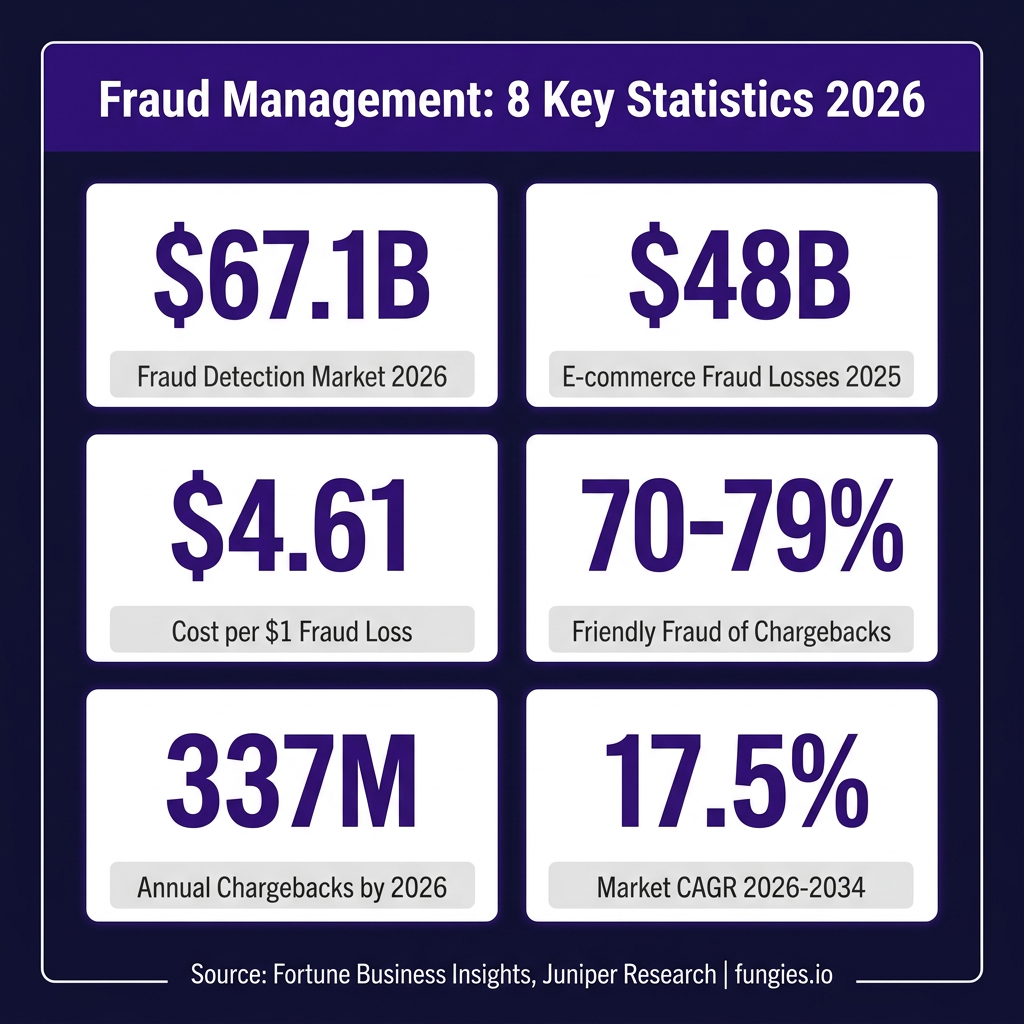
- The global fraud detection and prevention market will reach $67.12 billion in 2026, up from $54.61 billion in 2025 (Fortune Business Insights)
- Global e-commerce fraud losses hit $48 billion in 2025, a 16% year-over-year increase (Juniper Research)
- 70-79% of all chargebacks are now attributed to friendly fraud, not third-party criminal activity (Mastercard, Datos Insights)
- For every $1 lost to fraud, US merchants absorb $4.61 in total costs including fees, operational overhead, and lost merchandise (JustPricing)
- Global chargeback volume will surge to 337 million cases annually by 2026, a 42% increase (Datos Insights)
- Identity fraud losses reached $27.3 billion in 2025, affecting 18 million victims (Javelin Strategy & Research)
- Deepfake attacks on contact centers increased from 1 every 2 days in 2023 to 7 per day in 2024 (Pindrop)
- The fraud detection market is projected to grow at a 17.5% CAGR from 2026 to 2034, reaching $243.72 billion (Fortune Business Insights)
Global Fraud Detection & Prevention Market Size
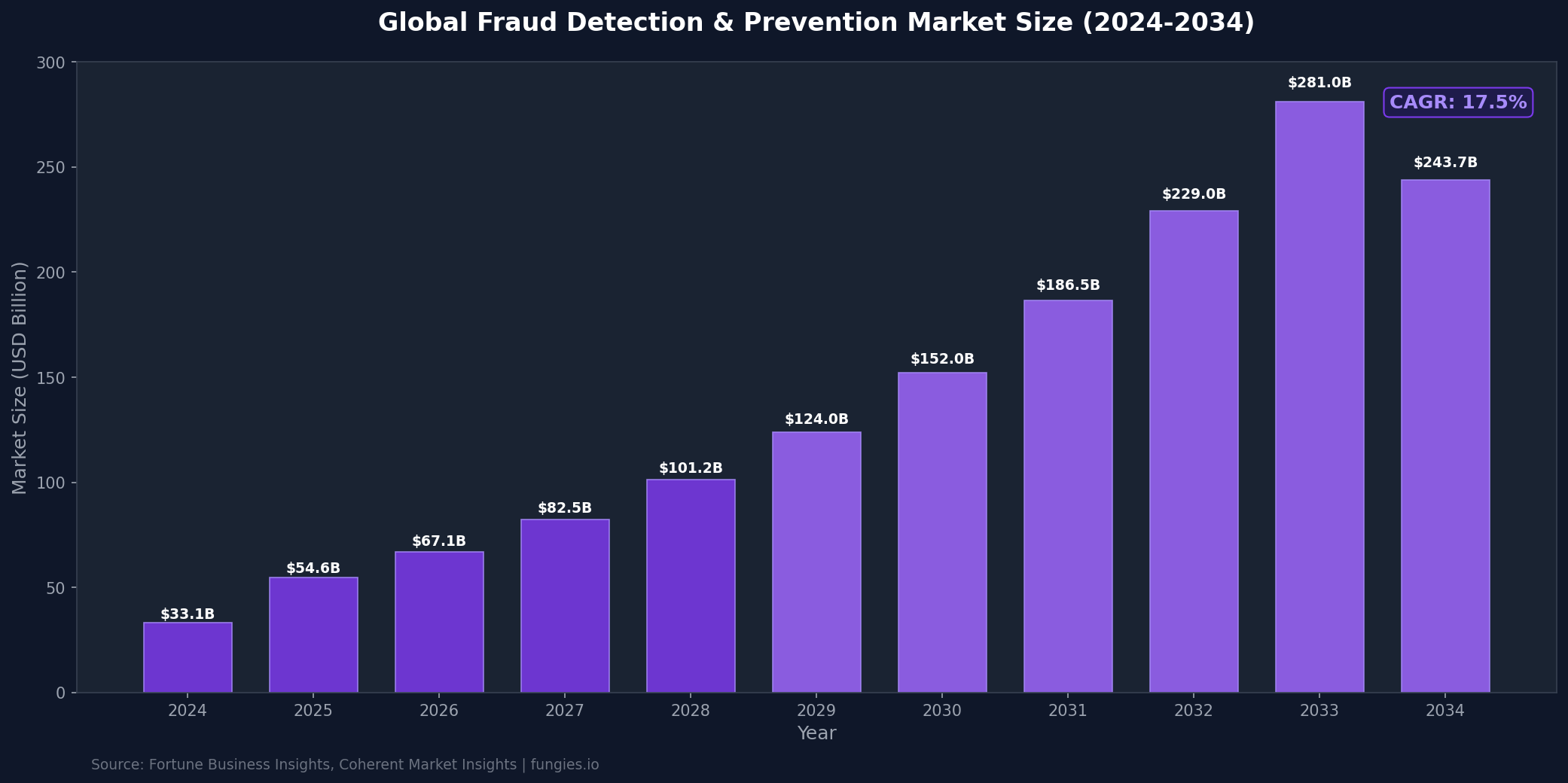
The fraud detection and prevention industry has evolved from a niche cybersecurity segment into a critical infrastructure component for global commerce. In 2024, the market was valued at $33.13 billion. By 2025, it had grown to $54.61 billion—a 65% single-year jump driven by escalating fraud volumes and regulatory pressure.
For 2026, analysts project the market will reach $67.12 billion. The long-term trajectory is even more striking: by 2034, the market will hit $243.72 billion, representing a compound annual growth rate (CAGR) of 17.5%. This growth isn’t speculative—it’s driven by measurable increases in fraud losses that force businesses to invest in prevention.
| Year | Market Size (USD Billion) | Growth Rate | Source |
|---|---|---|---|
| 2024 | $33.13B | — | Grand View Research |
| 2025 | $54.61B | +65% | Fortune Business Insights |
| 2026 | $67.12B | +23% | Fortune Business Insights |
| 2028 | $101.20B | +17.5% CAGR | Coherent Market Insights |
| 2030 | $152.00B | +17.5% CAGR | MarketsandMarkets |
| 2034 | $243.72B | +17.5% CAGR | Fortune Business Insights |
The AI fraud prevention subsegment is growing even faster. According to Future Market Insights, AI in fraud management will reach $17.4 billion by the end of 2026 and grow at an 18.5% CAGR to hit $95.1 billion by 2036. Machine learning in fraud detection specifically is projected to reach $302.9 billion by 2034, growing at a 35.8% CAGR from $14.2 billion in 2024.
Regional Breakdown: Where Fraud Prevention Spending Is Concentrated
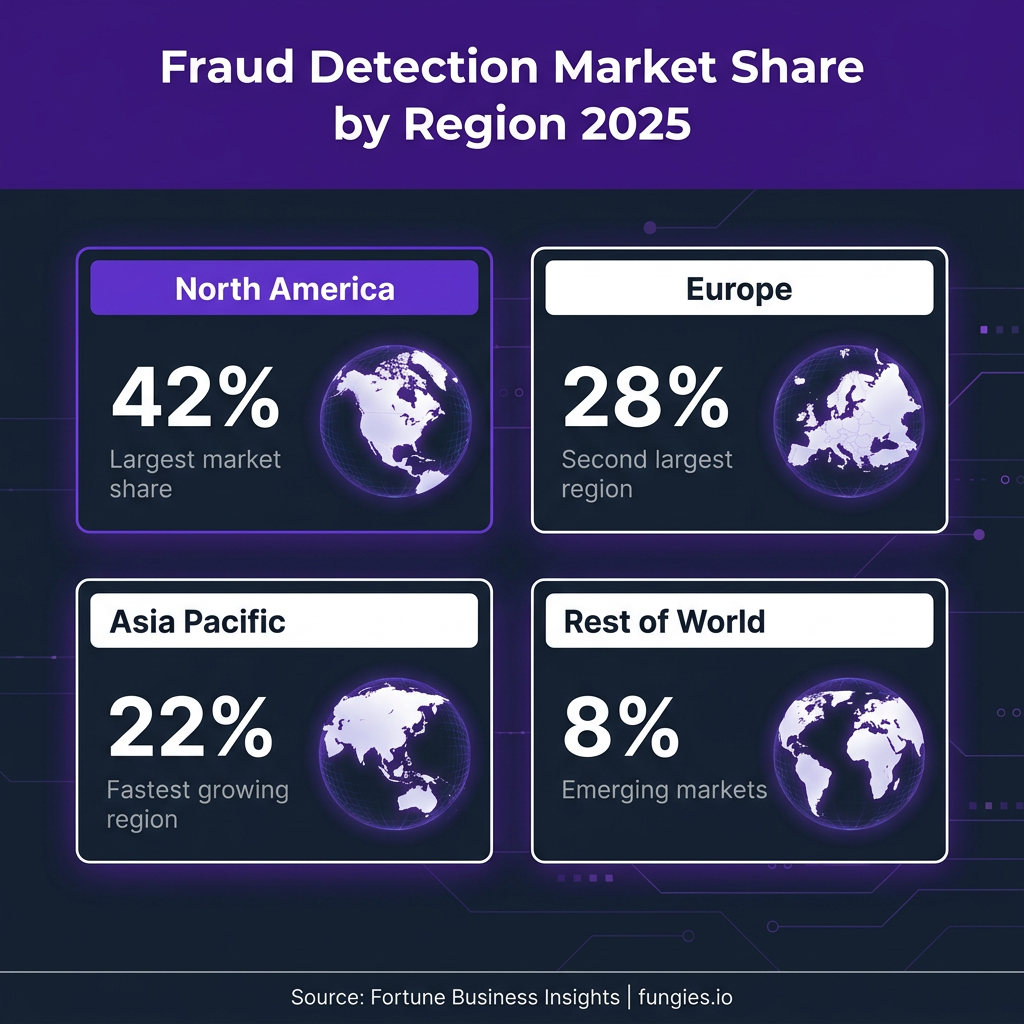
Fraud is a global problem, but prevention spending is concentrated in mature digital economies. North America dominates the market with a 42% share in 2025, driven by high e-commerce penetration, strict regulatory requirements, and sophisticated fraudster targeting of US consumers.
Europe holds the second-largest share at approximately 28%, with the UK, Germany, and France leading adoption. The Asia-Pacific region accounts for 22% of the market but is growing fastest as digital payments explode in India, Southeast Asia, and China.
| Region | Market Share (2025) | Key Characteristics | Growth Outlook |
|---|---|---|---|
| North America | 42.0% | Highest fraud losses per merchant; regulatory pressure | Steady growth |
| Europe | 28.0% | Strong PSD2/SCA compliance driving investment | Moderate growth |
| Asia Pacific | 22.0% | Fastest-growing region; mobile-first fraud | High growth |
| Latin America | 5.0% | Emerging market; increasing digital adoption | Rapid growth |
| Middle East & Africa | 3.0% | Nascent market; growing awareness | Emerging |
According to Research Nester, North America is expected to maintain its 35.9% share of the banking fraud management market through 2035. The region’s dominance stems from aggressive cybersecurity reforms, high digital payment volumes, and the concentration of major fraud prevention vendors.
Key Players & Market Share
The fraud detection market is fragmented but consolidating. Leading vendors include established technology giants, specialized fraud prevention firms, and emerging AI-native challengers. According to Frost & Sullivan, market leaders include:
| Company | Headquarters | Primary Focus | Notable Strengths |
|---|---|---|---|
| LexisNexis Risk Solutions | USA | Identity verification, fraud analytics | Comprehensive data assets |
| FICO | USA | Fraud analytics, scoring models | Enterprise banking clients |
| NICE Actimize | Israel/USA | Financial crime management | AML integration |
| IBM | USA | AI-powered fraud detection | Watson AI platform |
| SAS Institute | USA | Analytics, machine learning | Advanced analytics |
| Accertify (Amex) | USA | E-commerce fraud prevention | Merchant solutions |
| Forter | USA | Real-time decisioning | Identity-based fraud detection |
| Signifyd | USA | Chargeback protection | Revenue protection guarantee |
The fraud analytics segment specifically is projected to dominate with a 60.2% share of the overall market in 2026, according to Coherent Market Insights. This reflects the industry’s shift from rule-based systems to AI-powered behavioral analytics and real-time decision engines.
Fraud Losses by Category: Understanding the Threat Landscape
Not all fraud is created equal. Understanding the breakdown of fraud types helps businesses prioritize their prevention investments.
E-Commerce Fraud
E-commerce fraud is the largest and fastest-growing category. According to Juniper Research, global e-commerce fraud losses reached $48 billion in 2025—up from $44.3 billion in 2024. By 2029, losses will hit $107 billion, a 141% increase over five years.
The cumulative impact is staggering: merchants will lose over $362 billion to online payment fraud between 2023 and 2028. For perspective, that’s more than the GDP of many countries.
Identity Fraud
Identity fraud has evolved from isolated incidents to a scalable, transnational enterprise. According to Javelin Strategy & Research, identity fraud losses reached $27.3 billion in 2025, affecting 18 million victims in the US alone.
The FTC reported that identity theft reports filed between January and September 2025 already exceeded the total for all of 2024. Full-year 2025 projections suggest 1.86 million identity theft reports—an unprecedented volume.
Chargeback Fraud (Friendly Fraud)
Friendly fraud—where legitimate cardholders dispute valid transactions—has become the dominant fraud type. According to Mastercard’s 2025 State of Chargebacks report, friendly fraud now accounts for 70-79% of all chargebacks, up 19% over the past three years.
By 2026, chargeback fraud is expected to cost merchants $28.1 billion—a 40% increase from $20 billion in 2023. Global chargeback volume will reach 337 million cases annually by 2026, up 42% from current levels.
| Fraud Type | 2025 Losses | 2029 Projection | Growth Rate |
|---|---|---|---|
| E-commerce Fraud | $48.0B | $107.0B | +141% |
| Identity Fraud | $27.3B | $35.0B+ | +28% |
| Chargeback Fraud | $20.0B+ | $28.1B | +40% |
| Credit Card Fraud | $43.0B | $55.0B+ | +28% |
Industry Benchmarks: What Merchants Actually Experience
Understanding industry averages helps merchants benchmark their own fraud performance. According to the Merchant Risk Council’s 2025 Global Payments and Fraud Report, which surveyed 1,000+ merchants across 35+ countries:
| Metric | Industry Average | Source |
|---|---|---|
| Revenue spent on fraud management | 10% | MRC Global Report |
| Fraud attack increase (2024-2025) | 13% by value | Signifyd |
| Chargeback win rate | 41% | JustPricing |
| Net recovery rate (after costs) | 12-18% | Chargebacks911 |
| Friendly fraud % of chargebacks | 70-79% | Mastercard |
| Merchants reporting friendly fraud increase | 72% | Chargebacks911 |
| Average chargeback value (Q3 2025) | $301.91 | Sift |
| Abusive returns increase (May 2025) | 64% | Signifyd |
The cost multiplier is particularly striking: for every $1 lost to fraud, US merchants absorb $4.61 in total costs. This includes the original transaction value, chargeback fees, operational overhead for dispute management, and the cost of lost merchandise that isn’t recovered.
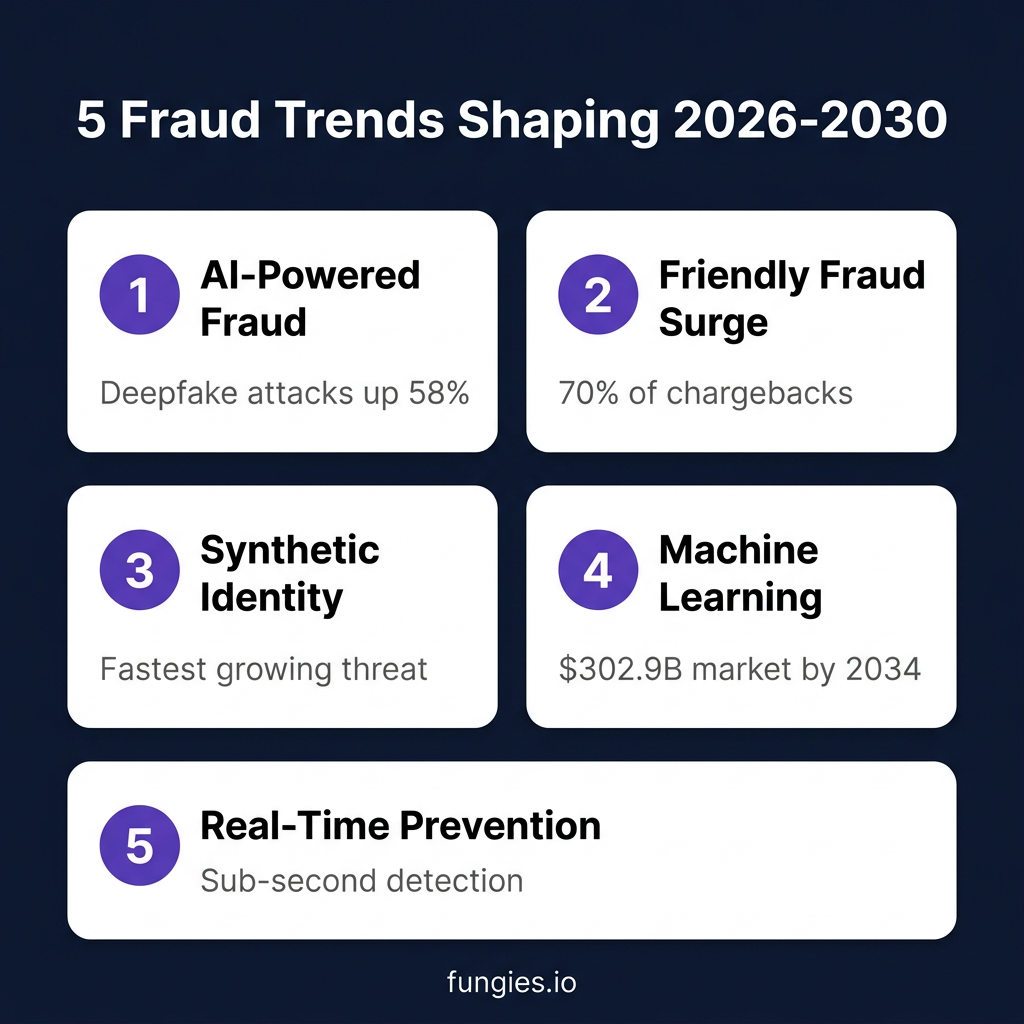
5 Major Fraud Trends Shaping 2026-2030
The fraud landscape is evolving rapidly. Here are the five trends that will define the next five years:
1. AI-Powered Fraud Attacks
Generative AI has become the engine driving fraud at scale. According to Sumsub’s 2025-2026 Identity Fraud Report, deepfakes now account for 11% of global fraudulent activity and one in five biometric fraud attempts. Deepfake usage in biometric fraud surged 58% year-over-year, while injection attacks rose 40%.
Pindrop’s 2025 Voice Intelligence Report found that deepfake attacks on contact centers increased from one every two days in 2023 to seven per day in 2024. Businesses now face an average of $343,000 in deepfake fraud exposure per contact center.
2. The Friendly Fraud Epidemic
Friendly fraud has overtaken third-party criminal fraud as the primary chargeback driver. Mastercard reports that 70-79% of chargebacks are now friendly fraud, and 72% of merchants reported an increase in 2024. The problem is compounded by easier dispute filing—consumers can now initiate chargebacks with a single click in banking apps.
3. Synthetic Identity Fraud
Synthetic identity fraud—creating fake identities by combining real and fabricated data—is one of the fastest-growing threats. According to PwC, synthetic identities bypass traditional verification systems because they don’t correspond to any real individual. The 2025 Identity Fraud Study found that synthetic identity creation is now automated at scale using AI.
4. Machine Learning Arms Race
The machine learning in fraud detection market is projected to reach $302.9 billion by 2034, growing at a 35.8% CAGR. This reflects an arms race: as fraudsters deploy AI to scale attacks, defenders must deploy AI to detect them. Real-time behavioral analytics, graph-based entity resolution, and sub-second decisioning are becoming table stakes.
5. Real-Time Prevention Requirements
The explosion of real-time payments (RTP, FedNow, SEPA Instant) means fraud detection must happen in milliseconds, not minutes. According to Juniper Research, fraud detection systems now need sub-second latency to intercept threats before settlement. This is driving adoption of edge computing and in-memory analytics.
Fraud Prevention by Industry Vertical
Fraud patterns vary significantly by industry. Here’s how different sectors are affected:
| Industry | Primary Fraud Types | 2025 Losses/Impact |
|---|---|---|
| Retail & E-commerce | Friendly fraud, return abuse, card testing | $48B+ globally |
| Banking & Financial Services | Account takeover, synthetic identity, wire fraud | $81.3B by 2035 |
| Travel & Hospitality | Card-not-present, loyalty fraud, refund abuse | High chargeback rates |
| Digital Goods & Gaming | Card testing, account takeover, virtual currency fraud | Rising rapidly |
| Insurance | Claims fraud, application fraud | $308B annually (US) |
| Healthcare | Identity theft, billing fraud | $68B annually (US) |
For SaaS and digital product companies specifically, fraud presents unique challenges. Card testing attacks—where fraudsters validate stolen cards using small transactions—can trigger payment processor penalties. Account takeover fraud targeting user accounts with stored payment methods is also rising sharply.
Methodology
This report synthesizes data from over 20 primary sources published between January 2025 and June 2026. Key sources include Fortune Business Insights, Juniper Research, Coherent Market Insights, MarketsandMarkets, Mastercard, the FBI Internet Crime Complaint Center (IC3), Javelin Strategy & Research, the Federal Trade Commission, and leading fraud prevention vendors including Signifyd, Sift, and Chargebacks911.
Market size figures represent analyst consensus where multiple sources exist. Where sources diverge significantly, we cite the range or the most recent authoritative estimate. All currency figures are in US dollars unless otherwise specified. Growth rates are compound annual growth rates (CAGR) unless noted as year-over-year.
Limitations: Some statistics, particularly around friendly fraud and synthetic identity, rely on merchant self-reporting and may understate the true scale. Regional breakdowns are approximate due to varying methodologies across research firms.
Frequently Asked Questions
What is the fraud detection market size in 2026?
The global fraud detection and prevention market will reach $67.12 billion in 2026, up from $54.61 billion in 2025. The market is projected to grow at a 17.5% CAGR through 2034, reaching $243.72 billion.
What percentage of chargebacks are friendly fraud?
According to Mastercard’s 2025 State of Chargebacks report, friendly fraud accounts for 70-79% of all chargebacks. This represents a 19% increase over the past three years as dispute filing has become easier for consumers.
How much do merchants lose to e-commerce fraud?
Global e-commerce fraud losses reached $48 billion in 2025, according to Juniper Research. By 2029, losses are projected to reach $107 billion—a 141% increase. For every $1 lost to fraud, US merchants absorb $4.61 in total costs.
What is synthetic identity fraud?
Synthetic identity fraud involves creating fake identities by combining real data (like Social Security numbers) with fabricated information. It’s one of the fastest-growing fraud types because these identities don’t correspond to real individuals, making them harder to detect with traditional verification systems.
How fast is AI fraud growing?
AI-powered fraud is growing exponentially. Deepfake attacks on contact centers increased from one every two days in 2023 to seven per day in 2024. Deepfakes now account for 11% of global fraudulent activity and one in five biometric fraud attempts.
Sources & Citations
- Fortune Business Insights. “Fraud Detection and Prevention Market Size, Share & Industry Analysis.” 2025. https://www.fortunebusinessinsights.com/industry-reports/fraud-detection-and-prevention-market-100231
- Juniper Research. “eCommerce Fraud Prevention Market 2025-2030.” December 2025. https://www.juniperresearch.com/research/fintech-payments/fraud-security/ecommerce-fraud-prevention-research-report
- Juniper Research. “Fraudulent eCommerce Transactions to Surpass $131 Billion.” https://www.juniperresearch.com/press/fraudulent-ecommerce-transactions-to-surpass-131bn
- Coherent Market Insights. “Fraud Detection Market Size, Share and Forecast, 2026-2033.” https://www.coherentmarketinsights.com/industry-reports/fraud-detection-market
- MarketsandMarkets. “Fraud Detection and Prevention Market Report 2025-2030.” https://www.marketsandmarkets.com/Market-Reports/fraud-detection-prevention-market-1312.html
- Future Market Insights. “AI in Fraud Management Market.” https://www.futuremarketinsights.com/reports/ai-in-fraud-management-market
- Research Nester. “Fraud Management in Banking Market Size, Growth Trends 2035.” https://www.researchnester.com/reports/fraud-management-in-banking-market/8183
- JustPricing. “47 Chargeback Statistics for 2026.” https://justpricing.com/chargeback-statistics
- Chargebacks911. “Chargeback Stats: All the Key Dispute Data Points for 2026.” https://chargebacks911.com/chargeback-stats
- Mastercard. “2025 State of Chargebacks Report.” March 2025. https://464903.fs1.hubspotusercontent-na1.net/hubfs/464903/2025%20state%20of%20chargebacks%20report.pdf
- Javelin Strategy & Research. “2025 Identity Fraud Study: Breaking Barriers to Innovation.” https://javelinstrategy.com/research/2025-identity-fraud-study-breaking-barriers-innovation
- Federal Trade Commission. Identity theft reporting data, Q1-Q3 2025. https://www.ftc.gov
- Sift. “Q4 2025 Digital Trust Index: Dispute & Chargeback Data.” https://sift.com/index-reports-disputes-q4-2025
- Signifyd. “State of Fraud and Returns Report 2025.” https://www.signifyd.com/ecommerce-fraud-and-returns-trends-2025
- Pindrop. “2025 Voice Intelligence and Security Report.” https://www.pindrop.com
- Sumsub. “Fraud Trends 2026: AI Scams, Deepfakes, and Emerging Threats.” https://sumsub.com/blog/fraud-trends
- Experian. “2026 Future of Fraud Forecast.” January 2026. https://fortune.com/2026/01/13/ai-fraud-forecast-2026-experian-deepfakes-scams
- PwC. “The Fraud Trend to Watch in 2026 and Beyond: The Era of Deepfakes and Synthetic Identities.” https://www.pwc.com/cz/cs/blog/rizeni-rizik/the-fraud-trend-to-watch-in-2026-and-beyond.html
- Merchant Risk Council. “2025 Global eCommerce Payments and Fraud Report.” https://merchantriskcouncil.org/learning/mrc-exclusive-reports/global-payments-and-fraud-report/2025-global-payments-and-fraud-report
- Ringly.io. “52 Ecommerce Fraud Statistics You Need to Know in 2026.” https://www.ringly.io/blog/ecommerce-fraud-statistics-2026
Last updated: June 1, 2026. Statistics reflect the most current available data as of publication date.