One developer paid $1,400 in a single month using Cursor. The pricing page said $20. Their actual bill said $1,400. That’s not a typo — it’s the new reality of AI coding tools in 2026.
Here’s the truth nobody puts on their pricing page: sticker prices range from $10 to $20 per month, but actual costs range from $10 to $1,400+ depending on which tool you pick and how you use it.
In this guide, I’ll break down the real costs of the five major AI coding tools in 2026. No marketing fluff. Just actual pricing data, hidden fees, and what you’ll really pay.

What Are AI Coding Tools?
AI coding tools are software that uses large language models to help you write, edit, debug, and review code. They fall into three categories:
- IDE extensions (GitHub Copilot) — integrate into your existing editor
- AI-native IDEs (Cursor, Windsurf) — purpose-built editors with AI at the core
- Terminal agents (Claude Code, OpenAI Codex) — command-line tools that can edit files and run commands
By 2026, these tools have moved from novelty to necessity. 41% of global code is now AI-generated, and 84% of developers use or plan to use AI tools according to Stack Overflow’s 2025 survey.
The 5 Best AI Coding Tools Ranked by Value
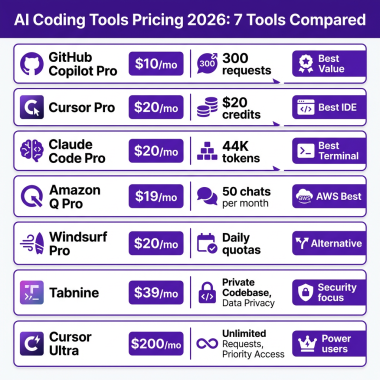
#1 GitHub Copilot — Best Value at $10/month
Price: $10/month individual | $19/month business
The good: Flat pricing with no overages. Works in VS Code, JetBrains, Xcode, Neovim, Eclipse, and Visual Studio. You get 300 premium requests per month, a coding agent, code review, and multi-model support including Claude Opus 4.6.
The catch: It’s primarily an autocomplete and chat tool. No terminal agent, no autonomous file editing across your entire codebase.
Best for: Developers who want reliable, predictable costs and already have a preferred IDE.
#2 Claude Code — Best Flat Pricing
Price: $20/month Pro | $100/month Max 5x | $200/month Max 20x
The good: The only tool where $20 actually means $20. No overages. No surprises. You get roughly $180 worth of API-equivalent token consumption for that flat $20. If you hit limits, Claude makes you wait until reset — annoying, but at least you know what you’re paying.
The catch: Terminal-first workflow. If you prefer GUI editors, this isn’t for you.
Best for: Developers who want predictable costs and don’t mind terminal-based workflows.
#3 Windsurf — Best for Cascade Agent
Price: $15/month Pro (500 credits) | $30/month Teams | $200/month Max
The good: Windsurf’s Cascade agent is genuinely impressive. The SWE-1 and SWE-1.5 models are purpose-built for software engineering tasks. At $15/month, it’s the cheapest entry point for a full AI IDE.
The catch: Windsurf switched to daily/weekly quotas on March 19, 2026. Heavy users may hit daily limits even on Pro. One developer reported that a single Opus 4.6 code review consumed 8% of their weekly quota.
Best for: Developers who want the Cascade agent experience at the lowest entry price.
#4 Cursor — Powerful but Unpredictable Costs
Price: $20/month Pro + overages | $60/month Pro+ | $200/month Ultra
The good: Cursor’s Auto mode is genuinely useful — it lets the model choose the best approach and it’s unlimited on paid plans. The codebase search and composer features are best-in-class.
The catch: Compute-based overages. One Hacker News user reported paying $1,400 in a month. Cursor uses a credit-based system where frontier models burn credits faster. The pricing is unpredictable.
Best for: Developers with expense accounts or those who can monitor usage carefully.
#5 OpenAI Codex — Pay-as-You-Go Risk
Price: $20/month Plus (with caps) | Pay-as-you-go for business (no cap)
The good: Codex claims 4x better token efficiency than Claude Code (1.5M vs 6.2M tokens per task). It’s genuinely efficient.
The catch: On April 3, 2026, OpenAI introduced Codex-only seats for business teams that bill purely on token consumption with no rate limits. Your bill depends entirely on usage. No ceiling.
Best for: Teams with predictable, measured usage patterns who want efficiency over flat pricing.
Complete Pricing Comparison Table
| Tool | Entry Price | Power User | Billing Model | Surprise Charges? |
|---|---|---|---|---|
| GitHub Copilot | $10/mo | $19/mo | Flat per seat | No |
| Claude Code | $20/mo | $100-200/mo | Flat per tier | No |
| Windsurf | $15/mo | $200/mo | Credit/quota | Limited |
| Cursor | $20/mo | $200/mo+ | Compute-based | Yes |
| OpenAI Codex | $20/mo | Uncapped | Token-based | Possible |

The Hidden Costs Nobody Talks About
Token Waste and Context Bloat
AI coding agents resend the full conversation history with every API call. As your context grows, so does your cost. A coding session that starts at $0.50 can end at $5.00 just because the agent kept adding to the context window.
The Agent Loop Tax
When an AI agent fails at a task, it tries again. And again. Each attempt costs tokens. Developers using Claude Code as a pure API agent report $500-2,000/month in costs — not because of the subscription, but because of agent loops retrying failed tasks.
Subscription Stacking
Many developers end up with multiple subscriptions: Copilot for autocomplete ($10), Cursor for agentic editing ($20), and Claude Code for complex tasks ($20). That’s $50/month before overages.
Which Tool for Which Use Case?
| Use Case | Best Tool | Why |
|---|---|---|
| Budget-conscious solo dev | GitHub Copilot | $10 flat, no surprises |
| Predictable costs | Claude Code | Flat pricing, hard limits |
| AI-native IDE experience | Windsurf | Best Cascade agent at lowest price |
| Complex multi-file edits | Cursor | Best composer and search |
| Enterprise teams | GitHub Copilot Business | SSO, compliance, flat pricing |
FAQ
What’s the cheapest AI coding tool in 2026?
GitHub Copilot at $10/month offers the best value for most developers. It includes 300 premium requests, multi-model support, and flat pricing with no overages.
Which AI coding tool has no surprise charges?
Claude Code and GitHub Copilot both offer flat pricing with no overages. If you hit limits on Claude Code, you wait for reset — you don’t get charged more.
Can I use AI coding tools for free?
Yes. GitHub Copilot Free offers 2,000 completions. Bolt.new gives 1M tokens/month. Codex CLI is open source. These free tiers are genuinely usable for light coding.
Why did my Cursor bill exceed $20?
Cursor uses compute-based billing. Frontier models and heavy Auto mode usage consume credits faster than the base plan includes. Monitor your usage dashboard weekly.
Is Claude Code worth $20/month?
Yes — you’re getting approximately $180 worth of API-equivalent usage for $20 flat. It’s the best value for terminal-based agentic coding.
Bottom Line
AI coding tools in 2026 are essential, but pricing is a minefield. The $10-20 sticker price is just the entry fee. Real costs depend on your usage patterns, the models you choose, and whether your tool bills by compute, tokens, or flat tiers.
My recommendation: Start with GitHub Copilot ($10) for autocomplete. Add Claude Code ($20) when you need terminal-based agentic work. Only consider Cursor or Windsurf if you specifically need an AI-native IDE. And always budget 50% more than the advertised price.
Want to build a SaaS that developers actually want to pay for? Sign up for Fungies — we handle payments, tax compliance, and checkout so you can focus on building.