Failed payments are quietly bleeding your SaaS business dry. While you’re focused on acquiring new customers, 9% of your Monthly Recurring Revenue (MRR) is evaporating due to expired credit cards, insufficient funds, and bank declines. Even worse? Between 20-40% of your churn isn’t customers leaving by choice — it’s involuntary churn from payment failures that could have been prevented.
That’s where dunning software comes in. The right dunning management platform doesn’t just send reminder emails — it uses AI-powered retry logic, card updater services, and smart customer communications to recover 60-80% of failed payments before they become lost revenue.
In this guide, I’ll break down the 8 best dunning software solutions for SaaS companies in 2026, comparing recovery rates, pricing, and ideal use cases so you can stop the revenue leak and keep more of the customers you’ve already worked hard to acquire.
What Is Dunning Software and Why Does It Matter?
Dunning software automates the process of recovering failed subscription payments. When a customer’s credit card charge fails — whether due to an expired card, insufficient funds, or a temporary bank issue — dunning software kicks in to retry the payment at optimal times, notify the customer, and update expired card information through network services.
Here’s why this matters for your SaaS business: acquiring a new customer costs 5-25x more than retaining an existing one. When you lose a customer to a failed payment — someone who actually wants to keep using your product — you’re not just losing their current subscription value. You’re losing their lifetime value, their potential upgrades, and their referrals.
The math is brutal. A SaaS company doing $2M ARR typically loses $100,000+ annually to failed payments alone. That’s not theoretical — that’s real money disappearing from your bank account every month because of preventable billing issues.
The 8 Best Dunning Software Solutions for SaaS in 2026
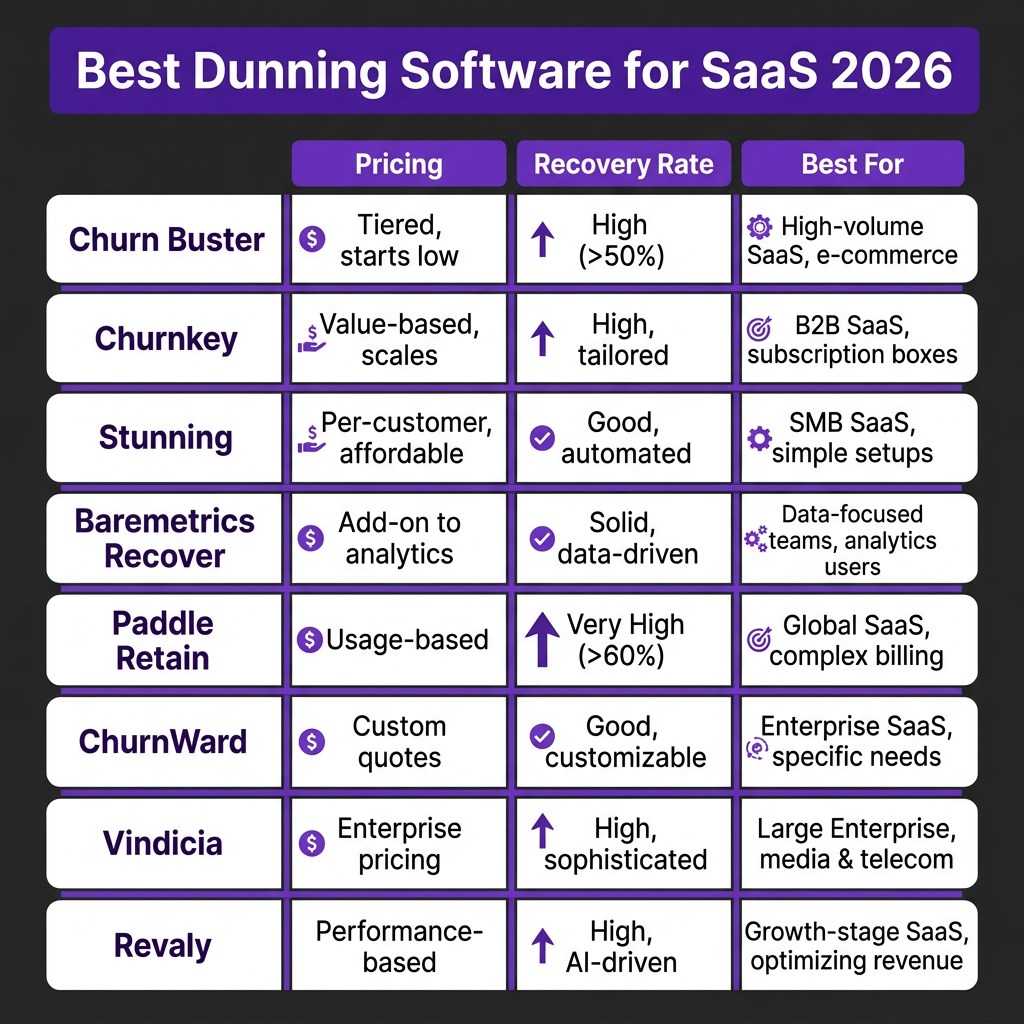
1. Churn Buster — Best Overall for High-Volume SaaS
Churn Buster is the most advanced dunning platform available, built specifically for subscription businesses with complex billing needs. What sets them apart is their combination of AI-driven retry logic with white-glove strategic support.
Key Features: AI-optimized retry timing based on decline codes and bank patterns, multi-channel recovery (email, SMS, in-app), real-time revenue-at-risk dashboards, and deep integrations with Stripe, Shopify, and Recharge. Their card updater integration catches expired cards before they cause failures.
Recovery Rate: 70-80% of failed payments
Pricing: Custom (starts around $500/month)
Best For: SaaS companies doing $50K+ MRR that want the highest recovery rates and strategic guidance
2. Churnkey — Best for Stripe-First SaaS
Churnkey combines dunning management with cancellation flows, making it a comprehensive retention platform. Their Failed Payment Wall is unique — it blocks product access until payment is updated, creating urgency without being aggressive.
Key Features: AI-powered retries, cancel flow optimization, Failed Payment Wall, customer segmentation for personalized recovery, and native Stripe integration. They also offer usage-based pricing options.
Recovery Rate: 65-75% of failed payments
Pricing: Starting at $120/month + percentage of recovered revenue
Best For: SaaS companies on Stripe wanting combined dunning and cancel flow management
3. Stunning — Best for Solopreneurs and Small Teams
Stunning was one of the first dunning tools on the market and remains a solid choice for smaller SaaS businesses. It’s straightforward, reliable, and doesn’t require a dedicated billing team to manage.
Key Features: Automated email sequences, in-app payment update forms, basic retry logic, and Stripe integration. The setup is simple and the UI is clean.
Recovery Rate: 50-60% of failed payments
Pricing: $50-200/month depending on volume
Best For: Bootstrapped SaaS founders and small teams just starting with dunning
4. Baremetrics Recover — Best for Analytics-Focused Teams
Baremetrics built Recover as an add-on to their analytics platform, and it shows. The reporting is exceptional — you’ll know exactly how much revenue you’re recovering, which campaigns work best, and where customers drop off.
Key Features: Deep analytics integration, customizable email campaigns, in-app payment capture, and cohort-based recovery tracking. The insights help you optimize beyond just dunning.
Recovery Rate: 55-65% of failed payments
Pricing: $100-500/month + Baremetrics subscription
Best For: Data-driven SaaS teams already using Baremetrics for analytics
5. Paddle Retain — Best for All-in-One Payment Infrastructure
If you’re using Paddle as your Merchant of Record, Retain is the obvious choice. It’s built directly into their platform, so there’s no separate integration needed. The recovery features are solid and continuously improving.
Key Features: Native Paddle integration, automated retries, customer notifications, and global tax compliance built-in. The unified platform reduces vendor complexity.
Recovery Rate: 60-70% of failed payments
Pricing: Included with Paddle (5% + $0.50 per transaction)
Best For: SaaS companies already using or considering Paddle for payments
6. ChurnWard — Best Budget Option for Bootstrapped SaaS
ChurnWard was built by bootstrapped founders who were frustrated with dunning tools that scaled pricing with MRR. They offer flat-rate pricing that makes sense for smaller SaaS businesses.
Key Features: Automated dunning emails, smart retry logic, customer portal for payment updates, and flat monthly pricing. No percentage fees or MRR-based tiers.
Recovery Rate: 50-60% of failed payments
Pricing: Flat $29/month
Best For: Bootstrapped SaaS at $10K-50K MRR wanting predictable costs
7. Vindicia — Best for Enterprise SaaS
Vindicia is the enterprise-grade option, used by companies processing hundreds of millions in subscription revenue. Their technology is sophisticated, but you’ll need dedicated resources to implement and manage it.
Key Features: Advanced AI retry logic, global payment method support, sophisticated customer segmentation, and enterprise-grade security and compliance.
Recovery Rate: 75-85% of failed payments
Pricing: Custom enterprise pricing
Best For: Enterprise SaaS with $10M+ ARR and dedicated billing teams
8. Revaly — Best for AI-First Recovery
Revaly focuses exclusively on AI-powered recovery, using machine learning to optimize retry timing and customer communications. Their silent recovery approach minimizes customer friction.
Key Features: AI-driven retry optimization, silent recovery (no customer contact needed), real-time decline code analysis, and usage-based pricing.
Recovery Rate: 65-75% of failed payments
Pricing: Pay-on-lift model (percentage of recovered revenue)
Best For: SaaS companies wanting AI-first recovery with minimal customer friction
How to Choose the Right Dunning Software
With 8 solid options, how do you pick the right one? Here’s my decision framework based on 6+ years running SaaS billing operations:
1. What’s your MRR? Under $10K, go with ChurnWard or Stunning. $10K-50K, Churnkey or Baremetrics. $50K+, Churn Buster or Vindicia.
2. What payment processor do you use? Stripe users have the most options. If you’re on Paddle, use Retain. If you’re using a Merchant of Record like Fungies, check what’s included.
3. Do you need cancel flows too? If you want combined dunning and cancellation management, Churnkey is the standout choice.
4. How important is analytics? If you live and breathe metrics, Baremetrics Recover offers the deepest insights.
5. What’s your budget philosophy? Flat-rate pricing (ChurnWard, Stunning) gives predictability. Percentage-of-recovery (Revaly, Churnkey) aligns incentives. Enterprise pricing (Churn Buster, Vindicia) gets you white-glove service.
The Dunning Recovery Process Explained
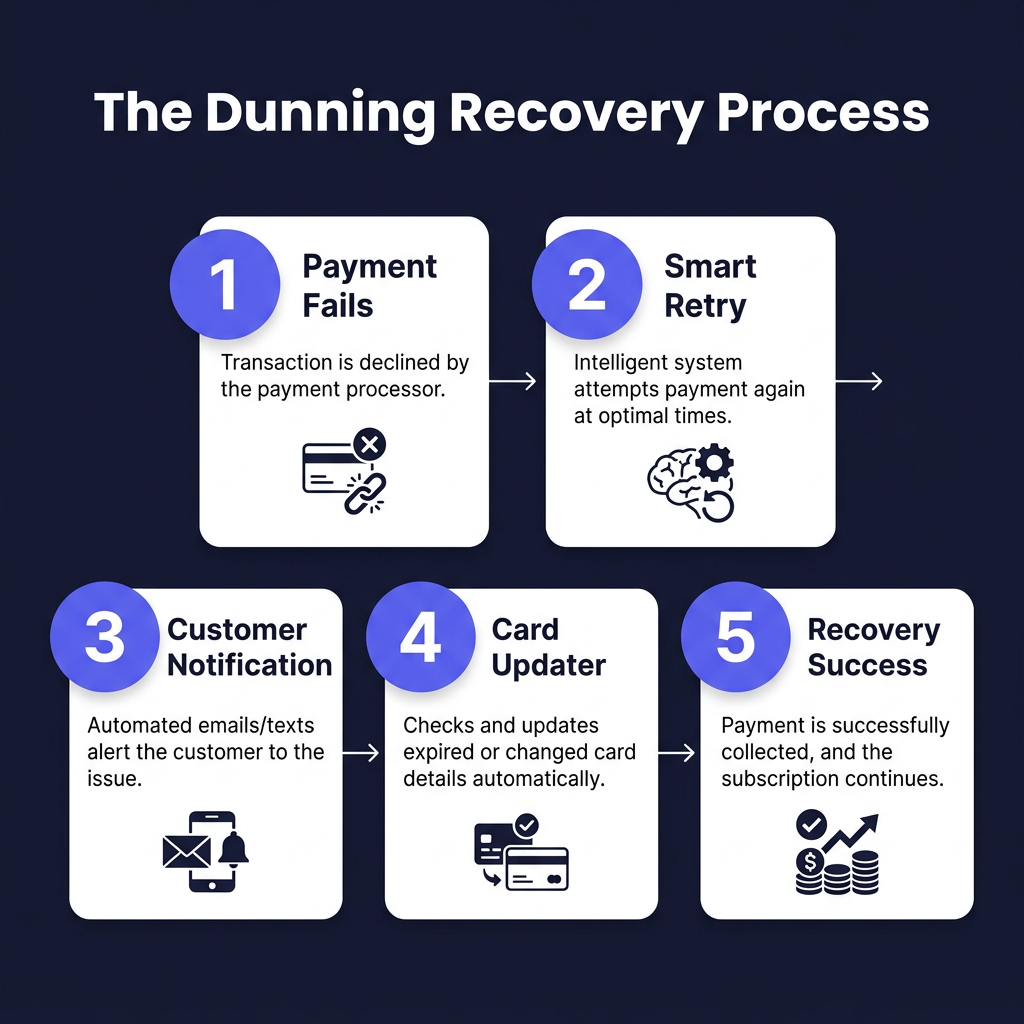
Understanding how dunning software works helps you evaluate options and set realistic expectations. Here’s the typical recovery flow:
Step 1: Payment Fails — The customer’s card is declined. The decline code tells you why (expired card, insufficient funds, bank decline, etc.).
Step 2: Smart Retry — The dunning software analyzes the decline code and schedules retries at optimal times. Soft declines (temporary issues) get more aggressive retries than hard declines (permanent issues).
Step 3: Customer Notification — If retries fail, the customer gets notified via email, SMS, or in-app message. The best dunning software personalizes these communications based on customer value and failure reason.
Step 4: Card Updater — Network services like Visa Account Updater and Mastercard Automatic Billing Updater check if the bank has new card information on file. This alone can recover 15-25% of failed payments.
Step 5: Recovery Success — The payment succeeds, the subscription continues, and the revenue is saved. The customer never intended to churn — they just needed a nudge to update their payment method.
FAQ: Dunning Software for SaaS
What percentage of failed payments can dunning software recover?
The best dunning software recovers 60-80% of failed payments. Basic tools typically recover 40-50%, while enterprise solutions with AI optimization can push 75-85%. Your actual recovery rate depends on your customer base, payment methods, and how quickly you implement dunning after a failure.
How much revenue do SaaS companies lose to failed payments?
Most SaaS companies lose 5-10% of recurring revenue to failed payments. For a company doing $1M ARR, that’s $50,000-100,000 annually. Companies without any dunning process can lose 15%+ of revenue. The impact compounds as you scale — at $10M ARR, you’re potentially losing $500K-1M annually.
What’s the difference between voluntary and involuntary churn?
Voluntary churn is when customers actively choose to cancel — they don’t see value, found a better alternative, or no longer need your product. Involuntary churn is when customers want to stay but can’t because of payment failures. Dunning software specifically addresses involuntary churn, which accounts for 20-40% of total churn in most SaaS businesses.
Can I build dunning in-house instead of buying software?
You can, but it’s rarely worth it. Building basic retry logic is simple, but building AI-optimized retry timing, card updater integrations, multi-channel customer communications, and comprehensive analytics takes months of engineering time. For most SaaS companies, buying dedicated dunning software pays for itself within the first month.
When should I implement dunning software?
As soon as you have paying customers. Even at $1K MRR, you’re losing money to failed payments. Early-stage SaaS often delays dunning implementation because it is not a priority, but that is backwards — the earlier you plug the leak, the more revenue you retain as you scale.
Conclusion: Stop the Revenue Leak Today
Failed payments aren’t just a billing inconvenience — they’re one of the biggest silent killers of SaaS growth. While you’re spending money on ads, content, and sales to acquire new customers, dunning software protects the revenue you’ve already earned.
The 8 solutions I’ve covered represent the best dunning software available in 2026. Whether you’re a bootstrapped founder just starting out or running a high-growth SaaS at scale, there’s a tool that fits your needs and budget.
My recommendation? Start with Churnkey if you’re on Stripe and want combined dunning and cancel flows. Go with Churn Buster if you’re at scale and want the highest recovery rates. Choose ChurnWard if you’re bootstrapped and want predictable pricing. And if you’re using Paddle or considering a Merchant of Record, their built-in dunning might be all you need.
Whatever you choose, implement it this week. Every day you wait is revenue walking out the door.
Stop Losing Revenue to Failed Payments
Fungies.io handles payment recovery, tax compliance, and global billing — so you can focus on growing your SaaS.
No credit card required • 5% + $0.50 per transaction
Sources
• Churn Buster: Dunning Management Software Comparison 2026
• Baremetrics: Dunning Management Complete Guide
• ChurnWard: Best Dunning Software for SaaS
• LedgerUp: Dunning Management for B2B SaaS
• Finsi.ai: Best Dunning Software Testing Results
• SlickerHQ: Payment Recovery Platforms Analysis