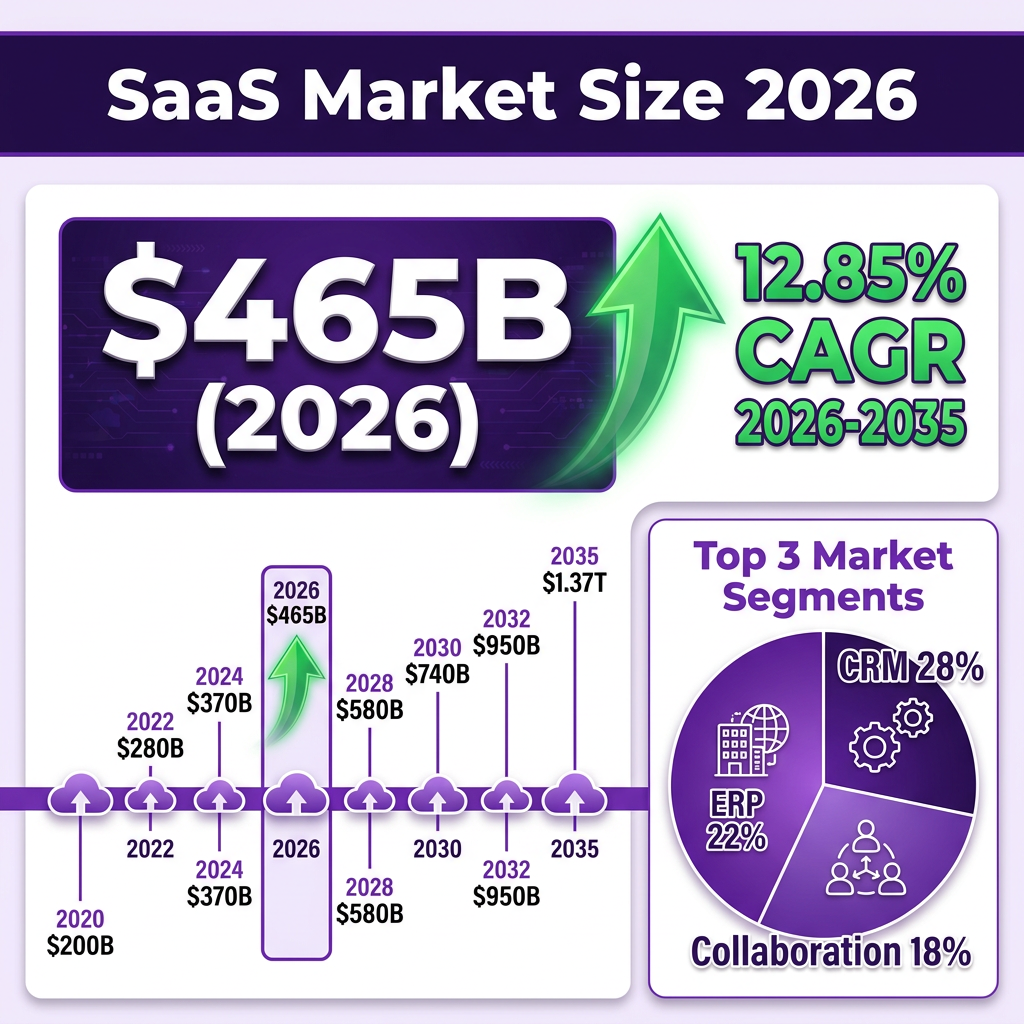
The global Software as a Service (SaaS) market has reached an inflection point in 2026. With the industry now valued at $465.03 billion and projected to nearly triple to $1.37 trillion by 2035, SaaS has evolved from a convenient alternative to on-premise software into the dominant paradigm for enterprise and consumer applications alike. This isn’t just incremental growth—it’s a fundamental restructuring of how software is built, distributed, and consumed across every industry vertical.
This comprehensive analysis examines the state of the SaaS market in 2026, drawing on data from over 20 industry sources and market research reports. We’ll explore the key statistics driving growth, the major trends reshaping the competitive landscape, the challenges facing both established players and newcomers, and the opportunities that will define the next decade of software innovation. Whether you’re a SaaS founder seeking growth strategies, an investor evaluating opportunities, or an enterprise buyer making vendor decisions, this report provides the data-driven insights you need to navigate the evolving SaaS ecosystem.
What’s driving this explosive expansion? The convergence of artificial intelligence, vertical specialization, and consumption-based pricing models has created a perfect storm of innovation. According to Gartner, worldwide software spending is forecast to grow 14.7% in 2026, reaching over $1.4 trillion in total value. Yet beneath these headline numbers lies a more complex story: one of intense competition, shifting buyer preferences, and the emergence of AI-native challengers disrupting established players.
The SaaS model has fundamentally transformed how businesses operate. Instead of purchasing perpetual licenses and managing on-premise infrastructure, organizations now subscribe to cloud-based solutions that scale with their needs. This shift has democratized access to enterprise-grade software, enabling small businesses to leverage the same tools as Fortune 500 companies. The subscription model also aligns vendor incentives with customer success—when customers succeed and grow, SaaS vendors benefit from expansion revenue.

Market Overview: The $465 Billion SaaS Ecosystem
The SaaS market’s trajectory from 2020 to 2035 tells a remarkable story of digital transformation acceleration. In 2020, the global SaaS market was valued at approximately $157 billion. By 2025, it had more than doubled to $408.21 billion. The 2026 valuation of $465.03 billion represents a 13.9% year-over-year increase, with the compound annual growth rate (CAGR) projected at 12.85% through 2035.
This growth isn’t uniform across all segments. The public cloud deployment model continues to dominate, accounting for the majority of SaaS revenue, while hybrid cloud solutions are gaining traction among enterprises with complex compliance requirements. North America maintains its leadership position, holding approximately 43.2% of global market share in 2025, with the United States alone representing $141.06 billion in 2026 SaaS value.
However, the most significant shift is happening in how SaaS companies are valued and funded. The median annual recurring revenue (ARR) multiple for public SaaS companies has compressed from decade highs, with the SaaS Capital Index showing median ARR multiples of 6.7x as of mid-2025. This valuation reset reflects market maturation and increased scrutiny of unit economics over pure growth metrics.
Enterprise Resource Planning (ERP) and Customer Relationship Management (CRM) remain the largest application segments, but the fastest growth is occurring in emerging categories. Business Intelligence & Analytics, Human Capital Management, and Content Collaboration tools are expanding at above-market rates, driven by the distributed workforce trend and data-driven decision-making imperatives.
The evolution of SaaS deployment models reflects changing enterprise needs. Public cloud SaaS offers the greatest scalability and lowest upfront costs, making it ideal for startups and SMBs. Private cloud deployments appeal to organizations in regulated industries like healthcare and finance that require dedicated infrastructure. Hybrid cloud approaches, combining on-premise and cloud resources, have gained popularity among enterprises undergoing gradual digital transformation.
Geographic distribution of SaaS revenue reveals both concentration and opportunity. While North America generates the majority of SaaS revenue, Europe and Asia-Pacific are growing faster on a percentage basis. The UK alone hosts approximately 2,000 SaaS companies generating over $10 billion annually. Emerging markets in Latin America, Africa, and Southeast Asia represent greenfield opportunities as internet penetration and cloud infrastructure improve.
Key Statistics and Data Points
Understanding the SaaS landscape requires diving deep into the numbers that define success, failure, and opportunity. Here are the critical statistics every SaaS founder, investor, and operator should know in 2026:
Market Size and Growth: The global SaaS market reached $465.03 billion in 2026, up from $408.21 billion in 2025. The vertical SaaS segment—industry-specific solutions—has emerged as a standout performer, valued at $143.45 billion in 2026 with a projected CAGR of 16.3% through 2035. This outpaces horizontal SaaS growth by nearly 4 percentage points annually. The AI SaaS market specifically is projected to grow from $115.22 billion in 2024 to $2.97 trillion by 2034 at a staggering 38.4% CAGR.
Company Count: There are now over 42,000 SaaS companies worldwide, with approximately 12,400 based in the United States. The UK follows with around 2,000 SaaS companies, generating over $10 billion in annual revenue. This proliferation of vendors has created both opportunity and complexity for buyers. The average enterprise now uses over 130 different SaaS applications, up from 80 just five years ago.
Revenue Benchmarks: Bootstrapped SaaS companies with $3M to $20M in ARR show median revenue growth of 15% annually, with top performers (90th percentile) achieving 42.3% growth. Net Revenue Retention (NRR) benchmarks for bootstrapped companies median at 103%, while venture-backed SaaS companies typically target 110-120% NRR. Private SaaS companies show NRR benchmarks around 101%, with bootstrapped companies reporting a median of 104%.
Unit Economics: Healthy SaaS companies maintain LTV:CAC ratios above 3:1, with CAC payback periods under 12 months being the typical target. Gross margins of 70-85% indicate healthy SaaS economics, while monthly churn above 7% is considered concerning, with best-in-class companies achieving below 3% monthly churn. The Magic Number—a measure of sales and marketing efficiency—should exceed 1.0 for sustainable growth.
AI Investment Surge: Spending on AI-native SaaS applications increased 108% year over year. According to the State of FinOps 2025 Report, 63% of organizations now manage AI spend, with adoption projected to reach 96% by 2026. AI captured roughly 80% of all global venture funding in Q1 2026, with approximately $242 billion of the quarter’s record $300 billion going to AI companies. Global venture capital deal value reached $512 billion in 2025, with exit value hitting $549.2 billion.
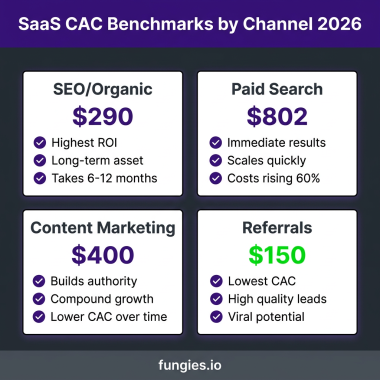
Marketing Efficiency: SEO delivers 702% ROI for B2B SaaS companies with a break-even time of just 7 months, dramatically outperforming paid channels. B2B SaaS companies achieve the highest content marketing ROI of any sector at 420%. The average B2B SaaS customer acquisition cost sits at $1,200, though this varies significantly by company size and market segment. Email marketing remains the most effective revenue channel, with 59% of B2B marketers naming it their top performer.
Valuation Metrics: AI-native SaaS raises at 40% higher valuations than traditional SaaS. Vertical AI SaaS companies for healthcare, legal, and financial services raised the largest early-stage rounds, with median Series A sizes of $22 million versus $15 million for traditional horizontal SaaS. The median EV/Revenue multiple for SaaS companies stands at 3.4x as of March 2026, with M&A deal multiples showing similar compression from 2021 peaks.
Customer Behavior: More than 50% of merchants now get their payment processing services directly through software platforms rather than standalone payment providers. Expansion revenue accounts for approximately 40% of new ARR for mature SaaS companies. Free trial conversion rates average 15-25% for B2B SaaS, while freemium models see 2-5% conversion to paid plans.
Regional Distribution: North America continues to lead the global SaaS market with 43.2% share, followed by Europe at 28% and Asia-Pacific at 21%. The United States alone accounts for $141.06 billion in SaaS value. However, emerging markets are growing faster, with Latin America and Southeast Asia showing 20%+ annual growth rates as cloud infrastructure matures.
Employment Impact: The SaaS industry now employs over 2.5 million people worldwide, with average salaries 35% higher than traditional software roles. Engineering, sales, and customer success roles dominate hiring, reflecting the operational priorities of subscription businesses.
Major Trends Shaping SaaS in 2026
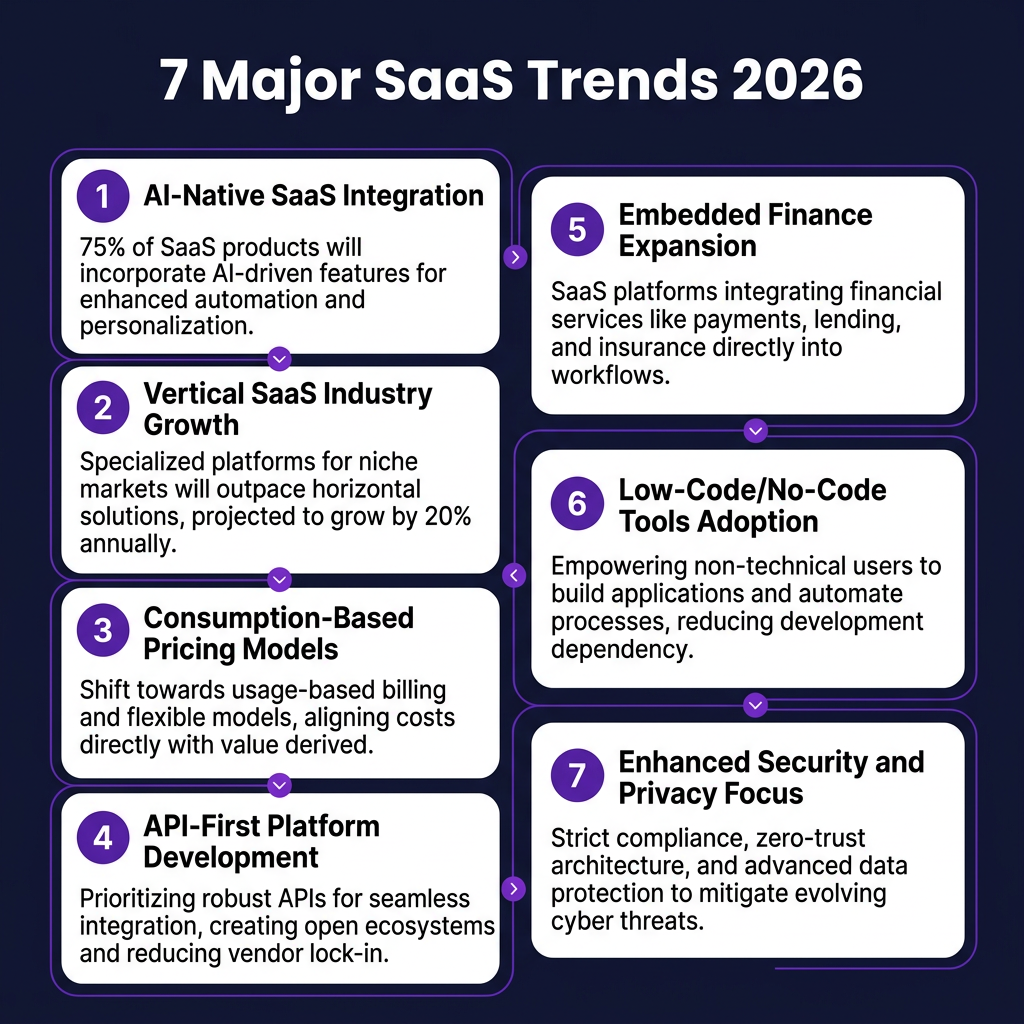
The SaaS landscape of 2026 is being reshaped by seven transformative trends that are redefining how software is built, sold, and consumed. Understanding these trends is essential for anyone operating in or evaluating the SaaS space.
1. AI-Native SaaS Disruption
Perhaps no trend is more consequential than the rise of AI-native SaaS applications. Unlike traditional SaaS products that bolt AI features onto existing architectures, AI-native companies build their entire value proposition around artificial intelligence capabilities. These companies are raising at 40% valuation premiums and capturing disproportionate market attention.
The impact extends beyond valuations. Gartner predicts that by 2028, 33% of enterprise software applications will include agentic AI—autonomous systems that can make decisions and take actions without human intervention. By 2030, 35% of point-product SaaS tools will be replaced by AI-driven alternatives or absorbed into larger platforms.
AI-native SaaS companies are approaching product development differently. Rather than starting with traditional software features and adding AI, they begin with AI capabilities and build interfaces around them. This enables entirely new categories of functionality—predictive analytics that anticipate customer needs, autonomous agents that handle routine tasks, and generative systems that create content and code. The result is software that doesn’t just organize work but actively performs it.
2. Vertical SaaS Ascendancy
Horizontal platforms that serve broad markets are losing ground to vertical SaaS solutions built for specific industries. The vertical SaaS market hit an estimated $130-143 billion in 2025-2026, growing at 16-23% annually—nearly double the pace of horizontal platforms.
ServiceTitan’s December 2024 IPO at a $9 billion valuation exemplifies this trend. The company serves home services contractors—a market most venture capitalists ignored for years—yet achieved massive scale by solving industry-specific problems that generic tools couldn’t address. Healthcare, construction, agriculture, and specialized manufacturing are now actively prioritizing industry-specific cloud tools.
The vertical SaaS advantage lies in deep workflow integration. While horizontal platforms offer breadth, vertical solutions provide depth—handling industry-specific compliance requirements, integrating with sector-specific tools, and speaking the language of their users. This specialization creates higher switching costs and enables premium pricing. Vertical SaaS companies also benefit from concentrated marketing—targeting trade shows, industry publications, and professional associations rather than broad-based advertising.
3. Consumption-Based Pricing Models
The traditional per-seat subscription model is being supplemented—and in some cases replaced—by consumption-based pricing. This shift aligns vendor revenue with customer value realization, reducing friction in the buying process and expanding addressable markets. Usage-based billing platforms have seen 85% year-over-year growth as companies seek to optimize their pricing strategies.
Consumption pricing takes several forms. Pure usage models charge based on volume—API calls, transactions processed, or data stored. Outcome-based pricing ties fees to specific results achieved, such as revenue generated or costs saved. Hybrid models combine base subscription fees with usage overages, providing predictable minimums while capturing growth.
The benefits of consumption pricing extend to both vendors and customers. Customers avoid over-provisioning and can start small before committing to larger investments. Vendors benefit from natural expansion revenue as customers grow and from reduced churn since customers don’t feel locked into fixed commitments. However, consumption pricing also introduces revenue volatility and requires sophisticated metering and billing infrastructure.
4. API-First Platform Architecture
Modern SaaS companies are building API-first, enabling seamless integration into existing workflows and creating opportunities for ecosystem expansion. The most successful platforms function as infrastructure that other applications build upon, creating network effects that compound over time.
API-first development means designing the application programming interface before building the user interface. This approach ensures that all functionality is programmatically accessible, enabling customers to build custom integrations and workflows. It also facilitates partnerships—other SaaS companies can integrate with API-first platforms to extend their own capabilities.
The platform strategy extends beyond APIs to marketplaces and ecosystems. Leading SaaS companies curate app stores where third-party developers can offer extensions and integrations. These marketplaces create additional revenue streams through revenue sharing while increasing platform stickiness. Customers benefit from expanded functionality without leaving their primary tools.
5. Embedded Finance Integration
More than 50% of merchants now get their payment processing services directly through software platforms rather than standalone payment providers. Embedded payment products are becoming so capable that they’re starting to rival big-name platforms like Stripe and PayPal, creating new revenue streams for SaaS vendors.
Embedded finance extends beyond payments to include lending, insurance, and banking services. A SaaS platform for contractors might offer invoice financing to help customers manage cash flow. An e-commerce platform might provide embedded insurance for shipped goods. These financial services generate additional revenue while solving real customer problems.
The infrastructure for embedded finance has matured significantly. Banking-as-a-Service (BaaS) providers enable SaaS companies to offer financial products without becoming regulated financial institutions themselves. APIs for payments, lending, and insurance can be integrated in weeks rather than months, lowering the barrier to entry.
6. Low-Code/No-Code Democratization
The democratization of software development through low-code and no-code platforms is expanding the SaaS market to non-technical users. This trend is particularly pronounced in vertical markets where domain experts can build solutions without traditional engineering resources.
Low-code platforms enable rapid application development using visual interfaces and pre-built components. Business analysts and operations teams can create custom tools that would previously have required engineering support. No-code platforms go further, enabling entirely non-technical users to build functional applications.
The implications for SaaS are significant. Traditional SaaS vendors face competition from custom-built solutions that precisely match customer needs. At the same time, low-code platforms themselves represent a major SaaS category, with companies like Airtable, Notion, and Zapier achieving multi-billion-dollar valuations by enabling citizen development.
7. Security-First Positioning
With cyberattacks increasing in sophistication and frequency, security and regulatory alignment have become major drivers of vendor selection. SaaS companies are investing heavily in compliance certifications, zero-trust architectures, and transparent security practices as competitive differentiators.
Security requirements vary by industry and geography. Healthcare SaaS must comply with HIPAA in the US and GDPR in Europe. Financial services require SOC 2 Type II certification at minimum. Government contractors need FedRAMP authorization. Meeting these requirements has become table stakes for enterprise sales.
Beyond compliance, security-conscious SaaS companies are implementing advanced protections. Zero-trust architectures assume breach and verify every access request. Encryption at rest and in transit protects data regardless of location. Security information and event management (SIEM) integration enables customers to monitor SaaS activity alongside other infrastructure.

Key Players and Competitive Landscape
The SaaS competitive landscape in 2026 is characterized by platform consolidation at the top, vertical specialization in the middle, and AI-native disruption at the edges. Understanding the key players and their strategies reveals where the market is heading.
The Platform Giants: Microsoft, Salesforce, Adobe, Google, Oracle, and SAP continue to dominate the overall SaaS market. These companies have built comprehensive ecosystems that make it difficult for customers to switch providers. Microsoft’s cloud and productivity suite, Salesforce’s CRM dominance, and Adobe’s creative monopoly represent moats that competitors struggle to cross.
Microsoft’s SaaS portfolio spans Office 365, Teams, Azure, Dynamics 365, and Power Platform, creating an integrated ecosystem that serves businesses of all sizes. The company’s AI investments through its OpenAI partnership have strengthened its competitive position, with Copilot features being integrated across the product line. Microsoft’s enterprise relationships and distribution capabilities make it a formidable competitor in any SaaS category it enters.
Salesforce remains the definitive CRM platform, having expanded beyond sales force automation to encompass marketing, service, commerce, and analytics. The company’s AppExchange marketplace hosts thousands of third-party applications, creating network effects that reinforce its market position. Salesforce’s Einstein AI platform attempts to bring predictive capabilities to every part of the customer journey.
However, these giants face new pressures. The “AI-kills-SaaS” narrative, while overstated, reflects genuine concerns about whether legacy platforms can adapt to AI-native competition. Adobe and Salesforce, in particular, have seen their relevance questioned as AI tools threaten to commoditize features that previously justified premium pricing.
Emerging Leaders: ServiceNow, Snowflake, Datadog, CrowdStrike, Zoom, and HubSpot have established themselves as category leaders with strong growth trajectories. These companies demonstrate how powerful recurring revenue, deep integrations, and AI-driven automation can create sustainable competitive advantages.
ServiceNow has become the platform of choice for enterprise workflow automation, expanding from IT service management to encompass HR, customer service, and custom applications. The company’s workflow engine enables large enterprises to digitize processes that previously relied on email and spreadsheets.
Snowflake revolutionized data warehousing with its separation of compute and storage, enabling elastic scaling and pay-per-use pricing. The company’s data cloud vision connects organizations to share and consume data, creating network effects that extend beyond individual deployments.
Vertical Specialists: ServiceTitan (home services), Toast (restaurants), Shopify (e-commerce), and Procore (construction) have proven that vertical focus can create billion-dollar outcomes. These companies achieve higher customer lifetime values and lower churn by solving industry-specific problems that horizontal platforms cannot address effectively.
Shopify has become the dominant platform for e-commerce, powering millions of online stores and processing billions in transactions. The company’s ecosystem includes payment processing, shipping, marketing tools, and a vast app marketplace. Shopify’s success demonstrates how vertical SaaS can expand to encompass an entire industry value chain.
AI-Native Challengers: A new generation of AI-native SaaS companies is emerging, raising at premium valuations and threatening to disrupt established categories. These companies build AI as the core product rather than an add-on feature, enabling capabilities that were previously impossible or prohibitively expensive.
The competitive dynamic is shifting from feature parity to AI capability differentiation. Companies that can leverage AI to deliver 10x improvements in customer outcomes—whether through automation, prediction, or personalization—are capturing market share from incumbents who are slower to adapt.
Competitive Positioning Strategies
Success in the 2026 SaaS landscape requires clear competitive positioning. Companies must choose whether to compete on breadth (platform strategy), depth (vertical specialization), or innovation (AI-native capabilities). Attempting to compete on all three dimensions simultaneously spreads resources too thin and results in mediocrity across the board.
The most successful SaaS companies of 2026 have chosen their battleground and committed fully. Microsoft competes on breadth, offering an integrated ecosystem that reduces vendor complexity. ServiceTitan competes on depth, becoming the definitive solution for home services contractors. NeuroFlow competes on innovation, delivering AI capabilities that legacy platforms cannot match.
Challenges and Pain Points
Despite the impressive growth figures, the SaaS industry faces significant challenges that threaten to slow expansion and compress margins. Understanding these pain points is crucial for strategic planning.
1. Market Saturation and Competition
With over 42,000 SaaS companies worldwide, many categories are approaching saturation. The “Slop SaaS” phenomenon—where hundreds of similar products compete for the same customers—has made differentiation increasingly difficult. Generic productivity tools, simple automation apps, and undifferentiated AI wrappers struggle to gain traction in crowded markets.
Category saturation manifests in several ways. Customer acquisition costs rise as more competitors bid for the same keywords and audiences. Differentiation becomes harder as feature sets converge. Price competition intensifies, compressing margins for all players. Sales cycles lengthen as buyers evaluate more options.
2. Customer Acquisition Cost Inflation
As competition intensifies, customer acquisition costs have risen across the industry. The average B2B SaaS CAC of $1,200 represents a significant increase from previous years, and many companies report CAC payback periods extending beyond the ideal 12-month threshold. This puts pressure on unit economics and forces companies to prioritize retention over acquisition.
CAC inflation has multiple causes. Digital advertising costs have risen as platforms optimize for revenue. Content marketing requires greater investment to stand out in crowded search results. Sales development representatives (SDRs) command higher salaries in competitive labor markets. The result is that SaaS companies must either accept lower margins or find more efficient acquisition channels.
3. AI Disruption Anxiety
The rapid advancement of AI capabilities has created existential anxiety among traditional SaaS companies. The fear that AI will commoditize existing features or enable customers to build internal solutions threatens the recurring revenue model that underpins SaaS valuations. This has contributed to valuation compression and increased focus on AI integration strategies.
The disruption threat is real but nuanced. AI is unlikely to eliminate SaaS entirely, but it will reshape which companies succeed. SaaS vendors that treat AI as a feature addition will struggle against AI-native competitors that reimagine entire workflows. Companies that can leverage proprietary data to train unique models may maintain advantages that general-purpose AI cannot replicate.
4. Budget Reallocation Pressures
Enterprise buyers are becoming more conservative with software spending, conducting rigorous ROI analyses before committing to new vendors. The shift toward platform consolidation—where companies prefer fewer vendors with broader capabilities—threatens point solutions that solve narrow problems.
The 2026 SaaS “crash” narrative reflects these budget pressures. While not a true crash, the industry is experiencing a reallocation where AI experimentation budgets compete with traditional SaaS subscriptions. CIOs are scrutinizing their SaaS portfolios, identifying redundant tools, and negotiating harder on renewals.
5. Churn and Retention Challenges
Monthly churn above 7% is considered concerning, yet many SaaS companies struggle to achieve best-in-class retention rates. As buyers become more sophisticated and switching costs decrease, maintaining high gross revenue retention (GRR) and net revenue retention (NRR) requires continuous value delivery and product innovation.
Retention challenges are compounded by the proliferation of alternatives. When customers have dozens of options in every category, loyalty becomes harder to maintain. SaaS companies must invest in customer success, product stickiness, and continuous innovation just to maintain their existing revenue base.
Regulatory and Compliance Complexity
As SaaS applications handle increasingly sensitive data, regulatory requirements have proliferated. GDPR in Europe, CCPA in California, HIPAA for healthcare, and SOC 2 for enterprise security each impose significant compliance burdens. Meeting these requirements requires dedicated resources and ongoing investment, creating barriers for smaller competitors while increasing operational costs for all players.
The regulatory landscape continues to evolve. New AI-specific regulations are emerging in the EU and elsewhere, potentially restricting how SaaS companies can deploy machine learning models. Data localization requirements in countries like China and Russia mandate local infrastructure, complicating global expansion strategies.
Opportunities and Growth Strategies
While challenges exist, the SaaS market offers substantial opportunities for companies that can execute the right strategies. Here are the most promising growth avenues for 2026 and beyond.
1. Vertical Market Expansion
The vertical SaaS opportunity remains underexploited. Industries that historically relied on custom systems or manual processes—agriculture, construction, logistics, and specialized professional services—are now actively seeking cloud-native solutions. Companies that develop deep domain expertise and solve industry-specific problems can achieve higher margins and lower churn than horizontal competitors.
Vertical expansion requires different capabilities than horizontal SaaS. Sales teams need industry expertise and relationships. Product teams must understand complex regulatory requirements and workflow nuances. Marketing must target industry-specific channels rather than broad-based campaigns. The payoff is higher customer lifetime value and stronger competitive moats.
2. AI-Native Product Development
Rather than adding AI features to existing products, forward-thinking companies are reimagining their entire value proposition around AI capabilities. This approach enables 10x improvements in customer outcomes and justifies premium pricing. The key is identifying workflows where AI can deliver transformative value rather than incremental improvements.
AI-native development requires organizational changes. Product teams must include AI/ML engineers and data scientists. User experience design must accommodate probabilistic outputs and uncertainty. Customer success must help users understand AI capabilities and limitations. Companies that make these investments can build sustainable advantages as AI becomes table stakes.
3. Platform Ecosystem Building
Building platforms that other developers and companies can extend creates powerful network effects. API-first architectures, marketplace ecosystems, and embedded finance capabilities transform standalone products into infrastructure that customers build their businesses upon. This increases switching costs and creates multiple revenue streams.
Platform strategies require long-term investment. APIs must be well-documented and stable. Developer relations teams must support integration partners. Marketplaces must be curated to maintain quality. The payoff is an ecosystem that generates value beyond what any single company could create alone.
4. Geographic Expansion
While North America dominates current SaaS revenue, significant growth opportunities exist in Europe, Asia-Pacific, and emerging markets. Companies that can adapt their products to local regulations, languages, and business practices can capture market share in less saturated regions.
Geographic expansion requires more than translation. Payment methods vary by region—SEPA in Europe, Alipay in China, PIX in Brazil. Data residency requirements may mandate local infrastructure. Sales approaches must adapt to cultural norms. Companies that invest in true localization can establish strong positions before competitors arrive.
5. Product-Led Growth Optimization
Freemium models, self-service onboarding, and viral product features remain powerful growth engines. Companies that optimize their product-led growth funnels—reducing time-to-value, increasing activation rates, and driving organic expansion—can achieve sustainable growth with lower CAC than sales-led alternatives.
Product-led growth requires cross-functional alignment. Product teams must prioritize onboarding and activation. Engineering must ensure reliability and performance at scale. Marketing must create content that helps users discover value. Sales must adapt to engage only when users are ready. When executed well, PLG creates a flywheel where product usage drives adoption, which drives more usage.
Case Studies and Success Stories
Real-world examples illustrate how successful SaaS companies are navigating the 2026 landscape. These case studies reveal strategies that others can adapt and apply.
Case Study 1: NeuroFlow AI—$0 to $100M ARR in 18 Months
NeuroFlow AI demonstrates the power of AI-native positioning. Starting with $500K in seed funding, the company achieved $100M ARR in just 18 months by making AI agents the core product rather than a feature. Their product-led growth engine kicked in when they launched a viral freemium tier: any user could create a basic agent for free, but sharing it with 3+ team members unlocked collaborative features. This strategy turned users into advocates and drove exponential growth without proportional sales investment.
The NeuroFlow story illustrates several key principles. First, AI-native products can achieve dramatically faster growth than traditional SaaS when they solve real problems. Second, viral mechanics built into the product can reduce CAC to near zero. Third, freemium can work even in B2B when the free tier delivers genuine value. The company’s success has inspired a generation of AI-native startups to pursue similar strategies.
Case Study 2: EcoTrack Analytics—Bootstrapped to $20M ARR
EcoTrack Analytics proves that venture funding isn’t required for SaaS success. The company reached $20M ARR without raising institutional capital by weaponizing community-driven customer acquisition in the sustainability niche. By building deep relationships with environmental consultants and sustainability officers, they created a referral engine that generated high-quality leads at minimal cost. Their vertical focus on carbon tracking and ESG reporting created natural differentiation in a crowded market.
EcoTrack’s journey shows the power of community-led growth. Rather than competing for paid advertising, they invested in content, events, and relationships that established them as thought leaders. Their customers
became advocates, referring peers and contributing to product development. The bootstrapped approach forced capital efficiency, resulting in strong unit economics that venture-funded competitors struggled to match.
Case Study 3: ServiceTitan—Vertical SaaS to $9B IPO
ServiceTitan’s December 2024 IPO at a $9 billion valuation validates the vertical SaaS thesis. By focusing exclusively on home services contractors—a market most VCs considered too small—the company built deep workflow integration that horizontal platforms couldn’t match. Their success demonstrates that industry-specific software can achieve massive scale when execution is flawless and the target market is properly understood.
ServiceTitan’s platform handles scheduling, dispatching, invoicing, and payment processing specifically for HVAC, plumbing, and electrical contractors. The company expanded into financing, marketing, and business intelligence—becoming the operating system for an entire industry. Their IPO proved that vertical SaaS can generate public-market returns comparable to horizontal platforms.
Future Outlook and Predictions (2026-2030)
Looking ahead, the SaaS market will undergo continued transformation through 2030. Here are the key predictions shaping strategic planning:
Market Size Trajectory: The global SaaS market is projected to reach $819.23 billion by 2030 according to Grand View Research, representing a CAGR of 12.0% from 2025. More aggressive forecasts from Precedence Research suggest the market could reach $1.37 trillion by 2035. The AI SaaS segment is expected to grow even faster, with projections of $2.97 trillion by 2034 at a 38.4% CAGR.
AI Integration Acceleration: By 2028, 33% of enterprise software applications will include agentic AI capabilities. The distinction between “AI features” and “AI-native” will become less relevant as AI becomes table stakes for competitive products. Companies that fail to meaningfully integrate AI will face existential competitive threats.
Vertical SaaS Consolidation: The vertical SaaS market will see significant M&A activity as larger platforms acquire specialized players to expand their industry coverage. Winners will be those who achieve dominant market share in their verticals before consolidation occurs.
Pricing Model Evolution: Consumption-based pricing will become the norm rather than the exception, with per-seat models declining in favor of usage-based, outcome-based, and hybrid approaches. This shift will require fundamental changes in how SaaS companies forecast revenue and manage cash flow.
Geographic Rebalancing: While North America will remain the largest market, Asia-Pacific and Europe will capture increasing share of SaaS revenue. Companies that establish strong positions in these markets early will benefit from first-mover advantages as digital transformation accelerates globally.
Platform Consolidation: Enterprises will continue consolidating their SaaS portfolios, preferring fewer vendors with broader capabilities. Point solutions will face pressure to either expand into platforms or accept acquisition. The winners will be platforms that can credibly claim to replace multiple single-purpose tools.
Key Takeaways
The SaaS market in 2026 presents both unprecedented opportunities and significant challenges. Here are the essential insights every stakeholder should understand:
- The global SaaS market reached $465.03 billion in 2026 and is projected to grow to $1.37 trillion by 2035 at a 12.85% CAGR, representing one of the largest and fastest-growing segments of the technology industry
- Vertical SaaS is outperforming horizontal platforms, growing at 16-23% annually versus 12-13% for generalist solutions, as industry-specific solutions deliver superior value
- AI-native SaaS companies are raising at 40% valuation premiums and capturing 80% of venture funding, signaling a fundamental shift in how software is built and valued
- Consumption-based pricing, embedded finance, and API-first architectures are reshaping business models and creating new revenue opportunities
- Success requires balancing growth with unit economics—LTV:CAC above 3:1 and CAC payback under 12 months remain critical benchmarks for sustainable businesses
- Over 42,000 SaaS companies worldwide are competing for market share, making differentiation and positioning essential for survival
- Enterprise buyers are consolidating vendors, favoring comprehensive platforms over narrow point solutions
- Geographic expansion beyond North America represents significant growth opportunities, particularly in Europe and Asia-Pacific
- The average enterprise now uses over 130 SaaS applications, creating both integration challenges and expansion opportunities
- Bootstrapped SaaS companies can achieve 15% median growth rates with 103% NRR, proving that venture funding isn’t required for success
Sources and Citations
- Precedence Research – Software As A Service (SaaS) Market Size, Share, and Trends 2026 to 2035: https://www.precedenceresearch.com/software-as-a-service-market
- Fortune Business Insights – Software as a Service [SaaS] Market Size, Global Report, 2034: https://www.fortunebusinessinsights.com/software-as-a-service-saas-market-102222
- Grand View Research – Software As A Service Market Size | Industry Report, 2030: https://www.grandviewresearch.com/industry-analysis/saas-market-report
- Zylo – 175+ Unmissable SaaS Statistics for 2026: https://zylo.com/blog/saas-statistics
- SaaS Capital – 2026 Benchmarking Metrics for Bootstrapped SaaS Companies: https://www.saas-capital.com/blog-posts/benchmarking-metrics-for-bootstrapped-saas-companies
- Business Research Insights – Vertical SaaS Market Size | CAGR 16.3%: https://www.businessresearchinsights.com/market-reports/vertical-saas-market-117289
- SaaS Mag – Why Vertical SaaS Is Outperforming Horizontal Platforms in 2026: https://www.saasmag.com/vertical-saas-outperforming-horizontal-2026
- Thunderbit – SaaS AI Tools: 60 Stats in 2026: https://thunderbit.com/blog/saas-ai-tools-stats
- SaaS Fourm – Case Studies: SaaS Success Stories from 2026: https://www.saasfourm.com/case-studies-saas-success-stories-from-lessons-from-explosive-growth
- Oliver Munro – 60+ SaaS Marketing Statistics & Benchmarks for 2026: https://www.olivermunro.com/writersblog/saas-marketing-statistics