Here’s a stat that should keep every SaaS founder up at night: the wrong pricing strategy can cost you 30-50% of your potential revenue. Not because your product is bad. Not because your marketing is weak. Simply because you priced it wrong.
I’ve seen this play out across dozens of SaaS companies. The ones that nail pricing don’t just earn more — they grow faster, retain better, and build sustainable competitive moats. The ones that don’t? They fight an uphill battle on every deal, constantly discounting just to close.
In this guide, I’ll walk you through the SaaS pricing landscape in 2026. We’ll cover the models that work, when to use each one, and exactly how to implement value-based pricing that captures what your product is actually worth.
What Is a SaaS Pricing Strategy?
A SaaS pricing strategy is the framework you use to charge customers for your software. But it’s more than just picking a number — it’s about aligning what you charge with the value your customers receive.
Here’s the thing most founders miss: your pricing model is a growth lever, not an afterthought. It affects your customer acquisition cost, your expansion revenue, your churn rate, and even your product roadmap. Get it right, and every other part of your business gets easier.
The median B2B SaaS company charges between $29-45 per user per month. But that number is almost meaningless without context. What matters is whether your pricing aligns with how customers measure value from your product.
Why SaaS Pricing Matters More Than Ever in 2026
SaaS pricing increased 11.4% in 2025 compared to 2024. Customers are paying more, but they’re also more discerning about value. The rise of AI has fundamentally changed the equation — when software can do the work of humans, seat-based pricing starts to break down.
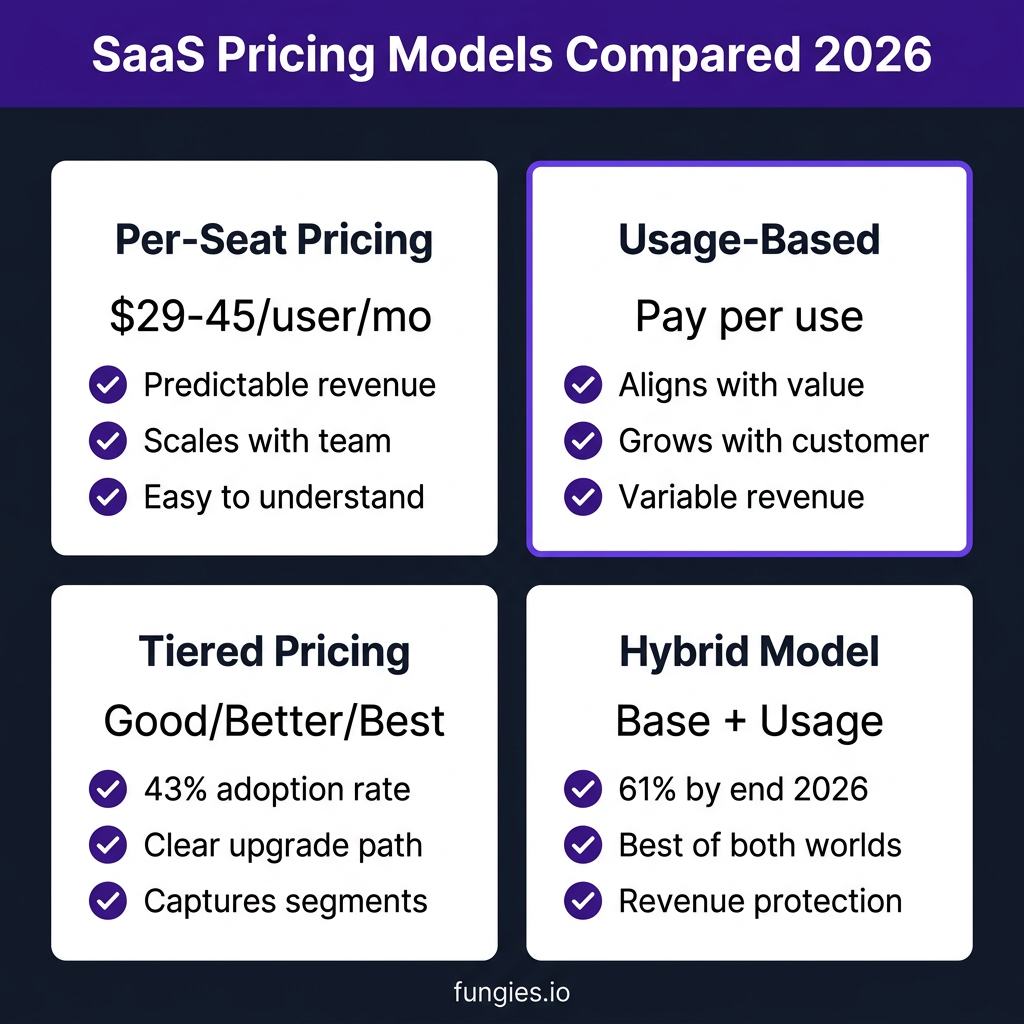
Consider this: 43% of SaaS companies now use hybrid pricing models, and that’s projected to reach 61% by the end of 2026. The industry is shifting away from simple per-seat models toward more sophisticated approaches that capture value more accurately.
The stakes are high. Companies that shift from per-seat to value-based pricing capture 15-25% more ACV on enterprise deals. That’s not incremental improvement — that’s transformational revenue growth from the same product.
The 6 Core SaaS Pricing Models
Let’s break down the pricing models that dominate the SaaS landscape in 2026. Each has its place — the key is knowing which fits your product, market, and growth stage.
1. Per-Seat Pricing (Per-User)
The classic model: you charge based on how many people use your product. It’s simple, predictable, and easy for customers to understand.
Best for: Products where value scales linearly with team size — think CRMs, project management tools, or collaboration software.
The catch: If your product has high expansion potential but you’re using per-user pricing, you cap your revenue growth at your customers’ hiring growth. That’s a problem if your product becomes deeply embedded in their workflows.
Median pricing: $29-45/user/month for B2B SaaS.
2. Usage-Based Pricing
Customers pay for what they use — API calls, storage, emails sent, or whatever metric aligns with value delivery.
Best for: Infrastructure products, developer tools, or any SaaS where heavy users get significantly more value than light users.
The advantage: Your revenue grows as your customers grow. No arbitrary caps on expansion.
The risk: Revenue becomes harder to predict. Customers may get sticker shock from unexpectedly high bills.
3. Tiered Pricing (Good/Better/Best)
You offer multiple packages at different price points — typically a basic tier for small teams, a professional tier for growing companies, and an enterprise tier with all the bells and whistles.
Best for: Most B2B SaaS companies. This is the dominant model for a reason.
The psychology: The middle tier typically sees the highest conversion. The enterprise tier anchors customers to a higher price point, making the middle tier feel like a bargain.
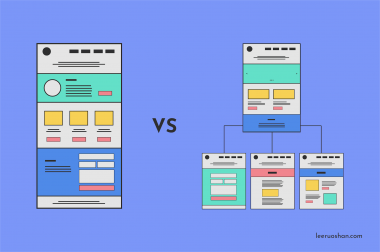
Key insight: 43% of SaaS companies use tiered pricing as their primary model.
4. Flat-Rate Pricing
One price, unlimited usage. Simple for customers, simple for you.
Best for: Early-stage products or tools with relatively uniform usage patterns across customers.
The limitation: You leave money on the table from power users while potentially pricing out smaller customers.
5. Freemium
A free tier with limited features, plus paid tiers for more functionality.
Best for: Products with low marginal costs and viral potential. Think Dropbox, Slack, or Notion.
The reality check: Freemium-to-paid conversion rates average just 2.6% for EdTech and 3-5% for most B2B SaaS. You need massive top-of-funnel volume to make this work.
6. Hybrid Pricing
A base fee plus variable usage components. You get predictable baseline revenue plus upside as customers grow.
Best for: Most mature SaaS companies. This is where the industry is heading.
The trend: 43% of SaaS companies now use hybrid models, projected to hit 61% by end of 2026.
Value-Based Pricing: The Strategy That Captures True Worth
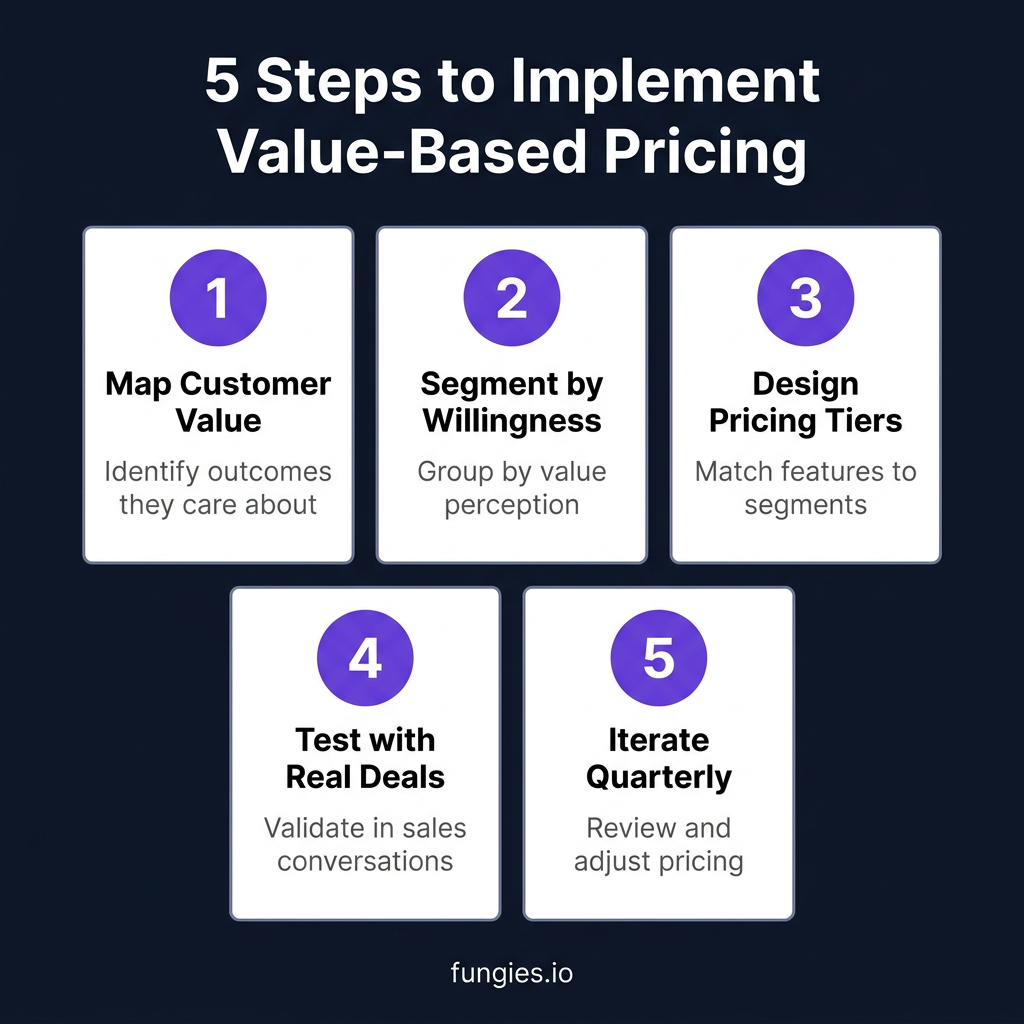
Value-based pricing sets prices according to what customers think your product is worth, not what it costs you to deliver. It’s the most profitable pricing strategy — but also the hardest to execute.
Here’s why it matters: companies using value-based pricing optimization see 20-30% more revenue than those using cost-plus or flat pricing models. When you price based on perceived value, you capture more of the surplus you create for customers.
But value-based pricing requires deep customer research. You need to understand:
- What outcomes your customers care about most
- How they measure success
- What they’d pay to achieve those outcomes
- How they compare alternatives
How to Choose the Right Pricing Model for Your SaaS
Picking a pricing model isn’t about copying competitors or following trends. It’s about matching your pricing to how customers derive value from your product.
Ask yourself three questions:
1. What Makes Your Product More Valuable to Some Customers Than Others?
If value scales with team size, per-seat pricing makes sense. If value scales with usage intensity, consider usage-based. If different customer segments need different features, tiered pricing is your friend.
2. How Quickly Do Customers Realize Value?
Products with immediate value realization can charge upfront. Products that take months to show ROI may need usage-based models that grow with proven value.
3. What’s Your Expansion Potential?
If customers naturally expand usage over time, make sure your pricing captures that growth. Per-seat pricing caps you at headcount growth. Usage-based pricing lets you grow with customer success.
SaaS Pricing Benchmarks and Statistics for 2026
Let’s ground this in real data. Here are the benchmarks you should know:
| Metric | Median | Top Quartile |
|---|---|---|
| B2B SaaS price per user/month | $29-45 | $75+ |
| Free-to-paid conversion | 34% | 50-60% |
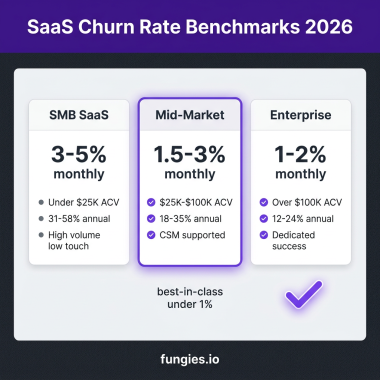
| Annual churn rate | 5-7% | <5% |
| Net Revenue Retention | 101-104% | 110%+ |
| CAC payback period | 18 months | <12 months |
Key pricing trends:
- SaaS pricing increased 11.4% year-over-year in 2025
- 43% of companies use hybrid pricing (base + usage)
- 61% of SaaS companies had adopted some form of usage-based pricing by end of 2023
- Value-based pricing delivers 20-30% more revenue than cost-plus models
Common SaaS Pricing Mistakes (And How to Avoid Them)
I’ve seen founders make the same pricing mistakes repeatedly. Here are the big ones to watch out for:
Mistake 1: Copying Competitors
Just because Stripe or HubSpot prices a certain way doesn’t mean you should. Their customer base, value proposition, and cost structure are different from yours. Build your pricing based on your customers, not your competitors.
Mistake 2: Underpricing to Win Deals
Discounting to close deals trains customers to expect discounts. It also signals that your product isn’t worth full price. If you’re consistently discounting more than 15%, your list price is wrong.
Mistake 3: Too Many Tiers
Three tiers is the sweet spot. More than four creates decision paralysis. Fewer than three leaves money on the table.
Mistake 4: Ignoring Expansion Revenue
Your pricing should make it easy for customers to grow with you. If your best customers hit a ceiling on what they can pay you, you’ve got a pricing problem.
Implementing Pricing Changes Without Alienating Customers
So you’ve realized your pricing needs to change. How do you do it without sparking a customer revolt?
Grandfather existing customers. Honor current rates for existing customers while charging new rates for new customers. This rewards loyalty while fixing your unit economics.
Communicate value, not price. Frame changes around the value you’re delivering, not the money you’re charging. Show customers what they’re getting, not what they’re paying.
Test with new segments first. Before rolling out pricing changes broadly, test them with new customer segments or geographies. Learn what works before committing.
Give plenty of notice. Sixty to ninety days is standard for pricing changes. Don’t spring increases on customers overnight.
FAQ: SaaS Pricing Strategy
What’s the most common SaaS pricing model?
Tiered pricing (Good/Better/Best) is the most common, used by 43% of SaaS companies. It works because it captures different customer segments while providing a clear upgrade path.
How often should I review my SaaS pricing?
At minimum, quarterly. Many successful SaaS companies review pricing monthly and make adjustments every 6-12 months. The market changes fast — your pricing should too.
Should I display pricing publicly?
For products under $10K ACV, yes. Transparency builds trust and reduces friction. For enterprise products with custom pricing, show “Contact Sales” with pricing guidance or a calculator.
What’s a good free-to-paid conversion rate?
The median is 34%, down from 50% in 2023. Top performers hit 50-60% with credit-card-required trials. If you’re below 20%, your free tier is either too generous or your paid tiers don’t show enough value.
How do I know if my pricing is too low?
If you’re closing more than 70% of qualified leads, your pricing is probably too low. If customers never negotiate or ask about discounts, you’re definitely underpriced. Healthy SaaS businesses see 40-60% close rates with some price sensitivity.
Conclusion: Your Pricing Strategy Is a Growth Lever
Pricing isn’t just about revenue — it’s about positioning, customer segmentation, and growth strategy. The right pricing model aligns your success with your customers’ success. It captures the value you create without creating friction.
In 2026, the trend is clear: hybrid and usage-based models are winning because they better align pricing with value. But the fundamentals haven’t changed. Understand your customers. Measure their outcomes. Price based on value delivered.
Get your pricing strategy right, and everything else gets easier. Your CAC improves. Your expansion revenue grows. Your churn drops. And you build a sustainable business that compounds over time.
Ready to implement better billing for your SaaS? Create your free Fungies account and start accepting payments with our flat 5% + $0.50 pricing — no monthly fees, no hidden charges, and tax compliance handled automatically.
Sources
- NxCode – SaaS Pricing Strategy Guide 2026
- Momentum Nexus – SaaS Pricing Strategy Guide
- Prospeo – Pricing for SaaS: Models, Benchmarks & Strategy
- Artisan Strategies – SaaS Conversion Rate Benchmarks 2026
- SaaS Capital – 2026 Benchmarking Metrics
- Digital Applied – SaaS Marketing Statistics 2026
- Genesys Growth – SaaS Pricing Optimisation Guide