Creator Economy Statistics 2026: Global Market Size, Data & Trends (Comprehensive Report)
The creator economy has evolved from a digital side hustle into a half-trillion-dollar global industry. In 2026, more than 207 million people worldwide identify as content creators—that’s 1 in every 40 people on Earth. What’s driving this explosive growth? According to Goldman Sachs Research, the creator economy could approach $480 billion by 2027, fueled by direct-to-fan monetization, brand partnerships, and platform innovation.
This comprehensive report compiles verified data from Grand View Research, Research and Markets, IAB, Influencer Marketing Hub, and other authoritative sources. Whether you’re a brand planning your 2026 creator marketing budget, an investor evaluating opportunities, or a creator building your business strategy—these statistics provide the foundation for data-driven decisions.
Key Creator Economy Statistics at a Glance
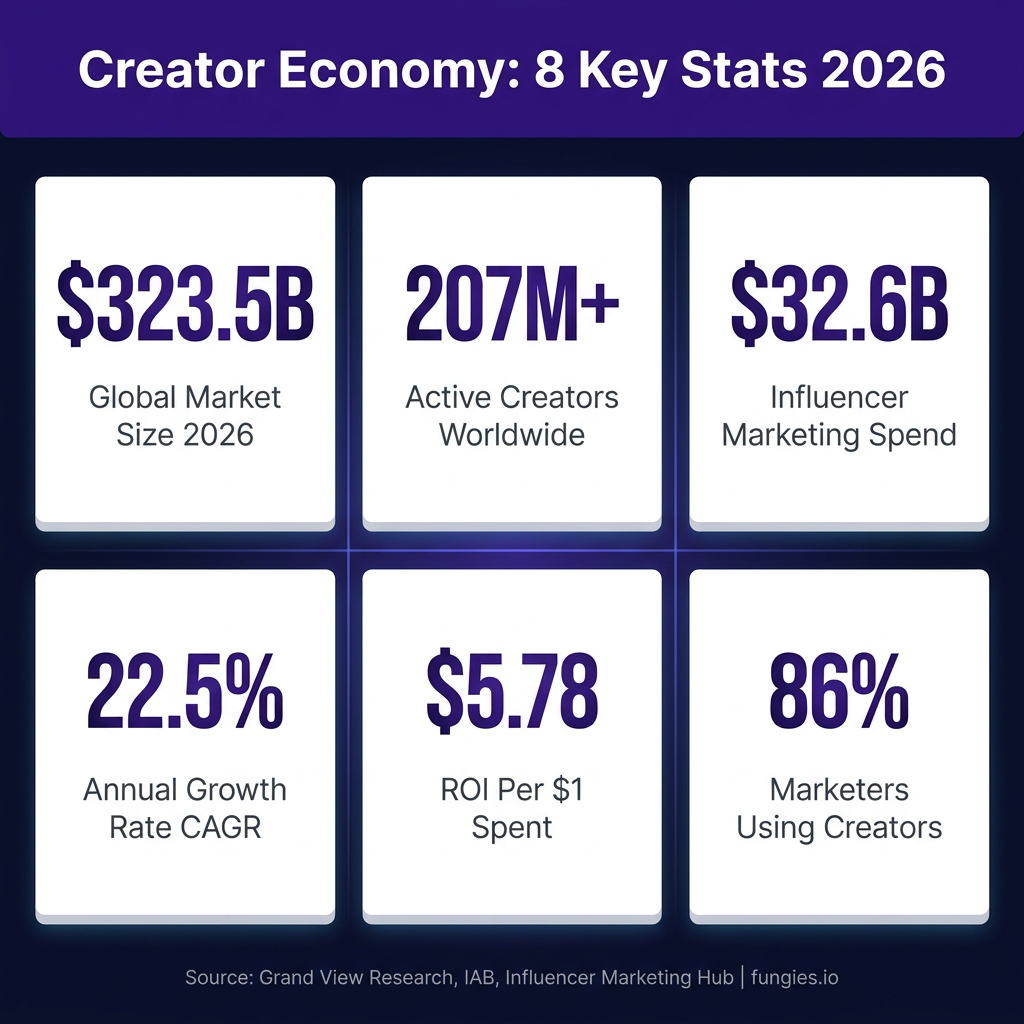
- $323.48 billion — Global creator economy market size in 2026 (Research and Markets)
- 207+ million — Active content creators worldwide (Companies History)
- 50 million — Professional creators earning primary income from content (Goldman Sachs)
- $32.55 billion — Global influencer marketing industry value in 2025 (Influencer Marketing Hub)
- 22.4-26.5% — Compound annual growth rate (CAGR) through 2035
- $5.78 — Average return for every $1 spent on influencer marketing
- 86% — Marketers who used influencer marketing in 2025 (HubSpot)
- 93% — Brands planning to increase creator marketing efforts in 2026
- 34.2% — North America’s share of global creator economy revenue
- 56% — Creators who launched communities in 2024-2025 (Circle)
Creator Economy Market Size & Growth
The creator economy has undergone remarkable expansion over the past decade. What began as a niche ecosystem of bloggers and early YouTubers has transformed into a global economic force rivaling traditional media industries.
According to Grand View Research, the global creator economy market size reached $205.25 billion in 2024. By 2025, multiple research firms including Goldman Sachs estimated the market had grown to approximately $250 billion. The latest 2026 data from Research and Markets places the current market value at $323.48 billion, representing year-over-year growth of 26.5%.
Looking ahead, the trajectory remains steep. Grand View Research projects the market will reach $1.35 trillion by 2033, growing at a CAGR of 23.3%. Research Nester offers an even more aggressive forecast: $1.35 trillion by 2035 with a 22.4% CAGR. By 2030, the creator economy is expected to exceed $528 billion globally.
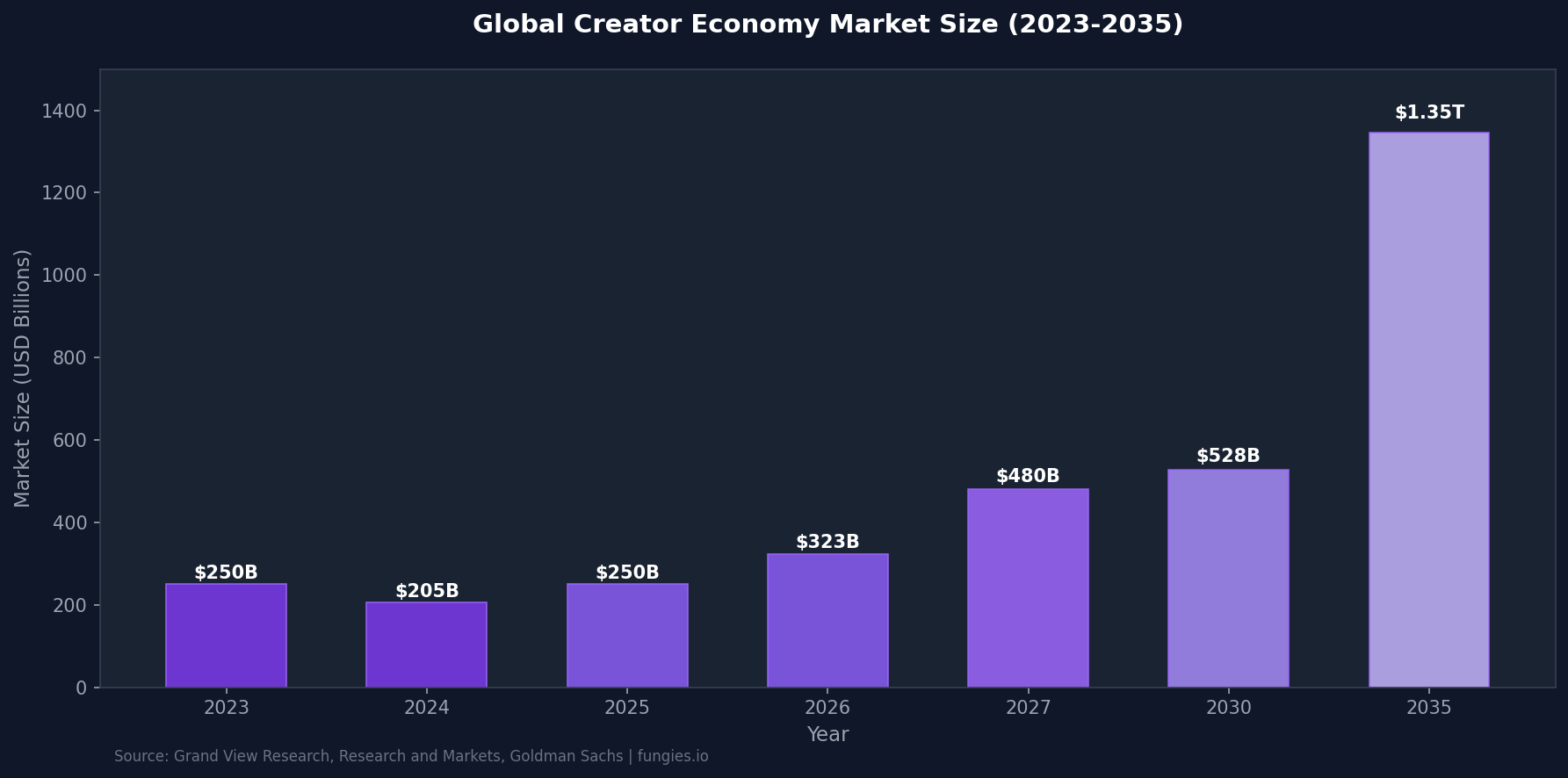
| Year | Market Size | Growth Rate | Source |
|---|---|---|---|
| 2023 | $250 billion | Baseline | Goldman Sachs |
| 2024 | $205.25 billion | – | Grand View Research |
| 2025 | $250+ billion | ~22% | Multiple Sources |
| 2026 | $323.48 billion | 26.5% | Research and Markets |
| 2027 | $480 billion (proj.) | 48% | Stan Store |
| 2030 | $528+ billion (proj.) | CAGR 22.5% | Tribe Group |
| 2033 | $1.35 trillion (proj.) | CAGR 23.3% | Grand View Research |
| 2035 | $1.35 trillion (proj.) | CAGR 22.4% | Research Nester |
Creator Economy by the Numbers: Infographic
Regional Breakdown: Where the Creator Economy Thrives
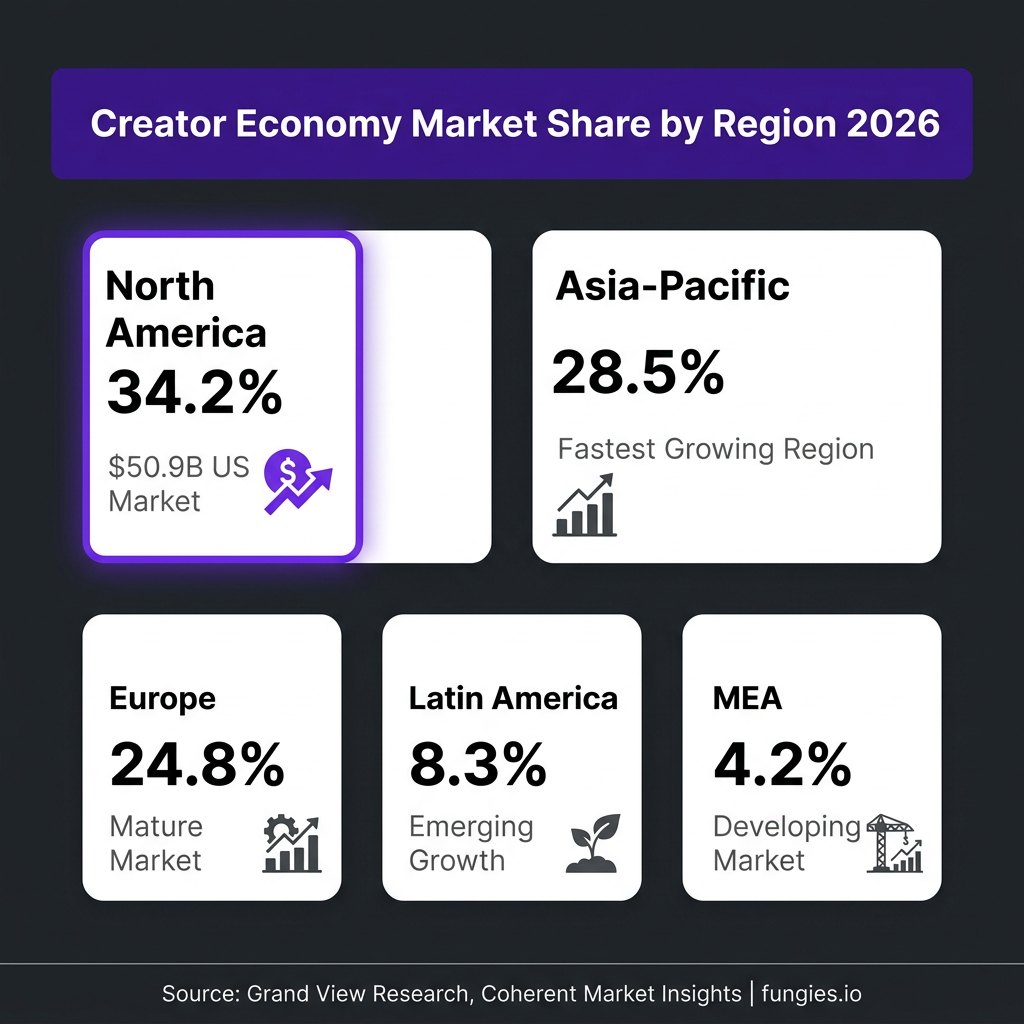
The creator economy is a truly global phenomenon, but regional dynamics vary significantly. North America continues to dominate in absolute terms, while Asia-Pacific emerges as the fastest-growing region.
According to Grand View Research, North America held 34.2% of global creator economy revenue in 2024, making it the largest regional market. The United States alone accounted for $50.9 billion in 2024, with projections indicating growth to $297.3 billion by 2034 at a 19.3% CAGR.
Coherent Market Insights expects North America to maintain over 35% market share through 2026, driven by early adoption of creator platforms, mature digital advertising markets, and high consumer spending on digital content.
Asia-Pacific represents the most dynamic growth story. While exact 2026 figures vary by source, the region’s massive internet user base, rapid smartphone adoption, and booming platforms like TikTok (ByteDance) position it as the growth engine for the next decade. Europe maintains a strong position with approximately 25% market share, characterized by mature regulatory frameworks and established creator ecosystems.
| Region | Market Share (2024) | Key Characteristics | Growth Outlook |
|---|---|---|---|
| North America | 34.2% | Mature market, highest monetization rates | 19.3% CAGR to 2034 |
| Asia-Pacific | ~28.5% | Fastest growing, largest user base | 25%+ CAGR projected |
| Europe | ~24.8% | Strong regulatory framework, steady growth | 18-20% CAGR |
| Latin America | ~8.3% | Emerging market, rising adoption | 22%+ CAGR |
| Middle East & Africa | ~4.2% | Developing infrastructure, early stage | 20%+ CAGR |
Key Players & Platform Market Share
The creator economy infrastructure is dominated by a handful of technology giants that provide the platforms, tools, and monetization mechanisms enabling creators to build audiences and generate revenue.
Video streaming platforms command the largest segment of the creator economy by platform type. YouTube, TikTok, and Twitch have become the primary venues for creator-audience relationships. According to Grand View Research, video streaming accounted for the largest platform revenue share in 2024, a trend expected to continue through 2030.
The major platform companies shaping the creator economy include:
- Alphabet (YouTube) — The original creator platform with the most mature monetization ecosystem including AdSense, memberships, and merchandise
- ByteDance (TikTok) — Dominant in short-form video with the Creator Fund and growing e-commerce integrations
- Meta (Instagram, Facebook) — Massive reach through Reels and creator monetization tools
- Amazon — Live streaming commerce and influencer storefronts
- Twitch (Amazon) — Leading live streaming platform for gaming creators
- Patreon — Subscription-based direct fan support
- Substack — Newsletter and written content monetization
- Canva, Vimeo, Ko-fi — Creator tools and alternative monetization
According to IAB’s 2025 Creator Economy Report, U.S. creator ad spend reached $37 billion in 2025, up 26% year-over-year—nearly 4x faster than the overall media industry’s growth. This signals that creator marketing has evolved from experimental tactic to core media channel.
| Platform/Company | Primary Function | Key Creator Feature |
|---|---|---|
| YouTube (Alphabet) | Long-form video | AdSense, Partner Program |
| TikTok (ByteDance) | Short-form video | Creator Fund, TikTok Shop |
| Instagram (Meta) | Visual content, Reels | Reels Play, subscriptions |
| Twitch (Amazon) | Live streaming | Subscriptions, bits, ads |
| Patreon | Membership platform | Direct fan subscriptions |
| Substack | Newsletters | Paid subscriptions |
Creator Income & Earnings Statistics
The financial reality of the creator economy presents a stark divide between perception and reality. While headlines celebrate millionaire influencers, the majority of creators earn modest incomes.
According to data from ShortsIntel and Zencastr, the creator income distribution follows a power law: a small percentage of creators capture the majority of earnings. More than two-thirds of creators report making under $1,000 per year, and 46% of full-time creators still fall below that threshold.
However, those who achieve professional status can earn substantial incomes. Full-time independent creators with at least three years of experience most commonly report earnings between $2,500 to $15,000 per month, though averages vary significantly by niche, platform, and audience geography.
Platform-specific earnings also differ dramatically:
- YouTube AdSense — Finance and business content earns $15-50 per 1,000 views; entertainment content typically $3-8 per 1,000 views
- TikTok Creator Fund — Lower payouts than long-form platforms, driving creators toward brand deals
- Brand partnerships — Nano creators (1K-10K followers): $100-800 per post; Micro creators (10K-100K): $500-5,000; Macro creators (100K+): $5,000-50,000+
According to Statista’s 2025 Creator Economy Report, only 34% of creators earn their primary income from platform ads—underscoring the importance of diversified revenue streams including sponsorships, merchandise, subscriptions, and affiliate marketing.
| Creator Tier | Follower Range | Avg. Annual Earnings | Primary Revenue Source |
|---|---|---|---|
| Hobbyist | 0-1,000 | <$1,000 | None/minimal |
| Nano | 1K-10K | $1,000-$10,000 | Affiliate, small brand deals |
| Micro | 10K-100K | $10,000-$100,000 | Brand partnerships, ads |
| Mid-tier | 100K-500K | $100,000-$500,000 | Sponsorships, products |
| Macro | 500K-1M | $500,000-$1M+ | Brand deals, merchandise |
| Mega | 1M+ | $1M-$50M+ | Multiple revenue streams |
Influencer Marketing Spend & ROI Benchmarks
Brand investment in creator partnerships has reached unprecedented levels. The global influencer marketing industry was valued at $32.55 billion in 2025 and is projected to hit $40.51 billion in 2026—a single-year jump of over 30% according to Ringly.io.
The return on investment justifies this spending. According to Influee, influencer marketing returns an average of $5.78 for every $1 spent—making it one of the highest-ROI marketing channels available. This figure represents aggregate performance across all tiers, platforms, and verticals.
Key influencer marketing benchmarks for 2026:
- 86% of marketers used influencer marketing in 2025 (up from 80% in 2023)
- 67% of brands plan to increase influencer marketing budgets in 2026
- 93% of brands plan to increase their creator marketing efforts overall
- 69% of marketers say influencer-generated content performs better than brand-directed content (Aspire)
- 77% of marketers repurpose creator content in paid social campaigns
- 86% of consumers have made at least one influencer-driven purchase in the past year
Engagement rates vary significantly by platform and creator tier. According to InfluenceFlow, average engagement rates range from 5-15% on Instagram to 8-20% on TikTok, with nano and micro creators typically outperforming macro influencers on engagement metrics.
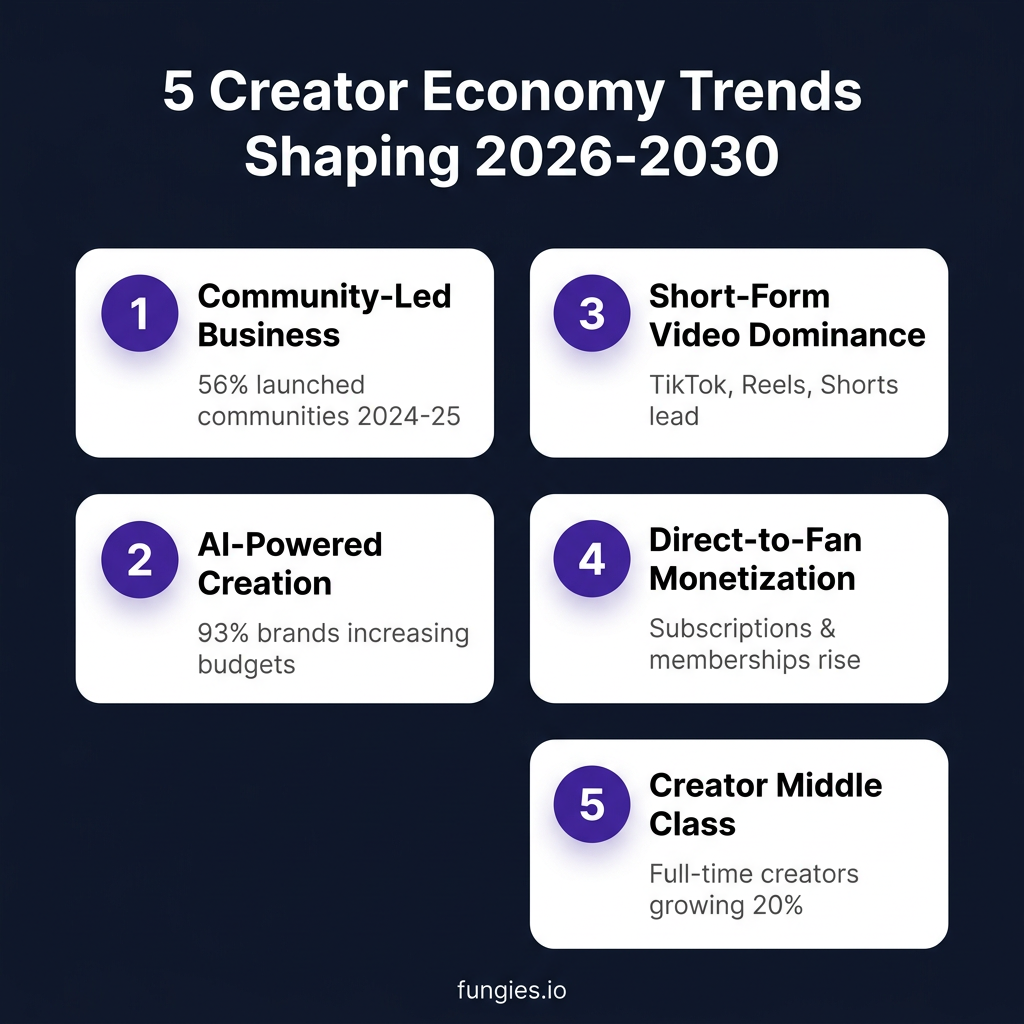
5 Creator Economy Trends Shaping 2026-2030
The creator economy continues to evolve rapidly. Based on data from Circle, Stan Store, and industry reports, these five trends will define the next phase of growth:
1. Community-Led Business Models
Creators are shifting from platform-dependent audiences to owned communities. According to Circle’s 2026 data, 56% of creators launched their community in 2024-2025—indicating community-building has become a near-default strategy rather than a late-stage optimization. This shift reduces dependency on algorithm changes and enables direct monetization through memberships and subscriptions.
2. AI-Powered Creation Workflows
Artificial intelligence is becoming a creator co-pilot rather than a replacement. The Influencer Marketing Factory’s 2026 survey found that creators increasingly use AI for content ideation, editing, and optimization—freeing time for higher-value creative work and audience engagement.
3. Short-Form Video Dominance
TikTok, Instagram Reels, and YouTube Shorts continue to capture disproportionate attention and engagement. The 25-34 age group is now the largest audience segment across platforms, and short-form content drives the highest engagement rates—particularly for micro and nano creators.
4. Direct-to-Fan Monetization
Creators are diversifying beyond ad revenue and brand deals. Subscription platforms like Patreon, direct merchandise sales, paid newsletters, and digital products are becoming primary revenue streams. This trend aligns with what Goldman Sachs identifies as the key to sustainable creator businesses.
5. The Rise of the Creator Middle Class
While mega-influencers grab headlines, the real growth is in full-time creators earning solid middle-class incomes. Goldman Sachs expects the 50 million global professional creators to grow at a 10-20% CAGR over the next five years, with their share of the creator universe remaining steady even as the overall ecosystem expands.
Methodology & Data Sources
This report synthesizes data from multiple authoritative sources to provide a comprehensive view of the creator economy in 2026. Our methodology prioritizes verified market research, official industry reports, and peer-reviewed data over self-reported figures or unverified claims.
Primary data sources include:
- Grand View Research — Market sizing and regional analysis
- Research and Markets — Growth projections and CAGR data
- Goldman Sachs Research — Creator economy forecasts and professional creator analysis
- IAB (Interactive Advertising Bureau) — U.S. creator ad spend data
- Influencer Marketing Hub — Industry benchmarks and ROI data
- Statista — Creator income and platform statistics
- Circle — Community-building trends and creator behavior
- Coherent Market Insights — Regional market share analysis
Market size figures vary between sources due to differing definitions of “creator economy” (some include only platform payouts, others encompass brand deals, merchandise, and related services). We present ranges where sources diverge and note specific methodologies where relevant.
Frequently Asked Questions
How big is the creator economy in 2026?
The global creator economy is valued at approximately $323.48 billion in 2026, up from $205.25 billion in 2024. The market is projected to reach $480-528 billion by 2027-2030 and could exceed $1.35 trillion by 2033-2035.
How many content creators are there worldwide?
There are over 207 million active content creators worldwide as of 2026. Of these, approximately 50 million are considered professional creators who earn their primary income from content creation.
What is the ROI of influencer marketing?
Influencer marketing returns an average of $5.78 for every $1 spent, making it one of the highest-ROI digital marketing channels. However, returns vary significantly by creator tier, platform, and campaign execution.
Which region has the largest creator economy?
North America holds the largest share at 34.2% of global creator economy revenue, with the U.S. market alone valued at $50.9 billion in 2024. However, Asia-Pacific is the fastest-growing region.
How much do content creators earn?
Earnings vary dramatically: over two-thirds of creators make under $1,000 annually, while full-time professional creators with 3+ years experience typically earn $2,500-$15,000 per month. Top-tier creators can earn millions annually through diversified revenue streams.
Sources & Citations
- Grand View Research — Creator Economy Market Report 2025-2033
- Research and Markets — Creator Economy Market Report 2026
- Goldman Sachs Research — The Creator Economy Could Approach Half-a-Trillion Dollars by 2027
- IAB — 2025 Creator Economy Ad Spend & Strategy Report
- Research Nester — Creator Economy Market Size & Share Forecast 2026-2035
- Coherent Market Insights — Global Creator Economy Market Size and Forecast
- Circle — Creator Economy Statistics for 2026
- Companies History — Creator Economy Statistics and Market Size 2026
- ShortsIntel — Creator Economy Statistics 2026
- The Influencer Marketing Factory — 2026 Creator Economy Report
- Stan Store — The State of the Creator Economy 2026
- Influee — Influencer Marketing Statistics for 2026
- Ringly.io — Influencer Marketing Statistics 2026
- Aspire — Top Influencer Marketing Statistics for 2026
- Statista — Influencer Marketing Worldwide
- Forrester — The State of the Creator Economy
Last updated: June 4, 2026. Statistics are compiled from the most recent available data. Market projections are based on analyst forecasts and should be considered estimates.