The Complete Guide to Merchant of Record for Indie SaaS Founders (2026)
There’s a number that most indie SaaS founders miss when they’re setting up payments: the compliance cost of going solo. Once you start selling in more than a handful of countries, you’re on the hook for VAT in Europe, GST in Australia, sales tax across 46 US states, and more. That’s not a weekend project
There’s a number that most indie SaaS founders miss when they’re setting up payments: the compliance cost of going solo. Once you start selling in more than a handful of countries, you’re on the hook for VAT in Europe, GST in Australia, sales tax across 46 US states, and more. That’s not a weekend project — it’s a full-time compliance job. A Merchant of Record (MoR) solves that entirely, and in 2026 there are more good options for indie SaaS founders than ever.
This guide covers what a Merchant of Record is, why it matters specifically for indie and bootstrapped SaaS builders, and how to pick the right one without overpaying or getting locked into a platform that doesn’t fit your stage.
What Is a Merchant of Record?
A Merchant of Record is the legal entity that appears on the customer’s receipt. When your customers buy through a MoR platform, the MoR — not you — is technically the seller of record. That single shift moves a massive amount of legal and financial responsibility off your plate.
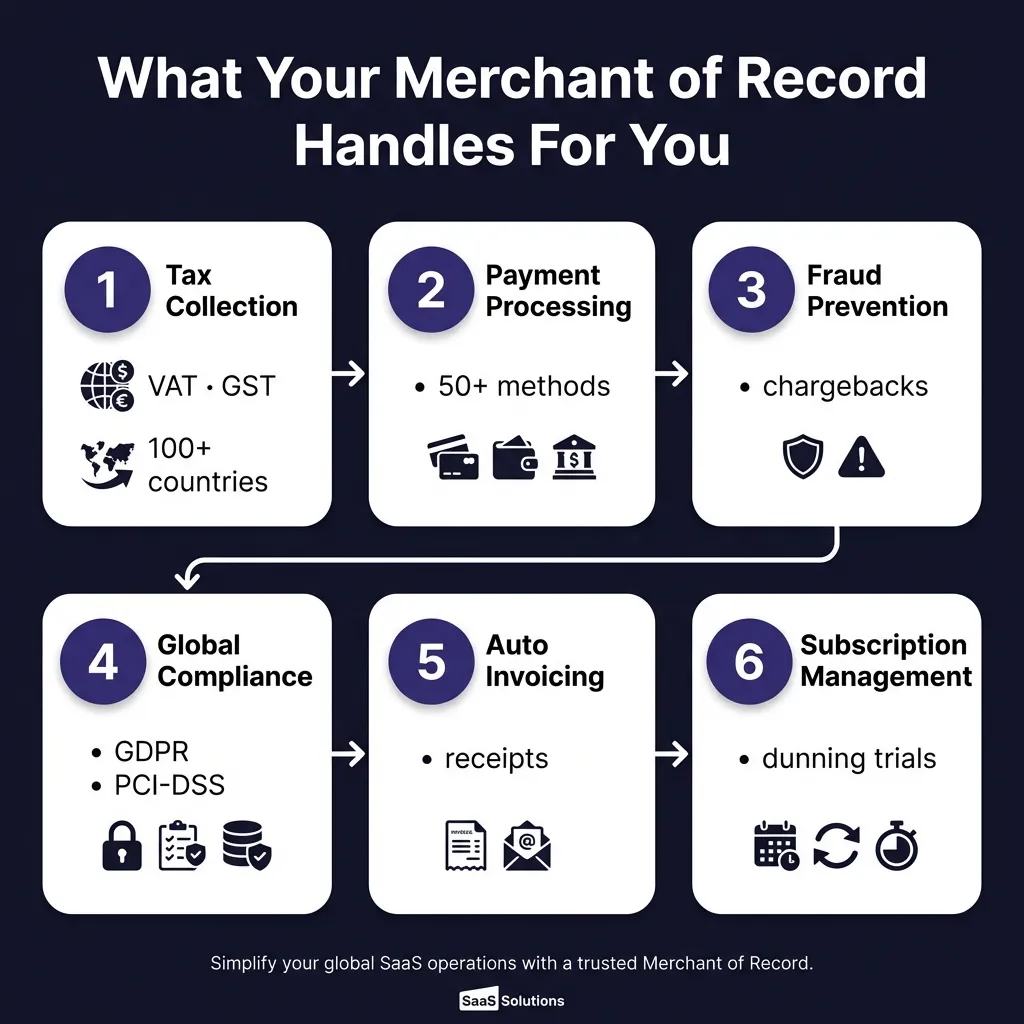
Concretely, a MoR handles:
- Tax collection and remittance — VAT, GST, US sales tax in every jurisdiction where you have customers
- Payment processing — card acquiring, fraud screening, currency conversion
- Chargeback management — disputing fraudulent claims on your behalf
- Compliance — PCI-DSS, GDPR, PSD2, local consumer protection laws
- Invoicing — auto-generated, jurisdiction-compliant receipts for every transaction
- Subscription billing — trials, upgrades, dunning, proration
Without a MoR, you handle all of that yourself. The alternative — Stripe + TaxJar + a tax lawyer + chargeback tooling — costs more than you think.
Why Indie SaaS Founders Need a MoR in 2026
If you’re building solo or with a small team, tax compliance is the thing that quietly kills momentum. Here’s what the landscape looks like in 2026:
- The EU’s VAT on digital services rules require registration in each member state once you cross the EU-wide threshold (€10,000) — or use OSS (One Stop Shop) filing
- The US has 46 states with sales tax, and economic nexus thresholds have been dropping — many states now trigger at just 200 transactions per year
- Australia, Canada, India, and the UK all have their own digital services tax obligations
- Tax authorities globally are tightening enforcement on cross-border digital sales
For an indie founder processing $5K/month, registering in every relevant jurisdiction, filing quarterly returns, and managing disputes isn’t feasible. A MoR makes it irrelevant — they take on the liability.
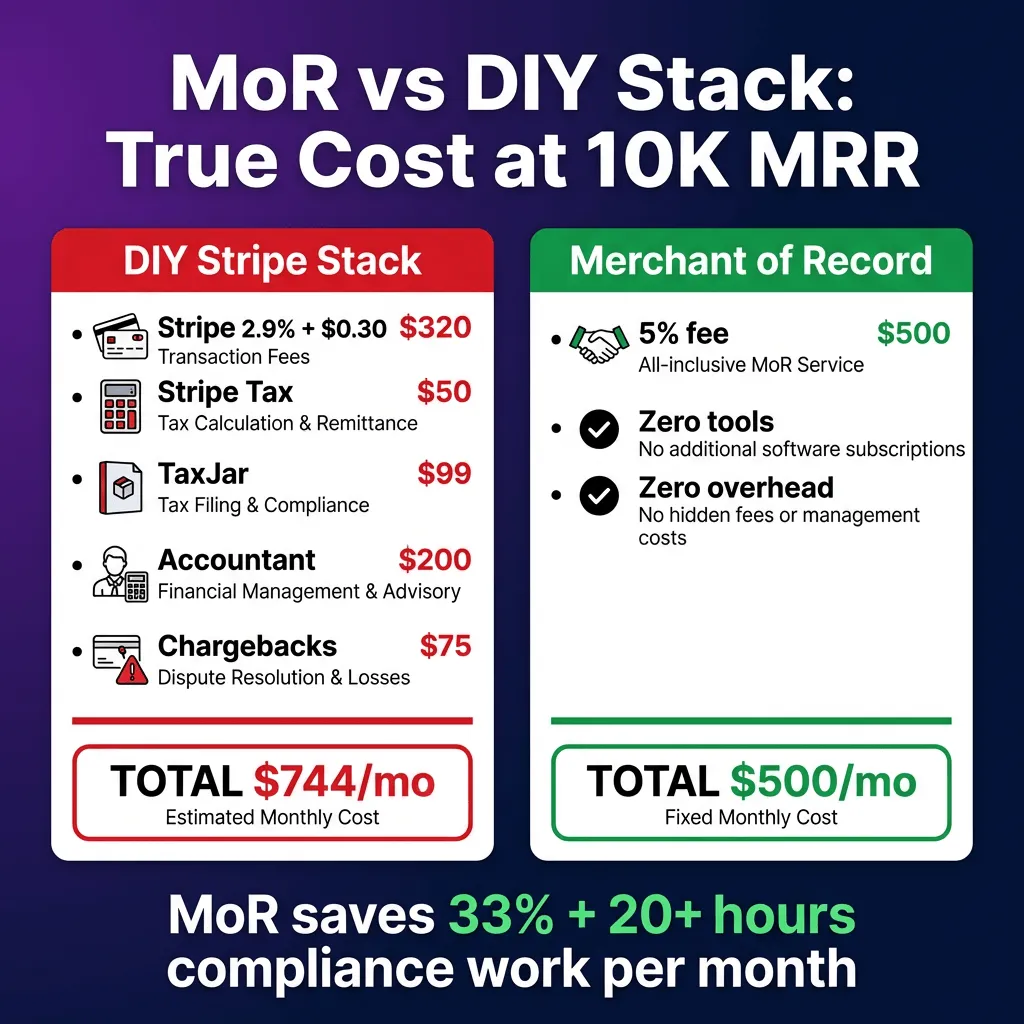
The math is also cleaner than most people realize. At $10K MRR, the true cost of a DIY Stripe stack often hits $700–$800/month when you factor in Stripe Tax ($50), a tax compliance tool like TaxJar ($99), accountant time (~$200), and average chargeback fees (~$75). A MoR charging 5% all-in costs $500. You’re paying less and getting more coverage.
How to Evaluate a Merchant of Record as an Indie Founder
Not every MoR is built for small teams. Some are enterprise-first products that happen to accept early-stage signups. Here’s what to actually look at:
Fee Structure
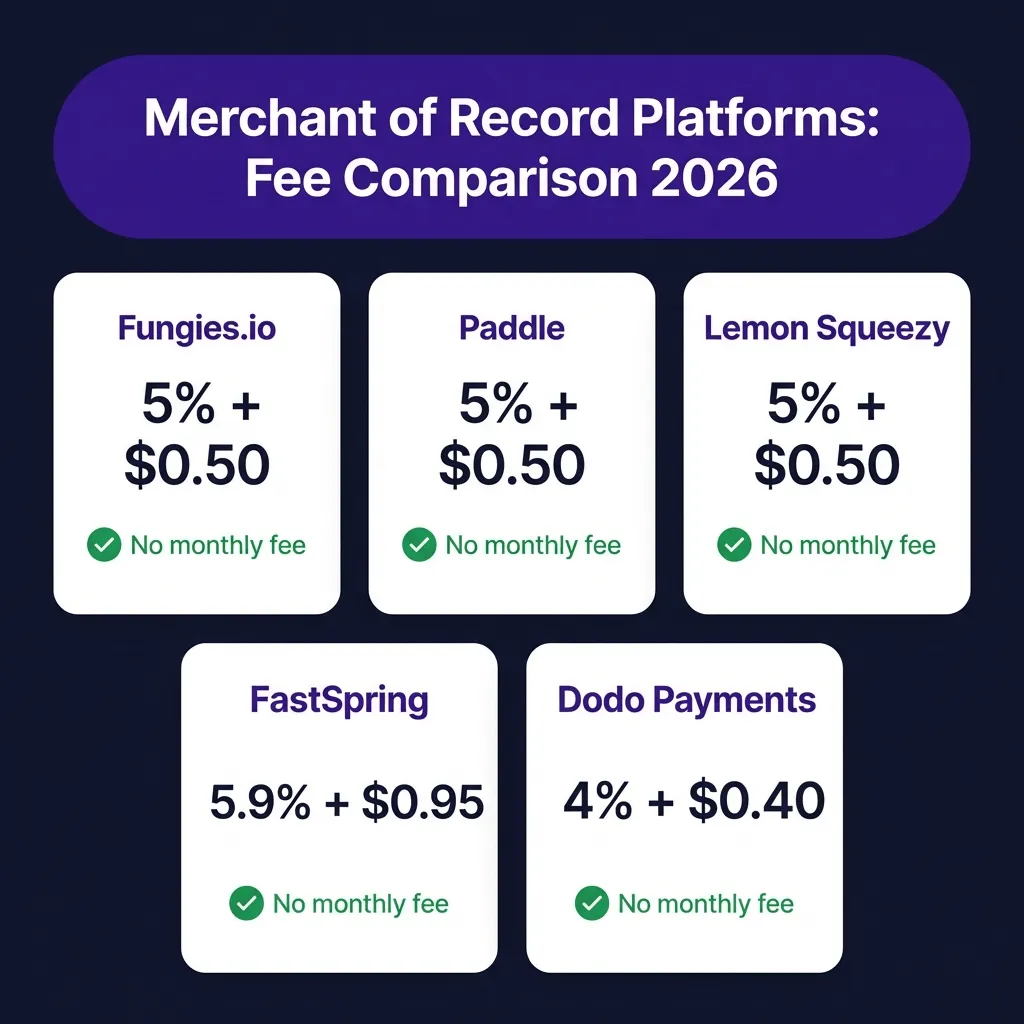
The standard MoR rate in 2026 is 5% + $0.50 per transaction — that’s where Paddle, Lemon Squeezy, and Fungies.io all land. FastSpring charges more (5.9%–8% depending on volume). Dodo Payments has positioned at 4% + $0.40. What matters more than the headline rate is what’s included: tax handling, fraud, chargebacks, and subscription tooling should all be in the base fee.
Monthly Fees vs. Pure Commission
For pre-revenue or early-stage founders, monthly fees are poison. A $50–$200/month fixed cost before you’ve validated revenue is a mistake. Fungies.io, Lemon Squeezy, and Dodo Payments all operate on pure commission models — no monthly charges, ever. Paddle is the same. FastSpring’s model varies by account size.
Onboarding Speed
Can you go from zero to taking payments in under an hour? Fungies.io, Lemon Squeezy, and Dodo Payments all have no-code setups that let you launch a storefront in minutes. Paddle requires a bit more setup but is still fast by enterprise standards. FastSpring’s onboarding involves a sales call and approval process — fine for $1M ARR companies, annoying when you’re launching a side project.
Tax Coverage
This is non-negotiable. Any MoR you consider should cover EU VAT, US state sales tax, Australian GST, and Canadian GST/HST at minimum. Most do. Double-check the specifics for your target markets — some platforms have gaps in emerging markets.
Developer Experience
You’ll need to integrate checkout into your app or landing page. Look for: clean REST APIs or webhooks, good documentation, embeddable checkout widgets, and sandbox environments for testing. Paddle’s Billing API is well-regarded. Fungies.io offers both a no-code storefront and an API for custom integrations. Lemon Squeezy has a clean API that most indie developers find easy to work with.
| Platform | Transaction Fee | Monthly Fee | MoR Coverage | Best For | Onboarding |
|---|---|---|---|---|---|
| Fungies.io | 5% + $0.50 | None | 100+ countries | Indie SaaS, digital products, game devs | Minutes (no-code) |
| Paddle | 5% + $0.50 | None | Global | SaaS with subscription complexity | Hours (self-serve) |
| Lemon Squeezy | 5% + $0.50 | None | Global | Digital products, creator-led SaaS | Minutes |
| FastSpring | 5.9% + $0.95 | None (volume-based) | Global | Enterprise software, B2B SaaS | Days (sales process) |
| Dodo Payments | 4% + $0.40 | None | 150+ countries | AI products, bootstrapped SaaS | Minutes |
Deep Dive: The Top MoR Platforms for Indie SaaS in 2026
Fungies.io — Best for Indie SaaS and Digital Products
Fungies.io was built from the ground up for exactly this audience: indie developers, micro-SaaS founders, and small teams who want complete MoR coverage without enterprise onboarding friction. The platform offers a no-code web store builder — you can have a working checkout page live in under 10 minutes without writing a line of code.
Key features that matter for indie founders:
- 5% + $0.50 per transaction, zero monthly fees
- Automatic VAT/GST/sales tax collection and remittance globally
- 50+ payment methods including cards, PayPal, SEPA, ACH, and Buy Now Pay Later
- Built-in subscription management with trials and upgrade flows
- Stripe Connect integration for fast payouts to your bank
- No-code storefront with custom domain support
The platform’s focus on indie developers means the UI doesn’t assume you have a finance team. Everything is self-serve. Sign up at Fungies.io and you can be live before lunch.
Paddle — Best for SaaS with Subscription Complexity
Paddle is the category leader for good reason. Their subscription management is genuinely sophisticated: grandfathering, proration, revenue recovery (dunning), trial management, and detailed MRR/ARR analytics. If your SaaS has complex billing — usage tiers, add-ons, annual vs monthly with prorated switching — Paddle handles it well.
The caveat for indie founders is that Paddle’s UI and API surface area can feel like overkill. You’re also at 5% + $0.50, the same rate as simpler alternatives. For most indie projects, Paddle is a great choice once you’re doing consistent $5K–$10K+ MRR and need the subscription tooling. For your first $1K MRR, something faster to set up makes more sense.
Lemon Squeezy — Best for Creator-Led SaaS
Lemon Squeezy has a strong following in the creator and indie developer community. Their checkout UX is polished, setup is fast, and the API is clean. They also have a native affiliate system built in — useful if influencer or affiliate marketing is part of your go-to-market.
Worth noting: Lemon Squeezy was acquired by Stripe in 2023. As of 2026, the platform continues operating independently, but it’s worth watching how the Stripe relationship evolves over time — particularly whether pricing or terms shift as the acquisition matures.
FastSpring — Best for Enterprise Software
FastSpring is the oldest player in this space and excels at enterprise use cases: B2B invoicing with PO support, reseller channels, multi-currency pricing pages, and deep customization. Their effective rate is higher (5.9%–8%), and onboarding involves a sales conversation rather than a self-serve signup.
For an indie founder just getting started, FastSpring is overkill. But if you’re selling to enterprise clients who need specific invoice formats, net payment terms, or complex licensing structures, FastSpring’s depth justifies the cost.
Dodo Payments — Best Budget MoR Option
Dodo Payments entered the market specifically targeting indie hackers and AI product builders. Their 4% + $0.40 rate is genuinely competitive, and their onboarding is fast. Coverage spans 150+ countries with full tax compliance. For cost-sensitive early-stage founders, it’s worth evaluating alongside Fungies.io.
MoR vs. DIY Stack: The Real Math
Let’s run the actual numbers at different revenue levels to make this concrete.
| Monthly Revenue | Stripe DIY (true cost) | MoR at 5% | Savings with MoR |
|---|---|---|---|
| $1,000 | ~$130 (Stripe fees + $99 TaxJar + accountant time) | $50 | ~$80/month |
| $5,000 | ~$440 (Stripe fees + compliance tools + accountant) | $250 | ~$190/month |
| $10,000 | ~$744 (Stripe 2.9%+$0.30 at avg $50 ticket + Stripe Tax + TaxJar $99 + accountant $200 + chargebacks $75) | $500 | ~$244/month |
| $50,000 | ~$2,800 (higher accountant costs, potential VAT lawyer, multi-jurisdiction filings) | $2,500 | ~$300/month + huge time savings |
The MoR advantage is strongest at the lower revenue tiers — the fixed costs of compliance tooling hurt the most when you’re not yet doing volume. And this table doesn’t count the time cost: indie founders who manage tax compliance themselves report spending 10–20+ hours per quarter on filings, research, and dispute resolution. A MoR eliminates that entirely.
How to Set Up a Merchant of Record for Your Indie SaaS
The actual setup process is simpler than most founders expect. Here’s the typical flow with a platform like Fungies.io:
- Sign up and verify — Takes 5 minutes. You’ll need basic business details and your Stripe account for payouts.
- Create your product catalog — Add your SaaS plans (monthly/annual), pricing, and descriptions. No-code interface.
- Configure your checkout — Customize the storefront with your branding, custom domain, and payment methods.
- Embed or link to checkout — Either link directly to your Fungies storefront, or use the API to embed checkout into your existing site.
- Test in sandbox — Run a test transaction to verify the flow and webhook delivery to your backend.
- Go live — Flip the switch. From that point, all tax collection, remittance, and compliance is handled automatically.
Paddle’s setup is broadly similar but has a few more steps around subscription configuration. Lemon Squeezy is arguably even faster for simple setups. The point is: none of these take more than a day, even with custom integration work.
5 Key Takeaways
- A MoR is cheaper than it looks. At $10K MRR, a 5% MoR fee beats the true cost of Stripe + compliance tools by ~$244/month.
- For indie founders, avoid monthly fees. Fungies.io, Lemon Squeezy, Paddle, and Dodo Payments all charge zero monthly fees. Never pay a subscription just to accept payments.
- Onboarding speed matters. If you can’t get from signup to live checkout in under an hour, the platform isn’t built for indie use cases.
- The compliance liability shift is the real value. Tax authorities are increasing enforcement on cross-border digital sales. A MoR puts the liability on the platform, not you.
- Fungies.io hits the indie sweet spot. Same 5% rate as Paddle and Lemon Squeezy, no-code setup in minutes, built specifically for developers selling SaaS and digital products globally.
FAQ
What is a Merchant of Record for SaaS?
A Merchant of Record for SaaS is a platform that becomes the legal seller on your customers’ receipts. It handles all global tax collection and remittance (VAT, GST, US sales tax), payment processing, fraud prevention, chargeback management, and compliance — so your SaaS company doesn’t need to manage any of this directly. Paddle, Fungies.io, Lemon Squeezy, and FastSpring are all Merchant of Record platforms.
Do indie SaaS founders need a Merchant of Record?
Yes — especially if you’re selling to customers in multiple countries. Once you have customers in the EU, UK, Australia, or the US across multiple states, you trigger digital services tax obligations in each jurisdiction. A MoR handles all of this automatically. Without one, you’re personally responsible for identifying, registering, and remitting taxes across dozens of jurisdictions.
What’s the cheapest Merchant of Record for indie hackers?
In 2026, Dodo Payments offers the lowest published rate at 4% + $0.40 per transaction. Fungies.io, Paddle, and Lemon Squeezy all charge 5% + $0.50. FastSpring is more expensive at 5.9%+. For most indie founders, the 1% difference between Dodo and the others is less important than integration quality, reliability, and feature set — but at $10K MRR, Dodo saves about $100/month compared to a 5% MoR.
Can I switch Merchant of Record platforms later?
Yes, but it involves work. You’ll need to migrate existing subscribers, re-integrate checkout, and potentially deal with a transition period for active subscriptions. Most platforms offer migration guides and support. The practical advice: choose carefully upfront and avoid platforms with lock-in clauses or high migration complexity. Fungies.io and Lemon Squeezy are generally the easiest to migrate away from if needed; FastSpring can be more complex due to their custom contract structures.
Conclusion
If you’re an indie SaaS founder in 2026 and you’re not using a Merchant of Record, you’re taking on unnecessary risk and almost certainly paying more than you should for compliance. The tax enforcement environment is tightening, the platforms are getting better and cheaper, and the setup friction is lower than ever.
For most indie and bootstrapped founders, Fungies.io is the natural starting point: no monthly fees, 5% + $0.50 all-inclusive, live in minutes, and built specifically for the developer audience. For more complex subscription needs at scale, Paddle is the right move. Either way, using a MoR is a straightforward decision once you run the numbers.
Start selling with Fungies.io free today →