Whop vs Gumroad vs Lemon Squeezy: Which Creator Platform Is Worth It in 2026?
Gumroad built the creator economy’s on-ramp. Whop redefined what a digital commerce platform could be. Lemon Squeezy became the go-to Merchant of Record for indie SaaS founders. And now, in 2026, creators and developers have to pick one — or figure out which is actually right for their business. Here’s the thing nobody tells you
Gumroad built the creator economy’s on-ramp. Whop redefined what a digital commerce platform could be. Lemon Squeezy became the go-to Merchant of Record for indie SaaS founders. And now, in 2026, creators and developers have to pick one — or figure out which is actually right for their business.
Here’s the thing nobody tells you upfront: these three platforms aren’t really competing. They serve different people at different stages selling different things. Getting this wrong costs you real money and hours of migration headaches later.
This guide breaks down exactly what each platform does, who it’s for, what you’ll pay, and where each one falls short.
What Are These Platforms, Actually?
Let’s set the scene before we get into fee tables.
Gumroad is the OG creator monetization platform. Launched in 2011 by Sahil Lavingia, it was built on one premise: creators shouldn’t need to be developers to sell things online. eBooks, courses, templates, music, PDFs — Gumroad handles it all with a minimal storefront and zero monthly fees. In 2025, Gumroad became a full Merchant of Record, meaning it now handles VAT and sales tax compliance on your behalf globally.
Whop launched in 2021 and took a different angle: community-first commerce. It started as a marketplace for Discord communities, trading signals, and digital access, then evolved into an all-in-one platform where you can sell courses, SaaS access, memberships, communities, and digital downloads under one roof. The app ecosystem is its superpower — you can stack Courses + Chat + Forums + Coaching into a single product.
Lemon Squeezy was acquired by Stripe in 2023 and has been the default choice for indie SaaS founders who want full Merchant of Record protection without enterprise complexity. It handles subscriptions, license keys, fraud prevention, and global tax compliance (190+ countries). It’s SaaS-first in a way Gumroad and Whop aren’t.
Fee Breakdown: What You Actually Pay
This is where most comparisons go wrong — they look at the headline fee and ignore processing. Let’s do the real math.
Gumroad Fees in 2026
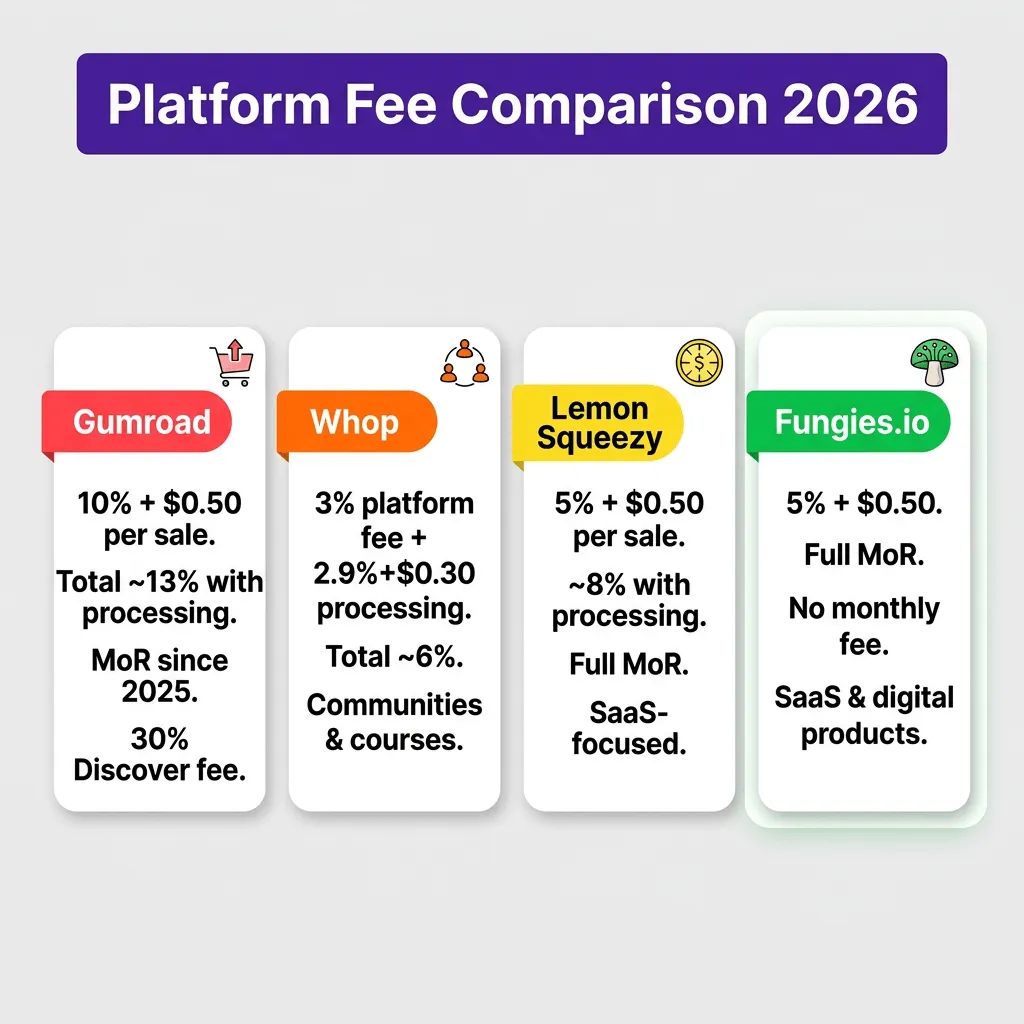
Gumroad charges a flat 10% + $0.50 per transaction. On top of that, payment processing (via Stripe or PayPal) adds roughly 2.9% + $0.30. So your real all-in rate is approximately 13% per sale.
There’s a catch with Gumroad’s Discover marketplace feature: if a customer finds you through Gumroad’s native discovery, the fee jumps to a flat 30% (all-inclusive). That’s Gumroad essentially acting as an affiliate and taking a serious cut.
There’s no monthly fee, which makes it genuinely free to get started. But at scale, 13% is brutal.
Whop Fees in 2026
Whop charges a 3% platform fee on every transaction, plus standard Stripe processing: 2.7% + $0.30 for domestic cards, an extra 1.5% for international cards. Your all-in rate lands around 5.7–7.2% depending on your audience’s geography.
No monthly fee on the base plan. If you’re doing under $10k/month, Whop’s model is genuinely lean — especially since it bundles community hosting, courses, and membership tools that you’d otherwise pay for separately.
Lemon Squeezy Fees in 2026
Lemon Squeezy’s standard fee is 5% + $0.50 per transaction. With payment processing included (they’re the MoR, so it’s baked in), your effective rate lands around 8% per sale.
No monthly fee for core ecommerce features. Email marketing features have a tiered pricing based on subscriber count (free up to 500 subscribers). All tax handling — VAT, GST, sales tax — is included in that fee. No extra compliance tools needed.
| Platform | Platform Fee | Processing | All-In Rate | Monthly Fee | MoR? |
|---|---|---|---|---|---|
| Gumroad | 10% + $0.50 | ~2.9% + $0.30 extra | ~13% | $0 | Yes (since 2025) |
| Whop | 3% | 2.7% + $0.30 | ~5.7–7.2% | $0 | Partial |
| Lemon Squeezy | 5% + $0.50 | Included | ~8% | $0 | Yes (full) |
| Fungies.io | 5% + $0.50 | Included | ~8% | $0 | Yes (full) |
Feature Comparison: What Each Platform Actually Does Well
Gumroad: Simplicity Is Its Superpower (and Limitation)
Gumroad is the easiest platform on this list to set up. Create an account, add a product, share the link. That’s it. No configuration rabbit holes, no developer handoff required.
What it does well:
- Instant setup — sell in under 10 minutes
- Discover marketplace — organic traffic from Gumroad’s built-in audience
- Physical products — Gumroad handles fulfillment logistics, unlike Whop or Lemon Squeezy
- Email list built-in — subscriber management and basic broadcasts included
- Mobile app — manage products and view analytics on the go
Where it struggles:
- 10% fee is punishing at any meaningful scale
- No SaaS billing or subscription management
- Limited checkout customization
- MoR status is newer and less battle-tested than Paddle or Lemon Squeezy
Whop: The All-in-One Community Commerce Stack
Whop has evolved into something genuinely different. It’s not just a payment tool — it’s an operating system for community-based digital businesses. Their app ecosystem lets you build layered products that combine courses, chat, Discord integration, forums, coaching calls, and SaaS access under one storefront.
What it does well:
- App ecosystem — stack multiple product types (courses + community + coaching + SaaS)
- Whop Discover marketplace — built-in discovery for creators
- Affiliate programs — referral links and automatic payouts
- Mobile-first — native app experience for members
- Low fees — 3% platform fee is the most competitive in this comparison
- Discord integration — automatic role assignment and access control
Where it struggles:
- Tax compliance is partial — not a full MoR for all jurisdictions
- Not ideal for SaaS subscription billing with metered usage
- Overkill if you just want to sell a PDF or a template
- Less suited for pure B2B SaaS
Lemon Squeezy: The SaaS Founder’s MoR
After Stripe’s acquisition, Lemon Squeezy doubled down on what it was already best at: making SaaS billing painless for small teams. It handles subscriptions, license keys, usage-based billing, and global tax compliance across 190+ countries. The compliance piece is rock-solid — EU VAT, US sales tax, Canadian GST, Australian GST, all handled automatically.
What it does well:
- Full MoR coverage — 190+ countries, every major tax jurisdiction
- Subscription management — trials, upgrades, downgrades, cancellations, prorations
- License key generation — automatic for software products
- Fraud prevention — AI-powered payment risk intelligence built in
- Embeddable checkout — drop into any website or app
- Stripe backing — infrastructure reliability of Stripe
Where it struggles:
- No community features — it’s pure commerce, not a platform
- Less creator-marketplace feel than Gumroad or Whop
- Post-acquisition, product roadmap has been less transparent
- Not ideal for creators who want organic discovery
The Merchant of Record Question: Why It Actually Matters
This is the most underrated factor in the whole comparison — and the one that bites creators hardest when they ignore it.
A Merchant of Record (MoR) is the legal entity responsible for your customer’s transaction. When a platform acts as your MoR, it handles:
- Collecting and remitting VAT/GST in each country
- US state sales tax (which requires registrations in 45+ states)
- Chargeback disputes — the MoR fights them on your behalf
- PCI compliance
- Fraud liability
Without MoR protection, you’re responsible for all of that yourself. That means registering for VAT in the EU, GST in Australia, sales tax in every US state you hit nexus in. According to research, SaaS companies lose an average of 4.3% of revenue to sales tax liabilities and compliance costs when they manage this themselves.
Here’s where each platform stands:
- Lemon Squeezy: Full MoR, 190+ countries, battle-tested
- Gumroad: Became a full MoR in 2025 — newer but covers major jurisdictions
- Whop: Partial MoR — handles some tax situations but not a complete global solution for complex tax jurisdictions
If you’re selling to a global audience and you’re doing more than $2k/month, you need full MoR protection. It’s not optional at scale.
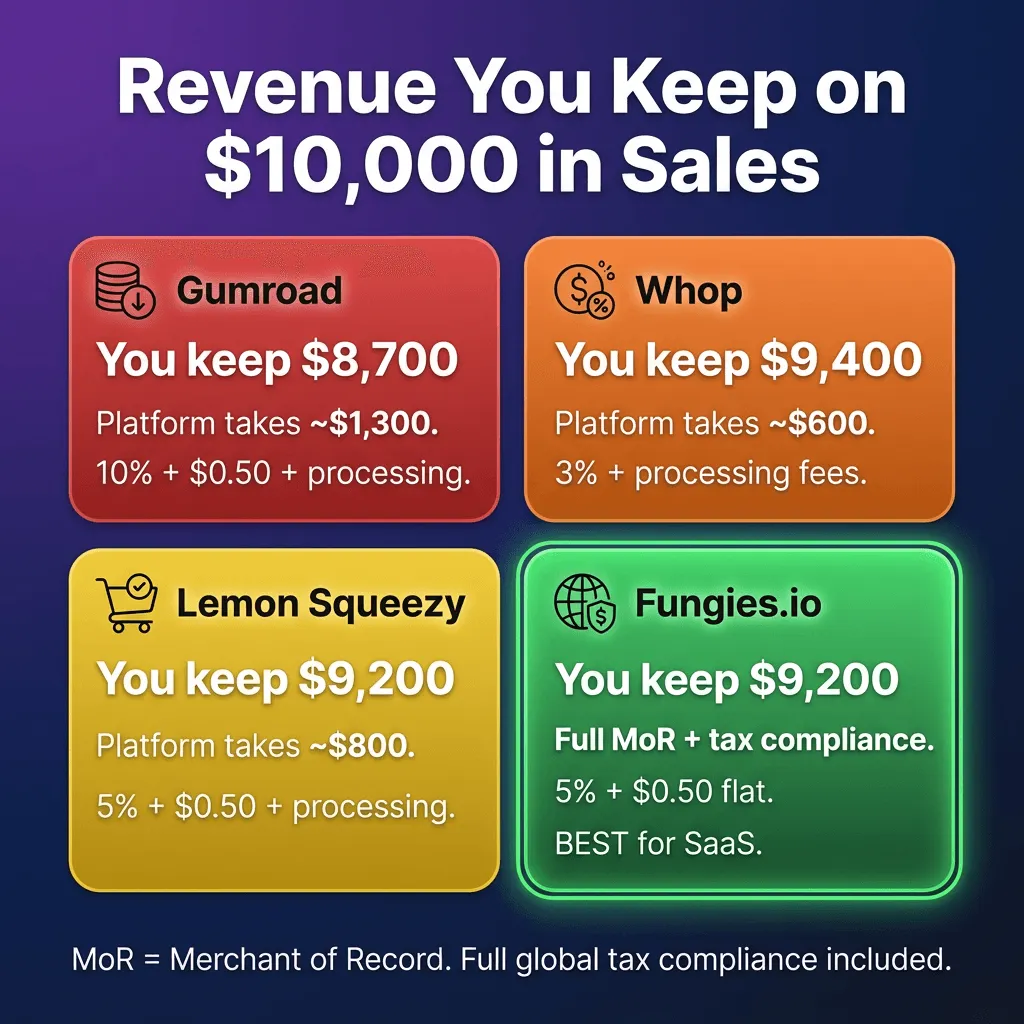
Real Revenue Math: $10,000 in Monthly Sales
Let’s stop talking abstractly and look at what you actually keep on $10,000 in monthly sales.
| Platform | Gross Revenue | Platform + Processing Fees | Net Revenue Kept | Annual Difference vs. Gumroad |
|---|---|---|---|---|
| Gumroad | $10,000 | ~$1,300 | ~$8,700 | — |
| Whop | $10,000 | ~$600 | ~$9,400 | +$8,400/yr |
| Lemon Squeezy | $10,000 | ~$800 | ~$9,200 | +$6,000/yr |
| Fungies.io | $10,000 | ~$800 | ~$9,200 | +$6,000/yr |
At $10k/month, staying on Gumroad costs you $8,400/year compared to Whop, and $6,000/year compared to Lemon Squeezy or Fungies. That’s real money — and it compounds as you scale.
The tradeoff: Gumroad’s Discover marketplace can drive organic sales that partially offset the higher fee. If you’re getting meaningful Discover traffic, the math changes. If you’re driving your own traffic, you’re paying the 13% tax for nothing.
Who Should Use What: The Honest Take
Use Gumroad if:
- You’re just starting out and want zero monthly overhead
- You’re testing a product idea before committing to a platform
- You sell physical products alongside digital ones
- Gumroad’s Discover audience is genuinely relevant to your niche
- Simplicity matters more than maximizing margin
Use Whop if:
- Your business is community-first — Discord servers, memberships, trading groups
- You want to bundle multiple product types under one storefront
- Your audience is under ~$10k/month and you want the lowest possible fees
- You need the mobile app experience for your members
- You’re building in the creator economy (not B2B SaaS)
Use Lemon Squeezy if:
- You’re building a SaaS product with recurring subscriptions
- You need license key generation for software
- You’re selling globally and need airtight MoR protection
- You want Stripe’s infrastructure reliability without Stripe’s complexity
- Post-acquisition Stripe backing gives you confidence
Use Fungies.io if:
- You’re a developer or indie SaaS founder who wants MoR protection at Lemon Squeezy pricing
- You want to ship fast — Fungies is built for speed-to-market
- You need a no-code checkout that embeds anywhere
- You want full global tax compliance without enterprise complexity
- You’re building a SaaS or selling digital products and want a modern, founder-friendly MoR
Key Takeaways
- Gumroad’s 13% all-in fee makes it expensive at scale — it’s a great starting point, but you’ll want to migrate once you’re doing consistent monthly revenue
- Whop wins on fees (3% platform) and is the clear choice if your business is community-first, but it’s not a full MoR solution
- Lemon Squeezy is the default for SaaS — full MoR, subscriptions, license keys, global tax. The Stripe acquisition adds infrastructure stability
- Merchant of Record protection matters — if you’re selling globally beyond $2k/month, you need full MoR coverage to avoid becoming personally liable for VAT/GST in dozens of countries
- Fungies.io offers the same MoR protections as Lemon Squeezy at competitive pricing with a developer-first setup — worth evaluating if you’re building SaaS or selling digital products globally
FAQ
Is Whop a Merchant of Record?
Partially. Whop handles some tax situations, but it’s not a full Merchant of Record solution across all global jurisdictions the way Lemon Squeezy or Fungies.io are. If you’re selling globally and need comprehensive VAT, GST, and sales tax coverage, you’ll want a platform with full MoR status. Check Whop’s current documentation for your specific jurisdictions before assuming you’re covered.
What are Gumroad’s fees in 2026?
Gumroad charges 10% + $0.50 per transaction, plus payment processing fees from Stripe or PayPal (approximately 2.9% + $0.30). Your effective all-in rate is around 13% per sale. If a customer finds you through Gumroad Discover, the fee jumps to 30% (all-inclusive, including processing). There’s no monthly fee.
Did the Lemon Squeezy / Stripe acquisition change anything?
Lemon Squeezy was acquired by Stripe in 2023. For users, the biggest practical effects have been infrastructure reliability improvements and Stripe’s fraud/risk tooling being better integrated. The product has continued operating under the Lemon Squeezy brand. Some founders have noted the roadmap communication has been less frequent post-acquisition, but core functionality remains solid. Pricing hasn’t changed significantly.
Which platform is best for indie SaaS founders in 2026?
For pure SaaS with subscriptions, Lemon Squeezy and Fungies.io are the two strongest options — both offer full MoR protection, subscription billing, and global tax compliance without monthly fees. Fungies.io is particularly well-suited for indie developers who want a modern, no-code setup and speed-to-market. Whop is better if your “SaaS” is really more of a community or digital-access product. Gumroad is better avoided for SaaS — it lacks subscription management and the 13% fee is punishing.
Conclusion
Whop, Gumroad, and Lemon Squeezy are each genuinely good — they’re just built for different people. Pick the wrong one and you’re either overpaying on fees, under-protected on tax compliance, or using enterprise infrastructure for something that needed a simple storefront.
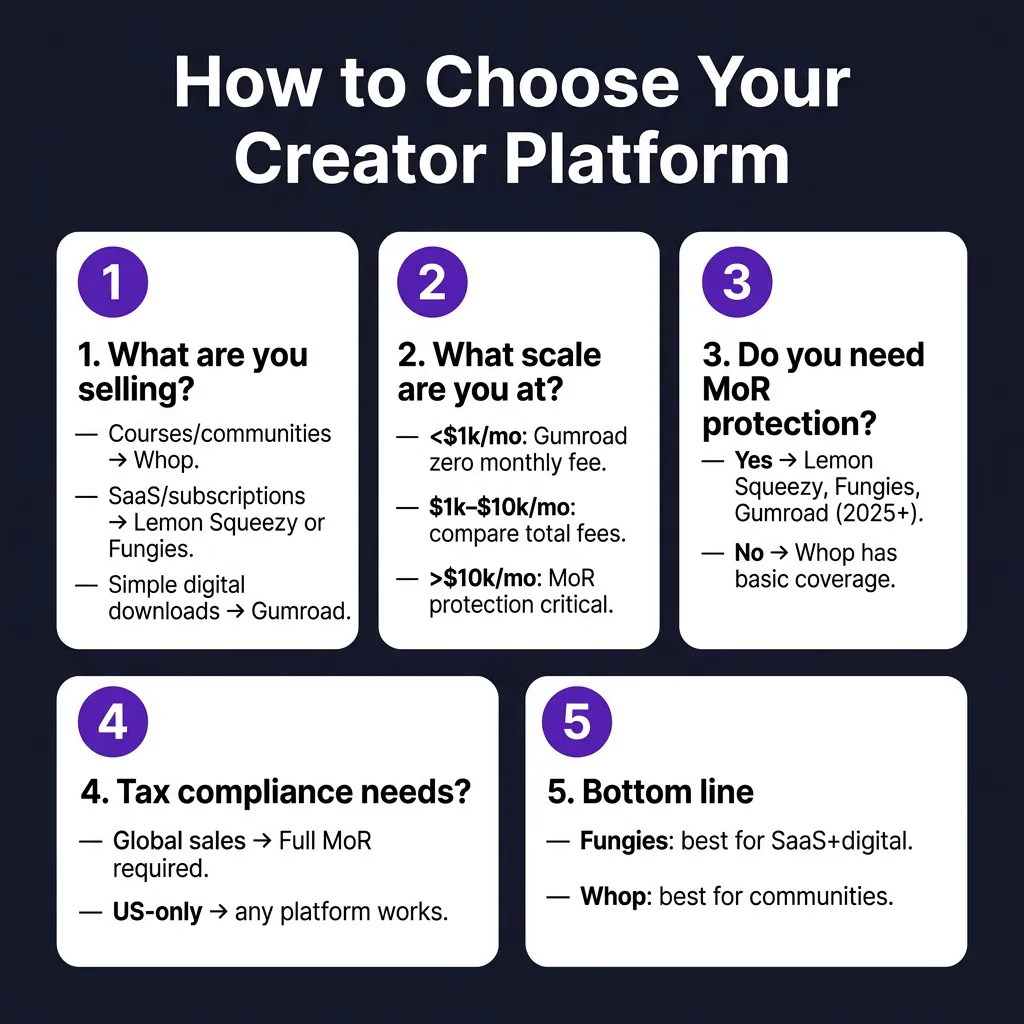
For most developers and digital product creators in 2026: Lemon Squeezy or Fungies.io for SaaS, Whop for communities, Gumroad to get started fast.
If you’re building a SaaS or digital product and want full Merchant of Record protection with a developer-friendly setup and no monthly overhead, Fungies.io lets you launch in minutes. No enterprise sales call required.
References
- Fritz AI: Whop App Review — Features, Fees, and Marketplace Quality
- Checkout Page: Gumroad Fees for Sellers 2026
- Dodo Payments: Lemon Squeezy Review 2026
- popup.fm: Gumroad Pricing — The 10% + 50¢ Success Tax Exposed
- EntreResource: Full Whop Review — First $63K in 60 Days
- Creem: Gumroad vs Creem Fee Comparison 2026
- Lemon Squeezy: Official Pricing Page