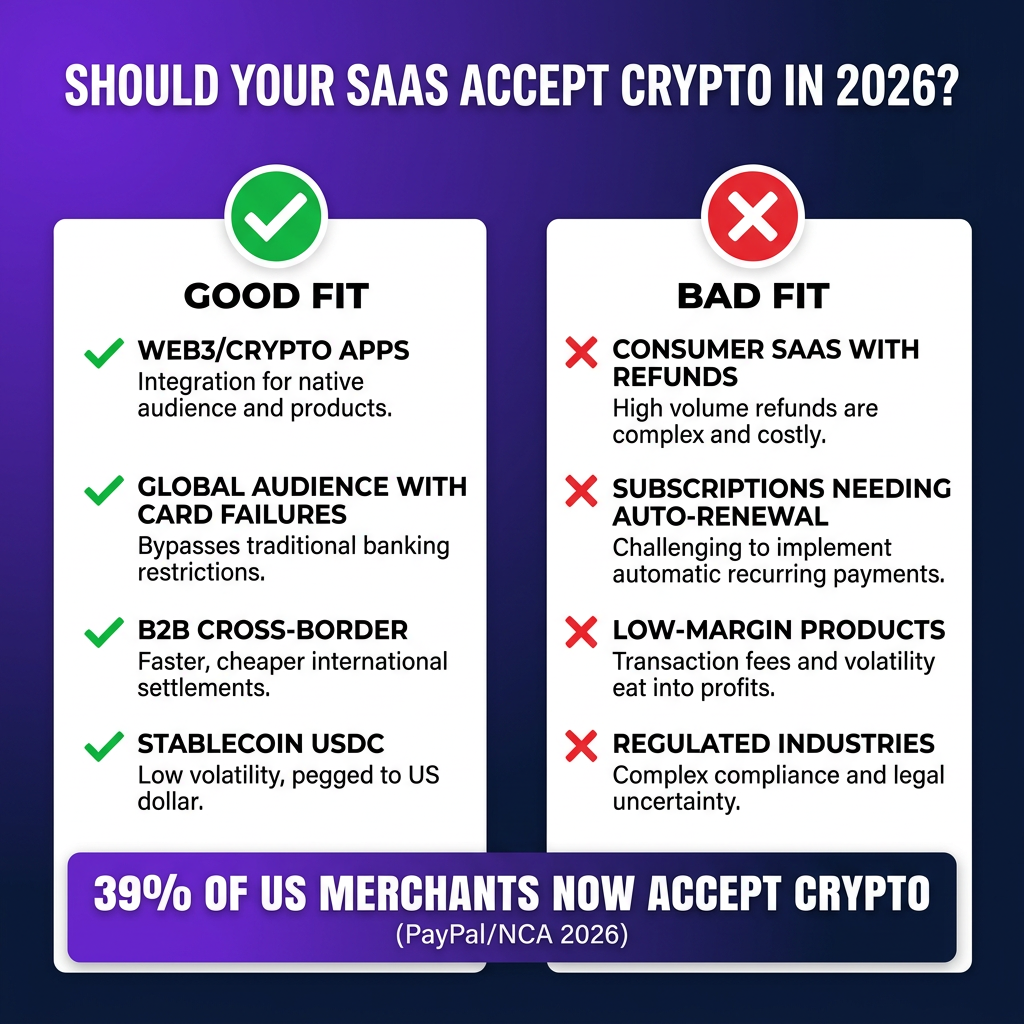
39% of US merchants now accept crypto payments — and that number jumped from virtually nothing in 2022. For digital products and SaaS, the question isn’t whether crypto is real anymore. It’s whether it makes sense for your business.
Short answer: it depends on who your customers are. Long answer: this article.
We’ll break down the actual fees, the tools available in 2026, where crypto genuinely helps, and where it’ll cause you more pain than it’s worth. No hype, just the cost-benefit math.
What Crypto Payments Actually Look Like for SaaS in 2026
Forget the 2017 Bitcoin-only checkout nightmare. The crypto payment stack in 2026 is mostly stablecoins — USDC, USDT, and EUR-pegged tokens. Your customer pays in USDC from their wallet. You receive USD in your bank account. No volatility. No holding crypto yourself.
The major shift happened in late 2024 and accelerated through 2025:
- Stripe acquired Bridge for $1.1B and launched stablecoin checkout at 1.5% per transaction
- Shopify expanded native USDC checkout through Shopify Payments in most regions
- Coinbase Commerce now charges 1% for onchain payments with auto-USD settlement
- Stripe launched stablecoin subscriptions in private preview — recurring USDC billing is now possible
The old objection — “I don’t want to touch crypto” — is gone. Modern gateways handle the entire conversion. Your accounting sees USD. Your bank sees USD. You never need a crypto wallet.
The Real Fee Breakdown: Crypto vs Cards vs MoR
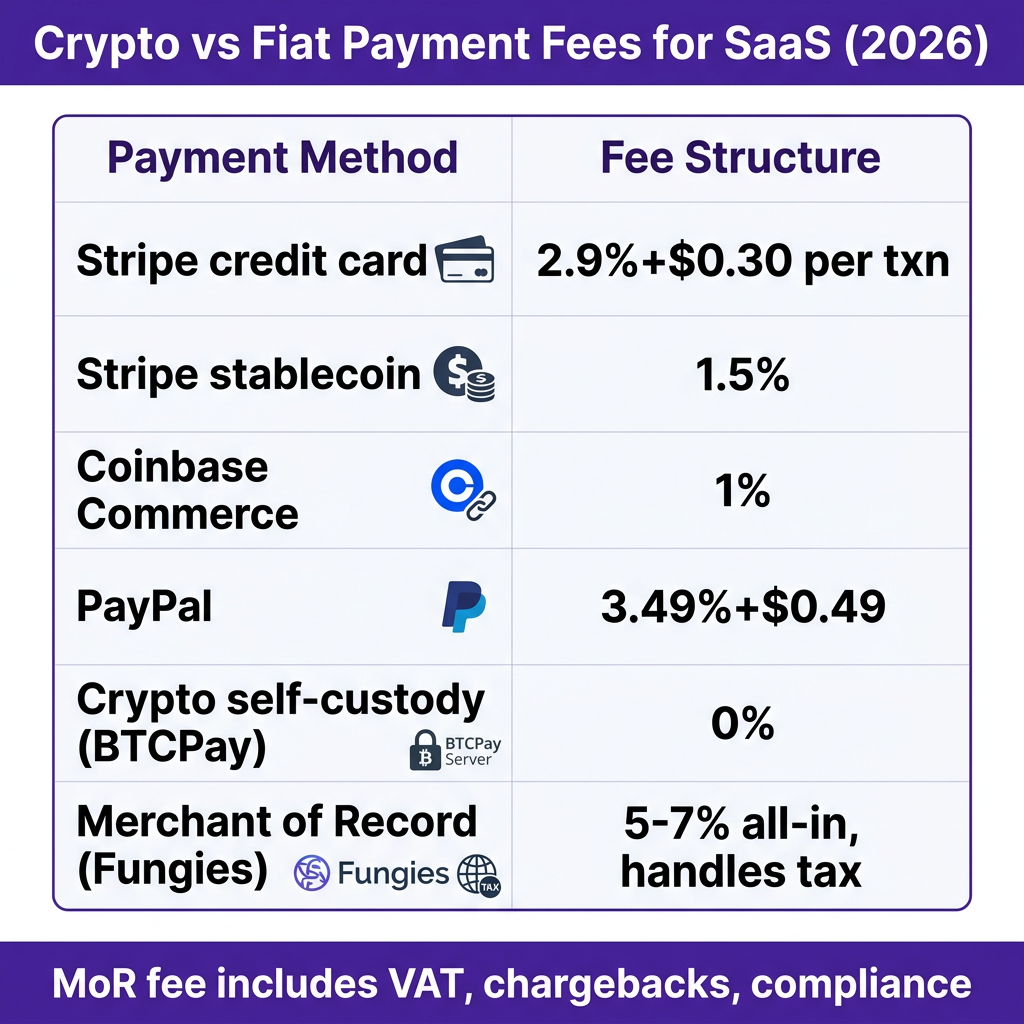
Here’s where things get interesting. Crypto fees are lower on paper — but the full picture is more nuanced.
| Payment Method | Fee Per Transaction | Chargeback Protection | Tax Compliance | Best For |
|---|---|---|---|---|
| Stripe (card) | 2.9% + $0.30 | ❌ (you handle disputes) | ❌ | Standard SaaS checkout |
| Stripe (stablecoin) | 1.5% | ✅ Irreversible | ❌ | Existing Stripe users adding crypto |
| Coinbase Commerce | 1% (onchain) | ✅ Irreversible | ❌ | Crypto-native businesses |
| CoinGate | 1% | ✅ Irreversible | ❌ | EU merchants, WooCommerce |
| BTCPay Server | 0% (self-hosted) | ✅ Irreversible | ❌ | Privacy-first, high volume |
| PayPal | 3.49% + $0.49 | ❌ | ❌ | B2C with PayPal audience |
| Merchant of Record (e.g. Fungies) | 5–7% all-in | ✅ MoR handles it | ✅ Handled globally | Global SaaS, compliance-heavy |
The catch with crypto-only gateways: they give you lower transaction fees but they don’t handle VAT, sales tax, 1099-K reporting, chargebacks-as-a-policy, or refund management. You’re trading one cost for operational complexity.
A Merchant of Record like Fungies charges more per transaction but owns the entire liability — tax, refunds, fraud, chargebacks. For global SaaS, that’s often worth the premium.
5 Scenarios Where Crypto Genuinely Helps
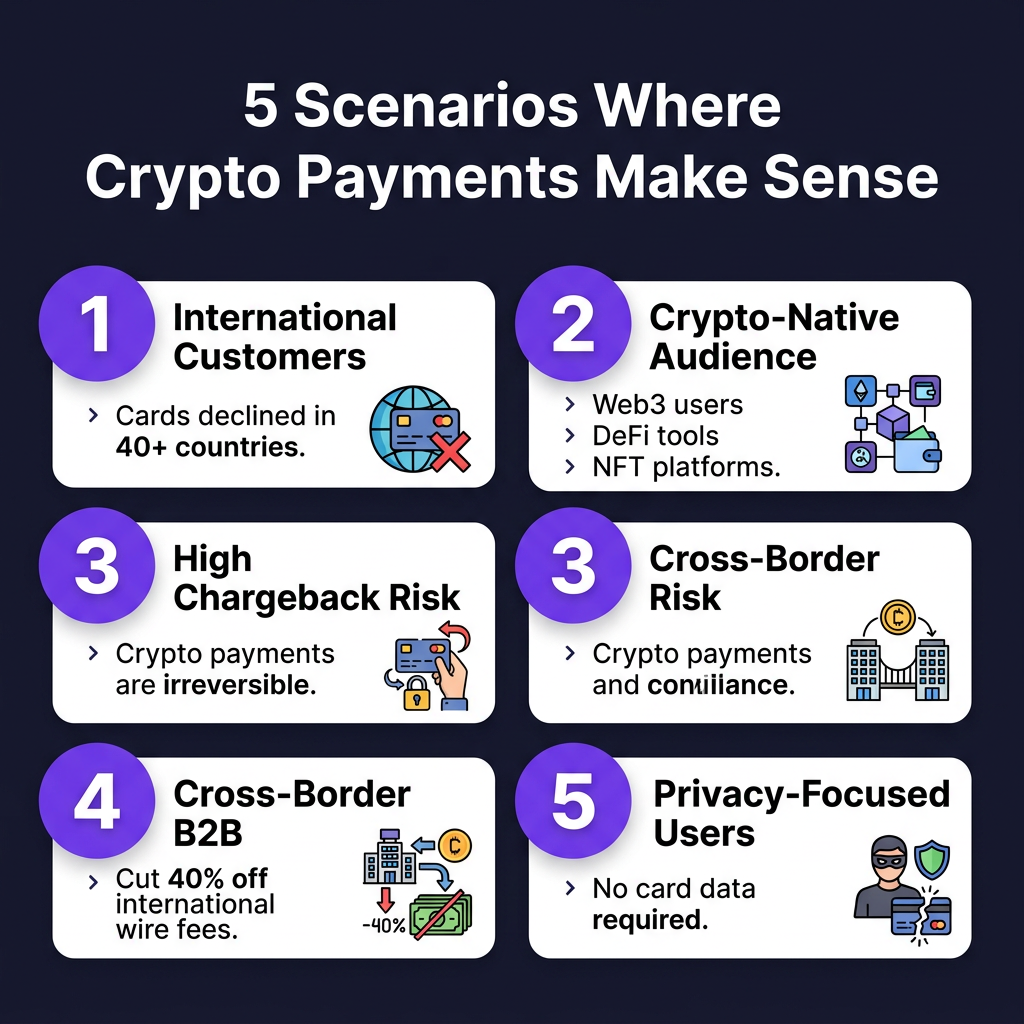
Crypto isn’t universally good or bad. Here are the five situations where it actually moves the needle:
1. Your customers are in countries where cards fail
Cards get declined in 40+ countries due to issuer restrictions, FX controls, or lack of banking access. Crypto (especially stablecoins) sidesteps this entirely. If you’re seeing high checkout abandonment from LatAm, Southeast Asia, or Eastern Europe, adding USDC checkout can convert customers who simply couldn’t pay otherwise.
2. You’re building for a crypto-native audience
Web3 tools, DeFi dashboards, NFT platforms, crypto analytics — your users have wallets. They’ll trust crypto checkout more than giving their card to yet another startup. Accepting USDC is table stakes if your product lives in that ecosystem.
3. You’re selling high-ticket digital products or licenses
On a $500 software license, 2.9% is $14.50. At 1% via Coinbase Commerce, it’s $5. That delta adds up fast when you’re doing volume. For B2B deals and larger license sales, the savings are real.
4. You’re doing cross-border B2B invoicing
International wire transfers cost $25–45 per transaction and take 3–5 business days. Stablecoin settlement on Solana: ~$0.01 in 6 seconds. For freelancers, agencies, and B2B SaaS with enterprise international clients, this is genuinely transformative. Platforms like Copperx and Request Finance now handle B2B stablecoin invoicing with QuickBooks/Xero integration.
5. You want to eliminate chargebacks on digital goods
Crypto transactions are irreversible. No “I didn’t authorize this” dispute six weeks after download. For digital goods businesses with high chargeback rates, this is significant — chargebacks cost merchants an average of $3.60 for every $1 lost, when you factor in fees and labor.
Where Crypto Payments Will Hurt You
Be honest about the downsides before you ship that USDC checkout button.
Subscriptions are still complicated
Stripe’s stablecoin subscription feature is in private preview as of mid-2026. For most SaaS businesses, auto-renewing subscriptions via crypto still require custom smart contract logic or platforms like Copperx. If your business model is monthly recurring revenue with automatic renewals, card billing is still smoother.
Refund UX is awkward
Crypto is irreversible by design. That means you have to manually send refunds. At scale, that’s operational overhead. And customers who want a refund will know it’s harder to get one — which can hurt trust if your product has a trial period or satisfaction guarantee.
Tax compliance is your problem
When you accept card payments through a Merchant of Record, they handle global VAT, US sales tax, and 1099-K reporting. When you accept crypto directly, you’re the merchant. You need to figure out whether USDC received in Poland triggers EU VAT. (Spoiler: it depends, and the rules vary by jurisdiction.)
Conversion rates may actually drop
Unless your audience is crypto-native, adding a “Pay with Crypto” option can confuse or alienate the majority of users. Research from checkout optimization studies shows unfamiliar payment methods increase cognitive load and drop-off. Add it as a secondary option, not a replacement.
The Best Crypto Payment Gateways for SaaS in 2026
| Gateway | Fee | Coins Supported | Settlement | Best For |
|---|---|---|---|---|
| Stripe (stablecoin) | 1.5% | USDC | USD/USDC T+1 | Existing Stripe users, US/EU |
| Coinbase Commerce | 1% (onchain) | USDC, USDT, DAI, BTC, ETH | Crypto or auto-USD | Crypto-native, no-code setup |
| CoinGate | 1% | USDT, USDC, BTC, ETH, 70+ coins | EUR/USD or crypto | EU merchants, WooCommerce |
| BTCPay Server | 0% (self-hosted) | BTC, Lightning, USDT | Crypto only | High volume, privacy-first |
| Copperx | ~1% | USDC, USDT | Crypto or fiat | B2B invoicing, subscriptions |
| Triple-A | 1–2% | BTC, ETH, USDC, 20+ coins | USD/EUR fiat | Enterprise, compliant regions |
Recommendation for most SaaS founders: Start with Stripe stablecoin checkout if you’re already on Stripe. It’s one toggle in the dashboard and costs 1.5% — half your current card rate. For crypto-native audiences, Coinbase Commerce at 1% is the simplest no-code option.
Crypto + Merchant of Record: The Best of Both Worlds
Here’s what most crypto payment guides miss: you don’t have to choose between crypto convenience and MoR compliance coverage.
Some Merchant of Record platforms are now adding crypto and stablecoin support. Dodo Payments lets you enable stablecoin payments directly from the dashboard. Fungies.io is building toward crypto checkout with the same all-in pricing — you get the lower chargeback risk of crypto payments plus global tax handling, VAT compliance, and fraud protection that comes with a full MoR.
For SaaS founders who want to sell globally without building a compliance department, that stack is the right answer: an MoR that supports crypto as a payment method. You don’t give up 5-7% in fees just for card processing — you pay for the entire backend: tax engine, dispute handling, refund policy, fraud protection, and now crypto checkout on top.
Key Takeaways
- Crypto payments in 2026 are stablecoins, not Bitcoin volatility — modern gateways settle in USD automatically
- Transaction fees are genuinely lower: 1–1.5% vs 2.9%+ for cards, saving hundreds per month at scale
- Chargebacks disappear with crypto — irreversible payments protect you from fraud disputes
- Tax compliance is NOT handled — you need an MoR or a separate tax service unless you’re tiny
- Add crypto as a secondary option, not primary, unless your audience is already crypto-native
FAQ
Does accepting crypto payments trigger VAT obligations?
Yes. Accepting USDC from a customer in Germany still triggers EU VAT obligations just like accepting euros. The payment method doesn’t change the tax treatment. Use a Merchant of Record to handle this automatically, or platforms like Avalara/TaxJar if you’re self-managing.
Can SaaS companies do recurring subscriptions in crypto?
As of mid-2026, Stripe’s stablecoin subscriptions are in private preview. Copperx and Request Finance support recurring crypto billing. Most SaaS founders still use card billing for subscriptions and offer crypto as a one-time purchase option.
What’s the best crypto payment gateway for a small SaaS with no crypto experience?
Coinbase Commerce. It’s hosted (no server setup), takes 1% per transaction, supports USDC/BTC/ETH, and auto-settles to USD. You can integrate it in under an hour with WooCommerce, Shopify, or a direct API link.
Are crypto payments worth it if I only have 100 customers?
Probably not yet — the setup overhead isn’t worth the fee savings at that scale. Focus on card checkout optimization first. When you’re doing $10K+ MRR, the 1–2% fee difference on crypto becomes meaningful ($100–200/month) and justifies the integration work.
Conclusion
Crypto payments for SaaS in 2026 are real, practical, and lower-cost than cards. The stablecoin infrastructure is mature enough that volatility isn’t the concern it was. The question is whether your customers actually want it and whether you can handle the compliance side.
If you’re already on Stripe, enable stablecoin checkout today — it takes five minutes and saves you 1.4% per transaction. If you’re building for a global audience and want both crypto flexibility and full tax/compliance handling in one place, Fungies.io handles the entire merchant of record stack so you can focus on building, not tax filing.
Set up your payment infrastructure on Fungies.io →
References
- PayPal x NCA: Crypto Goes Mainstream — 4 in 10 US Merchants Accept Digital Assets (Jan 2026)
- Best Crypto Payment Gateways 2026 — Stablecoin Support Ranked
- Stripe: Introducing Stablecoin Payments for Subscriptions
- Tazapay: Stablecoin Payments for Global Businesses (2026)
- Dodo Payments: Should Your SaaS Accept Crypto in 2026?
- 0xProcessing: Stripe vs PayPal vs Crypto Fees in 2026