Freemium vs Free Trial: 10 Data-Backed Strategies to Maximize SaaS Conversions in 2026
Freemium converts 3.7% while free trials hit 18.5%—but which is right for your SaaS? Discover 10 data-backed strategies to maximize conversions in 2026, plus benchmarks, industry data, and a framework to choose the right model for your growth stage.
Here’s a stat that’ll make you rethink your entire SaaS go-to-market strategy: freemium models convert only 3.7% of free users to paid, while free trials hit a median of 18.5%—yet companies like Slack, Notion, and Figma built billion-dollar businesses on freemium. The difference isn’t luck. It’s strategic fit.
I’ve spent years analyzing SaaS conversion funnels, and here’s what most founders get wrong: they choose their model based on what competitors do, not what their product actually needs. In 2026, with customer acquisition costs up 14% year-over-year and growth rates declining, picking the wrong approach can cost you millions in lost revenue.
What Is Freemium? The Viral Growth Engine
Freemium gives users unlimited access to a basic version of your product forever, with premium features locked behind a paywall. Think Dropbox’s 2GB free tier or Spotify’s ad-supported streaming. The model bets on network effects and habit formation to eventually convert a small percentage of users.
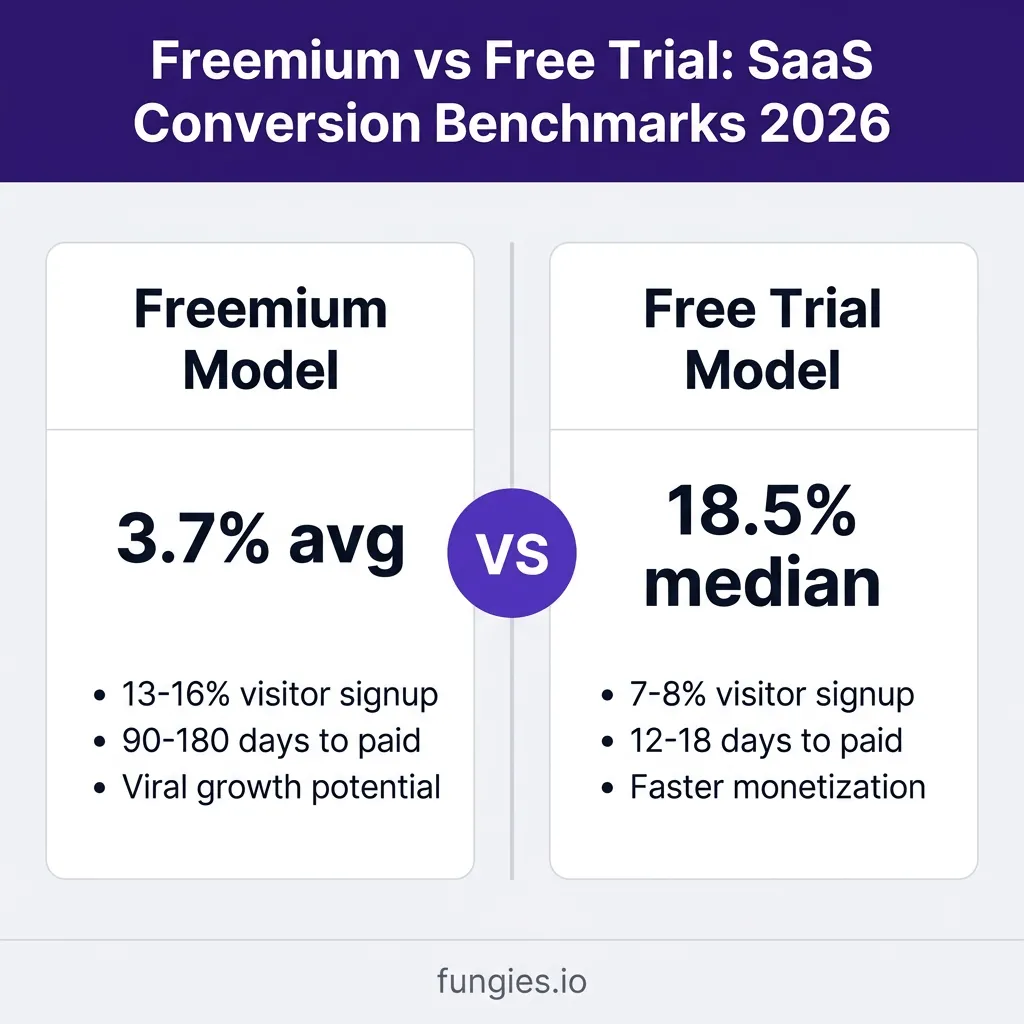
Here’s the brutal math: freemium requires massive scale to work. At a 3.7% average conversion rate, you need roughly 27 free users to get one paid customer. But freemium excels at one thing—viral distribution. Products with built-in sharing mechanisms (like Calendly’s “Powered by” links or Zoom’s 40-minute meeting limits) can achieve 13-16% visitor-to-signup rates, compared to 7-8% for trials.
What Is a Free Trial? The Fast Path to Revenue
Free trials give users full product access for a limited time—typically 7, 14, or 30 days. The clock creates urgency, and the full feature set lets users experience your product’s complete value. According to 2026 ChartMogul data, opt-in trials (no credit card required) convert at 8.9%, while opt-out trials (credit card required) hit 31.4%.
The trade-off? Friction. Requiring a credit card upfront reduces signup volume by 60-70%, but the users who do convert are more committed. Trials also monetize faster—averaging 12-18 days to paid conversion versus 90-180 days for freemium.
The 2026 Conversion Benchmarks You Need to Know
Before diving into strategies, let’s look at the actual numbers from 1,200+ SaaS companies analyzed in 2026:
| Metric | Freemium | Free Trial (Opt-In) | Free Trial (Opt-Out) |
|---|---|---|---|
| Visitor to Signup | 13-16% | 7-8% | 2.5% |
| Free-to-Paid Conversion | 3.7% | 8.9% | 31.4% |
| Time to Monetization | 90-180 days | 12-18 days | 12-18 days |
| Median Growth Rate | 18% | 21% | 21% |
Source: ChartMogul 2026 Conversion Report, First Page Sage benchmarks
10 Strategies to Maximize Your SaaS Conversions
1. Match Your Model to Your Average Contract Value (ACV)
If your ACV is under $20/month, freemium often makes sense—you need volume to hit revenue targets. But for ACVs above $50, free trials typically perform better because the sales cycle justifies the higher touch. Products in the $20-50 range? Test both. Companies like ConvertKit started with freemium, then switched to trials as they moved upmarket.
2. Optimize for Activation in the First 10 Minutes
Here’s a number that should haunt you: every 10-minute delay in time-to-first-value costs 8% in conversion. Top-performing SaaS companies achieve 60%+ activation rates by guiding users to their “aha moment” within minutes. For Notion, it’s creating a page. For Loom, it’s recording the first video. Map your activation event and optimize ruthlessly for it.
3. Use Progressive Feature Gating for Freemium
Don’t lock everything behind a paywall immediately. Let users experience value before hitting limits. Dropbox’s approach is textbook: store files freely, pay for more space. Canva lets you design freely, pay to remove backgrounds or access premium templates. The key is making the free tier genuinely useful while making the upgrade feel like a natural next step.
4. Implement Behavioral Payment Capture for Trials
Instead of requiring credit cards at signup (which kills 60-70% of signups), capture payment details after users hit activation milestones. Products using behavioral triggers—like completing 3 projects or inviting 2 team members—see 40% higher conversion than calendar-based trials. The user feels ready to pay, rather than being forced.
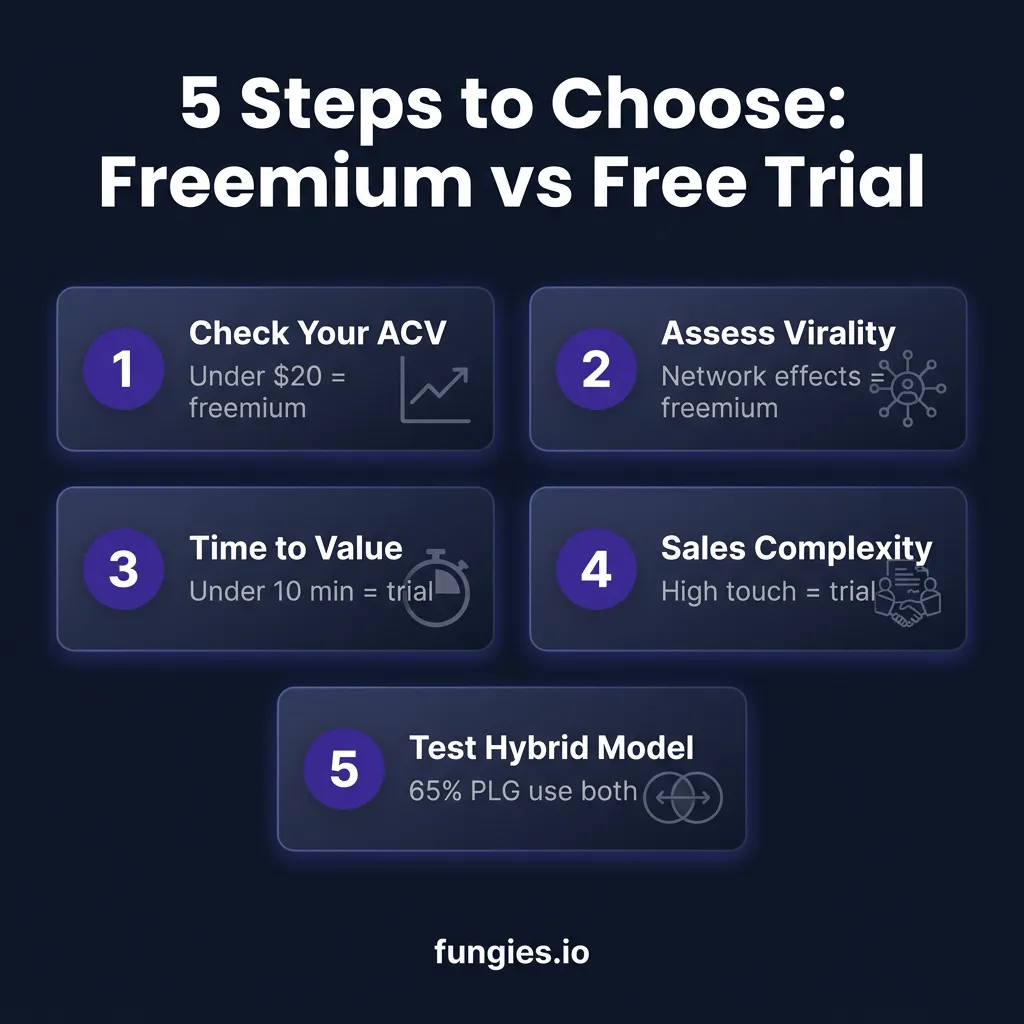
5. Test the Hybrid Model (65% of PLG Companies Do)
The fastest-growing SaaS companies in 2026 aren’t choosing—they’re combining. Offer a freemium tier for viral acquisition, then provide premium feature trials to accelerate conversion. Figma does this brilliantly: free for individual designers, but teams can trial Organization features. This approach captures the best of both worlds.
6. Segment Your Conversion Strategy by Industry
Freemium conversion rates vary dramatically by vertical. Communications tools (Slack, Zoom) see 3.8% freemium-to-paid conversion. HR software drops to 3.3%. Cybersecurity struggles at 3.6% because free tiers feel risky. Know your industry’s benchmarks and adjust expectations accordingly.
7. Reduce Trial Friction with Smart Onboarding
40-60% of trial users never return after their first login. Combat this with personalized onboarding sequences. Send a welcome email within 5 minutes. Trigger in-app guidance based on behavior. Offer live chat for high-intent accounts. Companies with dedicated onboarding see 25% higher trial-to-paid rates.
8. Price Based on Value Metrics, Not Arbitrary Limits
SaaS companies using value metrics—like emails sent, projects created, or revenue processed—grow at 2x the rate of those using arbitrary limits like “10 users” or “5 projects.” Why? Because value metrics align your pricing with customer success. When your customers win, you win. Stripe charges based on transaction volume. Slack charges based on active users. Both scale with customer growth.
9. Use Regional Pricing to Boost Global Revenue
Here’s a growth lever most SaaS companies ignore: regional pricing increases global revenue by 25-40% while only reducing average unit price by 15-20%. A customer in India might balk at $50/month but happily pay $15 for the same product. Tools like Fungies.io handle the tax complexity automatically, making global pricing accessible even for early-stage startups.
10. Avoid the Discount Trap
80% of SaaS companies discount by 25% or more to acquire customers. Here’s the problem: these customers churn at 3-5x higher rates. Discounting attracts price-sensitive users who were never your ideal customers. Instead of slashing prices, add value. Offer extended trials, premium onboarding, or annual payment incentives. Your unit economics will thank you.
Freemium vs Free Trial: Which Should You Choose?
After analyzing hundreds of SaaS companies, here’s my framework:
| Choose Freemium If… | Choose Free Trial If… |
|---|---|
| ACV under $20/month | ACV above $50/month |
| Product has viral/network effects | Complex setup or configuration needed |
| Time-to-value under 2 minutes | Time-to-value over 10 minutes |
| Self-serve onboarding works | Sales touch needed for success |
| You can support free users profitably | High support costs per user |
Honestly, most SaaS companies should start with trials. You get faster feedback, quicker revenue validation, and cleaner data on who’s actually willing to pay. Only add a freemium tier once you’ve proven product-market fit and have the infrastructure to support it.
FAQ: Freemium vs Free Trial
What’s a good free trial conversion rate in 2026?
The median B2B SaaS trial-to-paid conversion rate is 18.5% for opt-in trials (no credit card) and 31.4% for opt-out trials (credit card required). Top quartile performers achieve 35-45%, while elite companies hit 60%+.
What’s a good freemium conversion rate?
Average freemium-to-paid conversion is 3.7%, but this varies by industry. Communications tools see 3.8%, HR software 3.3%, and enterprise products around 3.8%. Anything above 5% is considered strong performance.
Can I use both freemium and free trials?
Yes—and 65% of product-led growth companies now use hybrid models. The typical approach is freemium for viral acquisition, with premium feature trials to accelerate conversion to paid plans.
How long should my free trial be?
Most SaaS trials range from 7 to 30 days. The right length depends on your time-to-value. If users can experience core value in a day, 7-14 days works. For complex products requiring setup, 21-30 days is better. Avoid 30+ days—urgency drops and conversion suffers.
Should I require a credit card for trials?
Credit card requirements increase trial-to-paid conversion from 8.9% to 31.4%, but reduce signup volume by 60-70%. For most startups, I recommend starting without credit cards to maximize learning, then adding the requirement once you’ve optimized activation.
Conclusion: Start With Strategy, Not Tactics
The freemium vs free trial debate isn’t about which model is “better”—it’s about which model fits your product, market, and growth stage. Freemium works when you have viral mechanics and can afford to wait 90-180 days for monetization. Free trials work when you need faster revenue validation and have higher ACVs.
My advice? Start with a 14-day free trial, no credit card required. Optimize for activation in the first 10 minutes. Once you’re converting 20%+ of trials and have product-market fit, consider adding a freemium tier for acquisition. And whatever you do, don’t discount aggressively—it’ll kill your retention.
Ready to implement your chosen model? Get started with Fungies.io—we handle the billing infrastructure, global tax compliance, and payment processing so you can focus on building a product worth paying for.
Sources
- ChartMogul 2026 SaaS Conversion Report – chartmogul.com
- First Page Sage Freemium Conversion Rates 2026 – firstpagesage.com
- First Page Sage Free Trial Conversion Benchmarks – firstpagesage.com
- 1Capture Free Trial Conversion Benchmarks 2025 – 1capture.io
- SaaSFactor 2025 SaaS Pricing Playbook – saasfactor.co
- PulseAhead Trial-to-Paid Conversion Benchmarks – pulseahead.com