SaaS founders raised $14.6 billion on lifetime deal launches in 2024 alone. AppSumo processed over 800,000 individual LTD purchases. And yet, most first-time LTD runners leave 40-60% of potential revenue on the table — not because their product is bad, but because they botch the payment setup, pricing structure, or tax compliance.
If you’re planning a lifetime deal for your SaaS in 2026, this guide covers everything: how to price it, which platform to use, how a Merchant of Record handles your taxes automatically, and how to avoid the traps that tank so many founders.
What Is a SaaS Lifetime Deal (LTD)?
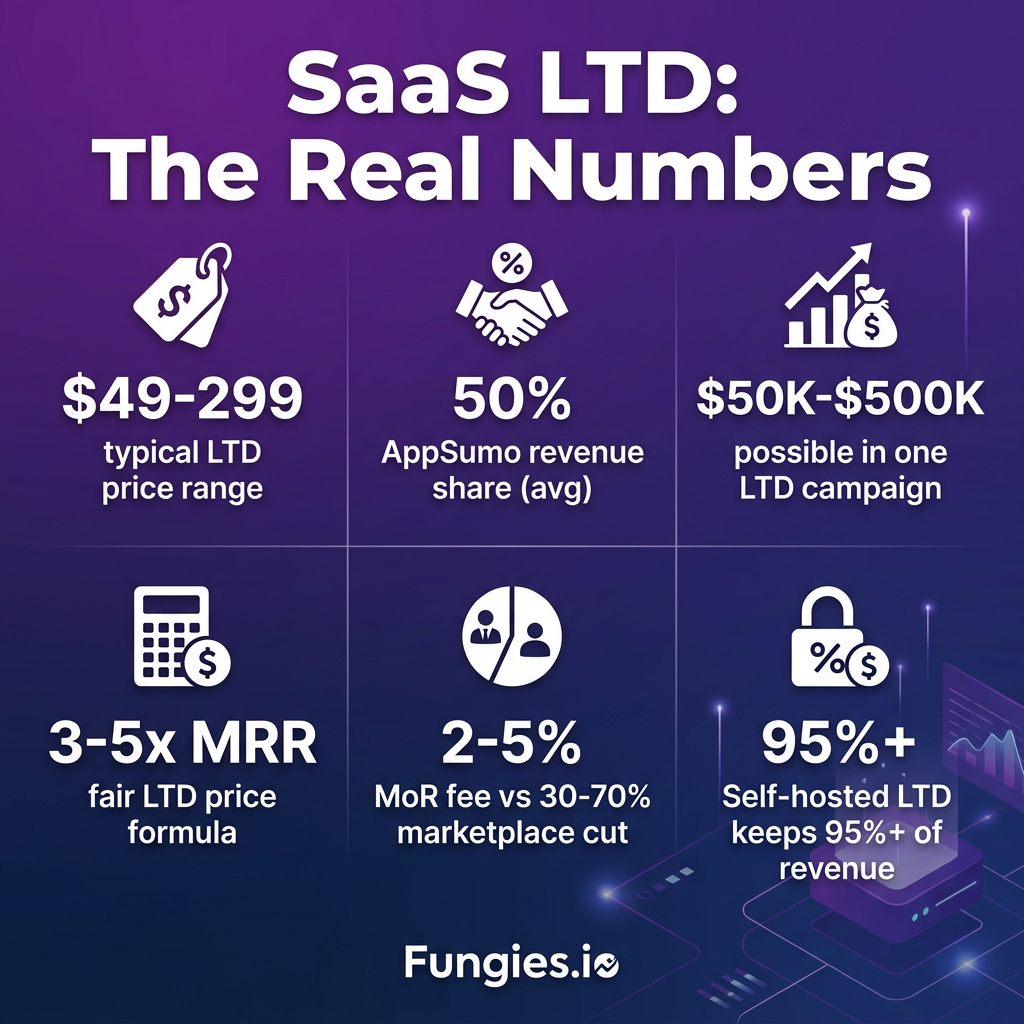
A lifetime deal is a one-time payment that gives the buyer permanent access to your software. No monthly bills, no renewal decisions. The buyer pays once — typically $49 to $299 — and gets access forever.
For founders, LTDs offer something subscriptions can’t match in the early stages: immediate capital. A single well-executed LTD campaign can generate $50,000 to $500,000 in weeks. No dilution, no debt, no waiting 18 months for MRR to compound.
For buyers, LTDs eliminate subscription fatigue. The average SaaS buyer now juggles 28 active software subscriptions. A lifetime deal removes one line item from that mental overhead — permanently.
When Should You Run an LTD?
Not every SaaS should run a lifetime deal. The timing matters more than most founders realize.
Run an LTD when:
- You have a working product with 10-50 active (even free) users providing feedback
- Your per-user infrastructure cost is low and predictable
- You need capital to fund development without giving up equity
- You want a fast injection of engaged users to test and iterate
- You’re pre-product-market-fit and need real feedback from invested users
Don’t run an LTD when:
- Your product is genuinely unfinished — LTD users are vocal and will leave negative reviews
- Infrastructure costs scale linearly with users (video rendering, AI compute)
- You’re post-PMF and already growing organically — you’ll cannibalize future subscription revenue
- You have no plan to eventually transition those users to paid subscriptions
How to Price Your Lifetime Deal
The most common pricing mistake: setting the LTD price too low because you’re scared no one will buy.
The standard formula used by successful LTD founders is:
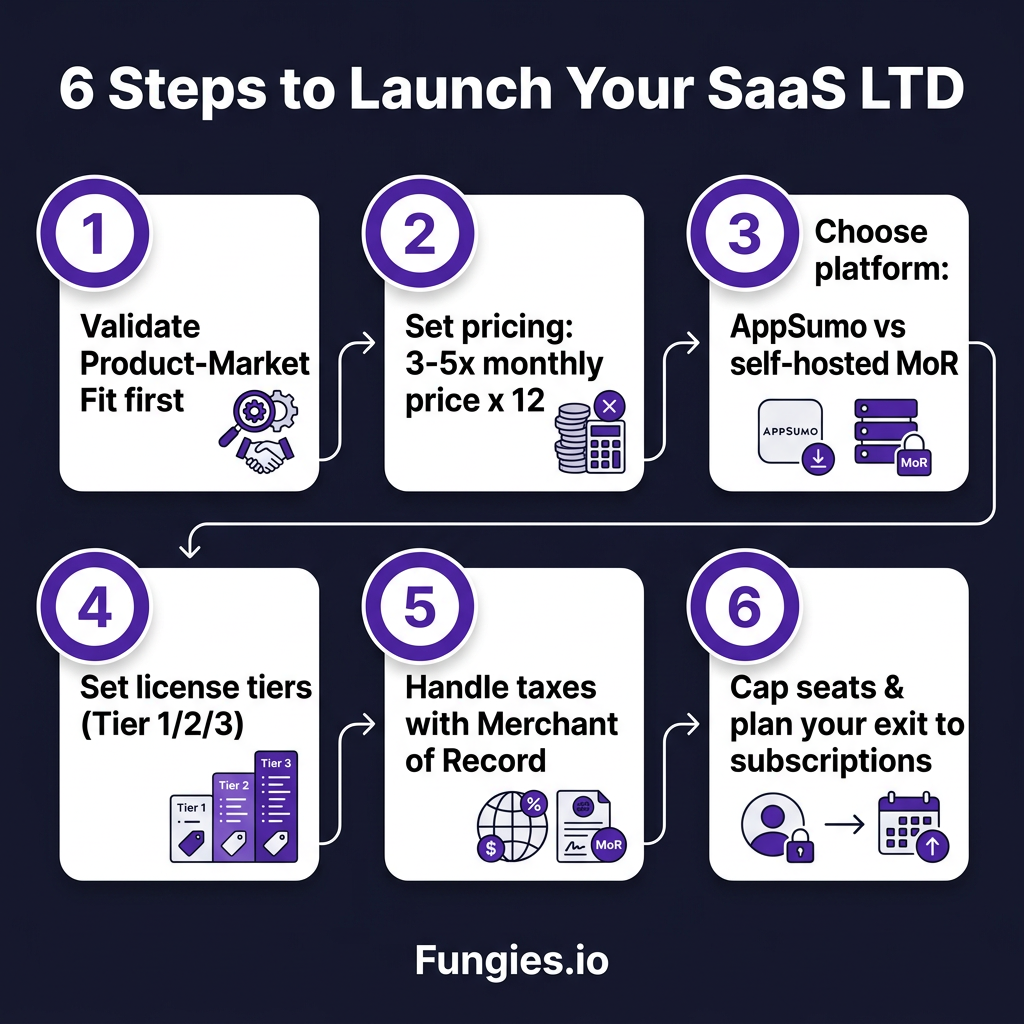
LTD Price = Monthly Price × 12 × 3 (or multiply by 36 months)
So if your monthly plan is $29/month:
- $29 × 36 = $1,044 → round down to $999 for Tier 3 all-features
- $29 × 18 = $522 → round to $499 for Tier 2
- $29 × 6 = $174 → round to $149 for Tier 1 (limited features)
The tiered model ($49 / $99 / $149 or $99 / $199 / $299) is the most effective structure on marketplaces like AppSumo. Buyers get to “upgrade” to a higher tier, which increases average order value significantly — often by 35-60%.
Cap your tiers. Don’t offer unlimited lifetime deals. Set a seat cap per tier (e.g. Tier 1: 1 workspace, Tier 2: 3 workspaces, Tier 3: 10 workspaces). This limits long-term support load and creates clear value differentiation.
AppSumo vs Self-Hosted: Which Is Better for Your LTD?
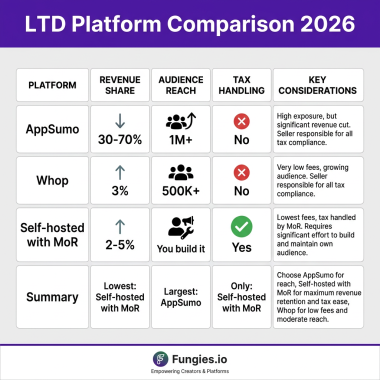
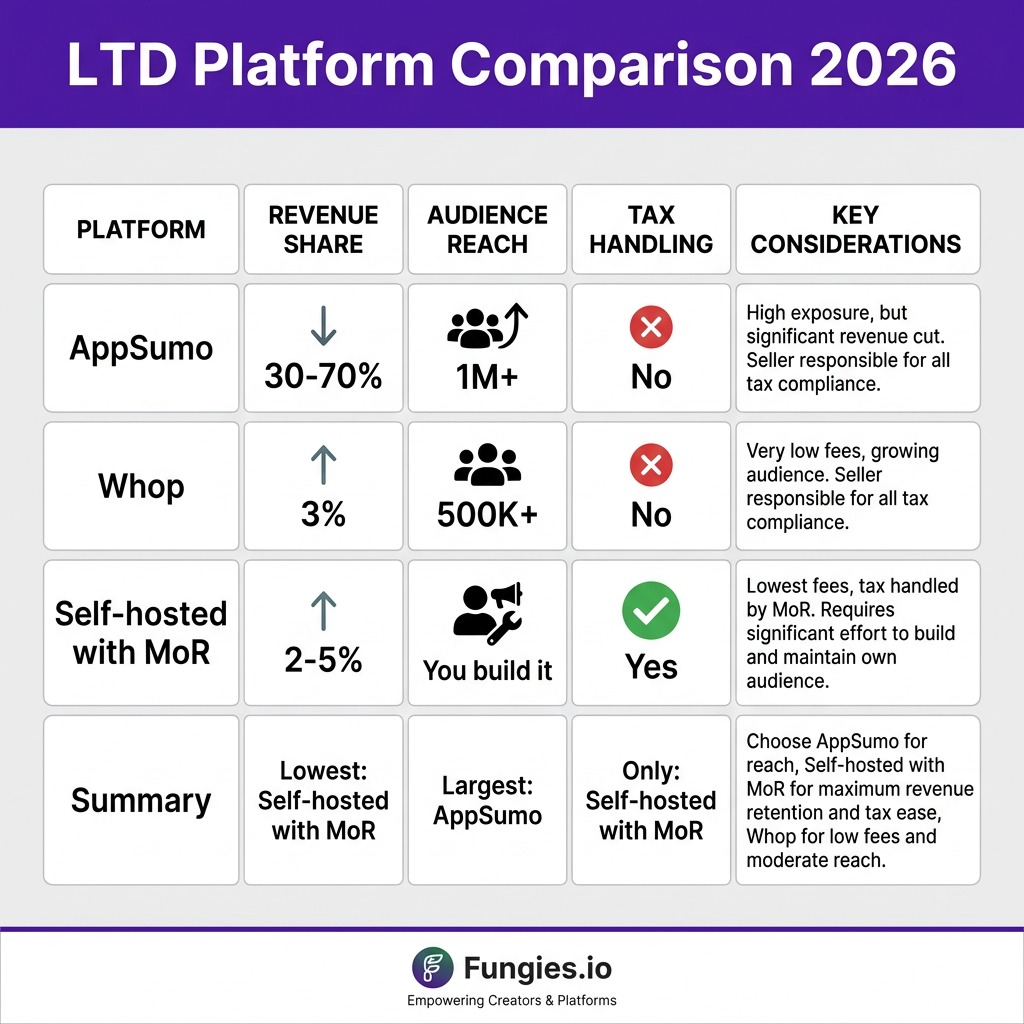
| Factor | AppSumo | Whop | Self-hosted (MoR) |
|---|---|---|---|
| Revenue share | ~30-50% to AppSumo | 3% flat fee | 2-5% MoR fee only |
| Built-in audience | 1M+ buyers | 500K+ buyers | Zero — you drive traffic |
| Tax & VAT handling | No (you’re responsible) | No | Yes (MoR handles all) |
| Chargeback liability | Shared / yours | Yours | MoR’s liability |
| Time to launch | 4-12 weeks review | Days | Days |
| Best for | No audience yet | Small existing audience | Existing audience + full control |
The math here is stark. On a $149 Tier 1 deal sold 500 times:
- AppSumo (40% cut): You keep $44,700
- Whop (3% cut): You keep $72,235
- Self-hosted via MoR (3% fee): You keep $72,235 + you own the customer relationship
AppSumo’s 1M+ buyer audience is genuinely valuable if you have zero distribution. If you already have a newsletter, X/Twitter following, or community, self-hosting via a Merchant of Record is almost always the better financial decision.
The Tax Problem Nobody Talks About
Here’s where most indie founders get burned: lifetime deal revenue is still subject to sales tax, VAT, and GST — in every jurisdiction where your buyer is located.
Sell 500 LTDs to customers across the US, EU, Australia, and Canada? You’ve just created tax obligations in potentially 40+ tax jurisdictions. The US alone has 46 states with economic nexus laws. EU VAT rules require collection from the first sale to EU customers.
AppSumo and most LTD marketplaces do not handle this for you. You’re the merchant of record in their setup, which means you carry the tax liability.
The fix: use a Merchant of Record (MoR) platform for your self-hosted LTD.
A MoR like Fungies.io becomes the legal seller on every transaction. They collect and remit tax everywhere. If there’s a dispute or chargeback, they handle it. Your job is to build the product and cash the payouts.
Setting Up Your LTD with a Merchant of Record
The setup process for a self-hosted LTD with a MoR takes less than 2 hours:
- Create your product in the MoR dashboard — set it as a one-time payment, not a subscription
- Configure your license tiers — Tier 1, Tier 2, Tier 3 as separate products or as a single page with toggle
- Set up a checkout embed — most MoRs (including Fungies) let you embed a checkout directly on your marketing page
- Configure license key delivery — automate this so buyers get access immediately after purchase
- Set your currency — MoRs handle multi-currency automatically; show prices in local currency for higher conversion
- Enable affiliate tracking — LTD launches go viral when you incentivize sharers with a 20-30% affiliate commission
| MoR Feature | Why It Matters for LTDs |
|---|---|
| Global tax collection | Sells to 180+ countries without VAT/sales tax headaches |
| One-time payment support | Essential — most billing tools default to subscriptions |
| Embeddable checkout | Keep buyers on your landing page, lower friction, higher CVR |
| Affiliate program | LTD virality comes from affiliate-driven sharing |
| Chargeback handling | MoR absorbs chargeback liability — huge for LTDs where fraud risk is higher |
| Instant payouts | Payout schedules vary — weekly payouts help with cash flow during a launch |
The LTD Transition Problem — And How to Solve It
The hardest part of running an LTD isn’t the launch. It’s what happens 18 months later when your LTD users represent 60% of your active user base but 0% of your recurring revenue.
Every founder who has run an LTD has faced this math: LTD users consume support, consume infrastructure, consume your team’s attention — but they never pay again.
Here’s how successful founders handle the transition:
1. Set an LTD expiry date from the start. Don’t promise “forever forever.” Cap the LTD at 3-5 years of access, or lock LTD users to the features available at launch. Future major features require upgrading to a subscription. Be transparent about this when you launch.
2. Create a “subscription-only” tier above LTD. Price a Pro/Business subscription at features LTD buyers don’t get (higher usage limits, priority support, new integrations). You’re not taking anything away — you’re creating value above what they paid for.
3. Run a migration campaign. 12 months after your LTD, send a personalized email: “Your LTD gave you access to our core product. We’ve built [X] since then. Here’s how to upgrade for $X/month.” Many LTD buyers convert to subscriptions if you give them a reason to.
4. Hard cap your LTD seats. Once you’ve hit your launch goal (say, 500-1,000 LTD buyers), close the LTD. Scarcity is a legitimate conversion tool, and it protects your future subscription business.
LTD Launch Checklist
Before you announce your LTD launch, confirm:
- ✅ Product works reliably for 10+ test users
- ✅ Pricing formula applied (36× monthly × tier logic)
- ✅ Merchant of Record set up (handles tax, chargebacks, global payments)
- ✅ Checkout embedded on landing page (not a separate URL)
- ✅ License key delivery automated (Zapier / webhook / MoR native)
- ✅ Affiliate program configured (20-30% commission)
- ✅ Seat cap set per tier
- ✅ Onboarding email sequence ready (Day 0, Day 3, Day 7, Day 14)
- ✅ “Upgrade to subscription” path planned from Day 1
- ✅ Support capacity assessed (LTD users ask a lot of questions)
Key Takeaways
- Price at 36× monthly — don’t undercut yourself out of fear; buyers expect to pay more for permanent access
- Use a Merchant of Record for self-hosted LTDs — it handles global tax compliance automatically and keeps 95%+ of revenue with you
- AppSumo is great for zero-audience launches, but costs you 30-50% of revenue — once you have a community, go self-hosted
- Plan the transition before you launch — hard cap seats, set feature tiers, design a path to subscriptions from Day 1
- LTD buyers are your best early advocates — treat them well, ship fast, communicate clearly, and they’ll drive organic growth you can’t buy
FAQ
Do I need to collect sales tax on my SaaS lifetime deal?
Yes. A one-time LTD payment is still taxable revenue in most jurisdictions — US states with economic nexus rules, EU (20% VAT on digital services from first EU sale), Australia (10% GST), and others. The easiest way to stay compliant is to route your LTD through a Merchant of Record that collects and remits tax on your behalf.
What’s a fair lifetime deal price for a $19/month SaaS?
Using the 36× formula: $19 × 36 = $684. A typical tiered structure would be $49 (Tier 1, 1 seat, limited features) / $99 (Tier 2, 3 seats) / $149 (Tier 3, 5 seats + all features). This gives buyers clear value at each level while protecting your long-term revenue potential.
Should I run my LTD on AppSumo or self-host it?
It depends on your existing audience. AppSumo’s 1M+ buyer community makes it valuable if you’re starting from scratch. If you already have an email list of 1,000+, a social following, or an active community, self-hosting via a Merchant of Record is almost always better — you keep 95%+ of revenue instead of 50-70%, and you own the customer relationship.
How do I prevent LTD buyers from overwhelming my support forever?
Three strategies: (1) cap total LTD seats to 500-1,000 max, (2) create a dedicated community (Discord, Slack) where LTD users help each other and reduce direct support load, and (3) build great onboarding documentation from the start. LTD buyers who feel looked after churn from your community at a fraction of the rate of passive users.
Ready to Launch Your LTD?
A lifetime deal done right is one of the most powerful early-stage growth tools available to a bootstrapped SaaS founder. You get capital, users, feedback, and social proof — all without dilution or debt.
The key is the infrastructure behind it: right pricing, right platform, and a Merchant of Record that handles the global tax and compliance work so you can focus on shipping.
Set up your LTD payment infrastructure on Fungies.io → We handle tax, chargebacks, and global payments so you don’t have to.
References
- Earlybird — How to Launch a Successful Lifetime Deal in 2026
- Dodo Payments — Why Lifetime Deals Are a Double-Edged Sword for SaaS
- Freemius — SaaS Lifetime Deals: When to Run One and How to Structure It
- The Bootstrapped Founder — Lifetime Deals and SaaS Businesses
- Numeral — Sales Tax and SaaS: State by State Breakdown 2026
- SaaSPirate — 576+ SaaS Lifetime Deals Platform