Digital Goods Tax Statistics 2026: Global VAT, Compliance Costs & Digital Services Tax (Comprehensive Report)
The taxation of digital goods has become one of the most complex challenges facing global businesses in 2026. With the European Union’s VAT gap reaching €128 billion and 25 U.S. states now taxing SaaS products, understanding digital tax obligations isn’t just about compliance—it’s about protecting your margins. This comprehensive report analyzes 30+ verified statistics on digital goods taxation, including VAT compliance costs, Digital Services Tax (DST) revenues, regional variations, and emerging trends that will shape the industry through 2030.
Key Statistics at a Glance
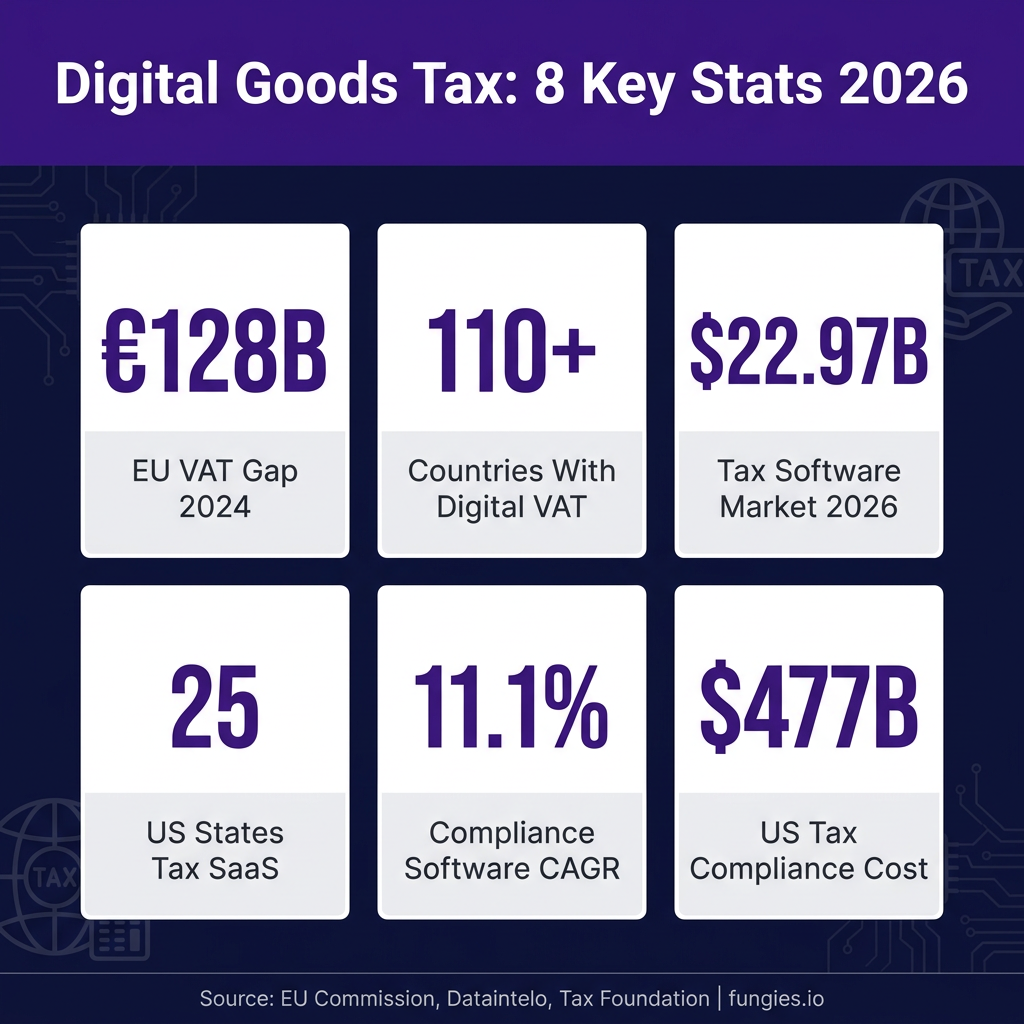
- The global indirect tax compliance software market is valued at $8.4 billion in 2025 and projected to reach $21.6 billion by 2034 (CAGR 11.1%)
- Over 110 countries now require foreign digital service providers to register for VAT/GST
- The EU VAT gap reached €128 billion in 2024, with significant compliance challenges
- 25 U.S. states now tax SaaS products in some form as of 2026
- France’s Digital Services Tax generated €680 million in revenue (2023)
- The tax management software market will grow from $24.52 billion (2025) to $33.21 billion by 2030
- U.S. tax compliance costs exceed $477 billion annually in total burdens
- More than 175 countries have implemented e-invoicing requirements
Market Size & Growth
The digital tax compliance industry is experiencing explosive growth as governments worldwide tighten reporting requirements and expand tax bases to include digital services. According to Dataintelo, the global indirect tax compliance software market was valued at $8.4 billion in 2025 and is projected to reach $21.6 billion by 2034, expanding at a compound annual growth rate (CAGR) of 11.1%.
Fortune Business Insights reports even higher figures, with the market valued at $20.26 billion in 2025 and expected to grow from $22.97 billion in 2026 to $56.02 billion by 2034, exhibiting a CAGR of 11.80%. The Tax Tech market, encompassing AI and automation solutions, is projected to reach $23 billion in 2026 and expand to $60 billion by 2033 at a 12% CAGR, according to Coherent Market Insights.
The broader tax management software market, which includes both direct and indirect tax solutions, is set to grow from $24.52 billion in 2025 to $33.21 billion by 2030 at a 6.3% CAGR, according to MarketsandMarkets. This growth is driven by escalating regulatory complexity, the global proliferation of e-invoicing mandates, and widespread enterprise adoption of cloud-native tax automation platforms.
| Market Segment | 2025 Value | 2030/2034 Value | CAGR |
|---|---|---|---|
| Indirect Tax Compliance Software | $8.4B | $21.6B (2034) | 11.1% |
| Tax Management Software (Total) | $24.52B | $33.21B (2030) | 6.3% |
| Tax Tech (AI/Automation) | $23B (2026) | $60B (2033) | 12.0% |
| Sales Tax Compliance Software | $2.5B | $5.0B (2030) | ~10% |
Regional Breakdown: VAT & Digital Tax by Geography
Digital tax regulations vary dramatically by region, with the European Union maintaining the most comprehensive framework while other regions rapidly expand their tax bases. Understanding these regional differences is critical for businesses selling digital products globally.
European Union
The EU remains at the forefront of digital taxation with its comprehensive VAT system. The VAT in the Digital Age (ViDA) reform package, adopted in March 2025, is transforming compliance requirements with real-time digital reporting obligations. The EU’s VAT gap—the difference between expected and actual VAT revenues—reached €128 billion in 2024, driving aggressive enforcement measures.
EU member states with the highest standard VAT rates include Hungary (27%), Finland (25.5%), and Croatia, Denmark, and Sweden (all at 25%). The EU minimum standard VAT rate is 15%, though most member states exceed this threshold significantly.
United States
The U.S. digital tax landscape is fragmented, with 25 states now taxing SaaS products in some form as of 2026. States like Louisiana enacted changes on January 1, 2025, expanding sales tax to include SaaS, digital products, and information services. California is considering extending sales tax to prewritten software broadly, which would raise an estimated $450 million in General Fund revenue and $560 million in local sales tax revenue in 2026-27.
The complexity stems from varying classifications—some states treat SaaS as tangible property, others as services, and some exempt it entirely. Economic nexus thresholds, triggered by revenue or transaction volume within a state, create additional compliance obligations.
Asia-Pacific
The Asia-Pacific region shows diverse approaches to digital taxation. Australia applies a 10% GST with a AUD 75,000 registration threshold. India introduced an “equalization levy” of 6% on online advertising and 2% on e-commerce operator revenues. The Philippines implemented a 12% VAT on digital services starting June 1, 2025, even for providers without physical presence.
| Region/Country | Tax Rate | Registration Threshold | Key Notes |
|---|---|---|---|
| European Union | 15-27% | €10,000 (cross-border) | ViDA reforms 2026 |
| United Kingdom | 20% | £85,000 | DST: 2% on digital revenues |
| United States | 0-15% | Varies by state | 25 states tax SaaS |
| Australia | 10% | AUD 75,000 | GST on digital services |
| India | 18% GST | Immediate (no threshold) | 2% equalization levy |
| Japan | 10% | ¥10 million | Consumption tax |
Digital Services Tax (DST) Revenue & Implementation
Digital Services Taxes represent a targeted approach to taxing the digital economy, with several European countries leading implementation. These taxes typically apply to revenues from online advertising, digital interfaces, and user data sales.
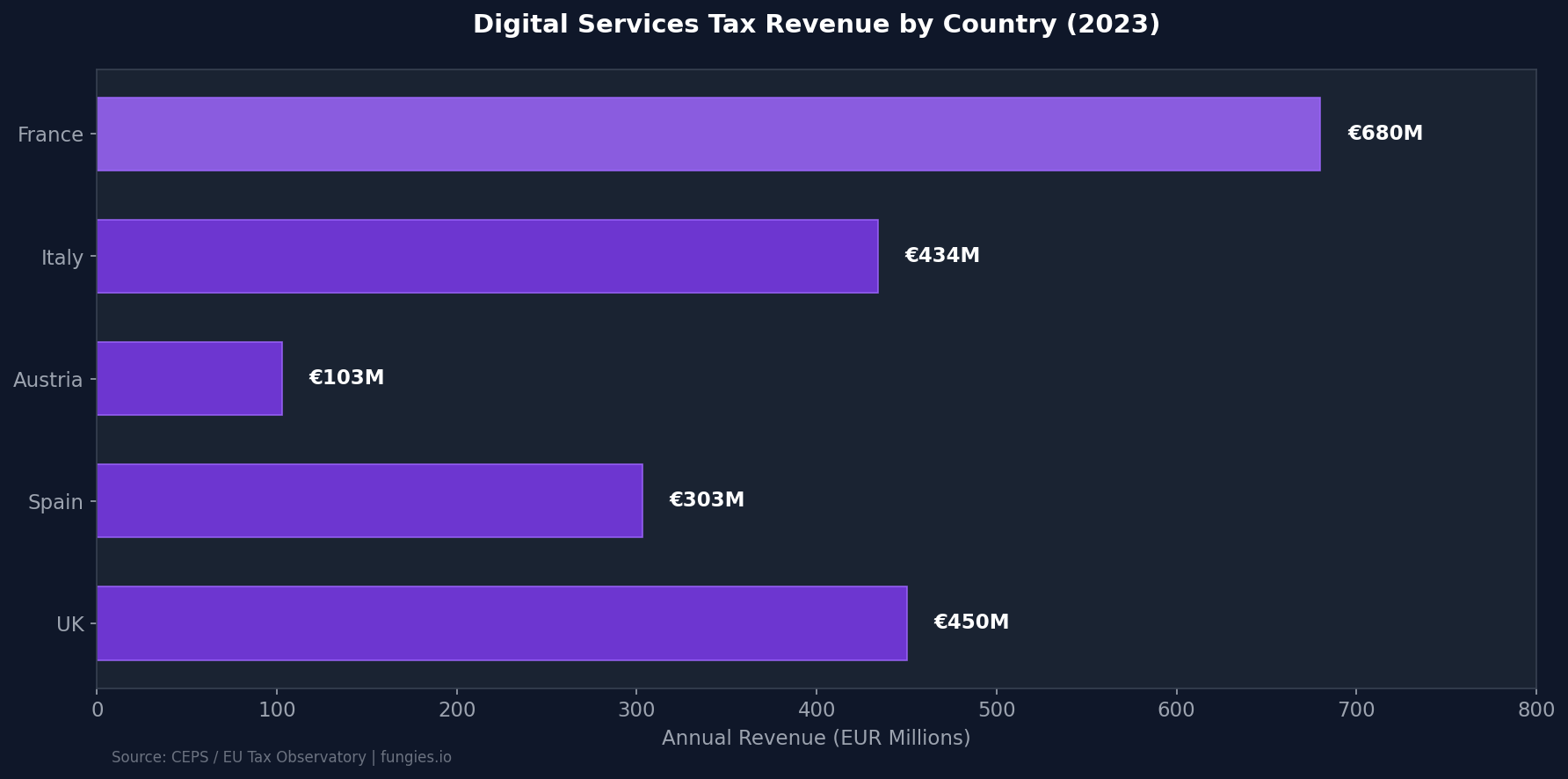
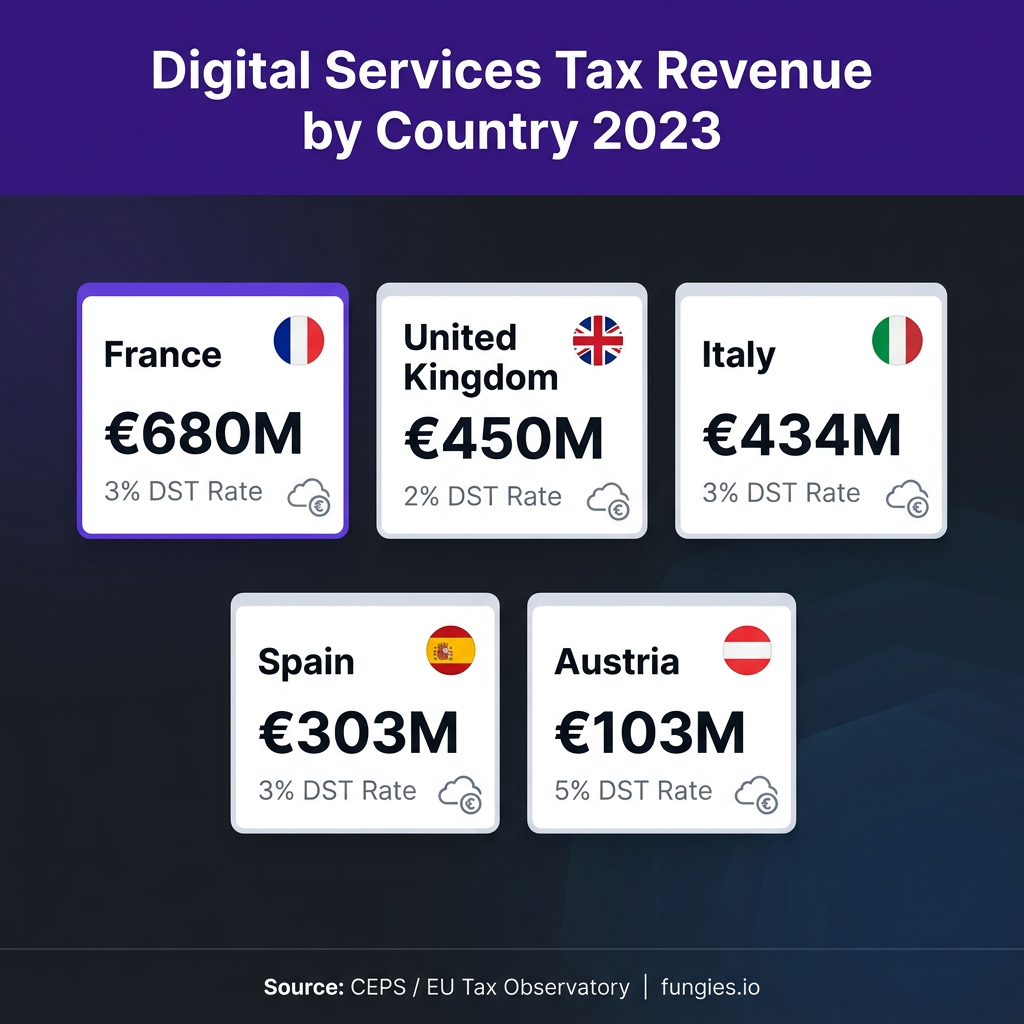
According to CEPS and EU Tax Observatory data, France leads in DST revenue generation with €680 million collected in 2023 at a 3% rate. The United Kingdom follows with approximately €450 million at a 2% rate, while Italy generated €434 million at 3%. Spain collected €303 million and Austria €103 million despite having the highest rate at 5%.
In October 2025, France’s National Assembly passed a proposal to increase its DST from 3% to 6% while raising the global revenue threshold from €750 million to €2 billion. This 67% rate increase would generate an additional €500 million annually, primarily affecting U.S. technology companies including Google, Amazon, Meta, Apple, and Microsoft.
| Country | DST Rate | Global Threshold | Domestic Threshold | 2023 Revenue |
|---|---|---|---|---|
| France | 3% | €750M | €25M | €680M |
| United Kingdom | 2% | £500M | £25M | €450M |
| Italy | 3% | €750M | €5.5M | €434M |
| Spain | 3% | €750M | €3M | €303M |
| Austria | 5% | €750M | €25M | €103M |
| Turkey | 7.5% | €750M | €20M | N/A |
Industry Benchmarks & Compliance Costs
Tax compliance represents a significant cost burden for businesses of all sizes. According to the National Taxpayers Union, U.S. taxpayers will spend nearly 6.93 billion hours complying with the federal tax code for the 2026 filing season, with total compliance burdens exceeding $477 billion.
The Tax Foundation reports even higher figures, estimating that tax complexity costs the U.S. economy over $536 billion annually. This includes over $148 billion in out-of-pocket costs to comply with tax forms. For individual income taxes alone, taxpayers spend over 2.1 billion hours at a total annual cost of $146.9 billion.
For businesses selling digital products globally, compliance costs multiply with each jurisdiction. Over 110 countries now require foreign digital service providers to register for VAT/GST, collect the appropriate tax, and remit it to tax authorities. Each registration carries administrative costs, filing requirements, and potential penalties for non-compliance.
| Compliance Metric | Value | Source |
|---|---|---|
| U.S. Tax Compliance Hours (2026) | 6.93 billion | National Taxpayers Union |
| U.S. Tax Compliance Cost | $477-536 billion | Tax Foundation |
| Countries Requiring Digital VAT | 110+ | Fonoa |
| E-Invoicing Mandates Globally | 175+ countries | Tax Foundation |
| EU VAT Gap | €128 billion | EU Commission |
| Partnership Late Filing Penalty | $255/month | IRS (2025) |
Trends & Predictions: The Future of Digital Taxation
Several transformative trends are reshaping the digital tax landscape through 2030. Understanding these developments is essential for strategic planning and compliance preparation.
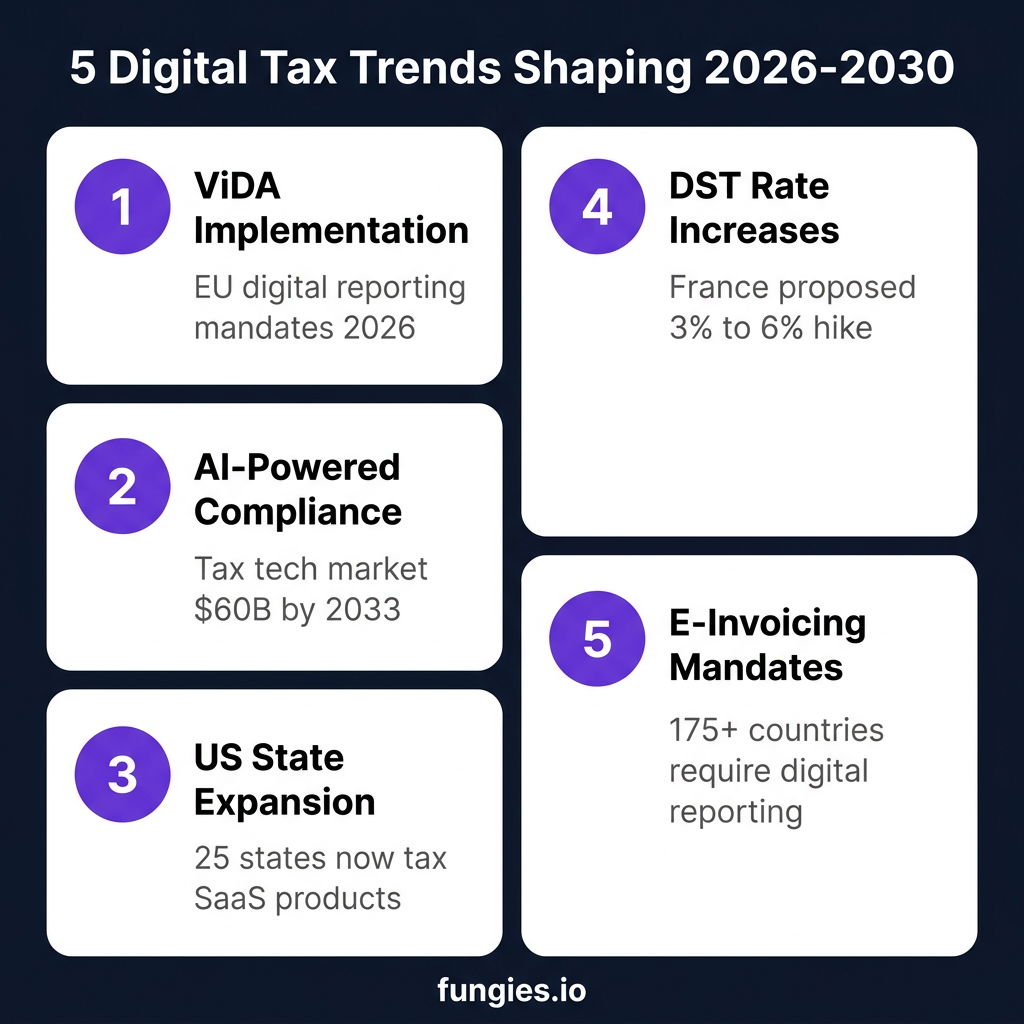
1. ViDA Implementation and Digital Reporting
The EU’s VAT in the Digital Age (ViDA) reform introduces real-time digital reporting requirements that will transform compliance processes. According to Bloomberg Tax, the digitalization of tax is transforming compliance and business processes, with tax authorities gaining access to granular, near real-time data. This creates “multiple digital touchpoints with customers, suppliers, internal functions, payment processes, and tax authorities.”
2. AI-Powered Compliance Solutions
The Tax Tech market is projected to reach $60 billion by 2033, driven by AI and automation adoption. These solutions offer real-time tax calculation, automated filing, and predictive compliance risk assessment. As the OECD observes, “digitalization, and the resulting increased availability of data, allow tax authorities to have greater access to VAT relevant information.”
3. U.S. State Tax Expansion
More than half of U.S. states now tax cloud-based and digital services, with the number expected to grow. States are redefining “taxable software” to include SaaS, digital advertising, and data processing services. Louisiana’s 2025 expansion to SaaS and digital products represents this accelerating trend.
4. DST Rate Increases and Trade Tensions
France’s proposed DST increase from 3% to 6% signals potential rate hikes across jurisdictions. However, as Bloomberg Tax notes, “DSTs will be high on the tax policy agenda in 2026 because trade pressures from the US are colliding with an increasing realization that DSTs won’t produce the revenues their sponsors hope.” The Tax Foundation recommends countries “pivot to raising revenue on digital services through value-added taxes (VATs).”
5. E-Invoicing Mandates Proliferation
More than 175 countries have implemented requirements for companies to use e-invoicing for reporting taxes on business transactions. This creates serious challenges for international companies to comply with disparate and changing requirements in each country where they have sales.
Methodology
This report compiles data from authoritative sources including the European Commission, EU Tax Observatory, OECD, Tax Foundation, National Taxpayers Union, IRS, and leading market research firms including Dataintelo, Fortune Business Insights, MarketsandMarkets, and Grand View Research. Statistics represent the most recent available data as of June 2026, with projections based on analyst consensus estimates.
Market size figures may vary between sources due to differing definitions of tax software segments (indirect vs. direct tax, compliance-only vs. full management suites). We prioritize sources with transparent methodologies and cross-reference figures where possible. DST revenue data is based on official government reports and CEPS analysis.
Frequently Asked Questions
How many countries tax digital services?
Over 110 countries currently require foreign digital service providers to register for VAT/GST, collect tax, and remit it to local authorities. This includes all 27 EU member states, the UK, Australia, India, Japan, and an expanding list of jurisdictions in Asia, Africa, and Latin America.
What is the EU VAT gap?
The EU VAT gap represents the difference between expected VAT revenue and actual collections. In 2024, this gap reached €128 billion, driven by fraud, evasion, avoidance, and bankruptcy. The gap varies significantly by member state, prompting aggressive enforcement measures and the ViDA reform package.
Which U.S. states tax SaaS products?
As of 2026, 25 U.S. states tax SaaS products in some form. Taxability varies widely—some states classify SaaS as tangible personal property, others as services, and treatment may differ between B2B and B2C transactions. Key taxing states include New York, Texas, Washington, Arizona, and increasingly Louisiana following its 2025 expansion.
What is Digital Services Tax (DST)?
Digital Services Tax is a revenue-based tax targeting large digital companies operating in jurisdictions where they may lack physical presence. DSTs typically apply to revenues from online advertising, digital interfaces, and user data sales. Rates range from 2% (UK) to 7.5% (Turkey), with revenue thresholds limiting application to major tech companies.
How much do tax compliance costs burden businesses?
U.S. tax compliance costs exceed $477-536 billion annually, with taxpayers spending nearly 7 billion hours on federal tax compliance. For digital businesses selling globally, costs multiply with each jurisdiction requiring VAT registration, ongoing filings, and potential audit defense.
Sources & Citations
- Dataintelo. “Indirect Tax Compliance Software Market Research Report 2034.” https://dataintelo.com/report/indirect-tax-compliance-software-market
- Fortune Business Insights. “Tax Management Software Market Size, Share & Industry Analysis.” https://www.fortunebusinessinsights.com/tax-management-software-market
- Coherent Market Insights. “Tax Tech Market Analysis 2026-2033.”
- MarketsandMarkets. “Tax Management Market by Solution Type, Tax Type – Global Forecast to 2030.” https://www.marketsandmarkets.com/Market-Reports/tax-management-market-230446693.html
- CEPS. “Towards a European Digital Services Tax.” April 2025. https://cdn.ceps.eu/wp-content/uploads/2025/04/2025_04_FMI-Toward-a-European-digital-tax-1-1.pdf
- EU Tax Observatory. “Digital Service Taxes.” June 2023. https://www.taxobservatory.eu/www-site/uploads/2023/06/EUTO_Digital-Service-Taxes_June2023.pdf
- Tax Foundation. “Digital Taxation around the World.” https://taxfoundation.org/research/all/global/digital-taxation
- Tax Foundation. “VAT Rates in Europe, 2026.” https://taxfoundation.org/data/all/eu/value-added-tax-vat-rates-europe
- Tax Foundation. “Tax Complexity Costs the US Economy over $536 Billion Annually.” https://taxfoundation.org/data/all/federal/irs-compliance-complexity-tax-costs
- National Taxpayers Union. “The Hidden Cost of the Tax Code: 6.93 Billion Hours and More Than $477 Billion in Total Compliance Burdens.” https://www.ntu.org/foundation/detail/the-hidden-cost-of-the-tax-code-693-billion-hours-and-more-than-477-billion-in-total-compliance-burdens
- European Commission. “VAT in the Digital Age (ViDA).” https://taxation-customs.ec.europa.eu/taxation/vat/vat-digital-age-vida_en
- Bloomberg Tax. “Digital Mandates and AI Reshape VAT Compliance Landscape in 2026.” https://news.bloombergtax.com/daily-tax-report-international/digital-mandates-and-ai-reshape-vat-compliance-landscape-in-2026
- Bloomberg Tax. “It’s Time to Abandon Digital Services Taxes for a Superior System.” https://news.bloombergtax.com/tax-insights-and-commentary/its-time-to-abandon-digital-services-taxes-for-a-superior-system
- Anrok. “SaaS sales tax by state in 2026.” https://www.anrok.com/saas-sales-tax-by-state
- Paddle. “2026 SaaS sales tax guide.” https://www.paddle.com/blog/saas-sales-tax-state-wide-and-international
- Sales Tax Institute. “The Expanding Digital Tax Net – How States are Taxing Digital Goods and Services in 2025.” https://www.salestaxinstitute.com/resources/expanding-digital-tax-net-digital-goods-services-2025
- Fonoa. “Global VAT & GST on Digital Services: Complete Guide.” https://www.fonoa.com/resources/blog/global-vat-and-gst-on-digital-services
- Avalara. “Global VAT and GST on digital services.” https://www.avalara.com/us/en/vatlive/global-vat-gst-on-e-services.html
- ITIF. “France’s Digital Tax Policy.” February 2025. https://itif.org/publications/2025/02/11/france-digital-tax-policy
- CCIA. “France’s Proposed Digital Services Tax Increase.” October 2025. https://ccianet.org/wp-content/uploads/2025/10/CCIA-Explainer-on-Frances-Proposed-Digital-Services-Tax-Increase.pdf
- California LAO. “The 2026-27 Budget: Sales Tax on Prewritten Software.” https://lao.ca.gov/LAOEconTax/Article/Detail/859
Last updated: June 10, 2026. Statistics reflect the most recent available data from official sources and market research firms.