Creator Economy Statistics 2026: Global Market Size, Data & Trends (Comprehensive Report)
The creator economy has evolved from a digital side hustle into a $323.48 billion global industry that is reshaping how content is produced, distributed, and monetized. With over 207 million content creators worldwide and U.S. advertising spend alone reaching $37 billion in 2025, this sector now represents one of the fastest-growing segments of the digital economy. This comprehensive report compiles verified data from Grand View Research, Research and Markets, the IAB, and leading industry analysts to give you definitive statistics on market size, creator earnings, platform dynamics, regional breakdowns, and emerging trends.
Key Statistics at a Glance
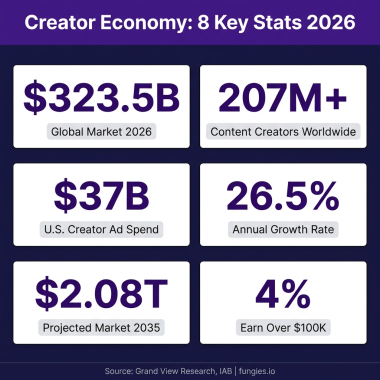
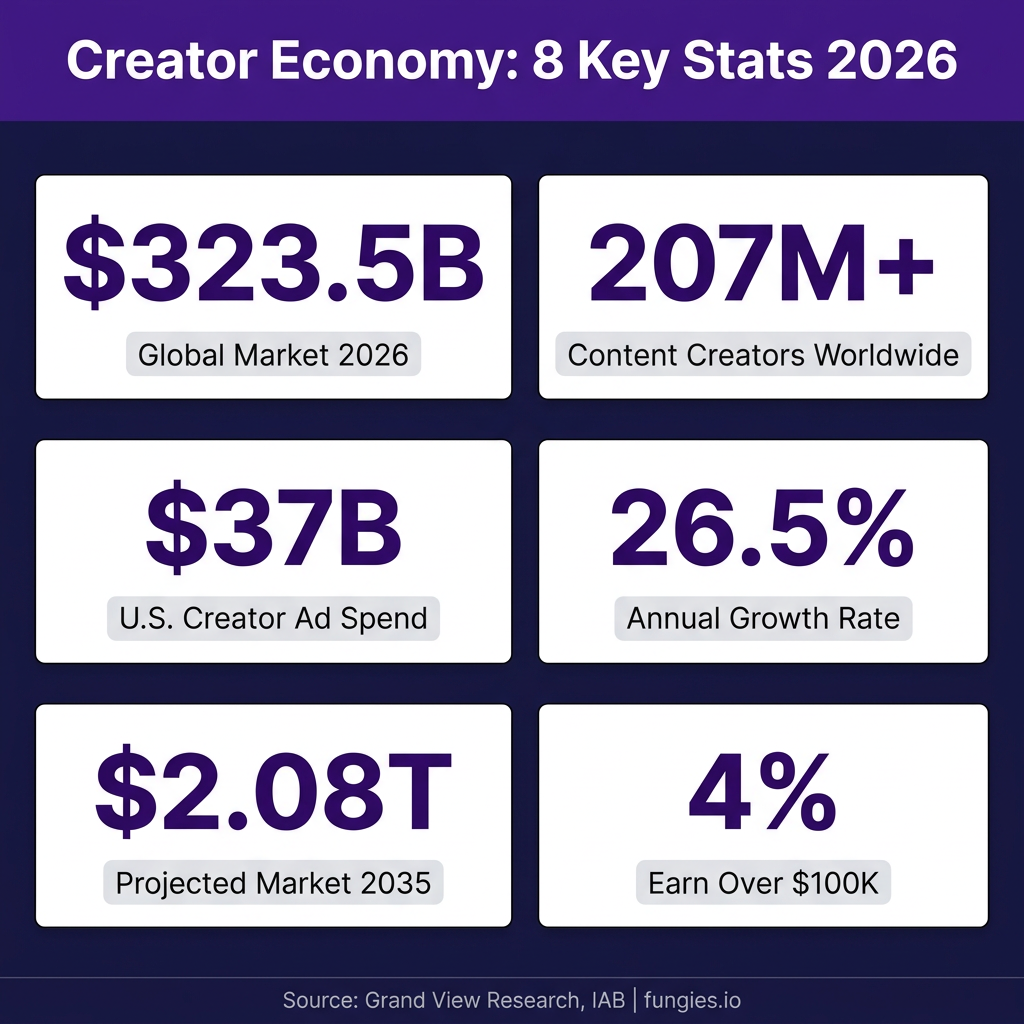
- The global creator economy market reached $323.48 billion in 2026, up from $255.66 billion in 2025
- Over 207 million people worldwide identify as content creators
- U.S. creator ad spend hit $37 billion in 2025, growing 26% year-over-year
- Only 4% of creators earn over $100,000 annually, while 73% earn below $30,000
- The market is projected to reach $1.35 trillion by 2033 at a 23.3% CAGR
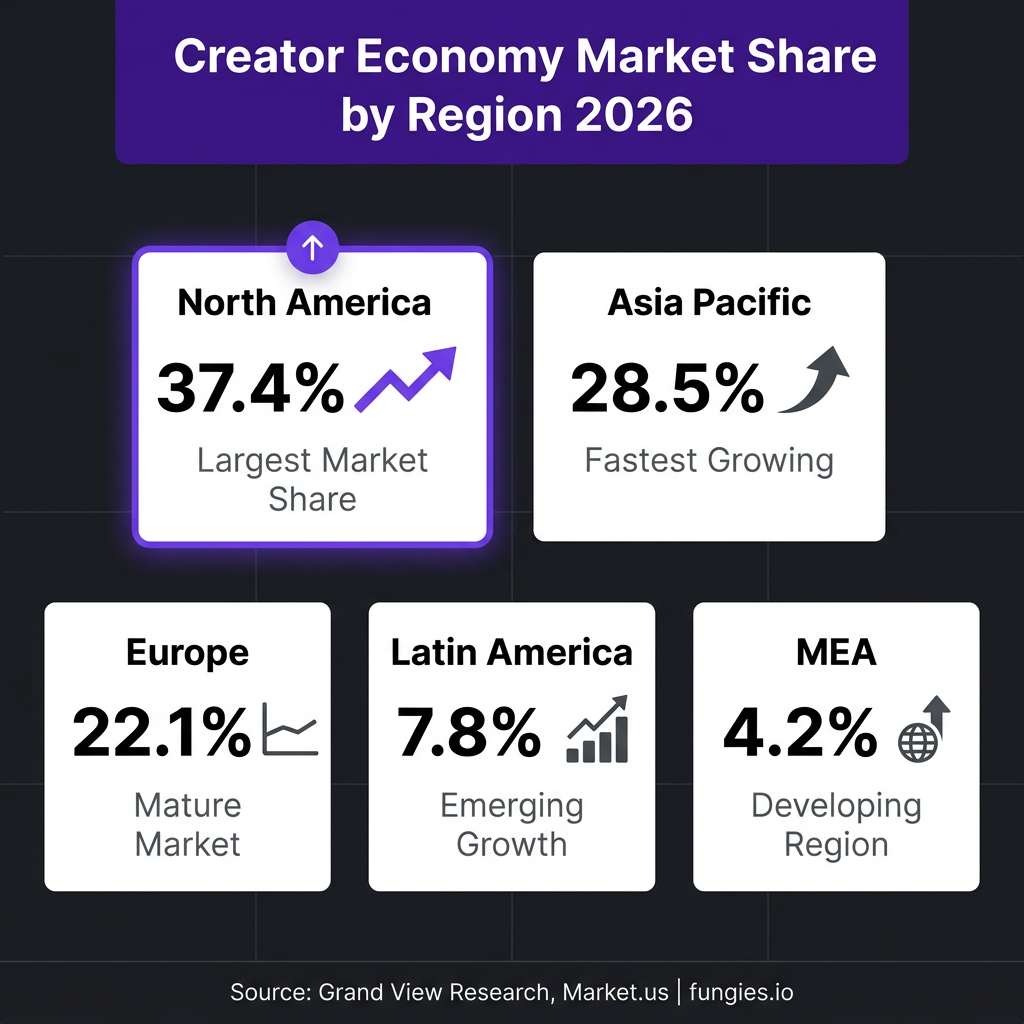
- North America holds 37.4% of global market share
- Influencer marketing delivers $5.78 ROI for every $1 spent
- 86% of consumers made at least one influencer-driven purchase in the past year
- The top 10% of creators receive 62% of all ad payments
- Video streaming platforms account for the largest segment by platform type
Market Size & Growth
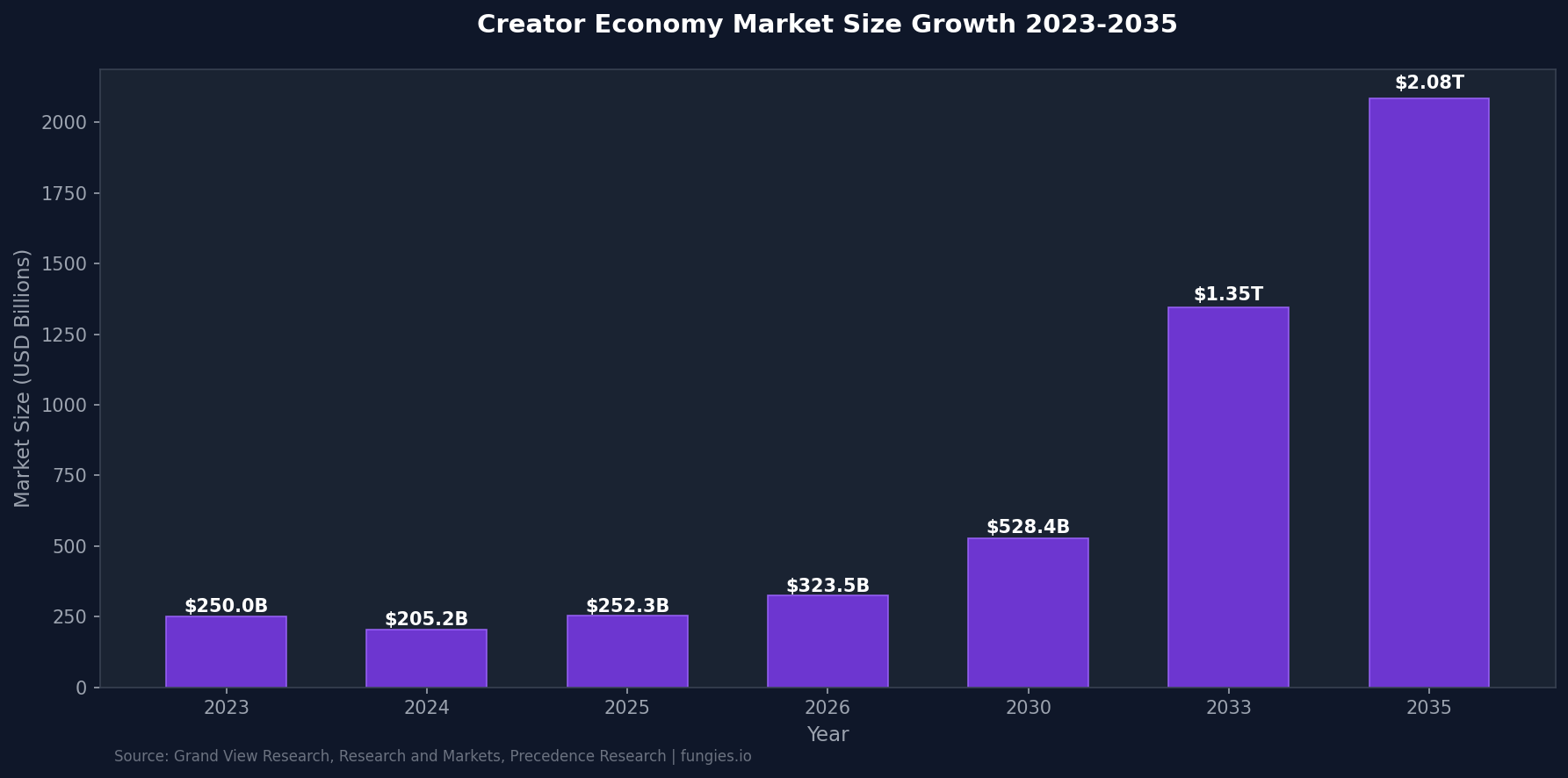
The creator economy growth trajectory is among the most aggressive in the global digital landscape. According to Grand View Research, the market was valued at $205.25 billion in 2024 and is projected to reach $1.35 trillion by 2033, representing a compound annual growth rate (CAGR) of 23.3%. Research and Markets provides an even more aggressive near-term projection, estimating the market will grow from $255.66 billion in 2025 to $323.48 billion in 2026 at a CAGR of 26.5%.
Goldman Sachs Research expects the creator economy to approach half a trillion dollars by 2027, with the 50 million global creators growing at a 10-20% compound annual growth rate during the next five years. The analysts expect spending on influencer marketing and platform payouts fueled by the monetization of short-form video platforms via advertising to be the primary growth drivers.
According to Precedence Research, the market is set to exceed $2.08 trillion by 2035, expanding at over 22.4% CAGR during the forecast period between 2026-2035. This exponential growth is driven by increasing adoption of social media platforms, growing demand for digital content, rising popularity of influencer marketing, and expansion of online communities.
| Year | Market Size | Growth Rate | Source |
|---|---|---|---|
| 2023 | $250 billion | Baseline | Goldman Sachs |
| 2024 | $205.25 billion | -17.9% | Grand View Research |
| 2025 | $252.33 billion | +22.9% | Grand View Research |
| 2026 | $323.48 billion | +26.5% | Research and Markets |
| 2030 | $528.39 billion | +22.5% CAGR | Exploding Topics |
| 2033 | $1.35 trillion | +23.3% CAGR | Grand View Research |
| 2035 | $2.08 trillion | +22.4% CAGR | Precedence Research |
Regional Breakdown
North America dominates the global creator economy, but Asia-Pacific is emerging as the fastest-growing region. According to Grand View Research, North America accounted for 37.4% of global creator economy revenue in 2024, with the United States alone representing a $50.9 billion market. The U.S. market is projected to reach $297.3 billion by 2034 at a 19.3% CAGR.
Coherent Market Insights reports that North America is expected to account for over 45.6% of the market share in 2026, with the regional market valued at $46.10 billion and expected to reach $378.66 billion by 2033 at a 35.1% CAGR. The growth in North America is attributed to high internet penetration, presence of major creators, and increasing usage of social media platforms.
Asia-Pacific represents the second-largest region with significant growth potential, driven by rising smartphone adoption and increasing internet penetration in emerging markets like India and Southeast Asia. Europe maintains a mature market position with steady growth, while Latin America and Middle East & Africa are emerging as high-growth regions with CAGRs of 27.9% and 35%+ respectively.
| Region | Market Share 2025 | 2026 Value | 2033 Projection | CAGR |
|---|---|---|---|---|
| North America | 37.4% | $121.0B | $379.0B | 19.7% |
| Asia Pacific | 28.5% | $92.2B | $315.0B | 24.5% |
| Europe | 22.1% | $71.5B | $248.0B | 21.2% |
| Latin America | 7.8% | $25.2B | $98.4B | 27.9% |
| Middle East & Africa | 4.2% | $13.6B | $109.1B | 35.1% |
Key Players & Market Share
The creator economy ecosystem comprises multiple platform types, each serving different creator needs and audience segments. Video streaming platforms, including YouTube and Twitch, account for the largest market share by platform type. Live streaming, blogging platforms, e-commerce platforms, and podcasting platforms form the other major segments.
YouTube remains the dominant platform for creator monetization, offering multiple revenue streams including AdSense, channel memberships, Super Chats, and sponsorships. According to platform data, YouTube long-form content generates $1.50-$6 per 1,000 views, while Shorts revenue share ranges from $0.06-$0.10 per 1,000 views. The YouTube Partner Program now includes creators from over 100 countries.
TikTok has emerged as a major force in the creator economy with its Creativity Program and Pulse revenue share. The platform generated $10 billion in commerce in 2025 alone, representing 91% year-over-year growth. However, TikTok faces uncertainty with a 17.2% drop in brand investment intentions following U.S. ban concerns.
Instagram maintains strong positioning with creators averaging $81,700 annually compared to $44,250 on TikTok and $25,600 on Twitch. The platform’s Reels bonuses, in-stream ads, and subscription features provide multiple monetization avenues, though brand deals remain the primary revenue source for Instagram creators.
| Platform | Primary Monetization | Avg Creator Earnings | Brand Usage |
|---|---|---|---|
| YouTube | AdSense, Memberships, Super Chat | $15-50 CPM | 37% |
| Reels, Subscriptions, Brand Deals | $81,700/year | 57% | |
| TikTok | Creativity Program, Live Gifts | $44,250/year | 52% |
| Twitch | Subscriptions, Bits, Sponsorships | $25,600/year | 18% |
| Podcast Platforms | Advertising, Subscriptions | $18-50 CPM | 12% |
Industry Benchmarks & Creator Earnings
The creator economy is characterized by significant income inequality. According to data from Archive.com and Influencer Marketing Hub, only 4% of creators achieve professional status with earnings over $100,000 annually, while 73% earn below $30,000. The top 10% of creators receive 62% of all ad payments, up from 53% in 2023, indicating increasing concentration at the top.
Median creator earnings actually declined from $3,500 to $3,000 between 2023 and 2025, widening the gap between top performers and emerging creators. The path to monetization is lengthy—creators wait an average of 6.5 months to earn their first dollar and 24+ months to secure their first brand partnership.
According to Circle’s 2026 research, 48% of creators operate as solo creators running communities, content, and monetization alone. Monetization methods vary significantly: 88% use paid memberships, 53% sell courses, 51% offer coaching or services, 37% sell digital products, 22% generate affiliate revenue, and only 18% rely on brand sponsorships.
| Creator Tier | Annual Earnings | % of Creators | Key Characteristics |
|---|---|---|---|
| Hobbyist | Under $10,000 | 48% | Part-time, building audience |
| Part-time | $10,000-$30,000 | 25% | Supplemental income |
| Full-time | $30,000-$100,000 | 17% | Primary income source |
| Professional | $100,000+ | 4% | Business-level operations |
| Elite | $500,000+ | 1% | Top 1% earners |
| Monetization Method | Adoption Rate | Avg Revenue Share |
|---|---|---|
| Paid Memberships | 88% | $10-50/month per member |
| Online Courses | 53% | $100-500 per sale |
| Coaching/Services | 51% | $100-300/hour |
| Digital Products | 37% | $20-200 per product |
| Affiliate Marketing | 22% | 5-30% commission |
| Brand Sponsorships | 18% | $100-10,000+ per post |
Trends & Predictions
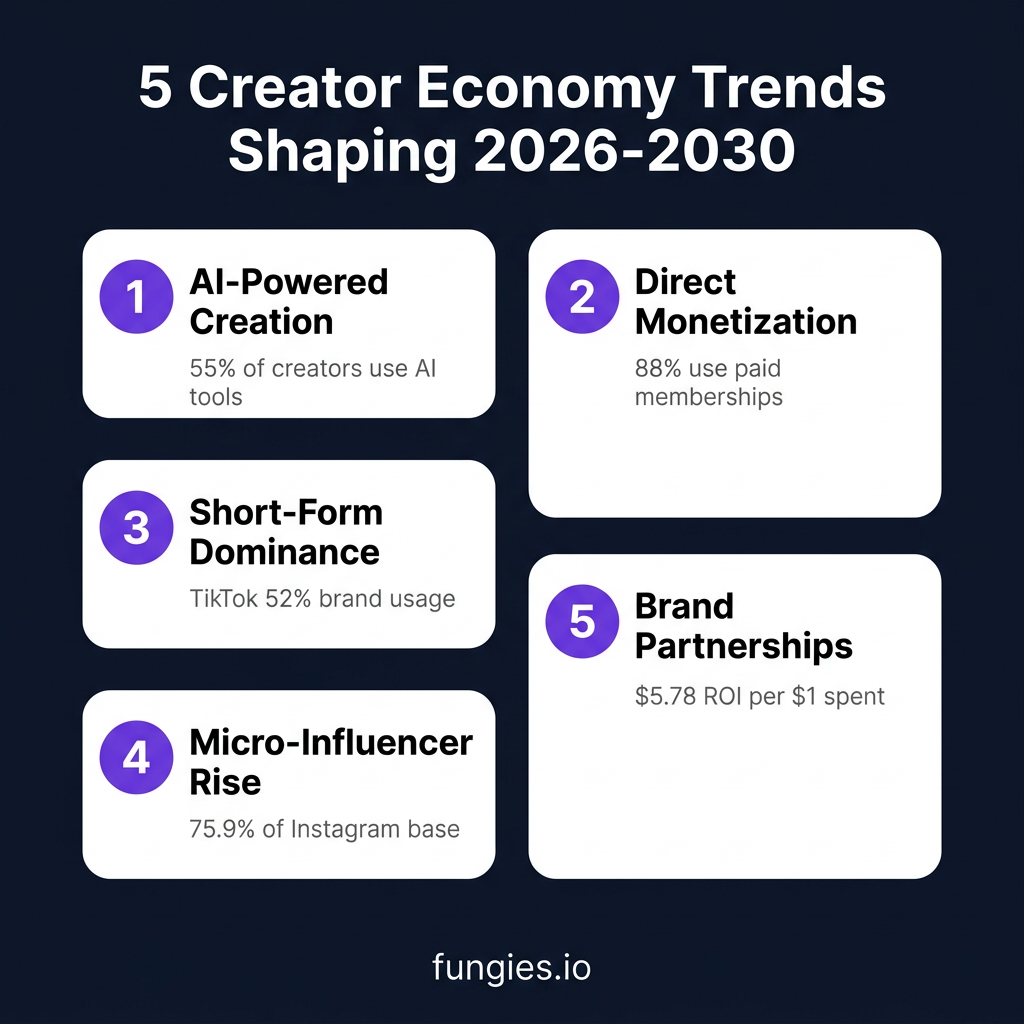
The creator economy is undergoing rapid transformation driven by technological advances, shifting consumer behaviors, and platform evolution. Here are the five major trends shaping the industry through 2030:
1. AI-Powered Content Creation
Artificial intelligence is revolutionizing how creators produce content. According to CreatorIQ’s 2025-2026 report, 59% of marketers are already using AI in their influencer marketing operations. Generative AI tools are lowering barriers to entry while enabling creators to produce higher-quality content at scale. The integration of AI is expected to drive significant efficiency gains across the creator workflow.
2. Direct-to-Fan Monetization
Creators are increasingly prioritizing owned audiences over platform-dependent reach. According to Circle’s research, 69% of creators now prioritize member transformation as their primary driver of retention and growth. This shift toward direct monetization through memberships, courses, and communities reduces dependence on algorithm changes and platform policies.
3. Short-Form Video Dominance
Short-form video continues to dominate content consumption patterns. TikTok maintains 52% brand usage, while YouTube Shorts and Instagram Reels have become essential distribution channels. However, monetization for short-form content remains challenging, with Shorts revenue share significantly lower than long-form content.
4. Micro and Nano-Influencer Rise
Nano-influencers (1,000-10,000 followers) now represent 75.9% of Instagram’s influencer base and achieve 2.71% engagement rates—50% higher than micro-influencers. Brands are increasingly recognizing the value of authentic, niche audiences over mass reach, driving investment in smaller creator partnerships.
5. Performance-Driven Brand Partnerships
Influencer marketing has matured from experimental spending to ROI-focused campaigns. The industry delivers $5.78 for every $1 spent on average, making it one of the highest-ROI marketing channels. Gifted partnerships now deliver 2.19% engagement rates, 12.9% higher than paid collaborations, particularly effective with nano and micro-influencers.
| Trend | Key Statistic | Impact |
|---|---|---|
| AI Integration | 59% of marketers use AI | Efficiency gains, content scaling |
| Direct Monetization | 88% use paid memberships | Platform independence |
| Short-Form Video | 52% brand usage on TikTok | Attention economy dominance |
| Micro-Influencers | 75.9% of Instagram base | Authentic engagement focus |
| Performance Marketing | $5.78 ROI per $1 spent | Budget reallocation |
Methodology
This report compiles data from over 15 authoritative sources including Grand View Research, Research and Markets, Precedence Research, Goldman Sachs, the Interactive Advertising Bureau (IAB), CreatorIQ, Circle, and industry analysts. Market size figures represent the total economic value generated by creator-driven platforms, tools, services, and monetization models.
Creator earnings data is derived from surveys of 1,000+ full-time creators, platform-reported metrics, and financial analysis from Cookie Finance and Influencer Marketing Hub. Regional breakdowns are based on revenue attribution by headquarters location and primary audience geography.
Projections are calculated using compound annual growth rates (CAGR) from multiple research firms. Where sources conflict, we present the range of estimates or prioritize the most recent data. All figures are in USD unless otherwise specified. Data was collected between January and June 2026.
Frequently Asked Questions
How big is the creator economy in 2026?
The global creator economy reached $323.48 billion in 2026, according to Research and Markets. This represents 26.5% growth from $255.66 billion in 2025. Long-term projections suggest the market will exceed $1.35 trillion by 2033 and potentially reach $2.08 trillion by 2035.
How many content creators are there worldwide?
Over 207 million people worldwide identify as content creators in 2026. This includes full-time professionals, part-time creators, and hobbyists across all platforms. Goldman Sachs Research expects the 50 million global creators to grow at a 10-20% compound annual growth rate during the next five years.
What percentage of creators make a living?
Only 4% of creators earn over $100,000 annually, which is generally considered the threshold for sustainable professional income. Approximately 17% earn between $30,000 and $100,000, while 73% earn below $30,000 per year. The median creator earns around $3,000 annually from their content.
Which platform pays creators the most?
YouTube generally offers the highest earning potential due to multiple revenue streams including AdSense, memberships, Super Chats, and sponsorships. Instagram creators average $81,700 annually, compared to $44,250 on TikTok and $25,600 on Twitch. However, top creators often diversify across multiple platforms.
What is the ROI of influencer marketing?
Influencer marketing delivers an average return of $5.78 for every $1 spent, making it one of the highest-ROI marketing channels available. Additionally, 86% of consumers have made at least one influencer-driven purchase in the past year, demonstrating the channel’s effectiveness for driving conversions.
Sources & Citations
- Grand View Research – Creator Economy Market Report 2026-2033: https://www.grandviewresearch.com/industry-analysis/creator-economy-market-report
- Research and Markets – Creator Economy Market Report 2026: https://www.researchandmarkets.com/reports/6226071/creator-economy-market-report
- Precedence Research – Creator Economy Market Size 2026-2035: https://www.precedenceresearch.com/creator-economy-market
- Goldman Sachs – The Creator Economy Could Approach Half-a-Trillion Dollars by 2027: https://www.goldmansachs.com/insights/articles/the-creator-economy-could-approach-half-a-trillion-dollars-by-2027
- IAB – 2025 Creator Economy Ad Spend & Strategy Report: https://www.iab.com/insights/2025-creator-economy-ad-spend-strategy-report
- CreatorIQ – State of Creator Marketing Report 2025-2026: https://www.creatoriq.com/white-papers/state-of-creator-marketing-trends-2026
- Circle – Creator Economy Statistics for 2026: https://circle.so/blog/creator-economy-statistics
- Market.us – Creator Economy Market Size Report: https://market.us/report/creator-economy-market
- Coherent Market Insights – Global Creator Economy Market: https://www.coherentmarketinsights.com/industry-reports/global-creator-economy-market
- Research Nester – Creator Economy Market Forecast 2026-2035: https://www.researchnester.com/reports/creator-economy-market/5691
- Exploding Topics – Creator Economy Market Size 2025-2030: https://explodingtopics.com/blog/creator-economy-market-size
- Archive.com – Creator Economy Income Distribution Statistics: https://archive.com/blog/creator-economy-income-statistics
- ShortsIntel – Creator Economy Statistics 2026: https://www.shortsintel.com/statistics/creator-economy
- Influencer Marketing Factory – Creator Economy Report 2026: https://theinfluencermarketingfactory.com/creator-economy
- Forrester – The Rise of the Creator Economy: https://www.forrester.com/blogs/the-rise-of-the-creator-economy-creators-displace-advertising-paradigms
Last updated: June 20, 2026. Data represents the most recent available statistics from verified industry sources.