Here’s a stat that’ll make you rethink your AI budget: LLM API pricing varies by over 600x in 2026. GPT-5 nano costs $0.05 per million input tokens. GPT-5.4 Pro? $30 per million input tokens—and $180 for output.
If you’re building with AI, that difference isn’t academic. At 10 million tokens per month, choosing the wrong model costs you $125,000 per year. This guide breaks down every major LLM API price as of May 2026, with real benchmarks and specific recommendations for your use case.
 .05 to 0/M Tokens" alt="LLM API Pricing Comparison 2026: Complete Guide to 30+ Models from .05 to 0/M Tokens” decoding=”async” width=”1024″ height=”1024″ src=”https://fungies.io/wp-content/uploads/2026/05/infographic-llm-api-pricing-comparison-2026-1-1.png” alt=”LLM API Pricing Comparison 2026: Four pricing tiers from budget to ultra premium” class=”wp-image-38876″ srcset=”https://fungies.io/wp-content/uploads/2026/05/infographic-llm-api-pricing-comparison-2026-1-1.png 1024w, https://fungies.io/wp-content/uploads/2026/05/infographic-llm-api-pricing-comparison-2026-1-1-300×300.png 300w, https://fungies.io/wp-content/uploads/2026/05/infographic-llm-api-pricing-comparison-2026-1-1-150×150.png 150w, https://fungies.io/wp-content/uploads/2026/05/infographic-llm-api-pricing-comparison-2026-1-1-768×768.png 768w, https://fungies.io/wp-content/uploads/2026/05/infographic-llm-api-pricing-comparison-2026-1-1-450×450.png 450w, https://fungies.io/wp-content/uploads/2026/05/infographic-llm-api-pricing-comparison-2026-1-1-600×600.png 600w, https://fungies.io/wp-content/uploads/2026/05/infographic-llm-api-pricing-comparison-2026-1-1-380×380.png 380w, https://fungies.io/wp-content/uploads/2026/05/infographic-llm-api-pricing-comparison-2026-1-1-50×50.png 50w” sizes=”(max-width: 1024px) 100vw, 1024px” />
What Changed in LLM Pricing in 2026
The AI pricing landscape shifted dramatically this year. Three trends matter:
- Price compression at the bottom: GPT-4 level performance now starts at $0.05/M tokens—80% cheaper than 2025.
- Premium tier expansion: New “Pro” and reasoning models (o3, GPT-5.4 Pro) push top-tier pricing to $180/M output tokens.
- Value differentiation: Quality scores from independent benchmarks (BenchLM, Theozard) now range from 64 to 100—making price-per-quality the metric that matters.
The result? You can’t just pick “GPT-5” anymore. You need to know which GPT-5, for which task, at what volume.
The Complete LLM API Pricing Table (May 2026)
All prices per million tokens. Quality scores from BenchLM.ai leaderboard.
| Model | Provider | Input | Output | Context | Quality |
|---|---|---|---|---|---|
| GPT-5 nano | OpenAI | $0.05 | $0.40 | 1M | — |
| Gemini 3.1 Flash-Lite | $0.25 | $1.50 | 1M | — | |
| DeepSeek V3 | DeepSeek | $0.27 | $1.10 | 131K | 79 |
| Grok 3 Mini | xAI | $0.30 | $0.50 | 256K | — |
| Gemini 3 Flash | $0.50 | $3.00 | 1M | 87 | |
| Mistral Large 3 | Mistral | $0.50 | $1.50 | 128K | — |
| DeepSeek R1 | DeepSeek | $0.55 | $2.19 | 128K | — |
| GPT-5.1 | OpenAI | $1.50 | $6.00 | 400K | 67 |
| GPT-5.2 | OpenAI | $1.75 | $14.00 | 400K | 77 |
| GPT-5.2-Codex | OpenAI | $1.75 | $14.00 | 400K | 73 |
| Gemini 3.1 Pro | $2.00 | $12.00 | 1M | 94 | |
| GPT-5.3 Codex | OpenAI | $2.50 | $10.00 | 400K | 80 |
| GPT-5.4 | OpenAI | $2.50 | $15.00 | 400K | 94 |
| Claude Sonnet 4.6 | Anthropic | $3.00 | $15.00 | 1M | 68 |
| Grok 4 | xAI | $3.00 | $15.00 | 256K | 77 |
| Claude Opus 4.6 | Anthropic | $5.00 | $25.00 | 1M | 85 |
| GPT-5.2 Pro | OpenAI | $25.00 | $150.00 | 400K | 66 |
| o3 Pro | OpenAI | $20.00 | $80.00 | 200K | 77 |
| GPT-5.4 Pro | OpenAI | $30.00 | $180.00 | 400K | 91 |
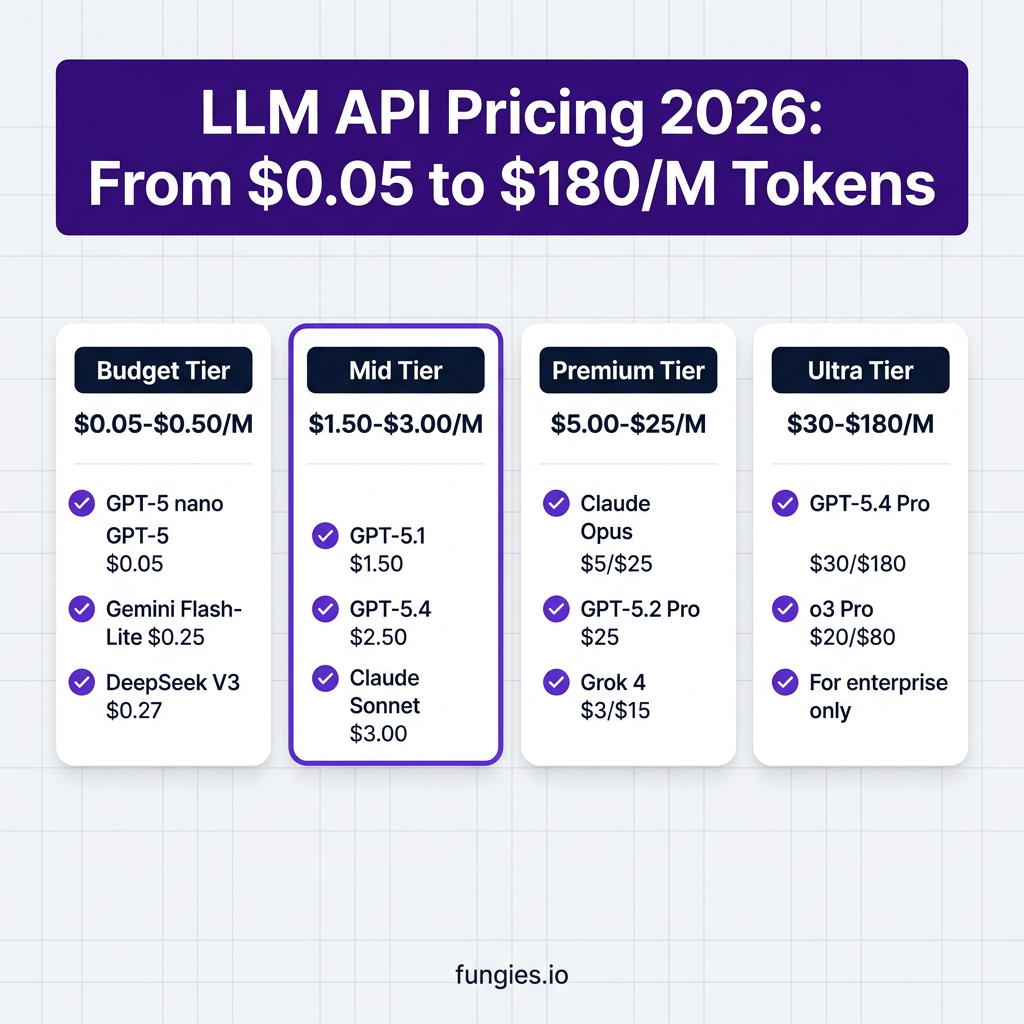
The Four Pricing Tiers Explained
Tier 1: Budget Models ($0.05–$0.50/M Input)
Best for: High-volume, lower-stakes tasks—classification, simple Q&A, content filtering.
- GPT-5 nano ($0.05/$0.40): The cheapest major LLM API. Good enough for basic tasks, terrible for reasoning.
- Gemini 3.1 Flash-Lite ($0.25/$1.50): Google’s budget option with 1M context window. Better quality than nano at 5x the price.
- DeepSeek V3 ($0.27/$1.10): The value champion—quality score 79 at budget pricing. Value score: 209 (highest on the market).
Tier 2: Production Sweet Spot ($1.50–$3.00/M Input)
Best for: Most production workloads. This is where most teams should live.
- GPT-5.4 ($2.50/$15): Quality score 94, same as Gemini 3.1 Pro. The default choice for serious applications.
- Gemini 3.1 Pro ($2.00/$12): Tied with GPT-5.4 at quality 94, but cheaper. Best value in the mid-tier.
- Claude Sonnet 4.6 ($3.00/$15): 1M token context window. Best for long-document processing.
Tier 3: Premium Flagships ($5.00–$25/M Input)
Best for: Complex reasoning, legal analysis, high-stakes decisions where errors are expensive.
- Claude Opus 4.6 ($5.00/$25): Quality score 85. Best for agentic coding (Claude Code) and complex multi-step reasoning.
- GPT-5.2 Pro ($25/$150): Quality score 66—surprisingly low for the price. Only use if you need specific Pro features.
Tier 4: Ultra-Premium ($20–$180/M Input)
Best for: Enterprise workloads where cost doesn’t matter—only capability does.
- o3 Pro ($20/$80): Reasoning model. Uses “thinking tokens” that add cost but improve accuracy on complex problems.
- GPT-5.4 Pro ($30/$180): The most expensive mainstream API. Quality score 91—excellent, but is it 600x better than nano?
 .05 to 0/M Tokens" alt="LLM API Pricing Comparison 2026: Complete Guide to 30+ Models from .05 to 0/M Tokens” decoding=”async” width=”1024″ height=”1024″ src=”https://fungies.io/wp-content/uploads/2026/05/infographic-llm-api-pricing-comparison-2026-2-1.png” alt=”Best Value LLM APIs for Developers 2026: Top 5 picks ranked by value score” class=”wp-image-38877″ srcset=”https://fungies.io/wp-content/uploads/2026/05/infographic-llm-api-pricing-comparison-2026-2-1.png 1024w, https://fungies.io/wp-content/uploads/2026/05/infographic-llm-api-pricing-comparison-2026-2-1-300×300.png 300w, https://fungies.io/wp-content/uploads/2026/05/infographic-llm-api-pricing-comparison-2026-2-1-150×150.png 150w, https://fungies.io/wp-content/uploads/2026/05/infographic-llm-api-pricing-comparison-2026-2-1-768×768.png 768w, https://fungies.io/wp-content/uploads/2026/05/infographic-llm-api-pricing-comparison-2026-2-1-450×450.png 450w, https://fungies.io/wp-content/uploads/2026/05/infographic-llm-api-pricing-comparison-2026-2-1-600×600.png 600w, https://fungies.io/wp-content/uploads/2026/05/infographic-llm-api-pricing-comparison-2026-2-1-380×380.png 380w, https://fungies.io/wp-content/uploads/2026/05/infographic-llm-api-pricing-comparison-2026-2-1-50×50.png 50w” sizes=”(max-width: 1024px) 100vw, 1024px” />
LLM API Cost by Use Case
Chatbots and Conversational AI
Assuming 500 input tokens per message and 10M tokens/month:
| Model | Monthly Cost | Conversations/$ |
|---|---|---|
| DeepSeek V3 | $440 | ~4,500 |
| Gemini 3.1 Pro | $8,000 | ~2,000 |
| GPT-5.4 | $10,000 | ~800 |
| Claude Opus 4.6 | $17,500 | ~450 |
Recommendation: GPT-5.4 or Gemini 3.1 Pro for production chatbots. DeepSeek V3 if you’re cost-constrained.
Coding Assistants and IDEs
Coding agents burn tokens fast. Claude Code or Cursor can easily hit 1M+ tokens per hour on large refactors.
| Use Case | Recommended Model | Why |
|---|---|---|
| Autocomplete | GPT-5.4 or GPT-5.3 Codex | Fast, cheap, good enough |
| Code review | Claude Sonnet 4.6 | 1M context for large files |
| Agentic coding | Claude Sonnet 4.6 | Balance of cost and capability |
| Complex refactoring | Claude Opus 4.6 | Best reasoning, expensive |
Document Processing
Per 10-page document (~4,000 tokens input, 500 output):
| Model | Cost per Document |
|---|---|
| DeepSeek V3 | $0.0014 |
| Gemini 3.1 Flash-Lite | $0.0018 |
| Gemini 3.1 Pro | $0.0140 |
| GPT-5.4 | $0.0175 |
| Claude Opus 4.6 | $0.0450 |
Processing 10,000 documents/day? That’s $14/day with Gemini 3.1 Pro vs $45/day with Claude Opus—a $11,000/year difference.
The Hidden Costs: What Pricing Tables Don’t Show
Context Window Math
A 1M token context window sounds great until you pay for it. Sending 100K tokens to Claude Opus 4.6 costs $0.50 just for the input—before the model generates a single token.
Rule of thumb: If your use case needs >50K context, Gemini’s 1M context at lower per-token pricing beats Claude’s 1M context.
Reasoning Model Premium
o3 and similar “reasoning” models use test-time compute—effectively running multiple internal steps before responding. The result is better accuracy on complex tasks, but the cost is 3-10x higher than non-reasoning equivalents.
For a math problem where GPT-5.4 fails 20% of the time and o3 fails 5% of the time, is the 8x price premium worth it? Only you can answer that—but factor it into your ROI calculations.
Rate Limits and Throughput
Cheap models often come with aggressive rate limits. DeepSeek V3’s $0.27/M pricing is unbeatable—if you can stay under the rate limits. For high-throughput applications, you may need to pay more for reliable access.
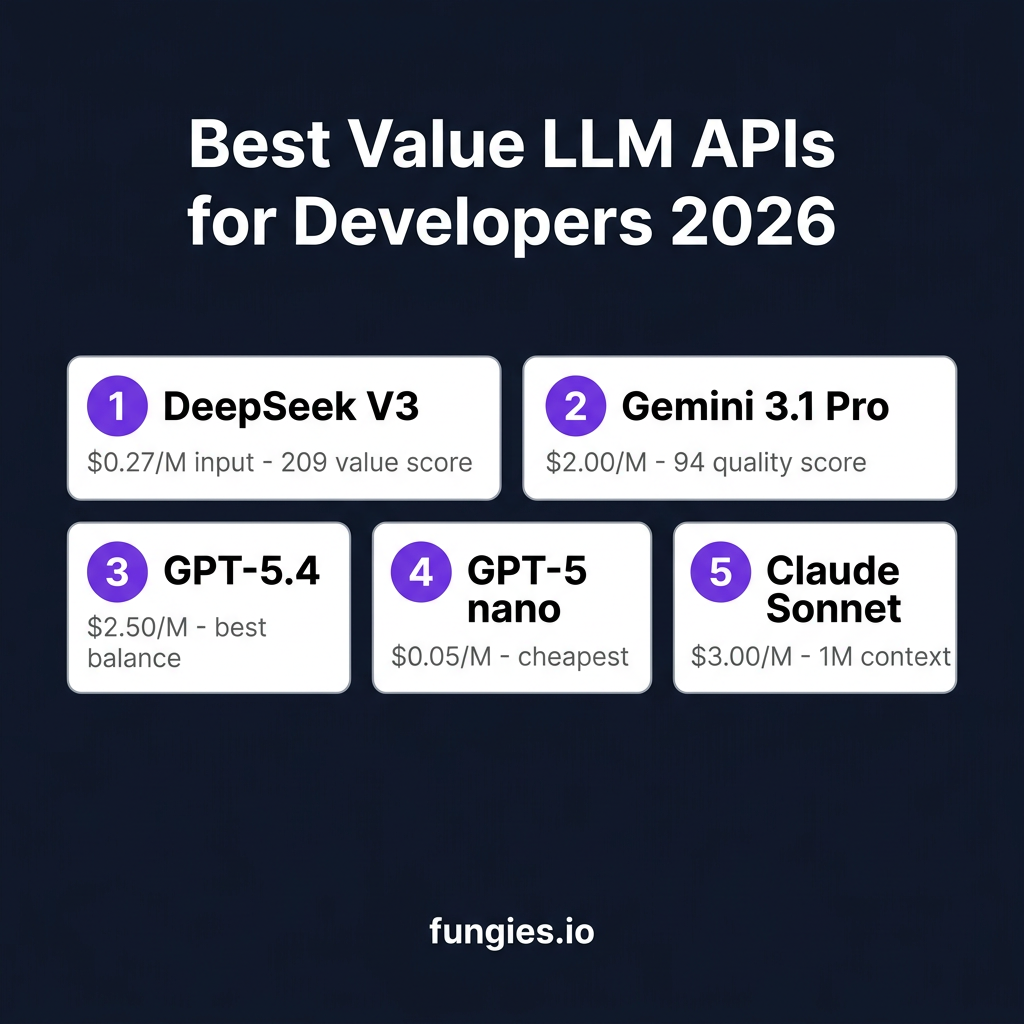
Top 5 Best Value LLM APIs for Developers
Ranked by value score (quality per dollar of output cost):
1. DeepSeek V3 — Value Score: 209
At $0.27/$1.10 with quality score 79, DeepSeek V3 delivers the best bang-for-buck in the market. The catch? It’s a Chinese model with potential data sovereignty concerns for some use cases.
2. Gemini 3.1 Pro — Value Score: 7.8
Quality score 94 at $2/$12. Tied with GPT-5.4 on quality, but 20% cheaper. The 1M context window is genuine—no hidden costs.
3. GPT-5.4 — Value Score: 6.3
The safe default. Quality 94, widely supported, predictable behavior. If you don’t want to think about model selection, start here.
4. GPT-5 nano — Value Score: N/A
No quality score, but at $0.05/$0.40 it’s 10x cheaper than anything else. Use it for classification, filtering, or any task where “good enough” is actually good enough.
5. Claude Sonnet 4.6 — Value Score: 4.5
Lower value score, but the 1M context window is real and useful. If you’re processing long documents or codebases, the extra context is worth the premium.
Key Takeaways: How to Choose Your LLM API
- Start with GPT-5.4 or Gemini 3.1 Pro for most production workloads. They’re the new “standard tier.”
- Use DeepSeek V3 for cost-sensitive, high-volume tasks where data sovereignty isn’t a concern.
- Reserve Claude Opus 4.6 for agentic coding and complex reasoning where errors are expensive.
- Avoid GPT-5.4 Pro and o3 Pro unless you have a specific use case that justifies the 10-100x cost premium.
- Track your actual token usage. Most developers overestimate their needs and overpay by 3-5x.
FAQ: LLM API Pricing 2026
What’s the cheapest LLM API in 2026?
GPT-5 nano at $0.05 per million input tokens. For context, 1 million tokens is roughly 750,000 words—about 3,000 pages of text.
Is Claude Opus 4.6 worth $5/$25?
For agentic coding and complex reasoning—yes. For simple chat or classification—no. The quality score of 85 is excellent, but GPT-5.4 at $2.50/$15 scores 94 and costs half as much.
Why is GPT-5.4 Pro so expensive?
It’s a reasoning model with test-time compute. The model internally “thinks” through multiple steps before responding, improving accuracy on complex tasks. You’re paying for that extra computation.
Can I mix different LLM APIs in one application?
Absolutely—and you should. Use GPT-5 nano for classification, GPT-5.4 for general responses, and Claude Opus for complex reasoning. Tools like OpenRouter or LiteLLM make this easy.
How do I estimate my LLM API costs?
Track tokens in your application for one week, then multiply. As a rough guide: 1,000 English words ≈ 1,300 tokens. Most chat messages are 50-200 tokens.
Conclusion
LLM API pricing in 2026 is a 600x spread from budget to premium. The good news? You don’t need the most expensive model for most tasks. GPT-5.4 or Gemini 3.1 Pro handle 80% of production workloads at reasonable cost. Reserve the flagships for the 20% where quality truly matters.
Building a SaaS that needs payment processing? Fungies.io handles checkout, tax compliance, and global payments—so you can focus on picking the right LLM for your AI features.
References
- CostGoat LLM API Pricing Comparison — Live pricing for 327+ models
- BenchLM.ai LLM Pricing Guide 2026 — Quality scores and benchmarks
- TLDL LLM API Pricing 2026 — GPT-5, Claude 4, Gemini comparisons
- CloudIDR Live Pricing Comparison — Real-time pricing tracker
- PE Collective LLM Pricing — Cross-provider analysis
- DecodesFuture LLM Pricing Guide — Token economics analysis