Here’s a number that should wake up every SaaS founder: venture capitalists spent over $300 billion in Q1 2026 alone, yet 95% of pitch decks never make it past the first email. The funding is there. The competition is brutal. And the founders who win aren’t always the ones with the best product — they’re the ones who understand how the game is actually played.
I’ve watched dozens of SaaS startups raise capital over the past few years. Some raised millions with nothing but a prototype and a compelling story. Others with working products and real revenue couldn’t get a single meeting. The difference? It wasn’t luck. It was preparation, positioning, and process.
This guide breaks down exactly what you need to know to raise your seed or Series A round in 2026. No generic advice. No fluff. Just the specific benchmarks, templates, and tactics that separate funded founders from the ones still polishing their decks.
The 2026 Funding Landscape: What’s Actually Changed
The venture capital world looks very different today than it did even two years ago. AI-native startups captured 61% of global VC deal value in 2025, and that trend has only accelerated. But here’s what most founders miss: the fundamentals of raising capital haven’t changed — the bar has just gotten higher.
According to data from PitchBook and the NVCA, early-stage valuations have compressed significantly. The median SaaS valuation multiple dropped from 7x ARR at the start of 2025 to 3.8x by March 2026. Top-tier companies still command 7–9x ARR, but merely being a SaaS business is no longer enough for premium valuations.
What investors want now is evidence. They want to see traction, efficient capital use, and a credible path to profitability. The era of funding ideas is over. Today’s VCs are looking for proof points: paying customers, strong unit economics, and teams that can execute.
Understanding Each Funding Stage: From Pre-Seed to Series A
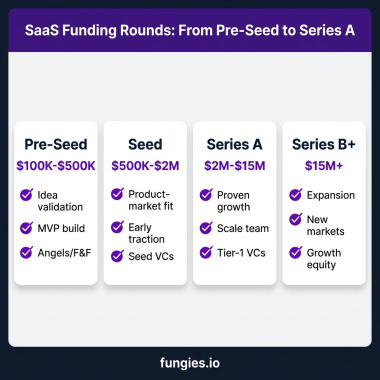
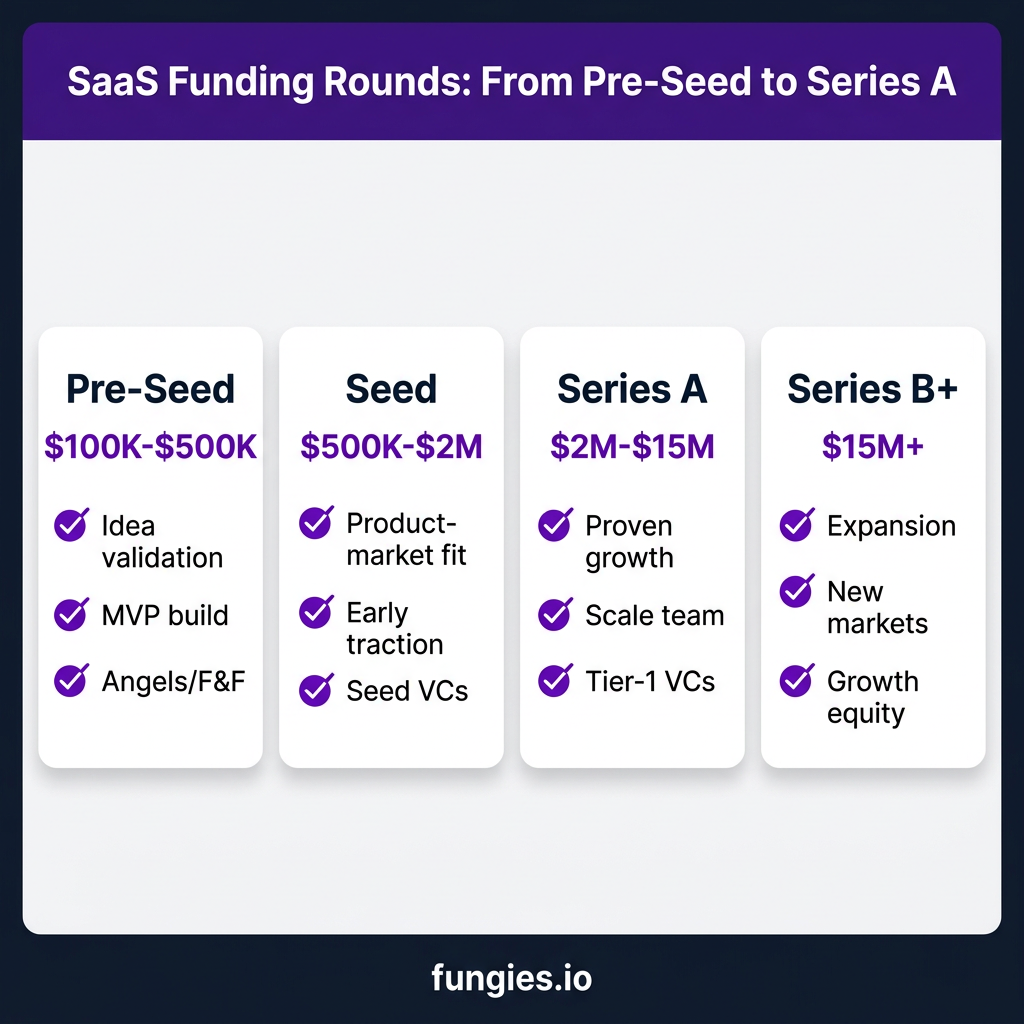
Before you start fundraising, you need to know which stage you’re actually in. Misunderstanding this is one of the fastest ways to get rejected. Here’s what each stage actually looks like in 2026:
| Stage | Amount | What You Need | Typical Investors |
|---|---|---|---|
| Pre-Seed | $100K–$500K | Idea validation, MVP, early team | Angels, accelerators, friends & family |
| Seed | $500K–$2M | Product-market fit signals, early traction | Seed VCs, angel syndicates |
| Series A | $2M–$15M | Proven growth engine, repeatable sales | Tier-1 VCs, growth funds |
| Series B+ | $15M+ | Scale operations, expand markets | Growth equity, late-stage VCs |
The key insight here: each stage has different metrics that matter. At pre-seed, investors bet on the team and vision. At seed, they want to see early product-market fit signals. By Series A, you need demonstrable, repeatable growth with clear unit economics.
The Metrics That Actually Matter to Investors in 2026
Let’s cut through the noise. Here are the specific numbers investors will ask about, and the benchmarks that separate fundable companies from the rest:
ARR and Growth Rate
For seed rounds, most VCs want to see at least $10K–$50K in monthly recurring revenue (MRR), though exceptional teams can raise with less. For Series A, the floor is typically $1M–$2M ARR with consistent month-over-month growth. Top-quartile companies grow 15–20% month-over-month at seed stage.
Burn Multiple
This has replaced CAC payback as the key capital efficiency metric. Burn multiple is simple: Net Burn ÷ Net New ARR. The median Series A SaaS startup has a 1.6x burn multiple, but top quartile companies hit 1.0–1.2x. If you’re above 2.0x heading into a raise, expect tough questions.
Net Revenue Retention (NRR)
NRR measures how much your existing customers grow or shrink. Best-in-class SaaS companies have NRR above 120%. Anything below 100% is a red flag — it means you’re losing more from churn than you’re gaining from expansion.
The Rule of 40
This classic SaaS metric combines growth rate and profit margin. The rule states that your growth rate plus your profit margin should equal at least 40%. A company growing 50% annually with -10% margins hits the rule. So does a company growing 20% with 20% margins.
How to Build a Pitch Deck That Gets Meetings
Your pitch deck has one job: earn a second meeting. That’s it. Most founders try to cram everything into their deck and end up with a document that confuses more than it convinces.
Based on analysis of 500+ successful decks, here are the 10 slides you actually need:
- Hook/Opening: The one-sentence version of what you do and why it matters. Get this right or nothing else matters.
- Problem: What painful, expensive problem are you solving? Make it specific and quantified.
- Solution: Your product, explained simply. One screenshot or demo link. Don’t over-explain.
- Market: Bottom-up market sizing. Show the math: X customers × Y price = Z opportunity.
- Business Model: How you make money. Pricing, contract terms, and unit economics.
- Traction: The proof. Revenue growth, customer logos, usage metrics. This slide makes or breaks you.
- Competition: The competitive landscape and your specific advantage. Be honest about alternatives.
- Go-to-Market: How you acquire customers. Channels, CAC, and what’s working now.
- Team: Why you’re the ones to build this. Relevant experience, domain expertise, and key hires.
- The Ask: How much you’re raising, what milestones it gets you to, and use of funds.
The best decks follow a simple rule: one claim per slide, backed by evidence. Investors scan decks in under 3 minutes. If they can’t grasp your core argument in that time, you’ve lost them.
Running a Disciplined Fundraising Process
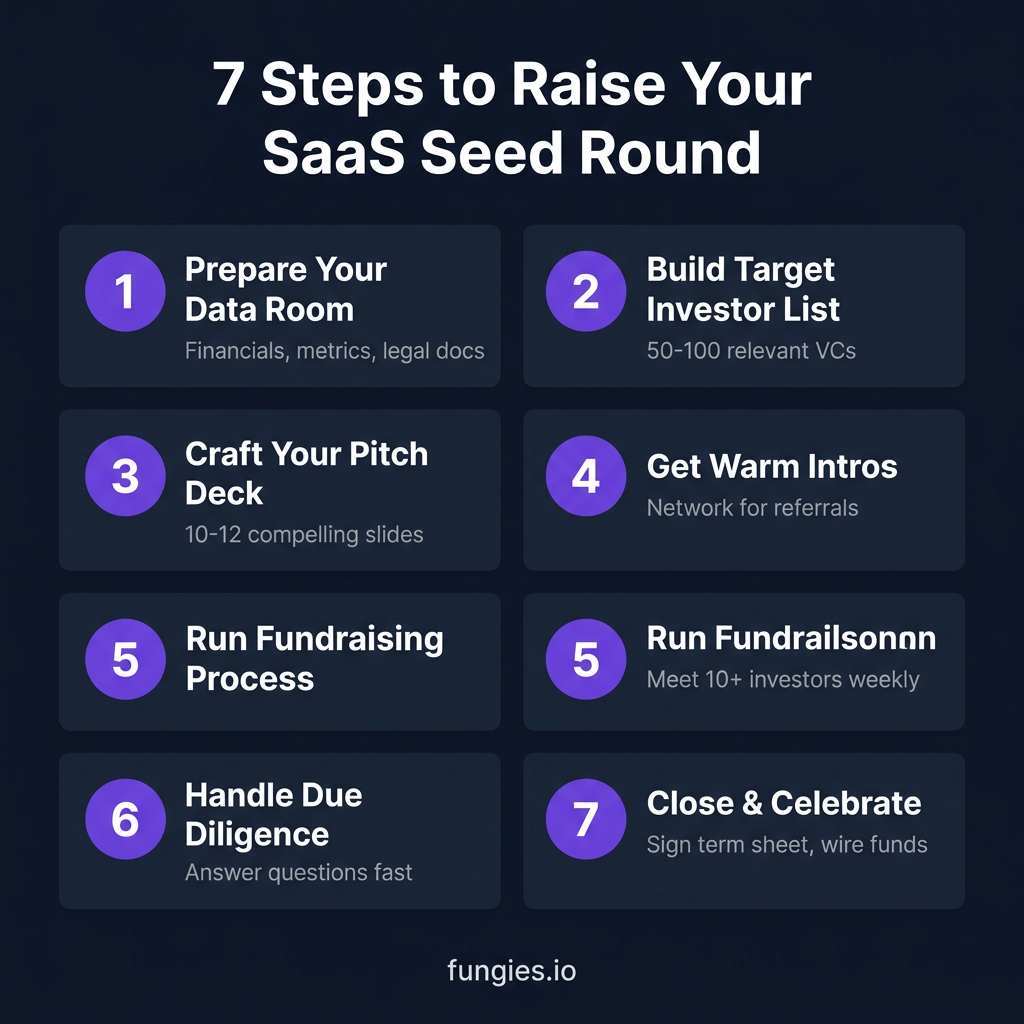
Fundraising is a full-time job. Most founders underestimate this and try to raise while running the business. The result? Both suffer. Here’s how to run a proper process:
Step 1: Prepare Your Data Room
Before you send a single email, have your data room ready. This includes: financial statements (P&L, balance sheet, cash flow), cap table, legal documents (incorporation, IP assignments, employment agreements), customer metrics (cohort analysis, churn data, NRR), and product metrics (usage data, roadmap). Having this ready shows professionalism and speeds up due diligence.
Step 2: Build Your Target List
Create a list of 50–100 investors who actually invest in your stage, sector, and geography. Research each one: recent investments, check size, and value-add beyond capital. Warm intros are 10x more effective than cold emails. Use your network — advisors, other founders, angel investors — to get introductions.
Step 3: Create Momentum
Fundraising is about momentum. You want multiple conversations happening simultaneously so you can create competition. Aim for 10+ investor meetings per week during active fundraising. Batch your meetings, follow up relentlessly, and always move toward a specific next step.
Step 4: Handle Objections
You will hear no. A lot. The best founders treat objections as data. Common ones include: “Too early” (build more traction), “Market is too small” (better market sizing), “Team is missing X” (hire or add advisors), and “Competition concern” (sharpen differentiation). Each objection is feedback on what to fix or communicate better.
Understanding Term Sheets: What to Accept and What to Negotiate
Getting a term sheet is exciting, but don’t let enthusiasm override diligence. Here are the key terms to understand:
Valuation matters, but it’s not the only thing that matters. A higher valuation with worse terms can be worse than a lower valuation with clean terms. Focus on: liquidation preferences (1x non-participating is standard), anti-dilution provisions (weighted average is fair; full ratchet is not), board composition (maintain control at early stages), and protective provisions (what requires investor approval).
The best term sheets are simple. If a term sheet has dozens of complex provisions, that’s a red flag. Good investors write straightforward deals because they know the real value creation happens after the investment, not in the legal structure.
Investor Relations: Keeping Your Backers Engaged
The work doesn’t end when the money hits your account. In fact, that’s when a new job begins: investor relations. Good investor communication turns passive backers into active advocates who can help with hiring, introductions, and future fundraising.
Send monthly updates, even if things aren’t going perfectly. The best updates include: key metrics (ARR, MRR, burn, runway), wins and milestones, challenges and how you’re addressing them, specific asks for help, and upcoming priorities. Keep it concise — one page is plenty.
Here’s a simple template that works: Start with a 2-3 sentence summary of the month’s big picture. Then bullet points for metrics, wins, and challenges. End with specific asks — introductions, hiring, advice — and next month’s focus. Send it consistently, on the same day each month.
The 7 Mistakes That Kill Fundraising Rounds
After watching hundreds of fundraising attempts, here are the most common failure modes:
- Raising too early: Before you have product-market fit signals, you’re just pitching a dream. Dreams don’t get funded in 2026.
- Over-optimizing valuation: A slightly lower valuation with the right partner beats a high valuation with a bad fit.
- Ignoring burn multiple: Growth at any cost is dead. Show you can grow efficiently.
- Weak storytelling: Facts tell, stories sell. Connect the dots for investors.
- Running a scattered process: Fundraising requires focus. Don’t try to do it part-time.
- Neglecting due diligence prep: Getting a term sheet is step one. Passing due diligence is step two.
- Picking the wrong investors: Not all money is equal. Choose partners who add value beyond capital.
Frequently Asked Questions
How long does the average SaaS fundraising process take?
From first outreach to money in the bank, expect 3–6 months. The best-prepared founders can do it in 6–8 weeks, but that’s the exception. Build runway accordingly — you should start fundraising when you have 9–12 months of cash left.
What if I don’t have any revenue yet?
Pre-revenue fundraising is possible but much harder than it used to be. You’ll need exceptional traction signals: waitlists, pilot customers, letters of intent, or strong technical validation. Your team credentials matter more at this stage — previous exits, domain expertise, or technical chops can compensate for lack of revenue.
Should I use a fundraising advisor or platform?
Advisors can help with deck review, pitch coaching, and investor introductions, but they don’t replace the work only a founder can do. Most charge a retainer plus success fees. Platforms like AngelList, Republic, and specialized SaaS fundraising networks can expand your reach, especially for seed rounds.
How do I know if I’m ready to raise Series A?
The Series A bar has risen significantly. Most VCs want to see $1M+ ARR, 15%+ month-over-month growth, clear product-market fit, and a repeatable acquisition channel. You should also have a clear plan for how you’ll use the capital to reach the next milestone — typically $5M+ ARR within 18–24 months.
What’s the most important thing investors look for?
After analyzing thousands of investment decisions, the pattern is clear: investors bet on people first, markets second, and products third. They want to see a team that can execute, a market large enough to support a venture-scale outcome, and a product that solves a real problem. Traction is the proof that ties it all together.
Final Thoughts: Fundraising Is a Means, Not an End
It’s easy to get caught up in the fundraising game — the pitch decks, the investor meetings, the term sheet negotiations. But remember this: fundraising is not success. It’s fuel for the real work of building a great company.
The founders who build enduring SaaS businesses don’t celebrate the raise. They celebrate the milestones the raise enables: the customers they serve, the team they build, the problem they solve. Fundraising is just a step on that journey.
If you’re preparing to raise capital, take a breath. Do the work. Know your numbers. Tell a compelling story. And remember that every no gets you closer to the right yes. The funding is out there. Go get it.
Ready to streamline your SaaS billing and payments? Get started with Fungies.io and focus on what matters — building your business.
Sources
- Pitchwise — Startup Funding Rounds Guide 2026
- CFO Advisors — 2026 Burn Multiple Benchmarks
- Growigami — SaaS Valuations Guide 2026
- L40° — SaaS Multiples 2026
- DECKO — What Investors Want in 2026
- VeryCreatives — SaaS Pitch Deck Structure 2026
- SaaStr — Monthly Investor Update Best Practices
- ChartMogul — SaaS Investor Updates