Polar.sh crossed 10,000 registered developers in early 2026. That kind of growth doesn’t happen by accident — especially in a market dominated by Paddle and Lemon Squeezy for years. Something about this open-source, developer-first Merchant of Record is clearly clicking.
But “clicking” doesn’t mean it’s the right choice for your SaaS. I’ve spent time digging into Polar’s actual pricing, feature set, API quality, and real developer feedback so you don’t have to.
Here’s everything you need to decide if Polar.sh is worth it in 2026.
What Is Polar.sh?
Polar is an open-source Merchant of Record (MoR) platform built specifically for developers. Founded in 2023, it’s grown from a GitHub sponsorship tool into a full-featured billing infrastructure that handles subscriptions, one-time sales, usage-based pricing, and global tax compliance.
The key differentiator: Polar is built on top of Stripe, is fully open source, and has a transparent public roadmap. You can literally read the source code on GitHub.
As a Merchant of Record, Polar takes on the legal liability for collecting and remitting sales tax, VAT, and GST in 60+ countries. That’s the same value prop as Paddle, FastSpring, or Lemon Squeezy — but Polar’s pricing structure and developer experience are meaningfully different.
Polar.sh Pricing in 2026: What You Actually Pay
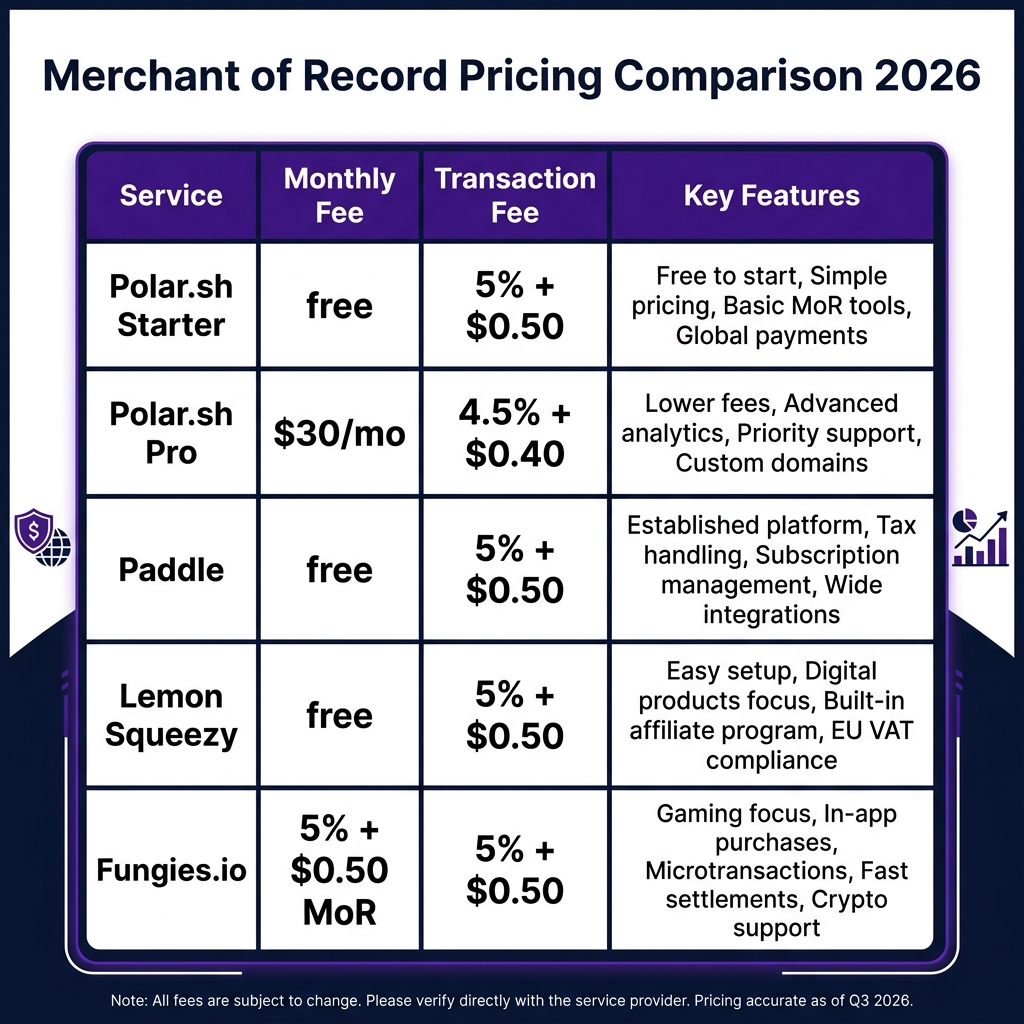
This is where things get interesting. Polar introduced tiered plans in 2025, moving away from a pure pay-as-you-go model.
| Plan | Monthly Fee | Transaction Fee | Support | Best For |
|---|---|---|---|---|
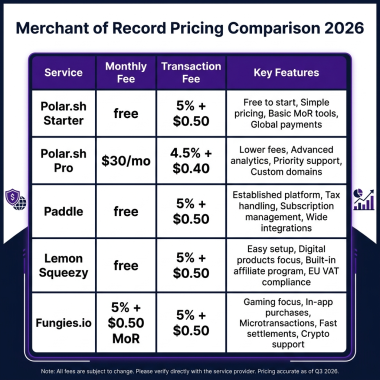
| Starter | Free | 5% + $0.50 | Community | Side projects, early validation |
| Pro | $30/mo | 4.5% + $0.40 | Email priority | Solo founders, $5K–30K MRR |
| Growth | $100/mo | 4.0% + $0.30 | Email priority | Growing SaaS, $30K–100K MRR |
| Scale | $400/mo | 3.4% + $0.30 | Slack + prioritized | High-volume, $100K+ MRR |
At the free Starter tier, Polar’s 5% + $0.50 matches Paddle exactly. The difference shows up at volume. On the Growth plan ($100/mo), you’re at 4.0% + $0.30. At $50,000 MRR with 500 transactions, that saves you roughly $500–600/month versus Paddle’s flat 5% + $0.50.
One important note: Polar’s Early Member pricing (4% + $0.40, free plan) was grandfathered when they moved to the new plan structure. If you signed up before the change, you keep that rate as long as you stay on the free tier.
Polar.sh vs the Competition: Full Feature Comparison
| Feature | Polar.sh | Paddle | Lemon Squeezy | Fungies.io | Dodo Payments |
|---|---|---|---|---|---|
| Merchant of Record | ✅ Yes | ✅ Yes | ✅ Yes | ✅ Yes | ✅ Yes |
| Base Transaction Fee | 5% + $0.50 | 5% + $0.50 | 5% + $0.50 | 5% + $0.50 | 4% + $0.40 |
| Monthly Subscription Option | ✅ Yes (paid plans) | ❌ No | ❌ No | ❌ No | ❌ No |
| Open Source | ✅ Yes (GitHub) | ❌ No | ❌ No | ❌ No | ❌ No |
| Usage-Based Billing | ✅ Yes | ✅ Yes | ⚠️ Limited | ✅ Yes | ⚠️ Limited |
| GitHub Sponsor Integration | ✅ Native | ❌ No | ❌ No | ❌ No | ❌ No |
| Embeddable Checkout | ✅ Yes | ✅ Yes | ✅ Yes | ✅ Yes | ✅ Yes |
| Free Plan Available | ✅ Yes | ✅ Yes | ✅ Yes | ✅ Yes | ✅ Yes |
| Countries Supported (Tax) | 60+ | 200+ | 100+ | 100+ | 40+ |
| Built-in Affiliate Program | ✅ Yes | ✅ Yes | ✅ Yes | ✅ Yes | ❌ No |
Polar’s biggest technical advantage is its API depth. The Polar API is REST-first, has webhooks for every event, and the open-source nature means you can self-host the webhooks processing logic and customize behavior in ways none of its competitors allow. If you’re a developer who wants control, that matters.
Getting Started with Polar.sh: The Actual Developer Experience
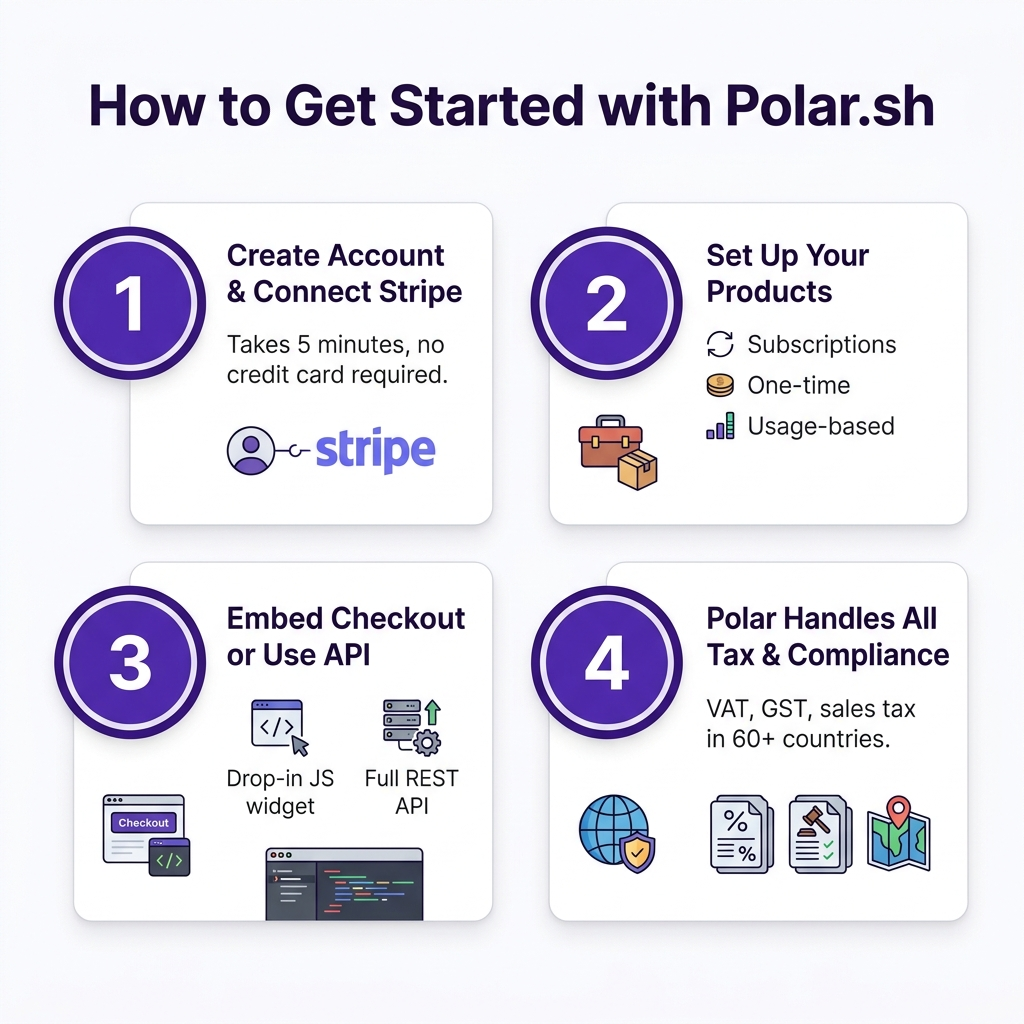
Setup is fast. Seriously — you can have a working checkout in under 20 minutes.
Step 1: Account Setup
Go to polar.sh, sign up with GitHub. Connect your Stripe account (Polar processes through Stripe under the hood). That’s the auth layer sorted in under 5 minutes.
Step 2: Create Your Products
From the dashboard you can create:
- Subscriptions — monthly/annual, with free trials and metered billing
- One-time products — software licenses, digital downloads, templates
- Usage-based — charge per API call, per seat, per GB
- GitHub Sponsors integration — unique feature no other MoR offers natively
Step 3: Embed the Checkout
Polar gives you three integration paths:
- Hosted checkout — redirect to a Polar-hosted page, zero code required
- Embedded widget — drop-in JavaScript that renders inline on your site
- REST API — full programmatic control, build your own UI
The embedded widget is the highlight. It’s clean, loads fast, and doesn’t feel like you’ve handed your user off to a third-party. Here’s a minimal integration:
<script src="https://cdn.polar.sh/embed/checkout.js"></script>
<button data-polar-checkout="your-product-id">Buy Now</button>
Step 4: Tax Compliance Is Automatic
Once you’re live, Polar collects and remits VAT/GST/sales tax on every transaction. You don’t file returns. You don’t track which state you have nexus in. Polar is the seller of record, so the tax liability sits with them, not you.
Polar.sh Limitations You Should Know
Honest review means covering the rough edges too.
1. Geographic Coverage Is Narrower Than Paddle
Polar handles tax compliance in 60+ countries. Paddle covers 200+. If you’re selling into Southeast Asia, the Middle East, or Africa at meaningful volume, Paddle’s broader coverage matters. Polar is actively expanding, but the gap exists today.
2. No Dedicated Support on the Free Plan
Free plan users get community support only. If something breaks with your checkout at 2am on a Friday, you’re on your own until Monday. For production businesses, the $30/month Pro plan’s email priority support is worth it for this reason alone.
3. Still Maturing in Some Enterprise Features
Custom invoicing, multi-entity support, and complex revenue recognition workflows are areas where Paddle and FastSpring have years of head start. If you’re a Series A+ company with a finance team that has specific requirements, evaluate carefully.
4. Account Review Process
Before your first payout, Polar runs a business verification. It’s not onerous, but it’s not instant either. Budget 24–72 hours for this if you’re launching soon.
Polar.sh Pricing Math: When Does It Actually Save You Money?
Let’s run real numbers. You’re doing $20,000 MRR with roughly 200 transactions per month.
| Platform | Monthly Fee | Transaction Costs (200 txns × avg $100) | Total Monthly Cost | % of Revenue |
|---|---|---|---|---|
| Polar Starter | $0 | $1,100 (5% + $0.50×200) | $1,100 | 5.5% |
| Polar Pro | $30 | $980 (4.5% + $0.40×200) | $1,010 | 5.05% |
| Polar Growth | $100 | $860 (4% + $0.30×200) | $960 | 4.8% |
| Paddle | $0 | $1,100 (5% + $0.50×200) | $1,100 | 5.5% |
| Lemon Squeezy | $0 | $1,100 (5% + $0.50×200) | $1,100 | 5.5% |
| Fungies.io | $0 | $1,100 (5% + $0.50×200) | $1,100 | 5.5% |
The Growth plan breakeven is at roughly $16,700 MRR (where the $100 monthly fee is covered by the savings on per-transaction rates). Above that, Polar Growth wins on pure cost.
Below $16.7K MRR, Starter is fine — and it’s identical in cost to Paddle or Lemon Squeezy.
Who Should Use Polar.sh in 2026?
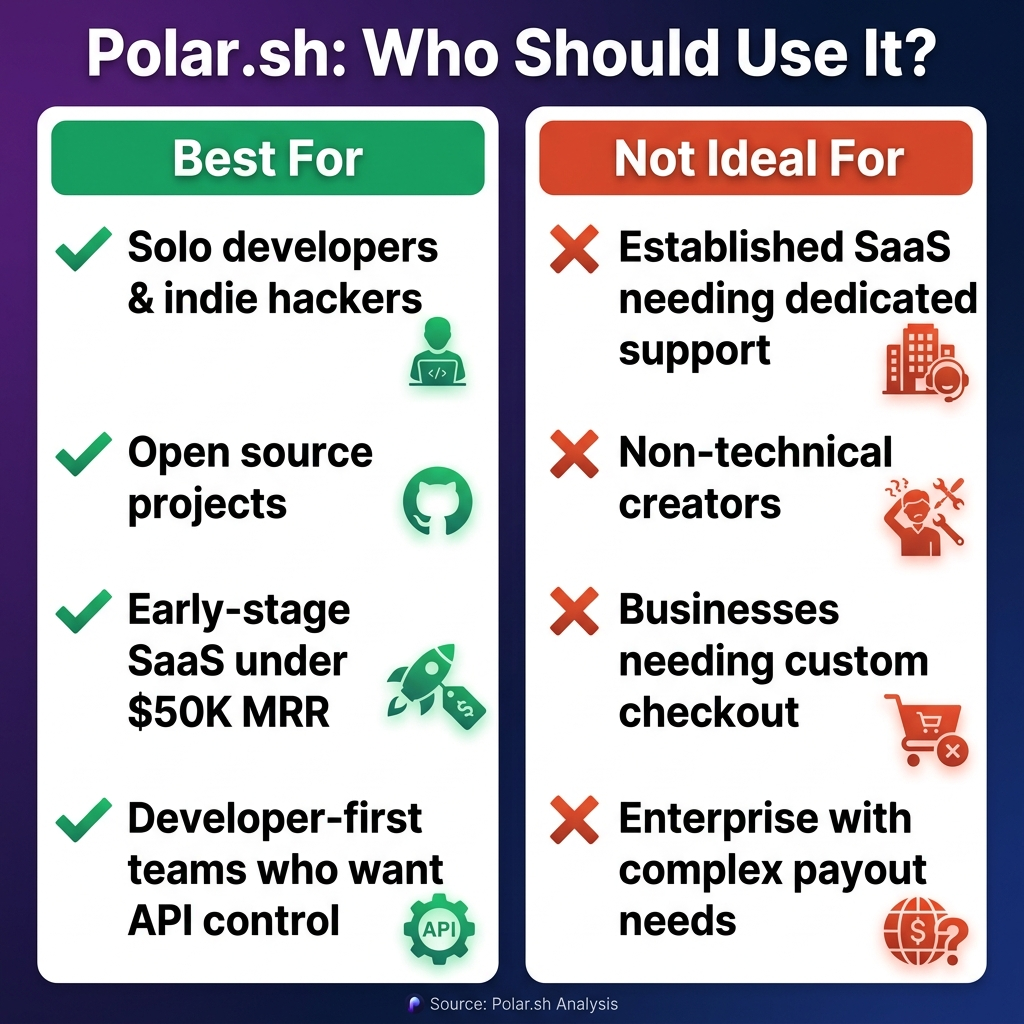
Polar is an excellent fit for:
- Solo developers and indie hackers who want a developer-first MoR with transparent pricing
- Open source projects — Polar’s GitHub Sponsors integration is genuinely unique and unmatched
- Early-stage SaaS under $50K MRR where the free plan or Pro plan makes economic sense
- Developers who want API control and don’t want a black-box checkout solution
- Projects already on Stripe — the integration is smoother because Polar runs on Stripe under the hood
Polar is probably not the right choice if:
- You need 24/7 dedicated support and SLAs (look at Paddle or FastSpring)
- You’re selling into markets outside Polar’s 60-country coverage
- You need complex enterprise billing workflows out of the box
- You’re a non-technical creator who wants a simple storefront (Payhip or Gumroad will serve you better)
Polar.sh vs Fungies.io: What’s the Difference?
Both are Merchant of Record platforms at the same baseline price (5% + $0.50). So why choose one over the other?
Polar is built around the developer workflow — GitHub integration, open-source infrastructure, API-first design. It’s ideal if your buyers are developers and you want deep customization.
Fungies.io is built for SaaS and digital product businesses that want a polished, conversion-optimized checkout without worrying about the infrastructure layer. Fungies focuses on the checkout experience, embedded storefronts, and making the payment flow feel native to your product rather than third-party.
The right pick depends on your priorities: developer control and open-source transparency (Polar) vs. polished commercial checkout experience and broader ecosystem (Fungies).
Key Takeaways
- Polar.sh is a legitimate MoR option in 2026 — it handles tax compliance in 60+ countries and the free tier is genuinely useful
- At Starter tier, the pricing is identical to Paddle and Lemon Squeezy (5% + $0.50). The economics only get better with paid plans at scale
- The GitHub Sponsors native integration is unique and valuable for open-source monetization
- Polar is API-first and open source — if developer control matters to you, no other MoR comes close
- For high-volume businesses, the Growth plan ($100/mo) breaks even at ~$16.7K MRR and saves real money above that
FAQ
Is Polar.sh a legitimate Merchant of Record?
Yes. Polar acts as the seller of record on all transactions, handling VAT, GST, and sales tax compliance in 60+ countries. They’ve been processing payments since 2023 and have thousands of active developers using the platform.
What’s the difference between Polar.sh and Paddle?
Both are Merchants of Record with identical free-tier pricing (5% + $0.50). Polar is open source, API-first, and runs on Stripe; Paddle is closed source, more mature, covers 200+ countries, and has stronger enterprise support. Polar offers subscription plans that reduce fees at scale; Paddle uses volume discounts via sales negotiation.
Does Polar.sh work for selling software licenses?
Yes. Polar supports one-time purchases, subscriptions, and can integrate with license key generation. It’s a solid choice for selling desktop software, plugins, and SaaS licenses with a developer-friendly API.
What are the best Polar.sh alternatives in 2026?
The closest alternatives are Paddle (more mature, broader coverage), Lemon Squeezy (creator-friendly, owned by Stripe), Dodo Payments (lower base fees), and Fungies.io (polished checkout experience, strong SaaS focus). The right choice depends on your volume, technical requirements, and target market.
Conclusion
Polar.sh has earned its place in the MoR market. It’s transparent where others are opaque, developer-friendly where others are generic, and open source when everything else is a black box. For indie developers and early-stage SaaS founders, it’s one of the best options available today.
That said, it’s not a one-size-fits-all. If you need enterprise support, global coverage beyond 60 countries, or a checkout that non-technical users can configure without touching code — there are better fits.
If you want to compare your options properly, try Fungies.io free — no transaction fees on your first $1,000 in sales, global MoR coverage, and a checkout your customers will actually trust.