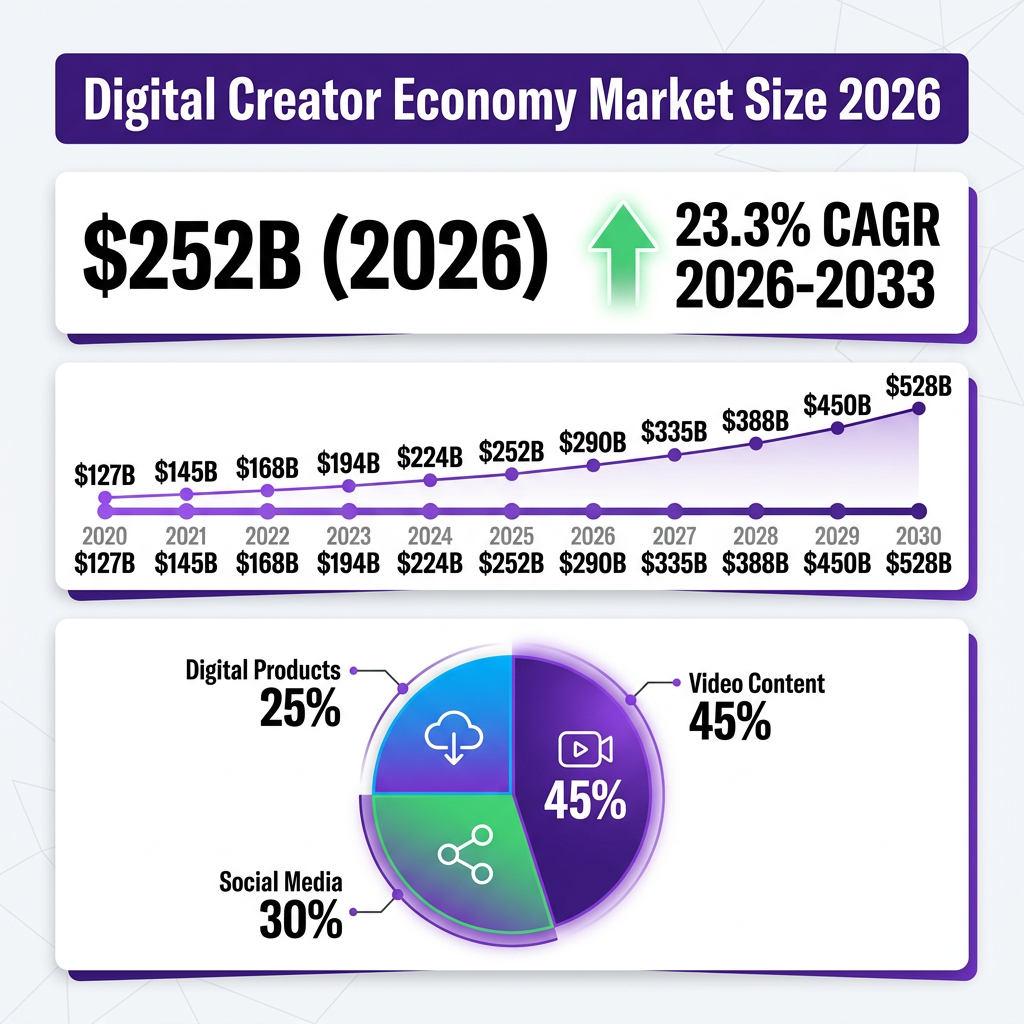
The digital creator economy has evolved from a niche side hustle into a global economic powerhouse. With over 207 million content creators worldwide and a market valuation exceeding $252 billion in 2026, this sector now represents one of the fastest-growing segments of the digital economy. What began as experimental social media content has transformed into a legitimate career path, complete with sophisticated monetization strategies, dedicated platforms, and institutional investment.
According to Grand View Research, the creator economy was valued at $205.25 billion in 2024 and is projected to reach an astounding $1.35 trillion by 2033, representing a compound annual growth rate (CAGR) of 23.3%. Goldman Sachs Research expects the ecosystem to approach half a trillion dollars by 2027, with the 50 million global creators growing at a 10-20% compound annual growth rate over the next five years. These aren’t just impressive numbers—they signal a fundamental shift in how content is produced, consumed, and monetized in the digital age.
The democratization of content creation has fundamentally disrupted traditional media industries. Where once gatekeepers controlled access to audiences through broadcast licenses, publishing deals, and distribution networks, today’s creators can reach millions directly through smartphones and internet connections. This shift has redistributed power from institutions to individuals, creating new opportunities while also introducing new challenges that the industry continues to navigate.

Market Overview: The $252 Billion Ecosystem
The creator economy’s explosive growth is driven by several converging factors: the democratization of content creation tools, the proliferation of social media platforms, changing consumer preferences toward authentic content, and the development of diverse monetization mechanisms. Unlike traditional media industries that required significant capital investment and gatekeeper approval, the creator economy enables individuals to build audiences and generate revenue with minimal upfront costs.
The market’s evolution can be traced through distinct phases. The early 2010s saw the emergence of the first YouTube millionaires, proving that individual creators could earn substantial incomes through advertising revenue. The mid-2010s brought platform diversification, with Instagram, Snapchat, and later TikTok offering new formats and monetization options. By the early 2020s, the ecosystem had matured to include not just advertising but brand partnerships, affiliate marketing, subscription models, digital products, and direct fan support.
Research and Markets provides an aggressive near-term projection, estimating the market will grow from $255.66 billion in 2025 to $323.48 billion in 2026 at a CAGR of 26.5%. This growth trajectory outpaces many traditional industries and reflects the increasing share of marketing budgets allocated to creator partnerships. The IAB reports that U.S. advertising spend in the creator economy reached $37 billion in 2025, growing 4x faster than the total media industry at 26% year-over-year.
Regional distribution shows North America leading with approximately 45.6% of market share in 2026, valued at $46.10 billion and expected to reach $378.66 billion by 2033 at a CAGR of 35.1%. The United States alone accounts for 162 million creators, of whom 45 million work professionally. This concentration reflects high internet penetration, the presence of major platforms, and established brand investment in influencer marketing.
The Asia-Pacific region represents the fastest-growing market, driven by massive user bases on platforms like TikTok, emerging middle-class consumers, and increasing smartphone penetration. Europe maintains steady growth with strong regulatory frameworks and mature advertising markets. Latin America and Africa, while smaller in absolute terms, show the highest growth rates as internet access expands and mobile-first content consumption becomes the norm.
The creator economy’s structure has also evolved significantly. Initially dominated by individual creators operating as solo practitioners, the industry now includes sophisticated media companies built around creator brands, talent management agencies representing thousands of creators, and technology platforms providing infrastructure for the entire ecosystem. This maturation has attracted institutional investment and professional management, further accelerating growth.
Key Statistics and Data
Understanding the creator economy requires diving deep into the numbers that define this industry. The statistics reveal not just the scale of the opportunity but also the challenges and inequalities that persist within the ecosystem.
Creator Population Statistics: Globally, over 207 million individuals identify as content creators. The United States leads with 162 million creators, representing a significant portion of the working population. Nearly half of all creators (46.7%) are engaged in full-time content creation, while the remainder balance creative work with other employment. The average creator takes approximately six and a half months to earn their first dollar, highlighting the challenge of building monetizable audiences.
Revenue and Earnings Data: Despite the large creator population, income distribution remains highly skewed. Only 4% of creators earn over $100,000 annually, while the majority struggle to generate sustainable income. Among full-time creators earning at least $60,000 annually, those with 3+ revenue streams earn $75,000 more on average than single-source creators. This data point underscores the importance of diversification in creator business models.
Platform-Specific Statistics: YouTube has paid out over $100 billion to creators since 2021 through its Partner Program. The platform continues to dominate long-form video monetization, with creators in the Partner Program worldwide reaching significant scale by 2025. TikTok’s Creator Fund and subsequent monetization programs have distributed millions to short-form creators, though per-view payouts remain lower than YouTube’s ad-sharing model.
Influencer Marketing Investment: The global influencer marketing industry reached $32.55 billion in 2025 and is projected to hit $40.51 billion in 2026. This represents a significant portion of total creator economy revenue and demonstrates brands’ increasing reliance on creator partnerships for marketing. According to the IAB, $13.2 billion of creator economy ad spend in 2026 will come from paid amplification of content from direct partnerships on social media—representing a 48% increase from $8.9 billion in the previous year.
Content Format Performance: Short-form video has emerged as the dominant content format, with TikTok, Instagram Reels, and YouTube Shorts driving engagement across demographics. Video content accounts for 45% of creator economy market segments, followed by social media at 30% and digital products at 25%. Live streaming continues to grow, particularly in gaming, entertainment, and educational categories.
Community and Membership Data: Circle’s data from their Trends Report shows that 44% of creator communities have between 1 and 100 members, indicating that much of the growth is happening at smaller scales. On Uscreen, a video monetization platform, the top 10% of creators generated $171 million over the past year alone. These figures demonstrate the long-tail nature of creator earnings, where a small percentage of creators capture the majority of revenue.
AI and Technology Adoption: A majority (77%) of marketers surveyed said they plan to divert budgets away from traditional creator marketing to AI-generated creator content in 2026. Meanwhile, 76% of marketers agree that the use of AI will increase total creator economy ad spend next year. This dual trend—AI as a tool for creators and AI as a potential replacement for some creator functions—will significantly shape the industry’s evolution.
Demographic Insights: The creator population skews young, with Millennials and Gen Z representing the majority of active creators. However, older demographics are increasingly entering the space, particularly in niches like financial education, professional development, and lifestyle content. Geographic distribution shows concentration in urban areas with strong internet infrastructure, though rural creator populations are growing as connectivity improves.
Engagement Metrics: Average engagement rates vary significantly by platform and follower count. Micro-influencers (10,000-100,000 followers) typically achieve higher engagement rates than mega-influencers, making them attractive to brands seeking authentic connections. TikTok leads in average engagement rates, followed by Instagram and then YouTube. These metrics drive pricing for brand partnerships and platform monetization.
Major Trends Shaping the Digital Creator Economy in 2026
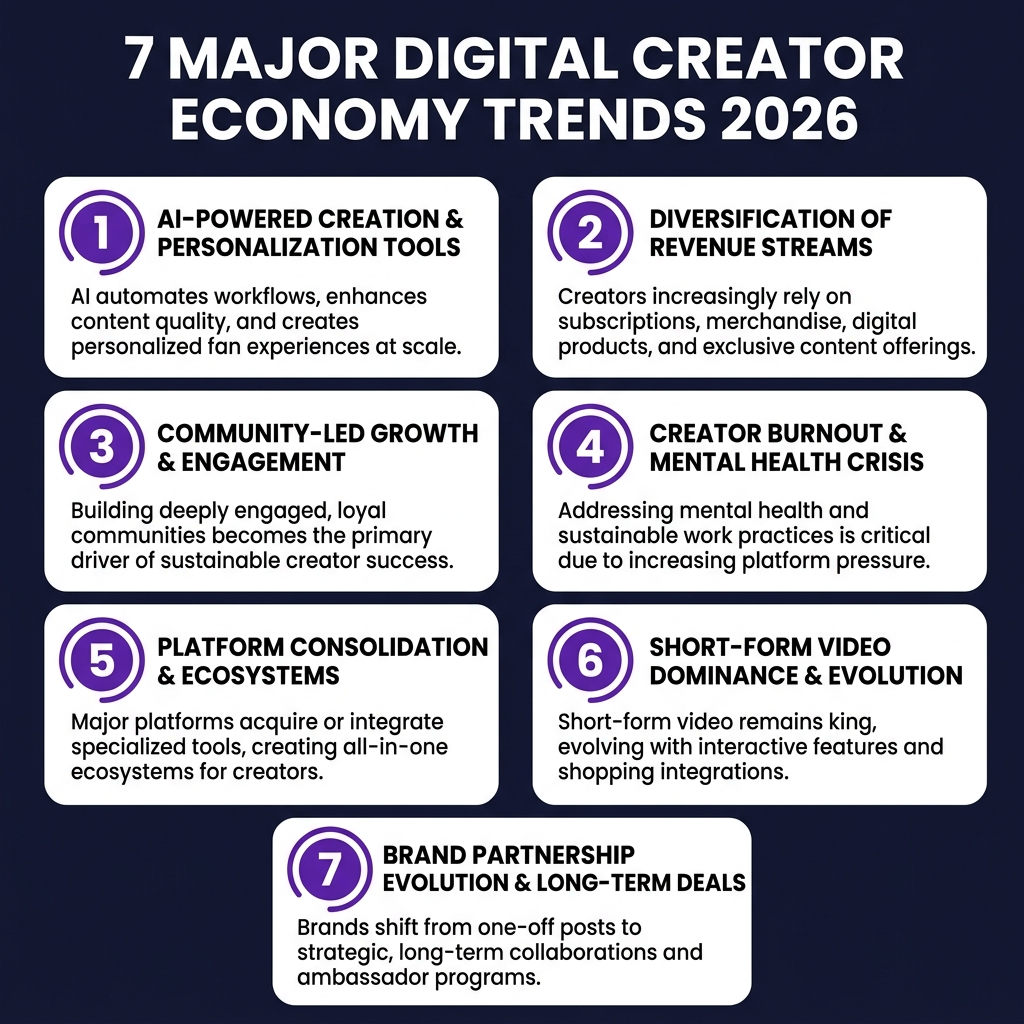
The creator economy is experiencing rapid transformation driven by technological innovation, changing consumer behaviors, and evolving platform dynamics. Seven major trends are defining the landscape in 2026:
1. AI-Powered Content Creation
Artificial intelligence has become an integral part of the creator workflow, from ideation to production to distribution. AI tools now assist with scriptwriting, video editing, thumbnail generation, and audience analytics. However, this trend carries tension: while AI enhances productivity, it also raises concerns about authenticity and potential displacement. The emergence of AI-generated virtual influencers—like Aitana, Spain’s first AI influencer created by The Clueless agency—demonstrates both the opportunity and disruption AI brings to the space.
Creators are adopting AI for tasks like automated transcription, content repurposing, and predictive analytics. Tools like ChatGPT assist with scripting and research, while video editing AI reduces production time from hours to minutes. This technological shift is democratizing high-quality content production, allowing smaller creators to compete with better-resourced competitors.
2. Revenue Diversification
Successful creators in 2026 are no longer relying on single revenue streams. The most resilient creator businesses combine brand partnerships, affiliate marketing, digital products, courses, memberships, merchandise, and platform monetization. Data shows that creators with three or more revenue streams significantly outperform those dependent on a single source. This diversification provides stability against algorithm changes, platform policy shifts, and market fluctuations.
The traditional model of relying on YouTube AdSense or brand sponsorships is being replaced by sophisticated business models that treat content as a funnel to higher-margin products and services. Courses, consulting, and digital products often generate more revenue than advertising, while requiring less ongoing time investment per dollar earned.
3. Community-Led Growth
Creators are increasingly prioritizing owned audiences over platform-dependent followers. Email lists, private communities, and membership platforms provide direct relationships with fans that aren’t subject to algorithmic reach limitations. Community-led business models are emerging as the most sustainable foundation for creator income, with platforms like Circle, Patreon, and Discord enabling deeper engagement and recurring revenue.
This shift reflects lessons learned from platform dependency risks. Creators who built massive followings on Vine, Google+, or early Facebook saw their audiences evaporate when platforms shut down or changed algorithms. Today’s successful creators treat social platforms as acquisition channels while building direct relationships through owned platforms.
4. Creator Burnout Crisis
The pressure of constant content creation has led to widespread burnout. Research from Billion Dollar Boy reveals that 52% of creators have experienced burnout as a direct result of their career, with 37% actively considering leaving the profession. The constant demand for new content, algorithmic changes, and intense audience interaction create unique pressures. This trend is driving demand for sustainable creation practices, mental health support, and business models that don’t require daily content production.
The creator economy’s always-on nature creates unique mental health challenges. Unlike traditional media with production schedules and off-seasons, social media algorithms reward consistent posting. Creators report feeling unable to take vacations or disconnect, fearing audience loss and revenue decline. Industry stakeholders are beginning to address this through mental health resources, but systemic solutions remain elusive.
5. Platform Consolidation
The era of fragmented creator tools is giving way to integrated platforms. Creators are seeking unified solutions for content management, audience analytics, monetization, and business operations. Major platforms including Meta, TikTok, YouTube, LinkedIn, and Snapchat have made coordinated pushes to facilitate creator-brand partnerships directly within their ecosystems, reducing the need for third-party intermediaries.
This consolidation extends to the business side, with talent agencies acquiring creator tools and platforms building agency services. The goal is end-to-end ecosystems that handle everything from content creation to brand matching to payment processing, capturing more value within single platforms.
6. Short-Form Video Dominance
Short-form video continues to capture the majority of user attention and creator investment. TikTok, Instagram Reels, and YouTube Shorts have trained audiences to expect immediate engagement, forcing creators to adapt their storytelling to compressed formats. This trend has implications for content depth, monetization potential, and creator sustainability, as short-form content typically generates lower per-view revenue than long-form alternatives.
The format’s popularity has driven innovation in storytelling techniques, with creators developing new methods to capture attention within seconds. However, concerns about attention span degradation and content superficiality accompany this trend, with some creators and audiences pushing back against the pressure to constantly consume bite-sized content.
7. Evolution of Brand Partnerships
Brand-creator relationships are maturing from transactional sponsorships to strategic partnerships. Long-term ambassadorships, co-creation of products, and equity arrangements are becoming standard for top-tier creators. Brands are investing in sophisticated creator selection processes, focusing on alignment with company values, audience demographics, and proven performance metrics rather than follower counts alone.
This evolution reflects the maturation of influencer marketing as a discipline. Early brand partnerships were often experimental, with limited measurement and unclear ROI. Today’s partnerships involve detailed contracts, comprehensive analytics, and integrated campaign strategies that treat creators as media channels rather than promotional tools.
Key Players and Competitive Landscape
The creator economy ecosystem comprises multiple categories of players, each contributing to the industry’s infrastructure and growth. Understanding this landscape is essential for creators seeking to navigate their careers and for businesses looking to engage with the creator economy.
Social Media Platforms
YouTube remains the dominant platform for long-form video monetization, with the most mature ad-sharing program and highest per-view payouts. The platform’s $100 billion+ payout to creators since 2021 demonstrates its commitment to revenue sharing. YouTube Shorts has emerged as a significant TikTok competitor, offering creators another avenue for short-form monetization. The platform’s strength in searchability and evergreen content makes it particularly valuable for educational and how-to creators.
TikTok has revolutionized content discovery with its algorithmic feed, enabling rapid audience growth for creators regardless of existing following. The platform’s Creator Fund and subsequent Creativity Program have distributed significant funds, though creators consistently report lower per-view earnings compared to YouTube. TikTok Shop and live streaming features are expanding monetization options, particularly in e-commerce categories.
Instagram continues to evolve from a photo-sharing app to a comprehensive creator platform. Reels competes directly with TikTok, while shopping features, subscriptions, and branded content tools provide multiple revenue streams. The platform’s strength in lifestyle, fashion, and beauty niches makes it essential for creators in these categories. Instagram’s close relationship with Facebook provides robust advertising infrastructure for brand partnerships.
Emerging Platforms: LinkedIn has become a significant player in B2B creator content, with professional thought leadership generating significant engagement. Snapchat maintains relevance with younger demographics through Spotlight. Twitch dominates live streaming for gaming and creative content, while newer platforms like BeReal and Lemon8 are attempting to capture market share with differentiated approaches. The platform landscape remains dynamic, with new entrants constantly challenging established players.
Creator Economy Infrastructure
Monetization Platforms: Patreon, Ko-fi, and Buy Me a Coffee enable direct fan support through subscriptions and one-time payments. These platforms have collectively processed billions in creator earnings. Uscreen, Teachable, and Kajabi provide infrastructure for video courses and membership sites, enabling creators to build Netflix-like experiences for their content. Stan Store and Beacons offer link-in-bio commerce solutions that aggregate multiple revenue streams, simplifying the fan purchase journey.
Creator Tools: Canva, Adobe Creative Suite, and CapCut provide accessible content creation tools that lower barriers to professional-quality production. TubeBuddy and VidIQ offer YouTube optimization, helping creators improve discoverability and performance. Later, Hootsuite, and Buffer manage social media scheduling, enabling consistent posting across platforms. These tools lower barriers to entry and improve content quality across the ecosystem.
Analytics and Management: CreatorIQ, AspireIQ, and Grin provide enterprise-level creator relationship management for brands, handling everything from discovery to campaign management to payment. ThoughtLeaders, Social Blade, and Creator Studio offer analytics for creators to track performance and optimize content strategies. These tools bring data-driven decision making to an industry that was previously reliant on intuition.
Investment and Venture Capital
Venture capital investment in creator economy startups reached significant levels in 2025, with over a dozen companies raising at least $50 million in new funding. Key investment areas include generative AI tools, creator monetization platforms, live shopping infrastructure, and analytics solutions. Notable VC firms active in the space include Andreessen Horowitz, Lightspeed Venture Partners, and Seven Seven Six.
According to Dealroom.co, global venture capital funding reached $456.0 billion in the first five months of 2026, with the creator economy capturing a meaningful share of this investment. The sector’s high growth rates, recurring revenue potential, and asset-light business models make it attractive to investors seeking exposure to digital transformation trends. However, some investors remain cautious about platform dependency risks and the winner-take-all dynamics that characterize many creator economy segments.

Challenges and Pain Points
Despite its impressive growth, the creator economy faces significant challenges that threaten its sustainability and accessibility. Understanding these pain points is crucial for creators, platforms, and investors seeking to build resilient businesses in this space.
1. Income Inequality and the “Creator Middle Class” Squeeze
The most significant challenge facing the creator economy is extreme income inequality. While headlines celebrate millionaire creators, the reality is that only 4% earn over $100,000 annually. The majority of creators struggle to generate sustainable income, with many earning less than minimum wage when accounting for hours invested. This creates a “winner-take-all” dynamic where a small percentage of creators capture the majority of revenue, while the long tail struggles to monetize effectively.
The “creator middle class”—those earning enough to support themselves but not achieving celebrity status—faces particular pressure. These creators often lack the bargaining power of top-tier influencers while bearing higher production costs than hobbyist creators. Platform algorithm changes can devastate their reach overnight, and brand partnerships remain inconsistent. This squeeze threatens the diversity of the creator ecosystem, as only those with independent financial means can sustain the early years of audience building.
2. Platform Dependency and Algorithm Risk
Creators building businesses on platforms they don’t control face significant risk. Algorithm changes, policy updates, and account bans can eliminate years of audience building in moments. The 2025 TikTok ban discussions in the United States highlighted this vulnerability, with creators facing the potential loss of their primary platform and income source. Many creators who built substantial followings on Vine experienced this trauma firsthand when the platform shut down in 2017.
This dependency extends to monetization policies. Platforms can reduce revenue shares, change eligibility requirements, or eliminate programs entirely. YouTube’s evolving Partner Program requirements, Instagram’s inconsistent monetization rollout, and TikTok’s changing Creator Fund terms all demonstrate this risk. Creators find themselves in constant adaptation mode, responding to platform changes that are completely outside their control.
3. Creator Burnout and Mental Health
The pressure of constant content creation has created a mental health crisis among creators. The Billion Dollar Boy study found that 52% of creators have experienced burnout, with 37% considering leaving the profession entirely. The unique pressures include: constant demand for new content, public scrutiny and criticism, algorithm anxiety, income instability, and the blurring of personal and professional boundaries.
Unlike traditional careers with defined work hours, creator work often extends into all aspects of life. The expectation of authenticity requires sharing personal experiences, while the need for consistency demands regular posting regardless of personal circumstances. This creates a sustainability challenge that the industry has only begun to address. Support systems remain underdeveloped, with limited access to mental health resources tailored to creator-specific challenges.
Opportunities and Growth Strategies
Despite these challenges, the creator economy offers substantial opportunities for those who approach it strategically. Three key growth strategies are emerging as particularly effective in 2026:
1. Building Owned Audiences and Diversified Revenue
The most successful creators in 2026 are treating their platforms as acquisition channels for owned audiences. Email lists, private communities, and membership platforms provide direct relationships that aren’t subject to algorithmic reach limitations. This strategy requires upfront investment in audience migration but pays dividends in long-term stability and higher lifetime value.
Revenue diversification is equally critical. Creators combining brand partnerships, affiliate marketing, digital products, courses, memberships, and platform monetization create resilient businesses that can weather changes in any single revenue stream. Data consistently shows that creators with multiple revenue sources earn significantly more than those dependent on single platforms. The goal is building a business that could survive the shutdown of any single platform.
2. Leveraging AI as a Productivity Multiplier
Rather than viewing AI as a threat, successful creators are adopting AI tools to enhance productivity and content quality. AI assists with research, scripting, editing, thumbnail creation, and analytics—freeing creators to focus on strategy and authentic connection with audiences. The key is using AI to augment rather than replace human creativity, maintaining the authenticity that audiences value.
Creators who master AI tools can produce higher-quality content more consistently, giving them competitive advantage in attention markets. However, this requires ongoing learning and adaptation as AI capabilities rapidly evolve. The creators who thrive will be those who view AI as a skill to develop rather than a threat to avoid.
3. Developing Creator-Entrepreneur Mindset
The most successful creators in 2026 are evolving from content producers to business owners. This means developing skills in business strategy, financial management, team building, and product development. Creators who view themselves as media companies rather than individual contributors build sustainable enterprises with enterprise value beyond their personal brands.
This evolution includes hiring teams for production, editing, and business operations; developing intellectual property beyond individual content pieces; and creating products and services that generate recurring revenue. The creator-entrepreneur model transforms the inherently limiting trading-time-for-money dynamic into scalable business ownership. It also creates exit opportunities, as demonstrated by several creator-led companies that have raised venture capital or been acquired.
Case Studies and Success Stories
Examining successful creator businesses reveals patterns and strategies that aspiring creators can adapt to their own contexts. Three case studies illustrate different paths to creator economy success:
Case Study 1: The Education Creator
A former software engineer built a YouTube channel teaching programming concepts, growing to 500,000 subscribers over three years. Rather than relying solely on AdSense revenue, the creator developed a comprehensive monetization strategy: a $200 programming course generating $2 million annually; a $20/month membership community with 5,000 members; affiliate partnerships with coding tools; and selective brand sponsorships. Total annual revenue exceeds $3.5 million with a team of five employees.
The key success factors were deep expertise in a valuable niche, consistent high-quality content production, and systematic audience migration to owned platforms. By treating YouTube as a funnel rather than a destination, the creator built a sustainable business with multiple revenue streams and significant enterprise value.
Case Study 2: The Lifestyle Influencer
A fashion and lifestyle creator built a multi-platform presence across Instagram, TikTok, and YouTube, amassing a combined following of 2 million. The creator’s business model emphasizes brand partnerships with long-term ambassadorships rather than one-off sponsorships, commanding $50,000+ per campaign. Additionally, the creator launched a product line generating $5 million in annual revenue with 40% margins. The business employs ten people including agents, managers, and production staff.
Success factors include authentic personal brand, strong audience engagement rates, and strategic expansion into product entrepreneurship. By leveraging audience trust into product sales, the creator built a business with significantly higher margins than pure content monetization could provide.
Case Study 3: The Niche Community Builder
A fitness creator focused on a specific training methodology built a dedicated community of 50,000 highly engaged followers rather than pursuing mass appeal. The creator’s business centers on a $50/month membership program with 3,000 subscribers generating $1.8 million in recurring annual revenue. Supplementary income comes from digital workout programs, coaching certifications, and a small number of aligned brand partnerships. With only two employees, the business maintains 70% profit margins.
Success factors include deep niche expertise, community-focused approach, and premium pricing for dedicated audiences. This model demonstrates that massive followings aren’t necessary for creator success—deep engagement in valuable niches can generate substantial returns with lower overhead and less competition.
Future Outlook and Predictions
The creator economy’s trajectory points toward continued growth and maturation, with several key developments expected through 2030:
Market Size Projections
According to Future Market Insights, the creator economy market is projected to grow from $253.1 billion in 2025 to approximately $2,055.3 billion by 2035, recording an absolute increase of $1,802.2 billion over the forecast period. Between 2025 and 2030, the market is projected to expand from $253.1 billion to $748.9 billion. Goldman Sachs Research expects the ecosystem to approach half a trillion dollars by 2027, with creator numbers growing at 10-20% annually.
These projections assume continued platform investment in creator monetization, increasing brand allocation to influencer marketing, and the emergence of new revenue models including social commerce and virtual goods. The forecast also accounts for AI integration enhancing creator productivity and potentially expanding the addressable market by lowering production barriers.
Platform Evolution
Major platforms will continue consolidating creator tools and services. YouTube, TikTok, and Meta are expected to expand their native monetization options, potentially reducing the need for third-party tools. Live shopping, which has achieved massive scale in Asian markets, will likely gain traction in Western markets as platforms invest in commerce infrastructure. Virtual and augmented reality content will create new formats and monetization opportunities as hardware adoption increases.
Platform competition for creator talent will intensify, potentially leading to better revenue shares and more favorable terms. However, this competition may also drive further consolidation as smaller platforms struggle to compete with the resources of major players.
Industry Maturation
The creator economy will increasingly resemble traditional media industries with professionalized operations, standardized contracts, and institutional investment. Creator economy businesses will produce recurring revenue streams diversified across brand partnerships, talent management fees, content production, affiliate revenue, and IP licensing—with lower capital intensity than traditional media and better audience engagement metrics.
Regulatory attention will likely increase as the industry grows, potentially bringing standardization to areas like disclosure requirements, contract terms, and platform practices. This maturation will benefit professional creators while potentially raising barriers to entry for hobbyists.
AI Integration
AI will become deeply integrated into creator workflows, from content ideation to production to distribution. Virtual influencers and AI-generated content will capture meaningful market share, particularly for brand-safe, mass-market content. However, authentic human creators will maintain advantage in niches requiring genuine expertise, personal connection, and trust. The successful creators of 2030 will likely be those who most effectively leverage AI as a productivity tool while maintaining human elements that audiences value.
Key Takeaways
- The digital creator economy has grown to a $252 billion market in 2026, with projections reaching $1.35 trillion by 2033 at a 23.3% CAGR
- Over 207 million creators worldwide are participating in the economy, though only 4% earn over $100,000 annually, highlighting significant income inequality
- Seven major trends are shaping 2026: AI-powered creation, revenue diversification, community-led growth, creator burnout, platform consolidation, short-form video dominance, and evolved brand partnerships
- Creators with three or more revenue streams earn $75,000 more annually than those dependent on single sources, emphasizing the importance of diversification
- Platform dependency remains the primary risk factor, driving successful creators to build owned audiences through email lists, memberships, and communities
Sources and Citations
- Grand View Research – Creator Economy Market Size and Growth Projections 2024-2033
- Goldman Sachs Research – The Creator Economy Could Approach Half a Trillion Dollars by 2027
- Research and Markets – Creator Economy Global Market Insights 2025-2030
- IAB (Interactive Advertising Bureau) – Creator Economy Advertising Spend Report 2026
- Billion Dollar Boy – Creator Burnout Research Study 2026
- Coherent Market Insights – North America Creator Economy Market Analysis
- Future Market Insights – Creator Economy Market Global Industry Analysis 2035
- Exploding Topics – Creator Economy Market Size Projections 2025-2030
- Circle.so – Creator Economy Trends Report 2026
- Clouted.com – Creator Economy Statistics 2026
- Stan Store – 8 Trends That Will Define the Creator Economy in 2026
- Forbes – The Creator Economy in 2026: The Era of Consolidation
- Dealroom.co – Global Venture Capital Funding Data 2026
Monetization Models and Revenue Streams
The creator economy offers diverse monetization opportunities that have evolved significantly over the past decade. Understanding these revenue streams is essential for creators seeking to build sustainable businesses and for brands looking to engage with creator audiences effectively.
Advertising Revenue
Platform advertising remains the foundational monetization method for many creators. YouTube’s Partner Program leads this category, sharing 55% of ad revenue with creators. The platform’s $100 billion+ payout since 2021 demonstrates the scale of this opportunity. However, ad revenue is highly variable based on niche, audience demographics, and content length. Finance and business content typically commands higher CPMs (cost per thousand views) than entertainment or gaming content.
Other platforms have introduced their own advertising programs. TikTok’s Creativity Program offers payouts based on video performance, though rates are generally lower than YouTube. Instagram and Facebook provide ad revenue sharing for Reels and in-stream video. Snapchat’s Spotlight program distributed over $250 million to creators in its first year. These programs provide accessible entry points for new creators but rarely generate substantial income without massive view counts.
Brand Partnerships and Sponsorships
Brand partnerships represent the largest revenue opportunity for many creators. The global influencer marketing industry reached $32.55 billion in 2025, with individual creators commanding rates from hundreds to hundreds of thousands of dollars per campaign. Pricing depends on follower count, engagement rates, content quality, niche expertise, and audience demographics.
The nature of brand partnerships has evolved significantly. Early influencer marketing focused on product placement and shoutouts. Today’s partnerships involve comprehensive campaign integration, long-term ambassadorships, co-creation of products, and even equity arrangements. Brands increasingly value authentic alignment over reach, with micro-influencers (10,000-100,000 followers) often delivering better ROI than celebrity creators.
Affiliate Marketing
Affiliate marketing enables creators to earn commissions on products they recommend. Amazon Associates remains the largest program, though specialized networks like RewardStyle, LTK, and ShareASale offer higher commissions in specific niches. Tech reviewers, fashion creators, and home improvement influencers particularly benefit from affiliate revenue.
The key to successful affiliate marketing is authentic product recommendations that genuinely serve the audience. Creators who prioritize commissions over value quickly lose trust and engagement. The most successful affiliate marketers treat product recommendations as editorial content, providing honest reviews and only promoting products they would use themselves.
Digital Products and Courses
Digital products represent one of the highest-margin revenue streams available to creators. Online courses, ebooks, templates, presets, and software tools can generate substantial income with minimal ongoing costs. Platforms like Teachable, Kajabi, and Gumroad have made it easy for creators to sell digital products directly to their audiences.
Courses are particularly lucrative for educational creators. A $200 course selling to just 1,000 customers generates $200,000 in revenue—equivalent to millions of YouTube views. The key is identifying valuable knowledge that audiences are willing to pay for and packaging it in a comprehensive, actionable format. Successful course creators often invest heavily in production quality, community support, and ongoing updates.
Memberships and Subscriptions
Recurring revenue through memberships provides stability that other monetization methods lack. Patreon leads this category, enabling creators to offer exclusive content, community access, and direct interaction in exchange for monthly subscriptions. Top creators earn six or seven figures monthly through Patreon alone.
YouTube Memberships, Twitch Subscriptions, and platform-native subscription features provide additional recurring revenue streams. The key to successful memberships is offering genuine value that justifies ongoing payment—exclusive content, early access, direct interaction, or community belonging. Creators who treat memberships as passive income rather than active community building often struggle with retention.
Direct Fan Support
Platforms like Ko-fi, Buy Me a Coffee, and Venmo enable direct financial support from fans without the commitment of subscriptions. These tools work particularly well for creators with strong audience relationships who want to offer a low-friction way for fans to show appreciation. While individual transactions are small, they can accumulate to meaningful income for creators with engaged communities.
Live streaming has created new direct support mechanisms through virtual gifts and donations. Twitch’s Bits, TikTok’s Gifts, and YouTube’s Super Chat allow viewers to financially support creators during live broadcasts. These features gamify support and create real-time interaction between creators and their most dedicated fans.
Regional Analysis: Creator Economy by Geography
The creator economy’s growth varies significantly by region, reflecting differences in internet infrastructure, platform availability, cultural attitudes toward content creation, and economic development. Understanding these regional dynamics is essential for global brands and creators seeking international expansion.
North America
North America dominates the creator economy with 45.6% of global market share, valued at $46.10 billion in 2026. The United States alone accounts for 162 million creators, with 45 million working professionally. This concentration reflects high internet penetration, mature advertising markets, and the headquarters location of major platforms like YouTube, Meta, and TikTok.
The North American creator economy is characterized by professionalization and institutional investment. Los Angeles has emerged as the epicenter of creator economy infrastructure, with talent agencies, production companies, and platform offices concentrated in the region. New York, Miami, and Austin also host significant creator economy activity. The region leads in creator monetization innovation, with new business models typically launching in North America before expanding globally.
Asia-Pacific
The Asia-Pacific region represents the fastest-growing creator economy market, driven by massive user bases, increasing smartphone penetration, and cultural enthusiasm for social media. China leads in social commerce integration, with creators on platforms like Douyin (TikTok’s Chinese counterpart) generating billions in product sales through live streaming.
South Korea and Japan have developed sophisticated creator ecosystems around gaming, beauty, and entertainment. Southeast Asian markets including Indonesia, Thailand, and Vietnam are experiencing rapid growth as internet access expands. India’s creator economy has exploded with the proliferation of affordable mobile data, though monetization remains challenging due to lower advertising rates.
Europe
Europe’s creator economy benefits from strong regulatory frameworks including GDPR, which has shaped how platforms handle creator and user data. The region has produced significant creator platforms and tools, though it lags behind North America in platform headquarters concentration. The UK leads European creator economy activity, followed by Germany, France, and the Netherlands.
European creators often face challenges with language fragmentation across markets, requiring localization for maximum reach. However, this also creates opportunities for creators who can bridge cultural and linguistic divides. The region’s strong privacy regulations have influenced global platform policies, affecting creators worldwide.
Latin America and Africa
These regions represent emerging creator economy markets with significant growth potential. Brazil leads Latin America with a vibrant creator ecosystem spanning entertainment, gaming, and lifestyle content. Mexico, Argentina, and Colombia also host substantial creator populations. Monetization challenges persist due to lower advertising rates and limited local brand investment, though global platforms are increasingly investing in these markets.
Africa’s creator economy is nascent but growing rapidly, particularly in Nigeria, South Africa, Kenya, and Egypt. Mobile-first content consumption and the proliferation of affordable smartphones are driving growth. Local platforms are emerging alongside global ones, creating unique opportunities for creators who understand regional cultures and languages.