You’ve built something people want to pay for. You’re in Poland, India, Nigeria, or Brazil — and your customers are in the US, Germany, and Australia. Sounds like a win. Then you open your browser and search “how to accept payments as a non-US founder” and fall down a rabbit hole of LLCs, EINs, VAT registrations, and tax nexus thresholds that makes you want to close the laptop forever.
Here’s the reality: over 63% of new SaaS founders are solo builders, and a huge percentage of them are outside the US. Yet nearly every payment guide starts with “first, set up your Stripe account” — assuming you have a US bank account, a US Social Security Number, and a US address. If you don’t, you hit a wall fast.
This guide cuts through that. Three clear paths to selling globally, real tax thresholds for every major market, and exactly which platforms handle compliance so you don’t have to. No fluff, no “consult a lawyer” cop-outs.
Why Non-US Founders Face a Different Problem
US-based founders have it relatively easy: Stripe, Braintree, or Checkout.com, a business checking account, and they’re off. Sales tax? Taxjar or Avalara handles it automatically.
Non-US founders face a stacked set of challenges:
- Payment processors require local entities — Stripe is available in 46+ countries, but full features (including Stripe Billing) often need a local bank account in a Stripe-supported country
- Tax liability is on you — if you’re selling B2C SaaS to EU customers, you’re responsible for collecting and remitting VAT from day one, regardless of revenue
- US economic nexus rules — if you crack $100K in US sales, you potentially trigger sales tax obligations in 40+ states, even without a US entity
- Payout friction — getting USD from Stripe to your local bank in Indonesia or Ukraine can involve 3+ FX conversions and 2-5% loss
The good news: there are clean solutions. Let’s go through all three paths.
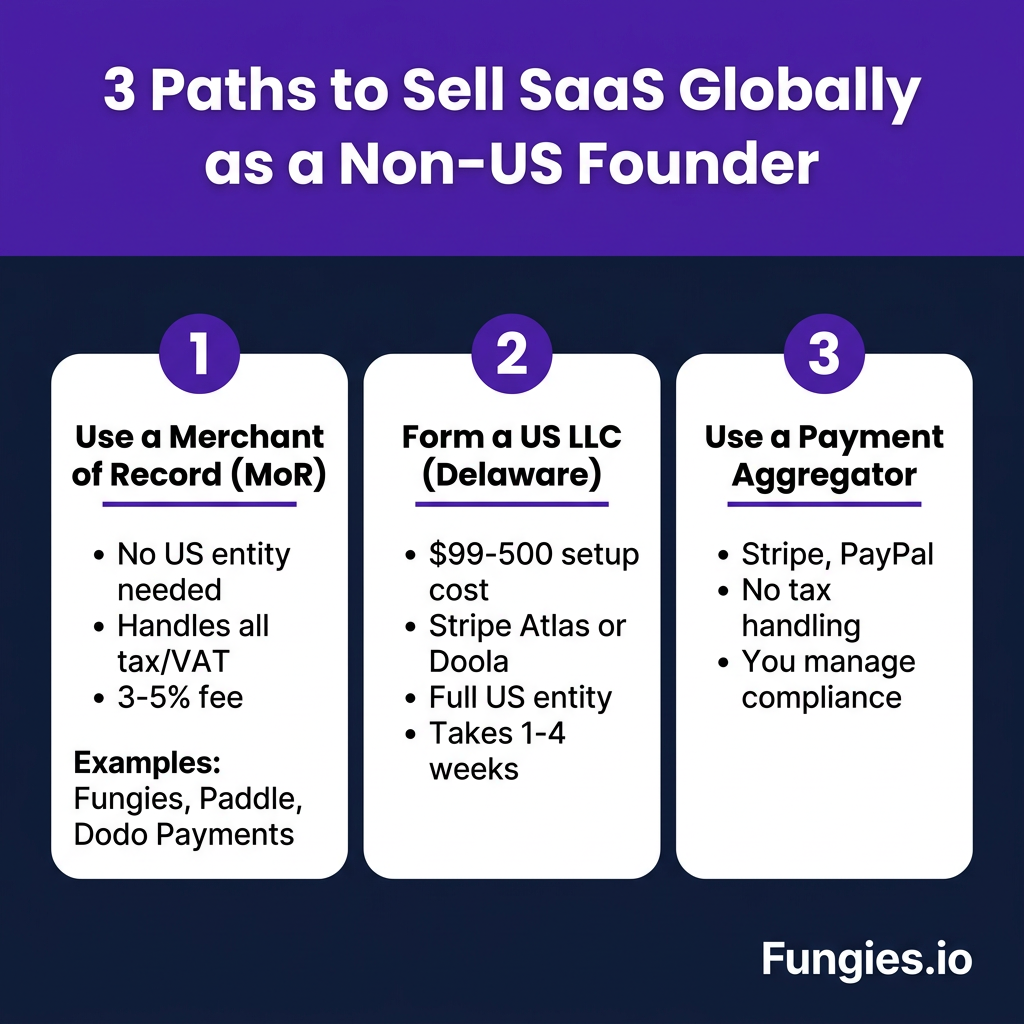
Path 1: Use a Merchant of Record (The Simplest Route)
A Merchant of Record (MoR) is a platform that becomes the legal seller for your product. You integrate their checkout, they collect payment from customers, handle all tax registration and remittance globally, manage refunds and chargebacks, and pay you out net of their fee.
For non-US founders, this is the fastest path to selling globally because:
- No US entity required — you can sign up from Poland, India, Brazil, or anywhere with a Fungies, Paddle, or Dodo Payments account
- Tax compliance is handled — EU VAT, US state sales tax, Australian GST, Canadian HST — all calculated and remitted by the MoR, not you
- No sales tax nexus risk — since the MoR is the seller of record, they have nexus, not you
- Global payouts — most MoR platforms pay out to international bank accounts in USD, EUR, or local currency via Wise/SWIFT
The cost: typically 5-6% per transaction. On a $49/month SaaS with 200 customers, that’s about $490/month in fees. Compare that to the cost of a US accountant ($150-300/hour), sales tax filing software ($1,200-3,600/year), and an attorney to review your EU VAT setup — the MoR is usually cheaper at scale under $50K MRR.
Top MoR Platforms for Non-US Founders
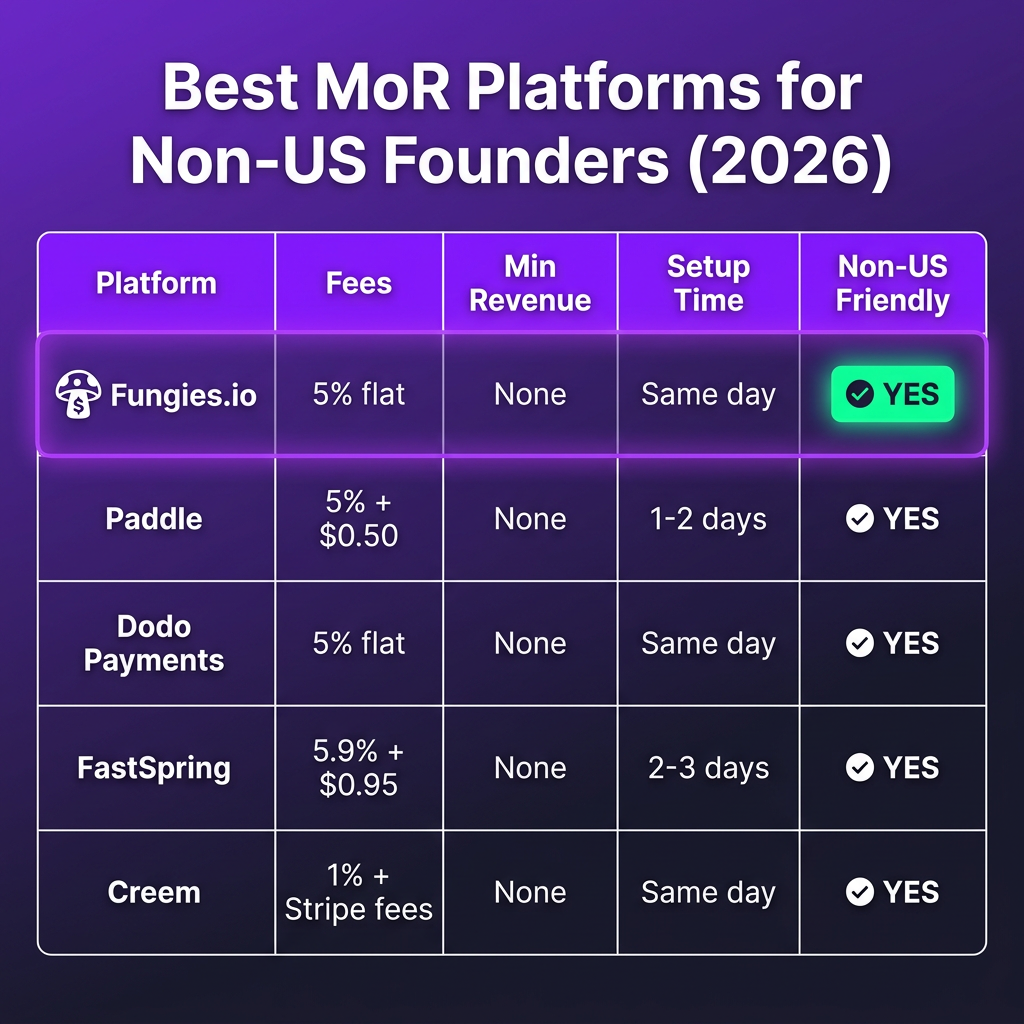
| Platform | Fees | Min Revenue | Non-US Signup | Best For |
|---|---|---|---|---|
| Fungies.io | 5% flat | None | ✅ Yes | Indie SaaS & digital products, affordable flat fee |
| Paddle | 5% + $0.50 | None | ✅ Yes | Mid-market SaaS, strong API |
| Dodo Payments | 5% flat | None | ✅ Yes | Indie builders, India-friendly |
| FastSpring | 5.9% + $0.95 | None | ✅ Yes | Enterprise software |
| Creem | ~1% + Stripe fees | None | ✅ Yes | Low-volume indie hackers |
| Lemon Squeezy | ~5% | None | ✅ Yes (Stripe-owned) | Simple digital products |
Bottom line: For most non-US founders doing under $20K MRR, start with a Merchant of Record. You can always migrate to a more complex stack later when the revenue justifies it.
Path 2: Form a US Entity (The Power Move)
Once you’re doing serious volume — or you want to work with US enterprise clients who require a US vendor — forming a US LLC or C-Corp makes sense. This unlocks full access to Stripe, US banking (Mercury, Relay), and the full US enterprise sales motion.
The most common route is a Delaware LLC or C-Corp via Stripe Atlas. Here’s what it actually looks like in 2026:
| Service | Cost | Entity Type | Banking | Best For |
|---|---|---|---|---|
| Stripe Atlas | $500 one-time | Delaware C-Corp or LLC | Mercury ($0) | VC-backed startups, Stripe-first |
| Doola | $297–$1,997/year | Delaware LLC or C-Corp | Mercury or Relay | Solo founders, all-in-one |
| Firstbase | $399 one-time | Delaware LLC or C-Corp | Relay or Brex | Non-US founders, registered agent |
| Clerky | $799 one-time | Delaware C-Corp only | — | Y Combinator-style startups |
| StartGlobal | $399 one-time | Wyoming or Delaware LLC | — | Budget-conscious founders |
Important: forming a US LLC as a non-US resident does not mean you owe US income tax. A single-member LLC owned by a non-US person is typically a “disregarded entity” for US tax purposes. You still owe tax in your home country. But once you have the LLC, you can trigger US sales tax nexus — which means you’ll need Stripe Tax or Avalara to handle US state-level compliance.
Path 3: Payment Aggregators With Manual Tax Handling
If you’re in a Stripe-supported country, you can use Stripe directly without a US entity. Stripe supports 46+ countries including Poland, India, Brazil, Mexico, Singapore, and most of Europe. You sign up with a local bank account, receive payouts in local currency, and you’re running.
The catch: Stripe is a payment processor, not a Merchant of Record. It doesn’t handle your tax compliance. You’re responsible for:
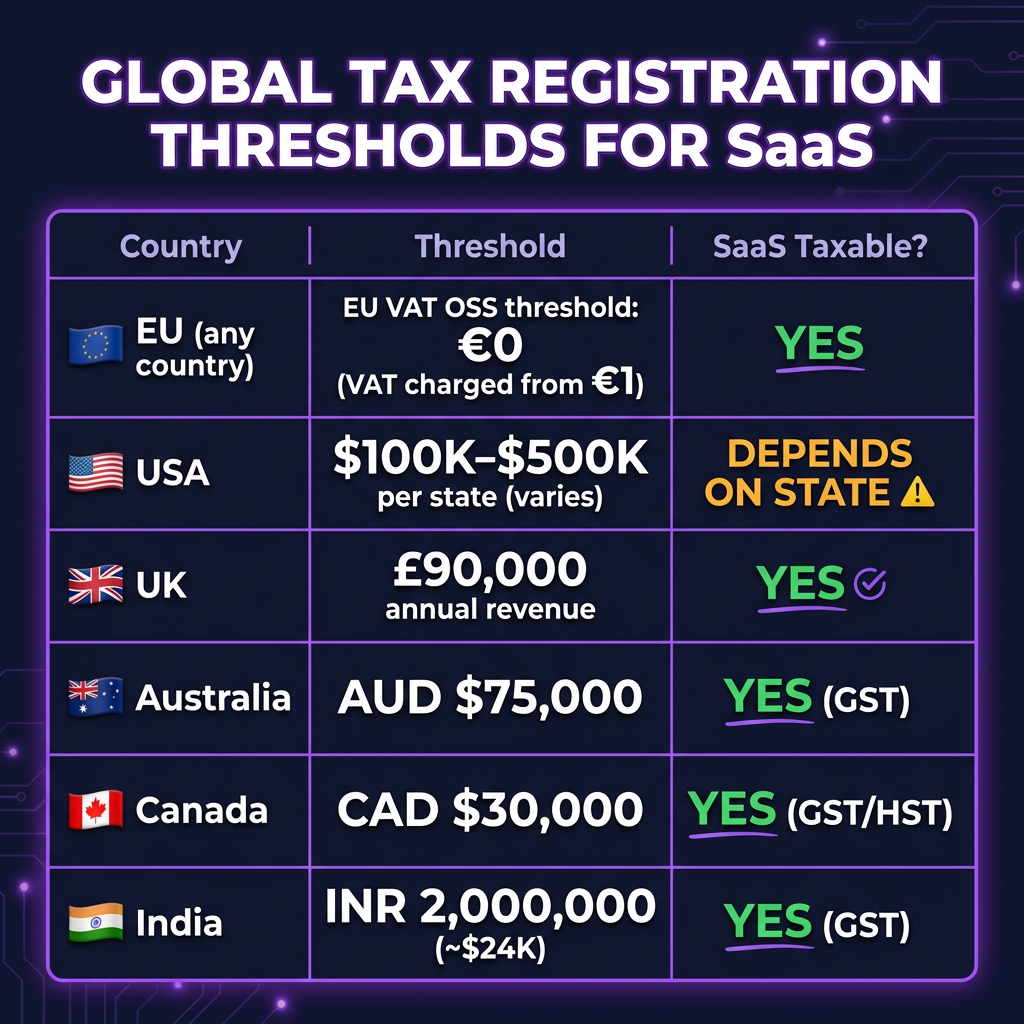
- Determining if you need to collect EU VAT (spoiler: if you sell B2C to EU customers, you do — from €1)
- Registering for the EU VAT OSS (One Stop Shop) scheme in one EU country
- Filing quarterly VAT returns
- Tracking US sales tax nexus thresholds by state
Stripe Tax (available in Stripe-supported countries) helps automate calculation, but it doesn’t file returns for you. You’ll still need a tax service or accountant. For founders at early stage (<$5K MRR), this can work if you’re selling primarily B2B (where reverse-charge typically applies). For B2C globally, the compliance overhead is significant.
Understanding Your Global Tax Exposure
Here’s the brutal truth most founders only learn after their first $100K in revenue: you have tax obligations in countries you’ve never visited, based purely on having customers there.
European Union (EU VAT)
The EU has had a “digital services” VAT rule since 2015. If you sell SaaS to EU consumers (B2C), you must collect VAT at the customer’s local rate — even if you’re based in Nigeria or Australia. There’s no minimum threshold.
The EU VAT OSS (One Stop Shop) scheme, launched in 2021, simplifies this: register once in any EU member state, collect the right VAT rate from each customer’s country, and file one quarterly return. Cost to register: free. Cost of non-compliance: significant fines plus back-tax liability.
B2B sales to EU companies are typically handled via reverse charge — your EU customer handles their own VAT, and you don’t collect it. Get their VAT number and put it on the invoice.
United States (Sales Tax Nexus)
Since the 2018 Supreme Court ruling in South Dakota v. Wayfair, US states can require any seller — including foreign companies — to collect sales tax once you hit their economic nexus threshold. Most states use $100,000 in annual sales as the trigger. California and New York use $500,000.
Here’s the key wrinkle: SaaS is not taxable in every state. Even if you have nexus in California, California doesn’t currently tax SaaS. New York has nexus AND taxes SaaS. Texas has nexus AND taxes SaaS. This creates a two-step compliance problem: track nexus first, then verify taxability per state before registering.
United Kingdom
Post-Brexit, the UK has its own VAT system. If you sell digital services to UK consumers, you need to register for UK VAT once you exceed £90,000 in annual UK revenue. Below that threshold, you don’t need to collect UK VAT.
Australia, New Zealand, Singapore
Australia’s GST applies to digital services once you hit AUD $75,000 in Australian revenue. New Zealand: NZD $60,000. Singapore: SGD $1,000,000 (effectively a non-issue for most indie SaaS). All require local GST registration — though these processes are now largely online and take 1-2 weeks.
The Payout Problem: Getting Your Money Home
Even if you’ve solved payments and taxes, there’s a third layer: getting paid efficiently. Here’s how non-US founders typically handle it:
| Method | Cost | Speed | Best For |
|---|---|---|---|
| Wise Business | 0.35–1.5% FX | 1-2 days | Most non-US founders — multi-currency accounts, holds USD/EUR/GBP |
| Payoneer | 2–3% FX | 1-3 days | Marketplaces, freelancers — slower but widely accepted |
| Mercury (US LLC required) | 0% FX on USD | Same day (ACH) | Once you have a US entity — cheapest for USD payouts |
| SWIFT wire (local bank) | $10–35 fee + FX spread | 2-5 days | Large one-off transfers |
| Stripe Payouts | Varies by country | 2-7 days | Stripe-supported countries only |
Most indie founders doing under $20K MRR end up with a Wise Business account. Open it before you launch — Wise accounts in Poland, India, and most EU countries are approved in 24-48 hours. You can receive USD, EUR, GBP payouts directly and convert at near-interbank rates.
The Compliance Checklist: Before You Take Your First Payment
Here’s what you actually need to have sorted before going live:
- Decide your selling structure — MoR, US entity, or direct payment processor. This decision drives everything else.
- Set up your tax collection layer — if using MoR, done. If using Stripe directly, enable Stripe Tax or integrate Anrok/Avalara.
- Check EU VAT OSS registration — if selling B2C globally, register via your local country’s OSS portal (or the MoR handles this).
- Add your Terms of Service and Privacy Policy — required for GDPR compliance in the EU and most state laws. Use Termly or Iubenda for a fast solution.
- Set up your payout account — Wise Business, Mercury (if US entity), or local bank via SWIFT.
- Track US state nexus monthly — if you’re growing fast in the US, build a simple spreadsheet tracking sales by state. At 80% of the $100K threshold, start the registration process.
When Does a Merchant of Record Stop Making Sense?
MoR platforms are the right answer for most founders until you hit about $100-200K MRR. After that, the 5% fee compounds into real money — a $200K MRR SaaS pays $120,000/year in MoR fees. At that point, you can hire a tax specialist, build your own Stripe + Avalara stack, and pay 2-3% total (Stripe fees + tax software) instead of 5%.
The migration is non-trivial. Paddle and Fungies both provide data exports. You’ll need to re-register for VAT OSS, set up Stripe Tax, and notify customers that the billing entity is changing. Plan for a 1-2 month project. Most founders don’t hit this decision point until they’ve already been running for 2-3 years.
Key Takeaways
- 🚀 Non-US founders can start selling globally today — a Merchant of Record removes all tax, entity, and compliance barriers
- 💰 Fungies, Paddle, and Dodo Payments work without a US entity — sign up with a local bank account or Wise
- 🌍 EU VAT applies from your first euro — MoR handles this automatically; if DIY, you need OSS registration
- 🇺🇸 US sales tax nexus hits at $100K per state — most states, but check SaaS taxability separately (not all states tax SaaS)
- 🔄 Switch to Stripe + Avalara around $100-200K MRR — before that, MoR fees are cheaper than the compliance overhead
Frequently Asked Questions
Do I need a US LLC to sell SaaS to US customers?
No. Using a Merchant of Record like Fungies, Paddle, or Dodo Payments, you can sell to US customers without a US entity. The MoR is the legal seller, handles all US sales tax, and pays you out internationally. If you want to use Stripe directly, you need a bank account in a Stripe-supported country (which may or may not be in the US).
Will I owe US income tax if I sell to US customers but I’m based abroad?
Generally no, if you don’t have a physical presence or employees in the US. Sales tax (which is what most guides discuss) is separate from income tax. For income tax, consult a tax advisor familiar with US-source income rules for your specific country — most countries have tax treaties with the US that prevent double taxation.
What’s the cheapest way to accept payments globally as a non-US indie founder?
Start with Fungies.io or Creem — both offer flat-fee MoR services without minimum revenue requirements. Pair with a Wise Business account for payouts. Total friction: 1 day to set up, no accountant required, full global tax compliance from day one.
When should I register for EU VAT manually instead of using an MoR?
Only if you’re processing high volume ($500K+ ARR from EU) and want to optimize the 5% MoR fee. Below that level, the cost of EU VAT registration, quarterly filings, and an accountant in an EU member state will almost certainly exceed what you’d save by leaving the MoR. Most founders stay on an MoR for 3-5 years before the math changes.
Conclusion
Being a non-US founder doesn’t mean building a smaller business. It means being more deliberate about your payment stack upfront. The founders who figure this out early — pick a clean MoR, set up a Wise account, ignore the rest until $100K MRR — spend their first two years building product instead of filing tax returns in 40 US states.
If you want to launch your global SaaS without the compliance headache, start with Fungies.io today. Sign up in under 10 minutes, no US entity required, and your first customer can check out from anywhere in the world — with the right tax collected and remitted automatically.
References
- Dodo Payments: Sales Tax Nexus for SaaS — When to Register
- Anrok: SaaS Sales Tax by State 2026
- Galvix: What International SaaS Companies Need to Know About US Sales Tax
- Miles Consulting: Sales Tax for Foreign SaaS Companies Scaling in the US
- Paddle: SaaS Sales Tax Guide (US and International)
- Freemius: How SaaS Founders Can Accept Payments Globally
- F3 Fund It: Taxes for SaaS Founders (US, EU, International)