The digital marketing landscape has undergone a seismic transformation. What started as banner ads and email blasts has evolved into a $786.2 billion global industry powered by artificial intelligence, privacy-first strategies, and short-form video dominance. In 2026, Meta has officially surpassed Google as the world’s largest digital advertising platform—a shift that signals fundamental changes in how brands connect with consumers.
This isn’t just about bigger budgets or flashier campaigns. The digital marketing market is projected to reach $1.69 trillion by 2033, growing at a compound annual growth rate (CAGR) of 14.3%. But the real story isn’t the numbers—it’s how AI adoption, cookie deprecation, and platform dynamics are forcing marketers to completely rethink their strategies.

Market Overview: The $786.2 Billion Digital Advertising Ecosystem
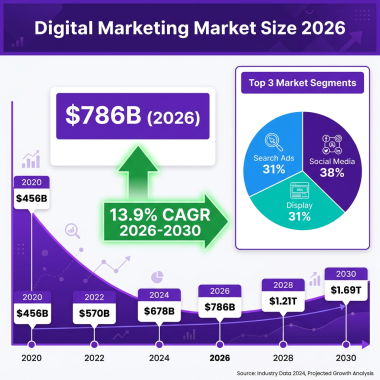
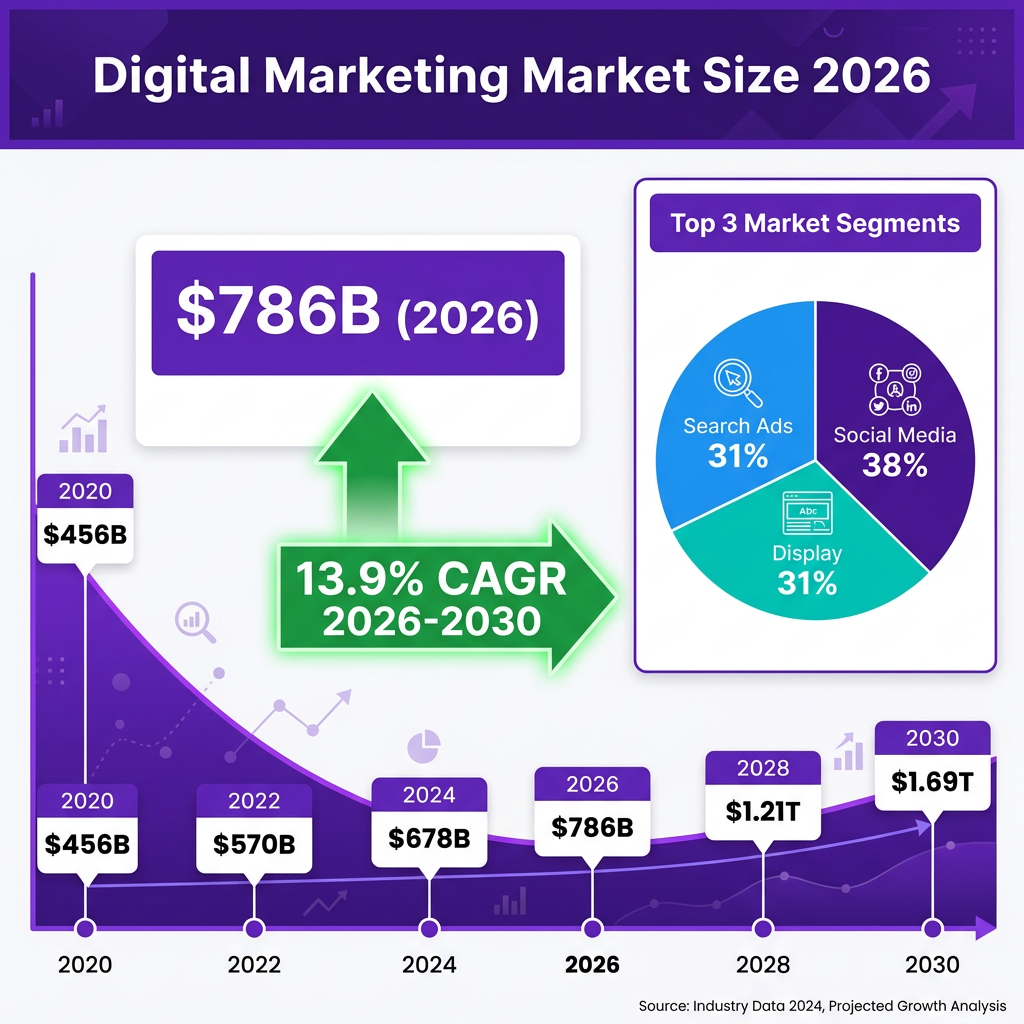
The global digital advertising market has reached unprecedented scale in 2026. According to the latest industry data, total digital ad spending is projected at $786.2 billion in 2026, with an annual growth rate of 13.9%. This represents a year-over-year growth rate that outpaces traditional media by a significant margin, cementing digital as the dominant force in advertising spend.
This explosive growth is driven by several converging factors: the proliferation of mobile devices, the maturation of programmatic advertising, the rise of AI-powered targeting, and the continued shift of consumer attention from traditional to digital channels. Digital’s share of total ad spend will reach 68.7% in 2026, up from previous years, indicating that nearly seven out of every ten advertising dollars are now spent online.
The market’s evolution tells a fascinating story of technological disruption. In 2023, the global digital marketing market was valued at approximately $780 billion. By 2025, this figure had grown to $456.7 billion according to some estimates, with projections showing the market reaching $1.20 trillion by 2034 at a CAGR of 10.99%. These varying figures reflect different methodologies and scope definitions, but the trajectory is unmistakable: digital marketing is experiencing sustained, robust growth.
Regional dynamics play a crucial role in this expansion. The United States remains the largest single market for digital advertising, driven by technological advancements, high internet penetration, and the growing importance of e-commerce. However, Asia-Pacific is emerging as the fastest-growing region, with countries like China, India, and Southeast Asian nations driving significant increases in digital ad spend.
The mobile revolution continues to reshape the landscape. With smartphone users anticipated to surge from 6.26 billion in 2021 to 7.5 billion by 2026, mobile devices now contribute to over half of total ad revenue. Mobile advertising accounts for 54% of digital ad budgets, reflecting the shift in consumer behavior toward on-the-go content consumption.
Search advertising remains a cornerstone of the digital marketing ecosystem, forecast to rise 7.4% in 2025 to $248.6 billion, accounting for 21.5% of total ad spend. However, social media advertising has emerged as the dominant force, reaching 25.8% of total ad spend in 2025 at $298.3 billion. This shift reflects changing consumer behaviors and the increasing sophistication of social platforms’ advertising capabilities.
Retail media has emerged as a particularly dynamic segment. This year marks the first time that retail media commands a larger share of global ad spend than linear television, representing a historic shift in advertising power. Retail media is the fastest-growing digital channel at 14.1% growth in 2026, driven by the explosion of e-commerce and the valuable first-party data that retailers possess.
Key Statistics and Data: The Numbers Behind Digital Marketing in 2026
Understanding the digital marketing landscape requires diving deep into the data that defines it. Here are the critical statistics that every marketer, business owner, and strategist needs to know:
Global Market Size and Growth:
- Global digital ad spending in 2026: $786.2 billion (13.9% annual growth)
- Digital’s share of total ad spend: 68.7%
- Global advertising market projected to reach $1.27 trillion in 2026
- Digital advertising accounts for over 73% of total advertising spend
- Projected market size by 2033: $1.69 trillion (14.3% CAGR)
- Alternative projection: $1.20 trillion by 2034 (10.99% CAGR)
- Global online advertising market surpassed $680 billion in 2026
Channel-Specific Performance:
- Social media advertising: 25.8% of total ad spend ($298.3 billion)
- Search advertising: 21.5% of total ad spend ($248.6 billion)
- Retail media growth: 14.1% (fastest-growing digital channel)
- Mobile advertising: 54% of digital ad budgets
- Video advertising segment growing at 12.8% CAGR
- Connected TV (CTV) ad spend: $37.95 billion in the US
- Digital TV segment expected to grow at 12.4% CAGR
Platform Dominance:
- Alphabet (Google), Amazon, and Meta control 55% of global ad market outside China
- Collective ad revenue of top three platforms: $524.4 billion in 2025
- Share projected to rise to 56.2% in 2026
- Meta’s projected 2026 ad revenue: $243.5 billion (24.1% growth)
- Google’s projected 2026 ad revenue: $239.5 billion (11.9% growth)
- Meta officially surpasses Google as world’s largest digital advertising platform in 2026
Consumer Behavior Metrics:
- Smartphone users: 7.5 billion projected by 2026 (from 6.26 billion in 2021)
- Share of online purchases made on mobile: 57%
- Share of local searches on Google: 46%
- 39% of consumers turn to Facebook first when ready to make a purchase
- 68% of consumers prefer not to use messaging apps to contact brands
AI and Automation Adoption:
- 54% of marketers already using AI in at least one marketing task in 2024
- 46% of marketers now use AI to scale creative production
- AI in marketing market size: $20.44 billion in 2024, projected $82.23 billion by 2030
- 73% of marketers still relying on email as a core channel
- Up to 30% of marketing budgets are wasted, according to most marketers
ROI and Performance Benchmarks:
- 49% of businesses report organic search delivers the best ROI
- 70% of marketers say Facebook has the strongest impact on their business
- 68% of SMB owners rank social media as their top marketing channel
- Companies implementing comprehensive email analytics report 73% improvements in campaign performance
- 58% increases in customer lifetime value through email optimization
Content and Video Marketing:
- 91% of marketers now use video marketing (up from 84%)
- Influencer marketing grew from $1.7 billion in 2016 to $16.4 billion in 2022
- Digital video delivers multi-year brand building effects comparable to Linear TV
- Short-form video dominance continues across all major platforms
Privacy and Compliance:
- Third-party cookies fully deprecated in Chrome by 2026
- Global privacy regulations standardizing across markets
- 86% of CMOs expecting budget increases despite economic uncertainties
- Algorithm-driven advertising projected to represent 71.6% of total spend by 2026
Major Trends Shaping Digital Marketing in 2026
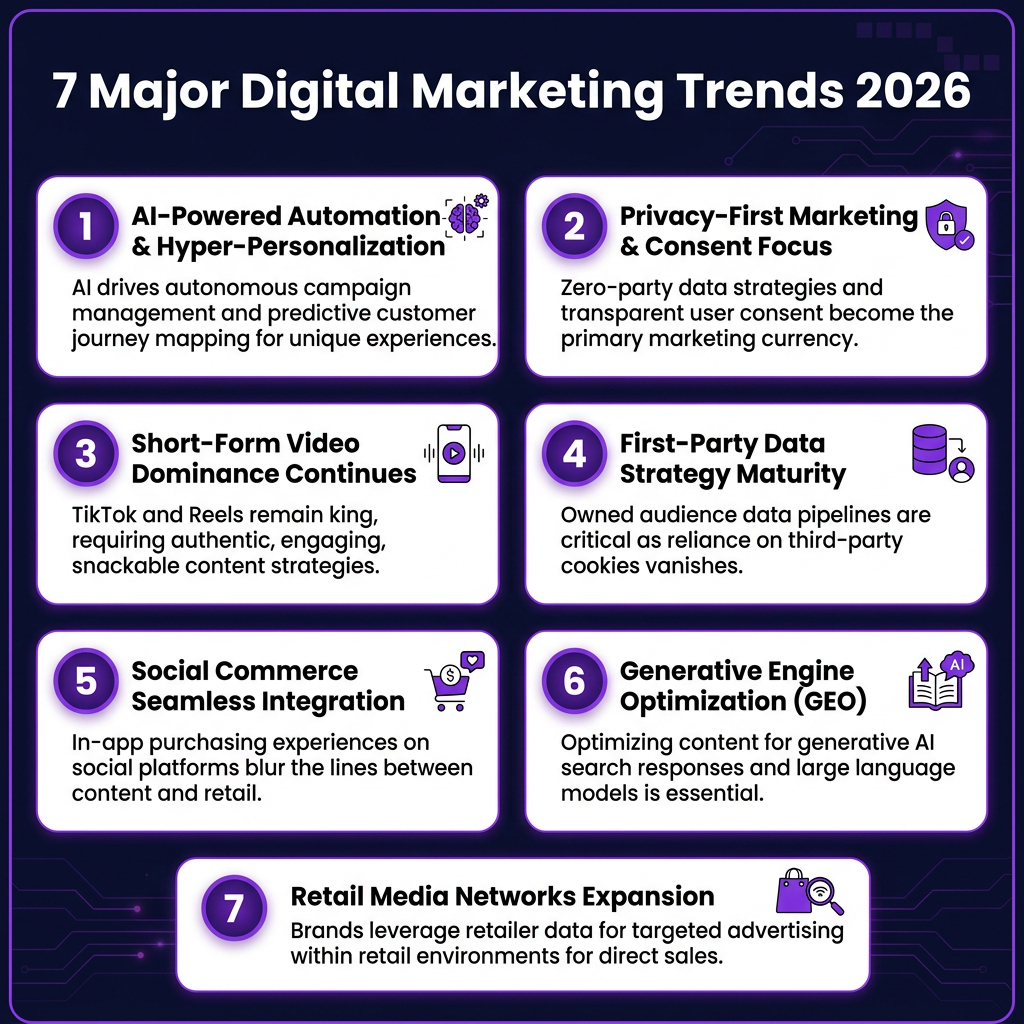
The digital marketing landscape of 2026 is defined by seven transformative trends that are reshaping how brands connect with consumers. Understanding these trends is essential for any business looking to maintain competitive advantage in an increasingly complex ecosystem.
1. AI-Powered Automation and Agentic Advertising
Artificial intelligence has moved from experimental tool to essential infrastructure. In 2026, AI is every marketer’s copilot, handling the heavy lifting so teams can focus on creativity, strategy, and community connection. Marketing automation has evolved from scheduled workflows to self-optimizing systems that plan, execute, and adjust campaigns across channels in real time.
Google AI Max, Meta Advantage+, and standalone ad agents now automate targeting, bidding, and creative optimization. This shift represents a fundamental change in how campaigns are managed—moving from human-driven decision-making to AI-augmented orchestration. However, this doesn’t eliminate the need for human strategists; instead, it elevates their role toward high-impact insights and brand strategy.
2. Privacy-First Marketing and First-Party Data
With third-party cookies fully deprecated in Chrome by 2026, the entire industry has shifted from a “data rental” model to an era of “asset building.” Marketers are tired of sinking budgets into renting attention and are building on channels they can control. The key to success is no longer simply “buying traffic,” but rather “building assets + verifying authenticity + achieving automation.”
Brands that accelerate their first-party data strategy in 2026 are better placed to drive growth. This means investing in direct consumer relationships, loyalty programs, and owned channels like email, SMS, and proprietary web experiences. Privacy enforcement is surging, with regulators “looking under the hood” and scrutinizing consent mechanisms, cookie banners, and data handling practices.
3. Short-Form Video Dominance
Video marketing has reached saturation point—with 91% of marketers using it as part of their strategy. But it’s short-form video that dominates attention spans in 2026. Platforms like TikTok, Instagram Reels, and YouTube Shorts have trained consumers to expect immediate, engaging content.
The video advertising segment is growing at the highest CAGR of 12.8%, while Connected TV (CTV) ad spend hits $37.95 billion in the US. What’s particularly notable is that digital video now delivers multi-year brand building effects on par with traditional linear TV—something that was unthinkable just a few years ago.
4. The Return to Owned Channels
One of the biggest shifts in 2026 is a return to channels marketers can actively shape. Email marketing, declared “dead” countless times, remains one of the most powerful, reliable, and profitable tools available. 73% of marketers still rely on email as a core channel, and companies implementing comprehensive email analytics report 73% improvements in campaign performance.
SMS marketing, community platforms, and owned web experiences are seeing renewed investment as brands seek to reduce dependence on algorithm-controlled social platforms. This trend reflects a maturation in marketing thinking—recognizing that rented audiences on social media can disappear overnight with algorithm changes.
5. Social Commerce and Shoppable Content
The line between content and commerce has dissolved. Social media now functions as a direct channel for brand visibility, customer trust, lead generation, and real-time market intelligence. 39% of consumers turn to Facebook first when ready to make a purchase, and social commerce capabilities have expanded across all major platforms.
This trend is particularly powerful because it shortens the customer journey—from discovery to purchase can now happen within a single platform session. For brands, this means optimizing for in-platform shopping experiences and understanding that social media is no longer just a top-of-funnel awareness channel.
6. Generative Engine Optimization (GEO)
As AI-powered search and conversational interfaces become mainstream, traditional SEO is evolving into Generative Engine Optimization. Marketers must now optimize content not just for search engine algorithms, but for AI systems that synthesize and present information to users.
This represents a fundamental shift in discoverability. The traditional way of interacting with search engines—typing keywords and scrolling through results—is becoming obsolete. Instead, users are engaging with AI assistants that provide synthesized answers. Brands that understand how to make their content discoverable and quotable by these systems will have significant advantages.
7. Retail Media Networks
Retail media has emerged as the fastest-growing digital channel at 14.1% growth in 2026. Amazon, Walmart, Target, and other major retailers have built sophisticated advertising platforms that leverage their valuable first-party purchase data. This year marks the first time retail media commands a larger share of global ad spend than linear television.
The appeal is clear: retail media offers closed-loop attribution, showing exactly how ad spend translates to sales. For brands selling through these channels, retail media has become an essential part of the marketing mix—providing targeting precision that rivals or exceeds traditional digital advertising.
Key Players and Competitive Landscape
The digital advertising market is dominated by a handful of tech giants whose competition shapes the entire industry. Understanding their strategies, strengths, and market positions is essential for any marketer making platform decisions.
Meta: The New King of Digital Advertising
2026 marks a watershed moment: Meta officially surpasses Google as the world’s largest digital advertising business. With projected ad revenue of $243.5 billion and growth of 24.1%, Meta has achieved what seemed impossible just a few years ago. This success is driven by several factors:
Meta’s Advantage+ AI automation has revolutionized campaign management, making sophisticated targeting accessible to advertisers of all sizes. The expansion of ad surfaces to WhatsApp and Threads has opened new inventory. Most importantly, Meta’s social graph provides targeting capabilities that are difficult to replicate—understanding not just what users search for, but who they are and what they care about.
The company’s recovery from the iOS 14 privacy changes demonstrates remarkable resilience. By building AI-powered attribution models and investing in first-party data, Meta has largely overcome the signal loss that threatened its business model.
Google/Alphabet: The Search Giant Adapts
While losing the top spot to Meta, Google remains a dominant force with projected 2026 ad revenue of $239.5 billion and 11.9% growth. Search advertising continues to capture high-intent users at the moment of consideration, making it invaluable for direct response campaigns.
Google’s response to the AI challenge has been multifaceted. The integration of generative AI into search results through Search Generative Experience (SGE) represents both an opportunity and a threat for advertisers. While it may reduce click-through rates for traditional search ads, it also creates new advertising surfaces within AI-generated responses.
YouTube remains a crown jewel in Google’s portfolio, with video advertising growing at 12.8% annually. The platform’s dominance in both short-form (Shorts) and long-form content gives advertisers unmatched reach across consumer preferences.
Amazon: The Retail Media Pioneer
Amazon’s advertising business has grown into a formidable force, leveraging its position as the world’s largest e-commerce platform. The company’s advertising revenue benefits from unique advantages: purchase data that reveals actual buying behavior, closed-loop attribution that connects ad spend directly to sales, and placement at the point of purchase.
Amazon’s advertising growth is particularly significant because it represents a different model than Meta or Google—one built on commerce rather than attention. As retail media expands, Amazon’s early investments position it to capture a growing share of brand advertising budgets.
The Triopoly’s Collective Dominance
Together, Alphabet, Amazon, and Meta are on track to capture nearly 55% of global advertising spend outside China, with collective ad revenue of $524.4 billion. This share is projected to rise to 56.2% in 2026, indicating continued consolidation despite regulatory pressures and competitive challenges.
This concentration has significant implications for marketers. On one hand, these platforms offer unparalleled scale, targeting capabilities, and measurement tools. On the other, dependence on a small number of gatekeepers creates vulnerability—algorithm changes, policy updates, or price increases can dramatically impact campaign performance.
Emerging Players and Challengers
Beyond the triopoly, several platforms are carving out significant positions:
Apple: Apple Ads is no longer just a brand protection channel—it’s becoming a scalable performance marketing platform. As privacy changes on iOS disrupted the advertising ecosystem, Apple’s own advertising business has grown, benefiting from its unique position as platform gatekeeper.
TikTok: Despite regulatory challenges, TikTok remains a dominant force in short-form video and youth culture. Its advertising capabilities have matured significantly, offering sophisticated targeting and creative tools that rival established platforms.
Microsoft: Through its partnership with OpenAI and integration of AI into Bing and other products, Microsoft is positioning itself as a significant player in AI-powered advertising. While its market share remains small compared to Google, its growth trajectory is noteworthy.
Retail Media Networks: Walmart, Target, Instacart, and other retailers are building advertising platforms that challenge Amazon’s dominance in retail media. These platforms offer brands access to valuable first-party purchase data and closed-loop attribution.

Challenges and Pain Points in Digital Marketing
Despite the opportunities, digital marketing in 2026 faces significant challenges that keep marketers awake at night. Understanding these pain points is essential for developing resilient strategies.
1. Privacy Regulations and Signal Loss
The deprecation of third-party cookies in Chrome has completed the privacy revolution that began with iOS 14.5. Marketers have lost the primary mechanism for cross-site tracking and attribution, forcing a fundamental rethinking of measurement and targeting strategies.
Privacy enforcement is surging in 2026, with regulators “looking under the hood” of consent mechanisms. Recent enforcement actions show that consent failures are rarely about the presence or absence of a banner alone. Issues like ignored browser opt-out signals, advertising cookies that continue operating after consumer opt-out, and “dark patterns” that make privacy choices harder to exercise are all under scrutiny.
The compliance burden has increased significantly. Companies must now implement comprehensive consent management, data mapping, vendor risk management, and individual rights management systems. For many organizations, the cost of compliance represents a significant portion of marketing technology budgets.
2. AI Disruption and Skill Gaps
While AI offers tremendous opportunities, it also creates significant challenges. The most pressing is the skill gap: many marketing teams lack the expertise to effectively leverage AI tools. This isn’t just about learning new software—it requires understanding how AI makes decisions, when to trust automation, and how to maintain brand voice when content is AI-generated.
There’s also the existential question: if AI can handle content creation, campaign optimization, and data analysis, what is the role of human marketers? The answer emerging in 2026 is that humans must focus on strategy, creativity, and emotional intelligence—areas where AI remains limited. But this transition is painful for many professionals whose tactical skills have been devalued.
3. Platform Dependence and Algorithm Volatility
With three companies controlling over half of global ad spend, marketers face significant platform risk. Algorithm changes can devastate campaign performance overnight. Policy updates can render previously acceptable content non-compliant. Price increases can erode margins with no alternative platforms offering equivalent scale.
The challenge is compounded by the opacity of platform algorithms. Marketers must invest significant budget in testing and learning to understand what works, only to have those learnings invalidated by the next algorithm update. This creates a constant cycle of adaptation that favors large advertisers with resources to absorb volatility.
Opportunities and Growth Strategies
Amidst the challenges, significant opportunities exist for marketers who adapt to the new landscape. Here are the key growth strategies for 2026:
1. First-Party Data as Competitive Advantage
Brands that invested early in first-party data collection are now reaping the rewards. With third-party cookies gone, proprietary customer data has become a significant competitive advantage. The most successful strategies include:
- Building loyalty programs that incentivize data sharing
- Creating valuable content and tools that require registration
- Implementing progressive profiling to build customer understanding over time
- Investing in customer data platforms (CDPs) to unify data across touchpoints
- Developing direct relationships through email, SMS, and community platforms
The key insight is that first-party data isn’t just about compliance—it’s about building sustainable competitive advantage. Brands with rich customer understanding can deliver better experiences, more effective targeting, and higher lifetime value.
2. AI-Augmented Creativity at Scale
While AI creates disruption, it also offers unprecedented opportunities for creative scale. 46% of marketers now use AI to scale creative production, generating variations for different audiences, platforms, and contexts without proportional increases in creative team size.
The most effective approach combines AI efficiency with human creativity. AI handles production, optimization, and testing at scale, while humans focus on strategy, big ideas, and emotional resonance. This partnership allows brands to be both more efficient and more creative.
3. Cross-Channel Integration and Measurement
As the customer journey becomes increasingly complex, integrated cross-channel strategies are essential. The key is building measurement frameworks that can attribute value across touchpoints, even as traditional tracking mechanisms become less reliable.
Marketing Mix Modeling (MMM) has experienced a renaissance, offering privacy-safe measurement that doesn’t depend on user-level tracking. Modern MMM combines advanced AI, big data, and real-time optimization to make offline performance measurable and actionable—not after the campaign ends, but while it’s still running.
Case Studies and Success Stories
Theory is valuable, but real-world examples demonstrate what’s possible. Here are three case studies that illustrate successful digital marketing strategies in 2026:
Case Study 1: B2B SaaS Company Leverages AI for Account-Based Marketing
A mid-sized B2B SaaS company selling marketing automation software faced the challenge of reaching enterprise decision-makers with limited budget. Their solution combined AI-powered targeting with personalized content at scale.
Using AI tools, they analyzed their best customers to identify lookalike accounts, then created personalized content for each target account based on industry, company size, and identified pain points. The AI generated variations of landing pages, emails, and ad creative tailored to each segment.
Results: 340% increase in qualified pipeline, 67% reduction in cost per qualified lead, and 45% improvement in sales cycle length. The key insight was that AI didn’t replace the marketing team—it amplified their ability to deliver relevant experiences at enterprise scale.
Case Study 2: E-commerce Brand Builds First-Party Data Empire
A direct-to-consumer beauty brand recognized early that third-party cookie deprecation would fundamentally change digital advertising. Rather than waiting for the inevitable, they invested heavily in first-party data collection starting in 2023.
They launched a loyalty program that rewarded customers for profile completion, purchase reviews, and social sharing. They created a skin assessment tool that provided personalized product recommendations while collecting valuable zero-party data. They built an engaged community on their owned platform, reducing dependence on social media algorithms.
Results: By 2026, they had built a database of 2.3 million customer profiles with rich preference and behavioral data. Their customer acquisition costs remained stable while competitors saw 40-60% increases due to signal loss. Most importantly, their customer lifetime value increased 85% due to better personalization and retention.
Case Study 3: Retail Media Network Drives Closed-Loop Attribution
A consumer packaged goods company struggling to measure the true impact of their digital advertising shifted significant budget to retail media networks. Working with a major grocery chain’s advertising platform, they gained access to closed-loop attribution that connected ad impressions directly to in-store and online purchases.
The campaign used the retailer’s first-party purchase data to target households with relevant product interests, then measured actual sales lift through loyalty card data. Creative was optimized based on real purchase outcomes rather than proxy metrics like clicks or impressions.
Results: 23% sales lift compared to control markets, 4.2x return on ad spend, and insights that informed product development and inventory planning. The closed-loop measurement provided confidence to increase investment, with the retail media channel growing from 5% to 35% of their digital budget over 18 months.
Future Outlook and Predictions: 2026-2030
Looking beyond 2026, several trends will shape the next phase of digital marketing evolution:
Market Growth Projections
The digital marketing market is on a trajectory to reach $1.69 trillion by 2033 at a 14.3% CAGR. Alternative projections suggest $1.20 trillion by 2034 or $1.5 trillion by 2030, depending on methodology. What’s consistent across all forecasts is sustained double-digit growth that will continue to capture share from traditional media.
By 2030, digital media is projected to capture nearly 65% of global ad spend, with some estimates suggesting even higher penetration. The global advertising market overall is expected to reach $1.27 trillion by 2026 and continue growing, with digital representing the vast majority of new investment.
AI Integration Deepens
By 2030, AI will be so deeply integrated into marketing workflows that it will be invisible—like electricity powering tools rather than a separate capability. Predictive forecasting, automated channel mix decisions, and real-time creative adaptation will become standard capabilities.
The AI in marketing market is projected to grow from $20.44 billion in 2024 to $82.23 billion by 2030—a fourfold increase. This investment will drive capabilities that seem futuristic today: AI agents that manage entire campaign workflows, predictive models that anticipate customer needs before they’re expressed, and creative systems that generate personalized content for individual users at scale.
Conversational and Voice Search Transform Discovery
By 2030, the traditional search paradigm—typing keywords and reviewing results—will be largely obsolete. Conversational AI interfaces, voice search, and predictive recommendations will become primary discovery mechanisms. This transformation requires marketers to optimize for AI understanding rather than keyword matching, focusing on entity relationships, contextual relevance, and structured data.
Privacy-First Becomes Default
The privacy transformations of 2026 will continue accelerating. By 2030, privacy-preserving measurement techniques like differential privacy, federated learning, and secure multi-party computation will become standard practice. First-party data strategies will mature from competitive advantage to table stakes—brands without rich customer understanding will find themselves unable to compete effectively.
Immersive Experiences and the Metaverse
While the metaverse hype of the early 2020s may have been premature, immersive digital experiences are steadily gaining traction. By 2030, augmented reality (AR) advertising, virtual try-ons, and immersive brand experiences will be mainstream rather than experimental. The technology will mature, costs will decrease, and consumer comfort with immersive interfaces will increase.
For marketers, this means developing capabilities in 3D content creation, spatial computing, and immersive storytelling. Early movers who build expertise in these areas will have significant advantages as the medium matures.
Regional Market Analysis
The global digital marketing landscape varies significantly by region, with distinct characteristics shaping each market’s development trajectory.
North America: The Innovation Hub
North America, led by the United States, remains the world’s largest and most sophisticated digital advertising market. The region accounts for approximately 38% of global digital ad spend, with the US alone representing over $300 billion in annual investment. What distinguishes the North American market is its maturity—brands here have been investing in digital channels for decades, resulting in highly sophisticated measurement, optimization, and creative capabilities.
The region is also the epicenter of platform innovation. Meta, Google, Amazon, and most major advertising technology companies are headquartered in the US, giving North American marketers early access to new capabilities and features. However, this maturity also means higher costs—CPMs in North America are among the highest globally, making efficiency and ROI optimization critical.
Europe: Privacy-First Leadership
Europe has emerged as the global leader in privacy regulation, with GDPR setting the standard that other regions are following. This regulatory environment has accelerated the shift toward first-party data strategies and consent-based marketing. European marketers have had to innovate faster than their global counterparts in building privacy-compliant measurement and targeting systems.
The European digital advertising market represents approximately 22% of global spend, with the UK, Germany, and France as the largest individual markets. The region’s diversity—multiple languages, cultures, and regulatory environments—creates complexity that rewards sophisticated, localized strategies.
Asia-Pacific: The Growth Engine
Asia-Pacific is the fastest-growing region for digital advertising, with China, India, and Southeast Asian markets driving expansion. China alone represents a massive parallel ecosystem, with domestic platforms like Alibaba, Tencent, and ByteDance dominating rather than the Western giants. The Chinese digital advertising market is estimated at over $150 billion, making it the second-largest globally.
India represents perhaps the most exciting growth opportunity, with digital ad spend growing at over 20% annually as internet penetration expands and e-commerce accelerates. Southeast Asian markets—Indonesia, Vietnam, Thailand, Philippines—are experiencing similar growth trajectories, driven by young, mobile-first populations.
Latin America and Middle East/Africa: Emerging Opportunities
These regions represent smaller but rapidly growing digital advertising markets. Brazil dominates Latin America, accounting for over half of regional ad spend. In the Middle East, the UAE and Saudi Arabia are investing heavily in digital infrastructure and marketing capabilities. Africa remains the smallest market but shows significant potential as mobile connectivity expands across the continent.
The Evolution of Marketing Roles and Skills
The transformation of digital marketing is fundamentally changing the skills required for success and the structure of marketing teams.
The Data Scientist Marketer
Modern marketers need data science capabilities that were previously specialized roles. Understanding statistical significance, running controlled experiments, building attribution models, and extracting insights from large datasets are now core competencies. The most valuable marketers combine creative intuition with analytical rigor—able to generate compelling ideas and validate them with data.
AI Collaboration Skills
Working effectively with AI tools requires new skills. Marketers must learn prompt engineering, understand AI capabilities and limitations, and develop judgment about when to trust automation versus human oversight. The ability to direct AI tools toward business objectives—rather than simply accepting their outputs—separates high performers from the pack.
Privacy and Compliance Expertise
As privacy regulations multiply and enforcement intensifies, compliance expertise has become essential. Marketers need to understand consent requirements, data handling obligations, and cross-border transfer restrictions. This isn’t just legal department territory—marketing decisions about data collection and use have direct compliance implications.
Cross-Functional Collaboration
Digital marketing increasingly requires collaboration across organizational boundaries. Working effectively with product teams on first-party data collection, with engineering on tracking implementation, with legal on compliance, and with sales on lead quality feedback are all essential. The siloed marketer who only understands their channel is becoming obsolete.
Technology Stack Evolution
The marketing technology landscape continues to evolve rapidly, with several key categories defining the modern stack.
Customer Data Platforms (CDPs)
CDPs have become essential infrastructure for first-party data strategies. These systems unify customer data from multiple sources, create persistent customer profiles, and enable activation across channels. As third-party data becomes less available, the value of well-implemented CDPs has increased dramatically.
Marketing Automation and AI Orchestration
Modern marketing automation goes beyond email workflows to encompass AI-powered orchestration across channels. These systems can automatically adjust spend allocation, creative rotation, and audience targeting based on real-time performance data. The sophistication of these tools is increasing rapidly, with some platforms now offering autonomous optimization capabilities.
Privacy-Enhancing Technologies (PETs)
New technologies are emerging to enable marketing effectiveness while preserving privacy. Differential privacy, federated learning, secure multi-party computation, and data clean rooms are becoming standard tools. Marketers need to understand these technologies and how to implement them effectively.
Measurement and Attribution
The measurement landscape has been transformed by privacy changes. Server-side tracking, conversion APIs, and privacy-preserving attribution models are replacing traditional pixel-based tracking. Marketing Mix Modeling (MMM) has experienced a renaissance as a privacy-safe alternative to user-level attribution.
Investment and Budget Allocation Strategies
With digital marketing representing nearly 70% of total advertising spend, how should businesses allocate their budgets in 2026?
The 60-30-10 Framework
Many successful marketers are adopting a 60-30-10 allocation framework: 60% to proven, scalable channels (search, social, retail media), 30% to emerging opportunities with demonstrated traction (CTV, programmatic audio, influencer partnerships), and 10% to experimental initiatives that could become future growth drivers (AI-generated creative, immersive experiences, new platform betas).
Channel Mix by Business Type
B2B companies continue to find strong ROI in search advertising, LinkedIn, and email marketing, with increasing investment in account-based marketing platforms and intent data providers. B2C brands are shifting more budget to retail media networks, social commerce, and short-form video. E-commerce businesses are prioritizing platforms with closed-loop attribution and shoppable ad formats.
Technology Investment Priorities
Beyond media spend, technology investments are critical. CDPs, consent management platforms, marketing automation systems, and privacy-enhancing technologies should represent 15-25% of total digital marketing budgets. Underinvestment in infrastructure creates competitive disadvantage that becomes increasingly difficult to overcome.
Key Takeaways
- The digital marketing market has reached $786.2 billion in 2026, growing at 13.9% annually, with projections to reach $1.69 trillion by 2033.
- Meta has officially surpassed Google as the world’s largest digital advertising platform, with $243.5 billion in projected 2026 revenue versus Google’s $239.5 billion.
- Seven transformative trends define 2026: AI-powered automation, privacy-first marketing, short-form video dominance, return to owned channels, social commerce, generative engine optimization, and retail media networks.
- Third-party cookie deprecation has completed the shift to first-party data strategies, with privacy regulations tightening globally and compliance becoming a core competency.
- 54% of marketers now use AI in at least one marketing task, with 46% leveraging AI to scale creative production.
- Retail media has overtaken linear television in ad spend share, growing at 14.1% as the fastest digital channel.
- Email marketing remains a core channel for 73% of marketers, with comprehensive analytics driving 73% improvements in campaign performance.
- Short-form video dominates content strategies, with 91% of marketers using video and CTV ad spend reaching $37.95 billion in the US.
- Platform consolidation continues, with Alphabet, Amazon, and Meta controlling 55% of global ad spend outside China.
- The future belongs to brands that combine AI efficiency with human creativity, building first-party data assets while delivering authentic, personalized experiences.
Sources and Citations
- Research and Markets – Digital Marketing Market Size, Share & Forecast to 2034: https://www.researchandmarkets.com/report/digital-marketing
- eMarketer – Meta to Surpass Google in Digital Ad Revenues: https://www.emarketer.com/learningcenter/guides/meta-to-surpass-google-in-digital-ad-revenues-for-first-time-ever
- The Drum – Alphabet, Amazon & Meta Control Over Half Global Ad Market: https://www.thedrum.com/news/alphabet-amazon-meta-control-over-half-global-ad-market-and-they-re-taking-more
- AffNinja – Digital Marketing Statistics 2026: https://affninja.com/digital-marketing-statistics
- Digital Applied – Digital Advertising Statistics 2026: https://www.digitalapplied.com/blog/digital-advertising-statistics-2026-data-points
- Statista – Advertising Worldwide Market Forecast: https://www.statista.com/outlook/amo/advertising/worldwide
- Precedence Research – Digital Advertising Market Size: https://www.precedenceresearch.com/digital-advertising-market
- BCC Research – Digital Advertising Global Market Opportunities: https://www.bccresearch.com/pressroom/ift/pioneering-the-path-to-a-12-trillion-digital-ad-market-by-2027
- Dotdigital – 2026 Marketing Predictions: https://dotdigital.com/blog/2026-marketing-predictions
- Smartly – 2026 Digital Advertising Trends Report: https://www.smartly.io/digital-advertising-trends/2026
- Sprout Social – Social Media ROI Statistics 2026: https://sproutsocial.com/insights/social-media-marketing-roi-statistics
- Klaviyo – Marketing Automation Trends 2026: https://www.klaviyo.com/blog/marketing-automation-trends
- MarkNtel Advisors – Digital Marketing Market Report: https://www.marknteladvisors.com/research-library/digital-marketing-market.html
- Grand View Research – AI in Marketing Market Size: https://www.grandviewresearch.com/industry-analysis/artificial-intelligence-marketing-market-report